

|
시장보고서
상품코드
2062239
파형관 : 시장 점유율 분석, 업계 동향 및 통계, 성장 예측(2026-2031년)Corrugated Pipe - Market Share Analysis, Industry Trends & Statistics, Growth Forecasts (2026 - 2031) |
||||||
 Mordor Intelligence
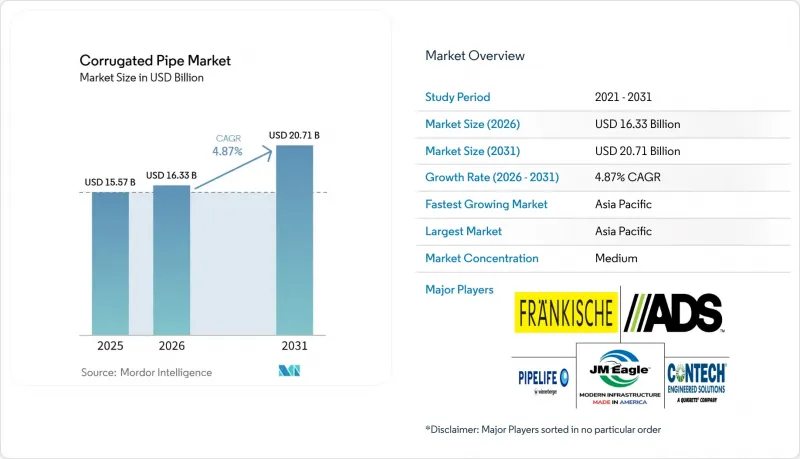
Mordor Intelligence에 의하면, 파형관 시장 규모는 2025년에 155억 7,000만 달러로 평가되었습니다. 2026년에 163억 3,000만 달러에 달하고, 2031년까지 207억 1,000만 달러에 이를 것으로 예측되며, 2026-2031년에 걸쳐 CAGR은 4.87%를 나타낼 전망입니다.
본 보고서는 재료(고밀도 폴리에틸렌, 기타), 벽 구조(이중벽 골판, 기타), 직경(300mm 이하, 기타), 용도(배수·하수, 카버트 및 도로, 기타), 최종 사용자 산업(지자체 인프라, 농업, 기타), 지역(아시아태평양, 북미, 기타)에 따라 분류되어 있습니다. 시장 전망은 금액(달러) 기준으로 제시되어 있습니다.
세계의 파형관 시장 동향 및 인사이트
배수 및 도로망에 대한 인프라 투자
유틸리티 예산은 새로운 고속도로 건설보다는 자산 보전에 중점을 두는 방향으로 바뀌고 있습니다. 미국의 초당적 인프라 법안에서는 도로 및 교량에 1,100억 달러가 배정되어 있으며, 칼버트 교체가 구체적인 항목으로 포함되어 있습니다. 매사추세츠주 콩코드에서는 긴급한 배수로 수리가 다른 유지관리 업무보다 우선시되고 있다는 보고가 있었으며, 이는 전미에서 관찰되는 추세입니다. 인도의 ‘국가 인프라 계획’에서는 지방 도로 및 도시 배수 시설에 대한 투자가 우선시되고 있으며, 그 결과 2·3급 도시에서 소구경 파이프에 대한 수요가 꾸준히 유지되고 있습니다. 각 기관에서는 칼버트 공사를 포장 재포장 공사와 연계하는 경향이 강해지고 있으며, 입찰 기간을 단축하는 한편, 적시 납품이 가능한 지역 창고를 보유한 공급업체를 우선적으로 선정하고 있습니다. 이러한 접근 방식 덕분에 교통 혼잡을 최소화하고 현지 재고를 확보할 수 있는 제조업체에 대한 조달 선호도가 높아지고 있습니다.
경량성, 내구성, 비용 효율성이 뛰어난 파이프에 대한 수요
파형관는 철근 콘크리트 제품의 대체재에 비해 60%에서 70% 더 가볍기 때문에 특히 외진 지역에서 크레인 임대 비용과 인건비를 대폭 절감할 수 있습니다. 2025년, 미네소타주 교통국은 재생 HDPE 파이프가 링 강성과 장기 처짐 측면에서 버진 수지 파이프와 동등한 성능을 발휘한다는 사실을 확인했습니다. 무굴착 공법은 기존 노선을 따라 파이프를 매설할 수 있으므로, 도시 지역에서 막대한 비용이 드는 도로 복구 공사를 피할 수 있어 비용 효율을 더욱 높입니다. 2025년 라이프사이클 조사에 따르면, 운송 및 설치에 소요되는 에너지를 고려했을 때, HDPE 배수 시스템의 내재 탄소량은 콘크리트에 비해 40% 낮은 것으로 밝혀졌습니다. 미터당 비용은 비싸지만, 총 설치 비용은 여전히 저렴하기 때문에 시공업체들은 플라스틱 파이프를 점점 더 선호하고 있습니다. 이러한 추세는 사용 후 수지공급이 안정되고 가격 프리미엄이 하락함에 따라 더욱 확대될 것으로 예측됩니다.
HDPE, PVC, 금속 원자재 가격 변동
배관 계약의 경우, 대개 6-12개월 전에 가격이 확정됩니다. 에틸렌이나 알루미늄 가격의 급등으로 인해, 제조업체는 계약 재협상을 요구받거나 손실을 감수할 수밖에 없는 상황에 처할 수 있습니다. 예를 들어, 2025년 초 알루미늄 가격이 15% 상승했을 때, 여러 제조업체가 고정가 입찰에서 철수했습니다. 현재 미국의 지자체 입찰에는 지수 연동형 가격 조항이 포함되는 추세이지만, 조달 노하우가 부족한 소규모 지자체에서는 가격이 안정될 때까지 프로젝트를 연기하는 경우가 많습니다. 이러한 가격 변동은 생산 일정을 차질하게 하고, 초과근무비를 증가시키며, 공장의 가동률을 저하시킵니다.
부문별 분석
2025년, 고밀도 폴리에틸렌(HDPE)은 강도, 유연성, 비용 면에서 최적의 균형을 보여주며, 골판지 파이프 시장 매출의 52.82%를 차지했습니다. 알루미늄은 연안 도시 및 화학 플랜트의 내식성 시스템에 대한 수요에 힘입어, 2031년까지 연평균 성장률(CAGR) 4.93%로 가장 높은 성장률을 보일 것으로 예측됩니다. 폴리염화비닐(PVC)은 화재 확산 방지 기준을 준수해야 하는 중력식 하수도 분야에서 여전히 그 입지를 유지하고 있는 반면, 폴리프로필렌은 내열성이 요구되는 공정용 배관에 이용되고 있습니다. 스테인리스와 섬유 강화 복합재료는 위생 및 전자기 투과성 측면에서 높은 비용이 정당화되는 틈새 용도에 대응하고 있습니다.
미네소타주 교통국(MnDOT)은 2025년, 사용 후 HDPE를 50% 사용하여 제조된 파이프가 AASHTO M294의 링 강성 기준을 충족함을 입증함으로써, 재활용 재료 사용을 의무화하는 대규모 공공 계약의 길을 열었습니다. 금속 부문에서는 ASTM B745의 개정을 통해 파형 프로파일과 접합부의 형태가 표준화되고 제조 비용이 절감됨에 따라, 알루미늄 가격이 도금 강재 가격에 근접하게 되었습니다. 현재, 재료 선택은 여러 방향으로 나뉘어 있습니다. 비용을 중시하는 지자체 구매자들은 재생 HDPE를 선호하는 반면, 염분이나 산성 환경이 있는 프로젝트의 경우 알루미늄이나 스테인리스에 대해 30%의 추가 비용을 지불하는 것을 마다하지 않습니다.
2025년에는 이중벽 골판 파이프가 시장 점유율의 46.00%를 차지했습니다. 이는 경량 설계와 수력 손실을 최소화하는 매끄러운 내경 덕분입니다. 강철 보강 폴리에틸렌(PE) 나선형 파이프 시장은 2031년까지 연평균 성장률(CAGR) 5.20%를 기록하며 성장할 것으로 전망됩니다. 이는 고속도로 관리 기관이 관리하는 심층 매설 하수관로에서 더 높은 하중 지지 성능이 요구되기 때문입니다. 단층관은 구조적 요건보다 저렴한 가격이 우선시되는 농업용 배수 분야에서 여전히 널리 사용되고 있습니다. 구멍이 뚫린 유형은 도시의 빗물 유출 규제에 따라 의무화된 침투조나 녹색 지붕에 일반적으로 채택되고 있습니다.
Contech의 Spirolite 라이너 시스템은 PE 나선형 프로파일에 강재를 결합한 것으로, 노후화된 콘크리트 하수도의 무굴착 개보수를 가능하게 하며, 프로젝트 비용을 최대 60% 절감합니다. 링 강성에 관한 ISO 9969 등의 국제 규격에 따라 검사 방법이 통일되어 있으므로, 시공업체는 국경을 넘어 상호 호환이 가능한 자재를 조달할 가능성이 있습니다. 경쟁 구도는 양극화되어 있습니다. 철근이 포함된 나선형 파이프는 주목도가 높은 인프라 프로젝트를 확보하고 있는 반면, 이중벽 HDPE 파이프는 가격에 민감한 주택 및 소규모 상업 시장을 독점하고 있습니다.
지역별 분석
아시아태평양은 2025년에 전 세계 매출의 46.03%를 차지했으며, 2031년까지 연평균 성장률(CAGR) 5.62%를 나타낼 것으로 전망됩니다. 중국의 ‘스펀지 도시’ 정책에 따라 30개 시범 도시에서 투수성 인프라 설치가 의무화됨에 따라, 처리 시설의 부하를 줄이고 대수층을 보전하는 천공형 HDPE 저류조의 조달이 촉진되고 있습니다. 인도의 ‘국가 인프라 파이프라인 계획’은 농촌 지역의 도로와 도시 지역의 배수 시설에 자금을 지원하고 있으며, 이로 인해 중소형 파이프에 대한 안정적인 수요가 창출되고 있습니다. 일본과 한국에서는 해안 지역의 부식된 강철 배수로를 HDPE 제품으로 교체하고 있는 반면, 아세안(ASEAN)에서는 홍수 위험을 줄이기 위해 배수 시설을 확충하고 있으며, 그 자금은 표준화된 열가소성 수지 시스템을 권장하는 다자간 은행을 통해 조달되는 경우가 많습니다.
북미도 이에 이어 시장 규모에서 큰 점유율을 차지하고 있습니다. 미국의 초당적 인프라 법안은 도로 및 교량에 1,100억 달러를 배정하고 있으며, 그 대부분은 배수관 교체에 사용되고 있습니다. 캐나다의 각 주에서는 자산 보전에 중점을 두고, 노후화된 아연 도금 강관을 HDPE로 교체하고 있습니다. 멕시코에서 일고 있는 니어쇼어링 열풍은 대구경 배수 시설이 필요한 새로운 산업단지의 건설을 촉진하고 있습니다. 수요는 단순한 수량에서 트렌치리스 개보수나 디지털 검사 같은 엔지니어링 서비스로 전환되고 있으며, 기존 기업들에게는 서비스 기반의 경쟁 우위가 생겨나고 있습니다.
유럽에서는 매출 성장세가 둔화되고 있지만, 규제 엄격성 면에서는 다른 지역을 앞서고 있습니다. PPWR 2025/40은 재생재 사용을 의무화하고 있으며, 폐쇄형 순환 계약을 체결한 공급업체에 인센티브를 제공합니다. 독일과 네덜란드에서는 사용 후 파이프 회수 프로그램이 시범적으로 시행되고 있는 반면, 동유럽 국가들은 EU의 결속 기금을 활용하여 HDPE를 이용한 농촌 지역의 배수 시설 개보수를 추진하고 있습니다. 남미 시장의 확대는 브라질과 아르헨티나가 주도하고 있지만, 환율 변동과 관세의 영향으로 수입 의욕은 위축되고 있습니다. 중동 및 아프리카에서는 사우디아라비아의 ‘비전 2030’에 따른 인프라 확충 추진과 남아프리카공화국의 물 손실 방지 프로그램 덕분에, 총량은 소폭이지만 내식성 알루미늄 파이프와 스테인리스 파이프의 수주가 증가하고 있습니다.
기타 혜택
- 엑셀 형식 시장 예측(ME) 시트
- 3개월간의 애널리스트 지원
자주 묻는 질문
목차
제1장 서론
제2장 조사 방법
제3장 주요 요약
제4장 시장 구도
제5장 시장 규모 및 성장 예측
제6장 경쟁 구도
제7장 시장 기회 및 향후 전망
KTH 26.06.22According to Mordor Intelligence, the corrugated pipe market size is projected to be USD 15.57 billion in 2025, USD 16.33 billion in 2026, and reach USD 20.71 billion by 2031, growing at a CAGR of 4.87% from 2026 to 2031.
This report is Segmented by Material (High-Density Polyethylene, and More), Wall Structure (Double-Wall Corrugated, and More), Diameter (Less Than 300 Mm, and More), Application (Drainage and Sewage, Culverts and Roads, and More), End-User Industry (Municipal Infrastructure, Agriculture, and More), and Geography (Asia-Pacific, North America, and More). The Market Forecasts are Provided in Terms of Value (USD).
Global Corrugated Pipe Market Trends and Insights
Infrastructure Investments in Drainage and Road Networks
Public-works budgets are increasingly focused on asset preservation rather than new highway construction. The U.S. Bipartisan Infrastructure Law allocates USD 110 billion to roads and bridges, with culvert replacement specifically included as a line item. Concord, Massachusetts, has reported that emergency culvert repairs are displacing other maintenance tasks, a trend observed nationwide. India's National Infrastructure Pipeline prioritizes investments in rural roads and urban drainage, resulting in steady demand for small-diameter pipes in tier-2 and tier-3 cities. Agencies are increasingly aligning culvert work with pavement overlays, reducing bid windows and favoring suppliers with regional warehouses for just-in-time delivery. This approach minimizes traffic disruptions and shifts procurement preferences toward manufacturers with local stock availability.
Demand for Lightweight, Durable and Cost-Effective Pipes
Corrugated pipes, which are 60% to 70% lighter than reinforced-concrete alternatives, significantly reduce crane rental and labor costs, particularly in remote areas. In 2025, the Minnesota Department of Transportation confirmed that recycled-HDPE pipes perform comparably to virgin-resin pipes in terms of ring stiffness and long-term deflection. Trenchless installation methods further enhance cost efficiency by allowing pipes to be installed through existing alignments, avoiding expensive street restoration in urban areas. A 2025 life-cycle study revealed that HDPE drainage systems have 40% lower embodied carbon compared to concrete when transportation and installation energy are considered. Contractors increasingly prefer plastic pipes despite higher per-meter costs, as total installed costs remain lower. This trend is expected to grow as post-consumer resin supply stabilizes and price premiums decrease.
Volatile HDPE, PVC and Metal Feedstock Prices
Pipe contracts often lock prices six to twelve months in advance. Price spikes in ethylene or aluminum can force fabricators to either renegotiate contracts or absorb losses. For instance, a 15% increase in aluminum prices in early 2025 led several producers to withdraw from fixed-price bids. Index-linked pricing clauses are now appearing in U.S. municipal tenders, but smaller towns with limited procurement expertise often delay projects until prices stabilize. This volatility disrupts production schedules, increases overtime costs, and reduces plant utilization rates.
Other drivers and restraints analyzed in the detailed report include:
- Stricter Storm-Water Runoff Compliance Mandates
- Recycled-HDPE Adoption in Decarbonization Programs
- Plastic-Waste and End-of-Life Recycling Concerns
For complete list of drivers and restraints, kindly check the Table Of Contents.
Segment Analysis
In 2025, high-density polyethylene (HDPE) captured 52.82% of the corrugated pipe market revenue, reflecting its optimal balance of strength, flexibility, and cost. Aluminum is anticipated to grow at the fastest rate, with a 4.93% CAGR through 2031, driven by the demand for corrosion-resistant systems in coastal cities and chemical plants. Polyvinyl chloride (PVC) continues to hold its position in gravity sewers that must adhere to flame-spread codes, while polypropylene is utilized in process-water lines requiring heat resistance. Stainless steel and fiber-reinforced composites cater to niche applications where hygiene or electromagnetic transparency justify higher costs.
MnDOT demonstrated in 2025 that pipes manufactured with 50% post-consumer HDPE met AASHTO M294 ring-stiffness criteria, opening up large public contracts requiring recycled content. On the metals side, updates to ASTM B745 standardized corrugation profiles and joint geometries, reducing fabrication costs and enabling aluminum to be priced closer to coated steel. Material selection now diverges: cost-sensitive municipal buyers prefer recycled-content HDPE, while projects in saline or acidic environments are willing to pay a 30% premium for aluminum or stainless steel.
Double-wall corrugated pipes accounted for 46.00% of the market share in 2025, attributed to their lightweight design and smooth inner bore, which minimizes hydraulic losses. Steel-reinforced polyethylene (PE) spiral pipes are projected to grow at a 5.20% CAGR through 2031, driven by the need for higher load ratings in culverts under deep fills by highway agencies. Single-wall pipes remain widely used in farm drainage applications, where affordability outweighs structural requirements. Perforated variants are commonly employed in infiltration basins and green roofs mandated by urban runoff regulations.
Contech's Spirolite liner system incorporates steel into a PE spiral profile, enabling trenchless rehabilitation of deteriorating concrete sewers and reducing project costs by up to 60%. International standards such as ISO 9969 for ring stiffness harmonize testing, allowing contractors to source materials interchangeably across borders. The competitive landscape is divided: steel-reinforced spirals secure high-profile infrastructure projects, while double-wall HDPE dominates price-sensitive residential and light-commercial markets.
Geography Analysis
Asia-Pacific held 46.03% of global revenue in 2025 and is forecast to grow at a 5.62% CAGR through 2031. China's sponge-city directive makes permeable infrastructure mandatory in 30 pilot metros and stimulates procurement of perforated HDPE basins that recharge aquifers rather than overload treatment plants. India's National Infrastructure Pipeline funds rural roads and urban drainage, channeling steady demand for small- and medium-diameter pipes. Japan and South Korea replace corroded steel culverts with HDPE in coastal prefectures, while ASEAN nations expand drainage to reduce flood risk, often financed by multilateral banks that favor standardized thermoplastic systems.
North America follows with a substantial value share. The U.S. Bipartisan Infrastructure Law provides USD 110 billion for roads and bridges, much allocated to culvert replacement. Canadian provinces focus on asset preservation, substituting HDPE for deteriorated galvanized steel. Mexico's near-shoring boom drives new industrial parks that need large-diameter drainage. Demand is evolving from pure volume toward engineered services such as trenchless rehab and digital inspection, giving incumbents a service-based moat.
Europe shows slower top-line growth yet leads in regulatory stringency. The PPWR 2025/40 compels recycled content, rewarding suppliers with closed-loop agreements. Germany and the Netherlands pilot take-back programs for end-of-life pipes, while Eastern European nations leverage EU cohesion funds to upgrade rural drainage with HDPE. South America's expansion centers on Brazil and Argentina, though currency swings and tariffs moderate import appetite. In the Middle-East and Africa, Saudi Arabia's Vision 2030 infrastructure push and South Africa's water-loss programs lift orders for corrosion-resistant aluminum and stainless-steel pipes despite smaller overall volumes.
- Advanced Drainage Systems
- Armtec
- Contech Engineered Solutions LLC
- DAYU Equipment Development Group
- FRANKISCHE Rohrwerke Gebr. Kirchner GmbH & Co. KG
- Jain Irrigation Systems Ltd.
- JM EAGLE, INC.
- Lane Enterprises, LLC.
- Pars Ethylene Kish Co.
- PIPELIFE INTERNATIONAL GmbH
- Prinsco, Inc.
- TDR Pipe
- Uponor North America
- Wavin N.V.
Additional Benefits:
- The market estimate (ME) sheet in Excel format
- 3 months of analyst support
TABLE OF CONTENTS
1 Introduction
- 1.1 Study Assumptions and Market Definition
- 1.2 Scope of the Study
2 Research Methodology
3 Executive Summary
4 Market Landscape
- 4.1 Market Overview
- 4.2 Market Drivers
- 4.2.1 Infrastructure investments in drainage and road networks
- 4.2.2 Demand for lightweight, durable and cost-effective pipes
- 4.2.3 Stricter storm-water runoff compliance mandates
- 4.2.4 Recycled-HDPE adoption in decarbonization programs
- 4.2.5 Edge-powered IoT leak-detection corridors
- 4.2.6 EV gigafactory chemical-waste channels need corrosion-resistant conduits
- 4.3 Market Restraints
- 4.3.1 Volatile HDPE, PVC and metal feedstock prices
- 4.3.2 Plastic-waste and end-of-life recycling concerns
- 4.3.3 Fire-safety codes limiting plastic conduit in high-rise builds
- 4.3.4 Emergence of cellular-concrete pipes eroding cost advantage
- 4.4 Value Chain Analysis
- 4.5 Porter's Five Forces
- 4.5.1 Bargaining Power of Suppliers
- 4.5.2 Bargaining Power of Buyers
- 4.5.3 Threat of New Entrants
- 4.5.4 Threat of Substitutes
- 4.5.5 Competitive Rivalry
5 Market Size and Growth Forecasts (Value)
- 5.1 By Material
- 5.1.1 High-Density Polyethylene (HDPE)
- 5.1.2 Polyvinyl Chloride (PVC)
- 5.1.3 Polypropylene (PP)
- 5.1.4 Stainless Steel
- 5.1.5 Aluminum
- 5.1.6 Other Materials
- 5.2 By Wall Structure
- 5.2.1 Double-Wall Corrugated
- 5.2.2 Single-Wall Corrugated
- 5.2.3 Steel-Reinforced PE Spiral
- 5.2.4 Perforated and Slotted Variants
- 5.3 By Diameter
- 5.3.1 Less than 300 mm (Small)
- 5.3.2 300-600 mm (Medium)
- 5.3.3 Greater than 600 mm (Large)
- 5.4 By Application
- 5.4.1 Drainage and Sewage
- 5.4.2 Storm-Water Management
- 5.4.3 Cable and Fiber-Optic Protection
- 5.4.4 Culverts and Roads
- 5.4.5 Industrial and Agricultural Uses
- 5.5 By End-user Industry
- 5.5.1 Municipal Infrastructure
- 5.5.2 Residential and Commercial Construction
- 5.5.3 Agriculture
- 5.5.4 Industrial Processing
- 5.5.5 Other End-user Industries
- 5.6 By Geography
- 5.6.1 Asia-Pacific
- 5.6.1.1 China
- 5.6.1.2 Japan
- 5.6.1.3 India
- 5.6.1.4 South Korea
- 5.6.1.5 ASEAN Countries
- 5.6.1.6 Rest of Asia-Pacific
- 5.6.2 North America
- 5.6.2.1 United States
- 5.6.2.2 Canada
- 5.6.2.3 Mexico
- 5.6.3 Europe
- 5.6.3.1 Germany
- 5.6.3.2 United Kingdom
- 5.6.3.3 France
- 5.6.3.4 Italy
- 5.6.3.5 Spain
- 5.6.3.6 Russia
- 5.6.3.7 Rest of Europe
- 5.6.4 South America
- 5.6.4.1 Brazil
- 5.6.4.2 Argentina
- 5.6.4.3 Rest of South America
- 5.6.5 Middle-East and Africa
- 5.6.5.1 Saudi Arabia
- 5.6.5.2 South Africa
- 5.6.5.3 Rest of Middle-East and Africa
- 5.6.1 Asia-Pacific
6 Competitive Landscape
- 6.1 Market Concentration
- 6.2 Strategic Moves
- 6.3 Market Share (%)/Ranking Analysis
- 6.4 Company Profiles (includes Global level Overview, Market level overview, Core Segments, Financials as available, Strategic Information, Products and Services, and Recent Developments)
- 6.4.1 Advanced Drainage Systems
- 6.4.2 Armtec
- 6.4.3 Contech Engineered Solutions LLC
- 6.4.4 DAYU Equipment Development Group
- 6.4.5 FRANKISCHE Rohrwerke Gebr. Kirchner GmbH & Co. KG
- 6.4.6 Jain Irrigation Systems Ltd.
- 6.4.7 JM EAGLE, INC.
- 6.4.8 Lane Enterprises, LLC.
- 6.4.9 Pars Ethylene Kish Co.
- 6.4.10 PIPELIFE INTERNATIONAL GmbH
- 6.4.11 Prinsco, Inc.
- 6.4.12 TDR Pipe
- 6.4.13 Uponor North America
- 6.4.14 Wavin N.V.
7 Market Opportunities and Future Outlook
- 7.1 White-space and Unmet-Need Assessment


