

|
시장보고서
상품코드
2114827
열가소성 파이프 시장 : 점유율 분석, 업계 동향과 통계, 성장 예측(2026-2031년)Thermoplastic Pipe - Market Share Analysis, Industry Trends & Statistics, Growth Forecasts (2026 - 2031) |
||||||
 Mordor Intelligence
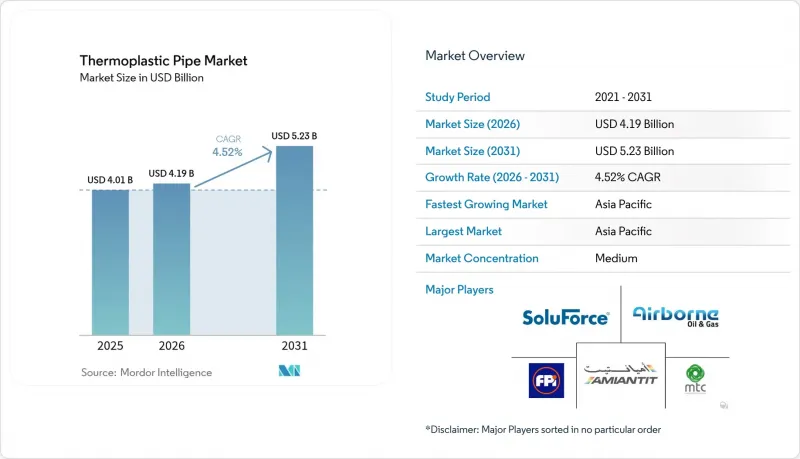
Mordor Intelligence에 의하면, 열가소성 파이프 시장 규모는 2025년 40억 1,000만 달러에서 2026년에는 41억 9,000만 달러로 확대되어 2026년부터 2031년까지 CAGR 4.52%로 성장을 지속하여, 2031년에는 52억 3,000만 달러에 이를 것으로 예측됩니다.
본 보고서는 파이프 유형(보강 열가소성 파이프, 열가소성 복합 파이프, 플렉서블 복합 파이프), 폴리머 유형(폴리에틸렌, 폴리비닐리덴 플루오라이드 등), 설치 장소(육상, 해상/해저, 광산 내/유정),용도(석유 및 가스, 화학·공정 산업 등), 지역(북미, 유럽, 아시아태평양 등)별로 분류되어 있습니다.
세계 열가소성 파이프 시장 동향 및 인사이트
부식된 강철 파이프라인의 급속한 교체
지자체와 미드스트림 사업자들은 1970년대부터 1990년대에 걸친 건설 붐 시기에 설치된 노후화된 자산 문제에 동시에 직면해 있습니다. 업계 현장 감사에 따르면, 현재 부식이 예정 외 유지보수 비용의 약 46%를 차지하고 있습니다. 미국 환경보호청(EPA)의 추산에 따르면, 2045년까지 상수도 시스템 개보수에 6,300억 달러가 필요하고, 이 중 1,150억 달러가 빗물 배수 네트워크에 투입될 예정입니다. 이러한 프로젝트에서는 PE나 폴리프로필렌(PP) 파이프를 사용함으로써 강관에 비해 설치 비용을 30-50% 절감할 수 있는 경우가 많은데, 그 이유는 릴이 가벼워 크레인 가동 시간이 단축되고, 용접이 전기 융착 이음매로 대체되기 때문입니다. 어드밴스트 드레나지 시스템즈(Advanced Drainage Systems)의 2025년 1분기 매출은 4.8% 증가한 8억 1,530만 달러를 기록했으며, 인프라 투자 및 고용법(IIJA)에 따른 자금 지원을 배경으로 인프라 부문이 두드러진 성장의 견인차 역할을 했습니다.
해양 사업자의 플로우라인에서 RTP/TCP로의 전환
브라질의 프리솔트층 및 서대서양 광구에서는 심해 탐사 대상이 수심 3,000미터 이상에 이릅니다. 10,000 psi를 초과하는 압력과 이산화탄소 농도로 인해 표준 API 규격의 강재에서는 응력 부식이 발생합니다. 2025년, 베이커 휴즈(Baker Hughes)는 페트로브라스(Petrobras)의 부지오스(Buzios) 유전용 77km의 플렉서블 파이프 공급 계약을 수주했습니다. 이 회사는 용접 강관 대비 60% 향상된 시공 효율을 그 이유로 꼽았습니다. 네덜란드의 전문 기업 스트롬(Strom)은 엑슨모빌(ExxonMobil)의 윅테일(Whiptail) 프로젝트에서 회사 사상 최대 규모의 TCP 수주를 확보하고, 수심 1,600m에 설치할 24개의 점퍼를 제조했습니다. 장척 스풀화를 통해 선박의 왕복 횟수를 줄여 작업을 수행할 수 있을 뿐만 아니라, 비금속 재질의 카카스를 사용하여 부식 모니터링이 불필요해집니다. 이러한 이점은 새로운 누출 감지 규정에 따라 정량화되어 있습니다.
원유 가격에 연동되는 폴리머 가격의 급등락
수지 원가는 나프타나 에탄과 같은 원자재 가격에 연동되어 있으며, 2025년에는 플랜트 가동 중단 및 운송 병목 현상을 배경으로 북미의 PE 및 PP 가격이 전월 대비 15% 이상의 변동을 이미 보이고 있습니다. 이에 따라 세키스이 화학공업은 2026년 4월부터 음용수용 PE 파이프의 정가를 15% 인상한다고 발표했습니다. 이러한 가격 변동은 시공사의 이익률을 압박하여 입찰 지연을 초래하는 경우도 적지 않습니다.
부문별 분석
RTP는 중압 탄화수소 용도 분야에서 다년간 쌓아온 실적을 바탕으로 2025년 열가소성 파이프 시장 점유율의 57.45%를 차지했습니다. 수요는 북미의 셰일가스 집배관 교체 및 중동 육상 지역의 수압 주입 루프에 의해 뒷받침되고 있습니다. TCP는 비교적 새로운 소재이지만, 심해 개발 사업자들이 그 내식성과 낮은 탄소 발자국을 중시하고 있기 때문에 2031년까지 연평균 성장률(CAGR)이 6.15%를 나타낼 것으로 전망됩니다. TCP의 열가소성 파이프 시장 규모는 2025년 11억 8,000만 달러를 기점으로 2031년까지 16억 9,000만 달러에 달할 것으로 예측됩니다. DNV가 2024년에 발표한 하이브리드 복합 플렉서블 파이프 규격 ‘ST-F207’에 따라, 고인장 라이저 용도에서 TCP의 채택이 더욱 정당화되었습니다. 플렉서블 복합 파이프(FCP)는 동적 유정 개입 및 해저 앰빌리컬 점퍼를 위한 틈새 솔루션으로서의 입지를 유지하고 있습니다.
총 설치 비용이 결정적인 기준이 되는 시장에서는 RTP가 우위를 유지하고 있습니다. 이는 스풀링이 가능한 코일 덕분에 플랜지나 용접이 많이 필요하지 않아 현장에서의 노동력을 최대 35%까지 절감할 수 있기 때문입니다. 그러나 산성 환경, 고압 또는 고온 조건에서의 성능이 자본 지출(Capex)보다 우선시되는 경우, TCP가 수주를 따내는 사례가 늘고 있습니다. 또한, 운영사는 수명 주기 동안의 탄소 배출량 감축을 중요하게 여기고 있으며, 조사에 따르면 주로 선박에 적재되는 중량이 가볍고 제조 공정이 적기 때문에 동등한 탄소강 제품에 비해 탄소 발자국이 50% 더 작은 것으로 나타났습니다. 예측 기간 동안, 경쟁력 있는 가격 책정과 제3자 보험사와의 관계가 TCP가 RTP와의 격차를 얼마나 빨리 좁힐지를 결정할 것입니다.
2025년 열가소성 파이프 시장 매출에서 폴리에틸렌이 47.60%의 점유율을 차지한 배경에는 광범위한 접근성과 간편한 융착 기술이 있었습니다. 상수도 네트워크에서 PE-100은 전기 융착 이음매를 채택하여 몇 분 만에 접합을 완료할 수 있습니다. 이를 통해 누수 위험을 줄이고, 교통량이 많은 도로 아래에서 비개착 공법을 이용한 설치가 가능해집니다. 그렇지만 가치 성장이 예상되는 것은 PVDF로, 수소 대응 시험 및 반도체 클린룸 배관 수요를 배경으로 연평균 성장률(CAGR) 6.90%로 성장을 지속하고, 있습니다. PVDF에 기인한 열가소성 파이프 시장 규모는 2025년 5억 500만 달러에서 2031년까지 7억 5,200만 달러로 확대될 전망입니다. PVDF는 140℃의 내열성을 가지며, 강산에 견디고 가스 투과율이 극히 낮은 특성을 갖추고 있으며, 이러한 특성은 GF Piping Systems사의 SYGEF 브랜드를 통해 입증되었습니다.
폴리프로필렌 및 PVC/CPVC는 중간층을 차지하고 있으며, 온도나 마모가 PE의 허용 범위를 초과하지만 PVDF나 폴리페닐렌 설파이드(PPS)를 채택할 정도는 아닌 온수 공급이나 광업용 슬러리 등의 분야에서 활용되고 있습니다. Syensqo사가 2025년에 시장에 출시할 압출 성형이 가능한 PPS는 200°C의 사용 환경에서 최초의 본격적인 경쟁 제품이 될 것, 초기 채택은 특수한 광산 내 가스 리프트 배관에 한정되어 있습니다. 따라서 소재 선정은 ‘만능형’에서 용도 특화형 블렌드로 전환되고 있으며, 폴리머와 설치용 공구, 디지털 검사 프로토콜을 결합할 수 있는 공급업체에게 이점이 주어지고 있습니다.
지역별 분석
아시아태평양은 2025년에 매출의 45.60%를 차지하고, 2031년까지 연평균 성장률(CAGR) 6.30%로 수요를 주도할 것입니다. APAC의 열가소성 파이프 시장 규모는 2031년까지 26억 4,000만 달러를 넘어설 것으로 예측됩니다. 인도만 해도 2025년에는 수도 부문 입찰액이 28억 달러를 넘어설 것으로 예상되는 반면, 동남아시아의 화학제품 생산액은 2030년까지 4,480억 달러에 육박하고, 공정 냉각 루프용 파이프 수요는 두 배로 증가할 전망입니다. 베트남이 그 대표적인 예입니다. SCG 케미칼스는 롱손 페트로케미칼을 강화하기 위해 7억 달러를 투자하여 파이프 가공업체를 위한 현지 수지 공급 체계를 구축했습니다.
북미는 2위를 차지하고 있으며, 셰일가스 수거 설비의 업그레이드와 용접 접합 PE 파이프의 채택을 경제적으로 필수로 여기는 연방 정부의 메탄 배출 규제가 원동력이 되고 있습니다. 어드밴스트 드레인 시스템즈(Advanced Drain Systems)의 매출 추이는 이러한 수요 규모를 뒷받침하고 있으며, 미국의 경제 부양 법안에 따라 빗물 저류 시설 및 해안 지역의 복원력 향상을 위한 자금이 투입되고 있습니다. 유럽 시장은 설비 교체 주기에 따라 성숙 단계로 접어들고 있지만, 2024/1787호 규정 및 ‘식수 지침’의 포지티브 리스트 요건으로 인해 규제 측면에서 호재를 누리고 있습니다.
남미, 중동 및 아프리카에서는 브라질과 서아프리카의 심해 개발, 그리고 페르시아만 주변의 해수 담수화 파이프라인이 시장을 지탱하고 있습니다. 자금 조달 모델과 인증 프로토콜은 여전히 장벽으로 작용하고 있지만, EPC 도급업체들은 유지보수 물류 비용이 높아지는 외딴 지역의 유전에서는 스풀이 가능한 RTP를 선호하여 채택하고 있습니다.
기타 혜택:
- 엑셀 형식 시장 예측(ME) 시트
- 3개월간의 애널리스트 지원
자주 묻는 질문
목차
제1장 서론
제2장 조사 방법
제3장 주요 요약
제4장 시장 구도
제5장 시장 규모와 성장 예측
제6장 경쟁 구도
제7장 시장 기회와 향후 전망
JHS 26.08.26According to Mordor Intelligence, the thermoplastic pipe market size is expected to grow from USD 4.01 billion in 2025 to USD 4.19 billion in 2026 and is forecast to reach USD 5.23 billion by 2031 at 4.52% CAGR over 2026-2031.
This report is Segmented by Pipe Type (Reinforced Thermoplastic Pipe, Thermoplastic Composite Pipe, and Flexible Composite Pipe), Polymer Type (Polyethylene, Polyvinylidene Fluoride, and More), Installation Location (Onshore, Offshore/Sub-sea, and Downhole/Wellbore), Application (Oil and Gas, Chemical and Process Industries, and More), and Geography (North America, Europe, Asia-Pacific, and More).
Global Thermoplastic Pipe Market Trends and Insights
Rapid Replacement of Corroded Steel Pipelines
Municipalities and midstream operators are simultaneously confronting ageing assets installed during the 1970s-1990s construction wave; corrosion now drives roughly 46% of unplanned maintenance spending according to industry field audits. The U.S. Environmental Protection Agency estimates USD 630 billion in water system upgrades will be needed by 2045, with a USD 115 billion slice earmarked for stormwater networks-projects where PE and polypropylene (PP) pipe often deliver 30-50% installed-cost savings versus steel because lighter reels reduce crane hours and welds are replaced with electro-fusion joints. Advanced Drainage Systems' Q1 2025 revenue rose 4.8% to USD 815.3 million, with infrastructure the standout growth driver amid Infrastructure Investment and Jobs Act funding.
Offshore Operators' Shift to RTP/TCP for Flow-Lines
Deepwater prospects extend beyond 3,000 metres in Brazil's pre-salt and western Atlantic acreage; pressures exceeding 10,000 psi, and carbon dioxide levels trigger stress corrosion in standard API-grade steel. In 2025, Baker Hughes secured contracts to supply 77 km of flexible pipe for Petrobras' Buzios field, citing deployment efficiencies of 60% relative to welded steel stalks.Dutch specialist Strohm landed its largest TCP award for ExxonMobil's Whiptail project, fabricating 24 jumpers for installation at 1,600 m water depth. Long-length spooling enables campaign execution with fewer vessel trips, while non-metallic carcasses eliminate corrosion monitoring-a benefit now quantified under new leak-detection rules.
Volatile Crude-Linked Polymer Prices
Resin costs track naphtha and ethane feedstocks, and 2025 has already delivered month-on-month swings above 15% for PE and PP in North America amid plant outages and freight bottlenecks. Sekisui Chemical therefore announced 15% list-price hikes for potable-water PE pipe from April 2026. Such volatility compresses contractor margins and often triggers bid delays.
Other drivers and restraints analyzed in the detailed report include:
- Urban Water & Wastewater Infrastructure Boom in APAC
- Hydrogen-Ready Thermoplastic Pipeline Pilots
- Pressure / Temperature Limits vs Steel
For complete list of drivers and restraints, kindly check the Table Of Contents.
Segment Analysis
RTP captured 57.45% of the thermoplastic pipe market share in 2025 due to its long track record for medium-pressure hydrocarbon service. Demand is underpinned by shale gathering-line replacements in North America and water injection loops onshore Middle East. TCP, though newer, posts a 6.15% CAGR through 2031 as deepwater developers lock in its corrosion immunity and low carbon footprint. The thermoplastic pipe market size for TCP is projected to reach USD 1.69 billion by 2031 after starting from a USD 1.18 billion base in 2025. DNV's 2024 hybrid composite flexible-pipe standard ST-F207 launch further legitimises TCP for high-tension riser duty. Flexible composite pipe (FCP) remains a niche solution for dynamic well intervention and subsea umbilical jumpers.
In markets where total installed cost is the decisive criterion, RTP maintains an edge because spoolable coils eliminate many flanges and welds, lowering field labour by up to 35%. Yet when performance in sour, high-pressure, or high-temperature conditions trumps capex, TCP increasingly secures the purchase order. Operators also value its lifecycle carbon reduction-studies show a 50 % smaller footprint than carbon-steel equivalents due mainly to lighter vessel loads and fewer fabrication steps. Over the forecast horizon, competitive pricing and third-party insurance relationships will determine how quickly TCP clips RTP's lead.
Polyethylene's 47.60% share of the thermoplastic pipe market income 2025 rested on ubiquitous availability and straightforward fusion techniques. In water networks, PE-100 adopts electro-fusion couplers that finish joints in minutes, cutting leak potential and permitting trenchless installations beneath busy roadways. Nonetheless, the value growth story lies in PVDF, clocking a 6.90% CAGR on the back of hydrogen-ready trials and semiconductor clean-room piping. The thermoplastic pipe market size attributable to PVDF is slated to rise from USD 505 million in 2025 to USD 752 million by 2031. PVDF tolerates 140 °C, resists aggressive acids, and displays very low gas permeability, attributes showcased in GF Piping Systems' SYGEF brand.
Polypropylene and PVC/CPVC occupy middle tiers, servicing districts such as hot-water supply and mining slurry where temperature or abrasion surpass PE's comfort zone but not enough to justify PVDF or polyphenylene sulfide (PPS). Syensqo's 2025 debut of extrudable PPS marks the first real challenger in 200 °C service, though early uptake remains confined to specialty downhole gas-lift lines. Material selection is thus moving away from one-size-fits-all toward application-specific blends, rewarding suppliers that can pair polymers with installation tooling and digital inspection protocols.
Complete Report Scope:
- By Pipe Type
- Reinforced Thermoplastic Pipe (RTP)
- Thermoplastic Composite Pipe (TCP)
- Flexible Composite Pipe (FCP)
- By Polymer Type
- Polyethylene (PE)
- Polypropylene (PP)
- Polyvinylidene Fluoride (PVDF)
- Poly Vinyl Chloride (PVC/CPVC)
- Others (PA, PPS, etc.)
- By Installation Location
- Onshore
- Offshore/Sub-sea
- Downhole/Wellbore
- By Application
- Oil and Gas
- Water and Wastewater
- Chemical and Process Industries
- Mining and Slurry
- District Heating and Cooling
- By Geography
- North America
- United States
- Canada
- Mexico
- Europe
- Germany
- United Kingdom
- France
- Italy
- Russia
- Rest of Europe
- Asia-Pacific
- China
- India
- Japan
- South Korea
- ASEAN Countries
- Rest of Asia-Pacific
- South America
- Brazil
- Argentina
- Rest of South America
- Middle East and Africa
- Saudi Arabia
- United Arab Emirates
- South Africa
- Egypt
- Rest of Middle East and Africa
- North America
Geography Analysis
Asia-Pacific held 45.60% of revenue in 2025 and remains the demand locomotive with a 6.30% CAGR to 2031. APAC's thermoplastic pipe market size is projected to top USD 2.64 billion by 2031. India alone is letting water-sector tenders topping USD 2.8 billion for 2025, while Southeast Asian chemical output is set to approach USD 448 billion by 2030, doubling pipe requirements for process cooling loops. Vietnam is emblematic: SCG Chemicals has invested USD 700 million to bolster Long Son Petrochemicals, creating a local resin supply for pipe converters.
North America ranks second, powered by shale gathering upgrades and federal methane fees that make fused-joint PE an economic imperative. Advanced Drainage Systems' sales trajectory underscores the volume, and U.S. stimulus bills funnel capital into stormwater retention and coastal resilience. Europe's market matures along replacement cycles but gains a regulatory kicker from 2024/1787 and the Drinking Water Directive's positive-list requirement.
South America, the Middle East, and Africa, are being served by deepwater activities in Brazil and West Africa and desalination pipelines around the Gulf. Funding models and qualification protocols remain hurdles, yet EPC contractors prefer spoolable RTP to remote oilfields where maintenance logistics cost premiums.
- TechnipFMC
- Pipelife Nederland BV
- Advanced Drainage Systems (ADS)
- Shawcor - Flexpipe Systems
- Future Pipe Industries
- National Oilwell Varco (NOV) - Fiberglass Systems
- Baker Hughes - Composite Pipe Solutions
- Prysmian - Subsea Composite Lines
- Polyflow LLC
- Magnum RTP
- Airborne Oil & Gas
- GF Piping Systems
- Wavin
- ALFAGOMMA Industrial Piping
- Simtech Process Systems
- Tianjin Jingtong Pipe Industry
- Cosmoplast
- Astral Limited
- IPEX Inc.
- Uponor
Additional Benefits:
- The market estimate (ME) sheet in Excel format
- 3 months of analyst support
TABLE OF CONTENTS
1 Introduction
- 1.1 Study Assumptions & Market Definition
- 1.2 Scope of the Study
2 Research Methodology
3 Executive Summary
4 Market Landscape
- 4.1 Market Overview
- 4.2 Market Drivers
- 4.2.1 Rapid replacement of corroded steel pipelines
- 4.2.2 Offshore operators shift to RTP/TCP for flow-lines
- 4.2.3 Urban water & wastewater infrastructure boom in APAC
- 4.2.4 Tightening methane-leak regulations in the U.S. and EU
- 4.2.5 Hydrogen-ready thermoplastic pipeline pilots
- 4.2.6 Modular CCS Plants Adopting Composite CO2 Lines
- 4.3 Market Restraints
- 4.3.1 Volatile crude-linked polymer prices
- 4.3.2 Pressure / temperature limits vs. steel
- 4.3.3 Slow deep-water qualification cycles
- 4.3.4 Micro-plastics compliance rules on certain resins
- 4.4 Supply-Chain Analysis
- 4.5 Regulatory Landscape
- 4.6 Technological Outlook (RTP, TCP, FCP, Hydrogen service)
- 4.7 Porter's Five Forces
- 4.7.1 Bargaining Power of Suppliers
- 4.7.2 Bargaining Power of Buyers
- 4.7.3 Threat of New Entrants
- 4.7.4 Threat of Substitutes
- 4.7.5 Industry Rivalry
5 Market Size & Growth Forecasts
- 5.1 By Pipe Type
- 5.1.1 Reinforced Thermoplastic Pipe (RTP)
- 5.1.2 Thermoplastic Composite Pipe (TCP)
- 5.1.3 Flexible Composite Pipe (FCP)
- 5.2 By Polymer Type
- 5.2.1 Polyethylene (PE)
- 5.2.2 Polypropylene (PP)
- 5.2.3 Polyvinylidene Fluoride (PVDF)
- 5.2.4 Poly Vinyl Chloride (PVC/CPVC)
- 5.2.5 Others (PA, PPS, etc.)
- 5.3 By Installation Location
- 5.3.1 Onshore
- 5.3.2 Offshore/Sub-sea
- 5.3.3 Downhole/Wellbore
- 5.4 By Application
- 5.4.1 Oil and Gas
- 5.4.2 Water and Wastewater
- 5.4.3 Chemical and Process Industries
- 5.4.4 Mining and Slurry
- 5.4.5 District Heating and Cooling
- 5.5 By Geography
- 5.5.1 North America
- 5.5.1.1 United States
- 5.5.1.2 Canada
- 5.5.1.3 Mexico
- 5.5.2 Europe
- 5.5.2.1 Germany
- 5.5.2.2 United Kingdom
- 5.5.2.3 France
- 5.5.2.4 Italy
- 5.5.2.5 Russia
- 5.5.2.6 Rest of Europe
- 5.5.3 Asia-Pacific
- 5.5.3.1 China
- 5.5.3.2 India
- 5.5.3.3 Japan
- 5.5.3.4 South Korea
- 5.5.3.5 ASEAN Countries
- 5.5.3.6 Rest of Asia-Pacific
- 5.5.4 South America
- 5.5.4.1 Brazil
- 5.5.4.2 Argentina
- 5.5.4.3 Rest of South America
- 5.5.5 Middle East and Africa
- 5.5.5.1 Saudi Arabia
- 5.5.5.2 United Arab Emirates
- 5.5.5.3 South Africa
- 5.5.5.4 Egypt
- 5.5.5.5 Rest of Middle East and Africa
- 5.5.1 North America
6 Competitive Landscape
- 6.1 Market Concentration Analysis
- 6.2 Strategic Moves (M&A, Partnerships, PPAs)
- 6.3 Market Share Analysis (Market Rank/Share for key companies)
- 6.4 Company Profiles (includes Global level Overview, Market level overview, Core Segments, Financials as available, Strategic Information, Products & Services, and Recent Developments)
- 6.4.1 TechnipFMC
- 6.4.2 Pipelife Nederland BV
- 6.4.3 Advanced Drainage Systems (ADS)
- 6.4.4 Shawcor - Flexpipe Systems
- 6.4.5 Future Pipe Industries
- 6.4.6 National Oilwell Varco (NOV) - Fiberglass Systems
- 6.4.7 Baker Hughes - Composite Pipe Solutions
- 6.4.8 Prysmian - Subsea Composite Lines
- 6.4.9 Polyflow LLC
- 6.4.10 Magnum RTP
- 6.4.11 Airborne Oil & Gas
- 6.4.12 GF Piping Systems
- 6.4.13 Wavin
- 6.4.14 ALFAGOMMA Industrial Piping
- 6.4.15 Simtech Process Systems
- 6.4.16 Tianjin Jingtong Pipe Industry
- 6.4.17 Cosmoplast
- 6.4.18 Astral Limited
- 6.4.19 IPEX Inc.
- 6.4.20 Uponor
7 Market Opportunities & Future Outlook
- 7.1 White-space & Unmet-need Assessment


