

|
시장보고서
상품코드
2062439
햅틱 기술 시장 : 시장 점유율 분석, 업계 동향 및 통계, 성장 예측(2026-2031년)Haptic Technology - Market Share Analysis, Industry Trends & Statistics, Growth Forecasts (2026 - 2031) |
||||||
 Mordor Intelligence
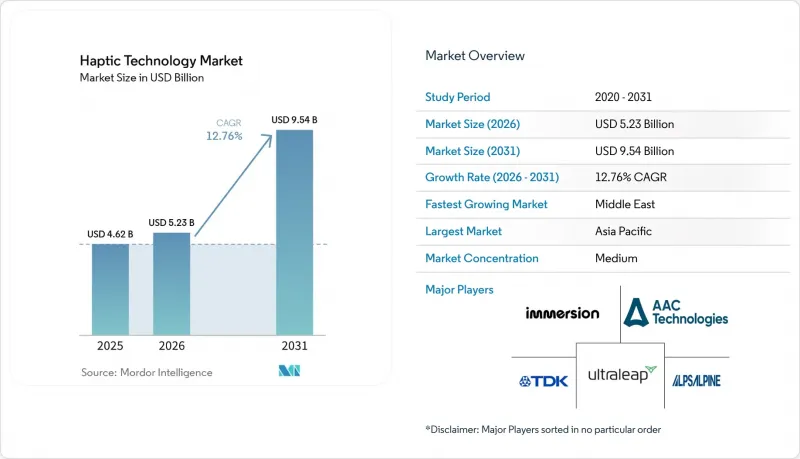
Mordor Intelligence에 의하면, 햅틱 기술 시장 규모는 2025년 46억 2,000만 달러로 평가되었고, 2026년에는 52억 3,000만 달러로 추정되고, 2031년까지 95억 4,000만 달러에 이를 것으로 예상되며, 2026-2031년 CAGR 12.76%로 성장할 전망입니다.
본 보고서는 구성 요소별(하드웨어 및 소프트웨어), 피드백 유형별(촉각(진동, 피부 신장, 전기 촉각) 및 힘/운동 감각), 액추에이터 기술별(편심 회전 질량(ERM) 모터, 압전 액추에이터 등), 용도별(헬스케어 및 의료기기, 산업 및 로봇공학 등), 지역별로 분류되어 있습니다. 시장 전망은 금액(달러) 기준으로 제시되어 있습니다.
세계의 햅틱 기술 시장 동향 및 인사이트
스마트폰의 보급과 촉각적 요소가 풍부한 UX에 대한 수요
모바일 기기 제조업체들은 현재 화면상의 특정 요소에 피드백을 국소적으로 전달할 수 있는 다중 액추에이터 어레이를 탑재하고 있으며, 이를 통해 사용자 만족도가 향상되고 접근성도 개선되고 있습니다. 플래그십 모델에는 서로 다른 주파수 대역으로 조정된 듀얼 LRA가 탑재되어 있어, 키보드의 타건감이 더욱 선명해졌으며, 알림이 은은하게 깜빡이고, 제스처 조작 확인 시 물리적 버튼을 모방하는 방식으로 작동합니다. 접이식 기기에서는 진폭을 손상시키지 않으면서 구부러지는 플렉서블 액추에이터의 장점을 활용하여, 향후 출시될 롤업형 스마트폰을 위해 새로운 설계의 자유도가 확대되고 있습니다. 성숙한 시장에서는 교체 주기가 지속적으로 길어지고 있기 때문에 촉각을 통한 차별화가 고객 유지를 위한 결정적인 요인으로 부상하고 있습니다. 이러한 변화로 인해 OEM 제조업체들은 촉각 서브시스템에 할당되는 부품 원가를 늘리게 되었으며, 이는 햅틱 기술 시장에서 기기당 가치를 높이는 결과를 가져오고 있습니다.
ADAS 및 안전 경고용 자동차 HMI
스티어 바이 와이어 및 운전자 모니터링 기능은 핸들, 페달, 시트 구조를 통해 전달되는 진동 펄스와 가변 저항에 의한 피드백에 의존합니다. 기아는 2026년형 모델에 스티어링 휠을 통한 촉각 경고 기능을 도입하여, 차선 이탈 방지 및 전방 충돌 방지 시스템이 임박한 위험을 감지하면 휠 림을 진동시킵니다. 이 방식은 통제된 연구에서 대시보드 아이콘 인식보다 30% 더 빠른 반응이 확인되었습니다. 2026년에 시행될 Euro NCAP 규정에 따르면, 5성급 평가를 받기 위해서는 물리적 공조 및 위험 제어 기능이 의무화되어 있으며, 이로 인해 촉각으로 확인할 수 있는 버튼에 대한 수요가 간접적으로 증가하고 있습니다. 또한, 각 고급차 제조업체들은 컴포트 모드와 스포츠 모드 사이에서 스티어링 감각을 전환하는 적응형 촉각 프로파일 실험을 진행하며, 커넥티드카 생태계 내에서 소프트웨어 정의형 수익 기회를 더욱 확대되고 있습니다.
고출력과 열 설계의 과제 : 정밀 액추에이터
압전 스택이나 정전 필름은 배터리 소모를 유발하고 발열 부위를 발생시키는 고전압 구동이 필요하기 때문에 엔지니어들은 히트 스프레더를 추가하거나 피드백 강도를 낮출 수밖에 없습니다. 두께가 5mm 미만인 스마트폰은 온도 상승으로 인해 중앙처리장치(CPU)의 작동이 제한되어 전반적인 성능이 저하될 가능성이 있으므로, 가장 심각한 절충점에 직면해 있습니다. 웨어러블 기기도 마찬가지로 제약을 안고 있으며, 블루투스나 센서의 처리 부하를 우선시하기 때문에 배터리용량이 극히 작다는 점이 이러한 제약을 더욱 가중시키고 있습니다. 자동차 실내는 70℃를 넘는 주변 온도에 노출되기 때문에 엔지니어는 퀴리점이 높은 재료를 선정하고 중복된 열퓨즈를 장착해야 하며, 이 모든 것이 시스템 비용을 증가시킵니다. 이러한 제약으로 인해 설계 및 도입 주기가 지연되면서, 햅틱 기술 시장의 단기적인 성장세가 둔화되고 있습니다.
부문별 분석
2025년에는 스마트폰, 자동차, 게임기에서 출하되는 모든 기기에 물리적 액추에이터와 드라이버 IC가 필요하게 됨에 따라, 하드웨어가 매출의 68.19%를 차지하며 햅틱 기술 시장을 독점했습니다. 유닛 수 증가세는 시간이 지남에 따라 둔화되고 있지만, 편심 회전 질량 모터가 더 고속인 LRA나 점점 더 널리 보급되고 있는 압전 스택으로 대체됨에 따라 하드웨어 매출은 여전히 큰 비중을 차지하고 있습니다. 햅틱 기술 시장에서의 점유율은 낮은 편이지만, 소프트웨어 부문은 2031년까지 연평균 성장률(CAGR) 13.45%를 기록하며 급속한 성장세를 보일 전망입니다. 이는 TouchSense나 Lofelt와 같은 크로스 플랫폼 미들웨어가 기기별 파형 라이브러리를 추상화함으로써 개발 주기를 단축하고 있기 때문입니다.
소프트웨어의 수익 모델은 여전히 유동적입니다. 미들웨어 라이선스의 대부분은 액추에이터 조달과 연계되어 있기 때문에 지속적인 수익 창출 기회가 제한적입니다. 이러한 한계를 극복하기 위해 각 벤더사는 오디오비주얼 컨텐츠와 동기화된 클라우드 렌더링을 통한 촉각 스트림의 시범 운영을 진행하고 있으며, 공간 오디오 라이브러리와 마찬가지로 촉각 효과를 하나의 서비스로 자리매김하고 있습니다. 이러한 전환은 지연 시간의 오버헤드를 해결하고, 최신 ISO 및 IEEE 표준에 포함된 코덱을 지원할 수 있는지 여부에 달려 있습니다. 클라우드 햅틱스가 상용화되면, 소프트웨어를 통해 햅틱 기술 시장 전체의 가치 분배가 수익성이 높은 지속적인 계약으로 전환될 가능성이 있습니다.
진동, 피부 신장, 전기 촉각 자극 등의 촉각 모달리티는 전력 소모가 적고, 스마트폰이나 웨어러블 기기에 쉽게 탑재할 수 있는 소형 크기이기 때문에 2025년 매출의 61.33%를 차지했습니다. 그러나 외과용 로봇 및 협업 로봇의 도입이 증가함에 따라, 힘 감각 및 운동 감각 피드백 시장은 촉각 시장을 능가하는 성장을 보일 것으로 예상되며, 연평균 성장률(CAGR) 13.41%로 확대될 것으로 전망됩니다. da Vinci 5와 같은 의료 시스템은 조직 저항의 벡터를 실시간으로 외과의사에게 피드백하여 천공 위험을 줄이는 동시에 학습 곡선을 단축합니다. 한편, 6자유도 힘 감지 핸들을 탑재한 산업용 협동 로봇은 초기 조립 수율을 25% 향상시킵니다.
전기 촉각 인터페이스는 피부 임피던스의 변동으로 인해 사용자 간 일관성이 저하되기 때문에 여전히 실험실 내의 희귀한 장치에 그치고 있습니다. 공중 초음파 어레이는 성능 면에서 한계가 있기는 하지만, 자동차 인포테인먼트나 공공 키오스크 분야에서 위생상의 장점을 살린 틈새 시장을 개척하고 있습니다. 고급 XR 장갑에 탑재된 피부 신장 장치는 가상 텍스처 인식을 용이하게 하는 전단력을 전달하지만, 여전히 비용이 높기 때문에 도입은 기업용 패키지로 한정되어 있습니다. 전반적으로, 전문 분야의 운동 감각 하드웨어로의 전환은 평균 판매 가격을 끌어올리고 있으며, 소비자 가전제품의 판매량 증가세가 안정된 상황에서도 햅틱 기술 시장을 확대시키고 있습니다.
지역별 분석
아시아태평양은 2025년에 38.22%의 점유율을 차지했으며, 계속해서 수익의 주축이 되었습니다. 이는 선전과 동관에 위치한 중국의 거대한 스마트폰 조립 클러스터, 일본의 압전 세라믹 분야에서의 선도적 입지, 그리고 한국의 디스플레이 통합 모듈에 관한 노하우에 의해 뒷받침되고 있습니다. 이 지역에서는 전자기기 및 의료기기에 사용되는 협동 로봇에 대한 수요에 힘입어, 2030년까지 일본의 촉각·힘 센서 출하량이 연평균 18% 성장할 것으로 전망됩니다. 2025년에 900만 대를 넘어설 것으로 예상되는 중국의 전기차 생산은 스티어링 휠과 터치 콘솔에 LRA(저저항 액추에이터) 및 피에조 스택의 탑재를 촉진하고 있으며, 이 지역의 부품 제조업체들은 풀가동 상태를 유지하고 있습니다. 한국 기업들은 폴더블 스마트폰의 보급 열풍에 발맞추어, 180도까지 구부려도 촉각 강도가 떨어지지 않는 곡면 액추에이터를 탑재하고 있습니다.
중동은 VR 의료·방위 시뮬레이터에 자금을 지원하는 ‘사우디 비전 2030’의 투자와 아랍에미리트의 XR 인재 양성 모듈 조달에 힘입어, 2031년까지 연평균 성장률(CAGR) 13.68%로 가장 높은 성장세를 보일 것으로 전망됩니다. 이스라엘의 방위 관련 기업들은 임무 실패율을 낮추기 위해 촉각 기능을 탑재한 무인 차량 스테이션을 도입하고 있으며, 그 용도는 민수용 기기를 넘어 다양화되고 있습니다. 카타르에 기반을 둔 스타트업이 2026년에 VR 의료 과정용 자금 조달에 성공한 것은 수입 하드웨어를 보완하는 현지 발 사업 확장을 보여주는 것으로, 이러한 요소들이 하나로 어우러져 해당 지역의 햅틱 기술 시장 규모를 끌어올리고 있습니다.
북미와 유럽에서는 ADAS(첨단 운전자 보조 시스템)의 의무화, 수술용 로봇의 도입, 그리고 게임기 교체 주기를 배경으로 연평균 성장률(CAGR)이 한 자릿수 중반대에서 안정적으로 유지되고 있지만, 스마트폰 시장의 포화로 인해 성장의 상한선이 정해져 있습니다. 애플이 추진하는 5,000억 달러 규모의 다년간 국내 투자(Advanced Manufacturing Fund 규모를 2배로 확대하는 것)는 제3자에 대한 로열티를 최소화하기 위한 맞춤형 액추에이터 설계에 대한 지속적인 연구 개발(R&D)에 주력하고 있음을 뒷받침합니다. 텍사스 기기(Texas Instruments)가 600억 달러 규모의 아날로그 반도체 생산 거점을 확장함으로써, 드라이버 IC의 현지 공급망을 확보하고 지정학적 충격에 대한 내성을 높이고 있습니다. Euro NCAP이 2026년에 정한, 촉각을 통해 확인할 수 있는 공조 및 위험 경보 제어 장치에 대한 요건은 그동안 터치스크린에만 국한되던 추세를 뒤집는 것으로, 특히 독일의 고급차 브랜드를 중심으로 촉각 기능을 갖춘 기계식 버튼에 대한 수요를 촉진할 것으로 보입니다. 남미와 아프리카는 수입 관세와 낮은 구매력으로 인해 뒤처져 있지만, 스마트폰 보급률의 상승에 힘입어 햅틱 기술 시장의 향후 성장을 위한 기반이 착실히 마련되고 있습니다.
기타 혜택 :
- 엑셀 형식 시장 예측(ME) 시트
- 3개월간의 애널리스트 지원
자주 묻는 질문
목차
제1장 서론
제2장 조사 방법
제3장 주요 요약
제4장 시장 구도
제5장 시장 규모 및 성장 예측
제6장 경쟁 구도
제7장 시장 기회 및 향후 전망
AJY 26.06.26According to Mordor Intelligence, the haptic technology market size is expected to increase from USD 4.62 billion in 2025 to USD 5.23 billion in 2026 and reach USD 9.54 billion by 2031, growing at a CAGR of 12.76% over 2026-2031.
This report is Segmented by Component (Hardware and Software), Feedback Type (Tactile (Vibration, Skin-Stretch, Electro-Tactile) and Force/Kinesthetic), Actuator Technology (Eccentric Rotating Mass (ERM) Motors, Piezoelectric Actuators, and More), Application (Healthcare and Medical Devices, Industrial and Robotics, and More), and Geography. The Market Forecasts are Provided in Terms of Value (USD).
Global Haptic Technology Market Trends and Insights
Smartphone Proliferation and Tactile-Rich UX Demand
Mobile device makers are now embedding multi-actuator arrays that localize feedback to specific on-screen elements, raising user satisfaction scores and aiding accessibility. Flagship platforms feature dual LRAs tuned to different frequency ranges so that keyboards feel crisp, notifications pulse discreetly, and gesture confirmations mimic physical buttons. Foldable form factors benefit from flexible actuators that curve without dampening amplitude, opening new design latitude for upcoming rollable phones. Because replacement cycles continue to lengthen in mature markets, tactile differentiation is emerging as a decisive retention lever. That shift has persuaded original-equipment manufacturers to raise bill-of-materials allocations for haptic subsystems, enhancing per-unit value in the haptic technology market.
Automotive HMIs for ADAS and Safety Alerts
Steer-by-wire and driver-monitoring features rely on vibration pulses and variable-resistance cues delivered through wheels, pedals, and seat structures. Kia deployed steering-wheel haptic warnings in its 2026 model-year vehicles, pulsing the rim when lane-departure or forward-collision systems detect imminent risk, a modality that proved 30% faster than dashboard-icon recognition in controlled studies. Euro NCAP rules taking effect in 2026 require physical climate and hazard controls for a five-star rating, indirectly boosting demand for tactile-confirmed buttons. Premium automakers are also experimenting with adaptive haptic profiles that shift steering feel between comfort and sport modes, deepening software-defined revenue prospects inside connected-car ecosystems.
High Power and Thermal Budgets of Precision Actuators
Piezoelectric stacks and electrostatic films demand elevated drive voltages that drain batteries and create hot spots, pressing engineers to add heat spreaders or scale back feedback intensity. Smartphones with sub-5 millimeter chassis depth face the starkest trade-offs because higher temperatures can throttle central-processing units, degrading overall performance. Wearables share similar constraints, magnified by tiny battery capacities that prioritize Bluetooth and sensor workloads. Automotive cabins endure ambient temperatures above 70 °C, forcing engineers to select materials with high Curie points and to integrate redundant thermal fuses, both of which increase system cost. These limitations slow design-in cycles and temper the short-term growth pace of the haptic technology market.
Other drivers and restraints analyzed in the detailed report include:
- XR Hardware Boom (VR-AR-MR Headsets and Gloves)
- Gaming Peripherals and Console Haptics Standardization
- Bill-of-Materials Cost and Mechanical Design Complexity
For complete list of drivers and restraints, kindly check the Table Of Contents.
Segment Analysis
Hardware dominated revenue with a 68.19% haptic technology market share in 2025 because smartphones, automobiles, and gaming consoles require physical actuators and driver ICs in every shipped unit. Although unit growth moderates over time, hardware revenue retains heft thanks to the replacement of eccentric rotating mass motors with faster LRAs and, increasingly, piezoelectric stacks. Software, capturing a smaller slice of the haptic technology market, is on a sharper 13.45% CAGR trajectory through 2031, as cross-platform middleware such as TouchSense and Lofelt shortens development cycles by abstracting device-specific waveform libraries.
The software revenue model remains in flux. Most middleware licenses ride along with actuator procurement, limiting recurring revenue opportunities. To counter that ceiling, vendors are piloting cloud-rendered tactile streams synchronized with audiovisual content, positioning haptic effects as a service similar to spatial-audio libraries. That pivot hinges on solving latency overheads and securing codec support embedded in recent ISO and IEEE standards. If cloud haptics proves viable, software could tilt the overall value pool of the haptic technology market toward higher-margin recurring contracts.
Tactile modalities, including vibration, skin stretch, and electro-tactile stimulation, accounted for 61.33% of 2025 revenue because of their low power draw and compact footprints, which map neatly onto smartphones and wearables. Yet force and kinesthetic feedback are forecast to outpace tactile, expanding at a 13.41% CAGR as surgical-robot and collaborative-robot installations multiply. Medical systems such as the da Vinci 5 route real-time tissue-resistance vectors back to surgeons, lowering perforation risk and shortening learning curves, while industrial cobots equipped with six-degree-of-freedom force handles yield 25% higher first-pass assembly yields.
Electrotactile interfaces remain laboratory curiosities due to variable skin impedance, which hampers user-to-user consistency. Mid-air ultrasonic arrays, although force-limited, find hygienic niches in automotive infotainment and public kiosks. Skin-stretch devices in premium XR gloves convey shear forces that facilitate virtual texture recognition but still carry premium costs, limiting adoption to enterprise bundles. Overall, the shift toward kinesthetic hardware in specialized domains boosts average selling prices, expanding the haptic technology market even as consumer-electronics volume growth stabilizes.
Geography Analysis
Asia-Pacific remained the revenue anchor with a 38.22% share in 2025, sustained by China's vast smartphone-assembly clusters in Shenzhen and Dongguan, Japan's piezoelectric ceramics leadership, and South Korea's display-integrated module know-how. The region where Japanese shipments of tactile and force sensors will grow 18% annually through 2030, propelled by demand for collaborative robots in electronics and medical equipment. Chinese electric-vehicle production exceeding 9 million units in 2025 is driving the insertion of LRAs and piezo stacks into steering wheels and touch consoles, keeping regional component makers at capacity. Korean companies are riding the wave of foldable-phone adoption, embedding curved actuators that function across 180-degree bends without degrading haptic intensity.
The Middle East is forecast to post the fastest CAGR of 13.68% through 2031, catalyzed by Saudi Vision 2030 investments that fund VR medical and defense simulators and by the United Arab Emirates' procurement of XR workforce-training modules. Israel's defense contractors are fielding haptic-enabled unmanned-vehicle stations that cut mission failure rates, diversifying applications beyond consumer devices. Qatar-based startups securing 2026 funding for VR medical courses demonstrate home-grown expansion that complements imported hardware, collectively uplifting the haptic technology market size in the region.
North America and Europe maintain steady mid-single-digit CAGRs on the back of ADAS mandates, surgical-robot installations, and console refresh cycles, although smartphone saturation places a ceiling on upside. Apple's multiyear USD 500 billion domestic investment, which doubles its Advanced Manufacturing Fund, underlines continued R&D focus on custom actuator design that minimizes third-party royalties. Texas Instruments' USD 60 billion analog-fab expansion secures local supply chains for driver ICs, buffering geopolitical shocks. Euro NCAP's 2026 requirement for tactile-verified climate and hazard controls reverses earlier touchscreen-only trends, set to stimulate demand for haptic-equipped mechanical buttons, particularly among premium German marques. South America and Africa trail because of import tariffs and lower purchasing power, yet rising smartphone penetration keeps a simmering baseline for future growth in the haptic technology market.
- Immersion Corporation
- AAC Technologies Holdings Inc.
- Texas Instruments Incorporated
- Alps Alpine Co., Ltd.
- Ultraleap Holdings Ltd.
- Microchip Technology Incorporated
- Johnson Electric Holdings Limited
- TDK Corporation (InvenSense Inc.)
- Synaptics Incorporated
- Analog Devices, Inc.
- Panasonic Corporation
- Samsung Electronics Co., Ltd. (System LSI)
- Boreas Technologies Inc.
- Novasentis Inc.
- HaptX Inc.
- bHaptics Inc.
- Senseg Oy
- Force Dimension SA
- Actronika SAS
- ON Semiconductor Corporation
- Sony Group Corporation
- Apple Inc.
Additional Benefits:
- The market estimate (ME) sheet in Excel format
- 3 months of analyst support
TABLE OF CONTENTS
1 INTRODUCTION
- 1.1 Study Assumptions and Market Definition
- 1.2 Scope of the Study
2 RESEARCH METHODOLOGY
3 EXECUTIVE SUMMARY
4 MARKET LANDSCAPE
- 4.1 Market Overview
- 4.2 Market Drivers
- 4.2.1 Smartphone Proliferation and Tactile-Rich UX Demand
- 4.2.2 Automotive HMIs for ADAS and Safety Alerts
- 4.2.3 XR Hardware Boom (VR/AR/MR Headsets and Gloves)
- 4.2.4 Gaming Peripherals and Console Haptics Standardization
- 4.2.5 MPEG-I and IEEE P1918.1 Standards Enabling Cross-Platform Haptic Content
- 4.2.6 5G Tactile-Internet Pilots for Remote Operations
- 4.3 Market Restraints
- 4.3.1 High Power and Thermal Budgets of Precision Actuators
- 4.3.2 Bill-of-Materials Cost and Mechanical Design Complexity
- 4.3.3 Concentrated IP Portfolio, Royalty Exposure to Immersion
- 4.3.4 Fragmented Cross-Platform Interoperability
- 4.4 Industry Value-Chain Analysis
- 4.5 Regulatory Landscape
- 4.6 Technological Outlook
- 4.7 Impact of Macroeconomic Factors on the Market
- 4.8 Porter's Five Forces Analysis
- 4.8.1 Threat of New Entrants
- 4.8.2 Bargaining Power of Suppliers
- 4.8.3 Bargaining Power of Buyers
- 4.8.4 Threat of Substitutes
- 4.8.5 Intensity of Competitive Rivalry
5 MARKET SIZE AND GROWTH FORECASTS (VALUE)
- 5.1 By Component
- 5.1.1 Hardware
- 5.1.2 Software
- 5.2 By Feedback Type
- 5.2.1 Tactile (Vibration, Skin-Stretch, Electro-Tactile)
- 5.2.2 Force / Kinesthetic
- 5.3 By Actuator Technology
- 5.3.1 Eccentric Rotating Mass (ERM) Motors
- 5.3.2 Linear Resonant Actuators (LRA)
- 5.3.3 Piezoelectric Actuators
- 5.3.4 Ultrasonic / Mid-Air Ultrasound
- 5.3.5 Electrostatic and Electro-Hydrodynamic Films
- 5.4 By Application
- 5.4.1 Consumer Electronics (Smartphones, Wearables, Tablets, PCs)
- 5.4.2 Gaming and XR Devices
- 5.4.3 Automotive and Transportation (HMI, ADAS, Infotainment)
- 5.4.4 Healthcare and Medical Devices
- 5.4.5 Industrial and Robotics
- 5.4.6 Other Applications
- 5.5 By Geography
- 5.5.1 North America
- 5.5.1.1 United States
- 5.5.1.2 Canada
- 5.5.1.3 Mexico
- 5.5.2 Europe
- 5.5.2.1 Germany
- 5.5.2.2 United Kingdom
- 5.5.2.3 France
- 5.5.2.4 Italy
- 5.5.2.5 Rest of Europe
- 5.5.3 Asia-Pacific
- 5.5.3.1 China
- 5.5.3.2 Japan
- 5.5.3.3 India
- 5.5.3.4 South Korea
- 5.5.3.5 Rest of Asia-Pacific
- 5.5.4 Middle East
- 5.5.4.1 Israel
- 5.5.4.2 Saudi Arabia
- 5.5.4.3 United Arab Emirates
- 5.5.4.4 Turkey
- 5.5.4.5 Rest of Middle East
- 5.5.5 Africa
- 5.5.5.1 South Africa
- 5.5.5.2 Egypt
- 5.5.5.3 Rest of Africa
- 5.5.6 South America
- 5.5.6.1 Brazil
- 5.5.6.2 Argentina
- 5.5.6.3 Rest of South America
- 5.5.1 North America
6 COMPETITIVE LANDSCAPE
- 6.1 Market Concentration
- 6.2 Strategic Moves
- 6.3 Market Share Analysis
- 6.4 Company Profiles (includes Global Level Overview, Market Level Overview, Core Segments, Financials as available, Strategic Information, Market Rank/Share, Products and Services, Recent Developments)
- 6.4.1 Immersion Corporation
- 6.4.2 AAC Technologies Holdings Inc.
- 6.4.3 Texas Instruments Incorporated
- 6.4.4 Alps Alpine Co., Ltd.
- 6.4.5 Ultraleap Holdings Ltd.
- 6.4.6 Microchip Technology Incorporated
- 6.4.7 Johnson Electric Holdings Limited
- 6.4.8 TDK Corporation (InvenSense Inc.)
- 6.4.9 Synaptics Incorporated
- 6.4.10 Analog Devices, Inc.
- 6.4.11 Panasonic Corporation
- 6.4.12 Samsung Electronics Co., Ltd. (System LSI)
- 6.4.13 Boreas Technologies Inc.
- 6.4.14 Novasentis Inc.
- 6.4.15 HaptX Inc.
- 6.4.16 bHaptics Inc.
- 6.4.17 Senseg Oy
- 6.4.18 Force Dimension SA
- 6.4.19 Actronika SAS
- 6.4.20 ON Semiconductor Corporation
- 6.4.21 Sony Group Corporation
- 6.4.22 Apple Inc.
7 MARKET OPPORTUNITIES AND FUTURE OUTLOOK
- 7.1 White-Space and Unmet Need Analysis


