|
시장보고서
상품코드
2063405
공급망 ERP(전사적 자원 계획) : 시장 점유율 분석, 업계 동향 및 통계, 성장 예측(2026-2031년)Supply Chain Enterprise Resource Planning - Market Share Analysis, Industry Trends & Statistics, Growth Forecasts (2026 - 2031) |
||||||
 Mordor Intelligence
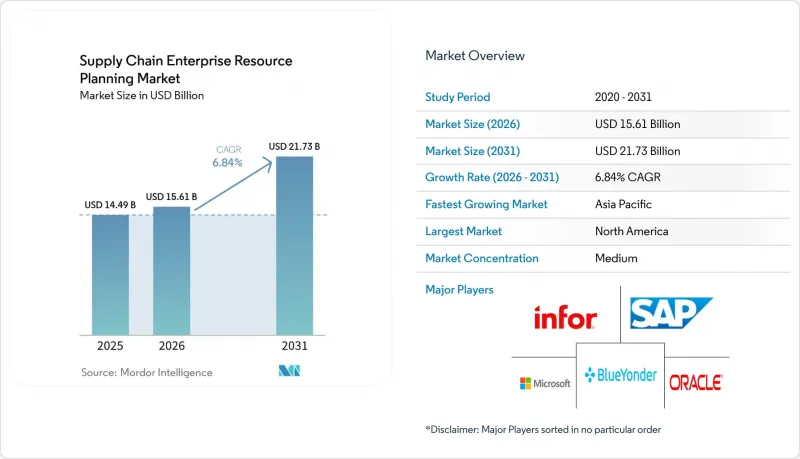
Mordor Intelligence에 의하면, 공급망 ERP(전사적 자원 계획) 시장 규모는 2025년에 144억 9,000만 달러로 평가되었습니다. 2026년 156억 1,000만 달러에서 2031년까지 217억 3,000만 달러에 이를 것으로 예상되며, 예측 기간(2026-2031년) CAGR은 6.84%를 나타낼 전망입니다.
본 보고서는 구성 요소(소프트웨어 및 서비스), 도입 형태(클라우드 기반, On-Premise형, 하이브리드형), 최종 사용자 산업(제조업, 소비재, 의료 및 제약, 식품 및 음료 등), 조직 규모(대기업, 중소기업) 및 지역별로 분류되어 있습니다. 시장 전망은 금액(달러) 기준으로 제공됩니다.
세계의 공급망 ERP(전사적 자원 계획) 시장 동향과 인사이트
Tier 1 ERP 제품군의 클라우드 우선 전환
Tier 1 벤더는 적극적인 클라우드 도입을 위한 주요 목표를 제시하며, 지속적인 기능 제공, 유연한 시뮬레이션 능력, 그리고 제3자 물류 업체와의 원활한 통합을 약속하고 있습니다. 이전을 통해 일반적으로 5년간의 총 소유 비용(TCO)은 어느 정도 절감되지만, 숨겨진 데이터 정제 작업이나 프로세스 재구축 작업으로 인해 프로젝트 일정이 연장되는 경우가 종종 있습니다. 벤더들은 마찰을 줄이기 위해 자동화된 전환 툴킷이나 고정 가격 패키지를 함께 제공하고 있지만, 고객들은 가동 개시 마일스톤과 연계된 성과 기반 계약을 점점 더 강력하게 요구하고 있습니다. 또한, 클라우드 기반 솔루션으로의 전환은 서비스 제공 모델의 혁신을 촉진하고 있습니다. 공급망 ERP(기업 자원 계획) 시장공급업체들은 인공지능(AI)과 머신러닝을 활용하여 예측 분석 기능을 강화하고 있으며, 이를 통해 기업들은 데이터에 기반한 의사결정을 보다 효과적으로 내릴 수 있게 되었습니다. 이러한 추세는 업무 최적화에 있어 실시간 인사이트이 필수적인 제조업이나 소매업 등의 업계에서 특히 두드러집니다. 그 결과, 기업들은 클라우드 도입을 단순한 비용 절감 방안이 아니라 경쟁 우위를 확보하기 위한 전략적 투자로 인식하기 시작했습니다.
AI를 활용한 예측형 공급망 계획
현재 머신러닝 알고리즘은 비정형 기상 데이터, 공급업체로부터 받은 이메일, 소셜 미디어상의 감정 분석 등을 반영하여 수요 예측을 미세 조정하고, 미래를 내다보며 배송 경로를 변경하고 있습니다. 내장된 코파일럿 기능 덕분에 수동 데이터 입력 작업이 중간 정도까지 줄어들어, 기업은 서비스 수준을 저하시키지 않으면서도 더 적정한 안전 재고를 유지할 수 있게 됩니다. 신뢰성은 여전히 일관된 이력 데이터에 의존하고 있으며, 이는 통합된 클라우드 네이티브 환경으로의 전환을 더욱 촉진하고 있습니다. 그 결과, 기업들은 업무 효율성과 의사결정 능력을 강화하기 위해 고도의 분석 기술에 대한 투자를 점점 더 우선시하고 있습니다.
사이버 보안 및 데이터 주권 관련 규정 준수 비용
EU, 중국, 인도 등의 관할 구역에서는 국내 데이터 저장이 의무화되어 있으며, 위반 시 엄격한 처벌이 부과됩니다. 따라서 다국적 기업들은 지역별로 별도의 ERP 시스템을 운영하고 있으며, 그 결과 인프라 비용이 증가하고 마스터 데이터의 동기화가 복잡해지고 있습니다. 제로 트러스트 보안, 다단계 인증 및 이상 감지는 연간 구독 요금에 10-15%의 추가 비용을 발생시키며, 이러한 부담은 중견 기업에게 특히 심각합니다. 게다가, 이러한 규정을 준수하기 위해서는 현지 기준을 충족시키기 위해 IT 인프라 업그레이드에 막대한 투자가 필요한 경우가 적지 않습니다. 공급망 ERP(기업 자원 계획) 시장의 이러한 동향은 지역별 복잡한 규정 준수 요건을 극복하기 위한 전문 컨설팅 서비스에 대한 수요를 촉진하고 있습니다.
부문별 분석
공급망 ERP(기업 자원 계획) 시장의 서비스 부문은 프로젝트 수행 시 집중적인 데이터 정제, 통합 및 변경 관리가 필요하기 때문에 연평균 성장률(CAGR) 7.24%로 확대되고 있으며, 이는 소프트웨어 부문의 성장률을 상회하고 있습니다. 도입 및 관리형 서비스 계약은 수주부터 입금까지 소요되는 일수(Order-to-Cash 사이클)와 같은 성과 지표에 점점 더 의존하고 있습니다. 2025년에도 소프트웨어는 여전히 시장 가치의 63.71%를 차지했으며, 이는 현대공급망 네트워크를 뒷받침하는 Tier 1 제품군과 알고리즘 계획 애드온에서 발생하는 구독 수익에 힘입은 것입니다. 지속적인 개선을 목적으로 한 리테이너 계약을 통해 컨설턴트는 시스템 가동 후에도 장기간 상주하게 되며, 이 서비스는 정기적인 수익원으로 변화하고 있습니다. 한편, 소프트웨어 공급업체들은 기본적인 지원 및 호스팅 서비스를 패키지로 묶어 제공함으로써 카테고리 간의 경계를 모호하게 만들고, 구매자가 두 항목에 걸친 실제 비용을 평가하도록 유도하고 있습니다. 오픈소스 제공업체들은 종합적인 가격 정책을 활용하여 총 소유 비용을 절감함으로써 중소기업을 유치하고 있습니다.
시장이 발전함에 따라 기업들은 역동적인 공급망의 요구에 적응하기 위해 ERP 솔루션에서 민첩성과 확장성을 점점 더 중요하게 여기고 있습니다. 벤더들은 이에 대응하여, 고급 분석 기능과 AI를 활용한 인사이트를 통합함으로써 의사결정 능력을 강화하고 있습니다. 또한, 모듈형 ERP 시스템으로의 전환을 통해 기업은 기능을 단계적으로 도입할 수 있게 되어, 초기 비용과 도입 위험을 줄일 수 있습니다. 이러한 추세는 예산 제약에 직면해 있으면서도 경쟁력을 유지하기 위해 견고한 솔루션이 필요한 중견 기업들에게 특히 매력적입니다. 지속가능성과 규정 준수에 대한 관심이 높아지면서 혁신이 더욱 가속화되고 있으며, ERP 공급업체들은 탄소 발자국 추적 및 규정 준수를 보장하기 위한 기능을 도입하고 있습니다.
클라우드 도입은 2025년 매출의 58.83%를 차지했으며, 하이퍼스케일러의 할인 혜택과 시뮬레이션 워크로드를 위한 탄력적인 용량에 힘입어 2031년까지 연평균 7.44%의 성장률을 기록하고 있습니다. 국방, 유틸리티, 공공 부문과 같은 분야에서는 기밀성이 높은 장부는 On-Premise에 남겨두고, 협업 모듈은 클라우드에 배치하는 하이브리드 구조가 정착되어 있습니다. On-Premise 도입은 감소 추세를 보이고 있지만, 에어갭 방식의 보안이 확장성보다 우선시되는 분야에서는 여전히 자리 잡고 있습니다. 엣지 캐시 어플라이언스와 지역 데이터센터는 지연 시간 및 데이터 저장 위치와 관련된 문제를 완화하여, 대역폭이 제한된 지역에서 클라우드의 매력을 높이고 있습니다. 구독 모델은 초기 비용을 보다 고르게 분산시킬 수 있어, 자본 예산 조정에 어려움을 겪고 있는 제조업에 있어 이점이 됩니다. 그 결과, 클라우드 도입률은 예측 기간보다 훨씬 이른 시점에 신규 도입의 70%를 넘어설 것으로 예상되며, 이는 벤더의 수익 구조를 더욱 변화시킬 것입니다.
또한, 인공지능(AI)이나 머신러닝(ML)과 같은 첨단 기술이 클라우드 기반 ERP 시스템에 통합됨에 따라, 업종을 불문하고 업무 효율이 향상되고 있습니다. 이러한 기술은 실시간 데이터 분석, 예측적 인사이트, 자동화된 의사결정을 가능하게 하여, 급변하는 시장에서 경쟁력을 유지하고자 하는 기업들에게 필수적인 요소가 되고 있습니다. 또한, 지속가능성에 대한 관심이 높아짐에 따라 조직들은 에너지 소비를 최적화하고 탄소 발자국을 줄여주는 클라우드 솔루션을 도입해야 할 필요성에 직면해 있습니다. 각 벤더사는 기업의 환경·사회·지배구조(ESG) 목표에 부합하는 그린 클라우드 서비스 제공을 확대하고 있으며, 이는 예측 기간 동안 클라우드 도입을 더욱 가속화할 것으로 전망됩니다.
지역별 분석
북미는 미국 내 AI를 활용한 계획 수립 및 니어쇼어 제조 추진을 주도하는 역할을 통해, 2025년에는 36.18%의 점유율을 차지하며 가장 큰 기여 지역으로 남았습니다. 캐나다의 생산 업체들은 수출 원산지 규정의 문서 요건을 충족하기 위해 ERP 시스템을 도입하고 있는 반면, 멕시코의 마키라도라(수출 가공 공장)는 국내 및 미국공급업체를 아우르는 이중 조달 모델을 관리하기 위해 시스템을 업그레이드하고 있습니다. 5G 연결의 보급과 하이퍼스케일러 데이터센터 밀도 증가로 인해 실시간 컨트롤 타워 대시보드가 가능해졌으며, 공급 차질에 대한 대응 시간이 단축되고 있습니다.
아시아태평양은 예측 기간 동안 연평균 성장률(CAGR) 7.84%를 기록하며 가장 역동적인 성장 궤도를 그리고 있습니다. 인도에서는 규정 준수 요건을 충족하는 템플릿을 통해 상품·서비스세(GST) 보고가 자동화되면서, 중견 기업들조차 스프레드시트에서 벗어나고 있습니다. 일본의 대기업들은 국내 클라우드 공급업체들이 저지연 가용성 영역을 보장함에 따라 On-Premise형 시스템을 단계적으로 폐지하고 있습니다. 중국에서는 정부 주도의 대체 캠페인을 통해 기업들이 세계 공급망과의 통합성을 해치지 않으면서도, 엄격한 사이버 보안 심사를 통과한 현지 관리형 ERP 시스템으로 전환하고 있습니다.
유럽에서는 규제 준수와 지속가능성 분야의 리더십이 균형을 이루고 있습니다. ViDA 전자 청구서 도입으로 지역 전체에서 국경을 초월한 데이터 교환이 가능해지는 한편, ‘디지털 제품 여권’을 통해 제조업체는 원자재 채굴부터 사용 후 제품의 재활용에 이르기까지의 탄소 발자국을 추적해야 합니다. 독일의 자동차 부품 공급업체는 ERP의 세부 항목에 직접 통합된 블록체인을 활용한 원산지 증명서의 시범 운영을 진행하고 있습니다. 북유럽의 소매업체들은 순환 경제에 기반한 반품 데이터를 활용하여 재생 및 재판매 프로그램을 운영하고 있습니다. 동유럽의 공장에서는 EU의 결속 기금을 활용하여 공장의 디지털화를 추진하고 있으며, 모듈형 스위트에 대한 수요가 더욱 높아지고 있습니다. 남미, 중동 및 아프리카는 규모가 작은 시장이지만, 각국 정부가 디지털 인프라에 투자하고 있으며, 현지 기업들이 다국적 기업의 자회사와 경쟁하려 하고 있어 꾸준히 성장하고 있습니다. 브라질의 ERP 도입률은 2025년에 33%를 넘어설 전망이며, 정부가 세무 규정 준수 프로세스의 디지털화를 추진함에 따라 추가적인 성장이 예상됩니다.
기타 혜택 :
- 엑셀 형식 시장 예측(ME) 시트
- 3개월간의 애널리스트 지원
자주 묻는 질문
목차
제1장 서론
제2장 조사 방법
제3장 주요 요약
제4장 시장 구도
제5장 시장 규모 및 성장 예측
제6장 경쟁 구도
제7장 시장 기회 및 향후 전망
KTH 26.06.22According to Mordor Intelligence, the supply chain enterprise resource planning market size was valued at USD 14.49 billion in 2025 and estimated to grow from USD 15.61 billion in 2026 to reach USD 21.73 billion by 2031, at a CAGR of 6.84% during the forecast period (2026-2031).
This report is Segmented by Component (Software, and Services), Deployment Mode (Cloud-Based, On-Premise, and Hybrid), End-User Industry (Manufacturing, Consumer Goods, Healthcare and Pharmaceuticals, Food and Beverage, and More), Organization Size (Large Enterprises, and Small and Medium Enterprises), and Geography. The Market Forecasts are Provided in Terms of Value (USD).
Global Supply Chain Enterprise Resource Planning Market Trends and Insights
Cloud-First Migration of Tier-1 ERP Suites
Tier-1 vendors target aggressive cloud-adoption milestones, promising continuous feature delivery, elastic simulation capacity, and easier integration with third-party logistics. Migrations typically lower the five-year total cost of ownership by a moderate share, yet hidden data cleansing and process re-engineering work often extends project timelines. Vendors bundle automated migration toolkits and fixed-price packages to reduce friction, while customers increasingly insist on outcome-based contracts tied to go-live milestones. Additionally, the shift to cloud-based solutions is driving innovation in service delivery models. The supply chain ERP market vendors are leveraging artificial intelligence and machine learning to enhance predictive analytics, enabling businesses to make data-driven decisions more effectively. This trend is particularly evident in industries like manufacturing and retail, where real-time insights are critical for optimizing operations. As a result, companies are increasingly viewing cloud adoption not just as a cost-saving measure but as a strategic investment to gain a competitive edge.
AI-Enabled Predictive Supply Chain Planning
Machine-learning algorithms now ingest unstructured weather feeds, supplier emails, and social sentiment to fine-tune demand forecasts and proactively reroute shipments. Embedded copilots reduce manual data entry by up to a moderate share and enable enterprises to maintain leaner safety stock without eroding service levels. Reliability still hinges on harmonized historical data, giving an additional push toward unified, cloud-native environments. As a result, businesses are increasingly prioritizing investments in advanced analytics to enhance operational efficiency and decision-making.
Cyber-Security and Data-Sovereignty Compliance Costs
Jurisdictions such as the EU, China, and India demand in-country data storage and impose stiff penalties for violations. Multinationals, therefore, maintain region-specific ERP instances, thereby increasing infrastructure costs and complicating master data synchronization. Zero-trust security, multi-factor authentication, and anomaly detection add 10-15% to annual subscription fees, a burden felt most acutely by mid-market firms. Additionally, compliance with these regulations often requires significant investment in IT infrastructure upgrades to meet local standards. This trend, in the supply chain ERP market, is driving demand for specialized consulting services to navigate the complexities of regional compliance requirements.
Other drivers and restraints analyzed in the detailed report include:
- Rise of Composable and Modular Architectures
- Near-Shoring and Resilience Programs
- Shortage of ERP-Skilled Supply-Chain Talent
For complete list of drivers and restraints, kindly check the Table Of Contents.
Segment Analysis
The services slice of the supply chain enterprise resource planning market is expanding at a 7.24% CAGR, eclipsing software growth as projects require intensive data cleansing, integration, and change management. Implementation and managed-service contracts increasingly hinge on performance outcomes such as order-to-cash cycle days. Software still generated 63.71% of value in 2025, buoyed by subscription revenue from tier-1 suites and algorithmic planning add-ons that underpin modern supply networks. Continuous-improvement retainers now keep consultants embedded long after go-live, turning services into an annuity stream. Meanwhile, software providers blur category lines by bundling basic support and hosting, prompting buyers to evaluate true cost across both line items. Open-source challengers leverage all-inclusive pricing to cut total ownership costs and woo small and medium enterprises.
As the market evolves, enterprises increasingly prioritize agility and scalability in their ERP solutions to adapt to dynamic supply chain demands. Vendors are responding by integrating advanced analytics and AI-driven insights to enhance decision-making capabilities. Additionally, the shift toward modular ERP systems allows businesses to adopt functionalities incrementally, reducing upfront costs and implementation risks. This trend is particularly appealing to mid-market firms, which often face budget constraints but require robust solutions to remain competitive. The growing emphasis on sustainability and compliance further drives innovation, with ERP providers embedding features to track carbon footprints and ensure regulatory adherence.
Cloud installations accounted for 58.83% of 2025 revenue and are accelerating by 7.44% through 2031, propelled by hyperscaler discounts and elastic capacity for simulation workloads. Hybrid structures persist in defense, utilities, and public-sector contexts where sensitive ledgers remain on-premise while collaboration modules live in the cloud. On-premise adoption is declining, but endures where air-gapped security trumps scalability. Edge-caching appliances and regional data centers mitigate latency and residency hurdles, broadening cloud appeal in bandwidth-constrained territories. Subscription models also distribute cash outlays more evenly, an advantage for manufacturers juggling capital budgets. As a result, cloud footprints are expected to exceed 70% of new deployments well before the forecast horizon, further reshaping vendor economics.
Additionally, the integration of advanced technologies such as artificial intelligence (AI) and machine learning (ML) into cloud-based ERP systems is driving operational efficiencies across industries. These technologies enable real-time data analysis, predictive insights, and automated decision-making, which are critical for businesses aiming to stay competitive in dynamic markets. Furthermore, the growing emphasis on sustainability is pushing organizations to adopt cloud solutions that optimize energy consumption and reduce carbon footprints. Vendors are increasingly offering green cloud services, aligning with corporate environmental, social, and governance (ESG) goals, which is expected to further accelerate cloud adoption during the forecast period.
Geography Analysis
North America remains the single largest regional contributor, with a 36.18% share in 2025, anchored by the United States' drive toward AI-augmented planning and nearshore manufacturing. Canadian producers adopt ERP systems to meet export rules-of-origin documentation requirements, while Mexican maquiladoras upgrade systems to manage dual-sourcing models spanning domestic and U.S. suppliers. Widespread 5G connectivity and hyperscaler data-center density enable real-time control-tower dashboards, shrinking response times to supply disruptions.
Asia-Pacific posts the most dynamic growth trajectory with a CAGR of 7.84% over the forecast period. India's compliance-ready templates automate goods and services tax reporting, encouraging even mid-market firms to migrate away from spreadsheets. Japanese conglomerates are phasing out on-premises systems as domestic cloud vendors guarantee low-latency availability zones. In China, state-led substitution campaigns steer enterprises toward locally maintained ERP copies that pass stringent cybersecurity reviews, without sacrificing integration with global supply networks.
Europe balances regulatory compliance with sustainability leadership. The ViDA e-invoicing roll-out enables borderless data exchange across the region, while the Digital Product Passport requires manufacturers to trace their carbon footprint from raw extraction through end-of-life recycling. German automotive suppliers pilot blockchain-backed certificates of origin built directly into ERP line items. Nordic retailers incorporate circular-economy returns data, enabling refurbish and resale programs. Eastern European plants leverage EU cohesion funds to digitalize factories, adding incremental demand for modular suites. South America, the Middle East, and Africa are smaller markets but are steadily growing as governments invest in digital infrastructure and local enterprises aim to compete with multinational subsidiaries. Brazil's ERP adoption surpassed 33% in 2025, with further growth expected as the government digitizes tax compliance processes.
- SAP SE
- Oracle Corporation
- Microsoft Corporation
- Infor, Inc.
- Epicor Software Corporation
- IFS AB
- QAD, Inc.
- Plex Systms, Inc.
- The Sage Group Plc
- SYSPRO (Proprietary) Ltd
- Acumatica, Inc.
- Unit4 N.V.
- Workday, Inc.
- Blue Yonder Group, Inc.
- Kinaxis Inc.
- E2open Parent Holdings, Inc.
- Manhattan Associates, Inc.
- Ramco Systems Ltd
- Odoo SA
- Aptean, Inc.
Additional Benefits:
- The market estimate (ME) sheet in Excel format
- 3 months of analyst support
TABLE OF CONTENTS
1 INTRODUCTION
- 1.1 Study Assumptions and Market Definition
- 1.2 Scope of the Study
2 RESEARCH METHODOLOGY
3 EXECUTIVE SUMMARY
4 MARKET LANDSCAPE
- 4.1 Market Overview
- 4.2 Market Drivers
- 4.2.1 Cloud-First Migration of Tier-1 ERP Suites
- 4.2.2 AI-Enabled Predictive Supply Chain Planning
- 4.2.3 Rise of Composable and Modular ERP Architectures
- 4.2.4 Near-shoring and Supply Chain Resilience Programs
- 4.2.5 Sustainability and Scope-3 Carbon-Tracking Mandates
- 4.2.6 Generative-AI Agents Automating Procure-to-Pay
- 4.3 Market Restraints
- 4.3.1 Generative-AI Agents Automating Procure-to-Pay
- 4.3.2 Cyber-Security and Data-Sovereignty Compliance Costs
- 4.3.3 Shortage of ERP-Skilled Supply-Chain Talent
- 4.3.4 Vendor Lock-In and Long-Term Total-Cost Concerns
- 4.4 Impact of Macroeconomic Factors on the Market
- 4.5 Industry Value Chain Analysis
- 4.6 Regulatory Landscape
- 4.7 Technological Outlook
- 4.8 Porter's Five Forces Analysis
- 4.8.1 Bargaining Power of Suppliers
- 4.8.2 Bargaining Power of Buyers
- 4.8.3 Threat of New Entrants
- 4.8.4 Threat of Substitutes
- 4.8.5 Intensity of Competitive Rivalry
5 MARKET SIZE AND GROWTH FORECASTS (VALUE)
- 5.1 By Component
- 5.1.1 Software
- 5.1.2 Services
- 5.2 By Deployment Mode
- 5.2.1 Cloud-Based
- 5.2.2 On-Premise
- 5.2.3 Hybrid
- 5.3 By End-User Industry
- 5.3.1 Manufacturing
- 5.3.2 Retail and E-commerce
- 5.3.3 Healthcare and Pharmaceuticals
- 5.3.4 Food and Beverage
- 5.3.5 Consumer Goods
- 5.4 By Organization Size
- 5.4.1 Large Enterprises
- 5.4.2 Small and Medium Enterprises
- 5.5 By Geography
- 5.5.1 North America
- 5.5.1.1 United States
- 5.5.1.2 Canada
- 5.5.1.3 Mexico
- 5.5.2 South America
- 5.5.2.1 Brazil
- 5.5.2.2 Argentina
- 5.5.2.3 Rest of South America
- 5.5.3 Europe
- 5.5.3.1 United Kingdom
- 5.5.3.2 Germany
- 5.5.3.3 France
- 5.5.3.4 Italy
- 5.5.3.5 Spain
- 5.5.3.6 Rest of Europe
- 5.5.4 Asia-Pacific
- 5.5.4.1 China
- 5.5.4.2 Japan
- 5.5.4.3 India
- 5.5.4.4 South Korea
- 5.5.4.5 Rest of Asia-Pacific
- 5.5.5 Middle East and Africa
- 5.5.5.1 Middle East
- 5.5.5.1.1 United Arab Emirates
- 5.5.5.1.2 Saudi Arabia
- 5.5.5.1.3 Rest of Middle East
- 5.5.5.2 Africa
- 5.5.5.2.1 South Africa
- 5.5.5.2.2 Egypt
- 5.5.5.2.3 Rest of Africa
- 5.5.5.1 Middle East
- 5.5.1 North America
6 COMPETITIVE LANDSCAPE
- 6.1 Market Concentration
- 6.2 Strategic Moves
- 6.3 Market Share Analysis
- 6.4 Company Profiles (includes Global Level Overview, Market Level Overview, Core Segments, Financials as available, Strategic Information, Market Rank/Share, Products and Services, Recent Developments)
- 6.4.1 SAP SE
- 6.4.2 Oracle Corporation
- 6.4.3 Microsoft Corporation
- 6.4.4 Infor, Inc.
- 6.4.5 Epicor Software Corporation
- 6.4.6 IFS AB
- 6.4.7 QAD, Inc.
- 6.4.8 Plex Systms, Inc.
- 6.4.9 The Sage Group Plc
- 6.4.10 SYSPRO (Proprietary) Ltd
- 6.4.11 Acumatica, Inc.
- 6.4.12 Unit4 N.V.
- 6.4.13 Workday, Inc.
- 6.4.14 Blue Yonder Group, Inc.
- 6.4.15 Kinaxis Inc.
- 6.4.16 E2open Parent Holdings, Inc.
- 6.4.17 Manhattan Associates, Inc.
- 6.4.18 Ramco Systems Ltd
- 6.4.19 Odoo SA
- 6.4.20 Aptean, Inc.
7 MARKET OPPORTUNITIES AND FUTURE OUTLOOK
- 7.1 White-Space and Unmet-Need Assessment