

|
시장보고서
상품코드
2063639
QT 연장 증후군 치료 : 시장 점유율 분석, 업계 동향 및 통계, 성장 예측(2026-2031년)Long QT Syndrome Treatment - Market Share Analysis, Industry Trends & Statistics, Growth Forecasts (2026 - 2031) |
||||||
 Mordor Intelligence
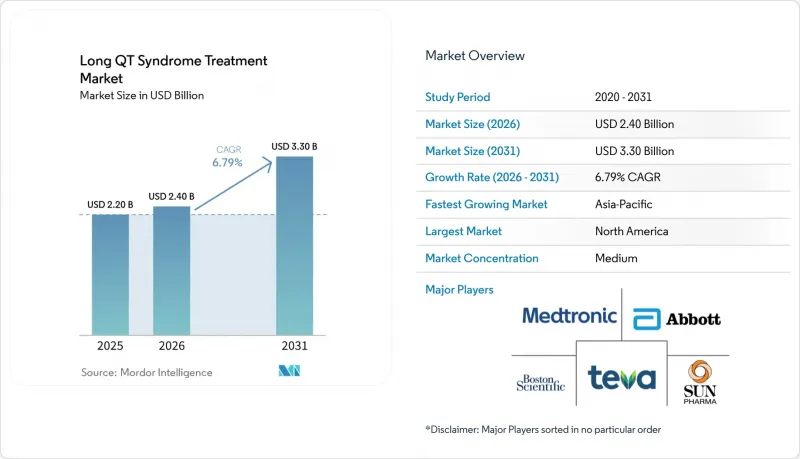
Mordor Intelligence에 의하면, QT 연장 증후군 치료 시장 규모는 2025년 22억 달러로 평가되었습니다. 2026년에는 24억 달러로 확대되어 2026-2031년 CAGR은 6.79%를 나타내, 2031년에는 33억 달러에 이를 것으로 예측됩니다.
본 보고서는 치료법(약물 요법, 의료기기, 외과 수술 등), 환자 연령대(17세 이하 소아, 18세 이상 성인), 최종 사용자(3차 병원 및 대학 병원, 부정맥 전문센터/전기생리학 검사실 등), 그리고 지역(북미, 유럽, 아시아태평양, 중동 및 아프리카, 남미)별로 분류되어 있습니다. 시장 전망은 금액(달러) 기준으로 제시되어 있습니다.
세계의 QT 연장 증후군 치료 시장 동향 및 인사이트
지침에 따른 베타 차단제 요법 : 치료의 기초
비선택적 베타 차단제는 국제 심혈관 질환 지침에서 선천성 LQTS 관리의 기초로 계속해서 자리 잡고 있습니다. 2025년에 실시된 5,692명의 환자를 대상으로 한 네트워크 메타분석에 따르면, 나드롤이 LQT1에서 프로프라놀롤보다 부정맥 발생을 더 효과적으로 감소시켰으며, LQT2 및 LQT3에서도 용량 의존적인 보호 효과를 보인 것으로 밝혀졌습니다. 이에 따라, 예방된 심정지를 기준으로 평가할 경우, 비용이 높은 나드롤에 대한 지불 주체의 수용도가 높아지고 있습니다. 비항부정맥제에 대한 QTc 데이터 표기를 의무화하는 FDA의 라벨 표시 지침은 치료받지 않은 경우의 QTc 연장 위험을 강조함으로써 간접적으로 베타 차단제의 우월성을 뒷받침하고 있습니다. Alembic, Kaken, Daewoong을 통한 신뢰할 수 있는 세계 공급망 덕분에 공급은 확보되어 있으나, 일부 중국 원료의약품(API) 제조 시설에 대한 품질 감사는 여전히 진행 중입니다. 이러한 요인들이 종합적으로 작용하여, QT 연장 증후군 치료 시장에서 약물 요법을 통한 1차 치료법의 지속적인 우위를 뒷받침하고 있습니다.
유전자형에 기반한 치료법 도입
멕시레틴은 SCN5A 변이를 가진 LQT3 환자에서 QT 단축 효과가 입증되었으며, 2024년 『Circulation』지에 게재된 연구에 따르면 특정 LQT2 변이에 대해서도 유효함이 밝혀져 그 임상적 유용성이 확대되고 있습니다. 고처리량 패치 클램프 기법과 iPS 세포 유래 심근 세포 플랫폼을 통해 검사 기관은 환자의 약물 반응을 예측할 수 있게 되어, 정밀한 처방 지원이 가능해졌습니다. 테바, ANI, 산 파마의 제네릭 의약품 경쟁으로 인해 단가가 1.50달러 아래로 떨어지면서 가격이 도입의 장벽이 되지 않게 되었고, 멕시레틴은 베타 차단제에 대한 비용 대비 효과가 높은 보조 요법으로 자리 잡았습니다. 미국과 일본에서는 유전자 검사 결과를 전자 진료 기록에 통합함으로써 치료법 제안이 자동화되어 있지만, 검사 인프라가 제한적이어서 저소득 지역에서의 보급은 더딘 임베디드니다. 변이 특이적 증거가 확대됨에 따라, QT 연장 증후군 치료 시장에서는 유전자형에 기반한 치료가 학술 연구 기관의 범위를 넘어 확산되고 있습니다.
대상 환자 수가 적어 발생하는 절대 수익의 제약
임상 유병률은 2,000명당 1명이며, 전 세계적으로 300만-400만 명의 잠재적 환자가 있는 것으로 추정되지만, 진단 누락으로 인해 실제로 치료를 받고 있는 환자 수는 이보다 훨씬 적어, 이로 인해 의료기기 및 의약품 공급업체의 절대적 수익이 제한되고 있습니다. 전문 의료기관의 데이터에 따르면, 최적화된 약물 요법과 QT 연장 증후군진단(LCSD)을 통해 사망률이 0.03%까지 감소한 것으로 나타났음에도 불구하고, 보험사는 무증상 보균자에 대한 ICD(부정맥 치료) 비용을 엄격하게 심사하고 있습니다. 환자 수가 제한적이라는 점은 무작위 배정 임상시험의 실시 가능성 또한 저해하고 있으며, 이로 인해 규제 당국이 신뢰성이 부족하다고 판단하는 등록 자료에 의존할 수밖에 없는 상황입니다. 그 결과, QT 연장 증후군 치료 시장의 매출 전망은 진단율의 미세한 변동에도 민감하게 반응하는 상황이 지속되고 있습니다.
부문별 분석
2025년 기준으로 약물 요법은 QT 연장 증후군 치료 시장의 74.15%를 차지했으며, 이는 베타 차단제가 지침상 주류로 자리 잡고 있다는 점과 돌연변이 특이적 코호트에서 메크시레틴의 사용이 확대되고 있음을 반영합니다. 외과적 치료법, 특히 좌심교감신경절제술은 ICD로 인한 합병증을 피할 수 있는 비디오 보조 흉강경 수술 기술이 전문 의료기관에서 도입됨에 따라 연평균 성장률(CAGR) 8.15%로 확대되고 있습니다. 기기 치료는 2차 예방에 있어 여전히 필수적이지만, 1차 예방에 대한 적용 여부는 재평가가 진행되고 있습니다. 웨어러블 제세동기 등의 보조적인 급성기 관리는 일시적인 보호 효과를 제공하지만, 수익에서 차지하는 비중은 미미합니다.
메이요 클리닉 및 밀라노에서 제공한 임상 데이터에 따르면, 좌심실 교감신경 절제술(LCSD) 후 심혈관 사건 발생률이 86% 감소했으며, QTc 수치의 지속적인 개선이 장기적인 성공을 예측하는 지표로 나타났습니다. ICD와 동등한 이 치료 성과에 더해, 합병증 위험이 낮다는 점이 젊은 연령대의 고위험 환자들에게 외과적 치료를 채택하는 데 힘을 실어주고 있습니다. 약물 요법은 가격 하락에 계속 직면하고 있지만, 그 기본적인 역할 덕분에 시장 점유율을 유지하고 있습니다. 이러한 변화들이 복합적으로 작용하여, QT 연장 증후군 치료 시장 규모 전망에 있어 치료법의 균형을 재정의하고 있습니다.
지역별 분석
북미는 2025년 매출의 43.17%를 차지했으며, 이는 ICD에 대한 광범위한 보험 적용, 견고한 유전자 검사 네트워크, 그리고 확립된 원격 모니터링 코드에 힘입은 결과입니다. 미국의 전문 의료 센터에서는 의료기기 이식과 AI를 활용한 사후 관리를 결합함으로써 치료 순응도를 높이고, 부적절한 전기 충격을 줄이고 있습니다. 캐나다에서는 각 주별 희귀질환 지원 체계를 활용하여 캐스케이드 선별검사에 자금을 지원하고 있지만, 주별 차이가 의료 서비스 접근 기회의 균등성에 영향을 미치고 있습니다.
아시아태평양은 일본의 전국 등록 제도와 중국의 확대되는 3차 의료 네트워크 덕분에, 그동안 진단을 받지 못했던 가족들이 치료를 받을 수 있게 됨에 따라 연평균 성장률(CAGR) 8.41%를 기록하며 가장 빠르게 성장하고 있는 지역입니다. 일본의 보험사들은 LCSD 및 피하 ICD에 대한 보험 적용을 실시하고 있으며, 도입을 가속화하고 있습니다. 한편, 중국은 MicroPort와의 제휴를 통해 기기 생산을 현지화하고 있습니다. 한국의 국민건강보험 제도는 유전자 검사 패널 비용을 부담함으로써 조기 진단을 지원하고 있습니다.
유럽에서는 데이터 공유를 촉진하는 중앙집권적인 유전체 프로그램과 EU 전역의 등록 시스템이 활용되고 있지만, 보험 급여의 불균형으로 인해 남유럽 및 동유럽 국가들에서는 치료 도입이 지연되고 있습니다. 중동 및 아프리카 및 남미에서는 기기 비용과 전문의 부족으로 인해 발전이 더딘 상황이며, 인지도는 높아지고 있지만 QT 연장 증후군 치료 시장 규모 확대는 제한적입니다. MicroPort와 CardioFlow의 합병을 통해 저비용 ICD가 도입됨에 따라, 의료 서비스가 충분히 제공되지 않는 지역에서 이 기기의 보급이 촉진될 것으로 기대됩니다.
기타 혜택 :
- 엑셀 형식 시장 예측(ME) 시트
- 3개월간의 애널리스트 지원
자주 묻는 질문
목차
제1장 서론
제2장 조사 방법
제3장 주요 요약
제4장 시장 구도
제5장 시장 규모 및 성장 예측
제6장 경쟁 구도
제7장 시장 기회 및 향후 전망
KTH 26.06.24According to Mordor Intelligence, the long qT syndrome treatment market size is expected to grow from USD 2.20 billion in 2025 to USD 2.40 billion in 2026 and is forecast to reach USD 3.30 billion by 2031 at 6.79% CAGR over 2026-2031.
This report is Segmented by Therapy Modality (Pharmacological, Device, Surgical, and More), Patient Age Group (Pediatric ≤17 Years, Adult ≥18 Years), End User (Tertiary Hospitals & Academic Medical Centers, Specialty Arrhythmia Centers/EP Labs, and More), and Geography (North America, Europe, Asia-Pacific, Middle East & Africa, South America). Market Forecasts are Provided in Terms of Value (USD).
Global Long QT Syndrome Treatment Market Trends and Insights
Guideline-Backed Beta-Blocker Therapy as Foundation of Care
Nonselective beta-blockers remain the cornerstone of congenital LQTS management across international cardiology guidelines. A 2025 network meta-analysis of 5,692 patients showed that nadolol reduced arrhythmic events more effectively than propranolol in LQT1 and delivered dose-dependent protection in LQT2 and LQT3, which is driving payer acceptance of higher-cost nadolol when measured against avoided cardiac arrests . FDA labeling guidance mandating QTc data for non-antiarrhythmic drugs indirectly reinforces beta-blocker primacy by highlighting the risk of untreated QTc prolongation. Reliable global supply from Alembic, Kaken, and Daewoong ensures access, although quality audits of certain Chinese API facilities persist. Collectively, these factors underpin the sustained dominance of pharmacologic first-line care within the Long QT Syndrome Treatment market.
Genotype-Guided Therapy Adoption
Mexiletine has proven QT-shortening benefits in LQT3 patients with SCN5A variants and, according to a 2024 Circulation study, benefits selected LQT2 mutations as well, expanding its clinical utility. High-throughput patch-clamp and iPSC cardiomyocyte platforms allow laboratories to predict patient drug response, supporting precision prescribing. Generic competition from Teva, ANI, and Sun Pharma has driven unit cost below USD 1.50, removing price as an adoption barrier and making mexiletine a cost-effective adjunct to beta-blockers. Integration of genetic results into electronic health records in the United States and Japan automates therapy suggestions, though limited testing infrastructure slows uptake in lower-income regions. As variant-specific evidence enlarges, the Long QT Syndrome Treatment market sees genotype-guided therapy permeate beyond academic centers.
Small Eligible Patient Pool Limits Absolute Revenues
Clinical prevalence of 1 in 2,000 translates to 3-4 million potential patients worldwide, yet underdiagnosis keeps the actively treated population far smaller, which caps absolute revenue for device and drug suppliers. Payers scrutinize ICD spending in asymptomatic carriers when specialty-center data show mortality as low as 0.03% with optimized medical therapy and LCSD. Limited patient numbers also hamper randomized trial feasibility, forcing reliance on registries that regulators view as less robust. Consequently, revenue forecasts within the Long QT Syndrome Treatment market remain sensitive to small variations in diagnosis rates.
Other drivers and restraints analyzed in the detailed report include:
- Expanding ICD Use with Shift Toward Subcutaneous ICDs in Channelopathies
- Cascade Genetic Testing and Earlier Diagnosis Expanding Treated Population
- Genericization and Price Erosion in Pharmacotherapy
For complete list of drivers and restraints, kindly check the Table Of Contents.
Segment Analysis
Pharmacological therapy accounted for 74.15% of the Long QT Syndrome Treatment market in 2025, reflecting beta-blocker guideline dominance and expanding mexiletine use in mutation-specific cohorts. Surgical options, principally left cardiac sympathetic denervation, are growing at an 8.15% CAGR as specialty centers adopt video-assisted thoracoscopic techniques that avoid ICD complications. Device therapy remains essential for secondary prevention but faces re-evaluation of primary-prevention indications. Adjunctive acute management, such as wearable cardioverter-defibrillators, provides temporary protection yet contributes a minor revenue slice.
Clinical data from Mayo Clinic and Milan documented an 86% reduction in cardiac events post-LCSD, with sustained QTc improvement predicting long-term success. This outcome parity with ICDs, coupled with lower complication risk, is propelling surgical adoption among young high-risk patients. Pharmacotherapy continues to confront price erosion, yet its foundational role sustains share. Together, these shifts redefine therapeutic balance inside the Long QT Syndrome Treatment market size forecast.
Geography Analysis
North America generated 43.17% of 2025 revenue, underpinned by broad ICD reimbursement, robust genetic testing networks, and established remote monitoring codes. Specialty centers in the United States pair device implantation with AI-driven follow-up, which lifts adherence and reduces inappropriate shocks. Canada leverages provincial rare-disease frameworks to fund cascade screening, though provincial variability affects uniformity of access.
Asia-Pacific is the fastest-growing region at an 8.41% CAGR as Japan's national registry and China's expanding tertiary network bring previously undiagnosed families into care. Japanese payers reimburse LCSD and subcutaneous ICDs, accelerating adoption, while China is localizing device manufacturing through partnerships with MicroPort. South Korea's universal health system funds genetic testing panels, sustaining early diagnosis.
Europe benefits from centralized genomic programs and pan-EU registries that facilitate data sharing, but reimbursement heterogeneity delays therapy rollout in Southern and Eastern states. The Middle East and Africa and South America lag because of device cost and specialist shortages, limiting the Long QT Syndrome Treatment market size expansion despite growing awareness. MicroPort's merger with CardioFlow is expected to introduce lower-cost ICDs that could improve penetration in these under-served regions.
- Abbott Laboratories
- Amneal Pharmaceuticals
- ANI Pharmaceuticals
- AvKARE, LLC
- BIOTRONIK
- Boston Scientific
- Camber Pharmaceuticals
- Dr. Reddy's Laboratories
- GeneDx
- Gilead Sciences
- Invitae
- Lupin
- Medtronic
- MicroPort CRM
- Senores Pharmaceuticals, Inc.
- Sun Pharmaceuticals Industries
- Teva Pharmaceutical Industries
- Thryv Therapeutics
- Zoll Medical
- Zydus Lifesciences
Additional Benefits:
- The market estimate (ME) sheet in Excel format
- 3 months of analyst support
TABLE OF CONTENTS
1 Introduction
- 1.1 Study Assumptions & Market Definition
- 1.2 Scope of the Study
2 Research Methodology
3 Executive Summary
4 Market Landscape
- 4.1 Market Overview
- 4.2 Market Drivers
- 4.2.1 Guideline-Backed Beta-Blocker Therapy as Foundation of Care
- 4.2.2 Genotype-Guided Therapy Adoption
- 4.2.3 Expanding ICD Use with Shift Toward Subcutaneous ICDs in Channelopathies
- 4.2.4 Cascade Genetic Testing and Earlier Diagnosis Expanding Treated Population
- 4.2.5 Remote Monitoring and Digital Follow-Up Increasing Therapy Adherence
- 4.2.6 Emerging Pipeline Attracting Investment
- 4.3 Market Restraints
- 4.3.1 Small Eligible Patient Pool Limits Absolute Revenues
- 4.3.2 Genericization and Price Erosion in Pharmacotherapy
- 4.3.3 Device Cost, Infrastructure, and Electrophysiologist Shortages in LMICs
- 4.3.4 Procedure/Device Complications and Safety Advisories Dampen Uptake
- 4.4 Supply-Chain Analysis
- 4.5 Regulatory Landscape
- 4.6 Technological Outlook
- 4.7 Porter's Five Forces Analysis
- 4.7.1 Threat of New Entrants
- 4.7.2 Bargaining Power of Suppliers
- 4.7.3 Bargaining Power of Buyers
- 4.7.4 Threat of Substitutes
- 4.7.5 Competitive Rivalry
5 Market Size & Growth Forecasts (Value, USD)
- 5.1 By Therapy Modality
- 5.1.1 Pharmacological Therapy
- 5.1.2 Device Therapy
- 5.1.3 Surgical Therapy
- 5.1.4 Adjunctive/Acute Management
- 5.2 By Patient Age Group
- 5.2.1 Pediatric (<=17 years)
- 5.2.2 Adult (>=18 years)
- 5.3 By End User
- 5.3.1 Tertiary Hospitals & Academic Medical Centers
- 5.3.2 Specialty Arrhythmia Centers / Electrophysiology Labs
- 5.3.3 Ambulatory Surgical Centers
- 5.4 By Geography
- 5.4.1 North America
- 5.4.1.1 United States
- 5.4.1.2 Canada
- 5.4.1.3 Mexico
- 5.4.2 Europe
- 5.4.2.1 Germany
- 5.4.2.2 United Kingdom
- 5.4.2.3 France
- 5.4.2.4 Italy
- 5.4.2.5 Spain
- 5.4.2.6 Rest of Europe
- 5.4.3 Asia-Pacific
- 5.4.3.1 China
- 5.4.3.2 India
- 5.4.3.3 Japan
- 5.4.3.4 South Korea
- 5.4.3.5 Australia
- 5.4.3.6 Rest of Asia-Pacific
- 5.4.4 Middle East and Africa
- 5.4.4.1 GCC
- 5.4.4.2 South Africa
- 5.4.4.3 Rest of Middle East and Africa
- 5.4.5 South America
- 5.4.5.1 Brazil
- 5.4.5.2 Argentina
- 5.4.5.3 Rest of South America
- 5.4.1 North America
6 Competitive Landscape
- 6.1 Market Concentration
- 6.2 Market Share Analysis
- 6.3 Company Profiles
- 6.3.1 Abbott Laboratories
- 6.3.2 Amneal Pharmaceuticals
- 6.3.3 ANI Pharmaceuticals, Inc.
- 6.3.4 AvKARE, LLC
- 6.3.5 Biotronik SE & Co. KG
- 6.3.6 Boston Scientific Corporation
- 6.3.7 Camber Pharmaceuticals, Inc.
- 6.3.8 Dr. Reddy's Laboratories
- 6.3.9 GeneDx
- 6.3.10 Gilead Sciences, Inc.
- 6.3.11 Invitae Corporation
- 6.3.12 Lupin Limited
- 6.3.13 Medtronic plc
- 6.3.14 MicroPort CRM
- 6.3.15 Senores Pharmaceuticals, Inc.
- 6.3.16 Sun Pharmaceutical Industries, Inc.
- 6.3.17 Teva Pharmaceuticals
- 6.3.18 Thryv Therapeutics
- 6.3.19 ZOLL Medical Corporation
- 6.3.20 Zydus Lifesciences
7 Market Opportunities & Future Outlook
- 7.1 White-space & Unmet-need Assessment


