

|
시장보고서
상품코드
2123517
확장성 심근병증 치료 시장 : 점유율 분석, 업계 동향과 통계, 성장 예측(2026-2031년)Dilated Cardiomyopathy Therapeutic - Market Share Analysis, Industry Trends & Statistics, Growth Forecasts (2026 - 2031) |
||||||
 Mordor Intelligence
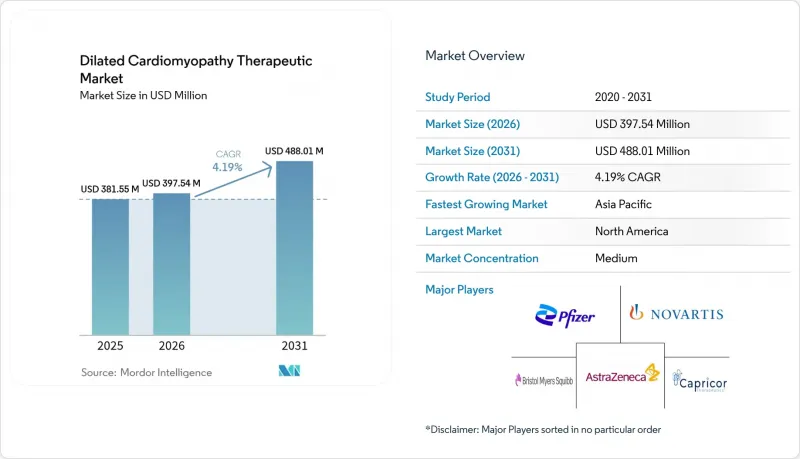
Mordor Intelligence에 의하면, 2026년 확장성 심근병증 치료 시장 규모는 3억 9,754만 달러로 추정되고 있어 2025년 3억 8,155만 달러에서 확대되어, 2031년에는 4억 8,801만 달러에 이를 것으로 예측됩니다.
2026년부터 2031년까지의 연평균 성장률(CAGR)은 4.19%가 될 것으로 전망됩니다.
본 보고서는 약물 분류별(ACE 억제제, β-차단제 등), 투여 경로별(경구, 정맥 내 등), 질환 원인별(유전성/가족성, 특발성 등), 최종 사용자별(병원 등), 지역별(북미, 유럽,아시아태평양, 중동 및 아프리카, 남미)별로 분류되어 있습니다. 시장 예측은 금액(달러) 기준으로 제시되어 있습니다.
전 세계 확장성 심근병증 치료 시장 동향 및 인사이트
전 세계 심혈관 질환 유병률 증가
심부전 유병자 수는 1990년 2,543만 명에서 2021년에는 5,550만 명으로 증가했습니다. 이에 따라 급성 허혈성 사건을 극복한 환자 및 만성 심실 기능 부전으로 진행되는 확장성 심근병증 환자의 수가 하류에서 증가하고 있습니다. 신흥 경제국에서는 도시형 생활 방식에 따라 고혈압, 비만, 대사증후군의 유병률이 상승하고 있으며, 이는 이러한 부담을 더욱 가속화하고 있습니다. 또한, 급성기 의료의 발전으로 인해 취약한 심근이 보상 부전에 이르기까지 생존하는 기간이 늘어남에 따라, 수명 연장이 유병률 증가에 박차를 가하고 있습니다. 그 결과, 임상의들은 더욱 광범위한 표현형의 다양성에 직면하고 있으며, 획일적인 프로토콜을 넘어 환자 개개인에 맞춘 치료 패키지가 요구되고 있습니다. 제약사들은 동반된 대사 상태에 따라 환자를 세분화할 기회를 인식하고 있으며, 신경호르몬 차단과 대사 재프로그래밍을 동기화하는 병용 요법을 제공합니다. 전반적으로, 질환의 유병률과 생존율 향상으로 인해 확장성 심근병증 치료 시장의 대상 환자 기반이 확대되고 있습니다.
확장성 심근병증에 대한 인식 제고와 조기 진단
2024년 유럽심장학회(ESC)의 비확장성 좌심실 심근병증 진단 기준에 따라, 뚜렷한 심실 확장이 나타나기 전 단계에서 개입이 가능해져 치료 대상 환자군이 30-40% 확대될 가능성이 있습니다. 심장 MRI 및 변형 초음파 검사는 무증상 섬유화를 감지함으로써, 더 조기적인 약물 치료 시작을 유도합니다. 가족성 선별 프로그램을 통해 증상이 나타나기 수십년전에 돌연변이 보균자가 특정되는 한편, 일반인을 대상으로 한 유전자 검사 플랫폼은 환자가 스스로 전문 클리닉을 방문하는 계기가 되고 있습니다. 이러한 진단 방식의 변화로 인해 질환 경과에 따른 치료 수요가 앞당겨지고, 환자 1인당 치료 기간이 길어지고 있습니다. 또한, 조기 단계에서의 개입은 치료 반응률을 향상시키고, 보험 환급을 촉진하는 실세계 데이터(REW)의 축적을 뒷받침합니다. 그 결과, 제약 기업은 임상시험에 바이오마커에 기반한 환자 선별을 도입하여 유효성 입증까지 걸리는 시간을 단축하고, 시장 내 입지를 명확히 하고 있습니다.
고액의 치료비와 보험 급여의 장벽
마바캄텐의 연간 가격은 30만 달러에 달하며, 1회 투여 유전자 치료는 100만 달러를 초과할 가능성도 있어, 보험 가입자층조차도 이용을 주저하게 만드는 요인이 되고 있습니다. 보험사는 광범위한 적용을 승인하기 전에 종단적 결과 데이터를 요구하지만, 그러한 증거가 확립되는 것은 출시 후 수년이 지나야 하므로 수익의 전환점이 늦어지게 됩니다. 신흥국에서는 본인 부담금에 의존하고 있기 때문에 접근성은 부유한 도시 지역 소비자로 한정되어 판매량 증가가 억제되고 있습니다. 또한, 첨단 치료법에는 정기적인 영상 진단, 유전체 분석, 바이오마커 모니터링이 필요하여 의료 제도에 부수적인 비용 부담을 가중시키고 있습니다. 이에 따라 제약사들은 결과 기반 계약이나 분할 납부 모델을 시범적으로 도입하고 있지만, 가격 책정에 대한 회의적인 시각은 여전히 남아 있어 확장성 심근병증 치료 시장의 성장 속도를 둔화시키고 있습니다.
부문 분석
현재 처방에서는 여전히 ACE 억제제가 주류를 이루고 있지만, 견실한 사망률 감소 데이터에 힘입어 SGLT-2 억제제가 연평균 성장률(CAGR) 6.43%로 시장 점유율을 급속히 확대하고 있어, 2025년 ACE 억제제의 점유율 34.10%는 서서히 감소하고 있습니다. 신경호르몬 제제는 가이드라인상 우선순위를 유지하고 있지만, 대사 리프로그래밍은 다중 질환을 동반한 환자를 치료하는 순환기 전문의들의 공감을 불러일으키는 새로운 질병 수정 차원을 제시하고 있습니다. 개발 파이프라인에서는 현재 수축 역학을 직접 표적으로 하는 심근 미오신 억제제와 사르코메어 조절제가 주목받고 있습니다. 마바캄텐이 선례를 만들었고, 아피캄텐이 REMS(위험 평가 및 관리 전략) 개선을 거쳐 이를 따르고 있습니다. 델라미오셀과 같은 세포 기반 치료법은 재생 신호를 공급하는 한편, ARNi 제품은 나트륨 이뇨 신호 전달을 강화함으로써 기존 패러다임과 신흥 패러다임 사이의 가교 역할을 합니다. 이처럼 광범위한 작용기전의 다양성은 치료 선택지를 확대하고, 확장성 심근병증 치료 시장의 복잡한 경쟁 구도를 뒷받침하고 있습니다.
2세대 SGLT-2 계열 약물은 복약 순응도를 높이기 위해 주 1회 투여를 목표로 하고 있습니다. 한편, 미토콘드리아 조절제에 대한 연구는 확장성 심근병증에 특유한 에너지 부족을 시정하는 것을 목표로 하고 있습니다. 신경호르몬 차단제와 대사제를 결합한 복합제는 초기 임상시험 단계에 있으며, 향후 처방 시장을 장악할 가능성이 있는 고정 용량 제제의 등장을 예고합니다. 가격 전략은 직접 비교 시험을 통해 입증된 부가적 효과를 중심으로 하고 있으며, 이 분야에서는 정밀하게 계층화된 하위 연구가 우위를 가져다줍니다. 그 결과, 고도로 세분화되어 있으면서도 시너지 효과를 내는 제품 환경이 형성되어, 임상의에게는 유연한 치료 알고리즘을 제공하는 한편, 지불자 측에는 만성 동반 질환에 걸친 중복 적응증을 조정해야 하는 과제를 안겨주고 있습니다.
경구 제제는 편의성과 익숙함 덕분에 여전히 가장 널리 사용되고 있습니다. 그러나 성장의 추이는 일관된 기계적 또는 전기적 지원을 제공하고, 복약 순응도의 장벽을 피하는 기기를 활용한 투여 플랫폼으로 이동하고 있습니다. 리드리스 좌심실 페이싱, 전도계 페이싱 및 심수축 조절은 약물 요법을 보완하는 최소 침습적 이식형 기기의 대표적인 예입니다. 2025년 ACC/AHA 적정 사용 기준에는 약물과 의료기기를 언제, 어떻게 병용해야 하는지를 지침으로 제시하는 335개의 임상 시나리오가 열거되어 있으며, 이는 현재 전기생리학자들이 직면하고 있는 복잡한 의사결정 트리를 반영한 것입니다(JACC.ORG). 또한, 신규 생물학적 제제용 피하 주입 펌프도 실현 가능성 시험 단계에 접어들었으며, 병원의 주입실을 이용하지 않고도 지속적인 약물 노출이 가능해질 것으로 기대됩니다.
임플란트에 연결된 디지털 생태계는 혈역학 데이터를 클라우드 분석 시스템으로 스트리밍하여, 알고리즘에 기반한 병용 경구약의 투여량 조정을 가능하게 합니다. 이러한 폐쇄 루프형 패러다임은 의약품 시장과 의료기기 시장의 경계를 모호하게 만들며, 의료 기술 기업과 제약 기업 간의 합작 투자를 촉진하고 있습니다. 초기 투자 비용은 높지만, 환급을 입원 일수 감축과 연계하는 가치 기반 계약 체계가 등장하고 있으며, 이를 통해 프리미엄 기술을 위한 경제적 여지가 생겨나면서 확장성 심근병증 치료 시장의 총 지출이 확대되고 있습니다.
지역별 분석
북미는 성숙한 환급 제도와 새로운 약물군의 신속한 도입을 권장하는 지침의 주도력에 힘입어, 2025년에는 전 세계 매출의 42.10%를 차지하며 확장성 심근병증 치료 시장의 중심이 되고 있습니다. 이 지역의 높은 비만 및 고혈압 유병률은 폭넓은 약물 치료의 기반을 유지하고 있는 반면, 자금력이 풍부한 학술 연구센터들이 유전자 치료 임상시험을 주도하며 해외 투자를 유치하고 있습니다. 지불 주체의 압력과 성과 연계형 계약의 융합으로 인해 경제적 위험은 점차 제약사 측으로 이전되고 있지만, 실세계 데이터를 통해 입원 건수의 감소가 입증된 경우 고품질 의약품은 여전히 채택되고 있습니다.
유럽은 국경을 초월한 참조 가격 제도와 획기적인 치료법의 승인을 신속화하는 유럽의약품청(EMA)의 롤링 리뷰 제도에 힘입어 한 자릿수대의 꾸준한 성장을 이어가고 있습니다. 국가별 편차는 여전히 남아 있습니다. 독일은 의료기기와의 통합을 신속하게 추진하고 있는 반면, 남유럽 국가들은 여전히 가격에 민감하지만, 진료 지침의 통일을 통해 일관된 임상 관행이 유지되고 있습니다. 확장성 심근병증 치료 시장은 영국, 네덜란드, 스칸디나비아 국가들의 강력한 환자 지원 네트워크의 혜택을 받고 있으며, 이는 등록 자료를 기반으로 한 증거 수집을 촉진하고, 공적 보험 기관이 고비용의 정밀 치료에 대한 보험 적용을 승인하도록 설득하는 요인이 되고 있습니다.
연평균 성장률(CAGR) 5.39%로 성장하는 아시아태평양은 중국의 심부전 유병률이 세계 평균을 웃도는 속도로 증가하고 있으며, 각국 정부가 심혈관 질환 관련 예산을 증액하고 있어 세계 전망을 새롭게 바꾸고 있습니다. 일본에서는 초고령화 사회가 의료기기 보급을 뒷받침하고 있는 반면, 인도에서는 신흥 중산층의 등장으로 수요가 공립 3차 병원부터 민간 심혈관 전문 병원 체인에 이르기까지 다양화되고 있습니다. 중국과 한국의 규제 당국은 미국이나 EU에 뒤처져 있는 승인 소요 기간을 단축하기 위해 실시간 심사 시범 사업을 시작하고 있어, 다국적 기업들의 조기 수익 확보가 기대됩니다. 그러나 보험 적용 범위의 불균일성과 가격 상한제로 인해, 확장성 심근병증 치료 시장에서는 판매량을 유지하면서도 전 세계 정가의 일관성을 보호하는 단계적 가격 책정 모델이 요구되고 있습니다.
기타 혜택:
- 엑셀 형식 시장 예측(ME) 시트
- 3개월간의 애널리스트 지원
자주 묻는 질문
목차
제1장 서론
제2장 조사 방법
제3장 주요 요약
제4장 시장 구도
제5장 시장 규모와 성장 예측
제6장 경쟁 구도
제7장 시장 기회와 향후 전망
JHS 26.09.07According to Mordor Intelligence, the dilated cardiomyopathy therapeutic market size in 2026 is estimated at USD 397.54 million, growing from 2025 value of USD 381.55 million with 2031 projections showing USD 488.01 million, growing at 4.19% CAGR over 2026-2031.
This report is Segmented by Drug Class (ACE Inhibitors, Beta-Blockers, and More), Route of Administration (Oral, Intravenous, and More), Disease Etiology (Genetic/Familial, Idiopathic, and More), End User (Hospitals, and More), and Geography (North America, Europe, Asia-Pacific, Middle East & Africa, South America). The Market Forecasts are Provided in Terms of Value (USD).
Global Dilated Cardiomyopathy Therapeutic Market Trends and Insights
Rising Global Prevalence of Cardiovascular Diseases
Heart-failure prevalence climbed from 25.43 million cases in 1990 to 55.50 million in 2021, increasing the downstream pool of dilated cardiomyopathy patients who survive acute ischemic events yet progress to chronic ventricular dysfunction. Emerging economies accelerate this burden as urban lifestyles raise hypertension, obesity and metabolic syndrome rates. Longevity gains compound incidence because improved acute care keeps vulnerable myocardium alive long enough to decompensate. Clinicians therefore encounter broader phenotypic variation, urging tailored therapy bundles that move beyond one-size-fits-all protocols. Drug makers recognise the opportunity to segment on comorbid metabolic status, offering combination regimens that synchronise neuro-hormonal blockade with metabolic re-programming. Collectively, disease prevalence and survivorship extend the addressable base for the dilated cardiomyopathy therapeutic market.
Growing Awareness and Early Diagnosis of Dilated Cardiomyopathy
The 2024 European Society of Cardiology criteria for nondilated left ventricular cardiomyopathy enable intervention before overt chamber enlargement, potentially expanding the treatable cohort by 30-40%. Cardiac MRI and strain echocardiography detect subclinical fibrosis, guiding earlier drug initiation. Familial screening programmes uncover mutation carriers decades before symptoms, while consumer genetics platforms seed patient self-referral to specialised clinics. These diagnostic shifts pull therapeutic demand forward in the disease timeline, creating longer treatment windows per patient. Early-stage intervention also boosts response rates, bolstering real-world-evidence packages that facilitate reimbursement. Consequently, drug developers integrate biomarker-based enrichment into clinical trials, accelerating time-to-proof and sharpening market positioning.
High Treatment Costs and Reimbursement Barriers
Mavacamten lists near USD 300,000 annually, while single-dose gene therapies could top USD 1 million, deterring uptake even in insured populations. Payers demand longitudinal outcome data before broad coverage, yet such evidence matures years after launch, delaying revenue inflection. Emerging economies rely on out-of-pocket spending, restricting access to affluent urban consumers and truncating volume growth. Advanced therapies also require serial imaging, genomics and biomarker surveillance, piling ancillary costs onto health systems. Manufacturers are therefore piloting outcomes-based contracts and instalment payment models, yet pricing scepticism persists and tempers the expansion pace of the dilated cardiomyopathy therapeutic market.
Other drivers and restraints analyzed in the detailed report include:
- Technological Advances in Heart Failure Pharmacotherapy
- Increasing Adoption of Precision Medicine and Genetic Testing
- Stringent Regulatory Requirements and Prolonged Approval Timelines
For complete list of drivers and restraints, kindly check the Table Of Contents.
Segment Analysis
Current prescriptions continue to lean on ACE inhibitors, yet their 34.10% share in 2025 is gradually eroding as SGLT-2 inhibitors scale fast on a 6.43% CAGR trajectory, bolstered by robust mortality-reduction data. Neuro-hormonal agents retain guideline primacy, but metabolic re-programming introduces a novel disease-modification layer that resonates with cardiologists treating multi-morbid patients. Development pipelines now spotlight cardiac myosin inhibitors and sarcomere modulators targeting contractile mechanics directly; mavacamten set the precedent, and aficamten follows with REMS refinement. Cell-based therapies such as Deramiocel deliver regenerative cues, whereas ARNi products bridge traditional and emerging paradigms by enhancing natriuretic signalling. This breadth of mechanistic diversity enlarges therapeutic armamentarium and supports a complex competitive mosaic for the dilated cardiomyopathy therapeutic market.
Second-generation SGLT-2 assets pursue once-weekly dosing to heighten adherence. Meanwhile, research into mitochondrial modulators seeks to correct energy deficits intrinsic to dilated myocardium. Combination packs that blend neuro-hormonal blockade with metabolic agents are in early trials, foreshadowing fixed-dose formulations that may dominate future prescriptions. Pricing strategies pivot on additive benefit demonstrated in head-to-head trials, an arena where precision-stratified sub-studies confer advantage. The result is a highly segmented yet synergistic product landscape that gives clinicians flexible algorithms while challenging payers to reconcile overlapping indications across chronic comorbidities.
Oral formulations remain the most widely used owing to convenience and familiarity. However, growth momentum is shifting toward device-enabled delivery platforms that supply consistent mechanical or electrical support and circumvent adherence barriers. Leadless left-ventricular pacing, conduction-system pacing and cardiac contractility modulation exemplify minimally invasive implants that augment pharmacotherapy. The 2025 ACC/AHA appropriate-use criteria list 335 clinical scenarios guiding when and how to combine drugs with hardware, reflecting the sophisticated decision tree now facing electrophysiologists [JACC.ORG]. Subcutaneous infusion pumps for novel biologics are also progressing through feasibility studies, promising sustained exposure while avoiding hospital infusion suites.
Digital ecosystems tethered to implants stream haemodynamic data into cloud analytics, permitting algorithm-driven dose adjustment of concomitant oral agents. This closed-loop paradigm blurs the boundary between drug and device markets and invites joint ventures between med-tech and pharmaceutical firms. Though initial capital outlay is high, value-based contracting frameworks linking reimbursement to reduced hospitalisation are emerging, creating economic headroom for premium technologies and expanding total spending within the dilated cardiomyopathy therapeutic market.
Complete Report Scope:
- By Drug Class
- ACE Inhibitors
- Beta-Blockers
- Angiotensin II Receptor Blockers
- Aldosterone Antagonists
- Angiotensin Receptor-Neprilysin Inhibitors (ARNi)
- SGLT-2 Inhibitors
- Other / Emerging (Gene, Cell, Myosin Modulators)
- By Route Of Administration
- Oral
- Intravenous
- Subcutaneous
- Implantable / Device-Mediated
- By Disease Etiology
- Genetic / Familial
- Idiopathic
- Ischemic
- Toxin-Induced (Alcohol, Chemotherapy, Etc.)
- Infectious / Inflammatory
- Endocrine / Metabolic
- Other Diseases
- By End User
- Hospitals
- Specialty Cardiology Clinics
- Research & Academic Institutes
- Other End Users
- Geography
- North America
- United States
- Canada
- Mexico
- Europe
- Germany
- United Kingdom
- France
- Italy
- Spain
- Rest of Europe
- Asia-Pacific
- China
- Japan
- India
- Australia
- South Korea
- Rest of Asia-Pacific
- Middle East & Africa
- GCC
- South Africa
- Rest of Middle East & Africa
- South America
- Brazil
- Argentina
- Rest of South America
- North America
Geography Analysis
North America anchors the dilated cardiomyopathy therapeutic market with 42.10% of global revenue in 2025, underpinned by mature reimbursement systems and guideline leadership that endorses rapid uptake of novel classes. The region's high prevalence of obesity and hypertension sustains a broad pharmacological base, while well-funded academic centres spearhead gene-therapy trials attracting inward investment. Convergence of payer pressure and outcomes-based contracts is gradually shifting economic risk onto manufacturers, yet premium drugs still win adoption where real-world data verify hospitalisation reductions.
Europe follows with steady single-digit growth, supported by cross-border reference pricing and the European Medicines Agency's rolling-review pathway that accelerates authorisation for breakthrough therapies. Country-level heterogeneity persists-Germany embraces device integration swiftly whereas Southern Europe remains price-sensitive-yet guideline harmonisation maintains consistent clinical practice. The dilated cardiomyopathy therapeutic market benefits from strong patient-advocacy networks in the United Kingdom, Netherlands and Scandinavia, which facilitate registry-driven evidence gathering that convinces public payers to reimburse high-cost precision agents.
Asia-Pacific, growing at 5.39% CAGR, is reshaping the global outlook as China's heart-failure prevalence rises faster than the world average and governments boost cardiovascular budgets. Japan's super-aged demographic fuels device uptake, while India's emerging middle class diversifies demand beyond public tertiary hospitals into private cardiology chains. Regulatory agencies in China and South Korea are launching real-time review pilots to shorten approval lag behind the US and EU, promising earlier revenue capture for multinational sponsors. Nonetheless, variable insurance coverage and price caps compel tiered-pricing models that preserve volume while protecting global list pricing integrity within the dilated cardiomyopathy therapeutic market.
- AstraZeneca
- Pfizer
- Novartis
- Bristol Myers Squibb (Incl. MyoKardia)
- Capricor Therapeutics
- Zensun (Shanghai) Sci-Tech Co. Ltd.
- Tenaya Therapeutics Inc.
- t2cure
- Vericel
- Ionis Pharmaceuticals
- Rocket Pharmaceuticals Inc.
- BridgeBio Pharma Inc.
- Eli Lilly and Company
- Johnson & Johnson
- Merck
- Abbott Laboratories
- Medtronic
- Renovacor Inc.
- CellProthera SA
Additional Benefits:
- The market estimate (ME) sheet in Excel format
- 3 months of analyst support
TABLE OF CONTENTS
1 Introduction
- 1.1 Study Assumptions & Market Definition
- 1.2 Scope of the Study
2 Research Methodology
3 Executive Summary
4 Market Landscape
- 4.1 Market Overview
- 4.2 Market Drivers
- 4.2.1 Rising Global Prevalence of Cardiovascular Diseases
- 4.2.2 Growing Awareness and Early Diagnosis of Dilated Cardiomyopathy
- 4.2.3 Technological Advances in Heart Failure Pharmacotherapy
- 4.2.4 Increasing Adoption of Precision Medicine and Genetic Testing
- 4.2.5 Robust Pipeline of Novel Therapies and Regulatory Support
- 4.2.6 Expanding Healthcare Expenditure in Emerging Economies
- 4.3 Market Restraints
- 4.3.1 High Treatment Costs and Reimbursement Barriers
- 4.3.2 Stringent Regulatory Requirements and Prolonged Approval Timelines
- 4.3.3 Safety Concerns and Adverse Effects of Polypharmacy
- 4.3.4 Limited Access to Advanced Therapies in Low- And Middle-Income Regions
- 4.4 Regulatory Landscape
- 4.5 Porter's Five Forces Analysis
- 4.5.1 Threat Of New Entrants
- 4.5.2 Bargaining Power Of Buyers/Consumers
- 4.5.3 Bargaining Power Of Suppliers
- 4.5.4 Threat Of Substitute Products
- 4.5.5 Intensity Of Competitive Rivalry
5 Market Size & Growth Forecasts (Value, USD)
- 5.1 By Drug Class
- 5.1.1 ACE Inhibitors
- 5.1.2 Beta-Blockers
- 5.1.3 Angiotensin II Receptor Blockers
- 5.1.4 Aldosterone Antagonists
- 5.1.5 Angiotensin Receptor-Neprilysin Inhibitors (ARNi)
- 5.1.6 SGLT-2 Inhibitors
- 5.1.7 Other / Emerging (Gene, Cell, Myosin Modulators)
- 5.2 By Route Of Administration
- 5.2.1 Oral
- 5.2.2 Intravenous
- 5.2.3 Subcutaneous
- 5.2.4 Implantable / Device-Mediated
- 5.3 By Disease Etiology
- 5.3.1 Genetic / Familial
- 5.3.2 Idiopathic
- 5.3.3 Ischemic
- 5.3.4 Toxin-Induced (Alcohol, Chemotherapy, Etc.)
- 5.3.5 Infectious / Inflammatory
- 5.3.6 Endocrine / Metabolic
- 5.3.7 Other Diseases
- 5.4 By End User
- 5.4.1 Hospitals
- 5.4.2 Specialty Cardiology Clinics
- 5.4.3 Research & Academic Institutes
- 5.4.4 Other End Users
- 5.5 Geography
- 5.5.1 North America
- 5.5.1.1 United States
- 5.5.1.2 Canada
- 5.5.1.3 Mexico
- 5.5.2 Europe
- 5.5.2.1 Germany
- 5.5.2.2 United Kingdom
- 5.5.2.3 France
- 5.5.2.4 Italy
- 5.5.2.5 Spain
- 5.5.2.6 Rest of Europe
- 5.5.3 Asia-Pacific
- 5.5.3.1 China
- 5.5.3.2 Japan
- 5.5.3.3 India
- 5.5.3.4 Australia
- 5.5.3.5 South Korea
- 5.5.3.6 Rest of Asia-Pacific
- 5.5.4 Middle East & Africa
- 5.5.4.1 GCC
- 5.5.4.2 South Africa
- 5.5.4.3 Rest of Middle East & Africa
- 5.5.5 South America
- 5.5.5.1 Brazil
- 5.5.5.2 Argentina
- 5.5.5.3 Rest of South America
- 5.5.1 North America
6 Competitive Landscape
- 6.1 Market Concentration
- 6.2 Market Share Analysis
- 6.3 Company Profiles (includes Global level Overview, Market level overview, Core Business Segments, Financials, Headcount, Key Information, Market Rank, Market Share, Products and Services, and analysis of Recent Developments)
- 6.3.1 AstraZeneca PLC
- 6.3.2 Pfizer Inc.
- 6.3.3 Novartis AG
- 6.3.4 Bristol Myers Squibb (Incl. MyoKardia)
- 6.3.5 Capricor Therapeutics Inc.
- 6.3.6 Zensun (Shanghai) Sci-Tech Co. Ltd.
- 6.3.7 Tenaya Therapeutics Inc.
- 6.3.8 t2cure GmbH
- 6.3.9 Vericel Corporation
- 6.3.10 Ionis Pharmaceuticals Inc.
- 6.3.11 Rocket Pharmaceuticals Inc.
- 6.3.12 BridgeBio Pharma Inc.
- 6.3.13 Eli Lilly And Company
- 6.3.14 Johnson & Johnson (Janssen)
- 6.3.15 Merck & Co. Inc.
- 6.3.16 Abbott Laboratories
- 6.3.17 Medtronic PLC
- 6.3.18 Renovacor Inc.
- 6.3.19 CellProthera SA
7 Market Opportunities & Future Outlook
- 7.1 White-Space & Unmet-Need Assessment


