

|
시장보고서
상품코드
2063728
전신성 홍반성 루푸스 치료제 시장 : 점유율 분석, 업계 동향과 통계, 성장 예측(2026-2031년)Systemic Lupus Erythematosus Drugs - Market Share Analysis, Industry Trends & Statistics, Growth Forecasts (2026 - 2031) |
||||||
 Mordor Intelligence
Mordor Intelligence에 의하면, 전신성 홍반성 루푸스 치료제 시장 규모는 2025년 26억 1,000만 달러에서 2026년에는 27억 1,000만 달러로 확대되어 2031년까지 38억 4,000만 달러에 이를 것으로 예측되며, 2026년부터 2031년까지 CAGR 6.65%로 성장할 전망입니다.
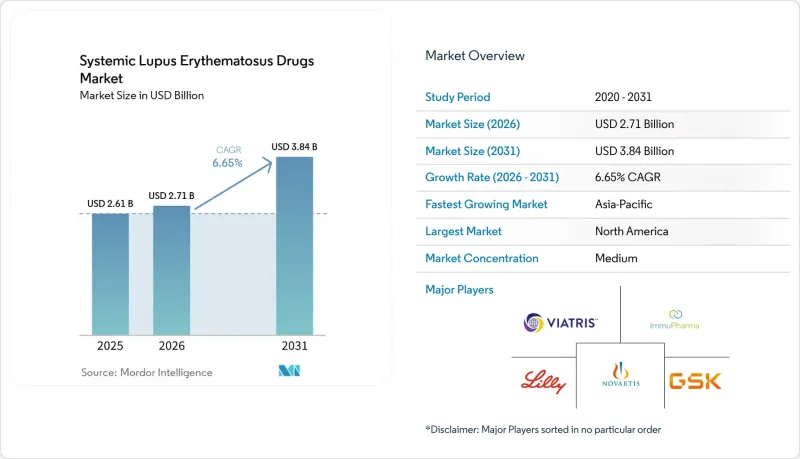
본 보고서는 치료법별(NSAIDs, 항말라리아제, 코르티코스테로이드 등), 투여 경로별(경구, 정맥 내, 피하), 유통 채널별(병원 약국, 소매 약국, 온라인 약국), 지역별(북미, 유럽, 아시아태평양, 중동 및 아프리카, 남미)로 분류되어 있습니다. 시장 전망은 금액(달러) 기준으로 제시되어 있습니다.
세계 전신성 홍반성 루푸스 치료제 시장 동향 및 인사이트
유병률 증가와 조기 진단
T세포 자가항체 및 세포 결합형 보체 활성화 산물(CB-CAP)을 검출하는 시판 중인 바이오마커 패널 덕분에 루푸스 진단이 더 조기 치료 단계로 전환되었습니다. 2025년에 AVISE 패널 1회 검사당 840.65달러의 메디케어 환급이 승인된 것은 치료 가능한 환자층을 확대하는 분자진단 도구에 대한 보험사 측의 지지를 뒷받침하는 것입니다. AMPEL사의 LuGENE과 같은 예측 검사를 통해 임상의는 병세가 악화되기 전에 치료법을 변경할 수 있게 되었으며, 이로 인해 전신성 홍반성 루푸스 치료제 시장 전반에서 표적 치료에 대한 수요가 직접적으로 확대되고 있습니다.
신규 생물학적 제제의 신속 승인
FDA가 루푸스 신염에 대한 오비누츠주맙의 추가 신청을 접수하고, 2025년 10월을 결정 시기로 정한 것은 해당 기관의 심사 가속화 의지를 여실히 보여주고 있습니다. 3상 임상시험 데이터에 따르면, 표준 치료의 33.1%에 비해 46.4%의 완전 신장 반응이 나타남으로써 새로운 기준이 확립되었습니다. Adicet Bio사와 Sana Biotechnology사의 동종 CAR-T 후보 약물에 대한 병행 패스트트랙 지정은 이러한 추세를 더욱 부각시키고 있으며, 차세대 치료법이 전신성 홍반성 루푸스 치료제 시장 경쟁 구도를 완전히 새롭게 바꿀 입지를 확고히 하고 있습니다.
고액의 치료비와 보상 청구 시의 장벽
2025년에 메디케어 파트 D의 연간 본인부담 상한액이 2,000달러로 설정되더라도, 누적된 약값은 많은 환자에게 여전히 지나치게 비쌉니다. 보험사는 고가의 생물학적 제제를 승인하기 전에 실제 임상 데이터와 의료 경제성 분석을 요구함으로써, 도입을 지연시키는 단계적 치료의 장벽을 부과하고 있습니다. 바이오시밀러의 출시로 인해 가격 압박은 다소 커지고 있지만, 전신성 홍반성 루푸스 치료제 시장에서 브랜드 의약품의 사용률을 현저히 낮추지는 못하고 있습니다.
부문별 분석
2025년, 전신성 홍반성 루푸스 치료제 시장에서 바이오의약품 시장 규모는 총 매출의 36.02%를 차지했습니다. GSK의 벤리스타는 적응증 확대와 2024년에 승인된 자동 주사기 제형의 호조에 힘입어 두 자릿수 성장을 유지했습니다. 줄기세포 및 유전자 치료는 아직 발전 단계에 있지만, 완치를 목표로 하는 치료 방침이 보험사 및 환자들로부터 지지를 받고 있어 연평균 성장률(CAGR) 9.41%라는 가장 높은 성장세가 예상됩니다.
2024년부터 2025년까지 여러 CAR-T 치료법이 패스트트랙 지정 및 희귀질환 치료제 지정을 획득했으며, 이는 규제 당국의 신뢰와 투자자들의 높은 관심을 반영하고 있습니다. 면역억제제와 DMARD(질병 수식 항류마티스제)는 스테로이드 용량을 점진적으로 줄일 수 있게 해주는 임상 치료의 주축으로 자리 잡고 있지만, 미국 류마티스학회(ACR)의 지침 개정안에서는 스테로이드 사용을 최소화하는 것이 우선시되고 있어, 간접적으로 생물학적 제제의 사용을 장려하고 있습니다. 전 세계 생산 규모의 확대는 전신성 홍반성 루푸스 치료제 시장 전체 수요가 지속적으로 증가할 것임을 시사합니다.
지역별 분석
2025년 북미는 전신성 홍반성 루푸스 치료제 시장 매출의 43.20%를 차지했습니다. 이는 종합적인 보험 적용, 탄탄한 임상시험 인프라, 그리고 FDA가 지정한 획기적 치료법(Breakthrough Therapy)의 급속한 확산에 힘입은 결과입니다. 2025년에 시행될 파트 D 본인부담 상한액 2,000달러는 의료 서비스 이용 장벽을 더욱 낮추는 한편, 가치 기반 계약(Value-based contracting)은 지불자의 인센티브와 치료 성과 개선을 일치시키는 역할을 합니다. 캐나다에서는 현재 진행 중인 전캐나다제약연합(PCA) 협상을 통해 가격대가 형성되고 있는 반면, 멕시코에서는 세구로 포풀라르(Seguro Popular) 개혁에 따라 환급액이 단계적으로 인상될 여지가 생기고 있습니다.
아시아태평양은 연평균 성장률(CAGR) 8.72%로 성장하고 있으며, 전신성 홍반성 루푸스 치료제 시장에서 가장 높은 성장세를 보이고 있습니다. 일본은 2024년에 루푸스 신염 치료제인 보크로스포린(LUPKYNIS)을 승인함으로써, 신약의 신속한 승인을 위한 선례를 마련했습니다. 중국 국가의약품감독관리국은 테리타시셉트 등 국산 바이오의약품에 대해 조건부 승인을 채택했습니다. 한편, 베이징과 상하이에서는 표적 치료에 대한 지원을 제공하는 시범 환급 프로그램이 시행되고 있습니다. 호주는 2024년에 애니플로르맙을 의약품 급여 제도(Pharmaceutical Benefits Scheme)에 포함시켜 합리적인 가격을 실현함과 동시에 시장 확대를 촉진했습니다. 인도와 한국은 확대되는 전문 의료 네트워크와 자가면역 질환에 대한 인식 제고를 활용하여 잠재적 수요를 발굴하고 있습니다.
유럽은 확립된 의료기술평가(HTA) 체계와 안정적인 보험급여 체계에 힘입어 여전히 매우 중요한 시장입니다. 독일의 조기 효능 평가에는 지속적 유효성을 평가하기 위한 실세계 데이터(REW) 요건이 포함되어 있는 반면, 영국의 브렉시트 이후 규제 상황은 여전히 유럽의약품청(EMA)의 기준에 부합하고 있습니다. 남유럽 국가들 시장에서는 가격 상승을 억제하면서도 폭넓은 접근성을 확보하기 위해 중앙집권적인 입찰 협상이 이루어지고 있습니다. 프랑스와 이탈리아의 실세계 레지스트리는 동반 진단 데이터를 통합한 적응형 지침 수립에 기여하고 있으며, 전신성 홍반성 루푸스 치료제 시장에서 정밀 의학의 도입을 촉진하고 있습니다.
기타 혜택:
- 엑셀 형식 시장 예측(ME) 시트
- 3개월간의 애널리스트 지원
자주 묻는 질문
목차
제1장 서론
제2장 조사 방법
제3장 주요 요약
제4장 시장 구도
제5장 시장 규모와 성장 예측
제6장 경쟁 구도
제7장 시장 기회와 향후 전망
JHS 26.06.23According to Mordor Intelligence, the systemic lupus erythematosus drugs market size is expected to increase from USD 2.61 billion in 2025 to USD 2.71 billion in 2026 and reach USD 3.84 billion by 2031, growing at a CAGR of 6.65% over 2026-2031.
This report is Segmented by Treatment Type (NSAIDs, Antimalarials, Corticosteroids, and More), Route of Administration (Oral, Intravenous, Subcutaneous), Distribution Channel (Hospital Pharmacies, Retail Pharmacies, Online Pharmacies), and Geography (North America, Europe, Asia-Pacific, Middle East & Africa, South America). The Market Forecasts are Provided in Terms of Value (USD).
Global Systemic Lupus Erythematosus Drugs Market Trends and Insights
Rising Prevalence and Earlier Diagnosis
Commercial biomarker panels detecting T-cell autoantibodies and cell-bound complement activation products (CB-CAPs) have moved lupus detection into an earlier therapeutic window. Medicare reimbursement of USD 840.65 per test for the AVISE panel in 2025 underscores payer support for molecular tools that enlarge the treatable cohort. Predictive assays like AMPEL's LuGENE enable clinicians to alter therapy before clinical deterioration, directly expanding demand for targeted treatments across the systemic lupus erythematosus drugs market.
Rapid Approvals of Novel Biologics
The FDA's acceptance of obinutuzumab's supplemental application for lupus nephritis with an October 2025 decision timeline exemplifies the agency's accelerated review posture. Phase III data showed a 46.4% complete renal response versus 33.1% for standard care, establishing a new benchmark. Parallel fast-track designations for allogeneic CAR-T candidates from Adicet Bio and Sana Biotechnology further highlight momentum, positioning next-generation modalities to reshape competitive dynamics within the systemic lupus erythematosus drugs market.
High Therapy Cost and Reimbursement Hurdles
Despite Medicare's USD 2,000 annual out-of-pocket cap for Part D in 2025, cumulative drug costs remain prohibitive for many patients. Payers demand real-world evidence and health-economic analyses before approving high-priced biologics, imposing step-therapy barriers that slow adoption. Biosimilar launches add marginal price pressure but have yet to meaningfully erode branded utilization in the systemic lupus erythematosus drugs market.
Other drivers and restraints analyzed in the detailed report include:
- Expansion of Companion-Diagnostic Biomarkers
- Tele-Rheumatology Boosting Access
- Safety Concerns: Infection and Malignancy Risks
For complete list of drivers and restraints, kindly check the Table Of Contents.
Segment Analysis
The systemic lupus erythematosus drugs market size for biologics translated to 36.02% of total sales in 2025. GSK's Benlysta maintained double-digit growth, buoyed by expanded indications and an autoinjector format approved in 2024. Stem-cell and gene-based therapies, though nascent, hold the fastest growth outlook at a 9.41% CAGR as curative intent resonates with payers and patients.
Multiple CAR-T assets secured fast-track or orphan-drug status in 2024-2025, reflecting regulator confidence and investor appetite. Immunosuppressants and DMARDs remain clinical mainstays that enable steroid tapering, yet guideline updates from the American College of Rheumatology prioritize steroid minimization, indirectly boosting biologic adoption. Manufacturing scale-up globally points to a durable rise in demand across the systemic lupus erythematosus drugs market.
Geography Analysis
North America generated 43.20% of systemic lupus erythematosus drugs market revenue in 2025, supported by comprehensive insurance coverage, robust clinical-trial infrastructure and rapid uptake of FDA-designated breakthrough therapies. Implementation of the USD 2,000 Part D out-of-pocket ceiling in 2025 further reduces access barriers, while value-based contracting aligns payer incentives with outcome improvements. Canada's evolving pan-Canadian Pharmaceutical Alliance negotiations shape pricing corridors, whereas Mexico's Seguro Popular reforms introduce incremental reimbursement headroom.
Asia-Pacific is advancing at a 8.72% CAGR, the highest regional trajectory in the systemic lupus erythematosus drugs market. Japan approved voclosporin (LUPKYNIS) for lupus nephritis in 2024, creating precedent for accelerated filings of novel agents. China's National Medical Products Administration adopted conditional approvals for domestic biologics such as telitacicept, while pilot reimbursement programs in Beijing and Shanghai subsidize targeted therapies. Australia listed anifrolumab on the Pharmaceutical Benefits Scheme in 2024, improving affordability and catalyzing market expansion. India and South Korea leverage expanding specialty-care networks and rising autoimmune-disease awareness to unlock latent demand.
Europe remains pivotal, anchored by established health-technology-assessment frameworks and stable reimbursement pathways. Germany's early-benefit assessments embed real-world evidence requirements that reward durable efficacy, while the United Kingdom's post-Brexit regulatory landscape continues to parallel EMA standards. Southern-European markets negotiate centralized tenders that temper price-growth but secure broad access. Real-world registries across France and Italy inform adaptive guidelines that integrate companion-diagnostic data, reinforcing precision-medicine adoption in the systemic lupus erythematosus drugs market.
- Abbvie
- AnaptysBio
- AstraZeneca
- Aurinia Pharmaceuticals Inc.
- Biogen
- Bristol-Myers Squibb
- Eli Lilly and Company
- Equillium
- Roche
- GlaxoSmithKline
- Idorsia
- ImmuPharma
- Kyverna Therapeutics
- Merck
- Novartis
- Pfizer
- RemeGen
- Sanofi
- UCB
- Viatris
Additional Benefits:
- The market estimate (ME) sheet in Excel format
- 3 months of analyst support
TABLE OF CONTENTS
1 Introduction
- 1.1 Study Assumptions & Market Definition
- 1.2 Scope of the Study
2 Research Methodology
3 Executive Summary
4 Market Landscape
- 4.1 Market Overview
- 4.2 Market Drivers
- 4.2.1 Rising Prevalence & Earlier Diagnosis of SLE
- 4.2.2 Rapid Approvals of Novel Biologics
- 4.2.3 Expansion of Companion-Diagnostic Biomarkers
- 4.2.4 Tele-Rheumatology Boosting Access in Underserved Areas
- 4.2.5 Venture Funding Surge for Autoimmune Biotech Platforms
- 4.2.6 Favorable Orphan-Drug & Fast-Track Designations
- 4.3 Market Restraints
- 4.3.1 High Therapy Cost & Reimbursement Hurdles
- 4.3.2 Safety Concerns: Infection & Malignancy Risks
- 4.3.3 Cold-Chain Complexity for mAbs & Cell Therapies
- 4.3.4 Physician Inertia Toward Switching from Legacy Steroids
- 4.4 Supply Chain Analysis
- 4.5 Regulatory Landscape
- 4.6 Porter's Five Forces Analysis
- 4.6.1 Threat of New Entrants
- 4.6.2 Bargaining Power of Buyers
- 4.6.3 Bargaining Power of Suppliers
- 4.6.4 Threat of Substitutes
- 4.6.5 Competitive Rivalry
5 Market Size & Growth Forecasts (Value in USD)
- 5.1 By Treatment Type
- 5.1.1 Non-Steroidal Anti-Inflammatory Drugs (NSAIDs)
- 5.1.2 Antimalarials
- 5.1.3 Corticosteroids
- 5.1.4 Immunosuppressants / DMARDs
- 5.1.5 Biologics
- 5.1.6 Stem-cell & Gene-based Therapies
- 5.2 By Route of Administration
- 5.2.1 Oral
- 5.2.2 Intravenous
- 5.2.3 Subcutaneous
- 5.3 By Distribution Channel
- 5.3.1 Hospital Pharmacies
- 5.3.2 Retail Pharmacies
- 5.3.3 Online Pharmacies
- 5.4 By Geography
- 5.4.1 North America
- 5.4.1.1 United States
- 5.4.1.2 Canada
- 5.4.1.3 Mexico
- 5.4.2 Europe
- 5.4.2.1 Germany
- 5.4.2.2 United Kingdom
- 5.4.2.3 France
- 5.4.2.4 Italy
- 5.4.2.5 Spain
- 5.4.2.6 Rest of Europe
- 5.4.3 Asia-Pacific
- 5.4.3.1 China
- 5.4.3.2 Japan
- 5.4.3.3 India
- 5.4.3.4 Australia
- 5.4.3.5 South Korea
- 5.4.3.6 Rest of Asia-Pacific
- 5.4.4 Middle East & Africa
- 5.4.4.1 GCC
- 5.4.4.2 South Africa
- 5.4.4.3 Rest of Middle East & Africa
- 5.4.5 South America
- 5.4.5.1 Brazil
- 5.4.5.2 Argentina
- 5.4.5.3 Rest of South America
- 5.4.1 North America
6 Competitive Landscape
- 6.1 Market Concentration
- 6.2 Market Share Analysis
- 6.3 Company Profiles (includes Global level Overview, Market level overview, Core Segments, Financials as available, Strategic Information, Market Rank/Share for key companies, Products & Services, and Recent Developments)
- 6.3.1 AbbVie
- 6.3.2 AnaptysBio
- 6.3.3 AstraZeneca Plc
- 6.3.4 Aurinia Pharmaceuticals Inc.
- 6.3.5 Biogen
- 6.3.6 Bristol Myers Squibb Company
- 6.3.7 Eli Lilly and Company
- 6.3.8 Equillium
- 6.3.9 F. Hoffmann-La Roche Ltd
- 6.3.10 GSK Plc
- 6.3.11 Idorsia
- 6.3.12 ImmuPharma
- 6.3.13 Kyverna Therapeutics
- 6.3.14 Merck & Co.
- 6.3.15 Novartis AG
- 6.3.16 Pfizer Inc.
- 6.3.17 RemeGen
- 6.3.18 Sanofi
- 6.3.19 UCB
- 6.3.20 Viatris Inc.
7 Market Opportunities & Future Outlook
- 7.1 White-space & Unmet-Need Assessment


