

|
시장보고서
상품코드
2063763
중동 및 아프리카의 접이식 카톤 : 시장 점유율 분석, 업계 동향 및 통계, 성장 예측(2026-2031년)Middle East And Africa Folding Carton - Market Share Analysis, Industry Trends & Statistics, Growth Forecasts (2026 - 2031) |
||||||
 Mordor Intelligence
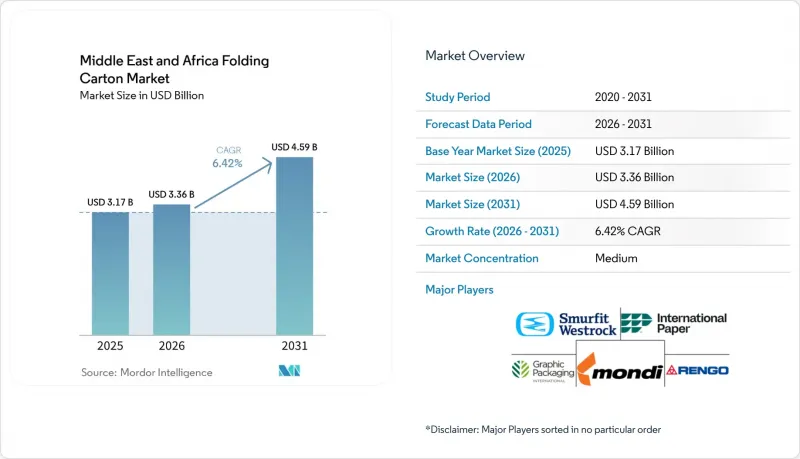
Mordor Intelligence에 의하면, 중동 및 아프리카의 접이식 카톤 시장 규모는 2025년 31억 7,000만 달러로 평가되었습니다. 2026년에는 33억 6,000만 달러로 확대되어 2031년까지 45억 9,000만 달러에 이를 것으로 예측되며, 2026년부터 2031년에 걸쳐 CAGR 6.42%로 성장할 전망입니다.
본 보고서는 원료 유형(고형 표백 황산 펄프, 접이식 카톤, 코팅 미표백 크라프트지 등), 인쇄 기술(오프셋 인쇄, 플렉소 인쇄 등), 최종 사용자 산업(식품 및 음료, 헬스케어 및 의약품, 퍼스널케어 및 화장품, 전기 및 전자기기 등), 지역별로 분류되어 있습니다. 시장 전망은 금액(달러) 기준으로 제시되어 있습니다.
중동 및 아프리카의 접이식 카톤 시장 동향 및 분석
급속한 도시화가 가공식품 소비를 견인하고 있습니다.
중동 및 아프리카 전역에서 도시 인구가 증가하고 있으며, 지방 도시에서는 노천 시장을 대신해 현대적인 식료품점이 점차 보급되고 있습니다. 나이지리아, 이집트, 케냐의 슈퍼마켓 체인에서는 시리얼, 비스킷, 분말 음료의 경우 진열대에 놓기 쉬운 접이식 카톤을 우선적으로 사용하고 있습니다. 이는 이러한 패키지들이 깔끔하게 쌓일 수 있고, 넓은 브랜딩 공간을 확보할 수 있으며, 습기가 많은 유통 경로에서도 견딜 수 있기 때문입니다. 걸프협력회의(GCC) 회원 도시에서 중산층의 소득 증가에 따라, 접이식 카톤이 제공할 수 있는 고품질 그래픽, 재밀봉 가능한 밀봉 방식, 그리고 인증받은 지속 가능한 원자재에 대한 수요가 높아지고 있습니다. 현지 가공업체들은 색상 정확도에 관한 브랜드 소유자의 요구 사항을 충족하기 위해 프리프레스 공정 및 오프셋 인쇄 라인의 업그레이드를 추진하고 있습니다. 한편, 사우디아라비아에서는 수입 대체 프로그램을 통해 골판지 원지의 국내 조달이 추진되고 있습니다. 도시로의 인구 이동으로 인해 구매력이 집중되는 가운데, 소비자들이 개별 판매 상품보다 용량이 정해진 위생적인 밀봉 포장을 선호함에 따라, 접이식 카톤의 출하량은 인구 증가율을 웃도는 속도로 증가하고 있습니다.
경량 운송용 포장이 필요한 전자상거래의 확대
온라인 소매의 확산이 가속화되면서 Noon, Jumia, Amazon 등의 플랫폼이 리야드, 두바이, 라고스, 나이로비에서 물류 네트워크를 확대되고 있습니다. 브랜드 소유주들은 화장품, 전자기기 액세서리, 일반의약품의 경우, 250-350 gsm의 무지 표백 황산 펄프지로도 충분한 구조적 강성을 확보할 수 있기 때문에 무거운 골판지 상자보다 접이식 카톤을 선택하고 있습니다. 가변 데이터 지원 디지털 인쇄기를 통해 컨버터는 설정 손실을 발생시키지 않고 주문별 그래픽, QR 코드, 시즌 한정 아트워크를 인쇄할 수 있어 재고의 노후화를 최소화할 수 있습니다. 미용·건강 제품 구독 박스에는 부피 중량 과세를 최적화하고 라스트 마일 비용을 절감하는 오프셋 라미네이트 가공 접이식 카톤이 채택되고 있습니다. 만안 국가들의 수도에서 클라우드 키친과 퀵커머스 식료품 앱이 급증함에 따라, 배송 중 식품의 품질과 브랜드 이미지를 유지할 수 있는 내유성 골판지 상자에 대한 수요가 높아지고 있습니다.
펄프 가격 변동이 제지업체의 이익률을 압박하고 있습니다.
에너지 비용의 급등과 스칸디나비아 지역공급 제약으로 인해, 2026년 초에는 NBSK(Northern Bleached Softwood Kraft) 가격이 톤당 1,710달러까지 상승했습니다. 수입 버진 펄프에 의존하고 있는 많은 접이식 카톤 가공업체들은 계약 가격 조정이 이루어지기까지 60-90일의 시차가 발생하여, 운전 자금의 여유가 점차 줄어들고 있습니다. 나이지리아와 이집트에서 발생한 통화 약세는 수입 비용 상승을 더욱 가속화하고 있으며, 헤지 수단을 갖추지 못한 중소규모의 환전업체들은 이익률이 급격히 압박받을 위험에 직면해 있습니다. 사우디아라비아의 MEPCO는 생산 능력을 두 배로 늘려 연간 90만 톤으로 확대할 계획이지만, 이 공장은 고화질 식품용 골판지에 필수적인 코팅 박스용 골판지가 아닌, 티슈와 특수 등급 제품을 주력 제품으로 하고 있습니다. 소매업체들의 비용 전가에 대한 저항으로 인해 새로운 오프셋 인쇄 라인에 대한 투자 의욕이 주춤하고 있으며, 컨버터들은 원자재 사용량을 줄이는 경량화 및 디지털 워크플로우로 방향을 전환하고 있습니다.
부문별 분석
확실한 통계 자료가 이러한 변화의 규모를 뒷받침하고 있습니다. 2025년 기준으로, 접이식 판지는 중동 및 아프리카의 접이식 카톤 시장에서 38.0%의 점유율을 차지했으나, 반면 고형 표백 황산 펄프(SBS)는 2031년까지 연평균 성장률(CAGR) 9.4%로 성장할 것으로 전망됩니다. 다국적 제과 및 스킨케어 브랜드들은 그 밝은 색상, 무취성, 그리고 수성 분산형 배리어와의 호환성을 이유로 후자를 선호하여 채택하고 있습니다. 의약품의 블리스터 포장이나 영양 보충제의 소포장은 PVC 포장재에서 가속 노화 시험을 통과한 SBS 카톤으로 전환되고 있으며, 이에 따라 고급 원료의 채택이 더욱 확대되고 있습니다.
밸류체인에 따라 성장 궤적이 달라집니다. 이집트의 비용 효율을 중시하는 가정용 세제 포장재에는 여전히 화이트 라이닝 칩보드가 사용되고 있는 반면, 걸프 지역의 화장품 제조업체들은 FSC 인증을 받은 SBS에 질감 있는 니스 처리를 한 제품에 더 높은 가격을 지불하고 있습니다. RDM사의 ‘Vincicoat PLUS’와 같은 재생 등급 제품은 인장 강도가 15-20% 향상되어, 브랜드 소유자는 그래픽 품질을 저하시키지 않으면서도 재생 소재 사용을 강조할 수 있게 됩니다. 이러한 양극화로 인해, 저비용의 혼합 폐기물 보드와 고성능의 버진 섬유를 모두 조달할 수 있는 컨버터가 우위를 점하게 되어, 다양한 고객층을 대상으로 폭넓은 서비스를 지속적으로 제공할 수 있습니다.
기타 혜택 :
- 엑셀 형식 시장 예측(ME) 시트
- 3개월간의 애널리스트 지원
자주 묻는 질문
목차
제1장 서론
제2장 조사 방법
제3장 주요 요약
제4장 시장 구도
제5장 시장 규모 및 성장 예측
제6장 경쟁 구도
제7장 시장 기회 및 향후 전망
KTH 26.06.26According to Mordor Intelligence, the middle east and Africa folding carton market size is expected to increase from USD 3.17 billion in 2025 to USD 3.36 billion in 2026 and reach USD 4.59 billion by 2031, growing at a CAGR of 6.42% over 2026-2031.
This report is Segmented by Material Type (Solid Bleached Sulfate, Folding Boxboard, Coated Unbleached Kraft, and More), Printing Technology (Lithographic, Flexographic, and More), End-User Industry (Food and Beverage, Healthcare/Pharmaceuticals, Personal Care and Cosmetics, Electrical and Electronics, and More), and Geography. The Market Forecasts are Provided in Terms of Value (USD).
Middle East And Africa Folding Carton Market Trends and Insights
Rapid Urbanization Driving Packaged Food Consumption
Urban populations are swelling across the Middle East and Africa, prompting modern grocery formats to replace open-air markets in secondary cities. Supermarket chains in Nigeria, Egypt, and Kenya prioritize shelf-ready folding cartons for cereals, biscuits, and powdered beverages because the packs stack neatly, carry large branding areas, and withstand humid distribution corridors. Rising middle-class incomes in Gulf Cooperation Council cities are boosting demand for premium graphics, resealable closures, and certified sustainable substrates that folding cartons can deliver. Local converters are upgrading pre-press workflows and offset lines to meet brand owner requirements for color accuracy, while import substitution programs in Saudi Arabia encourage domestic sourcing of cartonboard grades. As migration concentrates purchasing power in urban hubs, folding-carton volumes grow faster than population because consumers favor portion-controlled, hygiene-sealed formats over loose goods.
E-commerce Expansion Requiring Lightweight Transit Packs
Online retail penetration is escalating, with platforms such as Noon, Jumia, and Amazon scaling fulfillment networks in Riyadh, Dubai, Lagos, and Nairobi. Brand owners choose folding cartons over heavier corrugated boxes for cosmetics, electronics accessories, and over-the-counter medicines, where structural rigidity is achievable with 250-350 gsm solid bleached sulfate. Variable-data digital presses allow converters to print order-specific graphics, QR codes, and seasonal artwork without makeready waste, minimizing inventory obsolescence. Subscription boxes for beauty and health products rely on litho-laminated folding cartons that optimize dimensional-weight tariffs, lowering last-mile costs. The surge of cloud kitchens and quick-commerce grocery apps in Gulf capitals drives demand for grease-resistant cartons that preserve food integrity and brand aesthetics during delivery.
Volatile Pulp Prices Compressing Converter Margins
Northern Bleached Softwood Kraft prices climbed to USD 1,710 per tonne in early 2026 after energy-cost spikes and Scandinavian supply constraints. Folding-carton converters, many of which are reliant on imported virgin fiber, endure 60-90-day lags before contract price adjustments, eroding working-capital buffers. Currency depreciation in Nigeria and Egypt amplifies landed-cost inflation, while smaller converters lacking hedging facilities risk rapid margin compression. Although Saudi Arabia's MEPCO is doubling capacity to 900,000 tonnes per year, the mill targets tissue and specialty grades rather than the coated boxboard essential for high-graphics food cartons. Cost pass-through resistance from retailers dampens investment appetite for new litho lines, nudging converters toward lightweighting and digital workflows that cut substrate usage.
Other drivers and restraints analyzed in the detailed report include:
- Government Plastic-Reduction Policies Favoring Paper-Based Packaging
- Pharmaceutical Cold-Chain Growth Requiring Barrier-Coated Cartons
- Under-Developed Collection Systems Limiting Recycled Fiber Availability
For complete list of drivers and restraints, kindly check the Table Of Contents.
Segment Analysis
Solid statistics underscore the scale of this shift. Folding Boxboard held a 38.0% slice of the Middle East and Africa folding carton market in 2025, while Solid Bleached Sulfate is set to grow at a 9.4% CAGR through 2031. Multinational confectionery and skincare brands prefer the latter for its brightness, odor neutrality, and compatibility with aqueous dispersion barriers. Pharmaceutical blisters and nutraceutical sachets are migrating from PVC wallets to SBS cartons that pass accelerated-aging tests, reinforcing premium substrate adoption.
Growth trajectories diverge across value chains. Cost-sensitive household detergent packs in Egypt retain white-lined chipboard, yet Gulf cosmetics marketers pay premiums for FSC-certified SBS paired with tactile varnishes. Recycled grades, such as RDM's Vincicoat PLUS, which deliver 15-20% higher tensile strength, enable brand owners to claim recycled content without downgrading graphics. This bifurcation rewards converters that can source both low-cost mixed-waste boards and high-performance virgin fiber, sustaining service breadth for diverse customer tiers.
List of Companies Covered in this Report:
- International Paper Company
- Smurfit Westrock plc
- Mondi plc
- Graphic Packaging Holding Company
- Rengo Co., Ltd.
- Georgia-Pacific LLC
- Oji Holdings Corporation
- El-Sewedy Paper Industries Co.
- Nampak Ltd.
- AR Packaging Group AB
- Nada Manufacturing Co.
- Emirates Printing Press LLC
- Uniprint (Pty) Ltd.
- Offset Printing Industries LLC
- Hala Print Co.
- Primepak Industries Nigeria Ltd.
- Future Pack Group
- Caira International Paperboard
Additional Benefits:
- The market estimate (ME) sheet in Excel format
- 3 months of analyst support
TABLE OF CONTENTS
1 INTRODUCTION
- 1.1 Study Assumptions and Market Definition
- 1.2 Scope of the Study
2 RESEARCH METHODOLOGY
3 EXECUTIVE SUMMARY
4 MARKET LANDSCAPE
- 4.1 Market Overview
- 4.2 Market Drivers
- 4.2.1 Rapid Urbanization Driving Packaged Food Consumption
- 4.2.2 E-commerce Expansion Requiring Lightweight Transit Packs
- 4.2.3 Government Plastic-Reduction Policies Favoring Paper-Based Packaging
- 4.2.4 Pharmaceutical Cold-Chain Growth Requiring Barrier Coated Cartons
- 4.2.5 Investment in High-Speed Digital Presses Enabling Short-Run SKUs
- 4.2.6 Rise of Halal-Certified Food Exports from GCC
- 4.3 Market Restraints
- 4.3.1 Volatile Pulp Prices Compressing Converter Margins
- 4.3.2 Under-developed Collection Systems Limiting Recycled Fiber Availability
- 4.3.3 Growing Plastic Barrier Films in Aseptic Cartons
- 4.3.4 Political Instability Affecting Cap-Ex Decisions in Parts of Africa
- 4.4 Industry Value Chain Analysis
- 4.5 Impact of Macroeconomic Factors on the Market
- 4.6 Regulatory Landscape
- 4.7 Technological Outlook
- 4.8 Porter's Five Forces Analysis
- 4.8.1 Bargaining Power of Buyers
- 4.8.2 Bargaining Power of Suppliers
- 4.8.3 Threat of Substitutes
- 4.8.4 Threat of New Entrants
- 4.8.5 Competitive Rivalry
5 MARKET SIZE AND GROWTH FORECASTS (VALUE)
- 5.1 By Material Type
- 5.1.1 Solid Bleached Sulfate
- 5.1.2 Folding Boxboard
- 5.1.3 Coated Unbleached Kraft
- 5.1.4 White Line Chipboard
- 5.1.5 Other Material Types
- 5.2 By Printing Technology
- 5.2.1 Lithographic Printing
- 5.2.2 Flexographic Printing
- 5.2.3 Digital Printing
- 5.2.4 Gravure Printing
- 5.2.5 Other Printing Technologies
- 5.3 By End-User Industry
- 5.3.1 Food and Beverage
- 5.3.2 Healthcare/Pharmaceuticals
- 5.3.3 Personal Care and Cosmetics
- 5.3.4 Electrical and Electronics
- 5.3.5 Household and Industrial Goods
- 5.3.6 Tobacco
- 5.3.7 E-commerce and Retail-ready Packaging
- 5.3.8 Other End-User Industries
- 5.4 By Geography
- 5.4.1 Middle East
- 5.4.1.1 Saudi Arabia
- 5.4.1.2 United Arab Emirates
- 5.4.1.3 Qatar
- 5.4.1.4 Turkey
- 5.4.1.5 Rest of Middle East
- 5.4.2 Africa
- 5.4.2.1 Egypt
- 5.4.2.2 South Africa
- 5.4.2.3 Nigeria
- 5.4.2.4 Kenya
- 5.4.2.5 Rest of Africa
- 5.4.1 Middle East
6 COMPETITIVE LANDSCAPE
- 6.1 Market Concentration
- 6.2 Strategic Moves
- 6.3 Market Share Analysis
- 6.4 Company Profiles (includes Global Level Overview, Market Level Overview, Core Segments, Financials as available, Strategic Information, Market Rank/Share, Products and Services, Recent Developments)
- 6.4.1 International Paper Company
- 6.4.2 Smurfit Westrock plc
- 6.4.3 Mondi plc
- 6.4.4 Graphic Packaging Holding Company
- 6.4.5 Rengo Co., Ltd.
- 6.4.6 Georgia-Pacific LLC
- 6.4.7 Oji Holdings Corporation
- 6.4.8 El-Sewedy Paper Industries Co.
- 6.4.9 Nampak Ltd.
- 6.4.10 AR Packaging Group AB
- 6.4.11 Nada Manufacturing Co.
- 6.4.12 Emirates Printing Press LLC
- 6.4.13 Uniprint (Pty) Ltd.
- 6.4.14 Offset Printing Industries LLC
- 6.4.15 Hala Print Co.
- 6.4.16 Primepak Industries Nigeria Ltd.
- 6.4.17 Future Pack Group
- 6.4.18 Caira International Paperboard
7 MARKET OPPORTUNITIES AND FUTURE OUTLOOK
- 7.1 White-Space and Unmet-Need Assessment


