

|
시장보고서
상품코드
2063776
싱가포르의 접이식 카톤 시장 : 점유율 분석, 업계 동향과 통계, 성장 예측(2026-2031년)Singapore Folding Carton - Market Share Analysis, Industry Trends & Statistics, Growth Forecasts (2026 - 2031) |
||||||
 Mordor Intelligence
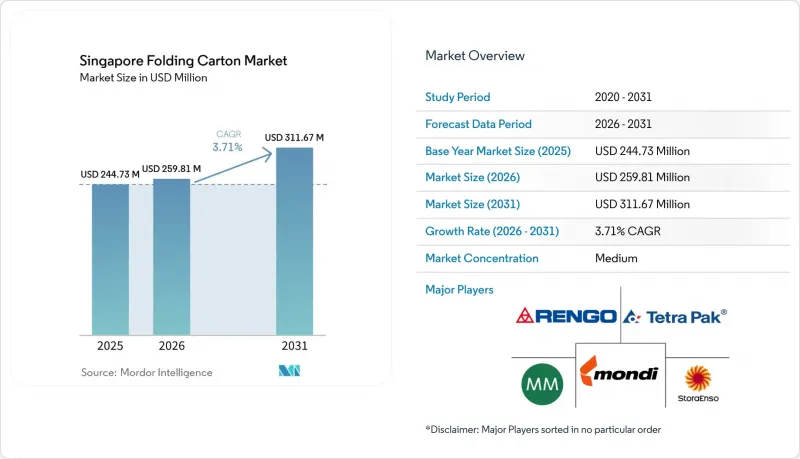
Mordor Intelligence에 의하면, 싱가포르 접는 식 골판지 시장 규모는 2025년에 2억 4,473만 달러, 2026년에 2억 5,981만 달러, 2031년까지 3억 1,167만 달러에 이를 것으로 예측됩니다.
2026년부터 2031년까지 연평균 성장률(CAGR) 3.71%로 성장할 것으로 전망됩니다.
본 보고서는 원료 유형(고형 표백 황산 펄프, 접이식 상자용 판지, 코팅 미표백 크라프트지, 화이트라인 칩보드 등), 인쇄 기술(평판 인쇄, 그라비아 인쇄, 디지털 인쇄 등), 최종 사용자 산업(식품 및 음료, 전기 및 전자기기, 퍼스널케어 및 화장품 등)별로 분류되어 있습니다. 시장 전망은 금액(달러) 기준으로 제시되어 있습니다.
싱가포르 접이식 카톤 시장 동향 및 인사이트
전자상거래용 포장 수요의 급증
싱가포르는 지역 물류 거점으로 자리매김하고 있어, 디지털 소매업체들은 보세 창고에 재고를 집중하고, 제품에 라벨을 다시 부착한 뒤 48시간 이내에 아세안 지역 구매자에게 배송할 수 있습니다. 국경을 넘는 소포에는 일반적으로 적어도 하나의 2차 접이식 카톤이 사용되기 때문에 거래량 증가는 싱가포르 접이식 카톤 시장의 취급량 증가로 직결됩니다. 전자상거래 사업자들은 반품 비용을 최소화하기 위해, 무단 개봉 방지 설계, QR 코드 삽입, 그리고 견고한 모서리 보호 기능을 강력히 요구하고 있습니다. 자동화된 CAD 라이브러리와 디지털 인쇄기를 갖춘 컨버터는 3,000-1만 5,000개의 카톤 주문에 대해 며칠 내에 견적, 교정, 납품을 처리할 수 있어 이러한 주문을 수주하고 있습니다.
지속 가능한 포장을 위한 정부의 추진과 ‘그린 플랜 2030’
포장에 관한 보고 의무와 2026년까지 매립 처분량을 20% 감축하겠다는 잠정 목표에 따라, 기업들의 재활용 가능한 소재로의 전환이 가속화되고 있습니다. 산림관리협의회(FSC)의 CoC 인증 현황 및 재생 섬유의 최소 사용률을 입증할 수 있는 접이식 카톤 제조업체는 현재 싱가포르에서 사업을 전개하는 전 세계 FMCG 바이어들로부터 우선 공급업체로 인정받고 있습니다. 현재 많은 음료 브랜드들도 종이 카톤이 음료 용기 보증금 제도의 적용 대상에서 제외된다는 규제상의 허점을 이용해, 폴리에틸렌 테레프탈레이트(PET)로 만든 멀티팩 링 대신 종이 카톤을 채택하고 있습니다.
높은 지대와 인건비가 현지 생산 능력을 제한하고 있습니다.
산업용 임대료 상승세가 이어지는 한편, 노동 개혁으로 인해 최저임금과 각종 세금이 인상되면서 가공업체들의 고정비가 증가하고 있습니다. 따라서 규모가 큰 싱가포르의 접이식 카톤 시장에는 두 가지 공급 경로를 통해 대응해야 합니다. 즉, 말레이시아나 인도네시아에서 지역 생산된 범용 카톤를 조달하는 한편, 현지 공장은 소량 생산, 고급 제품 또는 지적 재산권을 고려해야 하는 프로젝트에 주력하는 방식입니다. 로봇을 활용한 금형 절단 및 AI 비전 시스템에 대한 자동화 투자는 비용 격차를 해소하는 것을 목적으로 하고 있지만, 막대한 초기 투자가 필요합니다.
부문별 분석
2025년, 싱가포르의 접이식 골판지 시장에서 코팅되지 않은 미표백 크라프트지는 33.87%의 시장 점유율을 차지했습니다. 이는 음료 용기, 냉동 식품용 슬리브, 기름기가 많은 스낵 포장재에서 그 습윤 강도와 배리어 코팅이 선호되기 때문입니다. 이 등급은 지자체에서 운영하는 재활용 시스템에 부합하며, FSC 인증도 획득하고 있어 ‘그린 플랜 2030’에 기반한 브랜드 소유자의 공약과도 일치합니다. 한편, 접이식 판지는 2031년까지 연평균 성장률(CAGR) 5.53%를 기록하며 시장 전체의 성장률을 상회할 것으로 전망됩니다. 매끄러운 클레이 코트 표면, 뛰어난 백색도, 높은 강성은 고급 화장품 및 건강기능식품 브랜드가 요구하는 엠보싱, 호일 스탬핑, 선명한 오프셋 인쇄를 가능하게 합니다. 두 가지 원자재를 모두 재고로 보유한 컨버터는 최적의 평량, 배리어 라미네이트 및 후가공을 통한 장식 솔루션을 제안할 수 있어 컨설팅 역할을 강화할 수 있으며, 평균 판매 가격(ASP) 상승에 따라 싱가포르 접이식 카톤 시장에서 더 큰 시장 점유율을 확보할 수 있습니다.
의약품용 골판지 시장에서는 엄격한 순도 및 광학적 요건으로 인해 대체재가 제한되고 있어, 고형 표백 황산 펄프(SBS)에 대한 수요는 여전히 견조합니다. 화이트라인 칩보드는 저예산 가정용 제품을 위해 제공되며, 재활용 소재를 활용함으로써 톤당 비용을 절감하는 동시에 기업의 지속가능성 지표를 충족시키고 있습니다. 분산 코팅이나 식물 유래 폴리머 라이닝이 적용된 보드 등의 특수 등급 제품은 전자레인지용 식품 트레이나 조절 분위기 포장(MAP)에 사용할 수 있으나, 현재는 인증 절차에 따라 생산량이 제한되고 있습니다. 고급 과자 수입업체들이 높은 가격 책정을 정당화하기 위해 개봉 시의 연출에 주력하고 있는 가운데, 접이식 판지의 질감 있는 표면 마감과 구조적 강성이 결정적인 요소로 작용하고 있습니다.
기타 혜택:
- 엑셀 형식 시장 예측(ME) 시트
- 3개월간의 애널리스트 지원
자주 묻는 질문
목차
제1장 서론
제2장 조사 방법
제3장 주요 요약
제4장 시장 구도
제5장 시장 규모와 성장 예측
제6장 경쟁 구도
제7장 시장 기회와 향후 전망
JHS 26.06.23According to Mordor Intelligence, the singapore folding carton market size is projected to be USD 244.73 million in 2025, USD 259.81 million in 2026, and reach USD 311.67 million by 2031, growing at a CAGR of 3.71% from 2026 to 2031.
This report is Segmented by Material Type (Solid Bleached Sulfate, Folding Boxboard, Coated Unbleached Kraft, White Line Chipboard, and More), Printing Technology (Lithographic Printing, Gravure Printing, Digital Printing, and More), and End-User Industry (Food and Beverage, Electrical and Electronics, Personal Care and Cosmetics, and More). The Market Forecasts are Provided in Terms of Value (USD).
Singapore Folding Carton Market Trends and Insights
Surge in E-Commerce Packaging Demand
Singapore's position as a regional fulfillment nexus allows digital retailers to consolidate inventory in bonded warehouses, re-label products, and ship within 48 hours to ASEAN shoppers. Each cross-border parcel typically uses at least one secondary folding carton, so transaction growth directly translates into additional tonnage for the Singapore folding carton market. E-tailers insist on tamper-evident designs, embedded QR codes, and robust corner protection to minimize return costs. Converters with automated CAD libraries and digital presses win these orders because they can quote, proof, and deliver runs of 3,000-15,000 cartons within a few days.
Government Push for Sustainable Packaging and Green Plan 2030
Mandatory Packaging Reporting and the interim 20% landfill-reduction target for 2026 accelerate corporate moves toward recyclable substrates. Folding-carton producers able to document Forest Stewardship Council (FSC) chain-of-custody status and minimum recycled-fiber thresholds now enjoy preferred-supplier status with global FMCG buyers operating in Singapore. Many beverage brands also use folding cartons to replace polyethylene terephthalate (PET) multipack rings, taking advantage of a regulatory gap because cartons currently fall outside the beverage-container deposit scheme.
High Land and Labor Costs Limiting Local Production Capacity
Industrial rents keep trending higher while labor reforms raise minimum salaries and levies, inflating fixed costs for converters. The larger Singapore folding carton market must therefore be served through a two-track supply chain: regionally produced commodity cartons flow in from Malaysia and Indonesia, while local plants concentrate on short-run, premium, or IP-sensitive jobs. Automation investments in robotic die-cutting and AI vision systems aim to close the cost gap but require significant upfront capital.
Other drivers and restraints analyzed in the detailed report include:
- Growth of Ready-to-Eat Meal Deliveries Boosting Folding Carton Usage
- Technological Advancements in Digital Printing for Short Runs
- Competition From Lower-Cost Imports From Malaysia and China
For complete list of drivers and restraints, kindly check the Table Of Contents.
Segment Analysis
Coated Unbleached Kraft captured 33.87% of the Singapore folding carton market share in 2025 as beverage carriers, frozen-food sleeves, and greasy snack packs favor its wet strength and barrier coatings. The grade fits within municipal recycling streams and carries FSC tags, aligning with brand-owner pledges under the Green Plan 2030. Folding Boxboard, however, is pegged to outpace overall market growth at a 5.53% CAGR to 2031. Its smooth, clay-coated surface, superior brightness, and high stiffness support embossing, foil stamping, and crisp offset graphics demanded by premium cosmetics and nutraceutical brands. Converters that stock both substrates can recommend optimal grammage, barrier lamination, and post-press embellishment, strengthening their consultative role and capturing a larger share of the Singapore folding carton market as ASPs rise.
Demand for Solid Bleached Sulfate remains sticky in pharmaceutical cartons where stringent purity and optical requirements limit substitution. White Line Chipboard serves low-budget household goods, leveraging recycled content to satisfy corporate sustainability metrics at a lower cost per ton. Specialty grades, including dispersion-coated and plant-based polymer-lined boards, address microwave-safe food trays and modified-atmosphere packs, though volumes are currently limited by qualification cycles. As importers of luxury confectionery lean on unboxing theatrics to justify premium price tags, Folding Boxboard's tactile finish and structural rigidity become decisive.
List of Companies Covered in this Report:
- Tetra Pak International S.A.
- Mayr-Melnhof Karton AG
- Rengo Co. Ltd
- Stora Enso Oyj
- Mondi plc
- Muda Packaging Industries Sdn Bhd
- Seow Khim Polythelene Pte Ltd.
- Toyo Ink Pte Ltd.
- LSY Packaging Pte Ltd.
- Paper Products Singapore (Pte) Ltd.
- Amcor plc
- International Paper Company
- Graphic Packaging International LLC
- Oji Holdings Corporation
- Smurfit Westrock plc
- Huhtamaki Oyj
Additional Benefits:
- The market estimate (ME) sheet in Excel format
- 3 months of analyst support
TABLE OF CONTENTS
1 INTRODUCTION
- 1.1 Study Assumptions and Market Definition
- 1.2 Scope of the Study
2 RESEARCH METHODOLOGY
3 EXECUTIVE SUMMARY
4 MARKET LANDSCAPE
- 4.1 Market Overview
- 4.2 Market Drivers
- 4.2.1 Surge in E-Commerce Packaging Demand
- 4.2.2 Government Push for Sustainable Packaging and Green Plan 2030
- 4.2.3 Growth of Ready-to-Eat Meal Deliveries Boosting Folding Carton Usage
- 4.2.4 Technological Advancements in Digital Printing for Short Runs
- 4.2.5 Rising Demand for Premium Healthcare Packaging Amid Aging Population
- 4.2.6 Brand-Owner Shift Toward Plastic-to-Paper Substitution
- 4.3 Market Restraints
- 4.3.1 High Land and Labor Costs Limiting Local Production Capacity
- 4.3.2 Competition From Lower-Cost Imports From Malaysia and China
- 4.3.3 Limited Domestic Recovered Fiber Constraining Recycled Board Adoption
- 4.3.4 Volatility in Virgin Paperboard Prices Linked to Global Pulp Markets
- 4.4 Industry Value Chain Analysis
- 4.5 Regulatory Landscape
- 4.6 Technological Outlook
- 4.7 Impact of Macroeconomic Factors on the Market
- 4.8 Porter's Five Forces Analysis
- 4.8.1 Threat of New Entrants
- 4.8.2 Bargaining Power of Suppliers
- 4.8.3 Bargaining Power of Buyers
- 4.8.4 Threat of Substitutes
- 4.8.5 Competitive Rivalry
5 MARKET SIZE AND GROWTH FORECASTS (VALUE)
- 5.1 By Material Type
- 5.1.1 Solid Bleached Sulfate
- 5.1.2 Folding Boxboard
- 5.1.3 Coated Unbleached Kraft
- 5.1.4 White Line Chipboard
- 5.1.5 Other Material Types
- 5.2 By Printing Technology
- 5.2.1 Lithographic Printing
- 5.2.2 Flexographic Printing
- 5.2.3 Digital Printing
- 5.2.4 Gravure Printing
- 5.2.5 Other Printing Technologies
- 5.3 By End-User Industry
- 5.3.1 Food and Beverage
- 5.3.2 Healthcare/Pharmaceuticals
- 5.3.3 Personal Care and Cosmetics
- 5.3.4 Electrical and Electronics
- 5.3.5 Household and Industrial Goods
- 5.3.6 Tobacco
- 5.3.7 E-commerce and Retail-ready Packaging
- 5.3.8 Other End-User Industries
6 COMPETITIVE LANDSCAPE
- 6.1 Market Concentration
- 6.2 Strategic Moves
- 6.3 Market Share Analysis
- 6.4 Company Profiles (includes Global level Overview, Market level overview, Core Segments, Financials as available, Strategic Information, Market Rank/Share for key companies, Products and Services, and Recent Developments)
- 6.4.1 Tetra Pak International S.A.
- 6.4.2 Mayr-Melnhof Karton AG
- 6.4.3 Rengo Co. Ltd
- 6.4.4 Stora Enso Oyj
- 6.4.5 Mondi plc
- 6.4.6 Muda Packaging Industries Sdn Bhd
- 6.4.7 Seow Khim Polythelene Pte Ltd.
- 6.4.8 Toyo Ink Pte Ltd.
- 6.4.9 LSY Packaging Pte Ltd.
- 6.4.10 Paper Products Singapore (Pte) Ltd.
- 6.4.11 Amcor plc
- 6.4.12 International Paper Company
- 6.4.13 Graphic Packaging International LLC
- 6.4.14 Oji Holdings Corporation
- 6.4.15 Smurfit Westrock plc
- 6.4.16 Huhtamaki Oyj
7 MARKET OPPORTUNITIES AND FUTURE OUTLOOK
- 7.1 White-Space and Unmet-Need Assessment


