

|
시장보고서
상품코드
2063779
중국의 접이식 카톤 : 시장 점유율 분석, 업계 동향 및 통계, 성장 예측(2026-2031년)China Folding Carton - Market Share Analysis, Industry Trends & Statistics, Growth Forecasts (2026 - 2031) |
||||||
 Mordor Intelligence
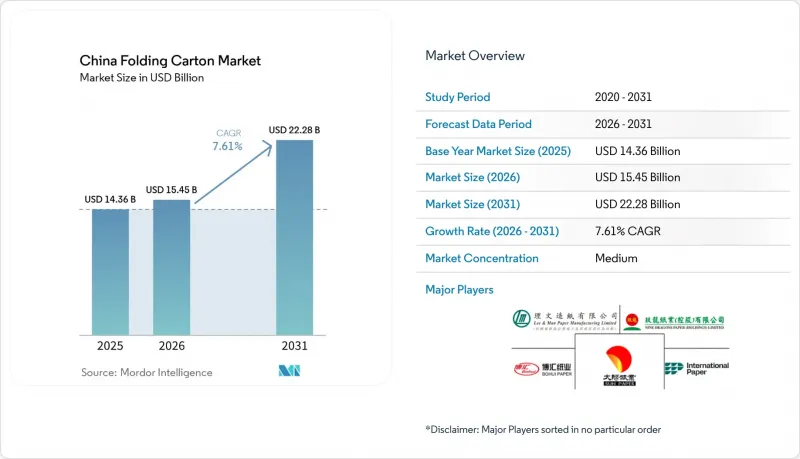
에 의하면, 중국의 접이식 카톤 시장 규모는 2025년에 143억 6,000만 달러로 평가되었습니다. 2026년에 154억 5,000만 달러에서 2031년까지 222억 8,000만 달러에 이를 것으로 예측됩니다.
2026년부터 2031년까지 연평균 성장률(CAGR) 7.61%로 성장할 것으로 전망됩니다.

본 보고서는 원료 유형(고형 표백 황산 펄프, 접이식 카톤, 코팅 미표백 크라프트지 등), 인쇄 기술(오프셋 인쇄, 플렉소 인쇄, 디지털 인쇄, 그라비아 인쇄 등), 최종 사용자 산업(식품 및 음료, 헬스케어 및 의약품, 퍼스널케어 및 화장품, 전기 및 전자기기 등)별로 분류되어 있습니다. 시장 전망은 금액(달러) 기준으로 제시되어 있습니다.
중국의 접이식 카톤 시장 동향 및 분석
재활용 가능한 섬유 기반 포장재에 대한 수요 증가
2025년에는 소포 처리량이 1,200억 개를 돌파했으며, 택배 포장 친환경 전환 계획에 따라 자재의 95%가 재활용 가능해야 한다는 기준이 제시됨에 따라, 화주들은 접이식 카톤로 전환했습니다. 각 브랜드는 잉크 사용량을 줄이고 재활용을 간소화하는 크라프트지의 미학을 도입하고 있는 반면, 나인 드래곤스(Nine Dragons)와 같은 통합 제지 업체들은 인증된 원자재 공급을 확보하기 위해 표백 박스보드 생산 능력을 연간 120만 톤으로 확대했습니다. 재사용 시범 프로그램이 존재하기는 하지만, 위생 문제와 역물류 관련 과제로 인해 일회용 상자가 여전히 주류를 이루고 있습니다.
전자상거래의 가속화가 소량 골판지 수요를 견인하고 있습니다.
중국의 접이식 카톤 시장의 온라인 채널을 통한 주문 점유율은 플래시 세일과 인플루언서가 주도하는 SKU에 힘입어 2025년에는 약 55%에 달한 것으로 추정됩니다. HP Indigo 및 EFI 디지털 인쇄기를 통해 PANTONE 색상 정확도 97%를 달성하고 QR 코드를 삽입할 수 있게 되어, 500개 단위의 소량 생산에서도 수익성을 확보할 수 있게 되었습니다. 심천의 전자제품 브랜드들은 정전기 방지 라이너와 맞춤형 다이컷을 요구하고 있으며, 컨버터 업체들은 디지털 워크플로우와 통합된 인라인 코팅에 투자하여 7일 리드타임을 실현해야 하는 압박을 받고 있습니다.
펄프 및 에너지 가격 변동
침엽수 펄프 가격은 2025년에 11.98% 하락하여 톤당 5,633위안(790달러)을 기록했으나, 2026년에는 8.81% 더 하락할 것으로 전망됩니다. 각 변환업체들은 원자재 가격 하락을 반기고 있지만, 산동 보후이(Shandong Bohui)와 같은 통합 제지 제조업체들은 대규모 펄프 생산 확대에 자금을 투입한 탓에 현재 수익 압박에 직면해 있습니다. 제지 공정에서 건조 비용의 70%를 에너지가 차지하기 때문에 연안 지역의 천연가스 요금 변동이 이익률을 더욱 불안정하게 만들고 있습니다.
부문별 분석
접이식 카톤은 매끄러운 표면과 안정적인 강성 덕분에 스낵, 유제품, 의약품 포장에 사용되는 고속 폴더-글루어 기계에 적용할 수 있어, 2025년에는 중국의 접이식 상자 시장 점유율의 37.21%를 차지했습니다. 이 부문은 통합 제지 공장이 중금속 이동에 관한 GB 4806 기준을 확실히 충족하는 버진 펄프 생산 라인을 추가한 덕분에 혜택을 보고 있습니다. 표백하지 않은 코트 크라프트지는 자연스러운 갈색을 진정성의 증거로 내세우는 유기농 식품 및 수제 음료 라벨의 인기에 힘입어, 연평균 성장률(CAGR) 8.23%를 기록하며 중국의 접이식 카톤 시장 규모를 웃도는 성장이 예상됩니다. 솔리드 블리치드 설페이트는 선명한 백색도, 엠보싱 가공성 및 호일 접착력 덕분에 프리미엄 가격 책정이 정당화되는 고급 화장품 분야에서 여전히 주요 기판으로 사용되고 있지만, 활엽수 펄프공급 제약으로 인해 시장 점유율 확대는 제한적입니다. 화이트 라인 칩보드는 세제나 건조 식품용 저가 시장을 차지하고 있지만, 재활용 원료 함유율이 인쇄 재현도와 내습성을 제한하기 때문에 냉동·냉장 식품 분야에서의 채택은 제한적입니다.
버진 펄프 생산 능력에 대한 투자자들의 관심이 높아지고 있는 것은 나인 드래곤즈(Nine Dragons)의 동관 공장에서 진행 중인 설비 현대화에서 뚜렷이 드러나고 있습니다. 이 회사는 2대의 구형 기계를 연간 62만 톤 규모의 크래프트 라이너 생산 라인으로 교체할 예정이며, 이는 식품용 등급으로의 전환을 시사하는 것입니다. 나노셀룰로오스로 강화된 특수 판지가 등장했으며, 시범 시험 결과 15%의 경량화가 확인되었습니다. 이를 통해 멀티채널 전자상거래 유통에서 물류 비용을 절감할 수 있을 것으로 보입니다. GB 4806 규격 준수를 검증하기 위해 사내 연구소를 보유한 제지 제조업체들은 투명한 조달을 추구하는 전 세계 브랜드 소유주들과의 제휴를 확대하고 있으며, 이에 따라 중국의 접이식 카톤 시장에서 대규모 생산 업체들은 현물 시장 거래업체들에 비해 이익률 측면에서 우위를 점하고 있습니다.
기타 혜택 :
- 엑셀 형식 시장 예측(ME) 시트
- 3개월간의 애널리스트 지원
자주 묻는 질문
목차
제1장 서론
제2장 조사 방법
제3장 주요 요약
제4장 시장 구도
제5장 시장 규모 및 성장 예측
제6장 경쟁 구도
제7장 시장 기회 및 향후 전망
KTH 26.06.26According to Mordor Intelligence, the china folding carton market size is expected to be USD 14.36 billion in 2025, USD 15.45 billion in 2026, and reach USD 22.28 billion by 2031, growing at a CAGR of 7.61% from 2026 to 2031.
This report is Segmented by Material Type (Solid Bleached Sulfate, Folding Boxboard, Coated Unbleached Kraft, and More), Printing Technology (Lithographic, Flexographic, Digital, Gravure, and More), End-User Industry (Food and Beverage, Healthcare/Pharmaceuticals, Personal Care and Cosmetics, Electrical and Electronics, and More). The Market Forecasts are Provided in Terms of Value (USD).
China Folding Carton Market Trends and Insights
Growing Demand for Recyclable Fiber-Based Packaging
Parcel volumes surpassed 120 billion in 2025, and the express delivery packaging green transition plan now requires 95% of materials to be recyclable, steering shippers toward folding carton. Brands embrace Kraft aesthetics that cut ink coverage and simplify recycling, while integrated mills such as Nine Dragons expanded bleached boxboard capacity to 1.2 million t per year to secure a certified supply. Pilot reuse programs exist, yet hygiene and reverse-logistics hurdles keep single-use carton dominant.
E-Commerce Acceleration Driving Small-Run Carton Volumes
China's folding carton market orders placed through online channels reached an estimated 55% share in 2025, driven by flash sales and influencer-driven SKUs. Digital presses from HP Indigo and EFI enable profitable runs of 500 units with 97% PANTONE accuracy and embedded QR codes. Electronics brands in Shenzhen demand anti-static liners and custom die-cuts, pushing converters to invest in inline coating that integrates with digital workflows to achieve seven-day lead times.
Volatility in Pulp and Energy Prices
Softwood pulp fell 11.98% in 2025 to CNY 5,633 (USD 790) per tonne and is forecast to dip another 8.81% in 2026. Converters welcome cheaper inputs, but integrated mills such as Shandong Bohui financed sizable pulp expansions that now face compressed returns. Energy can represent 70% of drying costs in papermaking, and fluctuating natural gas tariffs in coastal provinces further destabilize margins
Other drivers and restraints analyzed in the detailed report include:
- Rising Premiumization in Cosmetics and Personal Care
- Government Plastic-Reduction Mandates Boosting Paperboard
- Competition from Flexible Plastic Packaging
For complete list of drivers and restraints, kindly check the Table Of Contents.
Segment Analysis
Folding Boxboard captured 37.21% of the Chinese folding carton market share in 2025, supported by its smooth surface and consistent stiffness, which enable high-speed folder-gluers for snack, dairy, and pharmaceutical packaging. The segment benefits from integrated mills adding virgin fiber lines that ensure compliance with GB 4806 limits on heavy-metal migration. Coated Unbleached Kraft is forecast to outgrow the China folding carton market size at an 8.23% CAGR, propelled by organic food and craft beverage labels that showcase natural brown tones as an authenticity cue. Solid Bleached Sulfate remains the substrate of choice for prestige cosmetics where bright whiteness, embossability, and foil adhesion justify premium pricing, yet constrained hardwood pulp supply limits share gains. White Line Chipboard fills value tiers for detergents and dry goods, though its recycled content caps print fidelity and moisture resistance, limiting uptake in frozen and chilled foods.
Rising investor interest in virgin-fiber capacity is evident in Nine Dragons' Dongguan upgrade, which will replace two legacy machines with a 620,000 tonne-per-year kraft liner line, signaling a pivot toward food-safe grades. Specialty boards fortified with nanocellulose are emerging, with pilot trials documenting 15% weight reductions that can lower logistics costs for multichannel e-commerce distribution. Mills that embed in-house labs to verify GB 4806 compliance increasingly partner with global brand owners that demand transparent sourcing, giving scaled producers a margin edge over spot-market traders in the China folding carton market.
List of Companies Covered in this Report:
- Nine Dragons Paper Holdings Limited
- Lee & Man Paper Manufacturing Limited
- Shandong Sun Paper Industry Joint Stock Co., Ltd.
- Shandong Bohui Paper Industry Co., Ltd.
- International Paper Company
- Graphic Packaging International, LLC
- Huhtamaki Oyj
- Stora Enso Oyj
- Mayr-Melnhof Karton AG
- Mondi plc
- Rengo Co., Ltd.
- Oji Holdings Corporation
- Zhejiang Jingxing Paper Joint Stock Co., Ltd.
- Ningbo Zhonghua Paper Co., Ltd.
- Shanghai DE Printed Box
- Hangzhou Gerson Paper Co., Ltd.
- ITC Limited
Additional Benefits:
- The market estimate (ME) sheet in Excel format
- 3 months of analyst support
TABLE OF CONTENTS
1 INTRODUCTION
- 1.1 Study Assumptions and Market Definition
- 1.2 Scope of the Study
2 RESEARCH METHODOLOGY
3 EXECUTIVE SUMMARY
4 MARKET LANDSCAPE
- 4.1 Market Overview
- 4.2 Market Drivers
- 4.2.1 Growing Demand for Recyclable Fiber-Based Packaging
- 4.2.2 E-Commerce Acceleration Driving Small-Run Carton Volumes
- 4.2.3 Rising Premiumization in Cosmetics and Personal Care
- 4.2.4 Government Plastic-Reduction Mandates Boosting Paperboard
- 4.2.5 Automation Investments Lowering Conversion Costs
- 4.2.6 Digital Printing Adoption Enabling Mass Personalization
- 4.3 Market Restraints
- 4.3.1 Volatility in Pulp and Energy Prices
- 4.3.2 Competition from Flexible Plastic Packaging
- 4.3.3 Supply Gluts from Rapid Mill Capacity Expansions
- 4.3.4 Stringent Food-Contact Compliance Costs
- 4.4 Industry Value Chain Analysis
- 4.5 Regulatory Landscape
- 4.6 Technological Outlook
- 4.7 Porter's Five Forces Analysis
- 4.7.1 Bargaining Power of Buyers
- 4.7.2 Bargaining Power of Suppliers
- 4.7.3 Threat of New Entrants
- 4.7.4 Threat of Substitutes
- 4.7.5 Competitive Rivalry
- 4.8 Impact of Macroeconomic Factors on the Market
5 MARKET SIZE AND GROWTH FORECASTS (VALUE)
- 5.1 By Material Type
- 5.1.1 Solid Bleached Sulfate
- 5.1.2 Folding Boxboard
- 5.1.3 Coated Unbleached Kraft
- 5.1.4 White Line Chipboard
- 5.1.5 Other Material Types
- 5.2 By Printing Technology
- 5.2.1 Lithographic Printing
- 5.2.2 Flexographic Printing
- 5.2.3 Digital Printing
- 5.2.4 Gravure Printing
- 5.2.5 Other Printing Technologies
- 5.3 By End-User Industry
- 5.3.1 Food and Beverage
- 5.3.2 Healthcare/Pharmaceuticals
- 5.3.3 Personal Care and Cosmetics
- 5.3.4 Electrical and Electronics
- 5.3.5 Household and Industrial Goods
- 5.3.6 Tobacco
- 5.3.7 E-Commerce and Retail-Ready Packaging
- 5.3.8 Other End-User Industries
6 COMPETITIVE LANDSCAPE
- 6.1 Market Concentration
- 6.2 Strategic Moves
- 6.3 Market Share Analysis
- 6.4 Company Profiles (includes Global Level Overview, Market Level Overview, Core Segments, Financials as available, Strategic Information, Market Rank/Share, Products and Services, Recent Developments)
- 6.4.1 Nine Dragons Paper Holdings Limited
- 6.4.2 Lee & Man Paper Manufacturing Limited
- 6.4.3 Shandong Sun Paper Industry Joint Stock Co., Ltd.
- 6.4.4 Shandong Bohui Paper Industry Co., Ltd.
- 6.4.5 International Paper Company
- 6.4.6 Graphic Packaging International, LLC
- 6.4.7 Huhtamaki Oyj
- 6.4.8 Stora Enso Oyj
- 6.4.9 Mayr-Melnhof Karton AG
- 6.4.10 Mondi plc
- 6.4.11 Rengo Co., Ltd.
- 6.4.12 Oji Holdings Corporation
- 6.4.13 Zhejiang Jingxing Paper Joint Stock Co., Ltd.
- 6.4.14 Ningbo Zhonghua Paper Co., Ltd.
- 6.4.15 Shanghai DE Printed Box
- 6.4.16 Hangzhou Gerson Paper Co., Ltd.
- 6.4.17 ITC Limited
7 MARKET OPPORTUNITIES AND FUTURE OUTLOOK
- 7.1 White-Space and Unmet-Need Assessment


