

|
시장보고서
상품코드
2063801
약물감시 자동화 : 시장 점유율 분석, 업계 동향 및 통계, 성장 예측(2026-2031년)Pharmacovigilance Automation - Market Share Analysis, Industry Trends & Statistics, Growth Forecasts (2026 - 2031) |
||||||
 Mordor Intelligence
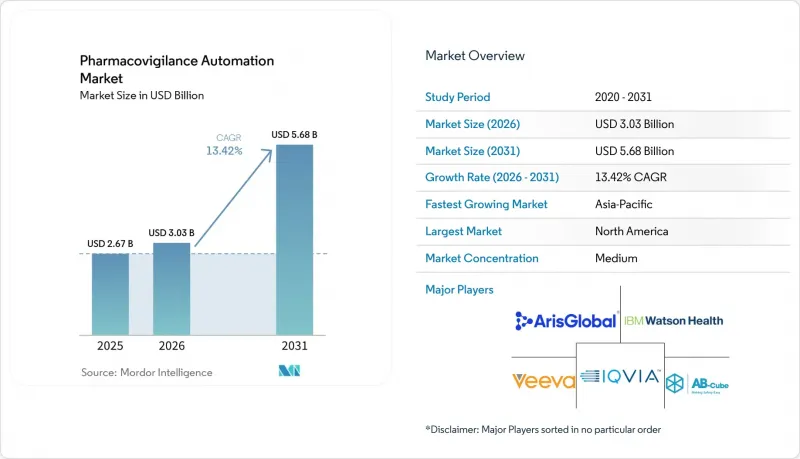
Mordor Intelligence에 의하면, 약물감시 자동화 시장 규모는 2025년에 26억 7,000만 달러로 평가되었습니다. 2026년에 30억 3,000만 달러에서 2031년까지 56억 8,000만 달러에 이를 것으로 예측됩니다.
2026년부터 2031년까지 연평균 성장률(CAGR) 13.42%로 성장할 것으로 전망됩니다.
본 보고서는 구성 요소(소프트웨어 및 서비스), 기술(인공지능(AI) 및 머신러닝, 기타), 기능(사례 처리 자동화, 기타), 배포 방식(클라우드 기반, On-Premise형, 하이브리드형), 최종 사용자(제약 회사, 기타), 지역(북미, 유럽, 기타)별로 분류되어 있습니다. 시장 규모 및 전망은 금액(달러) 기준으로 표시되어 있습니다.
세계의 약물감시 자동화 시장 동향 및 인사이트
의약품 안전 규정 준수에 대한 규제 압박 증가
세계 각국의 규제 당국은 보고 기한을 단축하고 데이터 품질 기준을 강화하고 있으며, 이로 인해 후원사는 인력만으로는 대규모로 반복할 수 없는 검증 점검을 자동화할 수밖에 없는 상황에 처해 있습니다. FDA와 EMA는 2026년 1월, 알고리즘을 통한 중복 감지, 서술적 요약 및 인과관계 코딩을 의료기기의 기능으로 간주하는 공동 원칙을 발표하고, 시판 전 검증 및 시판 후 감시를 의무화했습니다. 2025년 9월, 12개 판매 승인 보유사를 대상으로 시작된 EMA의 시범 사업은 이미 레거시 시스템의 규정 준수 문제를 여실히 드러내고 있습니다. 이러한 규제 요건은 감사 추적, 버전 관리 및 ISO 13485 인증을 갖춘 플랫폼을 제공하는 공급업체에 유리한 조건을 제공함으로써, 약물감시 자동화 시장을 견인하고 있습니다. CIOMS는 2025년 12월, AI 모델의 훈련 데이터셋 및 편향 완화 조치를 정기 안전성 보고서에 기재할 것을 권고함으로써 이러한 추세를 더욱 강화했습니다. 이러한 조치들은 종합적으로 볼 때 투자를 가속화하는 동시에, 규정 준수 대응 도구가 통합되지 않은 솔루션에 대한 진입 장벽을 높이고 있습니다.
다중 채널 출처에서 발생하는 이상반응 데이터량 증가
보고가 의사에 의한 제출에 그치지 않고 모바일 앱, 소셜 미디어, 웨어러블 기기까지 확대됨에 따라, 이상반응 건수는 폭발적으로 증가하고 있습니다. 인도에서는 2024년, 모바일 신고 앱을 통해 480만 건의 사례가 기록되어 2020년 수치의 거의 2배에 달했습니다. 학술 연구에 따르면, 소셜 미디어상의 사건 중 40%는 공식 신고 시스템에 접수되지 않고 있지만, 알고리즘을 활용한 데이터 마이닝을 실시하면 그중 15%는 더 빨리 드러나는 것으로 나타났습니다. 분산형 임상시험에서는 전자화된 환자 보고 결과(ePRO)가 제공되지만, 규제 당국은 후원사에게 24시간 이내에 선별 심사를 완료할 것을 요구하고 있으며, 이는 수동으로 심사를 수행하는 담당자에게는 비현실적인 과제입니다. 유럽의 DARWIN EU 네트워크는 2027년까지 1억 5,000만 건의 전자 기록을 추가하게 되어, 기존의 안전 관리 부문을 압도하게 될 것입니다. 따라서 데이터의 자동 수집과 NLP를 활용한 선별 작업이 필수적이며, 이는 약물감시 자동화 시장을 더욱 확대하게 될 것입니다.
데이터 개인정보 보호 및 관할 구역을 초월한 규정 준수상의 장벽
EU의 GDPR(EU 개인정보보호규정)은 복잡한 보호 조치가 없는 한, 적정성 인정을 받지 않은 관할 구역으로의 데이터 전송을 금지하고 있어, 미국에 본사를 둔 클라우드 도입을 복잡하게 만들고 있습니다. 중국의 PIPL은 엄격한 현지화를 의무화하고 있으며, 다국적 기업은 국내에서 격리된 데이터베이스를 운영해야 합니다. FDA는 여전히 외부 위탁 호스팅에 대해 21 CFR Part 11 준수를 요구하고 있어, 소규모 후원사의 감사 부담이 가중되고 있습니다. 이러한 중복된 법규는 데이터 레이크를 분할하고, 검증 비용을 증가시키며, 전환 속도를 늦추고, 약물감시 자동화 시장의 단기 목표 수익을 제한하고 있습니다.
부문별 분석
소프트웨어가 여전히 수익 기반의 대부분을 차지하는 한편, 서비스 부문의 비중은 확대되고 있습니다. 2025년 기준으로, 소프트웨어는 약물감시 자동화 시장의 65.82%를 차지했습니다. 그러나 성장은 매니지드 서비스 쪽으로 이동하고 있으며, 기술, 인건비, 규제 당국에 대한 신청을 단일 청구서로 통합한 사례별 아웃소싱 계약을 바탕으로, 서비스 부문은 2031년까지 연평균 성장률(CAGR) 14.31%를 나타낼 것으로 전망됩니다. EVERSANA가 2025년 7월에 공개한 ‘ORCHESTRATE PV’는 중견 바이오테크 기업이 라이선스 문제를 완전히 회피할 수 있도록 함으로써 이러한 전환을 상징하고 있습니다.
하이브리드형 참여 모델의 도입 또한 서비스 수익을 뒷받침하고 있습니다. 후원 기업들은 데이터 매핑, 검증 스크립트 작성, 규제 당국용 문서 작성이 필요한 12-18개월의 전환 기간 동안 컨설턴트에 의존하고 있습니다. Nextrove와 같은 틈새 시장 기업은 다국어 사례 번역을 전문으로 하며, 앞서 언급한 제약 사항을 해결하고 있습니다. 장래에는 자동화가 심화됨에 따라 인적 서비스가 대체될 가능성도 있지만, 세포 및 유전자 치료의 사후 관리 및 실세계 데이터(REW) 수집에 수반되는 복잡성으로 인해, 약물감시 자동화 업계에서는 기술과 인재를 융합한 패키지에 대한 수요가 지속될 것으로 보입니다.
2025년에는 인공지능(AI)과 머신러닝이 도입의 45.17%를 차지했습니다. 한편, 자연어 처리(NLP)는 분산형 임상시험 보고서, 환자 보고 결과(PRO), 그리고 소셜 미디어 데이터 분석의 도입에 힘입어 연평균 성장률(CAGR) 15.92%라는 가장 빠른 성장세를 보이고 있습니다. 트랜스포머 아키텍처는 영어에서 92%라는 놀라운 추출 정확도를 달성하여, 기존의 규칙 기반 시스템을 크게 능가하고 있습니다.
각 벤더사는 제약 요인으로 지적되고 있는 편향의 격차를 줄이기 위해 다국어 코퍼스 연구 개발에 주력하고 있습니다. 로보틱 프로세스 자동화(RPA)는 여전히 핵심 기반 역할을 하고 있지만, 그 기능이 보다 광범위한 솔루션 제품군에 직접 통합됨에 따라 성장세가 둔화되고 있습니다. 블록체인의 감사 추적 기록이나 그래프 데이터베이스의 시그널 맵을 포함하는 초기 시범 프로젝트는 ‘기타’ 범주에 분류되어 있으며, 이는 의약품 안전성 모니터링 자동화 시장에서 단기적인 수익 변동이라기보다는 향후 인접 분야로의 확장을 시사하고 있습니다.
지역별 분석
북미는 FDA의 적극적인 규제 집행과 AI의 조기 도입에 힘입어 2025년 매출의 36.48%를 차지했습니다. 안전성상의 미비 사항과 관련된 양식 483의 지적 사항은 2024년에 23% 급증하여, 후원 기업들이 자동화된 중복 점검 및 서술적 요약 도입을 서두르게 했습니다. 2026년 1월 발표된 FDA-EMA AI 원칙은 검증에 대한 기대치를 명확히 함으로써 투자를 더욱 촉진하고 있습니다. 캐나다와 멕시코는 규모는 작지만, 중앙 집중형 사례 접수 허브를 촉진하는 USMCA(미국·멕시코·캐나다 협정)의 일관성에서 혜택을 받고 있습니다. 이미 정착된 Argus 데이터베이스와의 통합에 따른 과제가 클라우드 전환을 지연시키고 있기 때문에 약물감시 자동화 시장 내에서는 서비스 컨설턴트에 대한 병행 수요가 지속되고 있습니다.
유럽은 매출액 기준 2위를 차지하고 있으며, DARWIN EU 및 의약품 안전성 위험 평가 위원회(PRAC)가 주관하는 2026년 규정 준수 모니터링 시범 사업 등 EMA의 노력으로부터 혜택을 받고 있습니다. 독일, 영국, 프랑스, 이탈리아, 스페인에는 제약 클러스터가 밀집해 있으며, 이것이 허가 신청 활동을 주도하고 있습니다. GDPR(EU 개인정보보호규정)의 엄격한 입장이 도입 방안을 좌우하고 있으며, 이것이 하이브리드 아키텍처가 급속히 확대되고 있는 이유입니다. 최근 ICH 개정안은 유럽의 전자 신청 게이트웨이와 호환되도록 되어 있어, 공급업체의 맞춤화 부담을 줄여주며, 이 지역을 약물감시 자동화 시장에서 매력적인 선점자(early mover)의 무대로 만들고 있습니다.
아시아태평양은 중국의 2024년 전자 신청 의무화와 인도의 모바일 앱 급증에 힘입어, 2031년까지 연평균 성장률(CAGR)이 19.34%로 가장 빠른 성장세를 보이고 있습니다. 일본의 ‘MIHARI’는 신호를 6개월 앞서 포착함으로써 구체적인 ROI(투자 대비 효과)를 입증하고 있으며, 한국과 호주에서도 이와 유사한 움직임이 잇따르고 있습니다. 중국의 PIPL(개인정보보호법)과 같은 현지화 규제는 알리바바 및 텐센트와의 국내 클라우드 제휴를 촉진하며, 광범위한 약물감시 자동화 시장 내에서 지역 고유의 생태계를 형성하고 있습니다. 중동 및 아프리카와 남미는 여전히 개발도상국 단계에 있지만, GCC(걸프협력회의) 규제 당국이 디지털 인프라를 구축하고 라틴아메리카 국가들이 ICH 기준에 부합해 나감에 따라 2028년 이후에는 성장세가 가속화될 가능성이 있습니다.
기타 혜택 :
- 엑셀 형식 시장 예측(ME) 시트
- 3개월간의 애널리스트 지원
자주 묻는 질문
목차
제1장 서론
제2장 조사 방법
제3장 주요 요약
제4장 시장 구도
제5장 시장 규모 및 성장 예측
제6장 경쟁 구도
제7장 시장 기회 및 향후 전망
KTH 26.06.26According to Mordor Intelligence, the pharmacovigilance automation market size is projected to be USD 2.67 billion in 2025, USD 3.03 billion in 2026, and reach USD 5.68 billion by 2031, growing at a CAGR of 13.42% from 2026 to 2031.
This report is Segmented by Component (Software and Services), Technology (Artificial Intelligence & Machine Learning, and More), Functionality (Automated Case Processing, and More), Deployment Mode (Cloud-Based, On-Premise, and Hybrid), End User (Pharmaceutical Companies, and More), and Geography (North America, Europe, and More). The Market and Forecasted in Terms of Value (USD).
Global Pharmacovigilance Automation Market Trends and Insights
Rising Regulatory Pressure for Drug-Safety Compliance
Global regulators have shortened reporting timelines and tightened data-quality thresholds, forcing sponsors to automate validation checks that human teams cannot repeat at scale. The FDA and EMA issued joint principles in January 2026 that treat algorithmic duplicate detection, narrative summarization, and causality coding as medical-device functions, requiring pre-market validation and post-market surveillance. EMA pilots that began in September 2025 across 12 marketing-authorization holders are already highlighting compliance gaps in legacy systems. These mandates reward vendors whose platforms ship with audit trails, version control, and ISO 13485 certification, thereby lifting the pharmacovigilance automation market. CIOMS reinforced the trend in December 2025 by recommending that AI model training datasets and bias-mitigation steps appear in periodic safety reports. Collectively, these measures accelerate investment while increasing entry barriers for solutions without embedded compliance tooling.
Increasing AE-Data Volumes From Multi-Channel Sources
Adverse-event counts are exploding as reports move beyond physician submissions to include mobile apps, social media, and wearables. India logged 4.8 million cases in 2024 via its mobile reporting app, nearly doubling 2020 figures. Academic work shows 40% of social-media events never reach formal reporting systems, yet 15% surface sooner when mined algorithmically. Decentralized trials feed electronic patient-reported outcomes that regulators expect sponsors to screen within 24 hours, an unrealistic task for manual reviewers. Europe's DARWIN EU network will add 150 million electronic records by 2027, overwhelming traditional safety desks. Automated ingestion and NLP triage, therefore, become essential, further expanding the pharmacovigilance automation market.
Data-Privacy & Cross-Jurisdiction Compliance Hurdles
The EU's GDPR blocks data transfers to non-adequate jurisdictions unless complex safeguards exist, complicating cloud deployments headquartered in the United States. China's PIPL enforces strict localization, obliging multinationals to run isolated databases inside the country. The FDA still requires 21 CFR Part 11 compliance for outsourced hosting, adding audit overhead for small sponsors. These overlapping statutes fragment data lakes, inflate validation costs, and slow the migration pace, limiting near-term addressable revenue for the pharmacovigilance automation market.
Other drivers and restraints analyzed in the detailed report include:
- Rapid Adoption of AI/ML-Centric Safety Platforms
- Cost-To-Serve Reduction Mandates by Big Pharma
- Legacy Safety-Database Integration Complexity
For complete list of drivers and restraints, kindly check the Table Of Contents.
Segment Analysis
Services are winning share even as software retains a dominant revenue base. In 2025, software captured 65.82% of the pharmacovigilance automation market share. Growth tilts toward managed offerings, however, with services posting a 14.31% CAGR to 2031 on the back of per-case outsourcing contracts that wrap technology, labor, and regulatory submissions into a single invoice. EVERSANA's July 2025 launch of ORCHESTRATE PV epitomizes this pivot by letting mid-tier biotechs bypass licenses altogether.
Adoption of hybrid engagement models is also fostering service revenue. Sponsors lean on consultants for 12-18 month migrations that demand data mapping, validation scripting, and regulator-facing documentation. Niche firms such as Nextrove specialize in multilingual case translation, addressing the restraints outlined earlier. Over the horizon, deeper automation could cannibalize human services, but complexities tied to cell-and-gene follow-up and real-world-evidence ingestion suggest sustained room for blended tech-plus-people packages inside the pharmacovigilance automation industry.
Artificial intelligence and machine learning are expected to account for 45.17% of deployments in 2025. Meanwhile, NLP is experiencing the fastest growth, with a 15.92% CAGR, fueled by the adoption of decentralized trial narratives, patient-reported outcomes, and analysis of social media data. Transformer architectures deliver an impressive 92% extraction accuracy for English, significantly outperforming traditional rule-based systems.
Vendors are pouring R&D into multilingual corpora to narrow the bias gap flagged as a restraint. Robotic process automation remains foundational but is flattening as capabilities embed directly into broader suites. Early pilots involving blockchain audit trails and graph-database signal maps are tucked in the "Others" bucket, signaling future adjacency plays rather than near-term revenue swings for the pharmacovigilance automation market.
Geography Analysis
North America generated 36.48% of 2025 revenue due to the FDA's aggressive enforcement and early AI uptake. Form 483 observations tied to safety deficiencies jumped 23% in 2024, pushing sponsors toward automated duplicate checking and narrative summarization. The January 2026 FDA-EMA AI principles further embolden investment by clarifying validation expectations. Canada and Mexico, though smaller, benefit from USMCA alignment that encourages centralized case-intake hubs. Integration headaches with entrenched Argus databases slow cloud conversions, sustaining a parallel demand stream for service consultants inside the pharmacovigilance automation market.
Europe ranks second in revenue and benefits from EMA initiatives such as DARWIN EU and the Pharmacovigilance Risk Assessment Committee's 2026 compliance-monitoring pilots. Germany, the United Kingdom, France, Italy, and Spain host dense pharma clusters driving license activity. GDPR's tough stance shapes deployment choices, explaining why hybrid architectures grow quickly. Recent ICH updates dovetail with European e-submission gateways, reducing customization overhead for vendors and making the region an attractive early-mover playground for the pharmacovigilance automation market.
Asia-Pacific is the fastest mover with a 19.34% CAGR through 2031, encouraged by China's 2024 e-submission mandate and India's mobile-app surge. Japan's MIHARI demonstrates tangible ROI by catching signals six months earlier, inspiring copycats in South Korea and Australia. Localization rules like China's PIPL foster domestic-cloud partnerships with Alibaba and Tencent, spawning a region-specific ecosystem inside the broader pharmacovigilance automation market. Middle East, Africa, and South America remain nascent but could accelerate post-2028 as GCC regulators build digital infrastructure and Latin American countries harmonize with ICH standards.
- AB Cube
- Accenture
- Aris Global
- BioClinica (Clario)
- Capgemini
- Cognizant
- Ennov
- EXTEDO
- Genpact
- IBM
- IQVIA
- Kinapse (Syneos Health)
- Oracle
- Parexel International
- ProductLife Group
- RxLogix
- Sparta Systems (Honeywell)
- TCS
- United BioSource (UBC)
- Veeva Systems
- Wipro
Additional Benefits:
- The market estimate (ME) sheet in Excel format
- 3 months of analyst support
TABLE OF CONTENTS
1 Introduction
- 1.1 Study Assumptions & Market Definition
- 1.2 Scope of the Study
2 Research Methodology
3 Executive Summary
4 Market Landscape
- 4.1 Market Overview
- 4.2 Market Drivers
- 4.2.1 Rising Regulatory Pressure for Drug-Safety Compliance
- 4.2.2 Increasing AE-Data Volumes From Multi-Channel Sources
- 4.2.3 Rapid Adoption of AI/ML-Centric Safety Platforms
- 4.2.4 Cost-To-Serve Reduction Mandates by Big Pharma
- 4.2.5 Automation Demand from Cell & Gene Therapy Post-Marketing Surveillance
- 4.2.6 Expansion of Real-World-Data (RWD) Networks Enabling Continuous Signal Detection
- 4.3 Market Restraints
- 4.3.1 Data-Privacy & Cross-Jurisdiction Compliance Hurdles
- 4.3.2 Legacy Safety-Database Integration Complexity
- 4.3.3 Vendor-Lock-in Concerns due to Proprietary AI Models
- 4.3.4 Multilingual NLP Model Bias Affecting Case-Intake Quality
- 4.4 Value / Supply-Chain Analysis
- 4.5 Regulatory Landscape
- 4.6 Technological Outlook
- 4.7 Porters Five Forces Analysis
- 4.7.1 Threat of New Entrants
- 4.7.2 Bargaining Power of Buyers
- 4.7.3 Bargaining Power of Suppliers
- 4.7.4 Threat of Substitutes
- 4.7.5 Competitive Rivalry
5 Market Size & Growth Forecasts (Value, USD)
- 5.1 By Component
- 5.1.1 Software
- 5.1.2 Services
- 5.2 By Technology
- 5.2.1 Artificial Intelligence (AI) & Machine Learning (ML)
- 5.2.2 Natural Language Processing (NLP)
- 5.2.3 Robotic Process Automation (RPA)
- 5.2.4 Others
- 5.3 By Functionality
- 5.3.1 Automated Case Processing
- 5.3.2 Adverse Event Reporting
- 5.3.3 Signal Detection & Risk Management
- 5.3.4 Medical Literature Monitoring
- 5.3.5 Others
- 5.4 By Deployment Mode
- 5.4.1 Cloud-based
- 5.4.2 On-premise
- 5.4.3 Hybrid
- 5.5 By End User
- 5.5.1 Pharmaceutical Companies
- 5.5.2 Biotechnology Companies
- 5.5.3 Contract Research Organizations (CROs)
- 5.5.4 Others
- 5.6 By Geography
- 5.6.1 North America
- 5.6.1.1 United States
- 5.6.1.2 Canada
- 5.6.1.3 Mexico
- 5.6.2 Europe
- 5.6.2.1 Germany
- 5.6.2.2 United Kingdom
- 5.6.2.3 France
- 5.6.2.4 Italy
- 5.6.2.5 Spain
- 5.6.2.6 Rest of Europe
- 5.6.3 Asia-Pacific
- 5.6.3.1 China
- 5.6.3.2 India
- 5.6.3.3 Japan
- 5.6.3.4 Australia
- 5.6.3.5 South Korea
- 5.6.3.6 Rest of Asia-Pacific
- 5.6.4 Middle East and Africa
- 5.6.4.1 GCC
- 5.6.4.2 South Africa
- 5.6.4.3 Rest of Middle East and Africa
- 5.6.5 South America
- 5.6.5.1 Brazil
- 5.6.5.2 Argentina
- 5.6.5.3 Rest of South America
- 5.6.1 North America
6 Competitive Landscape
- 6.1 Market Concentration
- 6.2 Market Share Analysis
- 6.3 Company Profiles (includes Global Level Overview, Market Level Overview, Core Segments, Financials as Available, Strategic Information, Market Rank/Share for Key Companies, Products & Services, and Recent Developments)
- 6.3.1 AB Cube
- 6.3.2 Accenture
- 6.3.3 ArisGlobal
- 6.3.4 BioClinica (Clario)
- 6.3.5 Capgemini
- 6.3.6 Cognizant
- 6.3.7 Ennov
- 6.3.8 EXTEDO
- 6.3.9 Genpact
- 6.3.10 IBM Watson Health
- 6.3.11 IQVIA
- 6.3.12 Kinapse (Syneos Health)
- 6.3.13 Oracle Corporation
- 6.3.14 Parexel International
- 6.3.15 ProductLife Group
- 6.3.16 RxLogix
- 6.3.17 Sparta Systems (Honeywell)
- 6.3.18 TCS
- 6.3.19 United BioSource (UBC)
- 6.3.20 Veeva Systems
- 6.3.21 Wipro
7 Market Opportunities & Future Outlook
- 7.1 White-space & Unmet-need Assessment


