|
시장보고서
상품코드
2063833
임상시험 환자 모집 분야 인공지능(AI) : 시장 점유율 분석, 업계 동향 및 통계, 성장 예측(2026-2031년)AI In Clinical Trial Patient Recruitment - Market Share Analysis, Industry Trends & Statistics, Growth Forecasts (2026 - 2031) |
||||||
 Mordor Intelligence
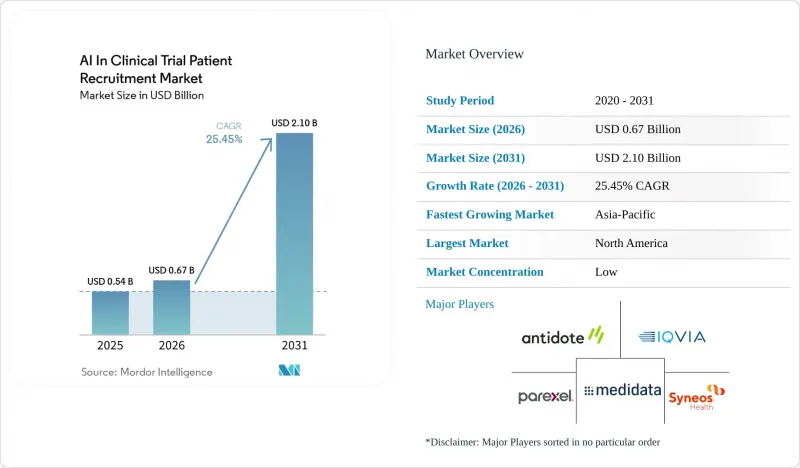
Mordor Intelligence에 의하면, 임상시험 환자 모집 분야 인공지능(AI) 시장 규모는 2025년 5억 4,000만 달러로 평가되었습니다. 2026년에는 6억 7,000만 달러로 확대되어 2026-2031년 CAGR은 25.45%를 나타내, 2031년까지 21억 달러에 이를 것으로 예측됩니다.
본 보고서는 AI 기술(머신러닝, 자연어 처리, 예측 분석, 컴퓨터 비전), 배포 방식(클라우드, On-Premise, 하이브리드), 임상시험 단계(I, II, III, IV), 치료 분야(종양학, 순환기, 신경학, 기타), 최종 사용자(제약·바이오기술, CRO, 기타), 데이터 소스(EHR, 유전체학, 레지스트리, 웨어러블), 지역별로 분류되어 있습니다. 시장 전망치는 금액(달러)으로 표시되어 있습니다.
세계의 임상시험 환자 모집 분야 인공지능(AI) 동향 및 인사이트
환자 등록 절차의 복잡화와 비용 증가가 AI 도입을 촉진하고 있습니다.
수동으로 의료 영상을 검토하는 데는 프로토콜당 평균 44.7시간이 소요되지만, AI 시스템을 사용하면 96%라는 높은 정확도로 단 2.5시간 만에 동일한 작업을 수행할 수 있습니다. 피험자 등록 지연은 여전히 큰 과제이며, 임상시험의 80%가 일정을 준수하지 못하고 있으며, 50%의 임상시험 실시 기관에서는 피험자를 단 한 명도 등록하지 못하고 있습니다. 이러한 비효율성을 해결하기 위해 스폰서들은 예측 등록 엔진의 도입을 확대되고 있습니다. 이러한 첨단 시스템 덕분에 활성화 기간이 39일에서 14일로 대폭 단축되고, 시설당 약 18만 달러의 불필요한 간접비가 절감됨에 따라 등록 절차가 간소화되고 시험 전반의 효율성이 향상됩니다.
팬데믹을 계기로 분산형 및 하이브리드 시험이 증가하면서 인프라 투자가 가속화되고 있습니다.
분산형 임상시험은 눈부신 성장을 거듭하고 있으며, 2025년에는 지출액이 86억 6,000만 달러에 달했으며, 앞으로도 계속 증가할 전망입니다. AI를 활용한 환자 매칭 기술은 이러한 임상시험에 필수적인 요소가 되어, 피험자 선정의 효율을 높이고 있습니다. 원격 의료를 통한 동의 획득 및 환자에게 직접 의약품을 배송하는 방식의 도입으로 임상시험의 지리적 범위가 확대되었으며, 기존에 학술 기관에 묶여 있던 반경 50마일이라는 제한이 해소되었습니다. 재택 모니터링과 정기적인 대면 방문을 결합한 하이브리드형 임상시험은 규제상의 안전 요건을 충족하는 동시에 AI가 탑재된 대시보드에 지속적인 데이터 스트림을 제공합니다. 이러한 접근 방식을 통해 안전 기준을 준수하면서도 기술을 활용하여 시험 운영을 최적화할 수 있게 됩니다.
편향과 사이버 보안 위협이 도입을 저해
종양학 사전 선별 모델에서는 정확도에 현저한 편차가 나타나며, 인종 하위 집단 간에 최대 12퍼센트 포인트의 차이가 확인되었습니다. 따라서 규제 당국은 이러한 불일치를 해결하기 위해 적극적인 편향 평가의 필요성을 강조하고 있습니다. 게다가 AI 플랫폼의 4분의 1 가까이가 종합적인 종단 간암호화 기능을 갖추지 못해, 기밀성이 높은 유전체 데이터가 유출 위험에 노출되어 있습니다. 이러한 취약점은 데이터 보안을 훼손할 뿐만 아니라, HIPAA나 GDPR(EU 개인정보보호규정)과 같은 규제 체계 하에서 조직이 규제상 제재를 받을 가능성으로 이어질 수도 있습니다.
부문별 분석
2025년, 임상시험 환자 모집 분야에서 머신러닝이 AI 시장 점유율의 45.10%를 차지하며, 시험 실시 기관의 실현 가능성을 정확하게 평가하는 능력을 보여주었습니다. 적격성 데이터의 최대 80%를 포함하는 자유 서술형 메모를 추출하는 알고리즘에 의해 주도되는 자연어 처리 시장은 연평균 성장률(CAGR) 26.25%라는 견실한 성장이 예상됩니다. 또한, 업계에서는 종양학 분야의 후원사가 실시한 실시간 파일럿 시험을 통해 유효성이 입증된 기법인 예측 분석도 점차 도입되고 있습니다. 이러한 접근 방식을 통해 베이즈 분석에 기반한 시험 진행 중 피험자의 재배정이 가능해집니다.
2세대 시스템은 합성 데이터를 활용하여 희귀질환 코호트를 강화하고, 식별자를 보호하면서 모델의 견고성을 높이고 있습니다. AI/ML 소프트웨어 지침을 준수하는 데는 라이프사이클당 약 80만 달러의 추가 비용이 소요되지만, 시장 출시 기간은 길어지더라도 신중한 제약사들의 신뢰를 크게 높여주고 있습니다.
2025년, 스폰서들이 On-Premise GPU에 대한 지출을 피한 결과, 임상시험 환자 모집 분야에서 AI 시장의 61.00%를 클라우드 플랫폼이 차지했습니다. 그러나 국경을 넘는 데이터 전송에 제한을 두는 규제를 배경으로, 하이브리드 모델은 연평균 성장률(CAGR) 26.86%로 성장하고 있습니다. 시장에서는 식별자를 On-Premise에 보관하면서 익명화된 적격성 요약 정보를 전 세계 대시보드로 전송하는 하이브리드 워크플로가 널리 보급되어 있으며, 여러 관할 구역에 걸친 규정 준수를 확보하기 위해 15%의 지연이라는 타협점을 용인하는 균형이 잡혀 있습니다.
지역별 분석
북미는 5만 곳의 활성 임상시험 실시 기관과, 벤더가 의료 시스템의 데이터 레이크에 원활하게 통합될 수 있도록 지원하는 광범위한 FHIR 상호운용성에 힘입어 전 세계 매출의 거의 절반을 차지하고 있습니다. 또한, 이 지역은 실시간 모니터링을 실증하는 FDA의 시범 사업의 혜택을 받고 있어, 리스크 회피 성향이 강한 후원사들에게 안도감을 주고, 조달 결정을 가속화하고 있습니다. 또한, 각 주의 메디케이드 청구 처리 시스템은 72시간 이내에 질병 발생 사례를 파악함으로써 피험자 모집 활동을 강화하고 있습니다.
아시아태평양은 가장 빠르게 성장하고 있는 지역입니다. 일본에서 생성형 AI를 활용한 사전 선별을 효과적으로 활용하는 사례와, 중국에서 국경을 넘기 전에 익명화된 데이터에 대한 보안 심사를 의무화하는 규제는 하이브리드 도입을 촉진하고 있습니다. 호주, 싱가포르, 한국도 유사한 체계를 채택하고 있으며, 희귀질환 진단에 중점을 둔 정부 보조금의 지원을 받아 임상시험 환자 모집에 AI를 더욱 적극적으로 활용하고 있습니다.
유럽은 GDPR(EU 개인정보보호규정)을 준수하는 아키텍처에 힘입어 이러한 추세를 이어가고 있습니다. 알고리즘 투명성에 관한 EMA의 지침과 조만간 시행될 EU AI법에 따라, 27개국에 걸친 신청 절차가 간소화되고 규정 준수 비용이 절감될 뿐만 아니라, 중견 바이오기술 기업들이 자신감을 가지고 다국간 연구를 확대할 수 있게 될 것입니다. 동유럽의 병원에서는 HL7 FHIR 표준을 준수하는 EHR 시스템 도입이 진행되고 있으며, 이를 통해 종양학 및 순환기학 분야의 임상시험을 위한 새로운 환자층이 개척되고 있습니다.
기타 혜택 :
- 엑셀 형식 시장 예측(ME) 시트
- 3개월간의 애널리스트 지원
자주 묻는 질문
목차
제1장 서론
제2장 조사 방법
제3장 주요 요약
제4장 시장 구도
제5장 시장 규모 및 성장 예측
제6장 경쟁 구도
제7장 시장 기회 및 향후 전망
KTH 26.06.24According to Mordor Intelligence, the aI in clinical trial patient recruitment market size is expected to grow from USD 0.54 billion in 2025 to USD 0.67 billion in 2026 and is forecast to reach USD 2.10 billion by 2031 at 25.45% CAGR over 2026-2031.
This report is Segmented by AI Technology (Machine Learning, NLP, Predictive Analytics, Computer Vision), Deployment (Cloud, On-Premises, Hybrid), Trial Phase (I, II, III, IV), Therapeutic Area (Oncology, Cardiovascular, Neurology, Others), End User (Pharma/Biotech, Cros, and More), Data Source (EHR, Genomics, Registries, Wearables), and Geography. Market Forecasts are in Value (USD).
Global AI In Clinical Trial Patient Recruitment Market Trends and Insights
Increasing Complexity and Cost of Patient Enrollment Propel AI Adoption
Manual chart reviews require an average of 44.7 hours per protocol, whereas AI systems can perform the same task in just 2.5 hours with a high accuracy rate of 96%. Enrollment delays remain a significant challenge, with 80% of trials failing to meet their timelines and 50% of sites unable to enroll any patients. To address these inefficiencies, sponsors are increasingly implementing predictive enrollment engines. These advanced systems significantly reduce activation time from 39 days to 14 days and eliminate approximately USD 180,000 in unnecessary overhead costs per site, streamlining the enrollment process and improving overall trial efficiency.
Pandemic-Led Rise of Decentralized and Hybrid Trials Accelerates Infrastructure Investment
Decentralized clinical trials have experienced substantial growth, with spending reaching USD 8.66 billion in 2025 and continuing to rise. AI-driven patient-matching technologies have become integral to these trials, enhancing the efficiency of participant selection. The adoption of telemedicine consent and direct-to-patient drug shipping has expanded the geographic reach of trials, removing the previous 50-mile radius limitation tied to academic centers. Hybrid trials, which combine home-based monitoring with periodic in-person visits, address regulatory safety requirements while simultaneously providing continuous data streams to AI-powered dashboards. This approach ensures compliance with safety standards while leveraging technology to optimize trial operations.
Bias and Cybersecurity Threats Constrain Adoption
Oncology prescreening models exhibit significant accuracy disparities, with up to a 12-percentage-point gap observed across racial subgroups. This has prompted regulatory bodies to emphasize the need for proactive bias assessments to address these discrepancies. Additionally, nearly a quarter of AI platforms lack comprehensive end-to-end encryption, leaving sensitive genomic data vulnerable to breaches. Such vulnerabilities not only compromise data security but also expose organizations to potential regulatory penalties under frameworks like HIPAA or GDPR.
Other drivers and restraints analyzed in the detailed report include:
- Regulatory Push for Real-World Data and AI Validation Pathways Creates New Enrollment Opportunities
- Growing EHR Interoperability Enables Scalable Prescreening
- Under-Representation of Minority Cohorts Limits Generalizability
For complete list of drivers and restraints, kindly check the Table Of Contents.
Segment Analysis
In 2025, machine learning captured 45.10% of the AI market share in clinical trial patient recruitment, showcasing its capability to accurately rank site feasibility. Natural-language processing, driven by algorithms proficient in mining free-text notes containing up to 80% of eligibility data, is projected to grow at a robust 26.25% CAGR. The industry is also adopting predictive analytics, a method validated in real-time pilots with oncology sponsors. This approach enables mid-study patient reassignments based on Bayesian analyses.
Second-generation systems utilize synthetic data to strengthen rare-disease cohorts, enhancing model robustness while protecting identifiers. Compliance with AI/ML software guidance adds an estimated USD 800,000 per lifecycle, extending the time to market but significantly increasing trust among cautious pharmaceutical sponsors.
In 2025, cloud platforms accounted for 61.00% of the AI market in clinical trial patient recruitment, as sponsors avoided on-premise GPU expenditures. However, hybrid models are expanding at a 26.86% CAGR, driven by regulations that impose restrictions on cross-border data transfers. The market is witnessing hybrid workflows that retain identifiers on-site while transmitting anonymized eligibility summaries to global dashboards, balancing a 15% latency trade-off for compliance across multiple jurisdictions.
Geography Analysis
North America contributes nearly half of global revenue, driven by 50,000 active investigator sites and extensive FHIR interoperability, which enables vendors to seamlessly integrate into health-system data lakes. The region also benefits from FDA pilots that demonstrate real-time oversight, providing assurance to risk-averse sponsors and accelerating procurement decisions. Additionally, state Medicaid claims engines enhance recruitment efforts by identifying disease events within 72 hours.
Asia-Pacific is the fastest-growing territory. Japan's effective use of generative-AI prescreeners and China's regulation requiring anonymized data to undergo security reviews before crossing borders encourage hybrid deployments. Australia, Singapore, and South Korea are adopting similar frameworks, supported by government grants focused on rare-disease diagnostics, which expand the AI in clinical trial patient recruitment market.
Europe follows, supported by GDPR-compliant architectures. EMA guidance on algorithmic transparency and the upcoming EU AI Act simplify filings across 27 states, reducing compliance costs and enabling mid-sized biotech firms to scale multi-country studies with confidence. Eastern European hospitals are increasingly implementing EHR systems compatible with HL7 FHIR standards, unlocking new patient pools for oncology and cardiology trials.
- AiCure
- Antidote Technologies
- BEKHealth
- Citeline Connect
- Clarify Health
- DataCubed Health
- Deep Lens (Guardant Health)
- Deep6 AI
- Evidation Health
- ICON
- Innoplexus
- IQVIA
- Medidata Solutions
- ObvioHealth
- Oracle Health Sciences
- Parexel International
- Reify Health
- Syneos Health
- TrialSpark
- TrialX
- Unlearn.AI
Additional Benefits:
- The market estimate (ME) sheet in Excel format
- 3 months of analyst support
TABLE OF CONTENTS
1 Introduction
- 1.1 Study Assumptions & Market Definition
- 1.2 Scope of the Study
2 Research Methodology
3 Executive Summary
4 Market Landscape
- 4.1 Market Overview
- 4.2 Market Drivers
- 4.2.1 Increasing Complexity & Cost of Patient Enrolment
- 4.2.2 Pandemic-Led Rise of Decentralized & Hybrid Trials
- 4.2.3 Regulatory Push for Real-World Data & AI Validation Pathways
- 4.2.4 Growing EHR Interoperability Enabling Scalable Pre-Screening
- 4.2.5 Multimodal Genomic-Phenotypic Matching Boosting Accuracy
- 4.3 Market Restraints
- 4.3.1 Data-Privacy & Cybersecurity Concerns Around Patient Data
- 4.3.2 Under-Representation of Minority Cohorts in Training Sets
- 4.3.3 Explainability & Validation Hurdles for AI Algorithms
- 4.3.4 Site-Level Workflow Inertia & Change-Management Friction
- 4.4 Value / Supply-Chain Analysis
- 4.5 Regulatory Landscape
- 4.6 Technological Outlook
- 4.7 Porters Five Forces Analysis
- 4.7.1 Bargaining Power of Suppliers
- 4.7.2 Bargaining Power of Buyers
- 4.7.3 Threat of New Entrants
- 4.7.4 Threat of Substitutes
- 4.7.5 Competitive Rivalry
5 Market Size & Growth Forecasts (Value, USD)
- 5.1 By AI Technology
- 5.1.1 Machine Learning
- 5.1.2 Natural Language Processing
- 5.1.3 Predictive Analytics
- 5.1.4 Computer Vision
- 5.2 By Deployment Model
- 5.2.1 Cloud-Based
- 5.2.2 On-Premise
- 5.2.3 Hybrid
- 5.3 By Clinical Trial Phase
- 5.3.1 Phase I
- 5.3.2 Phase II
- 5.3.3 Phase III
- 5.3.4 Phase IV (Post-Marketing)
- 5.4 By Therapeutic Area
- 5.4.1 Oncology
- 5.4.2 Cardiovascular
- 5.4.3 Neurology
- 5.4.4 Metabolic Disorders
- 5.4.5 Infectious Diseases
- 5.4.6 Rare Diseases
- 5.4.7 Others
- 5.5 By End User
- 5.5.1 Pharmaceutical & Biotech Sponsors
- 5.5.2 Contract Research Organizations (CROs)
- 5.5.3 Academic Medical Centers
- 5.5.4 Hospital Sites & Investigator Groups
- 5.5.5 Patient Recruitment Agencies
- 5.6 By Data Source
- 5.6.1 Electronic Health Records (EHR)
- 5.6.2 Genomic & Omics Datasets
- 5.6.3 Patient Registries
- 5.6.4 Insurance Claims
- 5.6.5 Wearables & Digital Biomarkers
- 5.7 By Geography
- 5.7.1 North America
- 5.7.1.1 United States
- 5.7.1.2 Canada
- 5.7.1.3 Mexico
- 5.7.2 Europe
- 5.7.2.1 Germany
- 5.7.2.2 United Kingdom
- 5.7.2.3 France
- 5.7.2.4 Italy
- 5.7.2.5 Spain
- 5.7.2.6 Rest of Europe
- 5.7.3 Asia-Pacific
- 5.7.3.1 China
- 5.7.3.2 India
- 5.7.3.3 Japan
- 5.7.3.4 South Korea
- 5.7.3.5 Australia
- 5.7.3.6 Rest of Asia-Pacific
- 5.7.4 Middle East & Africa
- 5.7.4.1 GCC
- 5.7.4.2 South Africa
- 5.7.4.3 Rest of Middle East and Africa
- 5.7.5 South America
- 5.7.5.1 Brazil
- 5.7.5.2 Argentina
- 5.7.5.3 Rest of South America
- 5.7.1 North America
6 Competitive Landscape
- 6.1 Market Concentration
- 6.2 Market Share Analysis
- 6.3 Company Profiles (includes Global level Overview, Market-level Overview, Core Segments, Financials, Strategic Information, Market Rank/Share, Products & Services, Recent Developments)
- 6.3.1 AiCure
- 6.3.2 Antidote Technologies
- 6.3.3 BEKHealth
- 6.3.4 Citeline Connect
- 6.3.5 Clarify Health
- 6.3.6 DataCubed Health
- 6.3.7 Deep Lens (Guardant Health)
- 6.3.8 Deep6 AI
- 6.3.9 Evidation Health
- 6.3.10 ICON plc
- 6.3.11 Innoplexus
- 6.3.12 IQVIA
- 6.3.13 Medidata Solutions
- 6.3.14 ObvioHealth
- 6.3.15 Oracle Health Sciences
- 6.3.16 Parexel
- 6.3.17 Reify Health
- 6.3.18 Syneos Health
- 6.3.19 TrialSpark
- 6.3.20 TrialX
- 6.3.21 Unlearn.AI
7 Market Opportunities & Future Outlook
- 7.1 White-space & Unmet-Need Assessment