

|
시장보고서
상품코드
2099828
임상 인텔리전스 시장 : 시장 점유율 분석, 업계 동향 및 통계, 성장 예측(2026-2031년)Clinical Intelligence - Market Share Analysis, Industry Trends & Statistics, Growth Forecasts (2026 - 2031) |
||||||
 Mordor Intelligence
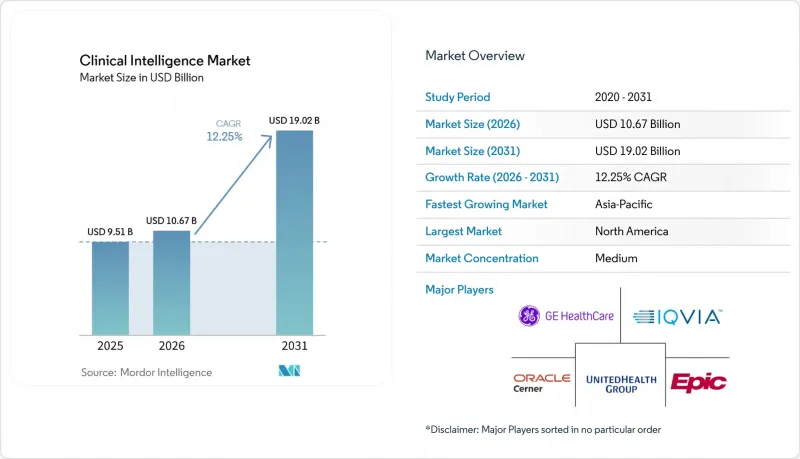
Mordor Intelligence에 의하면, 임상 인텔리전스 시장 규모는 2025년 95억 1,000만 달러로 평가되었고, 2026년 106억 7,000만 달러에서 2031년까지 190억 2,000만 달러로 확대될 전망이며, 2026-2031년 CAGR 12.25%를 나타낼 것으로 예측됩니다.
본 보고서는 유형별(CDSS, 집단건강관리, 소급적 성과 관리 및 예측 분석 등), 구성 요소별(소프트웨어, 서비스, 하드웨어), 도입 형태별(클라우드 기반, 온프레미스형, 하이브리드형), 최종 사용자별(병원, 의료 서비스 제공업체, 약국, 기타), 지역별(북미, 유럽, 아시아태평양 등)로 분류되어 있습니다. 예측치는 금액(달러)으로 표시되어 있습니다.
세계의 임상 인텔리전스 시장 동향 및 인사이트
전자건강기록(EHR), 보험 청구 데이터 및 임상 데이터 레이크의 보급
임상 인텔리전스 시장은 EHR 시스템, 청구 데이터 환경, 사회적 결정 요인의 입력 정보에 걸쳐 있는 더 대규모이며 분산된 임상 데이터베이스로부터 구조적인 지원을 얻고 있습니다. 2024년에는 EU 회원국 전체에서 EHR 도입률이 83%를 나타낸 것으로 평가되었으며, 이는 기관 차원의 분석 및 모델 개발을 위한 더 고밀도의 종단적 환자 데이터 풀이 존재함을 시사합니다. 더 중요한 변화는 의료 시스템이 원시 데이터를 조직의 경계를 넘어 이동시키지 않고도 모델 학습 및 추론을 수행할 수 있는 연합 분석 계층을 구축하고 있다는 점입니다. 이러한 변화로 인해 조직은 HIPAA 및 GDPR(EU 개인정보보호규정) 규제 프레임워크 내에서 데이터 생성부터 임상 조치에 이르는 프로세스를 단축할 수 있게 되어, 속도와 개인정보 보호 간의 상충 관계가 완화됩니다. 따라서 임상 인텔리전스 시장에서는 여러 소스에 걸쳐 분산된 데이터 패브릭을 관리할 수 있는 벤더가 우위를 점하고 있습니다. 이러한 플랫폼은 단일 인스턴스의 데이터 수집 도구보다 대규모 계약이나 광범위한 이용 사례에 대응하기 쉬운 위치에 있기 때문입니다.
사후 보고에서 실시간 임상 조치로의 전환
임상 인텔리전스 시장은 관리적 검토를 목적으로 구축된 사후 보고형 도구에서 임상 현장에서의 진료 자체에 있어 의사 결정에 영향을 미칠 수 있는 실시간 시스템으로 전환되고 있습니다. CMS 보고서에 따르면, BPCI Advanced 프로그램에서는 기준치와 비교해 에피소드당 지급액이 1,014달러 감소했으며, 외과 수술 에피소드의 경우 에피소드당 1,694달러의 감소가 나타났습니다. 이로 인해 의료 제공업체 입장에서는 변동성이 비용 유출로 이어지기 전에 개입할 수 있는 도구를 도입해야 할 측정 가능한 근거가 생겼습니다. 또한, 이로 인해 이러한 플랫폼을 구매하는 주체도 변화하고 있습니다. 조달 담당자가 품질 관리 팀에서 실적 평가 기간 동안 가시적인 비용 절감을 요구하는 재무 책임자나 가치 기반 계약 팀으로 이동하고 있기 때문입니다. 이에 따라 임상 인텔리전스 시장에 대한 증거 기준이 높아지고 있습니다. 진료 상황별 상세한 분석이 불가능한 광범위한 대시보드는 시의성이 중요한 계약에서는 유용성이 떨어지기 때문입니다. 그 결과, 특히 종합적 지불 제도나 책임 의료(Accountable Care)의 압박을 받고 있는 시스템에서 과거의 진료 패턴을 즉각적인 워크플로우 지침으로 연결해 주는 플랫폼에 대한 선호도가 높아지고 있습니다.
다중 벤더 임상 시스템 스택에서의 상호 운용성 마찰
임상 인텔리전스 시장은 여전히 큰 실행상의 장벽에 직면해 있습니다. EHR, 청구 데이터, 영상 진단 및 기타 임상 데이터 시스템 간의 의미론적 불일치로 인해, 많은 벤더가 시사하는 것보다 도입에 더 많은 시간이 소요되고 비용도 높아지고 있기 때문입니다. 『Frontiers in Health Services』지에 게재된 2025년 체계적 문헌고찰에 따르면, HL7 FHIR, SNOMED CT, LOINC의 도입 현황에 편차가 있는 데다, API 표준화의 격차가 워크플로우의 비효율성과 의사결정 지연을 계속해서 유발하고 있는 것으로 밝혀졌습니다. Epic, Oracle Health, athenahealth와 같은 여러 EHR 시스템을 통합할 때의 부담은 소스가 하나 추가될 때마다 데이터 처리의 분기점이 늘어나 도입에 드는 노력이 증가합니다. 미국의 TEFCA나 유럽의 European Health Data Space와 같은 거버넌스 노력은 신뢰성과 접근 규칙 개선에 기여하고 있습니다. 하지만 이러한 노력만으로는 벤더별 FHIR 구현 내부의 의미론적 차이를 완전히 해소하지는 못하고 있습니다. 즉, 임상 인텔리전스 시장에서는 사내에 고도의 엔지니어링 역량을 갖춘 대규모 의료 제공업체가 여전히 진입하기 쉬운 상황이 지속되고 있습니다. 반면, 중규모 시스템의 경우 투자 회수 기간이 길어지고, 플랫폼 투자에 대한 실질적인 수익률도 낮아지는 경향이 있습니다.
부문 분석
2025년 시점에서 임상 의사결정 지원 시스템(CDSS)은 임상 인텔리전스 시장의 31.31%를 차지했으며, 현재 매출 구성에서 가장 큰 부문으로 자리 잡고 있습니다. 이러한 위상은 EHR(전자건강기록) 워크플로우와의 긴밀한 통합과 보험사 주도의 근거 기반 처방 요건을 반영한 결과이며, 병원 입장에서는 CDSS 도입이 불가피한 상황이 되었습니다. 임상 인텔리전스 시장에서 Epic 및 Oracle Health 환경에 통합된 CDSS 도구는 데이터 전송으로 인한 지연 없이 입력 시점의 임상 이벤트로부터 권장 사항을 생성할 수 있으므로, 데이터에 대한 직접적인 접근성의 이점을 누리고 있습니다. 위험 부담 기관은 여전히 환자 패널(담당 환자 집단)에 대한 가시성을 필요로 하기 때문에 집단건강관리(Population Health Management)는 2위 부문으로 자리 잡고 있지만, 지불자 간에 파편화된 데이터 흐름이 일부 시장에서 이러한 도구의 진정한 가치를 충분히 발휘하는 것을 계속해서 방해하고 있습니다. 품질 개선 및 성과 측정 시스템 또한, 특히 유럽의 의료 시스템에서 전국적인 품질 등록부 및 결과 기반 상환 체계로 인해 더욱 엄격한 보고 체계가 요구되는 가운데 그 존재감을 높이고 있습니다.
'소급적 성과 관리 및 예측 분석'은 2026-2031년 연평균 성장률(CAGR) 15.38%를 기록하며 가장 빠르게 성장하는 부문으로, 그 성장 속도는 임상 인텔리전스 시장 전체를 크게 상회하고 있습니다. 이러한 성장은 현행 가치 기반 계약 하에서 과거 의료 서비스의 변동성과 미래를 내다본 비용 및 결과 예측을 연계해야 하는 의료 제공업체들 수요를 반영하고 있습니다. 2026년 『npj Digital Medicine』 저널의 연구에 따르면, 자동화된 약리유전학 권장 시스템은 수동 검토 과정으로는 도저히 따라잡을 수 없는 속도와 일관성으로 근거 기반의 결과를 생성할 수 있는 것으로 나타났습니다. 이는 임상 인텔리전스 업계에 중요한 의미를 지닙니다. 왜냐하면 소급적 분석 도구가 더 이상 사후 검토에만 국한되지 않고, 실시간 의사결정 지원을 위해 정보를 제공하는 목적으로 구축되는 사례가 늘어나고 있기 때문입니다. 따라서 사후 인텔리전스와 진료 에피소드 수준 인텔리전스 간의 실질적인 경계가 좁혀지고 있으며, 임상 인텔리전스 시장의 구매자들은 이전 조달 주기에 비해 이러한 플랫폼을 CDSS(임상 의사결정 지원 시스템) 도구와 더 직접적으로 비교하고 있습니다.
2025년에는 소프트웨어가 매출의 56.24%를 차지했으며, 임상 인텔리전스 시장 전체에서 계속해서 가장 큰 구성 요소가 되었습니다. 의료 서비스 제공업체들은 서로 연동되지 않은 도구를 개별적으로 조합하는 대신, 데이터 수집, 거버넌스, 분석, AI 실행을 단일 환경에서 통합한 플랫폼에 대한 지출을 지속하고 있습니다. 이러한 매출 측면의 우위는 용도를 핵심 데이터 인프라에 연결하는 구독형 라이선싱 및 번들링 전략을 통해 강화되고 있으며, 시간이 지남에 따라 워크플로우에 대한 의존도가 높아지고 있습니다. 많은 워크로드가 클라우드 환경으로 이전됨에 따라 하드웨어가 지출에서 차지하는 비중은 현재 줄어들고 있지만, 로컬 처리나 데이터 상주성이 여전히 중요한 특정 유전체학 및 영상 진단 분야에서는 고성능 컴퓨팅이 여전히 중요한 역할을 수행하고 있습니다. 이러한 구조는 도입 심화가 고객 가치에서 차지하는 비중이 점점 커지고 있음에도 불구하고, 임상 인텔리전스 시장이 여전히 주로 플랫폼을 통해 수익을 창출하고 있음을 보여줍니다.
서비스 부문은 가장 빠르게 성장하는 분야로, 2026-2031년 연평균 성장률(CAGR) 16.52%를 나타낼 것으로 전망됩니다. 이는 많은 조직이 소프트웨어를 구매할 수는 있지만, 그로부터 가치를 창출하는 데 필요한 운영 체제가 여전히 갖춰지지 않았기 때문입니다. 의료 제공업체 전반에 걸쳐 데이터 사이언스 역량, 워크플로우 재설계 역량, 그리고 관리형 분석 지원에 큰 격차가 존재합니다. 또한, 2026년 유나이티드헬스그룹이 15억 달러 규모의 AI 투자를 약속한 것은 대규모 통합 기업이 소규모 시스템이 여전히 외부 파트너로부터 조달해야 하는 역량을 사내에서 자체적으로 구축할 수 있음을 보여주는 신호로 언급되었습니다. 임상 인텔리전스 업계에서는 파마코유전체학의 통합, 다중 소스 데이터 거버넌스, 그리고 워크플로우 내 통합과 관련된 서비스 업무가 기존의 보고서 작성 체계보다 더 큰 전략적 가치를 지니고 있습니다. 따라서 임상 인텔리전스 시장에서는 단순한 기술 도입뿐만 아니라 구현, 최적화 및 변경 관리를 중심으로 더욱 강력한 서비스 계층이 등장하고 있습니다.
지역별 분석
2025년, 북미는 임상 인텔리전스 시장의 43.61%를 차지했으며, 매출 측면에서 가장 규모가 큰 지역 기여자가 되었습니다. 이 지역은 가치 기반 의료 인프라가 잘 갖춰져 있고, EHR(전자 건강 기록) 기반이 성숙해 있으며, 통합형 의료 시스템을 통한 집중적인 기술 투자의 혜택을 받고 있습니다. 미국은 여전히 최대의 국가별 시장으로 자리 잡고 있습니다. 이는 CMS(미국 의료보험센터)의 지급 모델이 관리되지 않는 의료의 불균형에 직접적인 경제적 영향을 미치며, 진료 현장 수준에서의 실시간 임상 지원에 대한 명확한 수요를 창출하고 있기 때문입니다. Oracle은 2026년 3월, 자사의 ‘Oracle Health Clinical AI Agent’가 미국 내 도입 사례를 통해 의사의 근무 시간을 20만 시간 이상 단축했다고 발표했습니다. 또한 아틀란티케어는 문서 작성 시간을 41% 단축했다고 보고했으며, 이러한 사례들은 구매자가 임상 인텔리전스 시장을 평가할 때 구체적인 워크플로우 벤치마크가 됩니다. 캐나다와 멕시코도 수요를 서서히 확대하고 있으며, 캐나다 주정부 시스템에서는 예측 분석을 활용하여 고령화에 따른 선택적 수술 대기 목록 및 장기 요양 부담을 관리하고 있습니다.
유럽은 임상 인텔리전스 시장에서 두 번째로 큰 규모를 자랑하는 지역이며, 독일과 영국이 이 지역 내에서 가장 중요한 성장 거점으로 두각을 나타내고 있습니다. 2026년 2월에 발표된 독일의 'GEMEINSAM DIGITAL 2026' 전략에서는 2028년까지 의료 및 요양 시설의 70% 이상에서 AI를 활용한 임상 기록 작성을 실현하는 것을 목표로 하고 있으며, 2030년까지 전자 환자 기록의 활성 사용자 수를 400만 명에서 2,000만 명으로 늘리는 것을 목표로 하고 있습니다. 2025년 7월에 발표된 프랑스의 AI 및 건강 데이터에 관한 국가 전략에서는 자동화된 임상 문서 작성이 단기적으로 최우선으로 추진될 AI 활용 사례로 지정되었으며, 주권적 데이터 호스팅 및 유럽 건강 데이터 공간(European Health Data Space) 준비와 연계되었습니다. 영국에서는 NHS(국민보건서비스)의 상호운용성 요건을 통해 구형 분석 시스템의 교체가 가속화되고 있습니다. 한편, 이탈리아와 스페인은 여전히 중규모 시장이며, 공공 디지털화 프로그램을 통해 집단건강관리 및 벤치마킹 도구에 대한 초기 수요가 발생하고 있습니다.
아시아태평양은 임상 인텔리전스 시장에서 가장 빠르게 성장하는 지역 부문으로, 2026-2031년 연평균 성장률(CAGR) 16.15%를 나타낼 것으로 전망됩니다. 중국, 인도, 한국, 호주, 일본에서 진행 중인 정부 주도의 의료 디지털화는 분석 도구 도입과 워크플로우 자동화를 위한 견고한 기반을 마련하고 있습니다. 인도의 ‘국가 디지털 헬스 미션(National Digital Health Mission)’은 건강 식별자의 표준화와 AI를 활용한 지역 의료 개입을 위한 데이터 기반 강화를 통해 집단건강관리 도구의 적용 범위를 확대되고 있습니다. 한국의 커넥티드 병원 투자와 일본의 고령화는 만성 질환 관리 및 노인 돌봄 분야에서 예측 도구에 대한 수요를 뒷받침하고 있습니다. 중동 및 아프리카에서는 걸프 국가들이 도입을 주도하고 있으며, Oracle, 클리블랜드 클리닉, G42는 2025년 5월, UAE를 거점으로 하는 AI 기반의 세계 헬스케어 제공 플랫폼을 출범하기 위한 전략적 제휴를 발표했습니다. 이는 해당 지역에서도 임상 인텔리전스 시장이 국가의 핵심 역량으로 자리매김하고 있음을 보여줍니다. 남미는 여전히 규모는 작지만 성장세가 두드러지는 시장이며, 브라질과 아르헨티나에서는 전자건강기록(EHR) 구축을 바탕으로 병원 시스템 및 확대되는 민간 의료보험 네트워크를 통한 분석 주도형 케어 관리로 전환이 진행되고 있습니다.
기타 혜택 :
- 엑셀 형식 시장 예측(ME) 시트
- 3개월간의 애널리스트 지원
자주 묻는 질문
목차
제1장 서론
제2장 조사 방법
제3장 주요 요약
제4장 시장 구도
제5장 시장 규모 및 성장 예측
제6장 경쟁 구도
제7장 시장 기회 및 향후 전망
AJY 26.08.07According to Mordor Intelligence, the clinical intelligence market size is projected to expand from USD 9.51 billion in 2025 and USD 10.67 billion in 2026 to USD 19.02 billion by 2031, registering a CAGR of 12.25% between 2026 to 2031.
This report is Segmented by Type (CDSS, Population Health Management, Retrospective Performance Management & Predictive Analytics, and More), Component (Software, Services, Hardware), Deployment (Cloud-Based, On-Premise, Hybrid), End User (Hospitals, Healthcare Providers, Pharmacies, Other), & Geography (North America, Europe, Asia-Pacific, and More). Forecasts are Provided in Value (USD).
Global Clinical Intelligence Market Trends and Insights
Proliferation of EHR, Claims, and Clinical Data Lakes
The Clinical intelligence market is gaining structural support from a larger and more distributed clinical data base that now stretches across EHR systems, claims environments, and social determinants inputs. EHR adoption reached 83% across EU member states in 2024, which points to a much denser pool of longitudinal patient data for analytics and model development at institutional scale. The more important change is that health systems are building federated analytics layers that let them train models and run inference without moving raw records across institutional boundaries. That change reduces the tradeoff between speed and privacy, because organizations can shorten the path from data generation to clinical action while staying within HIPAA and GDPR guardrails. The Clinical intelligence market therefore favors vendors that can govern distributed data fabrics across multiple sources, because those platforms are better positioned than single-instance ingestion tools to support larger contracts and broader use cases.
Shift From Retrospective Reporting To Real-Time Clinical Actioning
The Clinical intelligence market is moving away from retrospective reporting tools built for administrative review and toward real-time systems that can influence decisions during the clinical encounter itself. CMS reported that the BPCI Advanced program reduced per-episode payments by USD 1,014 relative to baseline, with surgical episodes showing reductions of USD 1,694 per episode, which gives providers a measurable reason to adopt tools that act before variation turns into cost leakage. This is also changing who buys these platforms, because procurement is shifting from quality teams toward finance leaders and value-based contract teams that want visible savings during active performance windows. That raises the evidence threshold for the Clinical intelligence market, since broad dashboards without encounter-level resolution are less useful in contracts where timing matters. The result is a stronger preference for platforms that connect historical care patterns to immediate workflow guidance, especially in systems exposed to bundled payment and accountable care pressures.
Interoperability Friction Across Multi-Vendor Clinical Stacks
The Clinical intelligence market still faces a major execution barrier because semantic misalignment across EHR, claims, imaging, and other clinical data systems makes deployment slower and more expensive than many vendors suggest. A 2025 systematic review in Frontiers in Health Services found that uneven adoption of HL7 FHIR, SNOMED CT, and LOINC, along with API standardization gaps, continues to create workflow inefficiencies and decision delays. Multi-EHR integration burden across Epic, Oracle Health, and athenahealth, where each added source expands the number of data-handling branches and increases implementation effort. Governance efforts such as TEFCA in the United States and the European Health Data Space in Europe improve trust and access rules. Still, they do not fully resolve the semantic differences inside vendor-specific FHIR implementations. This means the Clinical intelligence market remains easier for large providers with internal engineering depth. At the same time, mid-sized systems face a longer time to value and a lower realized return on platform investment.
Other drivers and restraints analyzed in the detailed report include:
- AI Copilot Adoption In Clinical Workflow Orchestration
- Value-Based Care Contracting Requires Measurable Care Variation Reduction
- Validation Burden For AI-Enabled Clinical Recommendations
For complete list of drivers and restraints, kindly check the Table Of Contents.
Segment Analysis
Clinical Decision Support Systems held 31.31% of the clinical intelligence market share in 2025, making this the largest type segment in the current revenue mix. That position reflects deep EHR workflow integration and payer-driven evidence-based prescribing requirements that make CDSS difficult for hospitals to avoid. In the Clinical intelligence market, embedded CDSS tools inside Epic and Oracle Health environments benefit from direct data proximity because recommendations can be generated from clinical events at the point of entry instead of after a data transfer lag. Population Health Management remains the second-largest type segment because risk-bearing organizations still need patient panel visibility, though fragmented cross-payer data flows continue to limit the full value of these tools in some markets. Quality Improvement and Performance Measurement Systems are also gaining ground where national quality registries and outcomes-based reimbursement frameworks require stronger reporting discipline, especially across European systems.
Retrospective Performance Management and Predictive Analytics is the fastest-growing type segment, with a 15.38% CAGR from 2026 to 2031, and that pace is well above the broader Clinical intelligence market. This growth reflects demand from providers that need to connect historical care variation with forward-looking cost and outcome forecasts inside active value-based contracts. A 2026 npj Digital Medicine study showing that automated pharmacogenomic recommendation systems can produce evidence-based outputs with speed and consistency that manual review processes cannot match. That matters for the Clinical intelligence industry because retrospective analytics tools are no longer confined to after-the-fact review and are increasingly being built to feed real-time decision support. The practical boundary between retrospective and encounter-level intelligence is therefore narrowing, which means buyers in the Clinical intelligence market are comparing these platforms more directly with CDSS tools than they did in earlier procurement cycles.
Software accounted for 56.24% of revenue in 2025, which kept it as the leading component across the Clinical intelligence market. Providers have continued to direct spending toward platforms that combine data ingestion, governance, analytics, and AI execution in one environment instead of stitching together disconnected tools. That revenue lead is reinforced by subscription licensing and bundling strategies that tie applications to core data infrastructure, which deepens workflow dependence over time. Hardware now represents a smaller portion of spending because more workloads are moving toward cloud environments, though high-performance computing still matters in selected genomics and imaging settings where local processing and data residency remain important. This structure shows that the Clinical intelligence market still monetizes primarily through platforms, even as implementation depth becomes a bigger part of customer value.
Services is the fastest-growing component, with a 16.52% CAGR from 2026 to 2031, because many organizations can buy software but still lack the operating readiness needed to extract value from it. A wide gap in data science capability, workflow redesign capacity, and managed analytics support across the provider landscape. It also referenced UnitedHealth Group's USD 1.5 billion AI investment commitment for 2026 as a sign that large integrated players can internalize capabilities that smaller systems still need to source from external partners. In the Clinical intelligence industry, services work tied to pharmacogenomics integration, multi-source data governance, and workflow embedding carries greater strategic value than legacy reporting setup. That is why the Clinical intelligence market is seeing a stronger services layer emerge around implementation, optimization, and change management rather than around simple technical deployment alone.
Complete Report Scope:
- By Type
- Clinical Decision Support Systems
- Population Health Management
- Retrospective Performance Management and Predictive Analytics
- Clinical Benchmarking
- Quality Improvement and Performance Measurement Systems
- By Component
- Software
- Services
- Hardware
- By Deployment
- Cloud-Based
- On-Premise
- Hybrid
- By End User
- Hospitals
- Healthcare Providers
- Pharmacies
- Other End Users
- By Geography
- North America
- United States
- Canada
- Mexico
- Europe
- Germany
- United Kingdom
- France
- Italy
- Spain
- Rest of Europe
- Asia-Pacific
- China
- Japan
- India
- Australia
- South Korea
- Rest of Asia-Pacific
- Middle East and Africa
- GCC
- South Africa
- Rest of Middle East and Africa
- South America
- Brazil
- Argentina
- Rest of South America
- North America
Geography Analysis
North America held 43.61% of the clinical intelligence market share in 2025, which made it the largest regional contributor to revenue. The region benefits from dense value-based care infrastructure, a mature EHR base, and concentrated technology investment by integrated health systems. The United States remains the largest country market because CMS payment models place direct financial consequences on unmanaged care variation and create clear demand for real-time clinical support at the encounter level. Oracle said in March 2026 that its Oracle Health Clinical AI Agent had generated savings of more than 200,000 physician hours across U.S. deployments, and AtlantiCare reported a 41% reduction in documentation time, which gives buyers a tangible workflow benchmark when they assess the Clinical intelligence market. Canada and Mexico add incremental demand, with Canadian provincial systems using predictive analytics to manage elective backlog and long-term care pressure tied to aging demographics.
Europe is the second-largest regional block in the Clinical intelligence market, and Germany and the United Kingdom stand out as the most important growth poles within the region. Germany's GEMEINSAM DIGITAL 2026 strategy, published in February 2026, targets AI-supported clinical documentation in more than 70% of health and care facilities by 2028 and aims to raise active electronic patient record users from 4 million to 20 million by 2030. France's July 2025 national strategy on AI and health data identified automated clinical documentation as the highest-priority near-term AI use case and linked it to sovereign data hosting and European Health Data Space preparation. The United Kingdom is accelerating replacement of legacy analytics systems through NHS interoperability demands, while Italy and Spain remain mid-tier markets where public digitization programs are creating early demand for population health management and benchmarking tools.
Asia-Pacific is the fastest-growing regional segment in the Clinical intelligence market, with a 16.15% CAGR from 2026 to 2031. Government-led health digitization across China, India, South Korea, Australia, and Japan is building a stronger base for analytics adoption and workflow automation. India's National Digital Health Mission is expanding the addressable environment for population health tools by standardizing health identifiers and strengthening the data foundation for AI-linked community health interventions. South Korea's connected hospital investment and Japan's aging population are supporting demand for predictive tools in chronic disease management and elder care. In the Middle East and Africa, the Gulf states lead adoption, and Oracle, Cleveland Clinic, and G42 announced a strategic partnership in May 2025 to launch an AI-based global healthcare delivery platform centered in the UAE, which shows that the Clinical intelligence market is also being treated as a sovereign capability in the region. South America remains a smaller but growing contributor, with Brazil and Argentina moving from EHR buildout toward analytics-led care management through hospital systems and expanding private health plan networks.
- Athenahealth
- CitiusTech
- eClinicalWorks
- Epic Systems
- GE HealthCare Technologies Inc.
- Health Catalyst, Inc.
- IBM
- Intersystems
- IQVIA
- Koninklijke Philips
- Meditech
- NextGen Healthcare
- Oracle
- Siemens Healthineers
- United Health Group
- Veradigm Inc.
- Wolters Kluwer
Additional Benefits:
- The market estimate (ME) sheet in Excel format
- 3 months of analyst support
TABLE OF CONTENTS
1 Introduction
- 1.1 Study Assumptions & Market Definition
- 1.2 Scope of the Study
2 Research Methodology
3 Executive Summary
4 Market Landscape
- 4.1 Market Overview
- 4.2 Market Drivers
- 4.2.1 Proliferation of EHR, Claims, And Clinical Data Lakes
- 4.2.2 Shift From Retrospective Reporting To Real-Time Clinical Actioning
- 4.2.3 AI Copilot Adoption In Clinical Workflow Orchestration
- 4.2.4 Value-Based Care Contracting Requires Measurable Care Variation Reduction
- 4.2.5 Pharmacogenomics and Precision Medicine Content Expansion
- 4.2.6 Cross-Enterprise Data Fusion For Trial Matching and Evidence Generation
- 4.3 Market Restraints
- 4.3.1 Interoperability Friction Across Multi-Vendor Clinical Stacks
- 4.3.2 Validation Burden For AI-Enabled Clinical Recommendations
- 4.3.3 Workflow Alert Fatigue and Low Physician Trust in Black-Box Scores
- 4.3.4 Budget Compression and Long Sales Cycles In Provider Organizations
- 4.4 Value Chain Analysis
- 4.5 Regulatory Landscape
- 4.6 Technological Outlook
- 4.7 Porter's Five Forces Analysis
- 4.7.1 Threat of New Entrants
- 4.7.2 Bargaining Power of Buyers
- 4.7.3 Bargaining Power of Suppliers
- 4.7.4 Threat of Substitutes
- 4.7.5 Competitive Rivalry
5 Market Size & Growth Forecasts (Value, USD)
- 5.1 By Type
- 5.1.1 Clinical Decision Support Systems
- 5.1.2 Population Health Management
- 5.1.3 Retrospective Performance Management and Predictive Analytics
- 5.1.4 Clinical Benchmarking
- 5.1.5 Quality Improvement and Performance Measurement Systems
- 5.2 By Component
- 5.2.1 Software
- 5.2.2 Services
- 5.2.3 Hardware
- 5.3 By Deployment
- 5.3.1 Cloud-Based
- 5.3.2 On-Premise
- 5.3.3 Hybrid
- 5.4 By End User
- 5.4.1 Hospitals
- 5.4.2 Healthcare Providers
- 5.4.3 Pharmacies
- 5.4.4 Other End Users
- 5.5 By Geography
- 5.5.1 North America
- 5.5.1.1 United States
- 5.5.1.2 Canada
- 5.5.1.3 Mexico
- 5.5.2 Europe
- 5.5.2.1 Germany
- 5.5.2.2 United Kingdom
- 5.5.2.3 France
- 5.5.2.4 Italy
- 5.5.2.5 Spain
- 5.5.2.6 Rest of Europe
- 5.5.3 Asia-Pacific
- 5.5.3.1 China
- 5.5.3.2 Japan
- 5.5.3.3 India
- 5.5.3.4 Australia
- 5.5.3.5 South Korea
- 5.5.3.6 Rest of Asia-Pacific
- 5.5.4 Middle East and Africa
- 5.5.4.1 GCC
- 5.5.4.2 South Africa
- 5.5.4.3 Rest of Middle East and Africa
- 5.5.5 South America
- 5.5.5.1 Brazil
- 5.5.5.2 Argentina
- 5.5.5.3 Rest of South America
- 5.5.1 North America
6 Competitive Landscape
- 6.1 Market Concentration
- 6.2 Market Share Analysis
- 6.3 Company Profiles (includes Global Level Overview, Market Level Overview, Core Segments, Financials as available, Strategic Information, Market Rank/Share, Products and Services, Recent Developments)
- 6.3.1 athenahealth, Inc.
- 6.3.2 CitiusTech Inc.
- 6.3.3 eClinicalWorks, LLC
- 6.3.4 Epic Systems Corporation
- 6.3.5 GE HealthCare Technologies Inc.
- 6.3.6 Health Catalyst, Inc.
- 6.3.7 International Business Machines Corporation
- 6.3.8 InterSystems Corporation
- 6.3.9 IQVIA Holdings Inc.
- 6.3.10 Koninklijke Philips N.V.
- 6.3.11 MEDITECH
- 6.3.12 NextGen Healthcare, Inc.
- 6.3.13 Oracle Corporation
- 6.3.14 Siemens Healthineers AG
- 6.3.15 UnitedHealth Group Incorporated
- 6.3.16 Veradigm Inc.
- 6.3.17 Wolters Kluwer N.V.
7 Market Opportunities & Future Outlook
- 7.1 White-Space and Unmet-Need Assessment


