

|
시장보고서
상품코드
2063862
중국의 GPU 침지 냉각 : 시장 점유율 분석, 업계 동향 및 통계, 성장 예측(2026-2031년)China GPU Immersion Cooling - Market Share Analysis, Industry Trends & Statistics, Growth Forecasts (2026 - 2031) |
||||||
 Mordor Intelligence
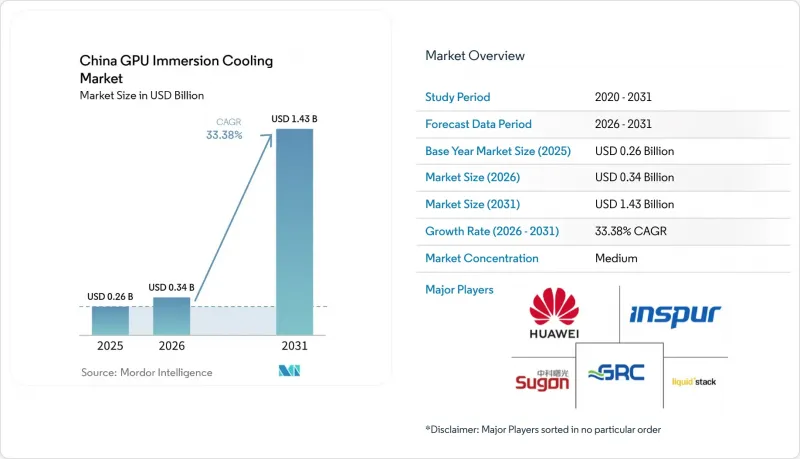
Mordor Intelligence에 의하면, 중국의 GPU 침지 냉각 시장 규모는 2026년에 3억 4,000만 달러에서 2031년까지 14억 3,000만 달러에 이를 것으로 예측되며, 2026년부터 2031년에 걸쳐 CAGR 33.38%로 성장할 전망입니다.
본 보고서는 침지 방식(단상 및 2상), 용액 유형(탱크/시스템, 유전성 유체 및 침지 최적화 GPU 서버 시스템), 적용 분야(하이퍼스케일/클라우드, 엔터프라이즈, 정부·연구기관용 HPC), GPU 전력 밀도(300W 미만, 300W-700W, 700W 초과) 및 지역별로 분류되어 있습니다. 시장 전망은 금액(달러) 기준으로 제시되어 있습니다.
중국의 GPU 침지 냉각 시장 동향 및 인사이트
중국 데이터센터에서 AI 모델 훈련 워크로드의 급증
중국 내 AI용 GPU 도입 대수는 2024년부터 2025년에 걸쳐 3배로 증가했으며, MIIT(중국 공업정보화부)는 2026년에 국내 생산 대수가 30만 대에 달할 것으로 예측했습니다. 내몽골에서 DeepSeek가 계획 중인 5만 GPU 규모의 시설과 같은 모델 훈련 클러스터는 칩당 350W-700W의 지속적인 부하로 가동되고 있으며, 그 열 밀도는 공랭식으로는 경제적으로 대응할 수 없는 수준에 도달했습니다. 정저우에 위치한 Sugon의 6만 GPU 규모 시설은 침지 냉각 아키텍처를 통해 핫 아일 격리 시스템과 보조 냉각 장치를 제거함으로써, 바닥 면적을 40% 절감할 수 있음을 입증하고 있습니다. 엣지 측에서는 추론 노드가 증가하고 있지만, 가장 많은 연속 전력을 소비하기 때문에 훈련 작업이 침지 냉각 도입을 주도하고 있습니다. 기밀 데이터에 대해 On-Premise 연산을 의무화하는 국가의 알고리즘 등록 규정은 GPU 수요를 증가시키고, 열 설계상의 제약을 더욱 가중시키고 있습니다.
데이터센터의 PUE 감축을 위한 정부의 탄소중립 의무
국가발전개혁위원회가 2025년 2월에 발표한 지침에 따라, 신규 데이터센터는 PUE를 1.3 미만으로 유지해야 하며, 기존 시설도 2027년까지 1.5로 개선해야 합니다. 베이징시는 이 정책을 보완하는 차원에서 PUE가 1.35를 초과하는 시설에 대해 1kWh당 0.10위안(0.013달러)의 추가 요금을 부과하고 있으며, 10MW 규모의 시설에는 수백만 위안의 벌금이 부과됩니다. 알리바바의 항저우 캠퍼스에서는 단상 침지 냉각 방식을 통해 PUE 1.09를 기록했는데, 이는 공랭식 방식의 1.25와 비교했을 때 보조 전력을 30-35% 절감한 결과입니다. 산업정보화부(MIIT)의 ‘그린 데이터센터’ 인증은 PUE 1.2 미만의 프로젝트에 대해 전력망 연결을 우선적으로 처리하며, 헬링게르 등 일부 현에서는 전력회사의 할인 혜택에 더해 1%의 보조금을 제공하고 있어, 이로 인해 투자수익률(ROI) 측면에서 침지 냉각 방식이 결정적으로 유리해지고 있습니다.
고품질 절연유의 국내 공급망 부족
3M사가 2025년 8월에 Novec공급을 중단함에 따라 주요 불소계 탄화수소공급원이 사라지게 되어, 사업자들은 유니프레지던트 페트로케미칼사의 IMF F6210 등 국내 대체품의 인증을 받을 수밖에 없는 상황에 처해 있습니다. 단상 유체의 가격은 2024년 톤당 64만 위안(8만 9,000달러)에서 2026년 초에는 톤당 20만 위안(2만 7,900달러)으로 급락했으나, 공급은 3개 생산사에 집중되어 있어 조달 리스크가 높아지고 있습니다. 2상 유체는 현지 제조업체들이 중간 비등점 화학 물질을 생산하지 못하고 있어, 여전히 공급이 부족하고 가격이 비싼 상태입니다. 쉘과 시노펙이 2026년 1월에 설립한 합작회사는 2027년까지 연간 5,000톤의 생산 능력을 목표로 하고 있지만, 하이퍼스케일러 기업들이 18-24개월 분량의 재고를 선구매하고 있어 운전자금이 늘어나고 있습니다.
부문별 분석
2025년 기준으로, 중국의 GPU 침지 냉각 시장 규모 중 78.22%를 단상 설계가 차지했습니다. 이는 광물유계 유체의 가격이 1톤당 35,000-10만 5,000위안(4,860-1만 4,583달러)으로, 2상 불소계 화합물보다 훨씬 저렴하기 때문입니다. 알리바바의 항저우 및 장베이 캠퍼스에서는 단상 탱크를 사용하여 PUE 1.05를 달성했으며, 이를 통해 효율 목표 달성에 복잡한 상변화 루프가 반드시 필요한 것은 아니라는 사실이 입증되었습니다. 한편, 2상 시스템은 잠열을 추출하여 건물의 난방으로 재활용하기 때문에 정저우의 슈퍼컴퓨팅 노드에서는 겨울철 시설 전체의 에너지 사용량을 18% 절감하고 있습니다.
앞으로 북부 지방에서는 낮은 외부 기온을 이용하여 수동적인 방열이 가능하기 때문에 2상식 시스템의 도입 용량은 연평균 성장률(CAGR) 33.67%로 증가할 전망입니다. 그러나 가격 경쟁력을 확보할 수 있을지는 2028년 이후 국내 불소계 냉매 생산 확대에 달려 있습니다. 현재로서는 유지보수가 용이하고 타사 서비스 네트워크가 잘 갖춰져 있기 때문에 기업들은 단상 방식을 선호하고 있습니다. 한편, 정부의 HPC 구매 담당자들은 에너지 회수 크레딧을 더 중요하게 여기고 있으며, 이로 인해 부문 구성이 점차 2상 방식으로 전환되고 있습니다.
액침 냉각에 최적화된 GPU 서버 시스템은 2025년에 중국의 GPU 액침 냉각 시장 점유율의 55.34%를 차지하며 최대 점유율을 확보했으며, 앞으로도 주요 성장 동력으로 자리매김할 것입니다. Sugon의 I980-G80 랙은 도입 기간을 6주에서 10일로 단축하며, 현장에서의 개조가 필요하지 않습니다. Inspur의 NF5498은 내액성 코팅 처리를 거쳐 출시되었으며, 열 검증 책임을 OEM에 넘김으로써 리스크 회피 성향이 강한 CIO들의 우려를 해소하고 있습니다.
절연 유체는 5-7년에 걸쳐 상각되므로 총 비용을 낮게 유지할 수 있습니다. 한편, 서버는 3년마다 갱신됩니다. 독립 탱크 제조업체들은 유럽 및 미국산 장비를 30-40% 할인해 판매하는 국내 신규 업체들의 가격 압박에 직면해 있습니다. 벤더들은 현재 수년에 걸친 유체 서비스 계약을 묶어 제공하고 있으며, 이를 통해 자본 지출(Capex)을 운영 비용(OpEx)으로 전환하고, 예산을 클라우드 비즈니스 모델에 맞추고 있습니다. 이것이 중국의 GPU 침지 냉각 업계 전반에 걸친 보급을 촉진하고 있습니다.
기타 혜택 :
- 엑셀 형식 시장 예측(ME) 시트
- 3개월간의 애널리스트 지원
자주 묻는 질문
목차
제1장 서론
제2장 조사 방법
제3장 주요 요약
제4장 시장 구도
제5장 시장 규모 및 성장 예측
제6장 경쟁 구도
제7장 시장 기회 및 향후 전망
KTH 26.06.26According to Mordor Intelligence, the china gPU immersion cooling market size is expected to be USD 0.34 billion in 2026 and reach USD 1.43 billion by 2031, growing at a CAGR of 33.38% from 2026 to 2031.
This report is Segmented by Immersion Type (Single-Phase, and Two-Phase), Solution Type (Tanks/Systems, Dielectric Fluids, and Immersion-Optimized GPU Server Systems), Deployment (Hyperscale/Cloud, Enterprise, and Government and Research HPC), GPU Power Density (Below 300W, 300W-700W, and Above 700W), and Geography. The Market Forecasts are Provided in Terms of Value (USD).
China GPU Immersion Cooling Market Trends and Insights
Surging AI Model Training Workloads in Chinese Data Centers
China's installed base of AI-oriented GPUs tripled between 2024 and 2025, and MIIT projects domestic output to hit 300,000 units in 2026. Model-training clusters such as DeepSeek's planned 50,000-GPU facility in Inner Mongolia run at sustained loads of 350 W-700 W per chip, driving thermal densities beyond the economic reach of air cooling. Sugon's 60,000-GPU installation in Zhengzhou demonstrates that immersion architectures reclaim 40% floor area by removing hot-aisle containment and supplemental chillers. Although inference nodes proliferate at the edge, training jobs dominate immersion adoption because they draw the highest continuous power. National algorithm-registration rules that compel on-premises compute for sensitive data amplify GPU demand, further tightening the thermal envelope.
Government Carbon-Neutrality Mandates for Data Center PUE Reduction
The National Development and Reform Commission's February 2025 directive obliges new data centers to achieve PUE below 1.3, while existing sites must retrofit to 1.5 by 2027. Beijing augments the policy with a CNY 0.10 (USD 0.013) kWh surcharge on sites above PUE 1.35, imposing multi-million-yuan penalties on a 10 MW facility. Alibaba's Hangzhou campus records a 1.09 PUE with single-phase immersion versus 1.25 under air flow, thanks to 30%-35% auxiliary-power savings. MIIT's Green Data Center badge fast-tracks grid connections for projects under PUE 1.2, and counties such as Helinge'er layer 1% subsidies atop utility discounts, tipping return-on-capital decisively toward immersion.
Limited Domestic Supply Chain for High-Grade Dielectric Fluids
3M's August 2025 Novec exit removed the dominant fluorocarbon source, forcing operators to qualify domestic substitutes such as Uni-President Petrochemical's IMF F6210. Prices for single-phase fluid plunged from CNY 640,000 (USD 89,000) t-1 in 2024 to CNY 200,000 (USD 27,900) t-1 by early 2026, yet supply is concentrated among three producers, raising procurement risk. Two-phase fluids remain scarcer and costlier because local producers lack mid-boiling-point chemistries. Shell and Sinopec's January 2026 joint venture targets 5,000 t annual capacity by 2027, but hyperscalers pre-buy 18-24 months of stock, inflating working capital.
Other drivers and restraints analyzed in the detailed report include:
- Emergence of Immersion-Ready 700 + W GPU Reference Designs From OEMs
- Accelerating Expansion of Domestic GPU Manufacturing Capabilities
- Fire Codes and Building Standards Lagging Immersion Installations
For complete list of drivers and restraints, kindly check the Table Of Contents.
Segment Analysis
Single-phase designs held 78.22% of China GPU immersion cooling market size in 2025 because mineral-oil fluids cost CNY 35,000-105,000 (USD 4,860-14,583) t-1, far below two-phase fluorocarbons. Alibaba's Hangzhou and Zhangbei campuses validated 1.05 PUE with single-phase tanks, proving that complex phase-change loops are not mandatory for efficiency targets. Two-phase systems, however, extract latent heat and return it as building warming, cutting total facility energy use by 18% during winter at the Zhengzhou supercomputing node.
Looking ahead, two-phase capacity is set to rise at a 33.67% CAGR because northern provinces can exploit low ambient temperatures for passive rejection. Yet price parity hinges on domestic fluorocarbon output scaling after 2028. For now, enterprises favor single-phase because maintenance is simpler and third-party service networks are mature. Government HPC buyers weigh energy-recovery credits more heavily, nudging the segment mix slowly toward two-phase.
Immersion-optimized GPU server systems secured the biggest slice of China GPU immersion cooling market share at 55.34% in 2025 and will remain the primary growth engine. Sugon's I980-G80 rack cuts deployment from six weeks to ten days, eliminating field retrofits. Inspur's NF5498 arrives with fluid-resistant coatings, shifting thermal-validation liability to the OEM and reassuring risk-averse CIOs.
Dielectric fluids present lower invoice totals because they amortize over five-to-seven years, whereas servers refresh triennially. Stand-alone tank makers face price pressure from new domestic entrants who discount Western gear by 30%-40%. Vendors now bundle multi-year fluid-service contracts, turning capex into opex and aligning budgets with cloud business models, which supports uptake across the China GPU immersion cooling industry.
List of Companies Covered in this Report:
- Sugon Information Industry Co., Ltd.
- Huawei Technologies Co., Ltd.
- Inspur Electronic Information Industry Co., Ltd.
- Lenovo Group Limited
- Tencent Holdings Limited
- Alibaba Group Holding Limited
- Baidu, Inc.
- China Mobile Communications Corporation
- GRC (Green Revolution Cooling, Inc.)
- LiquidStack Holdings Inc.
- Submer Technologies SL
- CoolIT Systems Inc.
- Iceotope Technologies Limited
- Shenzhen Immersion Cooling Technology Co., Ltd.
- Zhejiang Tiangong Cooling Technology Co., Ltd.
- Qingdao Haier Intelligent Cooling Technology Co., Ltd.
- Chemours Chemical (Shanghai) Co., Ltd.
- Shell plc
- Sinopec Lubricants Company
Additional Benefits:
- The market estimate (ME) sheet in Excel format
- 3 months of analyst support
TABLE OF CONTENTS
1 INTRODUCTION
- 1.1 Study Assumptions and Market Definition
- 1.2 Scope of the Study
2 RESEARCH METHODOLOGY
3 EXECUTIVE SUMMARY
4 MARKET LANDSCAPE
- 4.1 Market Overview
- 4.2 Market Drivers
- 4.2.1 Surging AI Model Training Workloads in Chinese Data Centers
- 4.2.2 Government Carbon-Neutrality Mandates for Data Center PUE Reduction
- 4.2.3 Accelerating Expansion of Domestic GPU Manufacturing Capabilities
- 4.2.4 Rising Electricity Tariffs in Tier-1 Cities Encouraging Thermal Efficiency
- 4.2.5 Availability of Subsidized Industrial Parks in Cooler Northern Provinces
- 4.2.6 Emergence of Immersion-Ready 700+ W GPU Reference Designs from OEMs
- 4.3 Market Restraints
- 4.3.1 Limited Domestic Supply Chain for High-Grade Dielectric Fluids
- 4.3.2 Fire Codes and Building Standards Lagging Immersion Installations
- 4.3.3 Water-Based Adiabatic Alternatives Competing on Capex
- 4.3.4 Perceived Warranty Risk by GPU Vendors for Immersion Use
- 4.4 Impact of Macroeconomic Factors on the Market
- 4.5 Industry Value Chain Analysis
- 4.6 Regulatory Landscape
- 4.7 Technological Outlook
- 4.8 Porter's Five Forces Analysis
- 4.8.1 Threat of New Entrants
- 4.8.2 Bargaining Power of Buyers
- 4.8.3 Bargaining Power of Suppliers
- 4.8.4 Threat of Substitutes
- 4.8.5 Competitive Rivalry
5 MARKET SIZE and GROWTH FORECASTS
- 5.1 By Immersion Type
- 5.1.1 Single-Phase Immersion Cooling
- 5.1.2 Two-Phase Immersion Cooling
- 5.2 By Solution Type
- 5.2.1 Immersion Cooling Tanks / Systems
- 5.2.2 Dielectric Fluids
- 5.2.3 Immersion-Optimized GPU Server Systems
- 5.3 By Deployment
- 5.3.1 Hyperscale / Cloud
- 5.3.2 Enterprise
- 5.3.3 Government and Research (HPC)
- 5.4 By GPU Power Density
- 5.4.1 Below 300W
- 5.4.2 300W - 700W
- 5.4.3 Above 700W
6 COMPETITIVE LANDSCAPE
- 6.1 Market Concentration
- 6.2 Strategic Moves
- 6.3 Market Share Analysis
- 6.4 Company Profiles (includes Global Level Overview, Market Level Overview, Core Segments, Financials as available, Strategic Information, Market Rank/Share, Products and Services, Recent Developments)
- 6.4.1 Sugon Information Industry Co., Ltd.
- 6.4.2 Huawei Technologies Co., Ltd.
- 6.4.3 Inspur Electronic Information Industry Co., Ltd.
- 6.4.4 Lenovo Group Limited
- 6.4.5 Tencent Holdings Limited
- 6.4.6 Alibaba Group Holding Limited
- 6.4.7 Baidu, Inc.
- 6.4.8 China Mobile Communications Corporation
- 6.4.9 GRC (Green Revolution Cooling, Inc.)
- 6.4.10 LiquidStack Holdings Inc.
- 6.4.11 Submer Technologies SL
- 6.4.12 CoolIT Systems Inc.
- 6.4.13 Iceotope Technologies Limited
- 6.4.14 Shenzhen Immersion Cooling Technology Co., Ltd.
- 6.4.15 Zhejiang Tiangong Cooling Technology Co., Ltd.
- 6.4.16 Qingdao Haier Intelligent Cooling Technology Co., Ltd.
- 6.4.17 Chemours Chemical (Shanghai) Co., Ltd.
- 6.4.18 Shell plc
- 6.4.19 Sinopec Lubricants Company
7 MARKET OPPORTUNITIES and FUTURE OUTLOOK
- 7.1 White-space and Unmet-Need Assessment


