

|
시장보고서
상품코드
2063863
유럽의 GPU 액침 냉각 시장 : 점유율 분석, 업계 동향과 통계, 성장 예측(2026-2031년)Europe GPU Immersion Cooling - Market Share Analysis, Industry Trends & Statistics, Growth Forecasts (2026 - 2031) |
||||||
 Mordor Intelligence
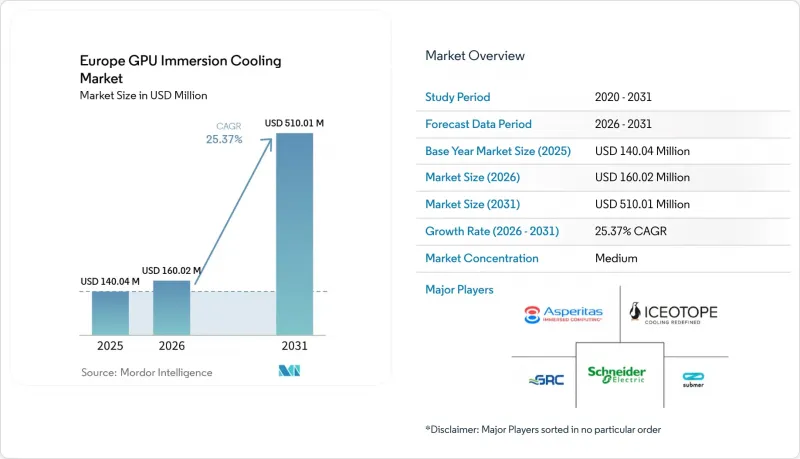
Mordor Intelligence에 의하면, 유럽 GPU 액랭 시장 규모는 2025년에 1억 4,004만 달러, 2026년에 1억 6,002만 달러, 2031년까지 5억 1,001만 달러에 이를 것으로 예측됩니다.
2026년부터 2031년까지 연평균 성장률(CAGR) 25.37%로 성장할 것으로 전망됩니다.
본 보고서는 액침 방식(단상 및 2상), 용액 유형(탱크/시스템, 유전체 유체 및 액침 최적화 GPU 서버), 도입 형태(하이퍼스케일/클라우드, 엔터프라이즈, 정부·연구기관용 HPC), GPU 전력 밀도(300W 미만, 300W-700W, 700W 초과), 지역(독일, 프랑스 등)에 따라 분류되어 있습니다. 시장 전망은 금액(달러) 기준으로 제시되어 있습니다.
유럽 GPU 액침 냉각 시장 동향 및 인사이트
AI 및 HPC 워크로드의 급증으로 고밀도 GPU 도입이 가속화되고 있습니다.
NVIDIA H100 및 H200 가속기를 핵심으로 하는 생성형 AI 훈련 랙은 일상적으로 120kW를 초과하는 경우가 있으며, 이는 고상식 공랭 방식의 경제적 한계를 넘어서는 수준입니다. 각국 및 유럽 전역의 연구 이니셔티브는 초기부터 액체 냉각을 규정한 수십억 유로 규모의 인프라 프로젝트에 자금을 지원해 왔으며, 기업들이 본받을 수 있는 참고용 청사진을 제시하고 있습니다. 2025년에 발표된 헝가리와 스웨덴의 EuroHPC 지원 슈퍼컴퓨터는 페타플롭스 규모의 열 부하를 처리하기 위해 액침 냉각 지원 설계를 명시적으로 의무화하고 있습니다. 이러한 플래그십 시스템은 상업용 구매자가 감수해야 하는 기술적 위험을 줄여주며, 대규모 도입의 선순환을 강화하고 있습니다. 앞으로 출시될 B 시리즈 GPU 제품군으로 인해 단일 칩의 전력 소비량이 1kW를 초과함에 따라, 시설의 전력 수요를 동시에 증가시키지 않으면서 랙의 처리량을 유지하기 위해서는 액체 액침 냉각이 실험적인 선택지에서 필수적인 요소로 자리 잡고 있습니다.
EU의 데이터센터 지속가능성 규정 및 탄소 배출 목표
에너지 효율 지침에 근거한 위임 규정에 따라, 500kW를 초과하는 시설은 2025년부터 연간 전력 사용 효율(PUE) 및 물 사용 효율(WUE) 지표를 공표해야 합니다. 이 공개 제도는 PUE를 1.05 수준으로 달성하는 수냉식 설비를 갖춘 시설에 유리하게 작용합니다. ‘기후 중립 데이터센터 협정’에 따른 병행 조치에 따라 2030년까지 순배출 제로 운영이 요구되고 있으며, 이에 따라 액체 냉각이 확장 계획에 사실상 포함되게 됩니다. Asperitas 등 사업자들은 지역 난방에 직접 공급할 수 있을 만큼 높은 냉각수 온도를 실현하는 단상 설계를 입증했으며, 협정 내 폐열 조항을 충족하고 있습니다. 천연 에스테르계 절연액을 대상으로 새로 승인된 IEC 규격은 입찰 절차를 효율화하는 인증 경로를 제공함으로써 도입을 더욱 가속화하고 있습니다.
기존의 공랭식 방식에 비해 높은 초기 설비 투자 비용
턴키 방식의 수냉식 랙은 3만-5만 달러로, 기존 랙의 1,000-2,000달러라는 가격을 훨씬 웃돌고 있습니다. 다만, 시설 전체를 비교할 때 규모의 경제를 고려하면 수냉 방식이 더 유리할 수도 있습니다. 기존 시설에 도입하는 시험의 경우, 소유주가 냉수 루프 배관 공사를 다시 하고, 바닥 하중을 강화하며, 절연유 대응 감시 시스템을 도입해야 하기 때문에 대부분의 경우 40%의 비용 증가를 감수해야 합니다. 3년 이내 투자 회수 원칙에 따라 운영되며 자금 조달에 제약이 있는 기업들은 이러한 경제성을 조화시키는 데 어려움을 겪고 있습니다. 특히, 공랭식 시스템을 단계적으로 업그레이드함으로써 단기적인 개선 효과를 얻을 수 있는 경우에는 더욱 그렇습니다. ‘Cooling-as-a-Service(냉각 서비스)’나 리스 방식이 등장하고 있지만, 아직 발전 단계에 머물러 있어 자본 배분에 미치는 단기적인 영향은 제한적입니다.
부문별 분석
2025년, 유럽의 GPU 수냉 시장에서 단상 수냉 방식이 78.56%의 점유율을 차지하고 있으며, 이는 해당 유체의 안정성과 간편한 운영에 대한 폭넓은 신뢰를 뒷받침하고 있습니다. Shell이나 Perstorp와 같은 공급업체들이 PFAS가 포함되지 않은 탄화수소계 유체를 시장에 출시하여 비용과 규제 위험을 모두 줄이고 있는 만큼, 단상 설계와 연계된 유럽의 GPU 수냉 시장 규모는 꾸준히 확대되고 있습니다. 기업들은 이러한 시스템이 기존의 냉수 루프와 호환된다는 점을 높이 평가하고 있으며, 이로 인해 개조 기간이 단축되고 있습니다. 도시 지역의 에지 사이트에서는 Asperitas사가 실증한 펌프리스 자연 대류 방식이 저소음 성능이 뛰어나고, 지역 난방에 적합한 55℃의 출구 온도를 생성하기 때문에 주목을 받고 있습니다.
2상 시스템은 2031년까지 연평균 성장률(CAGR) 25.55%를 나타낼 것으로 예측되지만, 여전히 랙 밀도가 150kW를 초과하는 하이퍼스케일 환경이나 연구시설에 집중되어 있습니다. 불소계 유체의 손실, 압력 제어의 복잡성, 그리고 특수 씰링재가 필요하기 때문에 이러한 틈새 시장 이외의 분야로의 보급은 제한적입니다. SINTEF가 공동 투자하는 CoolHeatDC 프로젝트는 히트 펌프에 직접 연결된 2상 모듈의 상용화를 목표로 하고 있습니다. 실지 시험을 통해 유지보수에 대한 기대가 입증된다면, 이 구성은 그 매력을 더욱 확대할 수 있을 것입니다. GPU 1대당 소비 전력이 1kW에 가까워짐에 따라 2상 설계 시장 점유율은 점차 확대될 것으로 보이지만, 금세기 말까지는 1상 설계가 주류 지위를 유지할 전망입니다.
2025년 유럽 GPU 액침 냉각 시장 규모에서 탱크 및 열교환 시스템이 55.34%를 차지한 것은 초기 도입자들이 케이스와 서버를 별도로 조달했기 때문입니다. 그러나 Dell, Hewlett Packard Enterprise, Lenovo, Supermicro가 서버 섀시, 콜드 플레이트 및 인증된 유체 호환성을 번들로 제공하며, 액침 냉각에 최적화된 SKU를 출시함에 따라 이 조달 모델은 변화하고 있습니다. 유럽 GPU 액침 냉각 업계의 관측통들은 이러한 턴키 솔루션이 도입 주기를 단축하고 보증 관련 분쟁을 해소할 것이라고 지적하며, 통합형 서버는 2031년까지 25.63%라는 가장 높은 성장률을 보일 것으로 전망하고 있습니다.
각 유체 공급업체들은 지속가능성 지표를 차별화 요소로 삼고 있으며, 페르스토프(Perstorp)의 PFAS 무함유 제품인 ‘Synmerse’ 시리즈와 올레온(Oleon)의 식물 유래 배합 제품이 이러한 추세를 상징하고 있습니다. DCX나 볼티모어 에어코일(Baltimore Aircoil)과 같은 탱크 제조업체들은 표준화된 모듈의 설치 면적을 공개함으로써 이에 대응하고 있으며, 대량 주문 시 리드 타임을 2개월 미만으로 단축하고 있습니다. 분석가들은 서버 OEM 업체들이 GPU 제품 포트폴리오 전반에 걸쳐 수냉식 지원 라인을 확충하면, 수익 구조가 통합형 시스템으로 이동할 것으로 전망하고 있습니다. 한편, 독립형 탱크는 하이퍼스케일 환경을 위한 맞춤형 구축이나 시설 개보수 과정에서 계속해서 중요한 역할을 할 것입니다.
기타 혜택:
- 엑셀 형식 시장 예측(ME) 시트
- 3개월간의 애널리스트 지원
자주 묻는 질문
목차
제1장 서론
제2장 조사 방법
제3장 주요 요약
제4장 시장 구도
제5장 시장 규모와 성장 예측
제6장 경쟁 구도
제7장 시장 기회와 향후 전망
JHS 26.06.23According to Mordor Intelligence, the europe gPU immersion cooling market size is expected to be USD 140.04 million in 2025, USD 160.02 million in 2026, and reach USD 510.01 million by 2031, growing at a CAGR of 25.37% from 2026 to 2031.
This report is Segmented by Immersion Type (Single-Phase, and Two-Phase), Solution Type (Tanks/Systems, Dielectric Fluids, and Immersion-Optimized GPU Servers), Deployment (Hyperscale/Cloud, Enterprise, and Government and Research HPC), GPU Power Density (Below 300W, 300W-700W, and Above 700W), and Geography (Germany, France, and More). The Market Forecasts are Provided in Terms of Value (USD).
Europe GPU Immersion Cooling Market Trends and Insights
Surging AI and HPC Workloads Driving Higher-Density GPU Deployments
Generative-AI training racks built around NVIDIA H100 and H200 accelerators routinely exceed 120 kilowatts, a level that outstrips the economic ceiling of raised-floor air cooling. National and pan-European research initiatives have funded billion-euro infrastructure projects that specify liquid cooling from day one, creating reference blueprints that enterprises can emulate. EuroHPC-backed supercomputers in Hungary and Sweden, both announced in 2025, openly mandate immersion-ready designs to cope with petaflop-scale heat loads. These flagship systems reinforce a virtuous cycle of volume commitments that lower technology risk for commercial buyers. As the forthcoming B-series GPU family pushes individual chip power past 1 kilowatt, immersion transitions from an experimental option to a necessity for maintaining rack throughput without a parallel rise in facility power.
EU Data Center Sustainability Regulations and Carbon Targets
The delegated regulation under the Energy Efficiency Directive compels sites above 500 kilowatts to publish annual power-usage-effectiveness and water-usage-effectiveness metrics beginning in 2025, a disclosure regime that favors immersion-equipped plants achieving PUE near 1.05. Parallel commitments under the Climate Neutral Data Centre Pact demand net-zero operations by 2030, effectively hard-coding liquid cooling into expansion blueprints. Operators such as Asperitas have demonstrated single-phase designs that deliver coolant temperatures high enough for direct district-heating export, addressing waste-heat clauses within the Pact. Newly approved IEC standards covering natural-ester dielectric fluids provide certification pathways that streamline tender procedures, further accelerating adoption.
High Up-Front Capex Versus Traditional Air Cooling
Turnkey immersion racks cost USD 30,000-50,000, dwarfing the USD 1,000-2,000 price of a conventional rack, even though whole-facility comparisons can favor immersion when scale effects are considered. Retrofit pilots often face a 40% cost premium because owners must re-plumb chilled-water loops, upgrade floor loading, and commission dielectric-compatible monitoring systems. Cash-constrained enterprises that operate under three-year payback rules struggle to reconcile those economics, particularly when incremental air-cooling upgrades deliver near-term relief. Cooling-as-a-service and leasing schemes are emerging but remain embryonic, limiting near-term impact on capital allocations.
Other drivers and restraints analyzed in the detailed report include:
- Escalating Electricity Prices in Western Europe Encouraging Energy-Efficient Cooling
- Rapid Decline in Dielectric Fluid Costs
- Limited Availability of GPU-Qualified Immersion-Ready Warranties
For complete list of drivers and restraints, kindly check the Table Of Contents.
Segment Analysis
Single-phase immersion cooling held 78.56% of the Europe GPU immersion cooling market share in 2025, underscoring widespread confidence in its fluid stability and simple operations. The Europe GPU immersion cooling market size tied to single-phase designs is expanding steadily as suppliers such as Shell and Perstorp bring PFAS-free hydrocarbon fluids to market, reducing both cost and regulatory risk. Enterprises value the compatibility of these systems with existing chilled-water loops, a factor that shortens retrofit timelines. In urban edge sites, pumpless natural-convection variants demonstrated by Asperitas are proving attractive because they operate quietly and generate 55-degree-Celsius outlet temperatures suitable for district heating.
Two-phase systems are on track for a 25.55% CAGR through 2031, yet they remain concentrated in hyperscale and research settings where rack densities cross 150 kilowatts. Fluorocarbon fluid loss, pressure-control complexity, and specialised seals have limited penetration outside those niches. The CoolHeatDC project, co-funded by SINTEF, aims to commercialise two-phase modules tied directly to heat pumps, a configuration that could broaden appeal if field trials validate maintenance expectations. As GPUs inch toward 1 kilowatt per device, two-phase designs will likely capture incremental share, though single-phase is set to maintain the majority position for the remainder of the decade.
Tanks and heat-exchange systems represented 55.34% of the Europe GPU immersion cooling market size in 2025 because early adopters sourced enclosures and servers separately. That procurement model is shifting as Dell, Hewlett Packard Enterprise, Lenovo, and Supermicro release immersion-optimized SKUs that bundle server chassis, cold plates, and certified fluid compatibility. Europe GPU immersion cooling industry observers note that these turnkey offers compress deployment cycles and eliminate warranty disputes, positioning integrated servers for the strongest growth at 25.63% through 2031.
Fluid suppliers are differentiating through sustainability metrics, with Perstorp's PFAS-free Synmerse range and Oleon's plant-based formulations highlighting the trend. Tank manufacturers such as DCX and Baltimore Aircoil have responded by publishing standardised module footprints, cutting lead times to under two months for high-volume orders. Analysts expect that once server OEMs finish extending liquid-ready lines across their full GPU portfolios, the balance of revenue will tilt toward integrated systems, while standalone tanks will retain relevance for hyperscale custom builds and facility retrofits.
List of Companies Covered in this Report:
- Submer Technologies SL
- Asperitas BV
- Iceotope Technologies Limited
- Green Revolution Cooling Inc.
- Schneider Electric SE
- DCX -The Liquid Cooling Company Sp. z o.o.
- LiquidStack Inc.
- Dell Technologies Inc.
- Hewlett Packard Enterprise Company
- Lenovo Group Limited
- Atos SE
- Fujitsu Limited
- Super Micro Computer Inc.
- Rittal GmbH and Co. KG
- Vertiv Group Corp.
- Midas Green Technologies LLC
- Boston Limited
- Inspur Systems Inc.
- ASUS Tek Computer Inc.
- Trane Technologies plc
Additional Benefits:
- The market estimate (ME) sheet in Excel format
- 3 months of analyst support
TABLE OF CONTENTS
1 INTRODUCTION
- 1.1 Study Assumptions and Market Definition
- 1.2 Scope of the Study
2 RESEARCH METHODOLOGY
3 EXECUTIVE SUMMARY
4 MARKET LANDSCAPE
- 4.1 Market Overview
- 4.2 Market Drivers
- 4.2.1 Surging AI and HPC Workloads Driving Higher-Density GPU Deployments
- 4.2.2 Rapid Decline in Dielectric Fluid Costs
- 4.2.3 Escalating Electricity Prices in Western Europe Encouraging Energy-Efficient Cooling
- 4.2.4 EU Data Center Sustainability Regulations and Carbon Targets
- 4.2.5 Increased Venture Funding for European Immersion Cooling Start-ups
- 4.2.6 Growing Preference for Edge Data Centers in Urban Europe
- 4.3 Market Restraints
- 4.3.1 Limited Availability of GPU-Qualified Immersion-Ready Warranties
- 4.3.2 High Up-Front Capex Versus Traditional Air Cooling
- 4.3.3 Fragmented Dielectric Fluid Standards Across EU
- 4.3.4 Supply Chain Constraints for High-Performance Tanks and Seals
- 4.4 Industry Value Chain Analysis
- 4.5 Regulatory Landscape
- 4.6 Technological Outlook
- 4.7 Porter's Five Forces Analysis
- 4.7.1 Threat of New Entrants
- 4.7.2 Bargaining Power of Suppliers
- 4.7.3 Bargaining Power of Buyers
- 4.7.4 Threat of Substitutes
- 4.7.5 Competitive Rivalry
- 4.8 Impact of Macroeconomic Factors on the Market
5 MARKET SIZE AND GROWTH FORECASTS (VALUE)
- 5.1 By Immersion Type
- 5.1.1 Single-Phase Immersion Cooling
- 5.1.2 Two-Phase Immersion Cooling
- 5.2 By Solution Type
- 5.2.1 Immersion Cooling Tanks / Systems
- 5.2.2 Dielectric Fluids
- 5.2.3 Immersion-Optimized GPU Server Systems
- 5.3 By Deployment
- 5.3.1 Hyperscale / Cloud
- 5.3.2 Enterprise
- 5.3.3 Government and Research (HPC)
- 5.4 By GPU Power Density
- 5.4.1 Below 300W
- 5.4.2 300W - 700W
- 5.4.3 Above 700W
- 5.5 By Region
- 5.5.1 Europe
- 5.5.1.1 Germany
- 5.5.1.2 United Kingdom
- 5.5.1.3 France
- 5.5.1.4 Italy
- 5.5.1.5 Rest of Europe
- 5.5.1 Europe
6 COMPETITIVE LANDSCAPE
- 6.1 Market Concentration
- 6.2 Strategic Moves
- 6.3 Market Share Analysis
- 6.4 Company Profiles (includes Global Level Overview, Market Level Overview, Core Segments, Financials as available, Strategic Information, Market Rank/Share, Products and Services, Recent Developments)
- 6.4.1 Submer Technologies SL
- 6.4.2 Asperitas BV
- 6.4.3 Iceotope Technologies Limited
- 6.4.4 Green Revolution Cooling Inc.
- 6.4.5 Schneider Electric SE
- 6.4.6 DCX -The Liquid Cooling Company Sp. z o.o.
- 6.4.7 LiquidStack Inc.
- 6.4.8 Dell Technologies Inc.
- 6.4.9 Hewlett Packard Enterprise Company
- 6.4.10 Lenovo Group Limited
- 6.4.11 Atos SE
- 6.4.12 Fujitsu Limited
- 6.4.13 Super Micro Computer Inc.
- 6.4.14 Rittal GmbH and Co. KG
- 6.4.15 Vertiv Group Corp.
- 6.4.16 Midas Green Technologies LLC
- 6.4.17 Boston Limited
- 6.4.18 Inspur Systems Inc.
- 6.4.19 ASUS Tek Computer Inc.
- 6.4.20 Trane Technologies plc
7 MARKET OPPORTUNITIES AND FUTURE OUTLOOK
- 7.1 White-Space and Unmet-Need Assessment


