

|
시장보고서
상품코드
2063899
미국의 해상 화물 운송 시장 : 시장 점유율 분석, 업계 동향 및 통계, 성장 예측(2026-2031년)United States Sea Freight Forwarding - Market Share Analysis, Industry Trends & Statistics, Growth Forecasts (2026 - 2031) |
||||||
 Mordor Intelligence
Mordor Intelligence에 의하면, 미국의 해상 화물 운송 시장 규모는 2025년 646억 9,000만 달러로 평가되었고, 2026년 674억 5,000만 달러로 추정되고, 2031년까지 823억 4,000만 달러로 확대될 전망이며, 2026-2031년 CAGR 4.07%를 나타낼 것으로 예측됩니다.
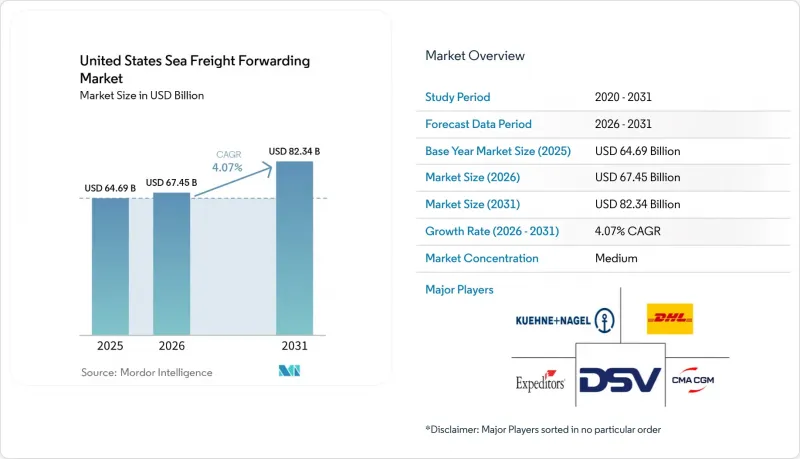
아시아에서 수입되는 상품에 대한 지속적인 수요, 항만의 단계적 자동화, 유연한 운송 수단에 대한 선호도 증가가 이러한 확장을 뒷받침하고 있습니다. 본 보고서는 서비스별(FCL, LCL), 화물 유형별(건화물/일반 화물, 냉장 화물), 최종 사용자 산업별(일렉트로믹스 및 반도체, 화학제품 및 석유화학제품, 식음료, 의약품 및 의료, 기타), 지역별(북동부, 남동부, 중서부, 남서부, 서부)로 분류되어 있습니다. 시장 전망은 금액(달러) 기준으로 제시되어 있습니다.
미국의 해상 화물 운송 시장 동향 및 인사이트
아시아에서 미국으로의 수입량 증가
아시아에서 수입되는 컨테이너는 미국 해상 화물 운송 시장의 수익원으로 계속해서 기능하고 있습니다. 현재 화물은 일정 안정성을 중시하여 다소 비싼 운임을 감수하는 반도체, 의료기기, 전기차 부품에 편중되어 있습니다. 기존의 로스앤젤레스·롱비치 지역에서 사바나, 휴스턴, 뉴욕으로 사업을 다각화하는 포워더는 고객의 혼잡 위험을 줄여줍니다. 여러 게이트웨이를 활용하는 전략은 인력이나 기상 문제로 인해 특정 연안 지역에서 혼란이 발생하더라도 시장 점유율을 확보할 수 있게 해줍니다.
항만 인프라 개선 및 자동화 프로젝트
자동화 크레인과 24시간 게이트 운영을 통해 체류 시간이 단축되어 터미널의 처리 능력이 향상되고 있습니다. 사바나 항구의 가든시티 지역 개보수 공사 및 로스앤젤레스 피어 400에서 이루어지는 로봇을 활용한 하역 작업은 우선 슬롯 이용 권한을 가진 포워더들에게 눈에 띄는 수준의 처리 속도 향상을 가져다주고 있습니다. ‘인프라 투자·고용법’에서는 수로 현대화에 170억 달러가 배정되었는데, 이에 신속히 대응한 기업들은 더 빨리 혜택을 누릴 수 있는 반면, 기존 시설에 의존하는 경쟁사들은 트럭의 회전 시간이 길어지는 문제에 직면해 있습니다.
항만의 혼잡과 노동력 부족
2024년 파업과 그에 따른 61.5%의 임금 인상으로 인해, 동부 해안과 멕시코만 연안의 부두를 통과하는 모든 컨테이너에 비용 증가분이 전가되었습니다. 로스앤젤레스와 롱비치에서 트럭의 평균 체류 시간은 2025년 하반기에는 3일 이하로 안정화되어, 포워더가 일당 청구액을 관리하는 데 도움이 되었습니다. 기항지의 다양화는 미래의 위험을 줄이는 데 도움이 되지만, 복잡성을 가중시키고 규모의 경제를 저해하게 됩니다. 화주들은 혼잡 지표를 면밀히 주시하고 있으며, 병목 현상이 발생했을 때 신속하게 우회 경로를 마련해 줄 수 있는 파트너를 높이 평가했습니다.
부문별 분석
2025년 미국 해상 화물 운송 시장에서 풀컨테이너 적재(FCL) 서비스는 매출의 73.11%를 차지했습니다. 수요를 예측할 수 있고, 화주가 40피트 컨테이너를 전자기기, 기계 또는 자동차 부품으로 가득 채울 수 있는 지역에서는 FCL이 주류를 이루고 있습니다. 소량 혼적(LCL) 서비스는 규모는 작지만, 소매 산업이 빈번하고 소규모의 재고 보충 주기로 전환되고 있는 추세를 반영하여 연평균 성장률(CAGR) 6.79%로 확대되고 있습니다.
LCL 혼적을 잘 아는 포워더는 여러 화주의 주문을 결합함으로써 단위당 비용을 절감하는 동시에 고액의 취급 수수료를 확보하고 있습니다. 창고 관리 시스템(WMS)은 운송 관리 시스템(TMS)과 연동되어 적재 계획의 자동화와 오류 감소를 실현하고 있습니다. 성공적인 물류업체들은 통관 업무와 국내 트럭 운송까지 통합하여, 전자상거래 판매업체들에게 원활한 문앞에서 문앞까지의 솔루션을 제공합니다. 디지털 예약 포털은 사무 업무의 부담을 줄여주어, 직원들이 예외 사항 관리에 집중할 수 있도록 합니다. 그 결과, 화물 수량이 증가하는 상황에서도 LCL의 이익률은 꾸준히 확대되고 있습니다.
기타 혜택
- 엑셀 형식 시장 예측(ME) 시트
- 3개월간의 애널리스트 지원
자주 묻는 질문
목차
제1장 서론
제2장 조사 방법
제3장 주요 요약
제4장 시장 구도
제5장 시장 규모 및 성장 예측(금액, 2026-2031년)
제6장 경쟁 구도
제7장 시장 기회 및 향후 전망
AJY 26.06.26According to Mordor Intelligence, the united states sea freight forwarding market size is projected to expand from USD 64.69 billion in 2025 and USD 67.45 billion in 2026 to USD 82.34 billion by 2031, registering a CAGR of 4.07% between 2026 and 2031.
Persistent demand for Asia-origin imports, gradual port automation, and a growing preference for flexible shipping options underpin the expansion. This report is Segmented by Service (Full-Container-Load, Less-Than-Container-Load), by Cargo Type (Dry/General, Reefer), by End-User Industry (Electronics and Semiconductors, Chemicals and Petrochemicals, Food and Beverage, Pharmaceuticals and Healthcare, and More), and by Geography (Northeast, Southeast, Midwest, Southwest, West). Market Forecasts are Provided in Terms of Value (USD).
United States Sea Freight Forwarding Market Trends and Insights
Expansion of US Import Volumes from Asia
Containerized imports from Asia keep the revenue engine running for the United States sea freight forwarding market. Cargo now skews toward semiconductors, medical devices, and electric-vehicle parts that tolerate premium rates for schedule reliability. Forwarders that diversify beyond the traditional Los Angeles-Long Beach complex to Savannah, Houston, and New York relieve congestion risk for customers. A multi-gateway strategy secures market share when labor or weather disrupts any single coast.
Improvements in Port Infrastructure and Automation Projects
Automated cranes and 24-hour gate operations reduce dwell times and lift terminal throughput. The Port of Savannah's Garden City upgrade and Pier 400's robotic handling in Los Angeles give forwarders with preferred slot access measurable velocity gains. The Infrastructure Investment and Jobs Act earmarks USD 17 billion to modernize waterways, but early movers reap benefits sooner, while competitors reliant on legacy facilities face longer truck turn times.
Port Congestion and Labor Disruptions
The 2024 strikes and the subsequent 61.5% wage increase embedded higher costs into every container that moves through East and Gulf Coast docks. Average truck dwell times at Los Angeles and Long Beach stabilized at under three days in late 2025, helping forwarders manage per-diem bills. Diversifying port calls helps mitigate future risk but adds complexity and reduces economies of scale. Shippers watch congestion metrics closely, rewarding partners that reroute quickly when bottlenecks emerge.
Other drivers and restraints analyzed in the detailed report include:
- Rising Adoption of Digital Freight Platforms
- E-Commerce Demand for Bulky-Goods Logistics
- Volatile Bunker-Fuel Prices
For complete list of drivers and restraints, kindly check the Table Of Contents.
Segment Analysis
Full-container-load services accounted for 73.11% of revenue in the United States sea freight forwarding market in 2025. FCL dominates where predictable demand lets shippers fill a 40-foot box with electronics, machinery, or auto parts. Less-than-Container-Load services, while smaller, are climbing at a 6.79% CAGR, reflecting retail's pivot to frequent, smaller replenishment cycles.
Forwarders that master LCL consolidation blend multiple shipper orders, lowering per-unit costs while capturing premium handling fees. Warehouse management systems link with transportation management systems to automate load planning and reduce errors. Successful providers also integrate customs brokerage and domestic trucking, offering a seamless door-to-door proposition for e-commerce sellers. Digital booking portals lower administrative workload, allowing staff to focus on exception management. The result is steady LCL margin expansion even as cargo pieces proliferate.
List of Companies Covered in this Report:
- Kuehne + Nagel
- DHL Global Forwarding
- DSV (incl. DB Schenker)
- CMA CGM Group (Including CEVA Logistics)
- Expeditors International
- C.H. Robinson
- Nippon Express
- GEODIS
- A.P. Moller - Maersk
- Hellmann Worldwide Logistics
- Kintetsu World Express
- BDP International (now part of PSA International)
- Savino Del Bene
- Fracht Group
- Crane Worldwide Logistics
- SEKO Logistics
- Flexport
- AIT Worldwide Logistics
- OEC Group
- Dimerco Express Group
- Mallory Alexander International Logistics
- Radiant Logistics
Additional Benefits:
- The market estimate (ME) sheet in Excel format
- 3 months of analyst support
TABLE OF CONTENTS
1 Introduction
- 1.1 Study Assumptions & Market Definition
- 1.2 Scope of the Study
2 Research Methodology
3 Executive Summary
4 Market Landscape
- 4.1 Market Overview
- 4.1.1 Expansion of US Import Volumes from Asia
- 4.1.2 Improvements in Port Infrastructure and Automation Projects
- 4.1.3 Rising Adoption of Digital Freight Platforms
- 4.1.4 E-Commerce Demand for Bulky Goods Logistics
- 4.1.5 Offshore-Wind Project-Cargo Opportunities (East Coast)
- 4.1.6 Shipper Preference for ESG-Certified Forwarders
- 4.2 Market Restraints
- 4.2.1 Port Congestion and Labor Disruptions
- 4.2.2 Volatile Bunker-Fuel Prices
- 4.2.3 Stricter IMO Environmental Regulations
- 4.2.4 Limited US Marine-Insurance Capacity for High-Risk Cargo
- 4.3 Regulatory Framework
- 4.4 Value Chain and Distribution Channel Analysis
- 4.5 Technology Innovations Outlook
- 4.6 Porter's Five Forces
- 4.6.1 Threat of New Entrants
- 4.6.2 Bargaining Power of Suppliers
- 4.6.3 Bargaining Power of Buyers
- 4.6.4 Threat of Substitutes
- 4.6.5 Rivalry Among Competitors
- 4.7 Freight-Rate and Surcharges Trend Analysis
- 4.8 Impact of Geo-Political Events on Supply Chain Shifts
5 Market Size & Growth Forecasts (Value, 2026-2031)
- 5.1 By Service
- 5.1.1 Full-Container-Load (FCL)
- 5.1.2 Less-than-Container-Load (LCL)
- 5.2 By Cargo Type
- 5.2.1 Dry/General
- 5.2.2 Reefer
- 5.3 By End User Industry
- 5.3.1 Electronics and Semiconductors
- 5.3.2 Chemicals and Petrochemicals
- 5.3.3 Food and Beverage
- 5.3.4 Pharmaceuticals and Healthcare
- 5.3.5 Retail and E-commerce
- 5.3.6 Others
- 5.4 By Region
- 5.4.1 Northeast
- 5.4.2 Southeast
- 5.4.3 Midwest
- 5.4.4 Southwest
- 5.4.5 West
6 Competitive Landscape
- 6.1 Market Concentration
- 6.2 Key Strategic Moves
- 6.3 Market Share Analysis
- 6.4 Company Profiles (includes Global level Overview, Market level overview, Core Segments, Financials as available, Strategic Information, Products & Services, and Recent Developments)
- 6.4.1 Kuehne + Nagel
- 6.4.2 DHL Global Forwarding
- 6.4.3 DSV (incl. DB Schenker)
- 6.4.4 CMA CGM Group (Including CEVA Logistics)
- 6.4.5 Expeditors International
- 6.4.6 C.H. Robinson
- 6.4.7 Nippon Express
- 6.4.8 GEODIS
- 6.4.9 A.P. Moller - Maersk
- 6.4.10 Hellmann Worldwide Logistics
- 6.4.11 Kintetsu World Express
- 6.4.12 BDP International (now part of PSA International)
- 6.4.13 Savino Del Bene
- 6.4.14 Fracht Group
- 6.4.15 Crane Worldwide Logistics
- 6.4.16 SEKO Logistics
- 6.4.17 Flexport
- 6.4.18 AIT Worldwide Logistics
- 6.4.19 OEC Group
- 6.4.20 Dimerco Express Group
- 6.4.21 Mallory Alexander International Logistics
- 6.4.22 Radiant Logistics
7 Market Opportunities & Future Outlook
- 7.1 White-space & Unmet-Need Assessment


