

|
시장보고서
상품코드
2064021
중국의 고출력 LED 패키지 시장 : 점유율 분석, 업계 동향과 통계, 성장 예측(2026-2031년)China High-Power LED Package - Market Share Analysis, Industry Trends & Statistics, Growth Forecasts (2026 - 2031) |
||||||
 Mordor Intelligence
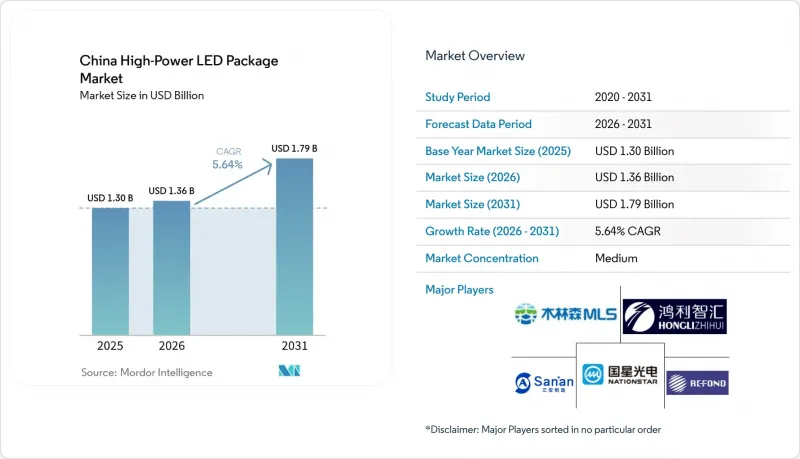
Mordor Intelligence에 의하면, 중국 고출력 LED 패키지 시장 규모는 2025년 13억 달러, 2026년 13억 6,000만 달러에서 2031년까지 17억 9,000만 달러로 확대되어 2026년부터 2031년까지 CAGR 5.64%를 나타낼 것으로 예측됩니다.
본 보고서는 출력 범위(1W-3W, 3W-10W, 10W 이상), 아키텍처(싱글 다이 패키지, 멀티 다이 패키지, COB 등), 용도(일반 조명, 자동차용 조명, 디스플레이 및 백라이트, 특수·니치 용도)별로 분류되어 있습니다. 시장 전망은 금액(달러) 기준으로 제시되어 있습니다.
중국 고출력 LED 패키지 시장 동향 및 분석
Mini 및 Micro-LED의 급속한 보급에 따라 더 높은 구동 전류가 요구되고 있습니다.
현재 미니 LED 및 마이크로 LED 백라이트는 고급 TV, 태블릿, 자동차 계기판에 탑재되어 있으며, 엣지 라이트 방식에 비해 대당 LED 수가 10배 증가했습니다. 패널 1장당 수천만 개의 100 마이크로미터 미만 칩을 본딩함으로써 국부적인 열유속이 20 W cm?²를 초과하게 되므로, 패키지 제조업체들은 자동차용 프로젝션 모듈에서 1 A를 초과하는 다이 전류에 대응할 수 있도록 열 인터페이스 및 확산층을 재설계하고 있습니다. 국내 공급업체들은 결함 밀도를 낮추기 위해 자동 매스 전사 장치와 구리 코어 기판을 도입하고 있지만, 웨이퍼 간 발광 파장 균일성은 초고해상도 디스플레이에서 이음매 없는 타일링을 구현하는 데 걸림돌이 되고 있습니다.
신에너지 차량에서의 어댑티브 매트릭스 헤드램프 보급
2024년, 중국에서는 1,287만 대의 신에너지차(NEV)가 판매되었으며, 승용차 판매에서 신에너지차가 차지하는 비중은 40.9%에 달했습니다. 중형 세단 1대당, 헤드램프 1개당 최소 100개의 제어 가능한 픽셀이 탑재되어 있으며, 플래그십 모델의 경우 2만 5,000개 이상을 통합하고 있어, AEC-Q101 규격을 충족하는 칩 온 보드(COB) 방식 또는 싱글 칩 방식의 픽셀화 LED에 대한 수요가 증가하고 있습니다. 산안광전과 루미레즈의 제휴와 같은 수직 통합 움직임에 힘입어 칩 비용이 약 30% 절감되었으며, 중국산 칩이 유럽의 고급차 제조업체 공급망에 진입할 수 있는 길이 열렸습니다.
광둥성과 장시성의 과잉 생산 능력으로 인한 가격 압박
2022년부터 2024년까지 이루어진 대규모 생산 능력 확대로 인해 공급 과잉이 발생했고, 평균 판매 가격은 30-40% 하락했습니다. 2025년부터 2026년까지 귀금속 가격의 급등으로 인해 일시적인 가격 반등이 나타났으나, 범용 조명 구매자들은 쉽게 구매를 미루거나 구동 전류 사양을 낮추는 경향이 있어, 이익률 회복은 여전히 불안정한 상황입니다. 최근 푸루이광전에 대한 출자 등 자산 매각 및 합병은 합리화가 진행 중임을 보여줍니다.
부문별 분석
2025년에도 1W-3W급 중국 고출력 LED 패키지 시장 규모는 개조용 다운라이트와 가로등에 힘입어 여전히 최대 규모를 유지했습니다. 그러나 칩의 효율이 향상됨에 따라 조명 기구 제조업체는 여러 개의 저와트수 패키지를 10W 이상의 단일 이미터로 대체할 수 있게 되었으며, 이를 통해 드라이버의 수와 조립 작업을 줄일 수 있게 되었습니다. 10W 이상의 패키지는 1A 이상으로 작동하는 적응형 드라이빙 빔 모듈과 산업용 하이베이 조명 기구의 지원에 힘입어 이미 가장 빠른 성장세를 보이고 있습니다. 1 K W-1 미만의 열저항을 실현하는 세라믹 기판이나 금-주석 다이 어태치는 단가를 높이는 요인이지만, 과거에는 실현 불가능했던 전류 수준에서도 장기간 루멘을 유지할 수 있게 해주기 때문에 표준으로 자리 잡고 있습니다.
열 설계의 혁신은 중출력 대역에도 변화를 가져오고 있습니다. 구리 코어 금속 기판은 질화알루미늄 세라믹의 3분의 1 비용으로 열저항을 약 1.3 K W?¹까지 낮출 수 있지만, -40°C-125°C의 자동차용 시험 사이클에서 12 W를 초과하면 납땜 접합부에 피로가 발생합니다. 따라서 열 관련 문제가 해결되면, 설계자들이 고전류 노드의 채택을 자제하게 될 것이므로, 1W-3W 범위의 층은 점차 시장 점유율이 줄어들게 될 것입니다. 이러한 추세는 기판 프레스, 형광체 배합, 드라이버 전자 회로를 사내에서 관리하고 있는 중국의 대형 패키지 제조업체들이 누리는 수직 통합의 이점을 더욱 강화하게 될 것입니다.
기타 혜택:
- 엑셀 형식 시장 예측(ME) 시트
- 3개월간의 애널리스트 지원
자주 묻는 질문
목차
제1장 서론
제2장 조사 방법
제3장 주요 요약
제4장 시장 구도
제5장 시장 규모와 성장 예측
제6장 경쟁 구도
제7장 시장 기회와 향후 전망
JHS 26.06.23According to Mordor Intelligence, the china high-power LED package market size is projected to expand from USD 1.30 billion in 2025 and USD 1.36 billion in 2026 to USD 1.79 billion by 2031, registering a CAGR of 5.64% between 2026-2031.
This report is Segmented by Power Range (1W-3W, 3W-10W, and Above 10W), Architecture (Single-Die Packages, Multi-Die Packages, COB, and More), Application (General Lighting, Automotive Lighting, Display and Backlighting, and Specialty/Niche). The Market Forecasts are Provided in Terms of Value (USD).
China High-Power LED Package Market Trends and Insights
Rapid Mini and Micro-LED Adoption Demanding Higher Drive Currents
Mini and Micro-LED backlights now ship in premium televisions, tablets, and automotive instrument clusters, increasing per-unit LED counts ten-fold compared with edge-lit designs. Bonding tens of millions of sub-100-micrometer chips per panel pushes local heat flux above 20 W cm-2, so packagers are redesigning thermal interfaces and spreading layers to handle die currents that exceed 1 A in automotive projection modules. Domestic suppliers have installed automated mass-transfer tools and copper-core boards to cut defect density, yet wafer-to-wafer emission-wavelength uniformity remains a hurdle for seamless tiling in ultra-high-definition displays.
Growth of Adaptive Matrix Headlamps in New Energy Vehicles
China sold 12.87 million New Energy Vehicles in 2024, lifting NEV penetration to 40.9% of passenger-car sales. Each mid-range sedan already carries at least 100 controllable pixels per headlamp, and flagship models integrate more than 25,000, driving demand for chip-on-board or single-chip pixelated LEDs qualified to AEC-Q101. Vertical integration moves, such as the Sanan-Lumileds deal, trimmed chip cost nearly 30% and opened European luxury OEM supply chains to Chinese die.
Price Compression From Over-Capacity in Guangdong and Jiangxi
Large-scale capacity expansions between 2022-2024 created a supply glut that cut average selling prices 30-40%. Although precious-metal cost inflation triggered a brief price rebound in 2025-2026, margin recovery remains fragile as buyers in commodity lighting easily defer purchases or down-spec drive currents. Asset sales and mergers, such as a recent stake purchase in Purui Optoelectronics, illustrate ongoing rationalization.
Other drivers and restraints analyzed in the detailed report include:
- LED Subsidy Roll-Offs Steering Suppliers Toward High-Efficiency Packages
- ERP Standards Tightening for Public-Lighting Installations
- Thermal-Management Limits Above 10 W in Compact Form Factors
For complete list of drivers and restraints, kindly check the Table Of Contents.
Segment Analysis
The China high-power LED package market size for the 1 W-3 W tier remained the largest in 2025, buoyed by retrofit downlights and streetlighting. However, improved chip efficacy lets luminaire makers replace several low-watt packages with a single Above 10 W emitter, cutting driver count and assembly labor. Packages at or above 10 W already command the fastest growth, underpinned by adaptive driving-beam modules and industrial high-bay fixtures that operate above 1 A. Ceramic substrates delivering sub-1 K W-1 thermal resistance and gold-tin die attach are becoming standard, even though they raise unit cost, because they enable long-term lumen maintenance at currents that were once impractical.
Thermal innovations are also disrupting the mid-range. Copper-core metal-core boards lower thermal resistance to roughly 1.3 K W-1 at one-third the cost of aluminum-nitride ceramics, but solder-joint fatigue emerges above 12 W during the -40 °C to 125 °C automotive test cycle. The 1 W-3 W tier therefore faces gradual share erosion as designers opt for fewer high-current nodes once thermal hurdles are cleared. The trend amplifies vertical-integration advantages enjoyed by large Chinese packagers that control substrate pressing, phosphor compounding, and driver electronics in-house.
List of Companies Covered in this Report:
- Sanan Optoelectronics Co., Ltd.
- Nationstar Optoelectronics Co., Ltd.
- MLS Co., Ltd.
- Hongli Zhihui Group Co., Ltd.
- Refond Optoelectronics Co., Ltd.
- Lextar Electronics Corp.
- Everlight Electronics Co., Ltd.
- Cree LED (Smart Global Holdings, Inc.)
- Nichia Corporation
- Seoul Semiconductor Co., Ltd.
- Osram Opto Semiconductors GmbH
- Lumileds Holding B.V.
- Dominant Opto Technologies Sdn. Bhd.
- Shenzhen Jufei Optoelectronics Co., Ltd.
- Kingsun Optoelectronic Co., Ltd.
- Sharp Corporation
- Samsung Electronics Co., Ltd.
- LG Innotek Co., Ltd.
- Lite-On Technology Corporation
- HC SemiTek Corporation
Additional Benefits:
- The market estimate (ME) sheet in Excel format
- 3 months of analyst support
TABLE OF CONTENTS
1 INTRODUCTION
- 1.1 Study Assumptions and Market Definition
- 1.2 Scope of the Study
2 RESEARCH METHODOLOGY
3 EXECUTIVE SUMMARY
4 MARKET LANDSCAPE
- 4.1 Market Overview
- 4.2 Market Drivers
- 4.2.1 LED Subsidy Roll-offs Steering Suppliers Toward High-Efficiency Packages
- 4.2.2 Rapid Mini/Micro-LED Adoption Demanding Higher Drive Currents
- 4.2.3 ERP Standards Tightening for Public Lighting Installations
- 4.2.4 Growth of Adaptive Matrix Headlamps in New Energy Vehicles
- 4.2.5 Smart Factory Retrofits Requiring High-Lux Illumination
- 4.2.6 Surge in UV-C Disinfection Modules in Semiconductor Fabs
- 4.3 Market Restraints
- 4.3.1 Price Compression from Over-capacity in Guangdong and Jiangxi
- 4.3.2 Thermal-Management Limits Above 10 W in Compact Form-Factors
- 4.3.3 High Import Dependence for Flip-Chip Gold-Bump Equipment
- 4.3.4 PFAS Regulation Increasing Encapsulation Costs
- 4.4 Technology Analysis
- 4.5 Regulatory Landscape
- 4.6 Impact of Macroeconomic Factors
- 4.7 Porter's Five Forces Analysis
- 4.7.1 Bargaining Power of Suppliers
- 4.7.2 Bargaining Power of Buyers
- 4.7.3 Threat of New Entrants
- 4.7.4 Threat of Substitutes
- 4.7.5 Intensity of Competitive Rivalry
5 MARKET SIZE AND GROWTH FORECASTS (VALUE)
- 5.1 By Power Range
- 5.1.1 1 W - 3 W
- 5.1.2 3 W - 10 W
- 5.1.3 Above 10 W
- 5.2 By Architecture
- 5.2.1 Single-die Packages (SMD / Discrete)
- 5.2.2 Multi-die Packages (SMD)
- 5.2.3 COB (Chip-on-Board)
- 5.2.4 Others (CSP, Flip-chip, Hybrid Modules)
- 5.3 By Application
- 5.3.1 General Lighting
- 5.3.2 Automotive Lighting
- 5.3.3 Display and Backlighting
- 5.3.4 Specialty / Niche
6 COMPETITIVE LANDSCAPE
- 6.1 Market Concentration
- 6.2 Strategic Moves
- 6.3 Market Share Analysis
- 6.4 Company Profiles (includes Global Level Overview, Market Level Overview, Core Segments, Financials as available, Strategic Information, Market Rank/Share, Products and Services, Recent Developments)
- 6.4.1 Sanan Optoelectronics Co., Ltd.
- 6.4.2 Nationstar Optoelectronics Co., Ltd.
- 6.4.3 MLS Co., Ltd.
- 6.4.4 Hongli Zhihui Group Co., Ltd.
- 6.4.5 Refond Optoelectronics Co., Ltd.
- 6.4.6 Lextar Electronics Corp.
- 6.4.7 Everlight Electronics Co., Ltd.
- 6.4.8 Cree LED (Smart Global Holdings, Inc.)
- 6.4.9 Nichia Corporation
- 6.4.10 Seoul Semiconductor Co., Ltd.
- 6.4.11 Osram Opto Semiconductors GmbH
- 6.4.12 Lumileds Holding B.V.
- 6.4.13 Dominant Opto Technologies Sdn. Bhd.
- 6.4.14 Shenzhen Jufei Optoelectronics Co., Ltd.
- 6.4.15 Kingsun Optoelectronic Co., Ltd.
- 6.4.16 Sharp Corporation
- 6.4.17 Samsung Electronics Co., Ltd.
- 6.4.18 LG Innotek Co., Ltd.
- 6.4.19 Lite-On Technology Corporation
- 6.4.20 HC SemiTek Corporation
7 MARKET OPPORTUNITIES AND FUTURE OUTLOOK
- 7.1 White-Space and Unmet-Need Assessment


