|
시장보고서
상품코드
2064415
인도네시아의 통합 시설 관리 시장 : 시장 점유율 분석, 산업 동향 및 통계 데이터, 성장 예측(2026-2031년)Indonesia Integrated Facility Management - Market Share Analysis, Industry Trends & Statistics, Growth Forecasts (2026 - 2031) |
||||||
 Mordor Intelligence
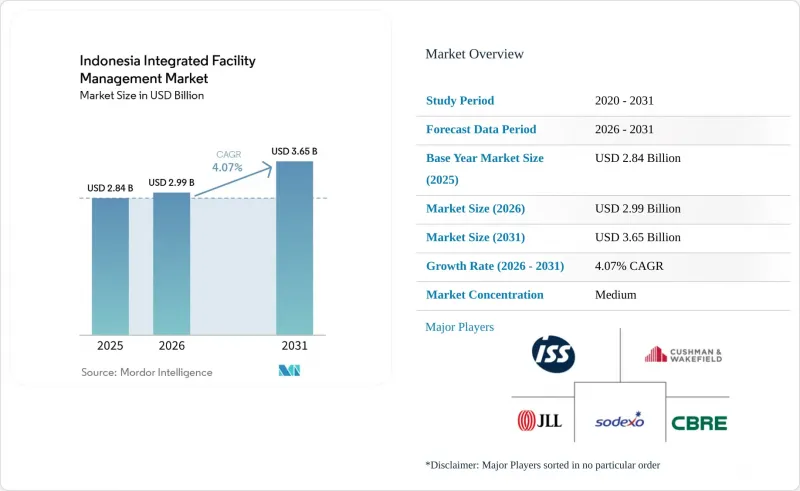
Mordor Intelligence에 의하면, 인도네시아의 통합 시설 관리 시장 규모는 2025년 28억 4,000만 달러로 평가되었고, 2026년에는 29억 9,000만 달러로 추정되고, 2026-2031년 CAGR 4.07%로 성장을 지속할 전망이며, 2031년까지 36억 5,000만 달러에 이를 것으로 예측됩니다.
본 보고서는 서비스 유형별(하드 시설 관리(자산 관리, MEP·HVAC 서비스 등), 소프트 시설 관리(사무 지원·보안, 청소 서비스, 케이터링 서비스 등)) 및 최종 사용자 산업별(상업, 호텔·관광, 공공시설·공공 인프라 등)로 분류되어 있습니다. 시장 전망은 금액(달러) 기준으로 제시되어 있습니다.
인도네시아의 통합 시설 관리 시장 동향 및 인사이트
도심 지역의 상업용 부동산의 급속한 확대
인도네시아의 통합 시설 관리 시장은 주요 도시 지역의 사무실 공급 부족으로 인해 혜택을 보고 있습니다. 자카르타 CBD(중앙 비즈니스 지구) 내 A급 사무실의 입주율은 2024년 4분기에 75%를 넘어섰으며, 지난 2년 동안 신규 A급 빌딩은 준공되지 않았습니다. 이러한 상황으로 인해 건물 소유주는 단순히 연면적 확대보다는 건물의 성능, 임차인에 대한 서비스 품질, 운영의 신뢰성 측면에서 경쟁을 벌여야 하는 상황에 놓여 있습니다. 비슷한 경향은 비교적 새로운 자산군에서도 나타납니다. INA와 DayOne이 72.4MW 용량의 바탐 데이터센터 플랫폼을 설립했으며, 이 플랫폼이 전 세계 하이퍼스케일러 기업들과 10년간 전량 공급 계약을 체결함에 따라 전력, 냉각, 안전 및 보안 관리에 대한 안정적인 수요가 예상됩니다. 단기적인 오피스 공급과 관련하여, 2027년과 2028년에 완공 예정인 A급 신규 타워는 ‘Two Sudirman’과 ‘Indonesia One’ 두 동뿐이며, 이는 기존 건물에 대한 높은 서비스 수준에 대한 수요가 지속될 것임을 뒷받침합니다. 이에 따라 인도네시아의 통합 시설 관리(IFM) 시장은 단순히 건물 수 증가뿐만 아니라, 주요 대도시권 내 자산 품질 경쟁과 밀접하게 연계된 상태를 유지하고 있습니다.
핵심 업무에 집중하기 위한 아웃소싱 확대 추세
인도네시아의 통합 시설 관리 시장에서는 특히 교통, 의료, 이벤트 인프라 분야에서 그동안 건물 운영을 자체적으로 수행해 온 기관들의 아웃소싱 수요가 증가하고 있습니다. ISS 인도네시아가 자카르타 국제컨벤션센터에서 계약을 갱신하고, 나아가 총 연장 231km에 달하는 트랜스자카르타 BRT 네트워크 전체에 대한 계약을 수주한 것은 대규모 공공 자산 분야에서 운영 규모에 맞춘 체계적인 서비스 계약이 점차 도입되고 있음을 보여줍니다. 이러한 수요는 매우 중요합니다. 트랜스자카르타 네트워크는 하루에 100만 명 이상의 승객을 수송하고 있으며, 청소, 유지보수 및 지원 서비스는 재현 가능한 프로세스와 명확한 서비스 관리 체계 하에서 제공되어야 하기 때문입니다. JLL이 발리 국제병원에서 계약을 수주한 사례도 그중 하나입니다. 이는 매우 복잡한 의료시설이 개원 직후 국제적인 건물 운영 모델로 전환되었음을 보여줍니다. 아웃소싱 대상이 민간 상업용 건물에서 공공 및 준공공 자산으로 확대됨에 따라, 인도네시아의 IFM 시장에서는 여러 거점에 걸친 장기 계약의 기반이 더욱 확대되고 있습니다.
첨단 시스템을 담당할 숙련된 기술자 부족
인도네시아의 통합 시설 관리(IFM) 시장에서는 빌딩 자동화, HVAC 최적화, 소방 시스템, 그리고 새로운 건축 규제로 인해 중요성이 커지고 있는 기타 첨단 기술 서비스 분야에서 여전히 기술 인력 부족이라는 병목 현상에 직면해 있습니다. 이러한 격차는 디지털 운영 분야에서 특히 두드러집니다. 왜냐하면 2025년 ITB(인도네시아 국제 박람회)에서 진행된 HVAC 디지털 트윈 관련 프로젝트에서는 IoT 센서, 실시간 데이터 흐름, 그리고 시스템 튜닝을 관리할 수 있는 기술자가 필수 조건으로 전제되었기 때문입니다. 이러한 기술을 갖춘 인력은 자바 섬의 주요 회랑 지역 이외에는 제한적이기 때문에 국내에서 고수준의 서비스 제공이 고르지 않게 이루어지고 있습니다. 인도네시아가 섬나라라는 지리적 조건은 이러한 제약의 해결을 더욱 어렵게 만들고 있습니다. 전문 팀을 외딴 섬의 산업 및 에너지 시설로 파견할 경우, 이동, 숙박 및 대응 시간 측면에서 부담이 따르기 때문입니다. UEM Edgenta가 2025년도에 다중 기술 습득, 역량 기반 교육 및 교차 배치를 중시하고 있다는 점은 인재 육성이 단기적인 인력 배치 문제가 아니라 업계 전반에 걸친 운영상의 필요성임을 보여줍니다.
부문별 분석
2025년, 인도네시아의 통합 시설 관리(IFM) 시장 규모 중 소프트 시설 관리(FM)가 61.6%를 차지했으며, 이는 청소, 경비, 사무 지원, 급식 및 관련 직장 서비스에 걸친 인도네시아의 노동 집약적 운영 모델을 반영하고 있습니다. 인도네시아의 통합 시설 관리 시장에서는 많은 소유주들이 보다 고도화된 기술적 아웃소싱으로 전환하기 전에, 우선 눈에 띄는 일상 업무를 외부에 위탁해 왔기 때문에 오랫동안 소프트 서비스가 선호되어 왔습니다. 청소 품질, 인력의 신뢰성, 그리고 현장 지원이 첨단 엔지니어링 시스템보다 사용자 경험에 더 직접적인 영향을 미치는 많은 시설에서 이러한 추세는 여전히 지속되고 있습니다. 또한, 의료 및 접객 업계에서 위생에 대한 기대가 높아지고 있는 점도 소프트 서비스 수요를 뒷받침하고 있습니다. 이러한 업계에서는 사업자 측에서 보다 체계적인 규정 준수 관리와 서비스 추적을 요구하고 있습니다. 보안 분야에서는 시장이 보다 통합적인 서비스 제공으로 전환되고 있습니다. OCS 인도네시아가 2025년 5월 인도네시아 국가경찰(Baharkam Polri)과 제휴한 사례에서 알 수 있듯이, 기관 고객들은 거버넌스와 운영 감독을 결합한 확장성 있는 모델을 원하고 있습니다.
하드 FM은 인도네시아 IFM 업계에서 가장 빠르게 성장하고 있는 분야로, 자동화, HVAC 성능, 화재 안전, MEP의 신뢰성이 더 이상 미룰 수 없는 규정 준수 요건으로 대두됨에 따라 2031년까지 연평균 성장률(CAGR) 5.1%로 확대될 것으로 전망됩니다. 스마트 빌딩 규제와 더욱 엄격해진 공조 효율 기준에 따라, 소유주들은 기존의 고층 빌딩 전체에 대해 개보수, 시운전 및 성능 모니터링 작업을 진행하고 있습니다. 존슨 컨트롤즈가 탐린 나인에서 완료한 프로젝트는 첨단 냉동 설비 설계와 빌딩 자동화 시스템을 결합하여 30%의 에너지 절감 효과를 달성함으로써, 인도네시아 IFM 시장의 확실한 기준이 되었습니다. 케이터링 서비스는 청소나 경비에 비해 여전히 분산된 상태이지만, 외딴 지역의 산업 및 에너지 프로젝트에서는 열악한 입지 조건 속에서도 공급의 연속성과 직원들의 서비스 체계를 유지해야 하기 때문에 통합형 캠프 관리 계약이 점점 더 선호되고 있습니다. 이로 인해 현재 수익 측면에서는 소프트 FM이 우위를 점하고 있지만, 규정 준수 및 에너지 성능이 자산 운용에서 더욱 중요해짐에 따라 하드 FM도 그 영향력을 확대되고 있습니다.
기타 혜택 :
- Excel 형식 시장 예측(ME) 시트
- 3개월간의 애널리스트 지원
자주 묻는 질문
목차
제1장 서론
제2장 분석 방법
제3장 주요 요약
제4장 시장 구도
제5장 시장 규모 및 성장률 예측
제6장 경쟁 구도
제7장 시장 기회 및 향후 전망
AJY 26.06.26According to Mordor Intelligence, the indonesia integrated facility management market size is expected to grow from USD 2.84 billion in 2025 to USD 2.99 billion in 2026 and is forecast to reach USD 3.65 billion by 2031 at 4.07% CAGR over 2026-2031.
This report is Segmented by Service Type (Hard Facility Management [Asset Management, MEP and HVAC Services, and More], and Soft Facility Management [Office Support and Security, Cleaning Services, Catering Services, and More]), and End User (Commercial, Hospitality, Institutional and Public Infrastructure, and More). The Market Forecasts are Provided in Terms of Value (USD).
Indonesia Integrated Facility Management Market Trends and Insights
Rapid Expansion of Commercial Real Estate in Urban Hubs
The Indonesia integrated facility management market is benefiting from tighter office supply in premium urban districts, where Jakarta's CBD Grade A occupancy stayed above 75% in Q4 2024, and no new Grade A buildings were completed during the prior two years. That setting is pushing landlords to compete more on building performance, tenant service quality, and operating reliability than on the simple expansion of floor space. The same pattern is visible in newer asset categories, since INA and DayOne established a Batam data center platform with 72.4 MW capacity that was fully contracted by a global hyperscaler for ten years, which points to steady demand for power, cooling, safety, and security management. In near-term office supply, only two new Grade A towers, Two Sudirman and Indonesia One, are scheduled for completion in 2027 and 2028, which supports continued demand for strong service standards in existing stock. This keeps the Indonesia integrated facility management (IFM) market closely tied to asset-quality competition in major urban hubs rather than to growth in building count alone.
Growing Outsourcing Trend to Focus on Core Competencies
The Indonesia integrated facility management market is seeing stronger outsourcing demand from institutions that previously kept building operations in-house, especially in transport, healthcare, and event infrastructure. ISS Indonesia's reappointment at the Jakarta International Convention Center and its appointment across TransJakarta's 231 km BRT network show that large public-facing assets are now using structured service contracts at an operating scale. That demand matters because the TransJakarta network serves more than one million passenger trips a day, so cleaning, maintenance, and support services must be delivered with repeatable processes and clear service control. JLL's appointment at Bali International Hospital adds another example, since a high-complexity healthcare asset moved into an internationally managed building operations model soon after inauguration. As outsourcing broadens from private commercial buildings to public and quasi-public assets, the Indonesia IFM market gains a larger base of multi-site and longer-duration contracts.
Shortage of Skilled Technicians for Advanced Systems
The Indonesia integrated facility management market still faces a skill bottleneck in building automation, HVAC optimization, fire systems, and other advanced technical services that are becoming more important under newer building rules. The gap is visible in digital operations because the 2025 ITB work on HVAC digital twins assumed technicians who could manage IoT sensors, live data flows, and system tuning. That skill profile is limited outside the main Java corridor, which makes high-standard service deployment uneven across the country. Indonesia's island geography makes the constraint harder to solve because moving specialist teams to outer-island industrial and energy sites adds travel, housing, and response-time pressure. UEM Edgenta's FY2025 emphasis on multi-skilling, competency-based training, and cross-deployment shows that workforce development is a sector-wide operating need rather than a short-term staffing issue.
Other drivers and restraints analyzed in the detailed report include:
- Government Incentives for Green and Smart Buildings
- Rising ESG-Linked Asset Management Mandates by Sovereign Funds
- Fragmented Supplier Base Inflating Procurement Costs
For complete list of drivers and restraints, kindly check the Table Of Contents.
Segment Analysis
Soft facility management (FM) retained 61.6% of the Indonesia integrated facility management (IFM) market size in 2025, which reflected the country's labor-intensive operating model across cleaning, security, office support, catering, and related workplace services. The Indonesia integrated facility management market has long favored soft services because many owners first outsourced visible day-to-day operations before moving into deeper technical outsourcing. That pattern still holds in many facilities where cleaning quality, manpower reliability, and front-line support shape user experience more directly than advanced engineering systems. Soft-service demand is also being strengthened by stricter hygiene expectations in healthcare and hospitality, where operators want more formal compliance controls and service tracking. In security, the market is moving toward more integrated delivery, as OCS Indonesia's May 2025 partnership with Baharkam Polri showed that institutional clients are looking for scalable models that combine governance and operational oversight.
Hard FM is the faster-moving part of the Indonesia IFM industry, and it is forecast to rise at a 5.1% CAGR through 2031 as automation, HVAC performance, fire safety, and MEP reliability become compliance requirements that are harder to postpone. The smart building rules and tighter AC efficiency standards are moving owners toward retrofit, commissioning, and performance-monitoring work across existing high-rise stock. Johnson Controls' completed work at Thamrin Nine gave the Indonesia IFM market a visible benchmark because the project paired advanced chiller plant design with building automation and delivered a 30% energy reduction. Catering remains more fragmented than cleaning or security, yet remote industrial and energy projects are increasingly favouring integrated camp management contracts where supply continuity and workforce servicing must be maintained across difficult locations. This keeps Soft FM dominant by current revenue, while Hard FM gains ground as compliance and energy performance become more central to asset operations.
List of Companies Covered in this Report:
- PT CBRE Indonesia
- PT Jones Lang LaSalle Indonesia
- Cushman & Wakefield plc
- Sodexo S.A.
- PT Shield-On Service Tbk.
- PT Samudera Indonesia Properti Manajemen
- Colliers International Group Inc.
- PT Global Facility Management
- PT ISS Ciptamitra Facility Services
- PT Angkasa Pura Solusi
- PT PP Properti Tbk.
- PT Wijaya Karya Realty
- PT Telkom Property Indonesia
Additional Benefits:
- The market estimate (ME) sheet in Excel format
- 3 months of analyst support
TABLE OF CONTENTS
1 INTRODUCTION
- 1.1 Study Assumptions and Market Definition
- 1.2 Scope of the Study
2 RESEARCH METHODOLOGY
3 EXECUTIVE SUMMARY
4 MARKET LANDSCAPE
- 4.1 Market Overview
- 4.2 Market Drivers
- 4.2.1 Rapid Expansion of Commercial Real Estate in Urban Hubs
- 4.2.2 Growing Outsourcing Trend to Focus on Core Competencies
- 4.2.3 Government Incentives for Green and Smart Buildings
- 4.2.4 Rising ESG-Linked Asset Management Mandates by Sovereign Funds
- 4.2.5 Digital Twin Adoption for Predictive Maintenance
- 4.2.6 Facility Consolidation in Decommissioned Oil and Gas Sites
- 4.3 Market Restraints
- 4.3.1 Shortage of Skilled Technicians for Advanced Systems
- 4.3.2 Fragmented Supplier Base Inflating Procurement Costs
- 4.3.3 Low Technology Adoption Among Small Facility Owners
- 4.3.4 Labour Law Uncertainties and Contractual Rigidities
- 4.4 Industry Value Chain Analysis
- 4.5 Regulatory Landscape
- 4.6 Technological Outlook
- 4.7 Porter's Five Forces Analysis
- 4.7.1 Threat of New Entrants
- 4.7.2 Bargaining Power of Suppliers
- 4.7.3 Bargaining Power of Buyers
- 4.7.4 Threat of Substitutes
- 4.7.5 Competitive Rivalry
- 4.8 Impact of Macroeconomic Factors on the Market
5 MARKET SIZE AND GROWTH FORECASTS (VALUE)
- 5.1 By Service Type
- 5.1.1 Hard Facility Management
- 5.1.1.1 Asset Management
- 5.1.1.2 MEP and HVAC Services
- 5.1.1.3 Fire Systems and Safety
- 5.1.1.4 Other Hard FM Services
- 5.1.2 Soft Facility Management
- 5.1.2.1 Office Support and Security
- 5.1.2.2 Cleaning Services
- 5.1.2.3 Catering Services
- 5.1.2.4 Other Soft FM Services
- 5.1.1 Hard Facility Management
- 5.2 By End User Industry
- 5.2.1 Commercial
- 5.2.2 Hospitality
- 5.2.3 Institutional and Public Infrastructure
- 5.2.4 Healthcare
- 5.2.5 Industrial and Process Sector
- 5.2.6 Other End-User Industries
6 COMPETITIVE LANDSCAPE
- 6.1 Market Concentration
- 6.2 Strategic Moves
- 6.3 Market Share Analysis
- 6.4 Company Profiles (includes Global Level Overview, Market Level Overview, Core Segments, Financials as available, Strategic Information, Market Rank/Share, Products and Services, Recent Developments)
- 6.4.1 PT CBRE Indonesia
- 6.4.2 PT Jones Lang LaSalle Indonesia
- 6.4.3 Cushman & Wakefield plc
- 6.4.4 Sodexo S.A.
- 6.4.5 PT Shield-On Service Tbk.
- 6.4.6 PT Samudera Indonesia Properti Manajemen
- 6.4.7 Colliers International Group Inc.
- 6.4.8 PT Global Facility Management
- 6.4.9 PT ISS Ciptamitra Facility Services
- 6.4.10 PT Angkasa Pura Solusi
- 6.4.11 PT PP Properti Tbk.
- 6.4.12 PT Wijaya Karya Realty
- 6.4.13 PT Telkom Property Indonesia
7 MARKET OPPORTUNITIES AND FUTURE OUTLOOK
- 7.1 White-Space and Unmet-Need Assessment