|
시장보고서
상품코드
2064488
중국의 통합 시설 관리 시장 : 시장 점유율 분석, 업계 동향 및 통계, 성장 예측(2026-2031년)China Integrated Facility Management - Market Share Analysis, Industry Trends & Statistics, Growth Forecasts (2026 - 2031) |
||||||
 Mordor Intelligence
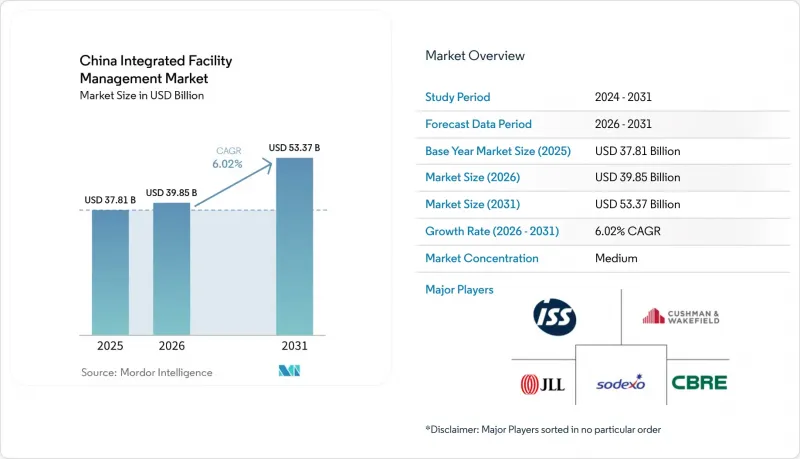
Mordor Intelligence에 의하면, 중국의 통합 시설 관리 시장 규모는 2025년에 378억 1,000만 달러로 평가되었고, 2026년 398억 5,000만 달러로 추정되고, 2031년까지 533억 7,000만 달러에 이를 것으로 예측되며, 예측 기간(2026-2031년) CAGR은 6.02%를 나타낼 전망입니다.
본 보고서는 서비스 유형별(하드웨어 통합 관리(자산 관리, MEP 및 HVAC 서비스 등), 소프트웨어 통합 관리(사무 지원 및 보안, 청소 서비스, 케이터링 서비스 등)), 최종 사용자별(상업, 호텔·리조트, 기관 및 공공 인프라, 의료, 기타)로 분류되어 있습니다. 시장 전망은 금액(달러) 기준으로 제시되어 있습니다.
중국의 통합 관리 시장 동향 및 인사이트
부동산, 사무실, 데이터센터 산업의 급속한 성장
데이터센터는 중단 없는 엔지니어링 지원, 더욱 엄격한 대응 시간 기준, 더욱 강력한 성능 검증이 필요하기 때문에 중국의 통합 관리 시장에서 독자적인 수요를 창출하고 있습니다. 이는 서비스 조합의 폭이 넓음에도 불구하고, 엔지니어링 측면에서의 진입 장벽이 비교적 낮은 기존 사무실 시설과는 다릅니다. ‘데이터센터 친환경 개발 행동 계획’은 전력 사용 효율 향상 및 재생에너지 이용 확대에 관한 요건을 규정하고 있으며, 이에 따라 하드 FM 서비스 분야에서 에너지 관리, 냉각 최적화, 전기 시스템 모니터링에 대한 수요가 증가하고 있습니다. 오피스 파크와 기업 캠퍼스 역시 이러한 수요 채널을 더욱 확대되고 있습니다. 특히 기술, 스마트 제조, 신에너지 관련 기업들이 안정적이고 종합적인 지원 서비스를 필요로 하는 부문에서 두드러집니다. 따라서 전문적인 검사, 냉방, 규정 준수, 계정 관리 등을 처리할 수 있는 서비스 제공업체들은 중국의 통합 시설 관리(IFM) 시장에서 더욱 견고한 계약 입지를 확보해 나가고 있습니다.
중국 내 제3자 FM 서비스 아웃소싱 확대
중국의 통합 시설 관리 시장은 임차인들이 보다 명확한 책임 소재와 더 우수한 통합 서비스를 요구하는 가운데, 제3자 제공 방식으로의 점진적인 전환으로 인한 혜택도 누리고 있습니다. 이러한 변화는 대기업의 포트폴리오에서 두드러지게 나타나고 있으며, 서비스 제공업체들은 업무 환경 서비스, 유지보수, 디지털 도구, 성과 보고서를 단일 운영 모델로 통합해야 할 필요가 있습니다. 최근 제품 및 계약의 출시 동향을 보면, 아웃소싱이 단순한 노동력 대체를 넘어 플랫폼 기반의 운영 방식으로 전환되고 있음을 알 수 있습니다. 또한, 디지털 트윈을 활용한 모니터링도 단일 서비스 구조 하에서 청소, 유지보수, 조경, 위생 관리를 지원하기 위해 활용되고 있습니다. 단편적인 조달이 아닌 종합적인 실행을 요구하는 임차인이 늘어남에 따라, 중국의 IFM 시장에서는 현장 서비스 제공, 디지털 가시화, 전국적인 계정 관리를 결합할 수 있는 공급업체가 우위를 점할 가능성이 높을 것으로 보입니다.
가격 책정, 참조 기준, 계약상의 표준화 부재
표준 가격 책정 및 계약 구조의 부재는 여전히 중국의 통합 시설 관리(IFM) 시장의 성장을 저해하고 있습니다. 그 이유는 많은 입찰이 최저가 선정에 중점을 둘 수밖에 없기 때문입니다. 이러한 접근 방식에서는 구매자가 단순한 노동력 공급과 기술적 깊이가 있는 진정으로 통합된 서비스 제공을 구분하기 어려워집니다. 조달 과정에서 가격에 대한 의존도가 너무 높으면, 서비스 품질이 뛰어나더라도 엔지니어링 및 디지털 역량이 뛰어난 공급업체는 이익률을 유지하는 데 어려움을 겪을 수 있습니다. 또한, 명확한 품질 기준 없이 계약이 체결되면, 클라이언트는 결과물의 품질에 편차를 느낄 수 있으며, 이는 계약 갱신에 대한 의욕을 떨어뜨리는 원인이 되기도 합니다. 계약 양식, 서비스 정의, 성과 기준이 더욱 일관성 있게 정립되기 전까지는 중국의 통합 시설 관리 시장이 가치 기반 조달 과정에서 계속해서 마찰에 직면할 것으로 보입니다.
부문별 분석
2025년, 소프트 통합 관리(FM)는 중국 통합형 통합 관리(IFM) 시장 점유율의 55.78%를 차지했으며, 상업, 공공기관, 캠퍼스 환경을 막론하고 최대 서비스 그룹으로서의 위상을 유지했습니다. 청소, 급식, 사무 지원은 눈에 보이는 업무이며, 반복적인 성격이 있고, 입주자가 단일 공급업체를 통해 일원화하여 관리하기 쉽기 때문에 여전히 가장 널리 아웃소싱되는 업무였습니다. 중국 IFM 시장의 이 부문은 대규모 기업 캠퍼스의 확대로 인해 혜택을 보고 있습니다. 이러한 장소에서는 고용주가 더욱 복잡한 사업장 전반에 걸쳐 일관된 지원 서비스를 필요로 합니다. 계약 범위가 확대됨에 따라, 고객사는 프론트 오피스 지원, 청소, 업무 공간 서비스, 특정 규정 준수 업무를 개별적으로 조달하기보다는 하나의 패키지로 묶어 조달하려는 경향이 강해지고 있습니다. 이러한 변화로 인해 서비스 구성이 더욱 데이터 중심적이고 프로세스 주도적인 형태로 바뀌어 가는 와중에도, 소프트 FM에 대한 안정적인 수요가 뒷받침되고 있습니다.
하드 FM은 가장 빠르게 성장하고 있는 서비스 부문이며, 이 부문에서 중국의 통합 시설 관리 시장 규모는 2026-2031년 연평균 성장률(CAGR) 6.73%로 확대되고 있습니다. 이러한 성장은 자산 관리, MEP(기계·전기·배관) 서비스, HVAC(냉난방·공조) 모니터링, 가동 시간, 안전성, 에너지 관리와 관련된 기타 엔지니어링 집약적 업무에 의해 주도되고 있습니다. 데이터센터에 대한 규제 역시 이러한 수요를 뒷받침하고 있습니다. 이는 사업자가 공식적인 효율화 목표에 따라 냉각, 전기 시스템, 성능 추적을 보다 엄격하게 모니터링해야 하기 때문입니다. 또한, 고객들이 미션 크리티컬한 사이트 전반에 걸쳐 문서화된 유지보수, 감사 기록, 그리고 보다 우수한 장애 대응을 요구함에 따라, 소방 시스템 및 안전 서비스 분야도 점점 더 전문화되고 있습니다. 중국의 통합 시설 관리 산업에서 이에 따라 하드 FM은 일상적인 서비스 제공과 마찬가지로 기술적 보증이 중요시되는 새로운 통합 계약에서 더 큰 시장 점유율을 확보할 수 있는 유리한 위치에 서 있습니다.
기타 혜택
- 엑셀 형식 시장 예측(ME) 시트
- 3개월간의 애널리스트 지원
자주 묻는 질문
목차
제1장 서론
제2장 조사 방법
제3장 주요 요약
제4장 시장 구도
제5장 시장 규모 및 성장 예측
제6장 경쟁 구도
제7장 시장 기회 및 향후 전망
AJY 26.06.26According to Mordor Intelligence, the china integrated facility management market size was valued at USD 37.81 billion in 2025 and is estimated to grow from USD 39.85 billion in 2026 to reach USD 53.37 billion by 2031, at a CAGR of 6.02% during the forecast period (2026-2031).
This report is Segmented by Service Type (Hard Facility Management [Asset Management, MEP and HVAC Services, and More], and Soft Facility Management [Office Support and Security, Cleaning Services, Catering Services, and More]), and End User (Commercial, Hospitality, Institutional and Public Infrastructure, Healthcare, and More). The Market Forecasts are Provided in Terms of Value (USD).
China Integrated Facility Management Market Trends and Insights
Rapid Growth of Real Estate, Office, And Data Centre Industries
Data centers are creating a distinct stream of demand in the China integrated facility management market because they need uninterrupted engineering support, tighter response windows, and stronger performance validation. This is different from conventional office facilities, where the service mix is broader, but the engineering threshold is often lower. The Data Center Green Development Action Plan set requirements around lower power usage effectiveness and rising renewable energy use, which has increased the need for energy management, cooling optimization, and electrical system oversight within hard FM services. Office parks and corporate campuses continue to add to this demand channel, especially where technology, intelligent manufacturing, and new energy firms need stable and bundled support services. Providers that can handle specialized testing, cooling, compliance, and account management are therefore gaining stronger contract positions in the China integrated facility management (IFM) market.
Rising Outsourcing of Third-Party FM Services in China
The China integrated facility management market is also benefiting from a gradual shift toward third-party delivery, as occupiers seek clearer accountability and better service integration. This shift is visible in large enterprise portfolios, where providers are being asked to combine workplace services, maintenance, digital tools, and performance reporting within a single operating model. Recent product and contract launches show how outsourcing is moving beyond labour substitution and toward a platform-based operating approach. Digital twin monitoring is also being used to support cleaning, maintenance, landscaping, and hygiene under one service structure. As more occupiers seek bundled execution instead of fragmented procurement, the China IFM market is likely to reward vendors that can combine site delivery, digital visibility, and national account management.
Lack Of Standardization in Pricing, Referencing, And Contracts
A lack of standard pricing and contract structures still slows the China integrated facility management (IFM) market because it keeps many tenders focused on lowest-cost selection. That approach makes it harder for buyers to distinguish between basic labour supply and genuinely integrated delivery with technical depth. When procurement leans too heavily on price, providers with stronger engineering or digital capability can struggle to defend margins even when their service quality is higher. This also creates weaker renewal dynamics, because clients may see inconsistent outcomes when contracts are awarded without clear quality benchmarks. Until contract templates, service definitions, and performance baselines become more consistent, the China integrated facility management market will continue to face friction in value-based procurement.
Other drivers and restraints analyzed in the detailed report include:
- Mandate of Energy Efficiency and Focus on Sustainable Solutions
- Acceleration Of Urbanization and Growth of Real Estate Sector in China
- Complex Legal Requirements from National and State-Level Regulations
For complete list of drivers and restraints, kindly check the Table Of Contents.
Segment Analysis
Soft Facility Management (FM) held 55.78% of China integrated facility management (IFM) market share in 2025, which kept it as the largest service group across commercial, institutional, and campus environments. Cleaning, catering, and office support remained the most widely outsourced activities because they are visible, repetitive, and easier for occupiers to centralize under one vendor. This part of the China IFM market also benefits from the spread of larger enterprise campuses, where employers need consistent support services across more complex sites. As contracts become broader, clients are increasingly bundling front-of-house support, cleaning, workplace services, and selected compliance tasks into one package rather than sourcing them separately. That shift supports stable demand for Soft FM even as the service mix becomes more data-aware and process-driven.
Hard FM is the fastest-growing service category, with the China integrated facility management market size for this segment advancing at a 6.73% CAGR from 2026 to 2031. The growth is being driven by asset management, MEP services, HVAC oversight, and other engineering-intensive work tied to uptime, safety, and energy control. Data center policy has added to this demand because operators need tighter oversight of cooling, electrical systems, and performance tracking under formal efficiency targets. Fire systems and safety services are also becoming more specialized as clients look for documented maintenance, audit trails, and better fault response across mission-critical sites. Within the China integrated facility management industry, this leaves hard FM well placed to capture a larger share of new integrated contracts where technical assurance matters as much as routine service coverage.
List of Companies Covered in this Report:
- CBRE Group Inc.
- Jones Lang LaSalle Incorporated
- Cushman & Wakefield plc
- ISS A/S
- Sodexo SA
- Savills plc
- Colliers International Group Inc.
- GDI Integrated Facility Services Inc.
- China Overseas Property Holdings Limited
- Poly Property Services Co. Ltd.
- Shanghai Xincheng Facility Management Ltd.
- Sichuan Huaming Property Management Co. Ltd.
- Shenzhen Capital Property Management Co. Ltd.
- Guangzhou Guangwu Property Management Ltd.
- Beijing Winn Property Management Co. Ltd.
- Secom Co. Ltd.
- Diebold Nixdorf Inc.
- Sangfor Technologies Inc.
- Qingdao Hisense Facility Management Co. Ltd.
- Greentown Service Group Co. Ltd.
Additional Benefits:
- The market estimate (ME) sheet in Excel format
- 3 months of analyst support
TABLE OF CONTENTS
1 INTRODUCTION
- 1.1 Study Assumptions and Market Definition
- 1.2 Scope of the Study
2 RESEARCH METHODOLOGY
3 EXECUTIVE SUMMARY
4 MARKET LANDSCAPE
- 4.1 Market Overview
- 4.2 Market Drivers
- 4.2.1 Acceleration of Smart Building Initiatives in Tier-1 Cities
- 4.2.2 Mandated Energy-Efficiency Targets for Public Facilities
- 4.2.3 Rising Outsourcing of Non-Core Operations by SOEs
- 4.2.4 Expansion of Industrial Parks in Western China
- 4.2.5 Growing Demand for Integrated Contracts in Healthcare Campuses
- 4.2.6 Deployment of 5G-Enabled Predictive Maintenance Platforms
- 4.3 Market Restraints
- 4.3.1 Talent Shortages in Specialized Hard FM Services
- 4.3.2 Persistent Price-Based Bidding in Government Tenders
- 4.3.3 Low Penetration of IFM in Small and Medium Enterprises
- 4.3.4 Regulatory Uncertainty Around Private-Public Partnership Models
- 4.4 Industry Value Chain Analysis
- 4.5 Regulatory Landscape
- 4.6 Technological Outlook
- 4.7 Impact of Macroeconomic Factors on the Market
- 4.8 Porter's Five Forces Analysis
- 4.8.1 Threat of New Entrants
- 4.8.2 Bargaining Power of Suppliers
- 4.8.3 Bargaining Power of Buyers
- 4.8.4 Threat of Substitutes
- 4.8.5 Competitive Rivalry
5 MARKET SIZE AND GROWTH FORECASTS (VALUE)
- 5.1 By Service Type
- 5.1.1 Hard Facility Management
- 5.1.1.1 Asset Management
- 5.1.1.2 MEP and HVAC Services
- 5.1.1.3 Fire Systems and Safety
- 5.1.1.4 Other Hard Facility Management Services
- 5.1.2 Soft Facility Management
- 5.1.2.1 Office Support and Security
- 5.1.2.2 Cleaning Services
- 5.1.2.3 Catering Services
- 5.1.2.4 Other Soft Facility Management Services
- 5.1.1 Hard Facility Management
- 5.2 By End-User Industry
- 5.2.1 Commercial
- 5.2.2 Hospitality
- 5.2.3 Institutional and Public Infrastructure
- 5.2.4 Healthcare
- 5.2.5 Industrial and Process Sector
- 5.2.6 Other End-User Industries
6 COMPETITIVE LANDSCAPE
- 6.1 Market Concentration
- 6.2 Strategic Moves
- 6.3 Market Share Analysis
- 6.4 Company Profiles (includes Global Level Overview, Market Level Overview, Core Segments, Financials as available, Strategic Information, Market Rank/Share, Products and Services, Recent Developments)
- 6.4.1 CBRE Group Inc.
- 6.4.2 Jones Lang LaSalle Incorporated
- 6.4.3 Cushman & Wakefield plc
- 6.4.4 ISS A/S
- 6.4.5 Sodexo SA
- 6.4.6 Savills plc
- 6.4.7 Colliers International Group Inc.
- 6.4.8 GDI Integrated Facility Services Inc.
- 6.4.9 China Overseas Property Holdings Limited
- 6.4.10 Poly Property Services Co. Ltd.
- 6.4.11 Shanghai Xincheng Facility Management Ltd.
- 6.4.12 Sichuan Huaming Property Management Co. Ltd.
- 6.4.13 Shenzhen Capital Property Management Co. Ltd.
- 6.4.14 Guangzhou Guangwu Property Management Ltd.
- 6.4.15 Beijing Winn Property Management Co. Ltd.
- 6.4.16 Secom Co. Ltd.
- 6.4.17 Diebold Nixdorf Inc.
- 6.4.18 Sangfor Technologies Inc.
- 6.4.19 Qingdao Hisense Facility Management Co. Ltd.
- 6.4.20 Greentown Service Group Co. Ltd.
7 MARKET OPPORTUNITIES AND FUTURE OUTLOOK
- 7.1 White-Space and Unmet-Need Assessment