|
시장보고서
상품코드
2064503
미국의 채혈 시장 : 시장 점유율 분석, 산업 동향 및 통계 데이터, 성장 예측(2026-2031년)United States Blood Collection - Market Share Analysis, Industry Trends & Statistics, Growth Forecasts (2026 - 2031) |
||||||
 Mordor Intelligence
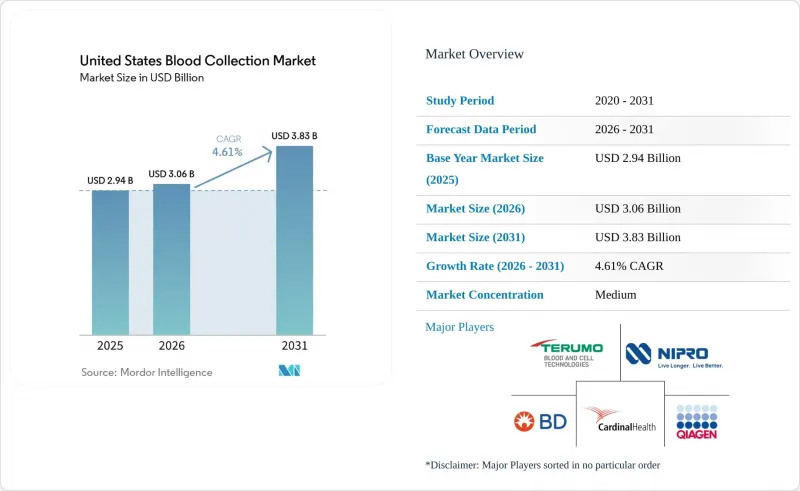
Mordor Intelligence에 의하면, 미국의 채혈 시장 규모는 2025년 29억 4,000만 달러로 평가되었고, 2026년에는 30억 6,000만 달러로 추정되고, 2026-2031년 CAGR 4.61%로 성장을 지속할 전망이며, 2031년까지 38억 3,000만 달러에 이를 것으로 예측됩니다.
본 보고서는 제품 유형별(채혈용 튜브, 바늘·세트, 채혈백, 란셋, 채혈 시스템), 채혈 부위별(정맥, 모세혈관), 방법별(수동, 자동), 용도별(진단, 수혈 지원, 연구), 최종 용도별(병원, 검사실, 혈액은행, 진료소), 지역별(미국)로 분류되어 있습니다. 시장 전망은 금액(달러) 기준으로 제시되어 있습니다.
미국의 채혈 시장 동향 및 인사이트
만성 질환 진단 건수 증가
채혈 시장에서 가장 강력한 장기적 수요 기반은 전체 성인 인구를 아우르는 만성 질환의 부담이 지속되고 있다는 점에 있습니다. CDC 보고서에 따르면, 미국 성인층에서 여러 만성 질환이 여전히 널리 퍼져 있으며, 이러한 증가 추세는 젊은 층까지 미치고 있는 것으로 나타났습니다. 이는 진단 모니터링이 더 조기에 시작되고, 치료 전 과정에 걸쳐 더 오랜 기간 동안 지속된다는 것을 의미합니다. 이러한 변화가 중요한 이유는 당뇨병, 비만, 심혈관 질환의 위험이 있거나 정신 질환을 앓고 있는 환자들이 1차 진료, 전문의 진료, 외래 진료 등 각 단계에서 검체 채취가 필요한 정기 검진 일정을 따르는 경우가 많기 때문입니다. 따라서 채혈 시장은 일시적인 수요 급증에 그치지 않고, 수요의 지속성 덕분에 혜택을 보고 있습니다. 왜냐하면 모니터링 대상 질환이 하나 늘어날 때마다 일상적인 관리 과정에서 반복적인 채혈이 이루어질 가능성이 높아지기 때문입니다. 암 치료에서는 혈액 제제가 종양학 치료 과정이나 지지 요법에서 널리 사용되기 때문에 정기적인 수요가 더욱 다층화됩니다. 이러한 수요 패턴 덕분에, 의료 지출에 대한 전반적인 전망이 불투명해지더라도 공급업체는 채혈관, 바늘, 란셋, 채혈 키트 및 관련 소모품에 대해 안정적인 기반을 확보할 수 있습니다.
지속적인 헌혈 및 수혈 지원의 필요성
채혈 시장은 기능적인 전국적 혈액 공급을 유지해야 한다는 지속적인 필요성에서도 뒷받침되고 있습니다. 미국 혈액 센터(America's Blood Centers)의 보고에 따르면, 미국에서는 1,500만 단위 이상의 혈액 제제가 수혈되고 있으며, 수혈은 여전히 매우 높은 일일 빈도로 계속되고 있습니다. 이로 인해 병원과 지역 혈액 네트워크에 있어 채혈 활동은 필수적인 요소가 되었습니다. AABB의 조사 결과에 따르면, 채혈 방식은 아페레시스(성분 채혈) 중심으로 전환되고 있으며, 현재 혈소판 공급은 아페레시스 방식 및 관련 일회용 세트에 크게 의존하고 있습니다. 이러한 변화는 조달의 경제성을 바꾸는 것입니다. 왜냐하면 자동화된 성분 채혈에서는 가치가 낮은 전혈 공급뿐만 아니라 전용 하드웨어, 소프트웨어 및 고가의 소모품이 사용되기 때문입니다. 헌혈자 참여율이 낮은 수준을 유지하고 있어 시스템은 여전히 한계에 부딪혀 있으며, 병원 수요를 충족시키기 위해서는 혈액센터가 신뢰할 수 있는 채혈 인프라와 충분한 헌혈자 처리 능력을 확보해야 합니다. 그 결과, 채혈 시장은 진단 검사뿐만 아니라 임상 사용을 위해 충분한 양의 헌혈 혈액 및 혈액 성분을 확보해야 하는 지속적인 운영상의 필요성에서도 지지를 얻고 있습니다.
채혈실 및 검사실의 인력 부족
인력 부족은 채혈 시장이 어느 정도의 채혈 능력을 실제 채혈량으로 전환할 수 있는지에 있어 여전히 중대한 장벽으로 남아 있습니다. 미국 노동통계국은 2024-2034년 채혈사의 고용이 6% 증가할 것으로 전망하고 있으며, 이는 채혈 인력에 대한 수요가 많은 의료기관이 현재 확보할 수 있는 인력 증가 속도를 웃돌며 증가하고 있음을 시사합니다. 또한, 의료 및 공중보건 검사실 인력 연합(Medical and Public Health Laboratory Workforce Coalition)은 검사실 인력 전체에서 예상되는 연간 결원을 메우기 위해 필요한 수준에 비해 여전히 크게 부족한 교육 파이프라인 현황에 대해서도 보고하고 있습니다. 인력 부족이 지속되면, 해당 시설은 처리 속도 저하, 검체 처리 지연, 그리고 진단 수요나 헌혈 센터 방문자 수의 급증에 대응할 수 있는 유연성 저하 문제에 직면하게 됩니다. 이로 인해 일부 기관은 자동화나 업무 흐름 재설계로 방향을 전환하고 있지만, 훈련을 받은 인력이 부족하여 발생하는 단기적인 처리 능력 부족 문제를 완전히 해소하는 것은 아닙니다. 그 결과, 채혈 시장에는 견고한 잠재 수요가 존재하지만, 그 수요의 일부는 병원, 검사실 및 이동식 서비스 분야의 인력 확보 상황에 따라 여전히 운영상의 제약을 받고 있습니다.
부문별 분석
2025년, 채혈용 튜브는 채혈 시장 점유율의 34.78%를 차지했으며, 이는 병원, 클리닉, 검사실에서 이루어지는 일상적인 정맥 천자 시 이러한 튜브가 핵심적인 역할을 하고 있음을 반영합니다. 혈청 분리용 및 무첨가 혈청용 튜브는 일상적인 생화학 검사 및 면역 측정 워크플로우의 대부분을 지속적으로 뒷받침하고 있는 반면, EDTA 튜브는 혈액학 및 특정 분자 검사 분야에서 여전히 중요한 역할을 수행하고 있습니다. 구연산 튜브 역시, 특히 반복적인 모니터링이 일반적인 심혈관 질환 및 혈전증의 치료 경로에서 응고 검사에서 계속해서 중요한 역할을 수행했습니다. 헤파린 및 혈장용 포맷은 임상적 판단에 있어 혈장의 안정성과 검사 결과의 신속한 제공이 중요한 검사 환경에서 지지를 얻었습니다. 이처럼 폭넓은 유용성 덕분에 채혈관은 채혈 및 검사 워크플로우의 가장 중요한 기반을 뒷받침하고 있어, 채혈 시장의 핵심적인 위치를 계속 유지하고 있습니다.
랜싯 및 모세관 미세 채혈 시장은 2031년까지 연평균 성장률(CAGR) 5.47%를 나타낼 것으로 예측되며, 미국 채혈 시장에서 가장 빠르게 확대되고 있는 제품 하위 부문이 될 것입니다. 이러한 성장은 자가 채혈, 외래 진료의 편의성, 그리고 분산형 프로그램에 적합한 안전 랜셋, 마이크로 컨테이너, 건조 혈액 스팟 키트와 밀접한 관련이 있습니다. Truvian사의 2025년 FDA 승인은 소량의 모세혈관 검체만으로도 소규모 환경에서 보다 광범위한 검사 항목을 수행할 수 있음을 보여주었으며, 이를 통해 성인 대상 미세 채혈 기기의 보급 확대를 뒷받침하는 근거가 강화되었습니다. 또한, 2025년에 Tasso가 ARUP Laboratories와 제휴를 맺음으로써 모세혈관 미세 시료를 이용한 검사법의 검증도 탄력을 받았습니다. 이에 따라 모세혈관 채혈은 제한적인 이용 사례에서 벗어나, 보다 일상적인 업무 흐름으로 전환되고 있습니다. 이러한 제품 구성의 확대에 따라, 채혈관은 규모 면에서 주도권을 유지하는 한편, 모세혈관 형식이 채혈 시장 증가분 성장의 대부분을 담당하게 될 것입니다.
2025년, 정맥 채혈은 매출의 40.57%를 차지했으며, 미국 채혈 시장 전체에서 여전히 주요 채혈 부위로서의 위상을 유지했습니다. 이 지위는 입원 환자의 진단, 외래 검사, 헌혈 및 아페레시스 시술에서 점점 더 많은 검체량에 대한 지속적인 수요를 반영하고 있습니다. 정맥 채혈 워크플로는 광범위한 검사 항목, 높은 처리량의 채혈, 그리고 기존 검사 장비와의 호환성을 지원하기 때문에 임상 업무에 깊이 뿌리내리고 있습니다. OSHA(미국 직업안전보건청)의 규정과 ‘바늘 찔림 사고 방지법’ 역시 정맥 접근용 기구를 더 안전한 설계의 제품으로 정기적으로 교체하도록 장려하고 있으며, 이는 바늘 및 윙이 부착된 세트와 관련된 조달 활동을 뒷받침하고 있습니다. 대규모 병원이나 진단 네트워크에서는 채혈량, 표준화, 검사 항목의 폭이 편의성이라는 고려 사항을 상회하는 한, 정맥 채혈이 여전히 기본 방식입니다.
모세혈관 채혈 시장은 2031년까지 연평균 성장률(CAGR) 5.28%로 확대될 것으로 예상되며, 채혈 시장 규모 전망에 있어 채혈 부위 하위 부문 중 가장 빠르게 성장할 분야가 될 것으로 보입니다. 이러한 성장은 정맥 천자가 현실적으로 어렵거나 바람직하지 않은 환경에서 손가락 채혈이나 소아의 재택 채혈에 대한 수용도가 높아지고 있음을 반영하고 있습니다. 2026년 RedDrop ONE 연구에 따르면, 보호자가 직접 수행하는 모세혈관 채혈이 CLIA 인증 실험실로 상온에서 익일 배송되는 다양한 지역에서 효과적으로 작동하는 것으로 나타났으며, 이 모델이 시범 운영 환경을 넘어 실제 운영상에서도 중요한 의미를 지닌다는 사실이 밝혀졌습니다. 또한, Tasso사와 ARUP Laboratories사는 분산형 마이크로 샘플링 방식에서 검사법의 검증 가능성이 더욱 확대되고 있음을 입증했습니다. 이를 통해 연구 및 모니터링 관리 분야의 모세혈관 채혈 워크플로우에 대한 신뢰도가 높아지고 있습니다. 모세혈관 채혈이 가까운 미래에 대규모로 정맥 채혈법을 대체할 가능성은 낮지만, 미국의 채혈 시장은 기존의 채혈 시설 외부에 있는 환자들에게 어떻게 접근할 것인가라는 측면에서 그 양상을 변화시키고 있습니다.
기타 혜택 :
- Excel 형식 시장 예측(ME) 시트
- 3개월간의 애널리스트 지원
자주 묻는 질문
목차
제1장 서론
제2장 분석 방법
제3장 주요 요약
제4장 시장 구도
제5장 시장 규모 및 성장률 예측
제6장 경쟁 구도
제7장 시장 기회 및 향후 전망
AJY 26.06.26According to Mordor Intelligence, the united states blood collection market size is expected to grow from USD 2.94 billion in 2025 to USD 3.06 billion in 2026 and is forecast to reach USD 3.83 billion by 2031 at 4.61% CAGR over 2026-2031.
This report is Segmented by Product Type (Tubes, Needles and Sets, Blood Bags, Lancets, Collection Systems), Site of Collection (Venous, Capillary), Method (Manual, Automated), Application (Diagnostics, Transfusion Support, Research), End Use (Hospitals, Laboratories, Blood Banks, Physician Offices), and Geography (United States). The Market Forecasts are Provided in Terms of Value (USD).
United States Blood Collection Market Trends and Insights
Rising Chronic Disease Diagnostic Volumes
The strongest long-cycle demand support for the blood collection market comes from the continued burden of chronic disease across the adult population. CDC reporting showed that multiple chronic conditions remained widespread among U.S. adults and that the rise extended into younger age groups, which means diagnostic monitoring begins earlier and continues for longer periods across the care journey. That shift matters because patients with diabetes, obesity, cardiovascular risk, and mental health conditions often move into recurring laboratory schedules that require specimen collection across primary care, specialist visits, and ambulatory settings. The blood collection market, therefore, benefits from volume durability rather than one-time spikes, since every additional monitored condition raises the likelihood of repeated blood draws during routine care. Cancer care adds another layer of recurring need because blood products are heavily used in oncology treatment pathways and supportive care. This demand pattern gives suppliers a stable base for tubes, needles, lancets, collection sets, and related consumables, even when broader healthcare spending conditions become less predictable.
Sustained Blood Donation and Transfusion Support Needs
The blood collection market also draws support from the ongoing need to maintain a functioning national blood supply. America's Blood Centers reported that more than 15 million blood products were transfused in the United States and that transfusions continue at a very high daily rate, which keeps collection activity essential for hospitals and community blood networks. AABB findings also showed that collection mix is moving toward apheresis-based component collection, with platelet distribution now heavily dependent on apheresis formats and related disposable sets. That shift changes the economics of procurement because automated component collection uses specialized hardware, software, and high-value consumables rather than lower-value whole-blood supplies alone. Low donor participation continues to keep the system tight, which means blood centers need dependable collection infrastructure and strong donor throughput to meet hospital demand. As a result, the blood collection market gains support not only from diagnostic testing but also from the persistent operational need to secure enough donated blood and blood components for clinical use.
Phlebotomy and Laboratory Staffing Shortages
Workforce limitations remain a material constraint on how much collection capacity the blood collection market can convert into realized volume. The U.S. Bureau of Labor Statistics expects phlebotomist employment to grow 6% from 2024 to 2034, which signals that demand for draw capacity is rising faster than many providers can staff today. The Medical and Public Health Laboratory Workforce Coalition also reported a training pipeline that remains well below the level needed to fill projected annual openings across the laboratory workforce. When staffing stays tight, facilities face slower throughput, delayed specimen processing, and less flexibility to absorb peaks in diagnostic demand or donor center traffic. That pushes some institutions toward automation and workflow redesign, but it does not fully remove the near-term capacity pressure created by too few trained workers. The result is that the blood collection market has strong underlying demand, yet parts of that demand remain operationally constrained by labor availability in hospitals, laboratories, and mobile services.
Other drivers and restraints analyzed in the detailed report include:
- Shift Toward Safety-Engineered Collection Devices
- At-Home and Decentralized Microsampling Expansion
- Intermittent Collection-Container Supply Disruptions
For complete list of drivers and restraints, kindly check the Table Of Contents.
Segment Analysis
Blood collection tubes held 34.78% of the blood collection market share in 2025, which reflected their central role in routine venipuncture across hospitals, clinics, and laboratories. Serum separation and plain serum tubes continued to support a large share of everyday chemistry and immunoassay workflows, while EDTA tubes remained important for hematology and selected molecular applications. Citrate tubes also stayed relevant in coagulation testing, especially in cardiovascular and thrombosis care pathways where repeat monitoring remains common. Heparin and plasma-oriented formats gained support in testing environments where plasma stability and turnaround efficiency matter for clinical decision making. This broad utility keeps tubes at the core of the blood collection market because they serve the largest installed base of collection and laboratory workflows.
Lancets and capillary micro-collection are projected to grow at 5.47% CAGR through 2031, making them the fastest-expanding product sub-segment in the United States blood collection market. Their growth is tied to safety lancets, micro-containers, and dried blood spot kits that fit self-collection, outpatient convenience, and decentralized programs. Truvian's 2025 FDA clearance showed that small-volume capillary samples can support a wider menu of testing in compact settings, which strengthens the case for broader adult adoption of microsampling devices. Tasso's 2025 collaboration with ARUP Laboratories also supported assay validation from capillary microsamples, which helps move capillary collection from limited-use cases toward more routine workflows. As this product mix broadens, tubes are likely to retain scale leadership, while capillary formats supply much of the incremental growth in the blood collection market.
Venous collection accounted for 40.57% of revenue in 2025, which kept it as the leading site of collection across the United States blood collection market. That position reflects the continued need for larger specimen volumes in inpatient diagnostics, outpatient testing, donor collection, and apheresis procedures. Venous workflows remain deeply embedded in clinical operations because they support broad analyte menus, high-throughput phlebotomy, and compatibility with established laboratory instruments. OSHA rules and the Needlestick Safety and Prevention Act also support recurring replacement of venous access hardware with safer designs, which sustains procurement activity around needles and winged sets. For large hospitals and diagnostic networks, venous collection remains the default route wherever volume, standardization, and menu breadth outweigh convenience considerations.
Capillary collection is expected to grow at 5.28% CAGR through 2031, making it the fastest-rising site sub-segment in the blood collection market size outlook. Its growth reflects stronger acceptance of fingerstick and pediatric home collection in settings where venipuncture is less practical or less desirable. The 2026 RedDrop ONE study showed that parent-administered capillary collection can work across varied geographies with overnight ambient shipping to a CLIA-certified lab, which gives the model real operational relevance beyond pilot settings. Tasso and ARUP Laboratories also demonstrated broader assay validation potential for decentralized microsampling, which improves confidence in capillary workflows for research and monitored care use cases. Capillary collection is unlikely to displace venous methods at scale in the near term, but it is reshaping how the United States blood collection market reaches patients outside traditional draw sites.
List of Companies Covered in this Report:
- Beckton Dickinson
- Greiner Bio One International
- Terumo Blood and Cell Technologies
- Fresenius
- Cardinal Health
- Haemonetics
- Nipro
- Sarstedt
- QIAGEN
- Streck, Inc.
- Tasso, Inc.
- Magnolia Medical Technologies
- Medline Industries
- Drawbridge Health, Inc.
- Trajan Scientific and Medical
- Thermo Fisher Scientific
- ICU Medical
- Retractable Technologies
- Exel International, Inc.
Additional Benefits:
- The market estimate (ME) sheet in Excel format
- 3 months of analyst support
TABLE OF CONTENTS
1 Introduction
- 1.1 Study Assumptions & Market Definition
- 1.2 Scope of the Study
2 Research Methodology
3 Executive Summary
4 Market Landscape
- 4.1 Market Overview
- 4.2 Market Drivers
- 4.2.1 Rising Chronic Disease Diagnostic Volumes
- 4.2.2 High Blood Testing Intensity Across Hospitals and Labs
- 4.2.3 Sustained Blood Donation and Transfusion Support Needs
- 4.2.4 Shift Toward Safety-Engineered Collection Devices
- 4.2.5 Adult Fingertip Collection Moving into Routine Testing
- 4.2.6 At-Home and Decentralized Microsampling Expansion
- 4.3 Market Restraints
- 4.3.1 Donor Participation and Deferral Limitations
- 4.3.2 Specimen Contamination and Pre-Analytical Error Risk
- 4.3.3 Phlebotomy and Laboratory Staffing Shortages
- 4.3.4 Intermittent Collection-Container Supply Disruptions
- 4.4 Value / Supply-Chain Analysis
- 4.5 Regulatory Landscape
- 4.6 Technological Outlook
- 4.7 Porter's Five Forces Analysis
- 4.7.1 Threat of New Entrants
- 4.7.2 Bargaining Power of Suppliers
- 4.7.3 Bargaining Power of Buyers
- 4.7.4 Threat of Substitutes
- 4.7.5 Industry Rivalry
5 Market Size & Growth Forecasts
- 5.1 By Product Type
- 5.1.1 Blood collection tubes
- 5.1.1.1 Serum separation and plain serum tubes
- 5.1.1.2 Plasma and heparin tubes
- 5.1.1.3 EDTA tubes
- 5.1.1.4 Citrate and coagulation tubes
- 5.1.1.5 ESR and specialty analyte-preservation tubes
- 5.1.2 Blood collection needles and sets
- 5.1.2.1 Multi-sample needles
- 5.1.2.2 Winged blood collection sets
- 5.1.2.3 Holders and luer adapters
- 5.1.3 Blood bags and whole-blood collection disposables
- 5.1.3.1 Whole-blood bag systems
- 5.1.3.2 Leukoreduction and sampling accessories
- 5.1.4 Lancets and capillary micro-collection
- 5.1.4.1 Safety lancets
- 5.1.4.2 Micro-containers and micro-hematocrit tubes
- 5.1.4.3 Dried blood spot and microsampling kits
- 5.1.5 Collection systems and accessories
- 5.1.5.1 Blood transfer devices
- 5.1.5.2 Specimen-diversion and blood-culture collection systems
- 5.1.5.3 Manual collection monitors and mixers
- 5.1.5.4 Automated apheresis and component-collection systems
- 5.1.1 Blood collection tubes
- 5.2 By Site of Collection
- 5.2.1 Venous
- 5.2.1.1 Diagnostic venipuncture
- 5.2.1.2 Donor whole-blood and component collection
- 5.2.2 Capillary
- 5.2.2.1 Fingerstick sampling
- 5.2.2.2 Heelstick and pediatric sampling
- 5.2.1 Venous
- 5.3 By Method
- 5.3.1 Manual blood collection
- 5.3.1.1 Standard venipuncture workflows
- 5.3.1.2 Manual donor whole-blood collection
- 5.3.2 Automated blood collection
- 5.3.2.1 Apheresis and component collection
- 5.3.2.2 Assisted automated sample-preparation workflows
- 5.3.1 Manual blood collection
- 5.4 By Application
- 5.4.1 Diagnostics
- 5.4.1.1 Clinical chemistry and immunoassay testing
- 5.4.1.2 Hematology and coagulation testing
- 5.4.1.3 Infectious disease testing
- 5.4.1.4 Molecular, genomic, and liquid biopsy testing
- 5.4.2 Treatment and transfusion support
- 5.4.2.1 Whole-blood donation
- 5.4.2.2 Component collection and transfusion support
- 5.4.3 Research and clinical trials
- 5.4.3.1 Biobanking and translational research
- 5.4.3.2 Decentralized sample-collection studies
- 5.4.1 Diagnostics
- 5.5 By End Use
- 5.5.1 Hospitals
- 5.5.2 Clinical and diagnostic laboratories
- 5.5.3 Blood banks and blood centers
- 5.5.4 Physician offices and ambulatory care centers
- 5.5.5 Emergency departments and mobile services
- 5.5.6 Academic and research institutes
- 5.5.7 Home and decentralized collection programs
6 Competitive Landscape
- 6.1 Market Concentration
- 6.2 Market Share Analysis
- 6.3 Company Profiles (includes Global level Overview, Market-level Overview, Core Segments, Financials, Strategic Information, Market Rank/Share, Products & Services, Recent Developments)
- 6.3.1 Becton, Dickinson and Company
- 6.3.2 Greiner Bio-One International GmbH
- 6.3.3 Terumo Blood and Cell Technologies
- 6.3.4 Fresenius Kabi AG
- 6.3.5 Cardinal Health, Inc.
- 6.3.6 Haemonetics Corporation
- 6.3.7 Nipro Medical Corporation
- 6.3.8 SARSTEDT AG & Co. KG
- 6.3.9 QIAGEN N.V.
- 6.3.10 Streck, Inc.
- 6.3.11 Tasso, Inc.
- 6.3.12 Magnolia Medical Technologies
- 6.3.13 Medline Industries, LP
- 6.3.14 Drawbridge Health, Inc.
- 6.3.15 Trajan Scientific and Medical
- 6.3.16 Thermo Fisher Scientific Inc.
- 6.3.17 ICU Medical, Inc.
- 6.3.18 Retractable Technologies, Inc.
- 6.3.19 Exel International, Inc.
7 Market Opportunities & Future Outlook
- 7.1 White-space & Unmet-need Assessment