

|
시장보고서
상품코드
2064541
독일의 펜스 시장 : 시장 점유율 분석, 산업 동향 및 통계 데이터, 성장 예측(2026-2031년)Germany Fencing - Market Share Analysis, Industry Trends & Statistics, Growth Forecasts (2026 - 2031) |
||||||
 Mordor Intelligence
Mordor Intelligence에 의하면, 독일의 펜스 시장 규모는 2025년에 11억 6,000만 달러로 평가되었고, 2026년에 12억 2,000만 달러로 추정되고, 2031년까지 15억 3,000만 달러에 이를 것으로 예측되며, 2026-2031년 CAGR 4.68%로 성장할 전망입니다.
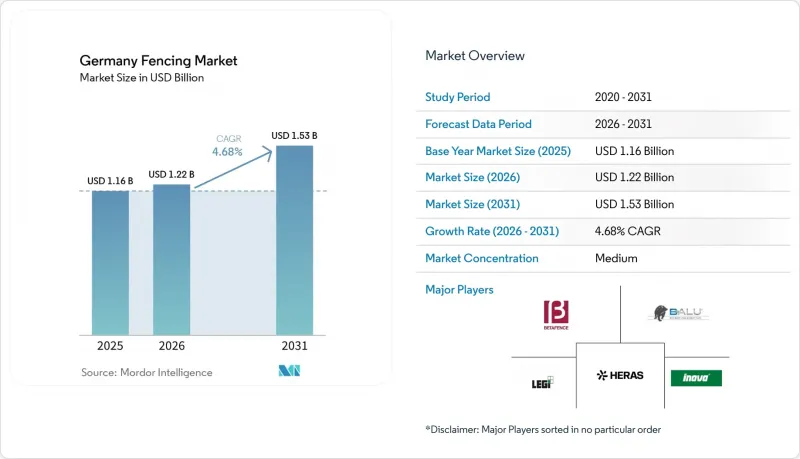
본 보고서는 재료별(금속, 목재, 플라스틱·복합재, 기타), 최종 사용자별(주택, 농업, 군 및 방위, 기타), 설치 방식별(고정식/영구 펜스, 가설식/이동식 펜스), 설치 채널별(전문 업체, 기타), 지역별(베를린, 프랑크푸르트, 기타)로 분류되어 있습니다. 시장 전망은 금액(달러) 기준으로 제시되어 있습니다.
독일의 펜스 시장 동향 및 인사이트
건설 및 인프라 개발의 성장
독일의 펜스 시장은 건설 주기와 밀접한 관련이 있습니다. 왜냐하면 진행 중인 모든 프로젝트에서 시공 중에는 임시 방호벽이, 인도 시에는 영구적인 경계 시스템이 필요하기 때문입니다. 2025년, 독일의 건설 수주액은 실질 기준으로 6.8% 증가했으며, 이는 2021년 이후 처음으로 나타난 증가세였습니다. 명목 수주액은 1,130억 유로(1,290억 달러)에 달했으며, 규정을 준수하는 펜스 솔루션이 필요한 진행 중인 프로젝트의 기반이 확대되었습니다. 독일경제연구소(DIW 베를린) 역시 2026년에는 총 건설량이 확대될 것으로 예측하고 있으며, 인프라 투자가 철도, 도로, 교량 공사로 전환되는 가운데 토목 공사가 가장 강력한 성장세를 보일 것으로 전망됩니다. 또한, 2025년 1월부터 11월까지 농업용 건축 허가 건수도 증가하고 있으며, 이에 따라 펜스 수요는 도시 지역 및 상업 활동뿐만 아니라 농장 시설과 농촌 지역의 경계 조성 사업으로까지 확대되고 있습니다. 독일의 펜스 시장은 토목 공사나 상업 프로젝트의 진행 속도가 주택 건설의 준공 속도를 앞지르는 지역에서 가장 큰 수혜를 보고 있습니다. 왜냐하면 이러한 프로젝트 유형은 규모가 더 크고, 사양 요건이 까다로운 경계 보호 요구 사항을 수반하기 때문입니다.
보안 및 경계 보호에 대한 수요 증가
독일의 펜스 시장에서는 경계 보호를 단순한 경계 요건이 아닌 사업 지속의 일부로 인식하는 구매자들 수요가 증가하고 있습니다. 2024년 9월부터 연방 당국이 독일 전역의 육상 국경에서 국경 통제를 강화한 이후에도 독일의 보안 태세는 여전히 엄중하며, 연방경찰(Bundespolizei)은 2024년에 8만 3,572건의 불법 입국을 기록했습니다. 이로 인해 공공 조달 및 시설 계획에서 물리적 보안은 여전히 눈에 띄는 우선순위로 남아 있습니다. 이러한 영향은 현재 공공시설의 범위를 넘어 확산되고 있으며, 데이터센터나 물류 업체 등의 상업용 사용자들은 일반적인 경계 제품이 아닌, 강제 침입 저항 기능과 차량 충돌 완화 기능을 갖춘 펜스 시스템을 구매하고 있습니다. 이러한 변화로 인해 기술 부문의 가격 탄력성이 향상되어 인증 범위가 넓은 공급업체들이 혜택을 보는 반면, 기본적인 메쉬 제품이나 저사양 제품은 여전히 가격 경쟁에 직면해 있습니다. 따라서 독일 펜스 시장에서 보안 수요는 성능을 중시하는 공급업체와 대량 생산을 중시하는 공급업체 간의 격차를 확대시키고 있습니다.
원자재 가격 변동
독일의 펜스 시장은 많은 영구적인 보안 및 산업용 펜스 시스템의 핵심에 여전히 강선 제품이 자리 잡고 있기 때문에 투입 비용의 변동성에 계속해서 노출되어 있습니다. 유럽연합(EU)의 철강 공급 상황은 여전히逼迫한 상태이며, 2021년 이후 유럽의 1차 철강 생산 능력의 절반 이상이 가동 중단 상태에 놓여 있어 가격 상승 압력이 지속되고 있으며, 이에 따라 비용에 민감한 입찰에 대응하는 제조업체의 유연성이 저하되고 있습니다. 투입 비용이 상승하면, 중저가 대공급업체는 소규모 지역 경쟁사에게 수주를 빼앗기지 않는 한, 비용 상승분을 전액 전가하지 못하는 경우가 종종 있습니다. 이로 인해, 특히 구매자가 수명 주기 성능이 아닌 초기 가격만으로 제안을 비교할 경우, 이익률 유지와 제품 품질 확보 사이에서 어려운 절충이 발생합니다. 독일 펜스 시장에서 이러한 제약이 가장 두드러지게 나타나는 분야는 용접 메쉬, 기본적인 농업용 시스템 및 표준 금속 제품이며, 이러한 분야에서는 투입 비용의 상승으로 인해 본래 미미했던 이익률이 급격히 압박받을 가능성이 있습니다.
부문별 분석
2025년 기준으로 목재는 독일 펜스 시장 규모의 40%를 차지했으며, 독일 내 주요 자재 부문으로서의 위상을 유지했습니다. 이러한 지위는 주택 및 농업 현장에서 소비자들의 높은 수용도에 힘입어 유지되고 있습니다. 이러한 분야에서는 구매자가 익숙한 외관, 폭넓은 디자인 선택지, 그리고 설치 시의 편의성을 중요시하고 있습니다. 또한 독일은 풍부한 국내 목재 자원을 보유하고 있어, 이는 공급의 예측 가능성을 뒷받침하며, 정원용 펜스, 목장용 펜스, 농장 경계 펜스 등 폭넓은 용도에서 목재 수요를 지탱하고 있습니다.
독일의 펜스 시장에서 이러한 현지 공급 측면의 우위는 좁고 저비용인 틈새 시장이 아닌, 표준 제품과 프리미엄 제품을 모두 폭넓게 구비할 수 있게 해줍니다. 또한, 보안 강화나 유지보수 부담 경감을 목적으로 다른 소재의 점유율이 확대되고 있음에도 불구하고, 목재가 여전히 자리 잡고 있는 이유도 설명할 수 있습니다. 수종 선택도 목재의 내구성에 한몫을 하고 있으며, 구매자는 예산이나 사용 수명에 따른 필요에 따라 방부 처리를 한 침엽수와 천연 내구성을 지닌 활엽수 중 하나를 선택할 수 있습니다. ROBINIO 등공급업체들은 로비니아 목재를 기반으로 한 제품을, 화학 처리 없이도 지중에서 장기적인 내구성을 제공하는 제품으로 평가했습니다. 이는 보다 자연스러운 사양을 선호하는 독일 구매자층의 요구와 부합합니다. 또한, FSC 인증에 기반한 조달 및 지속가능성에 관한 메시지도 정원이나 목장의 펜스 조달 과정에서 더욱 두드러지게 나타나고 있으며, 미관과 환경 기준이 모두 중시되는 상황에서 목재가 그 매력을 유지하는 데 기여하고 있습니다. 따라서 독일의 펜스 업계에서 목재는 쇠퇴해 가는 구식 선택지가 아니라, 실용적이면서도 문화적으로 친숙한 소재로서 계속해서 그 역할을 수행하고 있습니다. 이 부문의 성장률은 금속만큼 높지는 않지만, 그 설치 실적과 폭넓은 활용 사례가 독일 펜스 시장 전체 수요를 지속적으로 뒷받침하고 있습니다.
금속은 가장 빠르게 성장하는 소재 부문이며, 독일 펜스 시장에서 금속 시장 규모는 2026-2031년 연평균 성장률(CAGR) 5.6%로 확대될 것으로 전망됩니다. 수요가 가장 높은 분야는 등반 방지 성능, 더 긴 수명, 또는 접근 제어·감지 시스템과의 호환성이 요구되는 현장이며, 이에 따라 금속은 에너지 시설, 교통 시설, 중요 인프라, 데이터센터 프로젝트에서 핵심적인 역할을 수행하고 있습니다. Praesidiad사와 Betafence사는 성능을 중시하는 조달 추세를 반영하여, 인증을 받은 고보안 경계 시스템을 제품 라인업에 추가했습니다. 독일의 펜스 시장에서 용접 메쉬, 파리수드 방식 및 압연 와이어 시스템이 광범위한 산업용 및 공공 용도를 아우르고 있기 때문에 강재는 여전히 주요 금속 유형로 자리 잡고 있습니다. 알루미늄 역시 주택 및 소규모 상업시설 분야에서 시장 점유율을 확대되고 있습니다. 초기 비용은 비싸지만, 경량성과 내식성이 수명 주기 전반에 걸친 가치를 뒷받침하고 있기 때문입니다. 플라스틱과 복합재료는 목재나 금속에 비해 시장 점유율은 낮지만, 시선 차단용 펜스나 모듈식 주택 시스템 분야에서 확고한 입지를 다져가고 있습니다. 복합재 인필 및 관련 시스템은 유지보수 비용 절감 효과와 더불어, 정원이나 경계선에서 더욱 통일감 있는 외관을 원하는 구매자들로부터 지지를 받고 있습니다. 콘크리트는 방음벽이나 특정 인프라 시설에서는 여전히 틈새 시장용 선택지에 그치고 있지만, 장식용 자재로는 특정 정원 프로젝트에서 제한적이긴 하지만 안정적인 역할을 수행하고 있습니다. 따라서 독일의 펜스 업계는 단일 대체 소재로 전환되고 있는 것이 아니라, 미관, 유지 관리, 보안에 대한 요구에 따라 형성되는 보다 명확한 소재 계층 구조로 나아가고 있습니다. 이러한 계층 구조로 인해 목재가 1위를 유지하고 있지만, 독일 펜스 시장에서 예측 기간 동안 금속이 다른 소재를 앞지를 것이라는 가장 명확한 전망이 제시되고 있습니다.
2025년, 독일의 펜스 시장에서 주택 부문은 38%의 점유율을 차지했으며, 최대의 최종 사용자 부문이 되었습니다. 독일의 방대한 주택 재고, 정원 및 야외 생활 공간에서의 사생활 보호에 대한 강한 중시, 그리고 펜스 제품에 대한 폭넓은 소매 접근성이 이러한 위상을 뒷받침하고 있습니다. 2025년에는 주택 관련 활동도 일부 개선되어, 새로운 경계 펜스, 교체용 패널, 모듈식 프라이버시 시스템에 대한 수요 유지에 기여했습니다. 독일의 펜스 시장에서 주택용 수요는 특히 중요합니다. 이는 수요가 소수의 계약 구매자에게 집중되는 것이 아니라, 자재의 유형, 가격대, 설치 채널 전반에 걸쳐 주문이 분산되기 때문입니다. 이로 인해 이 부문은 단일 프로젝트 주기에 대한 의존도가 낮아졌으며, 광범위한 가계 지출 및 소규모 도급업자의 활동과 더욱 밀접하게 연계되어 있습니다.
또한, 이 부문은 홈센터 및 건축자재 공급 채널의 강력한 유통망의 혜택을 받고 있어, 일반 가정에서 제품을 비교하거나 프로젝트 계획을 세우는 것이 쉬워졌습니다. 호른바흐를 비롯한 소매업체들은 천연 목재 및 모듈식 펜스의 제품 라인업을 지속적으로 확대하고 있으며, 이는 교체 수요를 뒷받침할 뿐만 아니라, 단순히 기능적인 경계 공사를 넘어 계획적인 야외 리모델링으로의 점진적인 전환을 촉진하고 있습니다. 주택 구매자들은 업체 주도의 프로젝트와 개인 관리 프로젝트 양쪽 모두에 걸쳐 있어, 이로 인해 독일 펜스 시장에서는 여러 판매 경로를 통해 판매량이 안정적으로 유지되고 있습니다. 전국적인 주택 준공 건수가 고르지 않더라도, 기존 주택 재고가 교체 및 개보수 수요를 활발하게 유지하고 있습니다. 이것이 바로 다른 최종 사용자 부문의 성장이 가속화되고 있음에도 불구하고, 주거용이 여전히 독일 펜스 시장의 구조적 기반을 이루고 있는 이유입니다.
농업 분야 사용자들은 펜스가 단순한 시각적 경계선이 아니라 가축 관리, 농장 보안, 토지 구획과 밀접하게 관련되어 있기 때문에 그 다음으로 중요한 수요층을 형성하고 있습니다. 수의학적 요건 및 농장 보호 요건으로 인해, 기존의 단일 펜스 형태의 농장보다 여러 줄을 조합한 설치 방식이나 보다 복잡한 배치가 계속해서 요구되고 있습니다. 이로 인해 프로젝트당 설치 거리가 늘어남에 따라, 펜스는 단순한 부대 설비가 아닌 운영상 필수적인 요소가 되었습니다. 독일의 펜스 시장은 이러한 추세로 인해 혜택을 보고 있습니다. 왜냐하면 농장에서 들어오는 주문의 경우, 지주, 그물, 문, 전기 펜스 등의 구성 요소가 하나의 구매 세트로 묶이는 경우가 많기 때문입니다. 또한, 기계화된 시공을 통해 속도와 균일성이 향상되는 대규모 지방 공사에서도 도급업체에 대한 수요를 뒷받침하고 있습니다. 에너지 및 전력 부문은 2031년까지 연평균 성장률(CAGR) 6.3%를 기록할 전망이며, 가장 빠르게 성장하고 있는 최종 사용자 부문으로, 이는 독일 펜스 시장에서 재생에너지 시설 및 공공시설의 경계 보호 수요가 증가하고 있음을 반영합니다. 이러한 시설에서는 설비, 케이블 경로, 변전소 구역 및 출입 통제 지점을 보호해야 하므로, 금속 재질의 고보안 경계 시스템의 가치가 높아지고 있습니다. 공공 부문, 군사, 정부 시설에서도 중요 인프라의 회복탄력성 강화가 더욱 구체화됨에 따라, 사양 주도형 프로젝트가 꾸준히 발생하고 있습니다. 광업, 석유·화학, 기타 산업 분야의 구매자들로부터는 기본적인 갱신 수요가 더해지지만, 가장 두드러진 성장 가속화가 나타나는 분야는 단연 에너지 관련 프로젝트입니다. 이러한 구조로 인해 독일의 펜스 시장은 더 이상 가정이나 농장 수요만으로 주도되는 것이 아니라, 전략적 인프라 구매자들이 성장 구도에서 더 큰 역할을 담당하게 되었습니다.
기타 혜택 :
- Excel 형식 시장 예측(ME) 시트
- 3개월간의 애널리스트 지원
자주 묻는 질문
목차
제1장 서론
제2장 분석 방법
제3장 주요 요약
제4장 시장 구도
제5장 시장 규모 및 성장 예측
제6장 경쟁 구도
제7장 시장 기회 및 향후 전망
AJY 26.06.26According to Mordor Intelligence, the germany fencing market size is projected to be USD 1.16 billion in 2025, USD 1.22 billion in 2026, and reach USD 1.53 billion by 2031, growing at a CAGR of 4.68% from 2026 to 2031.
This report is Segmented by Material (Metal, Wood, Plastic & Composite, and More), End-User (Residential, Agricultural, Military & Defense, and More), Installation Type (Fixed / Permanent Fencing and Temporary / Mobile Fencing), Installation Channel (Professional Contractor and Others), and Geography (Berlin, Frankfurt, and More). The Market Forecasts are Provided in Terms of Value (USD).
Germany Fencing Market Trends and Insights
Growth in Construction and Infrastructure Development
The Germany fencing market is closely tied to the construction cycle because every active project creates a need for temporary barriers during execution and permanent boundary systems at handover. German construction order intake grew 6.8% in real terms in 2025, which marked the first increase since 2021, and nominal orders reached EUR 113 billion (USD 129 billion), creating a broader base of live projects that require compliant fencing solutions. The German Institute for Economic Research (DIW Berlin) also expects overall construction volume to expand in 2026, with civil engineering showing the strongest momentum as infrastructure investment shifts to rail, road, and bridge work. Agricultural building permits also increased in the January to November 2025 period, which extends fencing demand into farm structures and rural perimeter projects alongside urban and commercial activity. The Germany fencing market benefits most where civil engineering and commercial work are improving faster than residential completions, because those project types carry larger and more specification-heavy perimeter needs.
Rising Demand for Security and Perimeter Protection
The Germany fencing market is seeing stronger demand from buyers that now treat perimeter protection as part of operational continuity rather than a simple boundary requirement. Germany's security posture remained elevated after federal authorities extended border controls across all German land borders from September 2024, and the Bundespolizei recorded 83,572 unauthorized entries in 2024, which kept physical security a visible priority in public procurement and facility planning. This effect now extends beyond public facilities, as commercial users such as data centers and logistics operators are buying fencing systems with forced-entry resistance and vehicle-mitigation features rather than standard perimeter products. That shift improves pricing resilience in technical categories and supports vendors with certification depth, while basic mesh and low-spec products remain exposed to price competition. In the Germany fencing market, security demand is therefore widening the gap between performance-led suppliers and volume-led suppliers.
Volatility in Raw Material Prices
The Germany fencing market remains exposed to input cost instability because steel wire products still sit at the center of many permanent security and industrial fencing systems. European Union (EU) steel supply conditions remained tight, with more than half of Europe's primary steel production capacity idled since 2021, which kept upward pressure on prices and reduced manufacturers' flexibility in responding to cost-sensitive tenders. When input costs move higher, suppliers in mid-range categories are often unable to pass through the full increase without losing orders to smaller local competitors. That creates a difficult trade-off between margin protection and product quality, especially where buyers compare offers on upfront price rather than lifecycle performance. In the German fencing market, this restraint is most visible in welded mesh, basic agricultural systems, and standard metal products, where input inflation can quickly narrow already modest margins.
Other drivers and restraints analyzed in the detailed report include:
- Stringent Safety and Regulatory Standards
- Increasing Adoption of Smart and Low-Maintenance Fencing Solutions
- Competition from Unorganized Local Manufacturers is Affecting Pricing and Product Quality
For complete list of drivers and restraints, kindly check the Table Of Contents.
Segment Analysis
Wood accounted for 40% of the Germany fencing market size in 2025, which kept it as the leading material category in the country. Its position rests on strong consumer acceptance in residential and agricultural settings, where buyers value familiar appearance, broad design choice, and ease of handling during installation. Germany also benefits from a large domestic timber base, which supports supply visibility and keeps wood relevant across garden fencing, paddock solutions, and farm boundaries.
In the Germany fencing market, that local supply advantage supports a wide mix of standard and premium products rather than a narrow low-cost niche. It also helps explain why wood remains established even as other materials gain share in higher-security or lower-maintenance uses. Species choice adds another layer to wood's staying power, allowing buyers to choose between treated softwood and naturally durable hardwood options, depending on budget and service-life needs. Suppliers such as ROBINIO position Robinia-based products as offering long-term in-ground durability without chemical treatment, which aligns with a segment of German buyers who prefer a more natural specification. FSC-linked sourcing and sustainability messaging have also become more visible in garden and paddock procurement, which helps wood retain appeal where aesthetics and environmental criteria both matter. In the Germany fencing industry, wood therefore continues to serve as a practical and culturally familiar material rather than a declining legacy choice. The segment's growth is slower than metal, but its installed base and broad use cases continue to anchor demand across the Germany fencing market.
Metal is the fastest-growing material segment, with the Germany fencing market size for metal projected to expand at a 5.6% CAGR between 2026 and 2031. Demand is strongest where sites require anti-climb performance, longer service life, or compatibility with access control and detection systems, making metal central to energy sites, transport facilities, critical infrastructure, and data center projects. Praesidiad and Betafence have expanded their portfolios to include certified high-security perimeter systems, reflecting this move toward performance-led procurement. Within the Germany fencing market, steel remains the main metal type because welded mesh, palisade formats, and rolled wire systems cover a wide range of industrial and public applications. Aluminum is also gaining ground in residential and light commercial applications, where lower weight and corrosion resistance support lifecycle value, even if the upfront cost is higher. Plastic and composite materials remain smaller than wood and metal, but they are building a firmer base in privacy fencing and modular residential systems. Composite infills and related systems appeal to buyers who want lower upkeep and a more uniform appearance across garden and boundary applications. Concrete remains a niche option for noise barriers and in selected infrastructure locations, while decorative materials play a limited but stable role in certain garden projects. The Germany fencing industry is therefore not shifting toward one replacement material, but toward a clearer material hierarchy shaped by aesthetics, upkeep, and security needs. That hierarchy keeps wood in the lead, but it gives metal the clearest path to outperformance through the forecast period in the Germany fencing market.
Residential held a 38% share of the Germany fencing market share in 2025, making it the largest end-user category. Germany's large housing stock, strong preference for privacy in gardens and outdoor living areas, and broad retail access to fencing products all support this position. Housing-related activity also improved in parts of the pipeline in 2025, helping maintain demand for new boundary fencing, replacement panels, and modular privacy systems. In the Germany fencing market, residential demand is especially important because it spreads orders across material types, price points, and installation channels rather than concentrating demand in a few contract buyers. That makes the segment less dependent on a single project cycle and more tied to a broad base of household spending and small-contractor activity.
The segment also benefits from strong distribution coverage across home improvement and building supply channels, making product comparison and project planning easier for households. Hornbach and other retailers continue to expand natural wood and modular fencing options, which support replacement demand and the gradual move toward planned outdoor upgrades rather than purely functional boundary work. Residential buyers span both contractor-led and self-managed projects, which keeps volume flowing through multiple sales routes in the Germany fencing market. Even with uneven residential completions at the national level, the installed housing base keeps replacement and modernization demand active. This is why residential remains the structural anchor for the Germany fencing market even while faster growth is coming from other end-users.
Agricultural users form the next important demand layer because fencing is tied to livestock management, farm security, and land separation rather than purely visual boundaries. Veterinary and farm protection requirements continue to support multi-line installations and more complex layouts than earlier single-fence farm formats. That raises per-project meterage and makes fencing an operating need rather than a discretionary one. The Germany fencing market gains from this because farm orders often combine posts, mesh, gates, and electrified elements in a single purchase set. It also supports contractor demand in larger rural jobs where mechanized installation improves speed and consistency. The energy & power is the fastest-growing end-user segment at a 6.3% CAGR through 2031, which reflects the rising perimeter needs of renewable energy and utility sites in the Germany fencing market. These sites need protection for equipment, cable routes, transformer areas, and controlled access points, which increases the value of metal and high-security perimeter systems. Public-sector, military, and government facilities also provide a steady stream of specification-led projects as critical infrastructure resilience moves further into implementation. Mining, petroleum and chemicals, and other industrial buyers add baseline replacement demand, but the strongest acceleration is clearly within energy-linked projects. This mix means the Germany fencing market is no longer driven only by household and farm demand, because strategic infrastructure buyers are taking a larger role in the growth profile.
List of Companies Covered in this Report:
- Betafence
- Heras
- LEGI Group
- Berlemann Torbau
- BALU Tore GmbH
- WISNIOWSKI
- Zaun Ltd
- Blaser Zaunsysteme GmbH
- A1 ZAUNDISCOUNT
- Heras Mobilzaun
- MY-Zaunsysteme
- GAVER Sichtschutz
- Praesidiad Group
- SchweiBgitter GmbH
- Bekaert
- DIRICKX Group
- CLD Physical Security Systems
- Jacksons Fencing
Additional Benefits:
- The market estimate (ME) sheet in Excel format
- 3 months of analyst support
TABLE OF CONTENTS
1 Introduction
- 1.1 Study Assumptions & Market Definition
- 1.2 Scope of the Study
2 Research Methodology
3 Executive Summary
4 Market Landscape
- 4.1 Market Overview
- 4.2 Market Drivers
- 4.2.1 Growth in Construction and Infrastructure Development
- 4.2.2 Rising Demand for Security and Perimeter Protection
- 4.2.3 Stringent Safety and Regulatory Standards
- 4.2.4 Increasing Adoption of Smart and Low-Maintenance Fencing Solutions
- 4.2.5 Increasing Agricultural Protection Needs Drive Demand for Farm and Livestock Fencing
- 4.2.6 Growing Preference for Sustainable and Recycled-Material Fencing
- 4.3 Market Restraints
- 4.3.1 Volatility in Raw Material Prices
- 4.3.2 Competition from Unorganized Local Manufacturers Affecting Pricing and Product Quality
- 4.3.3 Price Sensitivity among Rural and Small-Scale Buyers Limiting Premium Fencing Adoption
- 4.3.4 Shortage of Skilled Fencing Installation Labor
- 4.4 Value / Supply-Chain Analysis
- 4.5 Regulatory Landscape
- 4.6 Technology & Innovation Trends
- 4.7 Porter's Five Forces
- 4.7.1 Bargaining Power of Suppliers
- 4.7.2 Bargaining Power of Consumers
- 4.7.3 Threat of New Entrants
- 4.7.4 Threat of Substitutes
- 4.7.5 Intensity of Competitive Rivalry
- 4.8 Pricing Analysis
- 4.9 Sustainability & Eco-Friendly Material Trends
- 4.10 Border Security Framework & Deployment Trends
5 Market Size & Growth Forecasts (Value in USD)
- 5.1 By Material
- 5.1.1 Metal
- 5.1.1.1 Steel
- 5.1.1.2 Aluminium
- 5.1.2 Wood
- 5.1.3 Plastic & Composite
- 5.1.4 Concrete
- 5.1.5 Other Materials
- 5.1.1 Metal
- 5.2 By End-User
- 5.2.1 Residential
- 5.2.2 Agricultural
- 5.2.3 Military & Defense
- 5.2.4 Government
- 5.2.5 Mining
- 5.2.6 Petroleum & Chemicals
- 5.2.7 Energy & Power
- 5.2.8 Other End-Users
- 5.3 By Installation Type
- 5.3.1 Fixed / Permanent Fencing
- 5.3.2 Temporary / Mobile Fencing
- 5.4 By Installation Channel
- 5.4.1 Professional Contractor
- 5.4.2 Others (Fabricators, DIY / Modular Kits)
- 5.5 By Geography
- 5.5.1 Berlin
- 5.5.2 Frankfurt
- 5.5.3 Hamburg
- 5.5.4 Munich
- 5.5.5 Rest of Germany
6 Competitive Landscape
- 6.1 Market Concentration
- 6.2 Strategic Moves
- 6.3 Market Share Analysis
- 6.4 Company Profiles {(Includes Global Level Overview, Market Level Overview, Core Segments, Financials as Available, Strategic Information, Products & Services, and Recent Developments)}
- 6.4.1 Betafence
- 6.4.2 Heras
- 6.4.3 LEGI Group
- 6.4.4 Berlemann Torbau
- 6.4.5 BALU Tore GmbH
- 6.4.6 WISNIOWSKI
- 6.4.7 Zaun Ltd
- 6.4.8 Blaser Zaunsysteme GmbH
- 6.4.9 A1 ZAUNDISCOUNT
- 6.4.10 Heras Mobilzaun
- 6.4.11 MY-Zaunsysteme
- 6.4.12 GAVER Sichtschutz
- 6.4.13 Praesidiad Group
- 6.4.14 SchweiBgitter GmbH
- 6.4.15 Bekaert
- 6.4.16 DIRICKX Group
- 6.4.17 CLD Physical Security Systems
- 6.4.18 Jacksons Fencing
7 Market Opportunities & Future Outlook
- 7.1 White-space & Unmet-Need Assessment


