
|
시장보고서
상품코드
2065513
말레이시아의 통합 시설 관리 시장 : 시장 점유율 분석, 업계 동향 및 통계, 성장 예측(2026-2031년)Malaysia Integrated Facility Management - Market Share Analysis, Industry Trends & Statistics, Growth Forecasts (2026 - 2031) |
||||||
 Mordor Intelligence
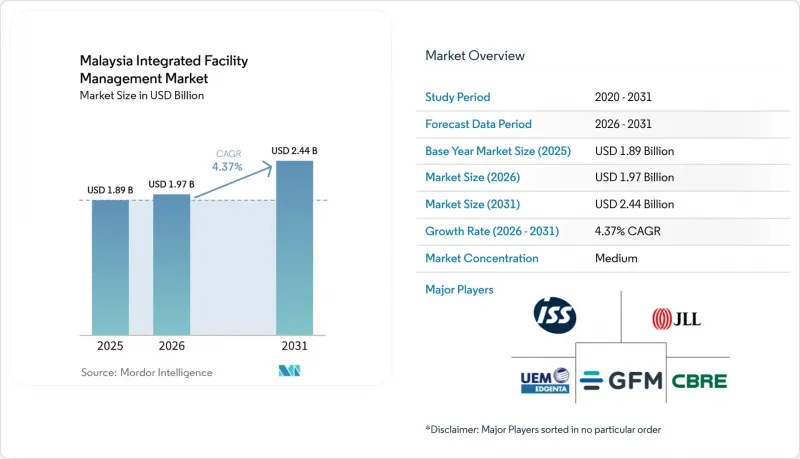
Mordor Intelligence에 의하면, 말레이시아의 통합 시설 관리 시장 규모는 2025년 18억 9,000만 달러로 평가되었고, 2026년에는 19억 7,000만 달러로 추정되고, 2026-2031년 CAGR 4.37%로 성장을 지속할 전망이며, 2031년에는 24억 4,000만 달러에 이를 것으로 예측됩니다.
본 보고서는 서비스 유형별(하드 시설 관리(자산 관리, MEP 및 HVAC 서비스 등), 소프트 시설 관리별(사무 지원 및 보안, 청소 서비스, 케이터링 서비스 등)) 및 최종 사용자별(상업, 호스피탈리티, 의료, 공공기관 및 공공 인프라 등)로 분류되어 있습니다. 시장 전망은 금액(달러) 기준으로 제시되어 있습니다.
말레이시아의 통합 시설 관리 시장 동향 및 인사이트
시설 관리 분야에서의 스마트 기술 도입 확대
말레이시아의 통합 시설 관리 시장은 더욱 디지털화된 운영 모델로 전환되고 있습니다. 이는 건물 소유주가 자산의 가시성 향상, 대응 시간 단축, 그리고 유지보수 비용에 대한 보다 엄격한 관리를 기대하고 있기 때문입니다. 2025년 7월 1일부터 1,000만 말레이시아 링깃(225만 달러) 이상의 공공 및 민간 건설 프로젝트에 대해 BIM(빌딩 정보 모델링) 도입이 의무화되고, 디지털 인도 기준이 상향됨에 따라 신축 건물이 운영을 시작할 때, 구조화된 자산 데이터의 중요성이 더욱 커졌습니다. PeDATA 및 SKATA 표준을 준수하는 자산 정보는 3D 시각화, 정기 유지보수, 수명 주기 계획의 개선에 기여하며, 이를 통해 말레이시아의 통합 시설 관리 시장에서 프로젝트 완료와 지속적인 서비스 제공 간의 연계가 더욱 공고해질 것입니다. 이는 BIM과 연동된 CMMS 플랫폼을 보유한 제공업체가, 연동되지 않은 사업자에서는 쉽게 실현할 수 없는 방식으로 자산 이력 및 유지보수 규칙을 승계할 수 있기 때문에 중요한 의미를 지닙니다. 초안에 인용된 조사에 따르면, GBI 인증을 취득한 건물에서 디지털 트윈 및 HVAC-BMS 통합의 도입률은 28%였던 반면, 인증을 받지 않은 건물에서는 7%에 그쳤으며, 이는 고급 빌딩이 일반 건물군보다 더 신속하게 FM(시설 관리)을 실천하고 있음을 보여줍니다. 그 결과, 말레이시아의 통합 시설 관리 시장에서는 기술을 단순한 독립적인 부가 기능으로 취급하기보다는 소프트웨어, 건물 제어, 현장 운영을 하나의 서비스 모델로 통합할 수 있는 운영 사업자가 높이 평가받고 있습니다.
도심 지역의 상업용 부동산 및 산업용 자산의 급속한 확대
말레이시아의 통합 시설 관리 시장은 특히 조호르 주와 클랑 밸리 지역에서 상업, 산업, 물류, 복합 용도 자산의 재고가 증가함에 따라 확대되고 있습니다. 2025년 첫 9개월 동안 승인된 투자액은 2,852억 링깃(641억 2,000만 달러)에 달했으며, 조호르주에서만 911억 링깃(204억 7,000만 달러)을 유치했습니다. 이에 따라 신축 빌딩 및 산업용지 전반에 걸친 체계적인 서비스에 대한 장기적인 수요가 증가하고 있습니다. 캐피탈랜드 인베스트먼트가 코로네이드 프로퍼티스와 제휴하여 조호르바루에 건설 중인 125만 제곱피트 규모의 ‘코로네이션 스퀘어 몰’은 운영 기간 동안 유지보수, 청소, 경비, 조경, 에너지 관리를 통합한 서비스가 필요한 대규모 상업 자산의 또 다른 대표적인 사례가 되었습니다. 산업용 부동산에서도 유사한 추세가 나타나고 있으며, 물류 및 제조 자산 포트폴리오가 확대됨에 따라 가동 시간 및 규정 준수 요건이 더욱 엄격해진 이용률이 높은 시설에서 지속적인 서비스 수요가 증가하고 있습니다. 말레이시아의 통합 시설 관리 시장에서도 품질 면에서 변화가 나타나고 있습니다. 데이터센터에서는 24시간 가동 관리, 정밀 냉각, 전원 공급의 연속성, 첨단 소화 시스템이 요구되기 때문에 이러한 계약은 기존의 사무실이나 소매 시설의 업무보다 더 복잡합니다. 이러한 차이로 인해, 일반적인 건물 운영뿐만 아니라 중요한 환경을 관리할 수 있는 서비스 제공업체일수록 더욱 강력한 성장이 기대됩니다.
규정 준수 및 인증 문제를 안고 있는 세분화된 시장 구조
말레이시아의 통합 시설 관리 시장은 견고한 수요 기반을 갖추고 있으나, 공급업체의 대부분이 여전히 지역별 입찰 시장에서 소규모로 사업을 영위하고 있어 서비스 품질에 편차가 나타나고 있습니다. 초안에 인용된 2024년 문헌 고찰에 따르면, 이 분야의 주요 과제는 사업자 간에 표준화된 유지보수 프로세스가 부재하다는 점이며, 이로 인해 서비스 품질의 편차가 발생하고 계약 갱신 가능성이 낮아지고 있습니다. 또한, 사업자는 CIDB, 재무성, JKR 관련 유틸리티 기관 및 의료 분야 특유의 규정에 걸친 중복된 등록·승인 요건을 관리해야 하는데, 컴플라이언스 담당자가 제한적인 중견 기업의 경우 이는 어려울 수 있습니다. 이 때문에 말레이시아의 통합 시설 관리 시장 전체가 과밀 상태에 있음에도 불구하고, 정부 관련 업무의 상당 부분이 비교적 소수의 인증 사업자 그룹에 집중되어 있습니다. 또한, 이러한 분열로 인해 계약 간에 성과 평가 기준이 아직 통일되지 않아, 클라이언트가 표준적인 기준에 따라 공급업체를 비교하는 것도 어려워지고 있습니다. 인정 수준이나 운영 규율에 편차가 있는 한, 말레이시아의 통합 시설 관리 시장에서는 충분한 자격을 갖춘 컨세션 사업자와 가격 주도형 중견 기업 간의 양극화가 앞으로도 계속될 것입니다.
부문별 분석
2025년, 말레이시아의 통합 시설 관리(IFM) 시장 규모 중 소프트 시설 관리(FM)가 61.6%를 차지했습니다. 이는 공공, 상업 및 기관 건물 분야에서 시장이 여전히 정기적인 노동 집약적 서비스에 크게 의존하고 있음을 보여줍니다. 청소, 경비, 해충 방제, 조경, 폐기물 관리, 케이터링, 안내 서비스는 보다 정기적인 일정에 따라 이루어지는 기계 설비 유지보수와는 달리, 빈번하게 그리고 광범위한 건물 기반에서 필요하기 때문에 여전히 지배적인 위치를 유지하고 있습니다. 말레이시아 IFM 업계에서 이러한 소프트 서비스 분야는 청소 및 경비 계약의 전환 비용이 여전히 낮기 때문에 가장 치열한 가격 경쟁에 직면해 있습니다. 따라서 각 사업자는 거래량은 많지만 이익률이 낮은 계약에서 이익률을 유지하기 위해 인력 관리, 노선 계획, 출근 관리 및 더욱 엄격한 일정 관리에 크게 의존하고 있습니다. 2025년 2월 최저임금이 월 1,700 말레이시아 링깃(382달러)으로 인상된 것은 이 부문에 추가적인 압박을 가했습니다. 이는 인건비가 여전히 대부분의 소프트웨어 서비스 계약에서 가장 큰 비용 항목이기 때문입니다.
하드 FM은 2031년까지 연평균 성장률(CAGR) 5.1%를 기록하며 성장할 것으로 예상되며, 말레이시아 IFM 시장에서 가장 빠르게 성장하는 서비스 부문이 될 전망입니다. 이 시장 분야는 전기 기계 시스템, HVAC, 화재 안전, 미션 크리티컬 인프라 등 전문적인 작업이 필요한 기술적으로 고도의 건물들에 의해 주도되고 있습니다. 말레이시아의 IFM 시장 점유율은 여전히 소프트 FM이 주도하고 있지만, 각 계약의 기술적 범위가 확대되고 가동 시간 요건이 더욱 엄격해짐에 따라, 금액 기준으로는 하드 FM이 그 격차를 좁혀가고 있습니다. 조호르 주에서 데이터센터 개발이 중요한 요인으로 작용하고 있습니다. PUE(전력 사용 효율)를 낮게 유지하고, 24시간 운영이 요구되는 시설에서는 기존의 상업용 유지보수 범위를 넘어선 정밀 냉각, 지속적인 전력 공급, 그리고 끊임없는 최적화가 필요하기 때문입니다. 존슨 컨트롤즈가 선웨이 그룹의 여러 부동산 프로젝트에서 진행 중인 사례 역시, 하나의 빌딩 기술을 도입하면 개발사의 광범위한 포트폴리오 전반에 파급 효과가 나타나며, 그 성능이 입증될 경우 하드 FM 서비스의 지속적인 수익성을 강화할 수 있음을 보여주고 있습니다. 말레이시아의 IFM 업계에서는 2025년 7월에 도입될 BIM 요건 또한 하드 FM을 뒷받침하고 있습니다. 디지털 방식으로 인계함으로써, 건물이 가동을 시작한 첫날부터 자산 유지보수 체계를 구축하기가 쉬워지기 때문입니다.
기타 혜택 :
- 엑셀 형식 시장 예측(ME) 시트
- 3개월간의 애널리스트 지원
자주 묻는 질문
목차
제1장 서론
제2장 조사 방법
제3장 주요 요약
제4장 시장 구도
제5장 시장 규모 및 성장 예측
제6장 경쟁 구도
제7장 시장 기회 및 향후 전망
LSH 26.06.24According to Mordor Intelligence, the malaysia integrated facility management market size is expected to grow from USD 1.89 billion in 2025 to USD 1.97 billion in 2026 and is forecast to reach USD 2.44 billion by 2031 at 4.37% CAGR over 2026-2031.
This report is Segmented by Service Type (Hard Facility Management [Asset Management, MEP and HVAC Service, and More], and Soft Facility Management [Office Support and Security, Cleaning Services, Catering Services, and More]), and End User (Commercial, Hospitality, Healthcare, Institutional and Public Infrastructure, and More). The Market Forecasts are Provided in Terms of Value (USD).
Malaysia Integrated Facility Management Market Trends and Insights
Growing Adoption of Smart Technologies in Facility Management
The Malaysia integrated facility management market is moving toward a more digital operating model as building owners expect better asset visibility, faster response times, and tighter control of maintenance spending. The July 1, 2025, BIM mandate for public and private construction projects valued at MYR 10 million (USD 2.25 million), or more raised the baseline for digital handover and made structured asset data more important when new buildings enter service. Asset information aligned with PeDATA and SKATA standards improves 3D visualization, scheduled maintenance, and lifecycle planning, which gives the Malaysia integrated facility management market a stronger link between project completion and ongoing service delivery. This matters because providers with BIM-linked CMMS platforms can carry forward asset histories and maintenance rules in ways that disconnected operators cannot easily match. Research cited in the draft also showed that GBI-certified buildings had a 28% adoption rate for digital twin and HVAC-BMS integration, compared with 7% in non-certified stock, which shows how premium buildings are advancing FM practices faster than the wider building base. As a result, the Malaysia integrated facility management market is rewarding operators that can combine software, building controls, and field execution into one service model rather than treating technology as a stand-alone add-on.
Rapid Expansion of Commercial Real Estate and Industrial Assets In Urban Centers
The Malaysia integrated facility management market is expanding with the country's rising stock of commercial, industrial, logistics, and mixed-use assets, especially in Johor and the Klang Valley. Approved investments reached MYR 285.2 billion (USD 64.12 billion), in the first nine months of 2025, and Johor alone drew MYR 91.1 billion (USD 20.47 billion), which increased the long-term need for structured services across new buildings and industrial sites. CapitaLand Investment's partnership with Coronade Properties on the 1.25 million sq ft Coronation Square Mall in Johor Bahru added another visible example of a large-format commercial asset that will require bundled maintenance, cleaning, security, landscaping, and energy management throughout its operating life. The same pattern is visible in industrial property, where portfolio expansion in logistics and manufacturing assets is creating more recurring service demand across high-use facilities with stricter uptime and compliance requirements. The Malaysia integrated facility management market is also seeing a quality shift because data centers require 24-hour uptime management, precision cooling, power continuity, and advanced fire suppression, which makes those contracts more complex than conventional office or retail work. That difference supports a stronger growth profile for providers that can manage critical environments rather than only general building operations.
Fragmented Market Structure with Compliance and Certification Challenges
The Malaysian integrated facility management market has a healthy demand base, but service quality remains uneven because a large share of providers still operate at a small scale across local tender markets. A 2024 literature review cited in the draft found that the sector's main challenge was the lack of standardized maintenance processes across operators, which leads to inconsistent delivery quality and weaker contract renewal potential. Providers also need to manage overlapping registration and approval requirements across CIDB, the Ministry of Finance, JKR-linked public works structures, and healthcare-specific rules, which can be difficult for mid-sized firms with limited compliance staff. This keeps a meaningful share of government-linked work within a relatively small certified pool, even when the broader Malaysia integrated facility management market remains crowded. The same fragmentation also makes it harder for clients to compare providers on a standard basis because performance measures are not yet uniform across contracts. As long as certification depth and operating discipline remain uneven, the Malaysia integrated facility management market will continue to show a split between well-qualified concessionaires and a more price-led middle tier.
Other drivers and restraints analyzed in the detailed report include:
- Government Green Building Incentives and ESG Mandates
- Rise Of Public-Private Partnerships for Government Building Management
- High Initial Capital Requirements for Technology Adoption and System Integration
For complete list of drivers and restraints, kindly check the Table Of Contents.
Segment Analysis
Soft Facility Management (FM) accounted for 61.6% of the Malaysia integrated facility management (IFM) market size in 2025, which shows how strongly the market still depends on recurring labour-based services across public, commercial, and institutional buildings. Cleaning, security, pest control, landscaping, waste management, catering, and reception services stayed dominant because they are needed frequently and across a broad building base, unlike mechanical maintenance, which follows a more periodic schedule. In the Malaysia IFM industry, those soft service categories also face the most intense price competition because switching costs remain low in cleaning and guarding contracts. Providers therefore rely heavily on workforce control, route planning, attendance tracking, and tighter scheduling to protect margins in contracts that are large by volume but thinner in profitability. The February 2025 minimum wage increase to MYR 1,700 (USD 382) per month placed extra pressure on this segment because labour cost is still the largest cost item in most soft service contracts.
Hard FM is forecast to grow at a 5.1% CAGR through 2031, making it the fastest-growing service category within the Malaysia IFM market. This part of the market is being lifted by more technically demanding buildings that need specialized work across electromechanical systems, HVAC, fire safety, and mission-critical infrastructure. The Malaysia IFM market share is still led by Soft FM, but Hard FM is closing the gap in value terms because each contract now carries more technical scope and tighter uptime requirements. Data center development in Johor is an important reason, since facilities operating at low PUE levels and under 24-hour service expectations need precision cooling, power continuity, and constant optimization that go beyond conventional commercial maintenance. Johnson Controls' work across multiple Sunway Group properties also shows how one building technology deployment can spread across a developer's wider portfolio, which strengthens repeat hard-service revenue once performance is proven. In the Malaysia IFM industry, the July 2025 BIM requirement also supports Hard FM because digital handover makes it easier to structure asset maintenance from the first day a building enters operation.
List of Companies Covered in this Report:
- UEM Edgenta Berhad
- GFM Services Berhad
- ISS A/S
- CBRE Group, Inc.
- JLL Malaysia Sdn Bhd
- Cushman and Wakefield plc
- Knight Frank Malaysia Sdn Bhd
- Colliers International Group Inc.
- KFM Holdings Sdn Bhd
- AWC Berhad
- Sime Darby Property Berhad
- Sodexo S.A.
- OCS Group Limited
- Allied Universal
- G4S Limited
- Johnson Controls International plc
- Honeywell International Inc.
- Tenaga Nasional Berhad
Additional Benefits:
- The market estimate (ME) sheet in Excel format
- 3 months of analyst support
TABLE OF CONTENTS
1 INTRODUCTION
- 1.1 Study Assumptions and Market Definition
- 1.2 Scope of the Study
2 RESEARCH METHODOLOGY
3 EXECUTIVE SUMMARY
4 MARKET LANDSCAPE
- 4.1 Market Overview
- 4.2 Market Drivers
- 4.2.1 Growing Adoption of Smart Technologies In Facility Management
- 4.2.2 Rapid Expansion Of Commercial Real Estate And Industrial Assets In Urban Centers
- 4.2.3 Government Green Building Incentives And ESG Mandates
- 4.2.4 Rise Of Public-Private Partnerships For Government Building Management
- 4.2.5 Mandatory BIM Integration And Digital Twin Adoption In FM
- 4.2.6 Increasing Corporate Focus On Workplace Health, Wellness, And Indoor Environmental Quality
- 4.3 Market Restraints
- 4.3.1 Fragmented Market Structure With Compliance And Certification Challenges
- 4.3.2 High Initial Capital Requirements For Technology Adoption And System Integration
- 4.3.3 Shortage Of Technically Skilled FM Professionals And High Workforce Turnover
- 4.3.4 Regulatory And Competitive Barriers For International Operators
- 4.4 Industry Value Chain Analysis
- 4.5 Impact of Macroeconomic Factors on the Market
- 4.6 Regulatory Landscape
- 4.7 Technological Outlook
- 4.8 Porter's Five Forces Analysis
- 4.8.1 Threat of New Entrants
- 4.8.2 Bargaining Power of Buyers
- 4.8.3 Bargaining Power of Suppliers
- 4.8.4 Threat of Substitute Products or Services
- 4.8.5 Intensity of Competitive Rivalry
5 MARKET SIZE AND GROWTH FORECASTS (VALUE)
- 5.1 By Service Type
- 5.1.1 Hard Facility Management
- 5.1.1.1 Asset Management
- 5.1.1.2 MEP and HVAC Services
- 5.1.1.3 Fire Systems and Safety
- 5.1.1.4 Other Hard Facility Management Services
- 5.1.2 Soft Facility Management
- 5.1.2.1 Office Support and Security
- 5.1.2.2 Cleaning Services
- 5.1.2.3 Catering Services
- 5.1.2.4 Other Soft Facility Management Services
- 5.1.1 Hard Facility Management
- 5.2 By End User Industry
- 5.2.1 Commercial
- 5.2.2 Hospitality
- 5.2.3 Institutional and Public Infrastructure
- 5.2.4 Healthcare
- 5.2.5 Industrial and Process Sector
- 5.2.6 Other End-User Industries
6 COMPETITIVE LANDSCAPE
- 6.1 Market Concentration
- 6.2 Strategic Moves
- 6.3 Market Share Analysis
- 6.4 Company Profiles (includes Global Level Overview, Market Level Overview, Core Segments, Financials as available, Strategic Information, Market Rank/Share, Products and Services, Recent Developments)
- 6.4.1 UEM Edgenta Berhad
- 6.4.2 GFM Services Berhad
- 6.4.3 ISS A/S
- 6.4.4 CBRE Group, Inc.
- 6.4.5 JLL Malaysia Sdn Bhd
- 6.4.6 Cushman and Wakefield plc
- 6.4.7 Knight Frank Malaysia Sdn Bhd
- 6.4.8 Colliers International Group Inc.
- 6.4.9 KFM Holdings Sdn Bhd
- 6.4.10 AWC Berhad
- 6.4.11 Sime Darby Property Berhad
- 6.4.12 Sodexo S.A.
- 6.4.13 OCS Group Limited
- 6.4.14 Allied Universal
- 6.4.15 G4S Limited
- 6.4.16 Johnson Controls International plc
- 6.4.17 Honeywell International Inc.
- 6.4.18 Tenaga Nasional Berhad
7 MARKET OPPORTUNITIES AND FUTURE OUTLOOK
- 7.1 White-space and Unmet-need Assessment