
|
시장보고서
상품코드
2065555
임베디드 분석 ERP(전사적 자원 계획) : 시장 점유율 분석, 산업 동향 및 통계 데이터, 성장 예측(2026-2031년)ERP With Embedded Analytics - Market Share Analysis, Industry Trends & Statistics, Growth Forecasts (2026 - 2031) |
||||||
 Mordor Intelligence
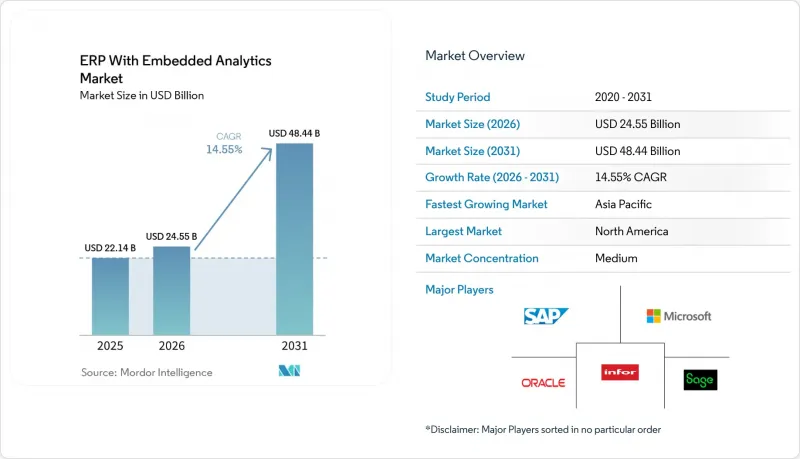
Mordor Intelligence에 의하면, 임베디드 분석 ERP(전사적 자원 계획) 시장 규모는 2026년 245억 5,000만 달러에서 2031년까지 484억 4,000만 달러로 확대되어 2026년부터 2031년에 걸쳐 CAGR 14.55%를 나타낼 것으로 예측되고 있습니다.
본 보고서는 배포 방식(클라우드, On-Premise, 하이브리드), 구성 요소(소프트웨어, 배포·통합 서비스, 교육·지원 서비스), 기업 규모(중소기업, 대기업), 기능(재무 및 회계, 인사, 기타 기능), 산업 분야(제조업, 은행, 금융서비스 및 보험(BFSI), 기타 산업 분야) 및 지역별로 분류되어 있습니다. 시장 전망은 금액(달러) 기준으로 제시되어 있습니다.
세계의 임베디드 분석 ERP(전사적 자원 계획) 시장 동향 및 인사이트
기업 내 클라우드 ERP 도입이 가속화되고 있습니다.
2025년에는 중견·대기업에서의 도입 건수 중 70% 이상이 클라우드로 전환되었습니다. 평균 인프라 비용은 On-Premise 대비 30% 감소하여, 고급 분석 인력에 대한 예산을 확보할 수 있게 되었을 뿐만 아니라, 통합된 데이터 레이크를 통해 부서 간 대시보드를 구현할 수 있게 되었습니다. 구독형 가격 책정 방식을 통해 수백만 달러 규모의 초기 라이선스 비용이 예측 가능한 연간 운영비로 전환됨에 따라, 자본 예산이 제한된 조직에서의 도입이 촉진되었습니다. 트랜잭션이 집중되는 업계에서는 지연에 대한 민감도가 높은 편이지만, 보안이 강화된 API 게이트웨이와 지역별 데이터센터 덕분에 GDPR(EU 개인정보보호규정) 및 중국의 PIPL 준수가 용이해졌습니다. 그 결과, 내장형 분석 ERP(전사적 자원 계획) 시장 규모를 확대하는 지속적인 성장세가 나타나고 있습니다.
업무 최적화를 위한 실시간 데이터 및 예측 인사이트에 대한 수요
제조업 분야에서는 IoT 원격 측정 기술을 활용해 최대 72시간 전에 설비 고장을 예측함으로써, 예기치 못한 가동 중단 시간을 40% 줄이는 사례가 늘고 있습니다. 마찬가지로, 소매업이나 제약 회사에서도 재고 보충 주기의 단축이나 임상시험 신청까지의 기간 단축 등 업무의 대폭적인 개선이 나타나고 있습니다. 이러한 발전은 업종을 불문하고 임베디드 분석이 가져다주는 확장 가능한 혁신적 가치를 입증하고 있습니다.
클라우드 ERP 도입에 따른 데이터 보안 및 개인정보 보호에 대한 우려
2024년에는 금융 및 의료 분야에서 12억 건의 기록이 유출되는 대규모 정보 유출 사고가 발생했으며, 43%의 기업이 보다 강력한 관리 체제가 갖춰질 때까지 전환을 일시 중단하는 사태가 벌어졌습니다. 수백만 유로에 달하는 GDPR(EU 개인정보보호규정) 위반 벌금과 데이터 현지화 법으로 인해 지역별 인스턴스가 강제되어 분석이 분절되고 있습니다. 제로 트러스트 아키텍처, 불변 백업, 국내 데이터센터는 이제 필수 요건이 되었지만, 이 모든 요소를 종합하면 구독 비용이 최대 18% 증가하게 됩니다.
부문별 분석
하이브리드형 접근 방식은 현재 규모가 작은 기업이나 기밀성이 높은 자산을 On-Premise에 보관해야 하는 규제 대상 기업 수요를 반영하여, 연평균 18.00%의 성장률이 예상됩니다. 은행 업계에서는 바젤 III의 보고 요건을 충족하기 위해 거래 장부를 On-Premise에 보관하는 한편, 업무 분석은 퍼블릭 클라우드로 이전하고 있으며, 이러한 구성으로 인프라 비용을 22% 절감하고 있습니다. 의료 분야에서는 HIPAA에 따라 임상 업무와 비임상 업무 간의 유사한 구분이 진행되고 있습니다. 엣지 컴퓨팅은 공장 현장에서 센서에서 수집된 데이터를 처리하고, 집계된 인사이트를 중앙 클라우드에 전송함으로써 이러한 설계를 강화합니다. 이를 통해 지연에 대한 불만이 해소되고, 임베디드 분석(Embedded Analytics)을 통해 전사적 자원 계획(ERP) 시장 경쟁력이 높아집니다.
자체 데이터를 활용한 생성형 AI 훈련에서도 하이브리드 토폴로지가 선호되고 있습니다. 모델 훈련 중에는 On-Premise GPU 클러스터가 지적 재산을 보호하며, 추론 처리는 탄력적으로 확장되는 클라우드 환경에서 수행됩니다. 재해 복구 요건 또한 이 모델을 뒷받침하고 있으며, On-Premise 기본 시스템에서 클라우드 복제본으로의 장애 전환을 몇 분 이내에 실현함으로써 분석 업무의 중단을 방지할 수 있게 됩니다. API 관리의 복잡성은 여전히 걸림돌로 작용하고 있기 때문에 각 벤더사는 현재 매니지드 게이트웨이를 번들로 제공하고 있으며, 그 가격은 일반적으로 기본 구독 요금보다 10-15% 비싸게 책정되어 있습니다.
매출의 68%는 여전히 소프트웨어가 차지하고 있지만, 가장 빠르게 성장하고 있는 부문은 도입 및 통합 서비스로, 연평균 성장률(CAGR)은 15.50%에 달할 전망입니다. 기업들은 메인프레임에서 데이터를 추출하고, 데이터 품질을 정제하며, 맞춤형 모델을 개발하는 데 어려움을 겪고 있으며, 총 예산의 30-40%를 시스템 통합 업체에 지출하고 있습니다. 이전 전문가들은 시간당 200-350달러의 보수를 받고 있으며, 이로 인해 기술 부족 문제가 두드러지고 있습니다. 분석 도구의 보급으로 인해 영업, 인사, 운영 팀에도 분석이 확산되면서 교육 및 지원 수요가 증가하고 있으며, 교육 과정 비용도 상당한 규모에 달하고 있습니다.
업데이트, 보안, 튜닝에 대한 책임을 맡는 매니지드 서비스가 부상하고 있으며, 그 비용은 일반적으로 라이선스 가격의 15-25%를 차지합니다. 임상시험 결과 예측이나 자산 포트폴리오 스트레스 테스트 등, 업계 특유의 미묘한 차이에 대응하는 맞춤형 알고리즘 개발은 제품 매출에 필적하는 새로운 서비스 수익을 창출하고 있습니다. 그 결과, 내장형 분석 ERP(전사적 자원 계획) 시장은 서비스 주도형 가치 창출로 기울고 있습니다.
지역별 분석
북미는 생성형 AI의 조기 도입과 탄탄한 클라우드 인프라에 힘입어 2025년 매출의 37%를 차지했습니다. 미국은 중견 기업을 대상으로 API 우선 제품을 제공하는 벤처 캐피털 지원 벤더들의 뒷받침을 받아, 해당 지역의 매출의 거의 4분의 3을 차지했습니다. 캐나다에서는 연방 정부의 디지털 예산을 활용하여 각 부처에 걸쳐 이중언어 클라우드 ERP 도입이 추진되었습니다. 한편, 멕시코에서는 니어쇼어링의 확산으로 인해 공급업체들은 미국 자동차 OEM 업체들이 요구하는 실시간 가시화 도구를 도입할 수밖에 없게 되었습니다.
아시아태평양은 연평균 성장률(CAGR) 13.50%를 기록하며 가장 빠르게 성장하고 있는 지역입니다. 중국의 산업 디지털화 지원금 덕분에 2025년에는 클라우드 ERP를 도입한 기업이 12만 곳 추가되었습니다. 그중 상당수는 엄격한 데이터 현지화 규제를 준수해야 하는 중소 제조업체들입니다. 인도의 생산 연계형 인센티브 프로그램은 추적성을 중시하고 있으며, 전자기기 및 의약품 수출업체들의 도입을 가속화하고 있습니다. 일본과 한국에서는 IoT 분석을 레거시 시스템에 통합하여 에너지 사용량을 최대 22%까지 절감하고 있으며, 임베디드 분석 시장이 성장 궤도에 오르는 가운데 해당 지역에서의 ERP 도입이 촉진되고 있습니다.
유럽은 2025년에 28%의 점유율을 차지했으며, 독일의 중견 기업(미텔슈탄트)은 ESG 보고 요건을 충족하기 위해 플랫폼을 업그레이드했고, 영국은 통관 병목 현상을 최대 40% 줄이기 위해 무역 규정 준수 분석을 도입했습니다. 남미에서는 공공 부문의 ERP 혁신에 80억 달러를 배정했으며, 브라질이 45개 기관을 클라우드 솔루션으로 전환하며 이를 주도하고 있습니다. 중동에서는 스마트 시티 예산을 유틸리티과 교통을 아우르는 통합 분석에 투입하고 있으며, 아프리카에서는 모바일 인터페이스를 활용해 데스크톱의 한계를 극복함으로써 전 세계의 전체적인 그림을 완성하고 있습니다.
기타 혜택 :
- 엑셀 형식 시장 예측(ME) 시트
- 3개월간의 애널리스트 지원
자주 묻는 질문
목차
제1장 서론
제2장 분석 방법
제3장 주요 요약
제4장 시장 구도
제5장 시장 규모 및 성장률 예측
제6장 경쟁 구도
제7장 시장 기회 및 향후 전망
KTH 26.06.29According to Mordor Intelligence, the eRP with Embedded Analytics market size is expected to increase from USD 24.55 billion in 2026 to USD 48.44 billion by 2031, growing at a CAGR of 14.55% over 2026-2031.
This report is Segmented by Deployment Mode (Cloud, On-Premise, and Hybrid), Component (Software, Implementation and Integration Services, and Training and Support Services), Enterprise Size (SMEs and Large), Function (Finance and Accounting, HR, and Other Functions), Industry Vertical (Manufacturing, BFSI, and Other Verticals), and Geography. Market Forecasts are Provided in Terms of Value (USD).
Global ERP With Embedded Analytics Market Trends and Insights
Accelerating Cloud ERP Adoption Among Enterprises
Cloud penetration exceeded 70% of mid-market and large-enterprise installations in 2025. Average infrastructure cost fell 30% relative to on-premise, unlocking budget for advanced analytics talent while centralized data lakes enabled cross-functional dashboards. Subscription pricing converted multi-million-dollar upfront licenses into predictable annual operating expenses, bolstering uptake among organizations with constrained capital budgets. Despite latency sensitivities in transaction-intensive verticals, secure API gateways and regional data centers are easing compliance with GDPR and China's PIPL. The net result is sustained momentum that enlarges the ERP with Embedded Analytics market footprint
Demand for Real-Time Data and Predictive Insights to Optimize Operations
Manufacturers are increasingly using IoT telemetry to predict equipment failures up to 72 hours in advance, reducing unplanned downtime by 40%. Similarly, retailers and pharmaceutical companies are experiencing significant operational improvements, including faster replenishment cycles and reduced timelines for clinical-trial submissions. These advancements underscore the scalable, transformative value of embedded analytics across industries.
Data Security and Privacy Concerns in Cloud ERP Deployments
High-profile breaches exposed 1.2 billion records across finance and healthcare during 2024, prompting 43% of enterprises to pause migrations pending stronger controls. Multi-million-euro GDPR fines and data-localization laws are forcing region-specific instances that fragment analytics. Zero-trust architectures, immutable backups, and in-country data centers are now table stakes, but collectively raise subscription spend by up to 18%.
Other drivers and restraints analyzed in the detailed report include:
- Integration of AI, ML and IoT Driving Embedded Analytics Capabilities
- Shift Toward ESG and Sustainability Reporting Embedded Into ERP Analytics
- Implementation Complexity and Cost Overruns
For complete list of drivers and restraints, kindly check the Table Of Contents.
Segment Analysis
Hybrid approaches, though smaller today, are projected to grow 18.00% annually, reflecting regulated enterprises that must keep sensitive assets on-premise. Banking players keep transaction ledgers locally for Basel III reporting while pushing operational analytics to the public cloud, an arrangement that trims infrastructure spending by 22%. In healthcare, HIPAA drives similar splits between clinical and non-clinical workloads. Edge computing augments these designs by processing sensor feeds at the factory floor before forwarding aggregated insights to central clouds, eliminating latency complaints and expanding the ERP's market appeal with Embedded Analytics.
Generative-AI training on proprietary data also favors hybrid topologies, with on-premises GPU clusters safeguarding intellectual property during model training while inference runs in elastically scaled cloud environments. Disaster-recovery imperatives reinforce the model, enabling failover from on-premises primaries to cloud replicas within minutes, ensuring uninterrupted analytics. API management complexity remains a stumbling block, so vendors now bundle managed gateways, typically priced at a 10-15% premium over base subscriptions.
Software still accounts for 68% of revenue, yet the fastest-growing segment will be implementation and integration services, with a 15.50% CAGR. Enterprises grapple with mainframe extraction, data-quality cleansing, and bespoke model development, funneling 30-40% of total budgets into system integrators. Migration specialists command USD 200-350 per hour, underscoring the scarcity of skills. Training and support lines are swelling because democratized analytics now touch sales, HR, and operations teams, adding sizable curriculum costs.
Managed services offerings that assume responsibility for updates, security, and tuning are emerging, typically 15-25% of license value. Custom algorithm development for vertical nuances. such as clinical-trial outcome prediction or asset-portfolio stress testing, creates fresh service revenue that rivals product income. As a result, the ERP with Embedded Analytics market is tilting toward service-led value capture.
Geography Analysis
North America accounted for 37% of 2025 sales, buoyed by early generative AI adoption and deep cloud infrastructure. The United States captured almost three-quarters of regional turnover, aided by venture-capital-backed vendors that supply API-first products to mid-market buyers. Canada channeled federal digital budgets into bilingual cloud ERP roll-outs across agencies, while Mexico's nearshoring wave compelled suppliers to adopt real-time visibility tools demanded by U.S. automotive OEMs.
Asia-Pacific is the fastest-growing region, with a 13.50% CAGR. China's industrial digitization subsidies added 120,000 cloud ERP tenants in 2025, many of them small manufacturers navigating stringent data localization edicts. India's production-linked incentive programs hinge on traceability, accelerating uptake among electronics and pharmaceutical exporters. Japan and South Korea embed IoT analytics into legacy systems to cut energy use by up to 22%, enhancing regional ERP adoption amid the Embedded Analytics market growth trajectory.
Europe held 28% share in 2025, with Germany's Mittelstand upgrading platforms to satisfy ESG reporting, and the United Kingdom installing trade-compliance analytics to shave customs bottlenecks by up to 40%. South America earmarked USD 8 billion for public-sector ERP transformations, Brazil leading the charge by migrating 45 agencies to cloud suites. The Middle East funnels smart-city budgets into unified analytics that span utilities and transport, and Africa leverages mobile interfaces to circumvent desktop limitations, completing the global picture.
- SAP SE
- Oracle Corporation
- Microsoft Corporation
- Infor Inc.
- The Sage Group plc
- Epicor Software Corporation
- IFS AB
- Workday Inc.
- Acumatica Inc.
- QAD Inc.
- Plex Systems Inc.
- Syspro (Pty) Ltd.
- Unit4 N.V.
- Odoo SA
- Ramco Systems Limited
- Rootstock Software LLC
- Priority Software Ltd.
- Aptean Inc.
- Deltek Inc.
- Totvs S.A.
Additional Benefits:
- The market estimate (ME) sheet in Excel format
- 3 months of analyst support
TABLE OF CONTENTS
1 INTRODUCTION
- 1.1 Study Assumptions and Market Definition
- 1.2 Scope of the Study
2 RESEARCH METHODOLOGY
3 EXECUTIVE SUMMARY
4 MARKET LANDSCAPE
- 4.1 Market Overview
- 4.2 Market Drivers
- 4.2.1 Accelerating Cloud ERP Adoption among Enterprises
- 4.2.2 Demand for Real-Time Data and Predictive Insights to Optimize Operations
- 4.2.3 Integration of AI, ML and IoT Driving Embedded Analytics Capabilities
- 4.2.4 Shift Toward ESG and Sustainability Reporting Embedded into ERP Analytics
- 4.2.5 Rise of Two-Tier ERP Architectures Requiring Unified Analytics
- 4.2.6 Generative AI Accelerating ERP Data Migration and Analytics Model Creation
- 4.3 Market Restraints
- 4.3.1 Data Security and Privacy Concerns in Cloud ERP Deployments
- 4.3.2 Implementation Complexity and Cost Overruns
- 4.3.3 Shortage of Skilled Data Engineers for Embedded Analytics
- 4.3.4 Vendor Lock-In Risks Limiting Analytics Flexibility
- 4.4 Industry Value Chain Analysis
- 4.5 Regulatory Landscape
- 4.6 Technological Outlook
- 4.7 Impact of Macroeconomic Factors on the Market
- 4.8 Porter's Five Forces Analysis
- 4.8.1 Threat of New Entrants
- 4.8.2 Bargaining Power of Suppliers
- 4.8.3 Bargaining Power of Buyers
- 4.8.4 Threat of Substitutes
- 4.8.5 Competitive Rivalry
5 MARKET SIZE AND GROWTH FORECASTS (VALUE)
- 5.1 By Deployment Mode
- 5.1.1 Cloud
- 5.1.2 On-Premise
- 5.1.3 Hybrid
- 5.2 By Component
- 5.2.1 Software
- 5.2.2 Implementation and Integration Services
- 5.2.3 Training and Support Services
- 5.3 By Enterprise Size
- 5.3.1 Small Enterprises (1-99 Employees)
- 5.3.2 Medium Enterprises (100-999 Employees)
- 5.3.3 Large Enterprises (1,000+ Employees)
- 5.4 By Industry Vertical
- 5.4.1 Manufacturing
- 5.4.2 Banking, Financial Services and Insurance
- 5.4.3 Healthcare
- 5.4.4 Retail and E-commerce
- 5.4.5 Government
- 5.4.6 IT and Telecom
- 5.4.7 Other Industry Verticals
- 5.5 By Function
- 5.5.1 Finance and Accounting
- 5.5.2 Supply Chain and Inventory Management
- 5.5.3 Human Resources
- 5.5.4 Production Planning and Scheduling
- 5.5.5 Customer Relationship Management
- 5.5.6 Other Functions
- 5.6 By Geography
- 5.6.1 North America
- 5.6.1.1 United States
- 5.6.1.2 Canada
- 5.6.1.3 Mexico
- 5.6.2 South America
- 5.6.2.1 Brazil
- 5.6.2.2 Argentina
- 5.6.2.3 Rest of South America
- 5.6.3 Europe
- 5.6.3.1 Germany
- 5.6.3.2 United Kingdom
- 5.6.3.3 France
- 5.6.3.4 Italy
- 5.6.3.5 Spain
- 5.6.3.6 Russia
- 5.6.3.7 Rest of Europe
- 5.6.4 Asia-Pacific
- 5.6.4.1 China
- 5.6.4.2 Japan
- 5.6.4.3 India
- 5.6.4.4 South Korea
- 5.6.4.5 Australia and New Zealand
- 5.6.4.6 Rest of Asia-Pacific
- 5.6.5 Middle East
- 5.6.5.1 Saudi Arabia
- 5.6.5.2 United Arab Emirates
- 5.6.5.3 Turkey
- 5.6.5.4 Rest of Middle East
- 5.6.6 Africa
- 5.6.6.1 South Africa
- 5.6.6.2 Egypt
- 5.6.6.3 Nigeria
- 5.6.6.4 Rest of Africa
- 5.6.1 North America
6 COMPETITIVE LANDSCAPE
- 6.1 Market Concentration
- 6.2 Strategic Moves
- 6.3 Market Share Analysis
- 6.4 Company Profiles (includes Global Level Overview, Market Level Overview, Core Segments, Financials as available, Strategic Information, Market Rank/Share, Products and Services, Recent Developments)
- 6.4.1 SAP SE
- 6.4.2 Oracle Corporation
- 6.4.3 Microsoft Corporation
- 6.4.4 Infor Inc.
- 6.4.5 The Sage Group plc
- 6.4.6 Epicor Software Corporation
- 6.4.7 IFS AB
- 6.4.8 Workday Inc.
- 6.4.9 Acumatica Inc.
- 6.4.10 QAD Inc.
- 6.4.11 Plex Systems Inc.
- 6.4.12 Syspro (Pty) Ltd.
- 6.4.13 Unit4 N.V.
- 6.4.14 Odoo SA
- 6.4.15 Ramco Systems Limited
- 6.4.16 Rootstock Software LLC
- 6.4.17 Priority Software Ltd.
- 6.4.18 Aptean Inc.
- 6.4.19 Deltek Inc.
- 6.4.20 Totvs S.A.
7 MARKET OPPORTUNITIES AND FUTURE OUTLOOK
- 7.1 White-Space and Unmet-Need Assessment