
|
시장보고서
상품코드
2114083
임베디드 분석 : 시장 점유율 분석, 업계 동향 및 통계, 성장 예측(2026-2031년)Embedded Analytics - Market Share Analysis, Industry Trends & Statistics, Growth Forecasts (2026 - 2031) |
||||||
 Mordor Intelligence
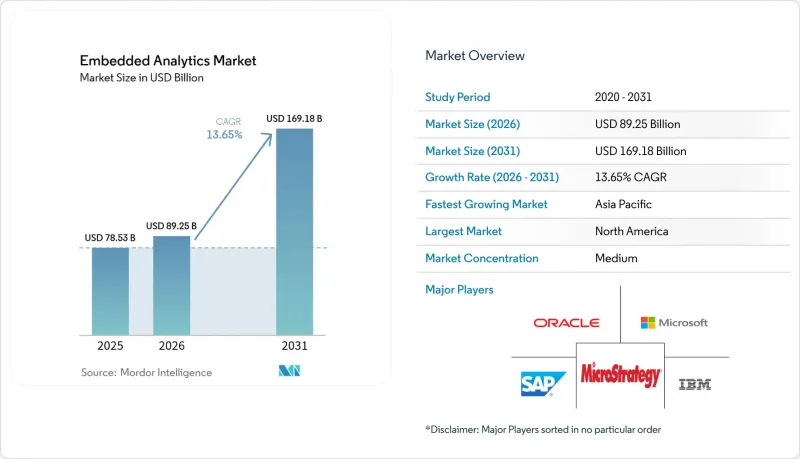
Mordor Intelligence에 의하면, 임베디드 분석 시장 규모는 2025년 785억 3,000만 달러에서 2026년에는 892억 5,000만 달러에 이르고, 2026-2031년 CAGR 13.65%로 성장을 지속하여 2031년에는 1,691억 8,000만 달러에 달할 것으로 예측됩니다.
본 보고서는 솔루션(소프트웨어 및 서비스),조직 규모(중소기업 및 기타), 배포 방식(클라우드 및 On-Premise), 최종 사용자 산업(은행, 금융서비스 및 보험(BFSI), 헬스케어 및 기타), 통합 방식(용도 내/워크플로우 내 및 기타), 비즈니스 기능(재무, 영업 및 기타), 분석 유형(기술적 분석 및 기타), 그리고 지역별로 분류되어 있습니다. 시장 전망은 금액(달러) 기준으로 제시되어 있습니다.
세계 임베디드 분석 시장 동향 및 인사이트
헤드리스 BI 프레임워크와 로우코드 플랫폼의 융합이 진전
헤드리스 BI와 로우코드 도구를 결합함으로써 개발 팀은 데이터 계층과 프레젠테이션 계층을 분리하고, 맞춤형 분석 기능 구축을 가속화할 수 있습니다. 2025년에는 북미 경영진의 37%가 맞춤형 데이터 앱을 지원하는 BI 도구를 원할 것으로 예측됩니다. RamSoft사는 Cube사의 헤드리스 아키텍처를 활용하여 2주 만에 프로덕션 환경 배포를 완료함으로써 기존 일정보다 수개월을 단축했습니다. 이러한 솔루션은 컨텍스트 전환이 필요 없으며, 사용자가 업무 화면에서 바로 인사이트를 활용할 수 있게 하여 생산성을 20-40% 향상시킵니다.
중견 제조업계의 준실시간 인사이트에 대한 수요
공장 운영자는 이상이 발생한 시점에 즉시 감지할 수 있도록 MES 및 SCADA 시스템에 분석 기능을 통합하고 있습니다. 임베디드 분석 시장과 관련된 제조업 매출액은 2020년 411억 달러에서 2025년에는 773억 달러로 증가할 전망입니다. 예지 보전만으로도 설비의 가동 중단 시간을 30-50% 줄일 수 있습니다. 독일과 일본의 공장에서는 변동이 심한 투입 비용이나 물류 혼란 속에서도 가동을 안정화하기 위해 이러한 기능을 ‘인더스트리 4.0’ 로드맵에 포함시키고 있습니다.
데이터 소재지 규제가 앱 내 클라우드 통합을 제한
엄격한 데이터 주권 관련 규제로 인해 다국적 기업들은 기밀 데이터(대부분의 경우 해당 데이터의 처리도 포함)를 특정 국경 내에 보관할 수밖에 없어, 전 세계적인 분석 시스템의 구축이 복잡해지고 있습니다. 현재 도입 사례의 약 40%를 차지하는 하이브리드 아키텍처에서는 규제 대상 워크로드에는 On-Premise 노드를, 기밀성이 낮은 분석에는 클라우드 리소스를 조합하여 사용하고 있습니다. 특히 규정 준수 부담이 가장 큰 금융 및 의료 분야에서는 그 복잡성과 비용으로 인해 가치 실현까지의 시간이 지연되고 있습니다.
부문 분석
소프트웨어 부문은 2025년에 559억 9,000만 달러의 매출을 창출하여 총 수익의 71.30%를 차지하며, 시각화, 모델링, AI 추론을 주도하는 핵심 엔진으로서의 역할을 강조하고 있습니다. 이러한 성장의 원동력은 호스트 용도 내에서 처방적 로직과 자동화된 의사 결정을 지원하는 더욱 풍부한 라이브러리와 API입니다. 한편, 기업들이 통합 전문 지식, 스키마 설계, 변경 관리 지원을 요구함에 따라 서비스 부문은 연평균 성장률(CAGR) 15.95%의 속도로 급속히 확대되고 있습니다. 역할 기반 보안, 멀티테넌트 데이터 모델, 사용자 경험 조정을 수반하는 복잡한 도입으로 인해 전문 서비스는 전략적 지출 항목으로 자리 잡고 있습니다.
멀티 클라우드 및 하이브리드 분석 아키텍처를 추구하는 조직에게는 연결성, 데이터 계보 거버넌스, 분석 자산을 위한 CI/CD 파이프라인에 대한 심층적인 지식이 요구됩니다. 따라서 자문 파트너는 아키텍처 청사진 수립과 같은 업스트림 공정으로 진출하는 한편, 관리형 서비스 제공업체는 시맨틱 레이어 업데이트, 쿼리 조정, ML 모델의 지속적인 학습과 같은 ‘데이터 2’ 운영을 제공합니다. 로우코드 도구의 보급으로 기존 BI 스택에 익숙하지 않은 사업부 팀까지 임베디드 분석 시장이 확대됨에 따라, 이 서비스 생태계는 더욱 확장될 것으로 예측됩니다.
2025년, 대기업은 임베디드 분석 시장의 496억 3,000만 달러(시장의 63.20%)를 차지하며, 거버넌스가 적용된 지표를 수천 명의 사내 사용자에게 전달하는 페더레이티드 데이터 패브릭을 도입했습니다. 이 기업들은 도메인 간 보안 및 감사 추적을 유지하면서 각 사업 부문에 서비스를 제공하기 위한 멀티테넌트 모델을 구축하고 있습니다. 이들의 최우선 과제는 전 세계 사업 거점 전반에 걸쳐 KPI 정의의 일관성을 확보하는 것입니다.
중소기업은 투자 규모는 작지만 연평균 성장률(CAGR) 14.75%라는 가장 높은 성장률을 보이고 있습니다. 종량제 클라우드 네이티브 플랫폼을 통해 이들 기업은 과거 포춘 500대 기업의 예산으로만 이용할 수 있었던 기능을 확보할 수 있게 됩니다. Knowledge Integration의 조사에 따르면, 문화적·프로세스적 기반이 갖춰져 있다면 중소기업도 분석적 인사이트력을 제품 혁신과 업무 민첩성으로 전환할 수 있는 것으로 나타났습니다. 로우코드 기반의 구성 유연성이 진입 장벽을 더욱 낮추면서, 중소기업은 기존 엔터프라이즈 BI 제품군에 수반되던 자본 투자 부담 없이 실험의 범위를 확대해 나갈 것으로 예측됩니다.
클라우드 도입으로 인한 수익은 2025년에 464억 1,000만 달러(총 수익의 59.10%)를 창출할 것이며, SaaS 벤더들이 네이티브 분석 기능으로 제공 내용을 강화함에 따라 연평균 성장률(CAGR) 15.35%로 증가할 전망입니다. 낮은 초기 비용, 유연한 확장성, 지속적인 기능 출시 덕분에 클라우드는 디지털 네이티브 기업과 중견 기업에게 기본 선택지가 되고 있습니다. 규제가 엄격한 워크로드의 경우, On-Premise가 여전히 필수적이며, 지출의 40.90%에 해당하는 321억 2,000만 달러를 차지하고 있습니다. 이러한 환경은 퍼블릭 클라우드에서는 반드시 실현할 수 없는 데이터의 지역성과 맞춤형 설정을 제공합니다.
하이브리드 아키텍처는 현재 로컬 데이터 처리 노드와 클라우드 기반 시각화 레이어를 융합한 주류 설계 패턴으로 자리 잡았습니다. 이 접근 방식은 데이터 주권에 관한 규제를 충족하면서 기밀성이 없는 데이터의 도메인 간 통합을 가능하게 합니다. 그 결과, 하이브리드 패턴과 관련된 임베디드 분석 시장 규모는 순수한 On-Premise 환경의 성장률을 상회할 것으로 예상되며, 이는 단계적인 전환 전략과 적시(JIT) 버스트 용량 확보를 지원하게 될 것입니다.
지역별 분석
북미는 2025년에 286억 6,000만 달러 시장 규모를 기록할 것으로 예상되며, 이는 전 세계 매출의 36.50%를 차지합니다. 이는 성숙한 디지털 인프라, 클라우드의 높은 보급률, 그리고 데이터 기반 프로세스에 정통한 인력을 반영한 결과입니다. 금융 서비스, 헬스케어, 기술 기업이 수요를 주도하고 있으며, 헤드리스 BI와 로우코드의 융합으로 임베디드 분석 시장 전반에 걸쳐 제품 배포가 가속화되고 있습니다. 조기에 도입한 기업들은 설명형 대시보드에서 AI를 활용한 처방형 모듈로 지속적으로 업그레이드하고 있습니다.
유럽에서는 도입 여부를 좌우하는 강력한 개인정보 보호 규제를 바탕으로 꾸준한 성장이 나타나고 있습니다. 독일, 영국, 프랑스가 투자를 주도하고 있으며, 제조업체들은 ‘인더스트리 4.0’ 프레임워크를 통합하고, 금융 플랫폼은 비은행 앱 내의 임베디드 금융 모델을 확대되고 있습니다. 각 벤더사는 GDPR(EU 개인정보보호규정) 및 소버린 클라우드 요건을 준수하는 세밀한 동의 관리, 암호화, 그리고 로컬 호스팅 옵션을 통해 차별화를 꾀하고 있습니다.
아시아태평양은 모바일 우선의 소비자 행동과 정부의 야심찬 변혁 계획에 힘입어 연평균 성장률(CAGR) 15.05%로 가장 빠르게 성장하고 있는 지역입니다. 일본은 자동화 계획에서 주도적인 입지를 차지하고 있으며, CFO의 89%가 2025년까지 임베디드 분석을 한층 더 심화할 계획입니다. 인도 및 동남아시아 국가들은 저비용 클라우드 인프라와 핀테크 혁신을 통해 도입을 가속화하고 있습니다. 이러한 추세에 힘입어 해당 지역의 임베디드 분석 시장 규모는 확대되고 있으며, 현지 플랫폼 제공업체들이 부상하는 동시에 다국적 벤더들에게 새로운 파트너십 기회가 창출되고 있습니다.
기타 혜택:
- 엑셀 형식 시장 예측(ME) 시트
- 3개월간의 애널리스트 지원
자주 묻는 질문
목차
제1장 서론
제2장 조사 방법
제3장 주요 요약
제4장 시장 구도
제5장 시장 규모와 성장 예측
제6장 경쟁 구도
제7장 시장 기회와 향후 전망
LSH 26.08.25According to Mordor Intelligence, the embedded analytics market size is expected to grow from USD 78.53 billion in 2025 to USD 89.25 billion in 2026 and is forecast to reach USD 169.18 billion by 2031 at 13.65% CAGR over 2026-2031.
This report is Segmented by Solution (Software, and Service), Organization Size (SME, and More), Deployment (Cloud, and On-Premise), End-User Vertical (BFSI, Healthcare, and More), Integration Mode (In-Application/Workflow, and More), Business Function (Finance, Sales, and More), Analytics Type (Descriptive Analytics, and More), and Geography. The Market Forecasts are Provided in Terms of Value (USD).
Global Embedded Analytics Market Trends and Insights
Growing Convergence of Headless BI Frameworks with Low-Code Platforms
Headless BI paired with low-code tooling lets development teams decouple the data layer from the presentation layer, accelerating custom analytics builds. In 2025, 37% of executives in North America seek BI tooling that supports bespoke data apps. RamSoft completed a production-grade rollout in two weeks through Cube's headless architecture, trimming months from earlier timelines. These solutions remove context-switching, delivering productivity lifts of 20-40% as users stay within operational screens while consuming insight.
Demand for Near-Real-Time Insight in Mid-Market Manufacturing Hubs
Factory operators embed analytics into MES and SCADA systems to flag anomalies as they emerge. Manufacturing-sector revenue tied to the embedded analytics market is set to climb from USD 41.1 billion in 2020 to USD 77.3 billion in 2025. Predictive maintenance alone cuts equipment downtime by 30-50%. German and Japanese plants fold these capabilities into Industrie 4.0 roadmaps to steady operations amid volatile input costs and logistics disruptions.
Data-Residency Rules Limiting In-App Cloud Embedding
Stringent sovereignty mandates force multinationals to keep sensitive data-and often processing-within specific borders, complicating global analytic rollouts. Hybrid architectures now account for roughly 40% of deployments, blending on-premise nodes for regulated workloads with cloud resources for less sensitive analyses. Complexity and cost slow time-to-value, particularly in finance and healthcare where compliance burdens are highest.
Other drivers and restraints analyzed in the detailed report include:
- FinTech Push for Embedded AI-Driven Dashboards inside Mobile Apps
- Energy-Utility Grid Modernization Needing In-Workflow Analytics
- Fragmented Open-Source Licensing Increasing Hidden TCO in SMEs
For complete list of drivers and restraints, kindly check the Table Of Contents.
Segment Analysis
The software segment generated USD 55.99 billion in 2025, equal to 71.30% of total revenue, underscoring its role as the core engine powering visualisation, modelling, and AI inference. Growth stems from richer libraries and APIs that now support prescriptive logic and automated decisioning inside host applications. Services, however, race ahead at a 15.95% CAGR as enterprises seek integration expertise, schema design, and change-management support. Complex rollouts involving role-based security, multi-tenant data models, and user-experience tuning are turning professional services into a strategic spend category.
Organizations pursuing multi-cloud or hybrid analytics architectures require deep knowledge of connectivity, data-lineage governance, and CI/CD pipelines for analytics assets. Advisory partners thus move upstream into architectural blueprints, while managed-service providers offer day-two operations that update semantic layers, tune queries, and continuously train ML models. This service ecosystem is expected to widen as low-code tooling expands the reach of the embedded analytics market into business-unit teams unfamiliar with traditional BI stacks.
Large enterprises controlled USD 49.63 billion-63.20% of the embedded analytics market-in 2025, deploying federated data fabrics that push governed metrics to thousands of internal users. These firms build multi-tenant models to serve business lines while preserving cross-domain security and audit trails. Their priority is consistency of KPI definitions across global footprints.
SMEs, though smaller in spending, are the fastest risers at 14.75% CAGR. Cloud-native platforms with usage-based pricing allow these firms to acquire capabilities once reserved for Fortune 500 budgets. Knowledge-integration research shows that SMEs convert analytical insight into product innovation and operational agility when cultural and process enablers are in place. As low-code composability lowers barriers further, SMEs are expected to widen experimentation without the capex burden previously attached to enterprise BI suites.
Cloud deployments generated USD 46.41 billion in 2025-59.10% of revenue-and will climb at 15.35% CAGR as SaaS vendors enrich their offerings with native analytics. Lower up-front cost, elastic scaling, and continuous feature releases make cloud the default for digital-native firms and mid-market adopters. On-premise remains essential for highly regulated workloads, accounting for USD 32.12 billion or 40.90% of spend. These environments provide data locality and bespoke customization that public clouds cannot always match.
Hybrid architecture is now a mainstream design pattern, blending local data-processing nodes with cloud-based visualisation layers. This approach satisfies sovereignty rules while still allowing cross-domain consolidation of non-sensitive data. As a result, the embedded analytics market size tied to hybrid patterns is projected to outpace purely on-premise growth, supporting phased migration strategies and just-in-time burst capacity.
Complete Report Scope:
- By Solution
- Software
- Service
- By Size of Organization
- Small and Medium Enterprises
- Large Enterprises
- By Deployment
- Cloud
- On-Premise
- By End-User Vertical
- BFSI
- IT and Telecommunication
- Healthcare
- Retail and E-Commerce
- Manufacturing
- Energy and Utilities
- Transportation and Logistics
- By Integration Mode
- On-Dashboard/Embedded Charts
- In-Application/Workflow
- On-Portal and Web Embedding
- By Business Function
- Finance and Accounting
- Sales and Marketing
- Operations and Supply Chain
- Human Resources
- By Analytics Type
- Descriptive Analytics
- Diagnostic Analytics
- Predictive Analytics
- Prescriptive Analytics
- By Geography
- North America
- United States
- Canada
- Mexico
- South America
- Brazil
- Argentina
- Chile
- Peru
- Rest of South America
- Europe
- Germany
- United Kingdom
- France
- Italy
- Spain
- Rest of Europe
- Asia-Pacific
- China
- Japan
- South Korea
- India
- Australia
- New Zealand
- Rest of Asia-Pacific
- Middle East
- United Arab Emirates
- Saudi Arabia
- Turkey
- Rest of Middle East
- Africa
- South Africa
- Rest of Africa
- North America
Geography Analysis
North America generated USD 28.66 billion in 2025, or 36.50% of global revenue, reflecting mature digital infrastructure, deep cloud penetration, and a workforce versed in data-driven processes. Financial services, healthcare, and technology firms lead demand, with headless BI and low-code convergence accelerating product rollouts across the embedded analytics market. Early enterprise adopters continue to upgrade from descriptive dashboards to AI-augmented prescriptive modules.
Europe exhibits steady growth anchored by strong privacy regulation that shapes deployment choices. Germany, the U.K., and France spearhead investment as manufacturers integrate Industry 4.0 frameworks and financial platforms extend embedded finance models inside non-bank apps. Vendors differentiate through granular consent management, encryption, and local hosting options that align with GDPR and sovereign-cloud mandates.
Asia-Pacific is the fastest-expanding region at 15.05% CAGR, powered by mobile-first consumer behaviour and ambitious government transformation agendas. Japan leads automation plans, with 89% of CFOs targeting deeper embedded analytics by 2025. India and Southeast Asian economies accelerate adoption via low-cost cloud infrastructure and fintech innovation. These dynamics broaden the embedded analytics market size in the region, giving rise to local platform providers and creating new partnerships for multinational vendors.
- Microsoft Corp.
- SAP SE
- IBM Corp.
- Oracle Corp.
- Salesforce (Tableau)
- SAS Institute Inc.
- TIBCO Software Inc.
- QlikTech International AB
- MicroStrategy Inc.
- Sisense Inc.
- Infor (Birst)
- Google Cloud (Looker)
- ThoughtSpot Inc.
- Domo Inc.
- Zoho Analytics
- GoodData Corp.
- Yellowfin BI
- Sigma Computing
- Exago Inc.
Additional Benefits:
- The market estimate (ME) sheet in Excel format
- 3 months of analyst support
TABLE OF CONTENTS
1 INTRODUCTION
- 1.1 Study Assumptions and Market Definition
- 1.2 Scope of the Study
2 RESEARCH METHODOLOGY
3 EXECUTIVE SUMMARY
4 MARKET LANDSCAPE
- 4.1 Market Overview
- 4.2 Market Drivers
- 4.2.1 Growing Convergence of Headless BI Frameworks with Low-Code Platforms
- 4.2.2 Demand for Near-Real-Time Insight in Mid-Market Manufacturing Hubs
- 4.2.3 FinTech Push for Embedded AI-Driven Dashboards inside Mobile Apps
- 4.2.4 Healthcare Shift to Value-Based Reimbursement Demanding Bedside Analytics
- 4.2.5 Energy-Utility Grid Modernization Needing In-Workflow Analytics
- 4.2.6 Increasing Demand for Real-time Data-driven Decision-making
- 4.3 Market Restraints
- 4.3.1 Data-Residency Rules Limiting In-App Cloud Embedding
- 4.3.2 Fragmented Open-Source Licensing Increasing Hidden TCO in SMEs
- 4.3.3 Scarcity of Domain-Contextual BI Talent Hindering Vertical Adoption in Africa
- 4.3.4 High Technical Debt inside Legacy Core-Banking Systems
- 4.4 Industry Value Chain Analysis
- 4.5 Regulatory Landscape
- 4.6 Technology Outlook
- 4.7 Porter's Five Forces Analysis
- 4.7.1 Bargaining Power of Suppliers
- 4.7.2 Bargaining Power of Buyers
- 4.7.3 Threat of New Entrants
- 4.7.4 Threat of Substitutes
- 4.7.5 Competitive Rivalry
- 4.8 Assessment of Macroeconomic Factors Impact
- 4.9 Investment Analysis
5 MARKET SIZE AND GROWTH FORECASTS (VALUE)
- 5.1 By Solution
- 5.1.1 Software
- 5.1.2 Service
- 5.2 By Size of Organization
- 5.2.1 Small and Medium Enterprises
- 5.2.2 Large Enterprises
- 5.3 By Deployment
- 5.3.1 Cloud
- 5.3.2 On-Premise
- 5.4 By End-User Vertical
- 5.4.1 BFSI
- 5.4.2 IT and Telecommunication
- 5.4.3 Healthcare
- 5.4.4 Retail and E-Commerce
- 5.4.5 Manufacturing
- 5.4.6 Energy and Utilities
- 5.4.7 Transportation and Logistics
- 5.5 By Integration Mode
- 5.5.1 On-Dashboard/Embedded Charts
- 5.5.2 In-Application/Workflow
- 5.5.3 On-Portal and Web Embedding
- 5.6 By Business Function
- 5.6.1 Finance and Accounting
- 5.6.2 Sales and Marketing
- 5.6.3 Operations and Supply Chain
- 5.6.4 Human Resources
- 5.7 By Analytics Type
- 5.7.1 Descriptive Analytics
- 5.7.2 Diagnostic Analytics
- 5.7.3 Predictive Analytics
- 5.7.4 Prescriptive Analytics
- 5.8 By Geography
- 5.8.1 North America
- 5.8.1.1 United States
- 5.8.1.2 Canada
- 5.8.1.3 Mexico
- 5.8.2 South America
- 5.8.2.1 Brazil
- 5.8.2.2 Argentina
- 5.8.2.3 Chile
- 5.8.2.4 Peru
- 5.8.2.5 Rest of South America
- 5.8.3 Europe
- 5.8.3.1 Germany
- 5.8.3.2 United Kingdom
- 5.8.3.3 France
- 5.8.3.4 Italy
- 5.8.3.5 Spain
- 5.8.3.6 Rest of Europe
- 5.8.4 Asia-Pacific
- 5.8.4.1 China
- 5.8.4.2 Japan
- 5.8.4.3 South Korea
- 5.8.4.4 India
- 5.8.4.5 Australia
- 5.8.4.6 New Zealand
- 5.8.4.7 Rest of Asia-Pacific
- 5.8.5 Middle East
- 5.8.5.1 United Arab Emirates
- 5.8.5.2 Saudi Arabia
- 5.8.5.3 Turkey
- 5.8.5.4 Rest of Middle East
- 5.8.6 Africa
- 5.8.6.1 South Africa
- 5.8.6.2 Rest of Africa
- 5.8.1 North America
6 COMPETITIVE LANDSCAPE
- 6.1 Market Concentration
- 6.2 Strategic Developments
- 6.3 Vendor Positioning Analysis
- 6.4 Company Profiles (includes Global level Overview, Market level overview, Core Segments, Financials as available, Strategic Information, Products and Services, and Recent Developments)
- 6.4.1 Microsoft Corp.
- 6.4.2 SAP SE
- 6.4.3 IBM Corp.
- 6.4.4 Oracle Corp.
- 6.4.5 Salesforce (Tableau)
- 6.4.6 SAS Institute Inc.
- 6.4.7 TIBCO Software Inc.
- 6.4.8 QlikTech International AB
- 6.4.9 MicroStrategy Inc.
- 6.4.10 Sisense Inc.
- 6.4.11 Infor (Birst)
- 6.4.12 Google Cloud (Looker)
- 6.4.13 ThoughtSpot Inc.
- 6.4.14 Domo Inc.
- 6.4.15 Zoho Analytics
- 6.4.16 GoodData Corp.
- 6.4.17 Yellowfin BI
- 6.4.18 Sigma Computing
- 6.4.19 Exago Inc.
7 MARKET OPPORTUNITIES AND FUTURE OUTLOOK
- 7.1 White-space and Unmet-Need Assessment