

|
시장보고서
상품코드
2065757
라이브 스트리밍 시장 : 시장 점유율 분석, 업계 동향 및 통계, 성장 예측(2026-2031년)Live Streaming - Market Share Analysis, Industry Trends & Statistics, Growth Forecasts (2026 - 2031) |
||||||
 Mordor Intelligence
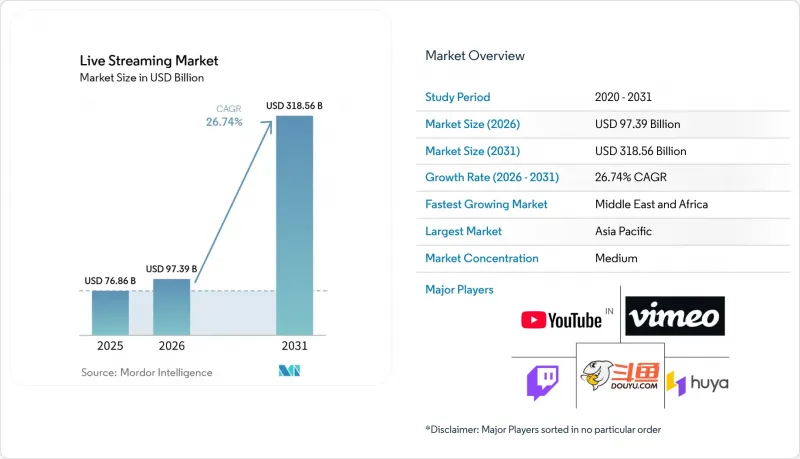
Mordor Intelligence에 의하면, 라이브 스트리밍 시장 규모는 2025년 768억 6,000만 달러로 평가되었고, 2026년 973억 9,000만 달러로 추정되고, 2031년까지 3,185억 6,000만 달러로 확대될 전망이며, 2026-2031년 연평균 복합 성장률(CAGR)은 26.74%를 나타낼 전망입니다.
본 보고서는 구성 요소별(솔루션, 서비스), 유형별(비디오 스트리밍, 오디오/팟캐스트 스트리밍), 수익 모델별(광고 지원형(AVOD/FVOD), 구독형(SVOD), 페이퍼뷰, 팁제), 플랫폼(웹, 모바일 앱, 스마트 TV 및 커넥티드 TV 기기, 게임 콘솔 및 가상현실), 최종 사용자 산업(게임 및 e스포츠, 미디어 및 엔터테인먼트 스튜디오, 스포츠 연맹 및 클럽, 기타), 지역별로 분류되어 있습니다.
세계의 라이브 스트리밍 시장 동향 및 인사이트
5G 지원 모바일 스트리밍
서울 수도권 내 이동통신 사업자들은 고밀도 3.5GHz 대역 구축에 힘입어 2024년과 2025년 동안 다운링크 속도의 중앙값을 160 Mbps 이상으로 유지했습니다. 이러한 환경 덕분에 보조 Wi-Fi 없이도 콘서트나 도시 전역에 걸쳐 모인 e스포츠 팬들의 행사 현장에서 4K 화질의 핸드헬드 라이브 중계가 가능해졌습니다. 게임 퍼블리셔가 대규모 업데이트를 발표할 때마다 저녁 시간대의 트래픽 피크가 유선 회선에서 모바일 네트워크로 뚜렷하게 이동하고 있으며, 이는 라이브 비디오 수요를 휴대전화 회선의 용량으로 돌리고 있음을 입증하고 있습니다. 통신 사업자가 특정 라이브 스트리밍 앱에 대한 제로레이팅을 프리미엄 요금제에 포함시키면, 일반적인 데이터 요금제와 비교했을 때 가입자의 해지율이 낮아지며, 비디오가 지닌 고객 유지력이 두드러지게 나타납니다. 멀티 기가비트급 5G 서비스 범위가 확대됨에 따라, 1초 미만의 지연 시간 덕분에 상호작용형 퀴즈 프로그램, 실시간 투표, 실시간 다각도 스포츠 중계가 가능해집니다. 이러한 상호작용이 어우러져, 컨텐츠와 커뮤니티를 동일한 모바일 기기 화면에서 융합함으로써 라이브 스트리밍 시장의 가치 제안을 한층 더 강화하고 있습니다.
e스포츠 공동 중계권
2024년 챔피언십 서킷의 북미 라이선스 제공사는 실시간 통계 데이터 오버레이 기능이 포함된 공동 방송 키트를 출시하여, 크리에이터들이 공식 영상 피드에 자신만의 해설을 겹쳐 넣을 수 있도록 했습니다. 이러한 접근 방식을 통해 기존 해설에서는 간과되었던 계층까지 도달 범위가 확대되었으며, 평균 동시 시청자 수도 증가했습니다. 현재 스폰서들은 메인 피드와 인증된 크리에이터의 미러 방송을 묶은 패키지를 구매하고 있으며, 단일 채널에 국한된 노출 수를 측정하는 것이 아니라 실제로 반응한 시청자를 측정할 수 있게 되었습니다. 진행자 주도의 방송은 전체적인 도달 범위가 비슷하더라도, 시청자 1인당 참여도 측면에서는 공식 스트리밍을 능가하는 경우가 적지 않습니다. 권리 보유자는 일괄 라이선스를 크리에이터 생태계로 전환함으로써, 사용자 참여를 보다 신속하게 다양한 수익원으로 전환하고 있습니다. 또한, 이 모델은 데이터 수집 속도를 높여줍니다. 모든 공동 배포가 데이터 노드가 되고, 그 데이터가 추천 엔진에 피드백됨으로써 생태계 전체의 네트워크 효과가 확대되기 때문입니다.
대역폭 가격 변동
동남아시아 일부 지역의 도매 중계 요금 변동으로 인해, 2024년 공휴일에는 여러 크리에이터 플랫폼이 적응형 비트레이트의 상한선을 설정할 수밖에 없었으며, 이로 인해 피크 시간대의 광고 재고가 감소했습니다. 이미 엣지 트랜스코더를 도입한 사업자는 온프레미스 처리를 통해 업스트림 데이터 양을 대폭 줄이고 화질을 유지할 수 있었기 때문에 변동에 더 원활하게 대응할 수 있었습니다. 이러한 대조적인 상황은 기술적 아키텍처의 선택이 거시적 차원의 비용 충격에 대한 헤지 수단이 될 수 있음을 보여줍니다. 그러나 소규모 서비스 사업자의 경우, 이 엣지 전략을 구현하기 위한 설비 투자 여력이 없기 때문에 가격 변동은 영상 품질 저하, 사용자 참여도 약화, 그리고 수익 감소라는 형태로 직접적인 영향을 미칩니다. 지역 통신 사업자들이 가격 책정을 안정화할 때까지, 대역폭의 불안정성은 신흥 경제국의 라이브 스트리밍 시장 전체의 성장을 계속해서 저해할 것입니다.
부문별 분석
2025년, 솔루션은 라이브 스트리밍 시장 점유율의 77.35%를 차지했습니다. 이는 인코딩, 컨텐츠 전송 네트워크(CDN), 기업 SDK가 여전히 원활한 재생에 필수적이기 때문입니다. 이 제공업체는 현재 객체 수준의 AI를 통합하여 가로 방향 피드에서 세로 방향 영상을 자동으로 자르는 방식으로, 모바일 시청자를 위해 스트림을 최적화하고 제작 비용을 절감하고 있습니다. 이러한 기능을 도입하는 고객사는 벤더 종속성을 심화시키고 있으며, 이는 기능의 깊이가 경쟁 우위를 얼마나 강화하는지를 보여줍니다. 또한, 다목적 캡처 기술을 통해 별도의 촬영 없이도 컨텐츠 라이브러리를 확충할 수 있어, 아카이브 전체의 수익 창출이 촉진됩니다. 그 결과, 시장의 성장이 부가 서비스 분야로 확대되는 가운데서도 솔루션에 대한 수요는 견조한 추세를 보이고 있습니다.
기업들이 인터랙티브 오버레이, 선거 당일 밤 데이터 시각화, 실시간 분석을 외부에 위탁함에 따라, 매니지드 서비스 및 전문 서비스 시장은 2031년까지 연평균 성장률(CAGR) 29.68%를 나타낼 것으로 전망됩니다. 2024년 선거 기간 동안 지도 관련 전체 업무 프로세스를 외부에 위탁한 유럽의 한 공영 방송사는 기존 사내 운영 방식에 비해 납기 기간을 절반으로 단축했습니다. 시장 출시까지 걸리는 시간이 단축됨에 따라, 뉴스룸은 직원들을 보도에 차별성을 부여하는 편집 업무에 투입할 수 있게 됩니다. 이와 같은 효율성 제고가 교육, 정부, 스포츠 등 각 분야에서도 호응을 얻고 있어, 서비스 부문은 시장을 확대하는 동시에 핵심 솔루션의 수익을 보완하고 있습니다.
2025년 라이브 스트리밍 시장 규모 중 91.40%를 비디오가 차지했습니다. 이는 2025년 럭비 대회에서 경기장 내 멀티 카메라 앵글 선택 기능이 도입됨에 따라 평균 세션 시간이 연장된 것이 주된 요인입니다. 새로운 엣지 노드를 통해 1초 미만의 지연 시간을 실현함으로써, 시청자들은 눈에 띄는 지연 없이 앵글을 투표할 수 있게 되었으며, 이러한 상호작용성이 비디오 경쟁력을 한층 더 강화하고 있음이 입증되었습니다. 이러한 사용자 경험의 향상은 스포츠, 뉴스, 엔터테인먼트 등 각 분야에서 사용자 1인당 평균 수익 증가로 이어지고 있습니다. 한편, BytePlus의 볼륨 인코딩에 대한 지속적인 테스트 결과, 몰입형 스트리밍에서 대역폭이 50% 감소한 것으로 확인되었으며, 이는 해당 분야의 향후 화질 향상을 시사하고 있습니다.
라이브 오디오 및 팟캐스트 스트리밍 시장은 연간 28.62% 이상의 성장률을 보일 것으로 전망됩니다. 2024년 7월, 한 SF 작가가 시청자들과의 질의응답을 곁들인 낭독회를 생중계했더니, 행사 진행 중에 전자책 매출이 6배로 급증했습니다. 제작 비용이 저렴하고 이어폰이 널리 보급되어 있는 덕분에, 라이브 오디오는 저자, 교육자, 인플루언서들에게 반복적으로 활용할 수 있는 참여 유도 도구로 자리 잡고 있습니다. 플랫폼들이 팁 기능이나 티켓 판매 위젯을 도입함에 따라, 오디오는 친밀한 세션을 직접적인 수익원으로 전환하며, 부수적인 기능에서 더 광범위한 생태계 내의 전략적 영역으로 그 위상을 빠르게 높여가고 있습니다.
지역별 분석
아시아태평양은 대규모 사용자 기반과 5G의 급속한 보급에 힘입어 2025년 라이브 스트리밍 시장 점유율의 약 44.30%를 유지했습니다. 한국에서는 정부 주도의 네트워크 계획에 따라 전국 평균 지연 시간이 20밀리초 미만으로 줄어들어, 전국 규모의 양방향 퀴즈 프로그램을 진행할 수 있게 되었습니다. 스포츠 경기장에서의 8K 시험 방송의 조기 도입은 해당 디스플레이에 대한 수요를 자극하고, 하드웨어와 광대역의 업그레이드를 동시에 촉진했습니다. 일본, 호주, 싱가포르에서는 e스포츠에 대한 투자가 국경을 초월한 다국어 방송의 기반이 되어 긍정적인 요인으로 작용하고 있습니다. 도쿄에서 진행된 볼륨메트릭 콘서트 플랫폼 실험은 시장 전반에 걸친 고대역폭 포맷의 테스트베드로서 아시아태평양의 역할을 더욱 부각시키고 있습니다.
중동 및 아프리카는 2031년까지 연평균 성장률(CAGR) 31.35%의 성장 궤도에 올라 있습니다. 2025년 2월에 개최된 범아랍 음악 시상식은 아랍어와 영어로 생중계되었으며, 첫날 밤에만 420만 달러의 굿즈 매출을 기록한 데 따라 주최 측은 이 행사를 월간 시리즈로 전환하기로 결정했습니다. 경기장과 도시 주변의 데이터센터를 연결하는 연맹 전체의 광섬유 백본을 통해, 현지에서 호스팅되는 스트리밍 소스가 구현되어 지연 시간과 결제 게이트웨이 장애 발생률이 감소하고 있습니다. 클라우드 트랜스코더 가격 하락에 힘입어 나이지리아와 케냐의 스타트업 기업들은 위성 통신 비용 부담 없이 고등학교 스포츠 경기나 지역 행사를 중계할 수 있게 되었으며, 기존에는 수익성을 확보하기 어려웠던 초지역적 틈새 시장을 개척하고 있습니다. 이러한 발전들이 맞물리면서, 그동안 서비스가 충분히 미치지 못했던 계층을 중심으로 라이브 스트리밍 시장 규모가 확대되고 있습니다.
북미는 도구 개발 분야에서 주도적인 위치를 유지하고 있습니다. 각 클라우드 제공업체들은 2024년 엔지니어링 서밋에서 1초 미만의 ‘글래스-투-글래스’ 워크플로를 공개하여, 스포츠 리그들이 실시간 베팅 오버레이를 테스트할 수 있도록 했습니다. 유럽은 라이브 커머스를 주도하고 있습니다. 2025년 3월, 프랑스의 한 명품 브랜드는 라이브 판매 이벤트를 통해 2,500유로(2,764달러)짜리 핸드백을 15분 만에 완판하며, 희소성 마케팅이 라이브 방송을 통한 매출 증대로 이어진다는 사실을 입증했습니다. 라틴아메리카는 ‘모바일 퍼스트’ 패러다임 아래에서 발전하고 있습니다. 2024년, 브라질 카니발 주최 측은 스트리트 크루의 운영비를 충당하기 위해 팁 기능을 활용함으로써, 지역 사회 주도의 대규모 수익 창출 가능성을 보여주었습니다. 이처럼 각 지역이 저마다 다른 가치 제안을 강화함으로써, 전 세계 라이브 스트리밍 시장의 성장을 함께 가속화하고 있습니다.
기타 혜택 :
- 엑셀 형식 시장 예측(ME) 시트
- 3개월간의 애널리스트 지원
자주 묻는 질문
목차
제1장 서론
제2장 조사 방법
제3장 주요 요약
제4장 시장 구도
제5장 시장 규모 및 성장 예측
제6장 경쟁 구도
제7장 시장 기회 및 향후 전망
LSH 26.06.24According to Mordor Intelligence, the live streaming market size is projected to expand from USD 76.86 billion in 2025 and USD 97.39 billion in 2026 to USD 318.56 billion by 2031, registering a CAGR of 26.74% between 2026 to 2031.
This report is Segmented by Component (Solutions, Services), by Type (Video Streaming, Audio / Podcast Streaming), Revenue Model (Advertising-Supported (AVOD/FVOD), Subscription-Based (SVOD), Pay-Per-View and Tipping), Platform (Web, Mobile Apps, Smart TV / CTV Devices, Gaming Consoles and VR), by End-User Vertical (Gaming and Esports, Media and Entertainment Studios, Sports Federations and Clubs, and More), Geography.
Global Live Streaming Market Trends and Insights
5G-Enabled Mobile Streaming
Mobile operators in metropolitan Seoul sustained median downlink speeds above 160 Mbps throughout 2024 and 2025, supported by dense 3.5 GHz deployments . These conditions allow 4K handheld live broadcasts from concerts and citywide e-sports fan gatherings without auxiliary Wi-Fi. Evening peak traffic has measurably shifted from fixed to mobile networks whenever game publishers unveil major updates, proving that live video diverts demand toward cellular capacity. When carriers wrap zero-rating for select live apps into premium plans, subscriber churn falls compared with standard data bundles, highlighting video's retention power. As multi-gigabit 5G coverage spreads, sub-second latency unlocks interactive trivia shows, live voting, and real-time multi-angle sports viewing. Together, these interactions reinforce the live streaming market's value proposition by merging content and community on the same handheld screen.
Esports Co-Streaming Rights
North American licensors of 2024 championship circuits issued co-streaming kits with real-time statistical overlays, allowing creators to layer personal narratives onto official video feeds. The approach widened reach into demographics overlooked by traditional commentary and lifted average concurrent viewership. Sponsors now buy packages that bundle primary feeds with verified creator mirrors, letting them measure activated audience rather than impressions confined to a single channel. Personality-led distribution often outperforms official streams on engagement per viewer, even when overall reach is similar. Rights holders are converting wholesale licences into creator ecosystems, therefore converting engagement into diversified revenue streams more quickly. The model also accelerates data capture, as every co-stream adds a data node that feeds back into recommendation engines, magnifying network effects across the broader ecosystem.
Bandwidth Price Volatility
Variable wholesale transit rates in parts of Southeast Asia forced several creator platforms to impose adaptive-bitrate caps during public holidays in 2024, undercutting ad inventory in peak windows. Operators that had already installed edge transcoders absorbed swings better because on-premise processing slashed upstream data volumes, preserving picture quality. The contrast shows that technical architecture choices can hedge against macro-level cost shocks. Yet smaller services lack capex headroom to replicate this edge strategy, so volatility passes through as lower video quality, weaker engagement, and reduced revenue. Until regional carriers smooth out pricing schedules, bandwidth instability will temper overall live streaming market growth in emerging economies.
Other drivers and restraints analyzed in the detailed report include:
- Live Commerce Adoption
- Live-Streaming API Integration in SaaS MarTech
- Fragmented Cross-Border Licensing
For complete list of drivers and restraints, kindly check the Table Of Contents.
Segment Analysis
Solutions commanded 77.35% of the live streaming market share in 2025 because encoding, content-delivery networks, and player SDKs remain essential for seamless playback. Providers now embed object-level AI that automatically crops vertical shots from landscape feeds, optimising streams for mobile viewers and reducing production overhead. Clients incorporating these features deepen vendor lock-in, illustrating how functional depth strengthens competitive moats. Multipurpose capture also expands content libraries without extra shoots, enhancing monetisation across archives. The result is resilient demand for solutions even as market growth broadens into ancillary services.
Managed and professional services are tracking a 29.68% CAGR through 2031 as enterprises outsource interactive overlays, election-night visualisations, and real-time analytics. A European public broadcaster that outsourced its entire map workflow during the 2024 election cycle cut delivery time in half compared with the previous in-house model. Faster time-to-market lets newsrooms redirect staff toward editorial tasks that differentiate coverage. Because similar efficiencies resonate across education, government, and sports, the services segment enlarges the market while complementing core solutions revenue.
Video represented 91.40% of the live streaming market size in 2025, anchored by stadium roll-outs of multi-camera angle selection that lengthened average session times during 2025 rugby tournaments. Sub-second latency on new edge nodes allowed viewers to vote on angles without perceptible delay, proving that interactivity reinforces video's dominance. Such experiential gains translate into higher average revenue per user across sports, news, and entertainment. Meanwhile, ongoing testing of volumetric encoding by BytePlus claims 50% bandwidth savings on immersive feeds , signaling future quality leaps that fortify the category.
Live audio and podcast streams are set to rise above 28.62% annually. A July 2024 science-fiction author hosted a live reading with audience Q and A and recorded a six-fold e-book sales spike during the event. Low production overhead and ubiquitous earbuds make live audio a repeatable engagement tool for authors, educators, and influencers. As platforms bake in tipping and ticketing widgets, audio converts intimate sessions into direct income streams, accelerating its shift from an ancillary feature to a strategic lane within the broader ecosystem.
Geography Analysis
Asia-Pacific retained roughly 44.30% of the live streaming market share in 2025, thanks to large user bases and rapid 5G deployment. South Korea's state-backed network plan drove nationwide average latency below 20 ms, enabling interactive trivia shows at a national scale. Early adoption of 8K trial streams at sporting venues spurred demand for compatible displays, nudging hardware and broadband upgrades together. Japan, Australia, and Singapore add tailwinds through esports investments that seed cross-border multi-language broadcasts. Platform experiments with volumetric concerts in Tokyo further illustrate Asia-Pacific's role as a test bed for high-bandwidth formats across the market.
The Middle East and Africa region is on a 31.35% CAGR path through 2031. A pan-Arab music awards ceremony in February 2025 streamed in Arabic and English and rang up USD 4.2 million in merchandise sales on opening night, prompting organisers to convert the event into a monthly series. Federation-wide fibre backbones linking stadiums to metro-edge data centres deliver locally hosted origins, cutting latency and payment-gateway failure rates. Nigerian and Kenyan start-ups, empowered by cloud-transcoder price drops, now cover high-school sports and community events without satellite overhead, unlocking hyper-local niches otherwise uneconomical. These developments collectively expand the live streaming market size across a previously underserved demographic base.
North America maintains a leadership position in tooling. Cloud providers revealed sub-second glass-to-glass workflows during 2024 engineering summits, letting sports leagues test real-time betting overlays. Europe champions live commerce; a March 2025 French luxury house sold out EUR 2500 (USD 2764) handbags within 15 minutes during a live drop, proving that scarcity marketing translates to livestream velocity. Latin America advances under a mobile-first paradigm: a Brazilian carnival organiser used tipping overlays in 2024 to fund street-crew costs, showing community-led monetisation at scale. Each region thus reinforces different value propositions, together accelerating global expansion of the live streaming market.
- Twitch Interactive, Inc.
- YouTube Live (Alphabet Inc.)
- Meta Platforms Inc. (Facebook Live, Instagram Live)
- Huya Inc.
- DouYu International Holdings Ltd.
- Vimeo Inc. (Livestream)
- Dacast Inc.
- Wowza Media Systems LLC
- Brightcove Inc.
- Akamai Technologies Inc. (Akamai Adaptive Media)
- Kaltura Inc.
- Mux, Inc.
- Stream Elements Ltd.
- Restream.io
- Streamlabs LLC
- Dacast
- Haivision
- Agora.io
- Tencent Cloud Live
- StreamYard
Additional Benefits:
- The market estimate (ME) sheet in Excel format
- 3 months of analyst support
TABLE OF CONTENTS
1 INTRODUCTION
- 1.1 Study Assumptions and Market Definition
- 1.2 Scope of the Study
2 RESEARCH METHODOLOGY
3 EXECUTIVE SUMMARY
4 MARKET LANDSCAPE
- 4.1 Market Overview
- 4.2 Market Drivers
- 4.2.1 Proliferation of 5G-Enabled Mobile Streaming in Asia Pacific
- 4.2.2 Esports Tournament Rights Driving Monetisation for Gaming Streams in North America
- 4.2.3 Shift of Live Commerce from China to Western Europe Fashion Retailers
- 4.2.4 Integration of Live-Streaming APIs into SaaS MarTech Stacks Among US SMEs
- 4.2.5 Premium Sport Leagues' Direct-to-Consumer (D2C) Models in Middle East
- 4.2.6 Cloud-based Transcoding Cost Decline Fueling Start-up Entrants in Africa
- 4.3 Market Restraints
- 4.3.1 Bandwidth Cost Volatility in Emerging Markets
- 4.3.2 Fragmented Global Licensing for Cross-Border Music Streaming Rights
- 4.3.3 Digital Ad-Fraud Affecting CPM Rates for Live OTT Streams
- 4.3.4 Latency Sensitivity Limiting Ultra-Low-Delay Use-Cases (e.g., E-sports Betting)
- 4.4 Porter's Five Forces Analysis
- 4.4.1 Bargaining Power of Suppliers
- 4.4.2 Bargaining Power of Buyers
- 4.4.3 Threat of New Entrants
- 4.4.4 Threat of Substitutes
- 4.4.5 Competitive Rivalry
- 4.5 Regulatory and Technological Outlook
- 4.5.1 Privacy Regulations Impacting Live Comment Feeds (GDPR, CPRA)
- 4.5.2 Progress of AV1 and VVC Codecs
- 4.6 Assessment of Impact of Macroeconomic Trends
- 4.7 Investment Analysis
5 MARKET SIZE AND GROWTH FORECASTS (VALUE)
- 5.1 By Component
- 5.1.1 Solutions (Encoding, Transcoding, CDN, Ingest, Player)
- 5.1.2 Services (Managed, Professional, Integration)
- 5.2 By Type
- 5.2.1 Video Streaming
- 5.2.2 Audio / Podcast Streaming
- 5.3 By Revenue Model
- 5.3.1 Advertising-Supported (AVOD/FVOD)
- 5.3.2 Subscription-Based (SVOD)
- 5.3.3 Pay-Per-View and Tipping
- 5.4 By Platform
- 5.4.1 Web
- 5.4.2 Mobile Apps
- 5.4.3 Smart TV / CTV Devices
- 5.4.4 Gaming Consoles and VR
- 5.5 By End-User Vertical
- 5.5.1 Gaming and Esports
- 5.5.2 Media and Entertainment Studios
- 5.5.3 Sports Federations and Clubs
- 5.5.4 News and Events Organisers
- 5.5.5 Education and Ed-tech Providers
- 5.5.6 Corporate and Enterprise Communications
- 5.6 By Geography
- 5.6.1 North America
- 5.6.1.1 United States
- 5.6.1.2 Canada
- 5.6.1.3 Mexico
- 5.6.2 South America
- 5.6.2.1 Brazil
- 5.6.2.2 Argentina
- 5.6.2.3 Rest of South America
- 5.6.3 Europe
- 5.6.3.1 Germany
- 5.6.3.2 United Kingdom
- 5.6.3.3 France
- 5.6.3.4 Italy
- 5.6.3.5 Spain
- 5.6.3.6 Rest of Europe
- 5.6.4 Asia Pacific
- 5.6.4.1 China
- 5.6.4.2 Japan
- 5.6.4.3 South Korea
- 5.6.4.4 India
- 5.6.4.5 Rest of Asia Pacific
- 5.6.5 Middle East and Africa
- 5.6.5.1 United Arab Emirates
- 5.6.5.2 Saudi Arabia
- 5.6.5.3 South Africa
- 5.6.5.4 Rest of Middle East and Africa
- 5.6.1 North America
6 COMPETITIVE LANDSCAPE
- 6.1 Strategic Developments
- 6.2 Vendor Positioning Analysis
- 6.3 Company Profiles (includes Global level Overview, Market level overview, Core Segments, Financials as available, Strategic Information, Products and Services, and Recent Developments)
- 6.3.1 Twitch Interactive, Inc.
- 6.3.2 YouTube Live (Alphabet Inc.)
- 6.3.3 Meta Platforms Inc. (Facebook Live, Instagram Live)
- 6.3.4 Huya Inc.
- 6.3.5 DouYu International Holdings Ltd.
- 6.3.6 Vimeo Inc. (Livestream)
- 6.3.7 Dacast Inc.
- 6.3.8 Wowza Media Systems LLC
- 6.3.9 Brightcove Inc.
- 6.3.10 Akamai Technologies Inc. (Akamai Adaptive Media)
- 6.3.11 Kaltura Inc.
- 6.3.12 Mux, Inc.
- 6.3.13 Stream Elements Ltd.
- 6.3.14 Restream.io
- 6.3.15 Streamlabs LLC
- 6.3.16 Dacast
- 6.3.17 Haivision
- 6.3.18 Agora.io
- 6.3.19 Tencent Cloud Live
- 6.3.20 StreamYard
7 MARKET OPPORTUNITIES AND FUTURE OUTLOOK
- 7.1 White-Space and Unmet-Need Assessment


