|
시장보고서
상품코드
2066371
스페인의 심혈관 의료기기 시장 : 점유율 분석, 업계 동향과 통계, 성장 예측(2026-2031년)Spain Cardiovascular Devices - Market Share Analysis, Industry Trends & Statistics, Growth Forecasts (2026 - 2031) |
||||||
 Mordor Intelligence
Mordor Intelligence에 의하면, 스페인 심혈관 의료기기 시장 규모는 2025년에 15억 5,000만 달러로 평가되었고 2026년 16억 3,000만 달러에서 2031년까지 20억 9,000만 달러에 이를 것으로 예측되며, 예측 기간(2026-2031년) CAGR은 5.08%를 나타낼 전망입니다.
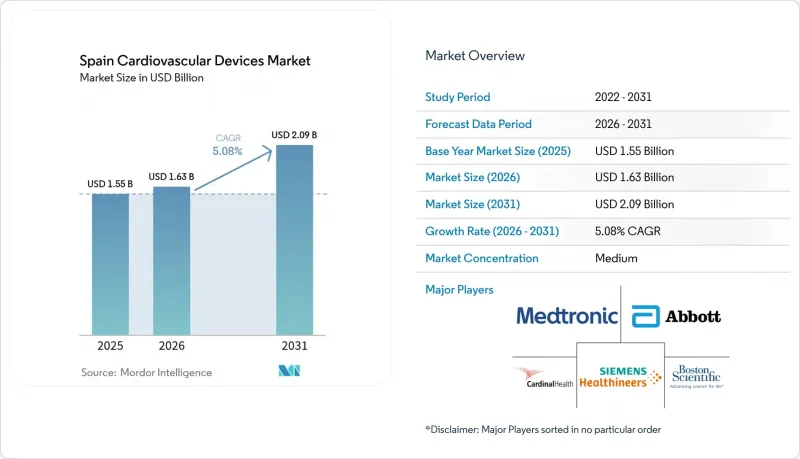
본 보고서는 기기 유형별(진단·모니터링 기기, 치료·외과용 기기), 적응증별(관상동맥 질환, 부정맥, 심부전, 심장 판막증), 최종 사용자별(병원, 재택치료, 기타) 및 지역별(스페인)로 분류되어 있습니다. 시장 전망은 금액(달러) 기준으로 제시되어 있습니다.
스페인 심혈관 의료기기 시장 동향 및 분석
‘2022-2029년 국가 심혈관 건강 계획’이 공공 조달을 촉진
이 계획에 따라 심혈관 의료기기 현대화에 2억 1,500만 유로를 배정하여 노후화된 영상 진단 시스템과 카테터 검사실의 교체를 가속화하고 있습니다. 표준화된 다년 계약을 통해 입찰 주기가 단축되고 교육이 보장됨에 따라, 기본 진단 플랫폼의 수량 주도형 성장과 첨단 기술에 대한 가치 주도형 수요가 촉진되고 있습니다. 의료 서비스가 부족한 지역의 병원에서는 최신형 심장 초음파 장비를 더 빨리 도입하고 있는 반면, 주요 의료 센터에서는 완벽하게 통합된 카테터 검사실이 도입되고 있습니다. 다층적인 제품 포트폴리오를 보유한 공급업체는 성능 스펙트럼의 양극단에 있는 요구 사항을 모두 충족함으로써 시장 점유율을 확보하고 있습니다.
급속한 고령화로 인해 의료기기 수요가 확대되고 있습니다.
65세 이상의 고령자가 심장 치료 환자의 과반수를 차지하고 있으며, 이들이 지중해 연안에 집중되어 있어 이용률이 높은 지역이 형성되어 있습니다. 현재 80대 연령층은 경카테터 판막 치환술에서 가장 빠르게 증가하는 집단으로, 병원들은 수술 일정과 수술 후 관리 프로토콜을 재검토해야 하는 상황에 직면해 있습니다. 제조업체들은 이에 대응하여 더 소형화된 임플란트를 개발하고 배터리 수명을 연장함으로써 재입원 위험을 줄이고 있습니다. 고령자 대상 기술을 도입한 병원에서는 지역 평균을 상회하는 이용 효율이 나타나는 경우가 종종 있습니다.
지역별 입찰가 상한선이 판매 가격을 압박하고 있습니다.
안달루시아나 발렌시아 등의 자치주에서는 직접 협상 가격보다 15-20% 낮은 기준 가격 제도가 시행되고 있습니다. 이 모델은 총 소유 비용을 중시하며, 소모품, 유지보수, 교육을 한 세트로 묶은 입찰을 장려하고 있습니다. 중견 공급업체들은 이익률이 낮은 부문에서 철수하고 있으며, 규모의 경제를 활용할 수 있는 기업들 사이에 시장 점유율이 집중되고 있습니다. 현행 규정이 유지된다면, 병원은 범용 제품 분야에서 선택의 폭이 좁아질 가능성이 있습니다.
부문별 분석
2025년, 스페인의 심혈관 의료기기 시장에서 치료용 및 외과용 기기가 56.78%의 점유율을 차지했습니다. 이는 관상동맥 스텐트 및 심장 리듬 관리용 임플란트에 의해 뒷받침되는 것입니다. 한편, 진단·모니터링 의료기기의 심혈관 기기 시장 규모는 AI를 활용한 영상 진단 및 조기 발견을 위한 정부의 자금 지원에 힘입어 2031년까지 연평균 성장률(CAGR) 5.86%로 확대될 것으로 예측됩니다. 또한, 첨단 경카테터 치료 기기는 기존 외과용 의료기기의 수명 주기를 단축하고, 입원 기간을 단축하는 저침습 시스템으로의 조달 전환을 촉진하고 있습니다. 핵심 하드웨어에 모듈형 소프트웨어 라이선스를 번들로 제공할 수 있는 공급업체는 생산 비용을 비례적으로 증가시키지 않으면서 추가 수익을 창출할 수 있습니다.
진단 장비의 도입은 더 이상 학술 기관에만 국한되지 않습니다. ‘분획 유동 예비량(FFR)’ 플랫폼과 3D 심초음파 검사는 ‘국가 심혈관 건강 계획’에 기반한 표준화된 조달 지침에 힘입어 지방 병원에도 점차 보급되고 있습니다. 동시에, 보험사가 회복 기간 단축으로 인한 비용 절감 효과를 인식함에 따라, 치료 분야에서는 구조적 심장 중재술에 대한 관심이 높아지고 있습니다. 의료기기의 혁신을 통해 입원 일수를 단축한 병원은 대개 성과 연계형 자금 조달의 대상이 되며, 이는 최신 임플란트에 대한 수요를 뒷받침하고 있습니다.
기타 혜택:
- 엑셀 형식 시장 예측(ME) 시트
- 3개월간의 애널리스트 지원
자주 묻는 질문
목차
제1장 서론
제2장 조사 방법
제3장 주요 요약
제4장 시장 구도
제5장 시장 규모와 성장 예측
제6장 경쟁 구도
제7장 시장 기회와 향후 전망
JHS 26.06.29According to Mordor Intelligence, the spain cardiovascular devices market size was valued at USD 1.55 billion in 2025 and estimated to grow from USD 1.63 billion in 2026 to reach USD 2.09 billion by 2031, at a CAGR of 5.08% during the forecast period (2026-2031).
This report is Segmented by Device Type (Diagnostic & Monitoring Devices, Therapeutic & Surgical Devices), Indication (Coronary Artery Disease, Arrhythmia, Heart Failure, Valvular Heart Disease), End User (Hospitals, Home Care Settings, Others), and Geography (Spain). The Market Forecasts are Provided in Terms of Value (USD).
Spain Cardiovascular Devices Market Trends and Insights
National Cardiovascular Health Plan 2022-2029 Catalyzing Public Procurement
The plan allocates EUR 215 million for cardiovascular equipment modernization, accelerating replacement of aging imaging systems and catheterization labs. Standardized multi-year service contracts shorten bid cycles and guarantee training, which spurs volume-led growth for basic diagnostic platforms and value-driven demand for advanced technologies. Hospitals in underserved regions gain faster access to updated cardiac ultrasound, while flagship centers adopt fully integrated cath-lab suites. Suppliers with tiered portfolios capture share by meeting both ends of the performance spectrum.
Rapidly Ageing Population Expanding Device Demand
Citizens older than 65 generate a disproportionate share of cardiac procedures, and their clustering along the Mediterranean coastline creates utilization hotspots. Octogenarians are now the fastest-growing group for transcatheter valve replacement, prompting hospitals to revise scheduling and after-care protocols. Manufacturers have answered with smaller implants and longer battery life, which reduce rehospitalization risk. Hospitals that embrace geriatric-friendly technology often see utilization efficiencies that exceed regional averages.
Regional Tender Price Caps Compress Selling Prices
Autonomous communities such as Andalusia and Valencia enforce reference pricing 15-20% below direct-negotiation levels. The model prioritizes total cost of ownership, encouraging bids that bundle disposables, maintenance, and training. Mid-tier suppliers leave low-margin categories, consolidating share among firms that leverage scale. Hospitals could face fewer options in commodity segments if the current rules persist.
Other drivers and restraints analyzed in the detailed report include:
- Reimbursement of TAVR & TMVR Accelerating Structural Heart Uptake
- Expansion of Private Cardiology Networks Driving Premium Equipment
- MDR Recertification Backlog Delaying Product Launches
For complete list of drivers and restraints, kindly check the Table Of Contents.
Segment Analysis
Therapeutic and surgical devices held 56.78% of Spain cardiovascular devices market share in 2025, buoyed by coronary stents and cardiac rhythm-management implants. Concurrently, the Spain cardiovascular devices market size for diagnostic and monitoring equipment is expected to grow at 5.86% CAGR through 2031 thanks to AI-guided imaging and national funding for early detection. Advanced transcatheter tools also shorten the life cycle of older surgical devices, shifting procurement toward minimally invasive systems that shorten hospital stays. Vendors that can package modular software licenses with core hardware capture incremental revenue without proportionally higher production costs.
Diagnostic adoption is no longer confined to academic centers. Fractional flow-reserve platforms and 3D echocardiography are penetrating regional hospitals, encouraged by standardized procurement guidelines under the National Cardiovascular Health Plan. At the same time, the therapeutic segment is intensifying its focus on structural heart interventions as payers recognize the cost benefits of shorter recovery times. Hospitals that achieve lower length-of-stay metrics through device innovation often qualify for performance-based financing, bolstering demand for the latest implants.
List of Companies Covered in this Report:
- Medtronic
- Boston Scientific
- Abbott Laboratories
- Edward Lifesciences
- Koninklijke Philips
- Siemens Healthineers
- Terumo
- BIOTRONIK
- MicroPort
- LivaNova
- Cardinal Health
- B. Braun
- Meril Life Science
- Acist Medical Systems
- Getinge AB (Maquet)
- W. L. Gore & Associates
- Johnson & Johnson
- Teleflex
Additional Benefits:
- The market estimate (ME) sheet in Excel format
- 3 months of analyst support
TABLE OF CONTENTS
1 Introduction
- 1.1 Study Assumptions & Market Definition
- 1.2 Scope of the Study
2 Research Methodology
3 Executive Summary
4 Market Landscape
- 4.1 Market Overview
- 4.2 Market Drivers
- 4.2.1 National Cardiovascular Health Plan 2022-2029 Catalyzing Device Procurement in Public Hospitals
- 4.2.2 Rapidly Ageing Spanish Population Expanding Cardiac Device Demand
- 4.2.3 Reimbursement of TAVR & TMVR Accelerating Structural Heart Device Uptake
- 4.2.4 Expansion of Private Cardiology Networks Driving High-End CRM & Imaging Equipment
- 4.2.5 Rising Funds for Digital Cardiac Tele-monitoring Platforms
- 4.3 Market Restraints
- 4.3.1 Regional Tender Price-Caps Compressing Average Selling Prices
- 4.3.2 MDR Recertification Backlog Delaying New Product Launches in Spain
- 4.3.3 Shortage of Interventional Cardiologists Outside Madrid & Catalonia Limiting Procedure Volumes
- 4.3.4 120-Day Hospital Payment Cycles Impacting Vendor Cash-Flow
- 4.4 Value / Supply-Chain Analysis
- 4.5 Regulatory Outlook
- 4.6 Technological Outlook
- 4.7 Porter's Five Forces
- 4.7.1 Threat of New Entrants
- 4.7.2 Bargaining Power of Suppliers
- 4.7.3 Bargaining Power of Buyers
- 4.7.4 Threat of Substitutes
- 4.7.5 Competitive Rivalry
5 Market Size & Growth Forecasts
- 5.1 By Device
- 5.1.1 Diagnostic & Monitoring Devices
- 5.1.1.1 ECG Systems
- 5.1.1.2 Remote Cardiac Monitor
- 5.1.1.3 Cardiac MRI
- 5.1.1.4 Cardiac CT
- 5.1.1.5 Echocardiography / Ultrasound
- 5.1.1.6 Fractional Flow Reserve (FFR) Systems
- 5.1.2 Therapeutic & Surgical Devices
- 5.1.2.1 Coronary Stents
- 5.1.2.1.1 Drug-Eluting Stents
- 5.1.2.1.2 Bare-Metal Stents
- 5.1.2.1.3 Bioresorbable Stents
- 5.1.2.2 Catheters
- 5.1.2.2.1 PTCA Balloon Catheters
- 5.1.2.2.2 IVUS/OCT Catheters
- 5.1.2.3 Cardiac Rhythm Management
- 5.1.2.3.1 Pacemakers
- 5.1.2.3.2 Implantable Cardioverter Defibrillators
- 5.1.2.3.3 Cardiac Resynchronization Therapy Devices
- 5.1.2.4 Heart Valves
- 5.1.2.4.1 TAVR/TAVI
- 5.1.2.4.2 Mechanical Valves
- 5.1.2.4.3 Tissue/Bioprosthetic Valves
- 5.1.2.5 Ventricular Assist Devices
- 5.1.2.6 Artificial Hearts
- 5.1.2.7 Grafts & Patches
- 5.1.2.8 Other Cardiovascular Surgical Devices
- 5.1.2.1 Coronary Stents
- 5.1.1 Diagnostic & Monitoring Devices
- 5.2 By Indication
- 5.2.1 Coronary Artery Disease
- 5.2.2 Arrhythmia
- 5.2.3 Heart Failure
- 5.2.4 Valvular Heart Disease
- 5.3 By End User
- 5.3.1 Hospitals
- 5.3.2 Home Care Settings
- 5.3.3 Others
6 Competitive Landscape
- 6.1 Market Concentration
- 6.2 Market Share Analysis
- 6.3 Company Profiles {(includes Global level Overview, Market level overview, Core Segments, Financials as available, Strategic Information, Market Rank/Share for key companies, Products & Services, and Recent Developments)}
- 6.3.1 Medtronic Plc
- 6.3.2 Boston Scientific Corporation
- 6.3.3 Abbott Laboratories
- 6.3.4 Edwards Lifesciences Corporation
- 6.3.5 Philips Healthcare
- 6.3.6 Siemens Healthineers AG
- 6.3.7 Terumo Corporation
- 6.3.8 Biotronik SE & Co. KG
- 6.3.9 MicroPort Scientific Corporation
- 6.3.10 LivaNova PLC
- 6.3.11 Cardinal Health (Cordis)
- 6.3.12 B. Braun Melsungen AG
- 6.3.13 Meril Life Sciences Pvt Ltd
- 6.3.14 Acist Medical Systems
- 6.3.15 Getinge AB (Maquet)
- 6.3.16 W. L. Gore & Associates
- 6.3.17 Johnson & Johnson (Biosense Webster)
- 6.3.18 Teleflex
7 Market Opportunities & Future Outlook
- 7.1 White-space & Unmet-Need Assessment