

|
시장보고서
상품코드
2066386
PET 포장 시장 : 점유율 분석, 업계 동향과 통계, 성장 예측(2026-2031년)PET Packaging - Market Share Analysis, Industry Trends & Statistics, Growth Forecasts (2026 - 2031) |
||||||
 Mordor Intelligence
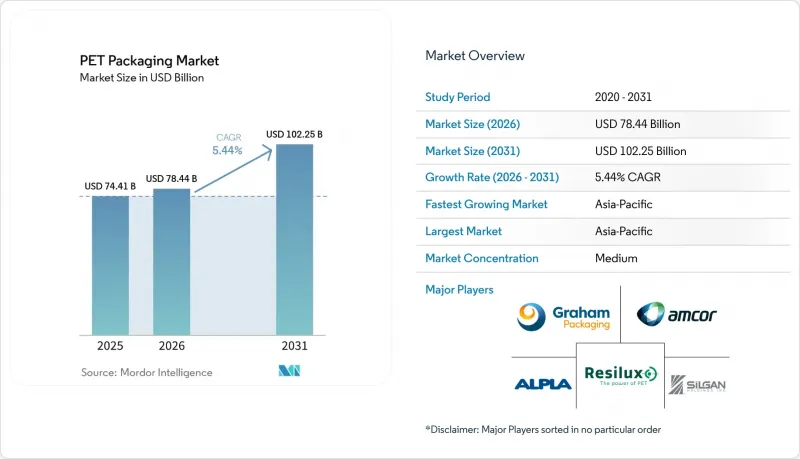
Mordor Intelligence에 의하면, PET 포장 시장 규모는 2025년에 744억 1,000만 달러로 평가되었고 2026년 784억 4,000만 달러에서 2031년까지 1,022억 5,000만 달러로 성장하여 2026년부터 2031년까지 CAGR 5.44%로 확대될 것으로 예측됩니다.
본 보고서는 포장 형태(경질 PET 포장 및 연질 PET 포장), 제품 유형(병·용기, 파우치·소포장 등), 수지 등급(버진 PET 및 재생 PET), 최종 사용 산업(식품 및 음료, 의약품, 퍼스널케어 및 화장품, 가정용품, 공업 제품 등) 및 지역별로 분류되어 있습니다. 시장 전망은 금액(달러) 기준으로 제시되어 있습니다.
세계 PET 포장 시장 동향과 인사이트
높은 재활용성과 경량화의 장점
PET 포장 시장은 경량화와 재활용 가능성이 서로 경쟁하는 것이 아니라 상호 보완하는 구조 덕분에 계속해서 혜택을 누리고 있습니다. 수지 사용량을 줄임으로써 재료비와 운송 부담이 경감되는 한편, 많은 최종 용도에서 동일한 포장이 기존의 재활용 흐름에 그대로 부합합니다. 이 점은 중요합니다. 왜냐하면, 상업용 충진 라인, 특히 규모와 라인 속도가 여전히 결정적인 요소로 작용하는 음료 분야에서 당사는 수년에 걸쳐 PET 병의 성능 최적화에 주력해 왔기 때문입니다. 식품 접촉용 재활용과 관련된 규제 측면에서도 PET는 유리한 입장에 있습니다. 이는 관련 EU 규정 하에서 식품 접촉용 재활용 플라스틱 소재에 대해 현재 승인된 유일한 경로가 사용 후 PET의 기계적 재활용뿐이기 때문입니다. 따라서 조달 팀은 경량화를 단순한 비용 절감 방안이 아니라, 계약 갱신, 포트폴리오 규정 준수, 장기적인 공급 안정성과 관련된 순환형 포장 요건으로 인식하고 있습니다. 상업적 규모에서 재료 효율성과 폐쇄형 루프에서의 수용성을 모두 갖춘 대체 소재는 거의 없기 때문에 PET 포장 시장은 앞으로도 이러한 두 가지 이점을 계속해서 누릴 것으로 보입니다.
유럽 및 미국에서의 식품용 재생 PET 의무화
PET 포장 시장은 이미 정책적 의도 단계를 넘어, 강제력이 있는 이행 기한이 설정된 규제에 힘입어 성장하고 있습니다. 유럽에서는 ‘일회용 플라스틱 지침’에 따라 2025년 1월부터 PET 음료병에 재활용 소재를 25% 함유해야 할 의무가 부과되었으며, ‘포장 및 포장 폐기물 규정’에 따르면 2030년 및 2040년까지 식품 접촉용 포장에 대한 재활용 소재 함유 요건이 더욱 강화될 전망입니다. 미국에서는 캘리포니아주의 AB 793법에 따라 2025년부터 식수 병에 재활용 소재를 25% 함유하도록 의무화되었으며, 2030년에는 50%라는 기준이 설정되었습니다. 이러한 단계적인 규제로 인해 현물 시장공급을 기다리는 것이 위험이 큰 전략이 되어가고 있기 때문에 브랜드 소유자들은 일반적인 시장 상황보다 더 이른 시점에 더 장기적인 인수 계약을 체결할 수밖에 없는 실정입니다. 그 결과, PET 포장 시장 전반에서 규제 시행 기한에 앞서 기준을 충족하는 식품용 rPET를 확보할 수 있는 재활용 업체, 가공업체, 컨버터로 자본 배분 결정이 점차 이동하고 있습니다. 또한, 유럽과 미국의 식품 접촉 기준을 충족하는 공급업체가 전 세계 소비자 브랜드에게 더욱 매력적인 수출 파트너로 부상함에 따라, PET 포장 시장의 영향이 아시아로도 확산되고 있습니다.
버진 PET 수지 가격 변동
PET 포장 시장은 버진 PET의 경제성이 정제 테레프탈산 및 모노에틸렌글리콜과 밀접하게 연관되어 있기 때문에 여전히 원료 가격 변동 위험에 노출되어 있습니다. 이러한 투입 자재는 특히 조달 계약이 업스트림 가격 변동을 따라가지 못하는 경우, 컨버터의 이익률에 지속적인 영향을 미치고 있습니다. 이익률 압박은 장기적인 공급 확보나 통합적인 조달 체계를 갖추지 못한 중소규모 컨버터에서 가장 두드러집니다. 이러한 경우, 수지 가격 변동에 따른 가격 상승으로 인한 이익이 상쇄되어, 계약 기간 중 고객과의 협상이 더욱 어려워질 가능성이 있습니다. 따라서 PET 포장 시장에서는 대기업들이 규모, 지역, 계약 구조를 통해 원자재 리스크를 분산할 수 있기 때문에 업계 재편에 대한 압력이 커지고 있습니다. 이러한 제약은 PET의 장기적인 수요 전망을 바꾸지는 않겠지만, 단기적인 수익성을 불안정하게 만들며, 조기에 원료 확보를 확정 지을 수 있는 가공업체에 유리하게 작용할 것입니다.
부문별 분석
2025년 기준으로 경질 PET 포장은 PET 포장 시장 점유율의 64.78%를 차지하고 있으며, 이는 이 카테고리가 대량 충전 시스템에 얼마나 확고하게 자리 잡고 있는지를 보여줍니다. 생수, 탄산음료, 식용유는 수십 년까지 생산 라인 속도, 차단 성능, 회수 시스템이 PET 병을 중심으로 구축되어 왔기 때문에 여전히 PET 병에 의존하고 있습니다. 따라서 브랜드 소유자가 지속가능성 지표 개선을 요구받는 상황이라 하더라도, 소재를 변경하는 데는 막대한 비용이 소요됩니다. 또한, PET 포장 업계는 규제가 가장 엄격한 시장에서 경질 PET가 이미 ‘병에서 병으로(bottle-to-bottle)’ 재활용을 뒷받침하는 수거 시스템에 통합되어 있다는 사실로부터도 혜택을 보고 있습니다. 이러한 구조적 우위 덕분에, 예측 기간 동안 경질 PET 포맷이 PET 포장 시장의 수량 기준 주력 제품으로 자리매김할 가능성이 높을 것으로 보입니다.
플렉서블 PET 포장은 2031년까지 연평균 성장률(CAGR) 5.98%를 나타낼 것으로 예측되며, 이는 리지드 PET 포장을 능가하는 성장세로서, 최종 용도 분야에서 그 중요성이 확대되고 있음을 시사합니다. 이러한 성장은 특정 식품 및 개인 위생 용도 분야에서 재활용이 불가능한 다층 라미네이트를 대체하는 단일 소재 설계에 힘입은 것입니다. 이는 그동안 대규모 재활용이 어려웠던 차단재 조합이 주로 사용되던 분야에 PET의 적용 범위를 확대한다는 점에서 중요합니다. 따라서 PET 포장 시장에서는 단순히 한 형태에서 다른 형태로 전환되는 것이 아니라, 연포장 용도와 경질 포장 용도 모두에서 동시에 성장이 나타나고 있습니다. 이러한 균형 덕분에 컨버터는 안정적인 병 수요에 대응하는 동시에 성장률이 높은 유연한 이용 사례에 대한 수요에도 대응할 수 있어, 보다 광범위한 생산 능력에 대한 투자가 뒷받침되고 있습니다. PET 포장 시장에서는 연포장 분야의 혁신과, 고객이 조달 과정에서 검증할 수 있는 재활용 가능성 주장을 결합할 수 있는 공급업체가 앞으로도 계속해서 우위를 유지할 것입니다.
2025년 기준으로, 병과 용기는 PET 포장 시장 규모의 68.91%를 차지하고 있으며, 제품 차원의 가치 측면에서 명실상부한 핵심을 이루고 있습니다. 이러한 우위는 전 세계 음료 업계가 오랫동안 병 전용 수거, 선별, 재활용 인프라에 투자해 온 사실을 반영하고 있습니다. 경쟁 형태가 비용, 규모, 다운스트림 공정과의 호환성을 동시에 충족해야 하기 때문에 이 기존 기반 덕분에 대체 위험은 낮게 억제되고 있습니다. 또한, 병이나 용기는 제품의 가시성이나 용기의 무결성이 구매 결정에 영향을 미치는 식품, 가정용품, 의약품 분야에서도 여전히 핵심적인 역할을 하고 있습니다. 그 결과, PET 포장 시장의 현재 가치 상당 부분은 병이나 용기가 여전히 상업적 표준으로 자리 잡고 있는 부문에서 창출되고 있습니다.
파우치와 사셰는 2031년까지 연평균 성장률(CAGR) 6.22%를 기록하며 성장할 것으로 예상되며, PET 포장 시장에서 가장 빠르게 성장하는 제품 유형으로 자리매김할 전망입니다. 그 매력은 1회분 가격 책정이 중요시되고, 유통망이 경량 포장을 선호하는 저소득층 소비자 시장에서 여전히 가장 강력하게 발휘되고 있습니다. 또한 아프리카와 중동 일부 지역에서는 완제품 병을 수입하는 것보다 현지에서 블로우 성형을 하는 것이 더 경제적이기 때문에 프리폼의 중요성이 커지고 있습니다. 한편, 인도와 나이지리아의 법적 규제로 인해 이 하위 부문에는 실질적인 정책상의 불확실성이 발생하고 있어, 사셰의 향후 전망은 더 이상 단순하지 않습니다. 즉, PET 포장 시장에는 단기적으로는 소포형 제품이 주도하는 성장 여지가 남아 있지만, 이러한 형태를 중심으로 구축된 생산 능력은 병에 중점을 둔 자산에 비해 중기적으로는 더 큰 위험을 수반하게 되었습니다. 합리적인 가격의 패키지 크기와 규제 준수가 용이한 형태를 모두 제공할 수 있는 컨버터는 지역별로 제각각인 정책 시행에 적응해 나가야 하는 PET 포장 시장에서 더욱 유리한 입지를 차지하게 될 것입니다.
지역별 분석
2025년, 아시아태평양은 PET 포장 시장 점유율의 47.38%를 차지하며 다른 어떤 지역보다 크게 앞서 나갔습니다. 해당 지역은 2031년까지 연평균 성장률(CAGR) 6.42%를 기록하며 성장할 것으로 예상되며, PET 포장 시장에서 가장 빠르게 성장하는 지역이 될 것입니다. 중국과 인도는 여전히 주요 견인 역할을 하고 있습니다. 중국은 수지 및 포장 분야의 규모가 매우 큰 반면, 인도는 식품 가공 및 개인 위생 용품 제조 분야에서 급속히 성장하고 있기 때문입니다. 인도에서는 FSSAI(인도 식품표준청)의 규정에 따라 2026 회계연도부터 카테고리 1 경질 플라스틱 포장재에 재활용 소재 30%를 함유해야 하므로, 재활용 소재 함유율 계획에서 인도의 중요성이 더욱 커지고 있습니다. 이에 따라 국내 rPET 생산 능력에 대한 투자가 증가하고 있으며, 인도가 향후 지역 공급 허브가 될 가능성이 더욱 높아지고 있습니다. 일본과 한국은 특히 차단 성능과 디자인의 정밀도가 중요시되는 프리미엄 음료 및 영양보조식품 분야에서 고사양 병 개발에 있어 계속해서 중요한 역할을 수행하고 있습니다.
유럽은 여전히 PET 포장 시장에서 규제가 가장 엄격한 지역이며, 이는 수요, 투자 시기 및 조달 행태에 계속해서 영향을 미치고 있습니다. EU의 ‘일회용 플라스틱 지침’에 따르면, 2025년 1월부터 PET 음료병에 재활용 소재를 25% 함유하는 것이 이미 의무화되어 있는 반면, ‘포장 및 포장 폐기물 규정’은 2026년 8월 12일부터 시행 단계에 접어들며, 향후 재활용 소재 함유율에 관한 요건이 더욱 엄격해질 전망입니다. 영국에서는 재활용 소재 함유율이 30% 미만인 포장재에 대해 2026년에 플라스틱 포장세가 톤당 228.82파운드(307.75달러)로 인상됨에 따라, 이와는 별개의 비용 부담이 가중되고 있습니다. 이러한 규제로 인해 식품 접촉용 등급의 rPET에 대한 수요가, 기존 공급량이 여유 있게 감당할 수 있는 속도를 넘어서는 속도로 증가하고 있습니다. 북미에서도 비슷한 경향이 나타납니다. 캘리포니아주의 AB 793법에 따라 재활용 소재 함유율 기준 준수가 촉진되는 한편, 가공업체들은 국내 공급에 있어 더욱 엄격해진 조달 조건에도 대응해야 합니다. 따라서 이들 지역의 PET 포장 시장에서는 계약 체결 시기가 앞당겨지고, 수직 통합이 진전되며, 추적 가능한 재활용 소재 공급에 대한 관심이 높아지는 추세를 보이고 있습니다.
아프리카에서는 도시화, 소매업의 정규화, 개별 포장된 소비재로 전환되는 추세 등 다양한 요인으로 인해 견조한 성장이 예상되며, 이러한 요인들이 지역 전체 수요를 지속적으로 뒷받침하고 있습니다. 동시에, 일부 일회용 제품에 대한 정책 조치로 인해 투자 우선순위가 변화하고 있으며, 나이지리아의 규제 과정을 통해 소포장(사셰)에 대한 압박이 커지고, 회수 가능한 경질 PET 제품에 대한 지지가 강화되고 있음을 시사하고 있습니다. 남미에서는 생수, 탄산음료, 식용유 분야에서 완만하지만 꾸준한 성장이 예상됩니다. 한편, 중동에서는 원자재 조달 리스크와 현지 생산에 대한 투자 간의 균형을 모색하고 있으며, 이를 통해 향후 수입 의존도가 낮아질 전망입니다.
기타 혜택:
- 엑셀 형식 시장 예측(ME) 시트
- 3개월간의 애널리스트 지원
자주 묻는 질문
목차
제1장 서론
제2장 조사 방법
제3장 주요 요약
제4장 시장 구도
제5장 시장 규모와 성장 예측
제6장 경쟁 구도
제7장 시장 기회와 향후 전망
JHS 26.06.29According to Mordor Intelligence, the PET packaging market size was valued at USD 74.41 billion in 2025 and is forecasted to grow from USD 78.44 billion in 2026 to USD 102.25 billion by 2031, advancing at a CAGR of 5.44% during 2026-2031.
This report is Segmented by Packaging Format (Rigid PET Packaging, and Flexible PET Packaging), Product Type (Bottles and Jars, Pouches and Sachets, and More), Resin Grade (Virgin PET, and Recycled PET), End-User Industry (Food and Beverage, Pharmaceuticals, Personal Care and Cosmetics, Household, Industrial Goods, and More), and Geography. The Market Forecasts are Provided in Terms of Value (USD).
Global PET Packaging Market Trends and Insights
High Recyclability And Light-Weighting Advantage
The PET packaging market continues to gain from the way light-weighting and recyclability reinforce each other rather than compete with each other. Lower resin use reduces material cost and transport load, while the same package still fits into an established recycling stream in many end uses. This matters because commercial filling lines have already spent years optimizing PET bottle performance, especially in beverages where scale and line speed remain decisive. The regulatory position of food-contact recycling also favors PET because post-consumer mechanical PET recycling remains the only currently authorized route for recycled plastic materials intended for food contact under the relevant EU framework. Procurement teams are therefore treating weight reduction less as a narrow cost exercise and more as a circular packaging requirement tied to contract renewal, portfolio compliance, and long-run supply stability. The PET packaging market is likely to keep benefiting from this dual advantage because few alternative substrates can match both material efficiency and closed-loop acceptance at a commercial scale.
Food-Grade Recycled PET Mandates In Europe And The United States
The PET packaging market is being pushed forward by rules that have already moved beyond policy intent and into enforceable timelines. In Europe, the Single-Use Plastics Directive required 25% recycled content in PET beverage bottles from January 2025, and the Packaging and Packaging Waste Regulation is expected to take recycled-content requirements further for contact-sensitive packaging by 2030 and 2040. In the United States, California AB 793 required 25% recycled content in beverage bottles from 2025 and set a 50% threshold for 2030. These staggered rules are forcing brand owners to sign longer offtake agreements earlier than they would under normal market conditions because waiting for spot supply is becoming a riskier strategy. That is shifting capital decisions across the PET packaging market toward recyclers, processors, and converters that can secure compliant food-grade rPET ahead of enforcement deadlines. The PET packaging market is also seeing spillover into Asia because suppliers that can meet Western food-contact standards are becoming more attractive export partners for global consumer brands.
Volatility In Virgin PET Resin Prices
The PET packaging market remains exposed to feedstock volatility because virgin PET economics are closely tied to purified terephthalic acid and monoethylene glycol. These inputs still shape converter margins, especially where procurement contracts lag changes in upstream pricing. Margin stress is most visible among smaller converters that lack long-term supply cover or integrated sourcing positions. In those cases, resin swings can erase pricing gains and make customer negotiations more difficult during the contract period. The PET packaging market is therefore seeing stronger pressure toward consolidation because larger players can spread raw material risk across scale, geography, and contract structure. This restraint does not change the long-run demand case for PET, but it does make near-term profitability less stable and rewards converters that can lock in feedstock access earlier.
Other drivers and restraints analyzed in the detailed report include:
- Expansion Of Chemical Recycling Infrastructure
- E-Commerce Demand For Impact-Resistant Lightweight Packaging
- Emerging Bans On Single-Use Sachets In Developing Countries
For complete list of drivers and restraints, kindly check the Table Of Contents.
Segment Analysis
Rigid PET packaging held 64.78% of the PET packaging market share in 2025, which shows how firmly the category is anchored in high-volume filling systems. Bottled water, carbonated drinks, and edible oils still rely on PET bottles because line speed, barrier performance, and collection systems have been built around them for decades. That makes material switching expensive, even when brand owners are under pressure to improve sustainability metrics. The PET packaging industry also benefits from the fact that rigid PET is already embedded in recovery systems that support bottle-to-bottle recycling in the most regulated markets. This structural advantage means rigid formats are likely to remain the volume base of the PET packaging market throughout the forecast period.
Flexible PET packaging is projected to grow at a 5.98% CAGR through 2031, which is faster than rigid PET packaging and points to widening end-use relevance. Growth is being supported by mono-material designs that are replacing non-recyclable multi-layer laminates in selected food and personal care applications. This is important because it expands PET into categories that had previously favored barrier combinations that were harder to recycle at scale. The PET packaging market is therefore seeing growth in flexible and rigid applications at the same time, rather than a simple shift from one format to the other. That balance supports broader capacity investment because converters can serve stable bottle demand while also chasing higher-growth flexible use cases. The PET packaging market should continue to reward suppliers that can link flexible innovation to recyclability claims that customers can verify in procurement processes.
Bottles and jars accounted for a 68.91% share of the PET packaging market size in 2025, making them the clear anchor of product-level value. Their lead reflects the global beverage sector's long investment cycle in bottle-specific collection, sorting, and recycling infrastructure. This installed base keeps replacement risk low because competing formats would need to match cost, scale, and downstream compatibility at the same time. Bottles and jars also remain central in food, household, and pharmaceutical applications where product visibility and container integrity shape buying decisions. As a result, the PET packaging market still draws much of its current value from categories where bottles and jars remain the commercial default.
Pouches and sachets are forecasted to grow at a 6.22% CAGR through 2031, which keeps them as the fastest-growing product type in the PET packaging market. Their appeal remains strongest in low-income consumer markets where single-serve price points matter and distribution networks favor lightweight packaging. Preforms are also becoming more important in parts of Africa and the Middle East, where local blow-molding can be more economical than importing finished bottles. At the same time, the outlook for sachets is no longer straightforward because legislation in India and Nigeria has introduced a real policy overhang for this sub-segment. This means the PET packaging market still has room for sachet-led growth in the near term, but capacity built around that format now carries more medium-term risk than bottle-focused assets. Converters that can serve both affordable pack sizes and more regulation-ready formats will be better placed as the PET packaging market adapts to uneven policy enforcement across regions.
Geography Analysis
Asia-Pacific held 47.38% of the PET packaging market share in 2025, which kept it well ahead of every other region. The region is projected to grow at a 6.42% CAGR through 2031, which makes it the fastest-growing geography in the PET packaging market. China and India remain the main anchors because one combines a very large resin and packaging scale, while the other is expanding quickly across food processing and personal care manufacturing. India has become more important for recycled content planning because its FSSAI rule requires 30% recycled content in Category-1 rigid plastic packaging from FY2026. This is drawing more investment into domestic rPET capacity and strengthening the case for India as a future regional supply hub. Japan and South Korea continue to matter for higher-specification bottle development, especially in premium beverages and nutraceutical formats where barrier performance and design precision carry more weight.
Europe remains the most tightly regulated region in the PET packaging market, and this continues to shape demand, investment timing, and sourcing behavior. The EU Single-Use Plastics Directive already required 25% recycled content in PET beverage bottles from January 2025, while the Packaging and Packaging Waste Regulation began its application phase on August 12, 2026, and is expected to tighten recycled-content expectations further over time. The UK is adding separate cost pressure because its Plastic Packaging Tax rose to GBP 228.82 (USD 307.75) per tonne in 2026 for packs with less than 30% recycled content. These rules are increasing the demand for food-contact-grade rPET faster than the existing supply can comfortably support. North America is facing a related pattern because California AB 793 is pushing recycled-content compliance while converters also manage tighter sourcing conditions for domestic supply. The PET packaging market in these regions is therefore moving toward earlier contracting, more vertical integration, and stronger interest in traceable recycled supply.
Africa is anticipated to witness robust growth due to various factors like urbanization, retail formalization, and the move toward individually packaged consumer goods, which continue to support demand across the region. At the same time, policy action against some single-use formats is changing investment priorities, with Nigeria's regulatory process signaling more pressure on sachets and a stronger case for recoverable rigid PET formats. South America is expected to deliver moderate but steady expansion in bottled water, carbonated beverages, and edible oil, while the Middle East is balancing feedstock risk with local manufacturing investment that should reduce import dependence over time.
- Amcor plc
- Resilux NV
- Gerresheimer AG
- ALPLA Werke Alwin Lehner GmbH and Co KG
- Silgan Holdings Inc.
- Graham Packaging Company LP
- GTX Hanex Plastic Sp. z o.o.
- Dunmore Corporation
- Comar LLC
- TOPPAN Holdings Inc.
- Huhtamaki Oyj
- Nampak Ltd.
- Plastipak Holdings Inc.
- ACTI PACK S.A.S
- RETAL Industries Ltd.
- Sealed Air Corporation
- Pactiv Evergreen Inc.
- Uflex Ltd.
- Zhongfu Industrial Co. Ltd.
- Novapet S.A.
Additional Benefits:
- The market estimate (ME) sheet in Excel format
- 3 months of analyst support
TABLE OF CONTENTS
1 INTRODUCTION
- 1.1 Study Assumptions and Market Definition
- 1.2 Scope of the Study
2 RESEARCH METHODOLOGY
3 EXECUTIVE SUMMARY
4 MARKET LANDSCAPE
- 4.1 Market Overview
- 4.2 Market Drivers
- 4.2.1 High Recyclability and Light-Weighting Advantage
- 4.2.2 Food-Grade Recycled PET Mandates in Europe and United States
- 4.2.3 Expansion of Chemical Recycling Infrastructure
- 4.2.4 E-Commerce Demand for Impact-Resistant Lightweight Packaging
- 4.2.5 Integration of Digital Watermarking for Automated Sorting
- 4.2.6 Adoption of Mono-Material PET Caps and Closures Enabling Bottle-to-Bottle Recycling
- 4.3 Market Restraints
- 4.3.1 Volatility in Virgin PET Resin Prices
- 4.3.2 Emerging Bans on Single-Use Sachets in Developing Countries
- 4.3.3 Supply Gap in Bottle-Grade rPET
- 4.3.4 Consumer Shift Toward Plastic-Free Packaging Alternatives
- 4.4 Industry Value Chain Analysis
- 4.5 Regulatory Landscape
- 4.6 Technological Outlook
- 4.7 Porter's Five Forces Analysis
- 4.7.1 Bargaining Power of Suppliers
- 4.7.2 Bargaining Power of Buyers
- 4.7.3 Threat of New Entrants
- 4.7.4 Threat of Substitutes
- 4.7.5 Intensity of Competitive Rivalry
- 4.8 Impact of Macroeconomic Factors on the Market
5 MARKET SIZE AND GROWTH FORECASTS (VALUE)
- 5.1 By Packaging Format
- 5.1.1 Rigid PET Packaging
- 5.1.2 Flexible PET Packaging
- 5.2 By Product Type
- 5.2.1 Bottles and Jars
- 5.2.2 Pouches and Sachets
- 5.2.3 Trays and Clamshells
- 5.2.4 Lids-Caps and Closures
- 5.2.5 Preforms and Other Product Types
- 5.3 By Resin Grade
- 5.3.1 Virgin PET
- 5.3.2 Recycled PET
- 5.4 By End-User Industry
- 5.4.1 Food and Beverage
- 5.4.2 Pharmaceuticals
- 5.4.3 Personal Care and Cosmetics
- 5.4.4 Household
- 5.4.5 Industrial Goods
- 5.4.6 Other End-User Industries
- 5.5 By Geography
- 5.5.1 North America
- 5.5.1.1 United States
- 5.5.1.2 Canada
- 5.5.1.3 Mexico
- 5.5.2 South America
- 5.5.2.1 Brazil
- 5.5.2.2 Argentina
- 5.5.2.3 Rest of South America
- 5.5.3 Europe
- 5.5.3.1 United Kingdom
- 5.5.3.2 Germany
- 5.5.3.3 France
- 5.5.3.4 Italy
- 5.5.3.5 Rest of Europe
- 5.5.4 Asia-Pacific
- 5.5.4.1 China
- 5.5.4.2 Japan
- 5.5.4.3 India
- 5.5.4.4 South Korea
- 5.5.4.5 Rest of Asia-Pacific
- 5.5.5 Middle East and Africa
- 5.5.5.1 Middle East
- 5.5.5.1.1 United Arab Emirates
- 5.5.5.1.2 Saudi Arabia
- 5.5.5.1.3 Rest of the Middle East
- 5.5.5.2 Africa
- 5.5.5.2.1 South Africa
- 5.5.5.2.2 Egypt
- 5.5.5.2.3 Rest of Africa
- 5.5.5.1 Middle East
- 5.5.1 North America
6 COMPETITIVE LANDSCAPE
- 6.1 Market Concentration
- 6.2 Strategic Moves
- 6.3 Market Share Analysis
- 6.4 Company Profiles (includes Global Level Overview, Market Level Overview, Core Segments, Financials as available, Strategic Information, Market Rank/Share, Products and Services, Recent Developments)
- 6.4.1 Amcor plc
- 6.4.2 Resilux NV
- 6.4.3 Gerresheimer AG
- 6.4.4 ALPLA Werke Alwin Lehner GmbH and Co KG
- 6.4.5 Silgan Holdings Inc.
- 6.4.6 Graham Packaging Company LP
- 6.4.7 GTX Hanex Plastic Sp. z o.o.
- 6.4.8 Dunmore Corporation
- 6.4.9 Comar LLC
- 6.4.10 TOPPAN Holdings Inc.
- 6.4.11 Huhtamaki Oyj
- 6.4.12 Nampak Ltd.
- 6.4.13 Plastipak Holdings Inc.
- 6.4.14 ACTI PACK S.A.S
- 6.4.15 RETAL Industries Ltd.
- 6.4.16 Sealed Air Corporation
- 6.4.17 Pactiv Evergreen Inc.
- 6.4.18 Uflex Ltd.
- 6.4.19 Zhongfu Industrial Co. Ltd.
- 6.4.20 Novapet S.A.
7 MARKET OPPORTUNITIES AND FUTURE OUTLOOK
- 7.1 White-Space and Unmet-Need Assessment


