|
시장보고서
상품코드
2066431
동반진단 시장 : 시장 점유율 분석, 업계 동향 및 통계, 성장 예측(2026-2031년)Companion Diagnostics - Market Share Analysis, Industry Trends & Statistics, Growth Forecasts (2026 - 2031) |
||||||
 Mordor Intelligence
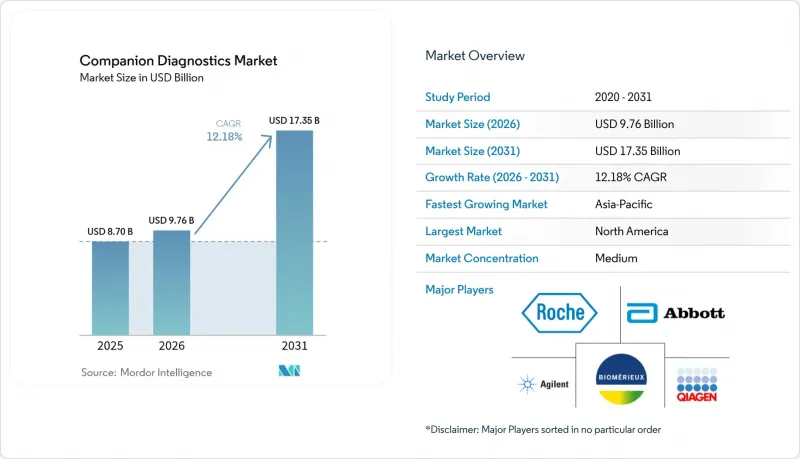
Mordor Intelligence에 의하면, 동반진단 시장 규모는 2025년에 87억 달러로 평가되었고, 2026년 97억 6,000만 달러로 추정되고, 2031년까지 173억 5,000만 달러에 이를 것으로 예측되며, 예측 기간(2026-2031년) CAGR은 12.18%를 나타낼 전망입니다.
본 보고서는 기술별(면역조직화학, 중합효소연쇄반응(PCR) 등), 적응증별(폐암, 유방암 등), 제품 유형별(어세이 및 키트, 기기 및 분석 장비 등), 검체 유형별(조직 생검, 체액 생검 등), 최종 사용자별(제약 및 바이오기술 기업, 의약품 개발 수탁 기관(CRO) 등), 지역별로 분류되어 있습니다.
세계의 동반진단 시장 동향 및 인사이트
동반진단 시장 동향 및 인사이트 : 종양학 진료 현장에서의 액체 생검 CDx의 급속한 확산
액체 생검 동반진단은 종양의 이질성을 실시간으로 파악할 수 있는 비침습적인 반복 검사 방법을 제공함으로써 암 치료 관리를 재정의하고 있습니다. 현재 임상의들은 순환 종양 DNA를 통해 질병의 진행 상황을 추적하며, 정적인 조직 샘플에만 의존하지 않고 치료법을 동적으로 조정하고 있습니다. 이에 따른 2차적 영향으로, 병원 검사실은 혈액 기반 검사 증가에 대응하기 위해 처리 능력과 콜드체인 물류를 재검토해야 하며, 이는 종양학 서비스 라인 전체의 자본 배분 일정에 영향을 미치고 있습니다. 2024년에 FDA로부터 여러 건의 승인을 획득한 ‘FoundationOne Liquid CDx’는 시장 침투를 가속화하고 있는 규제 측면에서의 모멘텀을 여실히 보여주고 있습니다. 그러나 액체 생검의 민감도는 여전히 암의 병기나 종양의 분비 메커니즘에 따라 달라지기 때문에 의료진은 중복 검사를 줄이면서도 진단 정확도를 유지할 수 있는 ‘조직 검사와 혈액 검사를 결합한 하이브리드 전략’을 도입해야 하는 상황에 놓여 있습니다.
맞춤형 의료와 정밀 종양학의 발전
동반진단은 단순한 선택적 부가 기능이라는 범주를 넘어, 많은 표적 치료제에 대한 접근에 있어 법적으로 정해진 전제조건이 되고 있습니다. FDA는 승인된 검사와 관련된 168가지 바이오마커와 약물의 조합을 목록으로 정리해 놓았으며, 이는 분자 수준의 확인이 없는 치료 과정에 대해 보험 지급 기관들이 점차 지급을 보류해 나갈 것임을 시사합니다. 이러한 연계로 인해 제약 기업들은 1상 임상시험의 초기 단계에서 검사를 공동 개발하도록 유도되고 있으며, 프로그램 전체의 일정은 단축되는 반면, 전임상 단계의 복잡성은 증가하고 있습니다. 이에 따른 직접적인 파급 효과로, 계약 연구 기관(CRO)은 수년에 걸친 전략적 아웃소싱 계약을 확보하기 위해 바이오마커 검증 체제를 확충하고 있으며, 바이오의약품 파이프라인에서 사실상 ‘분자 수준의 게이트키퍼’로서의 지위를 확립해 가고 있습니다.
높은 개발 비용
동반진단 시약의 개발에는 5,000만-1억 달러와 3-5년이 소요될 수 있어, 진단 시약은 장기적인 자본 프로젝트로 간주되고 있습니다. 중소기업들은 개발 자금을 확보하기 위해 주식을 양도함으로써, 대형 제약 기업과의 제휴에 점점 더 운명을 맡기고 있습니다. 이에 따른 2차적 영향으로는 지적재산권 포트폴리오의 통합을 들 수 있습니다. 대기업들이 의료기기의 권리를 인수함에 따라, 신규 진출기업들의 사업 수행 자유도는 점점 좁아지고 있습니다. 이러한 까다로운 지적 재산권 환경으로 인해 벤처 투자자들은 단일 바이오마커 개념보다는 검사 메뉴를 확장할 수 있는 플랫폼 기업을 선호하게 되었으며, 벤처 자금은 틈새 시장용 바이오마커에서 확장성이 있는 정보과학 주도형 솔루션으로 미묘하게 이동하고 있습니다. 이러한 구조적 변화가 동반진단 시장을 형성하고 있습니다.
부문별 분석
2025년 시점에서도 동반진단 시장 점유율의 21.8%를 차지하는 PCR이 여전히 가장 큰 점유율을 유지하고 있지만, NGS는 다른 모든 기술을 능가하는 성장이 예상됩니다. 동반진단 분야에서 NGS 시장 규모는 PCR 기반 대체 기술을 능가할 것으로 예상되며, 2026-2031년 연평균 성장률(CAGR) 13.85%로 확대될 것으로 전망됩니다. 병원 조달위원회에서는 총소유비용(TCO) 분석이 점점 더 많이 이루어지고 있으며, 그 분석 결과에 따르면 3년의 상각 기간 동안 높은 시료 처리 능력이 NGS 소모품 비용의 상승분을 상쇄한다는 사실이 밝혀졌습니다. 그 결과, 장비 공급업체들은 현재 시약 계약에 분석 소프트웨어를 묶어 판매하고 있으며, 이러한 구조를 통해 수익 인식이 하드웨어의 일시적인 판매에서 지속적인 서비스 수익으로 전환됨에 따라 분기별 수익 전망이 재구성되고 있습니다.
면역요법의 병용 요법이 보급됨에 따라, 흑색종 동반진단 시장은 2031년까지 연평균 성장률(CAGR) 13.22%로 시장 점유율을 확대해 나갈 전망입니다. 이에 따른 영향으로, 피부과 클리닉은 신속한 반사 검사를 확실하게 수행하기 위해 분자 검사실과 긴밀히 협력해야 하며, 이를 통해 기존에는 별개였던 두 임상 분야가 효과적으로 융합되게 됩니다. 이번 통합으로 인해 전자차트 공급업체들은 리플렉스 분자 검사 패널을 지원할 수 있도록 주문 입력 모듈을 조정해야 할 필요에 직면해 있습니다. 이러한 IT상의 조정은 표면적으로는 사소한 것으로 보일 수 있지만, 의료 시스템 전체에 있어 주목할 만한 관리상의 투자를 의미합니다.
지역별 분석
2025년 기준으로 북미는 39.95%의 시장 점유율을 차지했습니다. 유나이티드 헬스케어의 FDA 승인 동반진단제에 대해, 해당 진단제가 해당 의약품과 병용될 경우 보험 적용을 실시한다는 방침은 보험사의 지지를 보여주는 것으로, 이는 도입 속도에 직접적인 영향을 미치고 있습니다. 이에 따른 예상 결과로, 유나이티드 헬스케어 계열사가 아닌 민간 보험사들도 경쟁력을 유지하기 위해 이 방침을 따를 가능성이 있으며, 그 결과 업계 전체의 검사 보상률이 안정화되는 연쇄반응이 일어날 것으로 예측됩니다.
아시아태평양은 2026-2031년 연평균 성장률(CAGR) 12.45%를 나타낼 것으로 전망됩니다. 일본 정부가 지원하는 암 유전체 프로파일링(CGP) 프로그램에 따르면, 2035년까지 CGP 시장 규모가 540억 엔에 달할 것으로 예측되고 있으며, 이에 따라 국내 검사 기관들은 시퀀싱 역량을 확대해 나가고 있습니다. 이 정부의 이니셔티브는 주변국들이 따를 선례가 되어 규제 기준의 조화를 가져올 뿐만 아니라, 국경을 초월한 임상시험 참여를 촉진하고, 연구가 부족한 아시아 인구 집단에 대한 데이터 축적을 가속화할 것입니다.
유럽의 체외진단용 의료기기 규정(IVDR)에 따라 각 기업은 제품 출시 전략을 재검토해야 하는 상황에 놓여 있습니다. 인증 기관의 처리 능력이 제한적이어서 시장 출시까지의 위험이 높아지고 있으며, 진단기기 제조업체들은 임시적인 해결책으로 검사 일원화 모델을 검토하고 있습니다. 이러한 일원화는 의도치 않게 특정 참조 검사 기관을 강화하게 되어, 검사량이 정점에 달했을 때 가격 동향에 영향을 미칠 가능성이 있는 준과점 상태를 초래할 우려가 있습니다.
기타 혜택 :
- 엑셀 형식 시장 예측(ME) 시트
- 3개월간의 애널리스트 지원
자주 묻는 질문
목차
제1장 서론
제2장 조사 방법
제3장 주요 요약
제4장 시장 구도
제5장 시장 규모 및 성장 예측
제6장 경쟁 구도
제7장 시장 기회 및 향후 전망
AJY 26.06.24According to Mordor Intelligence, the companion diagnostics market size was valued at USD 8.70 billion in 2025 and estimated to grow from USD 9.76 billion in 2026 to reach USD 17.35 billion by 2031, at a CAGR of 12.18% during the forecast period (2026-2031).
This report is Segmented by Technology (Immunohistochemistry, Polymerase Chain Reaction, and More), Indication (Lung Cancer, Breast Cancer, and More), Product Type (Assays and Kits, and Instruments and Analyzers, and More), Sample Type (Tissue Biopsy, Liquid Biopsy, and More), End-User (Pharmaceutical and Biotechnology Companies, Contract Research Organizations (CROs), and More), and Geography.
Global Companion Diagnostics Market Trends and Insights
Companion Diagnostics Market Trends & Insights Rapid Adoption of Liquid-Biopsy CDx in Oncology Practices
Liquid biopsy companion diagnostics are redefining cancer management by providing a minimally invasive route for repeat testing that captures tumor heterogeneity in real time. Clinicians now track disease evolution through circulating tumor DNA, dynamically adjusting therapy rather than relying on static tissue snapshots. A second-order implication is that hospital laboratories must recalibrate throughput and cold-chain logistics to accommodate larger volumes of blood-based assays, affecting capital-allocation timelines across the entire oncology service line. FoundationOne Liquid CDx, granted multiple FDA approvals in 2024, illustrates the regulatory momentum that is quickening market uptake . Yet liquid biopsy sensitivity still varies by cancer stage and by tumor shedding biology, meaning providers are pressured to adopt hybrid tissue-plus-blood strategies that preserve diagnostic accuracy while controlling test redundancy.
Advancements in Personalized Medicine and Precision Oncology
Companion diagnostics have moved beyond optional add-ons; they are codified prerequisites for access to many targeted drugs. The FDA lists 168 biomarker-drug pairings linked to approved tests, signaling that reimbursement agencies will progressively withhold payment for therapy courses lacking molecular confirmation. This linkage is steering pharmaceutical companies to co-develop tests earlier in Phase I trials, compressing total program timelines but increasing preclinical complexity. An immediate knock-on effect is that contract research organizations (CROs) are expanding biomarker-validation benches to secure multi-year strategic outsourcing contracts, positioning themselves as de facto molecular gatekeepers for biopharma pipelines.
High Development Costs
Developing a companion diagnostic can require USD 50-100 million and 3-5 years, framing diagnostics as long-cycle capital projects. Smaller firms increasingly tie their fortunes to big-pharma alliances, trading equity stakes for developmental funding. The second-order consequence is a consolidation of intellectual-property portfolios: as large companies absorb device rights, freedom-to-operate for newcomers narrows. This tightening IP landscape nudges venture investors to favor platform companies with expandable assay menus rather than single-marker concepts, subtly migrating venture dollars away from niche biomarkers toward scalable informatics-driven solutions, these structural shifts are shaping the companion diagnostic market.
Other drivers and restraints analyzed in the detailed report include:
- Technological Innovations in Diagnostic Tools
- Growing Prevalence of Chronic Diseases
- Stringent Regulatory Policies
For complete list of drivers and restraints, kindly check the Table Of Contents.
Segment Analysis
PCR still owns the largest 2025 slice at 21.8% of the companion diagnostic market share, yet NGS is expected to outpace all other technologies. NGS market size in companion diagnostics is forecast to outpace PCR-based alternatives, expanding at 13.85% CAGR between 2026-2031. Hospital procurement committees increasingly run total-cost-of-ownership analyses that reveal high sample throughput offsets higher NGS consumable costs over a three-year amortization window. Consequently, instrument vendors now bundle analytics software into reagent contracts, an arrangement that shifts revenue recognition from one-time hardware sales to recurring service streams-reshaping quarterly earnings visibility.
Melanoma companion diagnostics will capture a market share acceleration to 13.22% CAGR through 2031 as immunotherapy combinations proliferate. The downstream impact is that dermatology clinics must coordinate closely with molecular labs to ensure rapid reflex testing, effectively blending two historically separate clinical silos. This integration forces electronic medical record vendors to adapt order-entry modules to accommodate reflex molecular panels, an IT adjustment that, although minor on the surface, represents a notable administrative investment across health systems.
Geography Analysis
North America holds 39.95% market share in 2025. UnitedHealthcare's policy to cover FDA-approved companion diagnostics when matched with the corresponding drug signals payer endorsement that directly influences adoption velocity. An inferred outcome is that private insurers outside the UnitedHealthcare umbrella may emulate the policy to remain competitive, leading to a cascade that can stabilize test reimbursement rates industry-wide.
Asia-Pacific is projected to log a 12.45% CAGR from 2026-2031. Japan's government-supported cancer genome profiling (CGP) program forecasts a 54 billion-yen CGP market by 2035, prompting domestic labs to scale sequencing capacity. This governmental commitment sets a precedent that neighboring countries may replicate, harmonizing regulatory expectations and spurring cross-border clinical-trial enrollment that accelerates data accumulation in under-studied Asian populations.
Europe's In Vitro Diagnostic Regulation environment is prompting companies to reexamine launch strategies. The limited capacity of notified bodies amplifies time-to-market risk, causing diagnostic firms to consider centralized testing models as interim solutions. Such centralization may inadvertently strengthen select reference laboratories, creating a quasi-oligopoly that could sway pricing dynamics once test volumes peak.
- Abbott Laboratories
- Agilent Technologies
- Roche
- bioMerieux
- QIAGEN
- Siemens Healthineers
- Thermo Fisher Scientific
- Danaher Corp. (Beckman Coulter)
- Illumina
- Myriad Genetics
- Guardant Health
- Sysmex Corp.
- Abnova Corp.
- BioGenex
- Tempus Labs Inc.
- Foundation Medicine Inc.
- Exact Sciences Corp.
- PerkinElmer
- Invivoscribe Inc.
Additional Benefits:
- The market estimate (ME) sheet in Excel format
- 3 months of analyst support
TABLE OF CONTENTS
1 Introduction
- 1.1 Study Assumptions & Market Definition
- 1.2 Scope of the Study
2 Research Methodology
3 Executive Summary
4 Market Landscape
- 4.1 Market Overview
- 4.2 Market Drivers
- 4.2.1 Rapid adoption of liquid-biopsy CDx in oncology practices
- 4.2.2 Advancements in Personalized Medicine and Precision Oncology
- 4.2.3 Technological Innovations in Diagnostic Tools
- 4.2.4 Growing Prevalence of Chronic Diseases
- 4.2.5 ADC-focused oncology pipeline requiring multiplex CDx platforms
- 4.2.6 Rising Investment from Pharmaceutical Companies
- 4.3 Market Restraints
- 4.3.1 High Development Costs
- 4.3.2 FDA post-market evidence obligations raising lifecycle costs
- 4.3.3 Stringent Regulatory Policies
- 4.3.4 Limited infrastructure in Emerging Countries
- 4.4 Supply-Chain Analysis
- 4.5 Regulatory Outlook
- 4.6 Porter's Five Forces Analysis
- 4.6.1 Threat of New Entrants
- 4.6.2 Bargaining Power of Buyers
- 4.6.3 Bargaining Power of Suppliers
- 4.6.4 Threat of Substitutes
- 4.6.5 Competitive Rivalry
5 Market Size & Growth Forecasts (Value, USD)
- 5.1 By Technology
- 5.1.1 Immunohistochemistry (IHC)
- 5.1.2 Polymerase Chain Reaction (PCR)
- 5.1.3 Real-Time PCR (RT-PCR)
- 5.1.4 In-Situ Hybridization (ISH)
- 5.1.5 Next-Generation / Gene Sequencing (NGS)
- 5.1.6 Other Technologies
- 5.2 By Indication
- 5.2.1 Lung Cancer
- 5.2.2 Breast Cancer
- 5.2.3 Colorectal Cancer
- 5.2.4 Leukemia
- 5.2.5 Melanoma
- 5.2.6 Gastric Cancer
- 5.2.7 Prostate Cancer
- 5.2.8 Other Indications
- 5.3 By Product & Service
- 5.3.1 Assays & Kits
- 5.3.2 Instruments & Analyzers
- 5.3.3 Software & Services
- 5.4 By Sample Type
- 5.4.1 Tissue Biopsy
- 5.4.2 Liquid Biopsy
- 5.4.3 Cytology Smears
- 5.5 By End-user
- 5.5.1 Pharmaceutical & Biotechnology Companies
- 5.5.2 Contract Research Organizations (CROs)
- 5.5.3 Clinical Reference Laboratories
- 5.5.4 Hospital & Cancer Centers
- 5.6 By Geography
- 5.6.1 North America
- 5.6.1.1 United States
- 5.6.1.2 Canada
- 5.6.1.3 Mexico
- 5.6.2 Europe
- 5.6.2.1 Germany
- 5.6.2.2 United Kingdom
- 5.6.2.3 France
- 5.6.2.4 Italy
- 5.6.2.5 Spain
- 5.6.2.6 Rest of Europe
- 5.6.3 Asia-Pacific
- 5.6.3.1 China
- 5.6.3.2 Japan
- 5.6.3.3 India
- 5.6.3.4 South Korea
- 5.6.3.5 Australia
- 5.6.3.6 Rest of Asia-Pacific
- 5.6.4 Middle East
- 5.6.4.1 GCC
- 5.6.4.2 South Africa
- 5.6.4.3 Rest of Middle East
- 5.6.5 South America
- 5.6.5.1 Brazil
- 5.6.5.2 Argentina
- 5.6.5.3 Rest of South America
- 5.6.1 North America
6 Competitive Landscape
- 6.1 Market Concentration
- 6.2 Strategic Moves
- 6.3 Market Share Analysis
- 6.4 Company Profiles (includes Global-level Overview, Market-level Overview, Core Segments, Financials as available, Strategic Information, Market Rank/Share, Products & Services, Recent Developments)
- 6.4.1 Abbott
- 6.4.2 Agilent Technologies Inc.
- 6.4.3 F. Hoffmann-La Roche Ltd
- 6.4.4 bioMerieux SA
- 6.4.5 QIAGEN N.V.
- 6.4.6 Siemens Healthineers AG
- 6.4.7 Thermo Fisher Scientific Inc.
- 6.4.8 Danaher Corp. (Beckman Coulter)
- 6.4.9 Illumina Inc.
- 6.4.10 Myriad Genetics Inc.
- 6.4.11 Guardant Health Inc.
- 6.4.12 Sysmex Corp.
- 6.4.13 Abnova Corp.
- 6.4.14 Biogenex Laboratories Inc.
- 6.4.15 Tempus Labs Inc.
- 6.4.16 Foundation Medicine Inc.
- 6.4.17 Exact Sciences Corp.
- 6.4.18 PerkinElmer Inc.
- 6.4.19 Invivoscribe Inc.
7 Market Opportunities & Future Outlook
- 7.1 White-space & Unmet-Need Assessment