|
시장보고서
상품코드
2066486
항공우주 재료 : 시장 점유율 분석, 업계 동향 및 통계, 성장 예측(2026-2031년)Aerospace Materials - Market Share Analysis, Industry Trends & Statistics, Growth Forecasts (2026 - 2031) |
||||||
 Mordor Intelligence
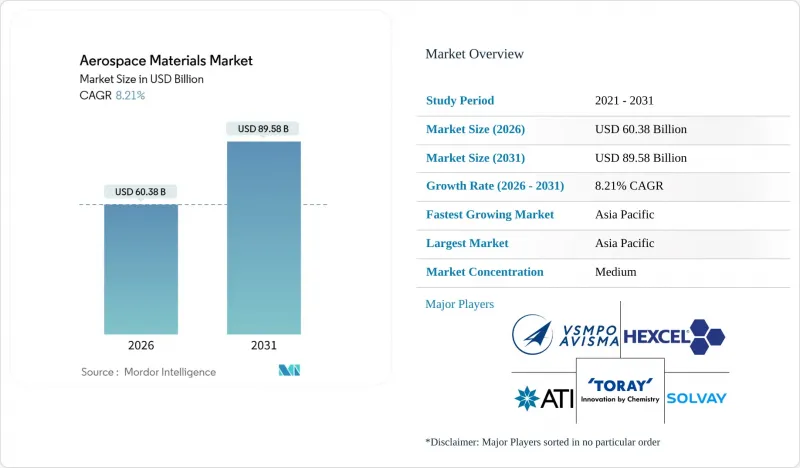
Mordor Intelligence에 의하면, 항공우주 재료 시장 규모는 2026년에 603억 8,000만 달러로 추정되고, 예측 기간(2026-2031년) CAGR 8.21%로 성장을 지속하여, 2031년에는 895억 8,000만 달러에 이를 전망입니다.
본 보고서는 재료 유형(구조용, 비구조용, 기능성 재료), 항공기 유형(민간기, 군용기 등), 용도(기체 구조, 엔진 부품, 내장 시스템, MRO 및 애프터마켓용 교체 부품 등), 그리고 지역(아시아태평양, 북미, 유럽, 남미, 중동 및 아프리카)별로 분류되어 있습니다. 시장 전망치는 금액(달러) 단위로 제시되어 있습니다.
세계의 항공우주 재료 시장 동향 및 인사이트
경량화를 원동력으로 하는 구조용 복합재료의 급증
2025년까지 주요 트윈아일 항공기 프로그램에서 구조 중량 중 복합재료의 비중이 50%를 초과했으며, 이에 따라 운용 중량이 20% 감소하고, 20년 수명 주기 동안 연료 소비량이 15% 절감될 것입니다. 비용 효율을 중시하는 협폭기 프로그램조차 복합재료의 비율을 높이고 있으며, 중국의 C919는 차기 블록 업그레이드에서 25%를 목표로 하고 있습니다. 헥셀사와 도레이사는 이러한 동향에 대응하기 위해 각각 수십억 달러 규모의 생산 능력 확충을 발표했습니다. 두 회사 모두 근로 시간을 35% 단축하는 첨단 섬유 배열 라인을 활용하고 있습니다. 그러나 지역 제트기나 터보프롭기에서는 여전히 알루미늄이 주류를 이루고 있으며, 2031년까지 소재의 양극화가 지속될 전망입니다. 특히 항공우주 등급 폴리아크릴로니트릴 전구체공급망 병목 현상이 여전히 소재 대체 속도를 늦추고 있습니다.
우주 발사 생태계의 급속한 확대
2020년부터 2025년에 걸쳐 연간 궤도 발사 횟수는 3배로 증가했습니다. 스페이스X(SpaceX) 등 재사용형 로켓 공급업체들은 1단 로켓 1기당 최대 15회의 비행 주기를 실현하고 있으며, 이러한 운용 프로파일에는 재진입 시 1,650°C에 달하는 고온을 견딜 수 있는 합금이 요구됩니다(2). 블루 오리진, ISRO 및 중동의 신생 프로그램에서는 탑재체 여유 공간을 최대한 확보하기 위해 알루미늄-리튬 합금, 세라믹 매트릭스 복합재료 및 탄소-탄소 소재의 노즈콘 구조가 채택되고 있습니다. 발사 사업자가 18-24개월마다 하드웨어를 업데이트함에 따라 자재 인증 주기가 단축되고 있으며, 이로 인해 공급업체들이 시험 인프라에 신속하게 투자하도록 촉진되고 있습니다. 위성 군집의 경우, 고주파 안테나 기판이나 내방사선 패널이 탑재됨에 따라 생산량이 증가하면서, 우주기체 1Kg당 재료 사용량이 늘어나고 있습니다. 이러한 점을 종합해 볼 때, 우주선 수요는 2031년까지 항공우주 재료 시장에 150억 달러 이상의 추가적인 비즈니스 기회를 가져다줄 것으로 예측됩니다.
항공우주 등급 탄소섬유의 높은 비용과 에너지 집약도
항공우주 등급 탄소섬유 1kg을 생산하려면 286MJ의 에너지를 소비하며, 31kg의 CO2e를 배출합니다. 이는 중량 기준으로 알루미늄의 탄소 발자국의 4배에 해당합니다. 2024년 에너지 가격 급등으로 인해 전구체 비용이 20% 이상 상승하면서, SGL Carbon이나 Teijin과 같은 통합형 제조업체들의 이익률이 압박을 받았습니다. 스몰 토우 섬유의 가격은 여전히 1Kg당 30-40달러로, 산업용 라지 토우 등급의 2배에 달할 전망입니다. 서유럽 기업들은 가격 변동을 완화하기 위해 모로코나 스페인의 재생에너지 공급원 근처에 새로운 생산 라인을 함께 설치하고 있지만, 가격 면에서 우위를 점하고 있는 중국의 경쟁사들은 주요 구조물용 AS9100 인증을 아직 취득하지 못하고 있습니다. 상업용 규모의 리그닌계 전구체는 30%의 에너지 절감 효과가 기대되지만, 상용화까지는 앞으로 3-5년이 더 걸릴 것으로 보입니다.
부문별 분석
2025년 매출액 중 구조용 재료가 85.04%를 차지했으며, 이는 동체 배럴, 주익 박스, 꼬리날개 어셈블리에서 이 재료가 차지하는 중요성을 반영한 것입니다. 이러한 부위에서는 경량화가 임무의 경제성에 직접적인 영향을 미칩니다. 탄소섬유 강화 플라스틱(CFRP)이 가장 큰 시장 점유율을 차지하고 있으며, 도레이와 헥셀이 공동으로 상용 프로그램에서 소비되는 프리프레그의 60%를 공급하고 있습니다. 알루미늄·리튬 합금은 구조 부재 분야에서 여전히 지출의 상당 부분을 차지하고 있으며, 기존 지그와의 호환성을 활용하여 설계를 전면적으로 재검토하지 않고도 7-10%의 경량화를 실현하고 있습니다. 티타늄은 구조 중량에서 차지하는 비율은 불과 5%에 불과하지만, 1Kg당 35-40달러라는 가격대 덕분에 전체 가치의 12%를 차지하고 있습니다. 항공우주 재료 시장 중 구조용 부문 시장 규모는 연평균 성장률(CAGR) 8.42%로 확대될 것으로 예측되며, 코팅, 실란트, 발포재 등에 사용되는 비구조용 소재보다 더 높은 성장세를 보일 것으로 전망됩니다.
비구조용 및 기능성 소재는 내식성, 방음, 연료 탱크의 밀폐와 같은 미션 크리티컬한 기능을 뒷받침하고 있습니다. 규제가 강화되는 가운데, PPG사의 크로메이트 프리 프라이머가 주목을 받으며, 2025년에는 이 회사의 항공우주용 코팅 매출을 12% 끌어올렸습니다. 헨켈사의 에폭시계 접착제는 이중 통로형 기체 1대당 수만 개의 체결 부품을 없애고, 조립 시간을 30% 단축했습니다. 3M 및 다우(Dow)사의 폴리우레탄 및 실리콘계 실란트는 -55°C에서 120°C에 이르는 온도 변화 범위에서 밀봉 성능을 확실하게 보장합니다. 기능성 부문 전체로는 엄격한 인증 기준 덕분에 20% 이상의 이익률을 유지하고 있지만, 한편으로 구조용 자재는 OEM의 협상력에 따른 가격 압박에 직면해 있습니다.
지역별 분석
아시아태평양은 2025년에 53.65%의 점유율로 항공우주 재료 시장을 주도했으며, 2031년까지 연평균 성장률(CAGR) 9.24%로 성장할 전망입니다. COMAC은 2025년에 C919 39대를 인도하고, 2028년까지 연간 150대를 생산할 계획입니다. 각 항공기에는 45톤의 알루미늄, 8톤의 티타늄, 12톤의 복합재료가 사용되고 있으며, 그 대부분은 국내 공급업체로부터 조달되고 있습니다. 인도에서는 2025년, 에어 인디아와 인디고가 정비 업무를 국내로 환원함에 따라 1,200건의 대규모 정비가 이루어졌으며, 이에 따라 구조용 접착제 및 교체용 패널 수요가 확대되었습니다. 일본은 연간 28억 달러 상당의 탄소섬유 프리프레그를 수출하고 있으며, 도레이의 나고야 공장이 전 세계 공급량의 40%를 차지하고 있습니다. 한편, 한국의 KF-21 전투기는 중량 대비 25%의 복합재료를 필요로 합니다. 아세안(ASEAN) 회원국들은 2024년부터 2025년에 걸쳐 항공기 구조 부품 분야에서 12억 달러 규모의 외국인 직접 투자를 유치하며, 지역 내 공급업체 기반을 확대했습니다.
북미 항공우주 재료 시장에서는 보잉, 록히드 마틴, 스페이스X의 생산 거점이 핵심 역할을 담당하고 있습니다. 스페이스X만 해도 팰컨 9 1기당 25톤의 알루미늄-리튬 합금과 8톤의 복합재료를 소비하고 있으며, 2024년에는 96회의 임무를, 2025년 중반까지 추가로 72회의 임무를 수행했습니다. ‘CHIPS·사이언스법’에 따른 정책 지원의 일환으로, 첨단 소재 공장에 5억 달러가 배정되어 탄소섬유와 티타늄의 수입 의존도를 낮추는 것을 목표로 하고 있습니다. 캐나다 퀘벡주의 클러스터는 전 세계 착륙 장치용 단조품의 15%를 공급하고 있는 반면, 멕시코의 항공우주 수출액은 케레타로주와 치와와주에서 2차 가공 역량이 확대됨에 따라 2025년에는 92억 달러에 달했습니다.
유럽은 복합재료, 알루미늄 합금, 티타늄의 지속적인 공급이 필요한 에어버스의 다중 거점 조립 네트워크에 의해 뒷받침되고 있습니다. A320neo의 생산 지연으로 인해 2025년 지역 항공기 생산량은 3% 감소했으나, A350의 인도 대수가 80대에 달함에 따라 와이드바디 항공기의 생산량은 안정적으로 유지되었습니다. 독일의 프리미엄 에어로테크, 프랑스의 사프란, 영국의 GKN 에어로스페이스는 2025년에 총 1만 1,500톤 이상의 티타늄 및 니켈 초합금을 가공했습니다. 브렉시트 이후 통관 과정에서 발생한 마찰로 인해 영국의 물류 비용이 5-8% 증가하자, 공급업체들은 기계 가공 라인을 폴란드와 체코로 이전하는 움직임을 보였습니다.
남미 및 중동 및 아프리카은 항공우주 재료 시장에서의 점유율은 작지만, 특히 엠브라에르의 E2 시리즈나 사우디아라비아의 현지화 추진 등 국지적인 성장세가 나타나고 있습니다.
기타 혜택 :
- 엑셀 형식 시장 예측(ME) 시트
- 3개월간의 애널리스트 지원
자주 묻는 질문
목차
제1장 서론
제2장 조사 방법
제3장 주요 요약
제4장 시장 구도
제5장 시장 규모 및 성장 예측
제6장 경쟁 구도
제7장 시장 기회 및 향후 전망
KTH 26.06.29According to Mordor Intelligence, the aerospace materials market size is estimated at USD 60.38 billion in 2026, and is expected to reach USD 89.58 billion by 2031, at a CAGR of 8.21% during the forecast period (2026-2031).
This report is Segmented by Material Type (Structural and Non-Structural and Functional Materials), Aircraft Type (Commercial, Military, and More), Application System (Airframe Structures, Engine Components, Interior Systems, MRO and Aftermarket Replacement, and More), and Geography (Asia-Pacific, North America, Europe, South America, and Middle East and Africa). The Market Forecasts are Provided in Value (USD).
Global Aerospace Materials Market Trends and Insights
Lightweight-Driven Surge in Structural Composites
Composite content surpassed 50% by structural weight in leading twin-aisle programs by 2025, unlocking a 20% reduction in operating weight that translates to 15% lower fuel consumption over a 20-year life cycle. Even cost-sensitive narrowbody programs are raising composite ratios, with China's C919 targeting 25% in its next block upgrade. Hexcel and Toray each announced multi-billion-dollar capacity additions to meet this trajectory, leveraging advanced fiber-placement lines that cut labor hours by 35%. Yet regional-jet and turboprop platforms remain predominantly aluminum, preserving a bifurcated material landscape through 2031. Supply-chain bottlenecks, notably in aerospace-grade polyacrylonitrile precursor, still temper the pace of substitution.
Rapid Expansion of Space-Launch Ecosystems
Annual orbital launches tripled between 2020 and 2025, with reusable-rocket providers such as SpaceX flying up to 15 cycles per first stage, a duty profile that demands alloys capable of surviving 1,650°C re-entry temperatures[2]. Blue Origin, ISRO, and emerging Middle Eastern programs have adopted aluminum-lithium, ceramic-matrix composites, and carbon-carbon nose-cone structures to squeeze payload margins. Material qualification cycles are compressing as launch operators iterate hardware every 18-24 months, catalyzing supplier investment in rapid-test infrastructure. Satellite constellations add volume by embedding high-frequency antenna substrates and radiation-hardened panels that raise material intensity per kilogram of spacecraft. Altogether, space-vehicle demand is expected to contribute over USD 15 billion in incremental opportunity for the aerospace materials market by 2031.
High Cost & Energy Intensity of Aerospace-Grade Carbon Fiber
Producing 1 kg of aerospace-grade carbon fiber consumes 286 MJ of energy and emits 31 kg of CO2e, quadrupling the carbon footprint of aluminum on a weight basis. Energy price spikes in 2024 raised precursor costs by more than 20%, squeezing margins for integrated producers such as SGL Carbon and Teijin. Small-tow fiber prices remain USD 30-40 per kilogram, twice the cost of industrial large-tow grades. Western firms are co-locating new lines near renewable energy sources in Morocco and Spain to mitigate volatility, while Chinese challengers undercut on price but still lack AS9100 certification for primary structures. Commercial-scale lignin-based precursors promise a 30% energy reduction, but commercialization sits three to five years out.
Other drivers and restraints analyzed in the detailed report include:
- OEM Carbon-Neutral Roadmaps Accelerating Material Substitution
- Additive-Manufactured Certified Alloys Enabling Design Freedom
- Strategic-Metal Supply-Chain Exposure
For complete list of drivers and restraints, kindly check the Table Of Contents.
Segment Analysis
Structural materials commanded 85.04% of 2025 revenue, reflecting their primacy in fuselage barrels, wing boxes, and empennage assemblies, where weight savings directly impact mission economics. Carbon-fiber-reinforced polymers capture the lion's share, with Toray and Hexcel together supplying 60% of prepreg consumed in commercial programs. Aluminum-lithium alloys still hold a significant portion of spend inside the structural envelope, leveraging drop-in compatibility with legacy jigs to deliver 7-10% weight reductions without wholesale redesign. Titanium, despite representing just 5% of structural weight, absorbs 12% of value because of its USD 35-40 per kilogram price point. The aerospace materials market size for structural categories is projected to grow at an 8.42% CAGR, outstripping non-structural materials that serve coatings, sealants, and foams.
Non-structural and functional materials underpin mission-critical functions such as corrosion resistance, acoustic damping, and fuel-tank sealing. PPG's chromate-free primers gained traction as constraints tightened, lifting the firm's aerospace coatings revenue by 12% in 2025. Henkel's epoxy adhesives eliminated tens of thousands of fasteners per twin-aisle airframe, cutting assembly hours by 30%. Polyurethane and silicone sealants from 3M and Dow secure pressure boundaries across -55°C to 120°C thermal cycles. Collectively, functional segments defend margins above 20% because of stringent qualification barriers, even as structural materials bear price compression from OEM bargaining power.
Geography Analysis
Asia-Pacific dominated the aerospace materials market with a 53.65% share in 2025 and is on track for a 9.24% CAGR to 2031. COMAC delivered 39 C919s in 2025 and plans annual output of 150 units by 2028, each airplane absorbing 45 t of aluminum, 8 t of titanium, and 12 t of composites, mostly sourced from domestic suppliers. India logged 1,200 heavy maintenance events in 2025 as Air India and IndiGo repatriated work, lifting demand for structural adhesives and replacement panels. Japan exports USD 2.8 billion in carbon-fiber prepreg annually, with Toray's Nagoya site feeding 40% of global supply, while South Korea's KF-21 fighter requires 25% composites by weight. ASEAN members attracted USD 1.2 billion in aerostructures foreign direct investment between 2024 and 2025, broadening the regional supplier base.
North America is anchored by Boeing, Lockheed Martin, and SpaceX production hubs in the aerospace materials market. SpaceX alone consumed 25 t of aluminum-lithium and 8 t of composites per Falcon 9, flying 96 missions in 2024 and 72 more by mid-2025. Policy support via the CHIPS and Science Act earmarks USD 500 million for advanced material plants, aiming to rebalance import dependence for carbon fiber and titanium. Canada's Quebec cluster supplies 15% of global landing-gear forgings, while Mexico's aerospace exports hit USD 9.2 billion in 2025 as tier-2 machining capacity scaled in Queretaro and Chihuahua.
Europe is supported by Airbus's multi-site assembly network requiring constant feeds of composites, aluminum alloys, and titanium. Production delays in the A320neo narrowed regional volume 3% in 2025, but widebody throughput remained steady as A350 deliveries reached 80 units. Germany's Premium Aerotec, France's Safran, and the U.K.'s GKN Aerospace jointly processed more than 11,500 t of titanium and nickel superalloys in 2025. Post-Brexit customs friction added 5-8% to U.K. logistics costs, prompting suppliers to shift machining lines toward Poland and Czechia.
South America and Middle East & Africa combined for a smaller market share in the aerospace materials market but exhibit pockets of growth, notably in Embraer's E2 series and Saudi Arabia's localization push.
- 3M
- Alcoa Corporation
- Allegheny Technologies Incorporated (ATI)
- Arkema
- ATI
- Axalta Coating Systems
- BASF
- Centre for Process Innovation Limited (CPI)
- Constellium SE
- CRS Holdings, LLC.
- Diacel Corporation
- DuPont
- Evonik Industries AG
- GKN Aerospace
- Greiner AG
- Henkel AG and Co. KGaA
- Hentzen Coatings, Inc.
- Hexcel Corporation
- Howmet Aerospace
- Isovolta AG
- Jiangsu Hengshen Co.,Ltd
- Kaiser Aluminum
- Mankiewicz Gebr & Co.
- Materion Corporation
- Mitsubishi Chemical Group
- PPG Industries, Inc.
- Precision Castparts Corp. (PCC)
- Reliance Industries Ltd.
- Rogers Corporation
- SGL Carbon
- Solvay
- Spirit AeroSystems, Inc.
- Tata Steel
- Teijin Limited
- The Sherwin Williams Company
- Timet (Titanium Metals Corp.)
- Toray Industries Inc.
- VSMPO-AVISMA
Additional Benefits:
- The market estimate (ME) sheet in Excel format
- 3 months of analyst support
TABLE OF CONTENTS
1 Introduction
- 1.1 Study Assumptions and Market Definition
- 1.2 Scope of the Study
2 Research Methodology
3 Executive Summary
4 Market Landscape
- 4.1 Market Overview
- 4.2 Market Drivers
- 4.2.1 Lightweight-driven surge in structural composites
- 4.2.2 Rapid expansion of space-launch ecosystems
- 4.2.3 OEM carbon-neutral roadmaps accelerating material substitution
- 4.2.4 Additive-manufactured certified alloys enabling design freedom
- 4.2.5 Circular-economy mandates for recyclable aerospace materials
- 4.3 Market Restraints
- 4.3.1 High cost and energy intensity of aerospace-grade carbon fiber
- 4.3.2 Strategic-metal supply-chain exposure (e.g., Russian titanium)
- 4.3.3 Lengthy certification and qualification cycles for new materials
- 4.4 Value Chain Analysis
- 4.5 Porter's Five Forces
- 4.5.1 Bargaining Power of Suppliers
- 4.5.2 Bargaining Power of Buyers
- 4.5.3 Threat of New Entrants
- 4.5.4 Threat of Substitute Products and Services
- 4.5.5 Degree of Competition
5 Market Size and Growth Forecasts (Value)
- 5.1 By Material Type
- 5.1.1 Structural Materials
- 5.1.1.1 Composites
- 5.1.1.1.1 Glass Fiber
- 5.1.1.1.2 Carbon Fiber
- 5.1.1.1.3 Aramid Fiber
- 5.1.1.1.4 Other Composites (Ceramic-Matrix Composites, etc.)
- 5.1.1.2 Plastics
- 5.1.1.3 Alloys
- 5.1.1.3.1 Aluminum and Al-Li Alloys
- 5.1.1.3.2 Titanium Alloys
- 5.1.1.3.3 Steel Alloys
- 5.1.1.3.4 Superalloys (Ni, Co)
- 5.1.1.3.5 Magnesium Alloys
- 5.1.1.3.6 Other Alloys
- 5.1.1.1 Composites
- 5.1.2 Non-Structural and Functional Materials
- 5.1.2.1 Coatings
- 5.1.2.2 Adhesives and Sealants
- 5.1.2.2.1 Epoxy
- 5.1.2.2.2 Polyurethane
- 5.1.2.2.3 Silicone
- 5.1.2.2.4 Other Adhesives and Sealants (Bio-based Adhesives, etc.)
- 5.1.2.3 Foams
- 5.1.2.3.1 Polyethylene
- 5.1.2.3.2 Polyurethane
- 5.1.2.3.3 Other Foams (Thermoplastic Foams, etc.)
- 5.1.2.4 Seals
- 5.1.1 Structural Materials
- 5.2 By Aircraft Type
- 5.2.1 General and Commercial
- 5.2.2 Military and Defense Aircraft
- 5.2.3 Space Vehicles
- 5.3 By Application System
- 5.3.1 Airframe Structures
- 5.3.2 Engine Components
- 5.3.3 Interior Systems
- 5.3.4 MRO and Aftermarket Replacement
- 5.3.5 Avionics and Electronics Housing
- 5.3.6 Landing-Gear and Actuation Systems
- 5.4 By Geography
- 5.4.1 Asia-Pacifc
- 5.4.1.1 China
- 5.4.1.2 India
- 5.4.1.3 Japan
- 5.4.1.4 South Korea
- 5.4.1.5 ASEAN Countries
- 5.4.1.6 Rest of Asia-Pacific
- 5.4.2 North America
- 5.4.2.1 United States
- 5.4.2.2 Canada
- 5.4.2.3 Mexico
- 5.4.3 Europe
- 5.4.3.1 Germany
- 5.4.3.2 United Kingdom
- 5.4.3.3 France
- 5.4.3.4 Italy
- 5.4.3.5 Russia
- 5.4.3.6 Rest of Europe
- 5.4.4 South America
- 5.4.4.1 Brazil
- 5.4.4.2 Argentina
- 5.4.4.3 Rest of South America
- 5.4.5 Middle East and Africa
- 5.4.5.1 Saudi Arabia
- 5.4.5.2 South Africa
- 5.4.5.3 Rest of Middle East and Africa
- 5.4.1 Asia-Pacifc
6 Competitive Landscape
- 6.1 Market Concentration
- 6.2 Strategic Moves
- 6.3 Market Share(%)/Ranking Analysis
- 6.4 Company Profiles {(includes Global level Overview, Market level overview, Core Segments, Financials as available, Strategic Information, Market Rank/Share for key companies, Products and Services, and Recent Developments)}
- 6.4.1 3M
- 6.4.2 Alcoa Corporation
- 6.4.3 Allegheny Technologies Incorporated (ATI)
- 6.4.4 Arkema
- 6.4.5 ATI
- 6.4.6 Axalta Coating Systems
- 6.4.7 BASF
- 6.4.8 Centre for Process Innovation Limited (CPI)
- 6.4.9 Constellium SE
- 6.4.10 CRS Holdings, LLC.
- 6.4.11 Diacel Corporation
- 6.4.12 DuPont
- 6.4.13 Evonik Industries AG
- 6.4.14 GKN Aerospace
- 6.4.15 Greiner AG
- 6.4.16 Henkel AG and Co. KGaA
- 6.4.17 Hentzen Coatings, Inc.
- 6.4.18 Hexcel Corporation
- 6.4.19 Howmet Aerospace
- 6.4.20 Isovolta AG
- 6.4.21 Jiangsu Hengshen Co.,Ltd
- 6.4.22 Kaiser Aluminum
- 6.4.23 Mankiewicz Gebr & Co.
- 6.4.24 Materion Corporation
- 6.4.25 Mitsubishi Chemical Group
- 6.4.26 PPG Industries, Inc.
- 6.4.27 Precision Castparts Corp. (PCC)
- 6.4.28 Reliance Industries Ltd.
- 6.4.29 Rogers Corporation
- 6.4.30 SGL Carbon
- 6.4.31 Solvay
- 6.4.32 Spirit AeroSystems, Inc.
- 6.4.33 Tata Steel
- 6.4.34 Teijin Limited
- 6.4.35 The Sherwin Williams Company
- 6.4.36 Timet (Titanium Metals Corp.)
- 6.4.37 Toray Industries Inc.
- 6.4.38 VSMPO-AVISMA
7 Market Opportunities and Future Outlook
- 7.1 Use of Carbon Nanotubes and Nano-Additives with Epoxy Adhesives
- 7.2 Circular and Recyclable Composite Streams
- 7.3 Additive Manufacturing of Complex Metal/Composite Parts