

|
시장보고서
상품코드
2066494
천연 고무 시장 : 시장 점유율 분석, 업계 동향 및 통계, 성장 예측(2026-2031년)Natural Rubber - Market Share Analysis, Industry Trends & Statistics, Growth Forecasts (2026 - 2031) |
||||||
 Mordor Intelligence
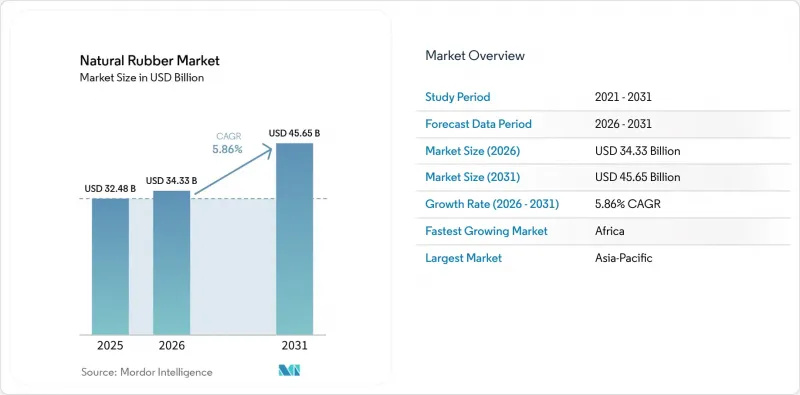
Mordor Intelligence에 의하면, 천연 고무 시장 규모는 2025년 324억 8,000만 달러로 평가되었고, 2026년 343억 3,000만 달러로 추정되고, 2031년까지 456억 5,000만 달러로 확대할 것으로 예측되며, 2026-2031년 CAGR은 5.86%를 나타낼 전망입니다.
본 보고서는 지역별(북미, 아시아태평양, 기타)로 분류되어 있습니다. 본 보고서에는 생산 분석(수량), 소비 분석(금액 및 수량), 수입 분석(금액 및 수량), 수출 분석(금액 및 수량), 도매 가격 동향 분석 및 전망, 주요 기업 목록 등이 포함되어 있습니다. 시장 전망은 금액(달러) 및 수량(미터톤) 단위로 제시되어 있습니다.
세계의 천연고무 시장 동향 및 인사이트
전기차로 인한 타이어 마모 및 교체 수요
전기차(EV)는 배터리 팩의 무게 증가와 순간 토크 특성으로 인해 트레드의 수명과 내마모성에 가해지는 부하가 커지기 때문에 타이어의 성능 요건이 더욱 높아지고 있습니다. 이는 천연고무 시장에 직접적인 영향을 미칩니다. 왜냐하면 타이어 제조업체들은 더 무거운 차체에서도 접지력, 열 제어, 내구성을 유지하면서 급격한 마모를 견딜 수 있는 컴파운드를 필요로 하기 때문입니다. 또한, 이러한 수요가 미치는 영향은 일시적인 것이 아니라 지속적인 것입니다. 신차 판매가 불안정한 상황에서도 교체 주기가 단축됨에 따라 타이어를 반복적으로 구매하게 되기 때문입니다. 천연고무 생산국 협회에 따르면, 2026년 수요 회복은 세계 무역 흐름에서 여전히 가장 영향력 있는 수요 거점인 중국에서 정부가 전기차 구매에 대해 지속적으로 제공하는 인센티브에 의해 부분적으로 뒷받침되고 있다고 합니다. 이에 따라 천연고무 시장은 아시아 및 대규모 타이어 교체 시장에서 전기차의 보급 속도와 밀접한 관련이 있습니다. 또한, 자동차 제조업체와 타이어 제조업체가 대형 차량용 제품을 개선해 나감에 따라, 저사양 제품보다 고품질 고무 등급에 대한 수요가 견조해질 가능성이 높다는 것을 의미합니다.
중국의 건설 및 광업 수요 회복
중국은 그 산업 활동의 변화가 지역의 조달, 운송 및 재고 상황에 신속하게 영향을 미치기 때문에 세계 고무 무역에서 여전히 가장 중요한 변동 요인으로 작용하는 구매국입니다. 국제무역센터(ITC)의 ‘트레이드맵’ 데이터에 따르면, 중국의 천연고무 수입량은 2024년 239만 톤에서 2025년 317만 톤으로 증가하여 전년 대비 32.3% 증가했습니다. 이는 구매 환경이나 하류 수요가 개선되면 수입 흐름이 얼마나 급속히 가속화될 수 있는지를 여실히 보여주고 있습니다. 중국 농업농촌는 자동차 및 트럭 수요와 수출 수주의 부분적인 회복이 지지 요인이 될 수 있다고 지적하고 있습니다. 이는 트럭, 오프로드 차량, 산업용 장비 등이 모두 타이어 수요를 통해 고무 소비를 견인하기 때문에 중요한 의미를 지닙니다. 천연고무 시장에서는 중국의 건설, 물류, 광업 활동이 완만한 회복세를 보이는 것만으로도, 국내 생산량이 국내 수요를 감당하지 못하고 있어 당분간 공급이 부족해질 가능성이 있습니다. 이러한 영향은 태국, 베트남, 인도네시아공급업체들에게서 가장 두드러지게 나타납니다. 왜냐하면 중국의 구매 동향은 종종 아시아 전역의 가격 전망을 재조정하기 때문입니다. 그 결과, 다른 지역 수요 상황이 제각각인 경우에도 천연고무 시장은 중국의 수입 동향에 극도로 민감한 상태가 지속되고 있습니다.
낙엽병, 백근부패병 및 기후로 인한 수확량 감소
병해의 영향으로 인해, 최대 고무 생산국이라 하더라도 실질적인 생산 능력이 저하되고 있습니다. 천연고무 생산국 협회(ANRPC)에 따르면, 세계 최대 고무 생산국인 태국의 생산량은 2026년에도 보합세를 보일 것으로 예상되는 반면, 2위 생산국인 인도네시아에서는 가격 침체, 잎 병해, 그리고 야자나무 재배지로의 토지 전환으로 인해 2022년 이후 시작된 생산량 감소가 지속될 것으로 전망됩니다. 중국 농업농촌도 2025년 5월 하이난성에서 중등도에서 심각한 흰가루병과 간헐적인 낙엽 현상이 발생하여, 수유기 라텍스 채취에 차질을 빚었습니다고 보고했습니다. 유럽산림연구소는 또한 토지 제약, 기후 변화, 인건비, 자연재해 및 낙엽병으로 인해 태국의 재배 면적이 2017년부터 2022년까지 4.5% 감소했다고 덧붙였습니다. 천연고무 시장에 있어 문제는 흉작으로 인한 수확량 감소뿐만이 아닙니다. 병해로 약해진 나무는 호우, 홍수, 계절적 스트레스의 영향을 받기 쉬워져 회복이 늦어질 뿐만 아니라, 여러 생산 주기에 걸쳐 생산량의 안정성이 저하됩니다. 따라서 표면상의 생산량이 전년 대비 소폭 증가했음에도 불구하고, 천연고무 시장에서는 공급의 취약성이 계속해서 가격에 반영되고 있는 것입니다.
지역별 분석
2025년, 아시아태평양은 천연고무 시장의 67.8%를 차지했으며, 다른 지역을 크게 앞지르고 최대 지역 부문이 되었습니다. 아시아태평양의 천연고무 시장은 광대한 재배 면적, 높은 가공 능력, 주요 타이어 생산 거점, 그리고 세계에서도 손꼽히는 탄탄한 수출 경로가 서로 어우러져 형성되어 있습니다. 그러나 병해의 위협과 기후 변화에 따른 스트레스로 인해 몇몇 주요 고무 생산국에서 실질 생산 능력이 감소하고 있습니다. 천연고무 생산국 협회(ANRPC)에 따르면, 세계 최대 고무 생산국인 태국의 생산량은 2026년에도 보합세를 보일 것으로 예상되는 반면, 2위 생산국인 인도네시아에서는 가격 침체, 잎병, 그리고 야자수 재배지로의 토지 전환으로 인해 2022년 이후 시작된 생산량 감소가 지속될 것으로 전망됩니다. 중국의 천연고무 수입량은 2024년 239만 톤에서 2025년에는 317만 메트르톤으로 증가하여 전년 대비 32.3% 증가를 기록했습니다. 이는 해당 국가가 국내 소비 수요를 충족시키기 위해 여전히 수입에 의존하고 있음을 여실히 보여주고 있습니다. 인도 역시 천연고무 시장의 주요 견인 요인으로 자리 잡고 있습니다. 천연고무 생산국 협회(ANRPC)는 2026년 수요가 2025년 대비 3.6% 증가할 것으로 전망하는 반면, 자동차 타이어 제조업체 협회(ATMA)에 따르면 연간 수요량은 140만 메트릭톤인 데 반해 국내 생산량은 85만 메트릭톤에 그치고 있습니다.
아프리카는 천연고무 시장에서 가장 빠르게 성장하는 지역으로, 2026-2031년 연평균 성장률(CAGR) 8.4%를 나타낼 것으로 전망됩니다. 아프리카 천연고무 시장은 새로운 농장에서 공급이 단순히 원자재 수출만을 목적으로 하는 것이 아니라, 현지 가공 능력과 연계되는 사례가 늘어나고 있어 성장세를 보이고 있습니다. 코트디부아르는 천연고무 생산량을 2019년 약 82만 메트릭톤에서 2023년에는 155만 메트릭톤으로 늘려, 아프리카 최대 생산국이자 세계 3위 생산국으로서의 입지를 확고히 다졌습니다. 해당 국가에서는 생산량 증가에 대응하기 위해 하류 가공 능력 확충도 추진되고 있으며, 2024년 10월에는 그랑 베레비에서 연간 10만 메트르톤 규모의 신공장이 가동을 시작할 예정이고, 2025년에는 추가로 2개의 공장이 가동될 전망입니다. 이에 따라 코트디부아르에서 해당 회사의 총 가공 능력은 연간 약 48만 메트르톤에 달할 것으로 예측됩니다.
북미, 유럽, 남미, 중동은 천연고무 시장에서 점유율이 낮지만, 이들 지역의 상당수가 수입에 크게 의존하고 있기 때문에 계속해서 무역 흐름을 좌우하고 있습니다. 천연고무 생산국 협회(ANRPC)는 미국의 타이어 출하량이 견조할 것으로 전망되는 점이 2026년 수요를 뒷받침하는 요인 중 하나라고 밝혔으며, 대규모 플랜테이션 기반이 없음에도 불구하고 북미는 여전히 중요한 시장으로 남아 있습니다. 남미에서는 브라질의 국내 생산량이 소비량을 모두 충당하지 못하고 있어, 천연고무 시장에서 브라질의 상황은 여전히 복잡합니다. 연방 정부는 2025-2026년 수확분 재배 천연고무에 대해 420만 달러(2,220만 브라질 레알)의 지원을 승인했습니다. 유럽은 규정 준수에 기반한 조달 및 검증된 추적성이 단순한 가격 경쟁을 넘어 공급업체 선정에 영향을 미칠 가능성이 있기 때문에 천연고무 시장에서 중요한 지역입니다. 특히, 엄격한 실사 요건을 갖춘 수입업체의 경우 이러한 경향이 두드러집니다. 중동은 천연고무 시장에서 비교적 안정적인 수요 지역이며, 그 조달은 현지 원자재 생산보다는 인프라·물류, 타이어 사용량, 그리고 아시아로부터의 수입 동향에 연동되어 있습니다.
- 엑셀 형식 시장 예측(ME) 시트
- 3개월간의 애널리스트 지원
자주 묻는 질문
목차
제1장 서론
제2장 조사 방법
제3장 주요 요약
제4장 시장 구도
제5장 시장 규모 및 성장 예측
제6장 최종 용도 및 산업
제7장 경쟁 구도
제8장 시장 기회 및 향후 전망
AJY 26.06.24According to Mordor Intelligence, the natural rubber market size is projected to expand from USD 32.48 billion in 2025 and USD 34.33 billion in 2026 to USD 45.65 billion by 2031, registering a compound annual growth rate (CAGR) of 5.86% during 2026-2031.
This report is Segmented by Geography (North America, Asia-Pacific, and More). The Report Includes Production Analysis (Volume), Consumption Analysis (Value and Volume), Import Analysis (Value and Volume), Export Analysis (Value and Volume), Wholesale Price Trend Analysis and Forecast, List of Key Players, and More. The Market Forecasts are Provided in Terms of Value (USD) and Volume (Metric Tons).
Global Natural Rubber Market Trends and Insights
EV-Driven Tire Wear and Replacement Demand
Electric vehicles are raising tire performance requirements because heavier battery packs and instant torque profiles increase stress on tread life and abrasion resistance. That matters directly for the natural rubber market because tire makers need compounds that can withstand faster wear while maintaining grip, heat control, and durability in a heavier vehicle base. The demand effect is also recurring rather than one-time, because shorter replacement cycles can boost repeat tire purchases even when new-vehicle sales move unevenly. The Association of Natural Rubber Producing Countries said demand recovery in 2026 is supported in part by continued government incentives for electric vehicle purchases in China, which remains the most influential demand center in global trade flows . That keeps the natural rubber market closely tied to how fast electric mobility expands in Asia and in large replacement tire markets. It also means premium rubber grades are likely to see firmer interest than lower-specification supply as vehicle makers and tire companies refine products for heavier fleets.
Rebound in Chinese Construction and Mining Demand
China remains the single most important swing buyer in the global rubber trade because changes in its industrial activity quickly affect regional procurement, shipping, and working inventory. According to International Trade Center (ITC) Trade Map data, China's natural rubber import volumes increased from 2.39 million tons in 2024 to 3.17 million tons in 2025, representing a 32.3% year-over-year increase, highlighting how quickly import flows can accelerate when buying conditions and downstream demand improve. China's Ministry of Agriculture and Rural Affairs has pointed to possible support from auto and truck demand and a partial recovery in export orders, which matters because trucks, off-road vehicles, and industrial equipment all feed rubber consumption through tire demand. In the natural rubber market, even a measured rebound in Chinese construction, logistics, and mining activity can tighten nearby availability, as domestic production does not cover domestic demand. That effect is strongest for suppliers in Thailand, Vietnam, and Indonesia because China's buying patterns often reset price expectations across Asia. As a result, the natural rubber market remains highly sensitive to Chinese import momentum even when demand conditions elsewhere are mixed.
Leaf Fall Disease, White Root Rot, and Climate-Linked Yield Loss
Disease pressure is reducing effective production capacity even in the largest rubber-producing countries. The Association of Natural Rubber Producing Countries stated that output in Thailand, the world's largest rubber producer, is projected to remain flat in 2026, while Indonesia, the second-largest producer, is set to continue its production decline that began after 2022 due to low prices, leaf diseases, and land conversion to oil palm. China's Ministry of Agriculture and Rural Affairs also reported that Hainan experienced moderate to severe powdery mildew and intermittent defoliation in May 2025, disrupting latex collection during the tapping season. The European Forest Institute added that Thailand's cultivation area fell by 4.5% from 2017 to 2022 due to land constraints, climate change, labor costs, natural disasters, and leaf fall disease . For the natural rubber market, the problem is not only lower yield in a bad year. Disease-weakened trees are more exposed to heavy rain, flooding, and seasonal stress, which slows recovery and makes output less reliable across multiple cycles. That is why the natural rubber market continues to price in supply fragility, even as headline production shows modest year-on-year growth.
Other drivers and restraints analyzed in the detailed report include:
- Medical Glove Restocking and Latex Demand Normalization
- Higher Crude-Linked Synthetic Rubber Costs Supporting Substitution
- Aging Tapper Workforce and Chronic Labor Scarcity
For complete list of drivers and restraints, kindly check the Table Of Contents.
Geography Analysis
Asia-Pacific accounted for 67.8% of the natural rubber market in 2025, making it the largest regional segment by a wide margin. The natural rubber market in Asia-Pacific is built on the overlap between large plantation acreage, dense processing capacity, major tire manufacturing hubs, and the world's deepest export channels. Disease pressure and climate-related stress are reducing effective production capacity across several major rubber-producing countries. The Association of Natural Rubber Producing Countries stated that output in Thailand, the world's largest rubber producer, is projected to remain flat in 2026, while Indonesia, the second-largest producer, is set to continue its production decline that began after 2022 due to low prices, leaf diseases, and land conversion to oil palm. China's natural rubber imports increased from 2.39 million tons in 2024 to 3.17 million metric tons in 2025, marking a 32.3% year-over-year rise and underscoring the country's continued reliance on imports to meet domestic consumption requirements. India also remains a key pull factor for the natural rubber market, as the Association of Natural Rubber Producing Countries projected 3.6% demand growth in 2026 compared to 2025, while the Automotive Tire Manufacturers Association said the annual requirement stands at 1.4 million metric tons, against domestic output of 0.85 million metric tons.
Africa is the fastest regional segment in the natural rubber market, with a projected CAGR of 8.4% during 2026-2031. The natural rubber market in Africa is gaining ground as new plantation supply is increasingly paired with local processing capacity rather than solely for raw material exports. Cote d'Ivoire increased natural rubber production from approximately 0.82 million metric tons in 2019 to 1.55 million metric tons in 2023, reinforcing its emergence as Africa's largest producer and the world's third-largest producer. The country is also expanding downstream processing capacity to support growing output, with a new 100,000 metric ton-per-year plant commencing operations in Grand-Bereby in October 2024 and two additional plants projected in 2025, which together are projected to raise the company's total processing capacity in Cote d'Ivoire to nearly 0.48 million metric tons annually.
North America, Europe, South America, and the Middle East hold smaller positions in the natural rubber market, but they continue to shape trade flows because most of them rely heavily on imports. The Association of Natural Rubber Producing Countries said stronger tire shipment projections in the United States were one of the demand supports for 2026, which keeps North America important even without a large plantation base. In South America, Brazil remains a mixed case for the natural rubber market because domestic production is not enough to cover consumption, and the federal government authorized USD 4.2 million (BRL 22.2 million) in support for cultivated natural rubber from the 2025/2026 harvest. Europe is important to the natural rubber market because compliance-driven sourcing and verified traceability can influence supplier selection beyond simple price competition, especially for importers with strict due diligence requirements. The Middle East is a steadier demand pocket in the natural rubber market, with procurement linked to infrastructure logistics, tire use, and import flows from Asia rather than to local raw material production.
- The market estimate (ME) sheet in Excel format
- 3 months of analyst support
TABLE OF CONTENTS
1 Introduction
- 1.1 Study Assumptions and Market Definition
- 1.2 Scope of the Study
2 Research Methodology
3 Executive Summary
4 Market Landscape
- 4.1 Market Overview
- 4.2 Market Drivers
- 4.2.1 EV-driven tire wear and replacement demand
- 4.2.2 Rebound in Chinese construction and mining demand
- 4.2.3 Medical glove restocking and latex demand normalization
- 4.2.4 Higher crude-linked synthetic rubber costs supporting substitution
- 4.2.5 The European Union deforestation regulation-compliant and traceable rubber premium creation
- 4.2.6 AI-enabled tapping, farm monitoring, and yield optimization
- 4.3 Market Restraints
- 4.3.1 Leaf fall disease, white root rot, and climate-linked yield loss
- 4.3.2 Aging tapper workforce and chronic labor scarcity
- 4.3.3 Deforestation compliance costs and land-use constraints
- 4.3.4 Trade barriers, tire-export disruptions, and buyer destocking
- 4.4 Opportunities
- 4.5 Challenges
- 4.6 Value Chain Analysis
- 4.7 Technologies and usage of AI in the Industry
- 4.8 Input Market Analysis
- 4.8.1 Seeds
- 4.8.2 Fertilizers
- 4.8.3 Crop Protection Chemicals
- 4.9 Distribution Channel Analysis
- 4.10 Market Sentiment Analysis
- 4.11 PESTLE Analysis
5 Market Size and Growth Forecasts (Value and Volume)
- 5.1 By Geography
- 5.1.1 North America
- 5.1.1.1 United States
- 5.1.1.1.1 Production Analysis (Area Harvested, Yield, and Production Volume)
- 5.1.1.1.2 Consumption Analysis (Consumption Value and Volume)
- 5.1.1.1.3 Import Analysis (Import Value, Volume, and Key Supplying Markets)
- 5.1.1.1.4 Export Analysis (Export Value, Volume, and Key Destination Markets)
- 5.1.1.1.5 Wholesale Price Trend Analysis and Forecast
- 5.1.1.1.6 Regulatory Framework
- 5.1.1.1.7 List of Key Players
- 5.1.1.1.8 Logistics and Infrastructure
- 5.1.1.1.9 Seasonality Analysis
- 5.1.1.2 Canada
- 5.1.1.2.1 Production Analysis (Area Harvested, Yield, and Production Volume)
- 5.1.1.2.2 Consumption Analysis (Consumption Value and Volume)
- 5.1.1.2.3 Import Analysis (Import Value, Volume, and Key Supplying Markets)
- 5.1.1.2.4 Export Analysis (Export Value, Volume, and Key Destination Markets)
- 5.1.1.2.5 Wholesale Price Trend Analysis and Forecast
- 5.1.1.2.6 Regulatory Framework
- 5.1.1.2.7 List of Key Players
- 5.1.1.2.8 Logistics and Infrastructure
- 5.1.1.2.9 Seasonality Analysis
- 5.1.1.3 Mexico
- 5.1.1.3.1 Production Analysis (Area Harvested, Yield, and Production Volume)
- 5.1.1.3.2 Consumption Analysis (Consumption Value and Volume)
- 5.1.1.3.3 Import Analysis (Import Value, Volume, and Key Supplying Markets)
- 5.1.1.3.4 Export Analysis (Export Value, Volume, and Key Destination Markets)
- 5.1.1.3.5 Wholesale Price Trend Analysis and Forecast
- 5.1.1.3.6 Regulatory Framework
- 5.1.1.3.7 List of Key Players
- 5.1.1.3.8 Logistics and Infrastructure
- 5.1.1.3.9 Seasonality Analysis
- 5.1.1.1 United States
- 5.1.2 South America
- 5.1.2.1 Brazil
- 5.1.2.1.1 Production Analysis (Area Harvested, Yield, and Production Volume)
- 5.1.2.1.2 Consumption Analysis (Consumption Value and Volume)
- 5.1.2.1.3 Import Analysis (Import Value, Volume, and Key Supplying Markets)
- 5.1.2.1.4 Export Analysis (Export Value, Volume, and Key Destination Markets)
- 5.1.2.1.5 Wholesale Price Trend Analysis and Forecast
- 5.1.2.1.6 Regulatory Framework
- 5.1.2.1.7 List of Key Players
- 5.1.2.1.8 Logistics and Infrastructure
- 5.1.2.1.9 Seasonality Analysis
- 5.1.2.2 Colombia
- 5.1.2.2.1 Production Analysis (Area Harvested, Yield, and Production Volume)
- 5.1.2.2.2 Consumption Analysis (Consumption Value and Volume)
- 5.1.2.2.3 Import Analysis (Import Value, Volume, and Key Supplying Markets)
- 5.1.2.2.4 Export Analysis (Export Value, Volume, and Key Destination Markets)
- 5.1.2.2.5 Wholesale Price Trend Analysis and Forecast
- 5.1.2.2.6 Regulatory Framework
- 5.1.2.2.7 List of Key Players
- 5.1.2.2.8 Logistics and Infrastructure
- 5.1.2.2.9 Seasonality Analysis
- 5.1.2.1 Brazil
- 5.1.3 Europe
- 5.1.3.1 Germany
- 5.1.3.1.1 Production Analysis (Area Harvested, Yield, and Production Volume)
- 5.1.3.1.2 Consumption Analysis (Consumption Value and Volume)
- 5.1.3.1.3 Import Analysis (Import Value, Volume, and Key Supplying Markets)
- 5.1.3.1.4 Export Analysis (Export Value, Volume, and Key Destination Markets)
- 5.1.3.1.5 Wholesale Price Trend Analysis and Forecast
- 5.1.3.1.6 Regulatory Framework
- 5.1.3.1.7 List of Key Players
- 5.1.3.1.8 Logistics and Infrastructure
- 5.1.3.1.9 Seasonality Analysis
- 5.1.3.2 France
- 5.1.3.2.1 Production Analysis (Area Harvested, Yield, and Production Volume)
- 5.1.3.2.2 Consumption Analysis (Consumption Value and Volume)
- 5.1.3.2.3 Import Analysis (Import Value, Volume, and Key Supplying Markets)
- 5.1.3.2.4 Export Analysis (Export Value, Volume, and Key Destination Markets)
- 5.1.3.2.5 Wholesale Price Trend Analysis and Forecast
- 5.1.3.2.6 Regulatory Framework
- 5.1.3.2.7 List of Key Players
- 5.1.3.2.8 Logistics and Infrastructure
- 5.1.3.2.9 Seasonality Analysis
- 5.1.3.3 Italy
- 5.1.3.3.1 Production Analysis (Area Harvested, Yield, and Production Volume)
- 5.1.3.3.2 Consumption Analysis (Consumption Value and Volume)
- 5.1.3.3.3 Import Analysis (Import Value, Volume, and Key Supplying Markets)
- 5.1.3.3.4 Export Analysis (Export Value, Volume, and Key Destination Markets)
- 5.1.3.3.5 Wholesale Price Trend Analysis and Forecast
- 5.1.3.3.6 Regulatory Framework
- 5.1.3.3.7 List of Key Players
- 5.1.3.3.8 Logistics and Infrastructure
- 5.1.3.3.9 Seasonality Analysis
- 5.1.3.4 Russia
- 5.1.3.4.1 Production Analysis (Area Harvested, Yield, and Production Volume)
- 5.1.3.4.2 Consumption Analysis (Consumption Value and Volume)
- 5.1.3.4.3 Import Analysis (Import Value, Volume, and Key Supplying Markets)
- 5.1.3.4.4 Export Analysis (Export Value, Volume, and Key Destination Markets)
- 5.1.3.4.5 Wholesale Price Trend Analysis and Forecast
- 5.1.3.4.6 Regulatory Framework
- 5.1.3.4.7 List of Key Players
- 5.1.3.4.8 Logistics and Infrastructure
- 5.1.3.4.9 Seasonality Analysis
- 5.1.3.1 Germany
- 5.1.4 Asia-Pacific
- 5.1.4.1 China
- 5.1.4.1.1 Production Analysis (Area Harvested, Yield, and Production Volume)
- 5.1.4.1.2 Consumption Analysis (Consumption Value and Volume)
- 5.1.4.1.3 Import Analysis (Import Value, Volume, and Key Supplying Markets)
- 5.1.4.1.4 Export Analysis (Export Value, Volume, and Key Destination Markets)
- 5.1.4.1.5 Wholesale Price Trend Analysis and Forecast
- 5.1.4.1.6 Regulatory Framework
- 5.1.4.1.7 List of Key Players
- 5.1.4.1.8 Logistics and Infrastructure
- 5.1.4.1.9 Seasonality Analysis
- 5.1.4.2 India
- 5.1.4.2.1 Production Analysis (Area Harvested, Yield, and Production Volume)
- 5.1.4.2.2 Consumption Analysis (Consumption Value and Volume)
- 5.1.4.2.3 Import Analysis (Import Value, Volume, and Key Supplying Markets)
- 5.1.4.2.4 Export Analysis (Export Value, Volume, and Key Destination Markets)
- 5.1.4.2.5 Wholesale Price Trend Analysis and Forecast
- 5.1.4.2.6 Regulatory Framework
- 5.1.4.2.7 List of Key Players
- 5.1.4.2.8 Logistics and Infrastructure
- 5.1.4.2.9 Seasonality Analysis
- 5.1.4.3 Japan
- 5.1.4.3.1 Production Analysis (Area Harvested, Yield, and Production Volume)
- 5.1.4.3.2 Consumption Analysis (Consumption Value and Volume)
- 5.1.4.3.3 Import Analysis (Import Value, Volume, and Key Supplying Markets)
- 5.1.4.3.4 Export Analysis (Export Value, Volume, and Key Destination Markets)
- 5.1.4.3.5 Wholesale Price Trend Analysis and Forecast
- 5.1.4.3.6 Regulatory Framework
- 5.1.4.3.7 List of Key Players
- 5.1.4.3.8 Logistics and Infrastructure
- 5.1.4.3.9 Seasonality Analysis
- 5.1.4.4 Thailand
- 5.1.4.4.1 Production Analysis (Area Harvested, Yield, and Production Volume)
- 5.1.4.4.2 Consumption Analysis (Consumption Value and Volume)
- 5.1.4.4.3 Import Analysis (Import Value, Volume, and Key Supplying Markets)
- 5.1.4.4.4 Export Analysis (Export Value, Volume, and Key Destination Markets)
- 5.1.4.4.5 Wholesale Price Trend Analysis and Forecast
- 5.1.4.4.6 Regulatory Framework
- 5.1.4.4.7 List of Key Players
- 5.1.4.4.8 Logistics and Infrastructure
- 5.1.4.4.9 Seasonality Analysis
- 5.1.4.5 Indonesia
- 5.1.4.5.1 Production Analysis (Area Harvested, Yield, and Production Volume)
- 5.1.4.5.2 Consumption Analysis (Consumption Value and Volume)
- 5.1.4.5.3 Import Analysis (Import Value, Volume, and Key Supplying Markets)
- 5.1.4.5.4 Export Analysis (Export Value, Volume, and Key Destination Markets)
- 5.1.4.5.5 Wholesale Price Trend Analysis and Forecast
- 5.1.4.5.6 Regulatory Framework
- 5.1.4.5.7 List of Key Players
- 5.1.4.5.8 Logistics and Infrastructure
- 5.1.4.5.9 Seasonality Analysis
- 5.1.4.6 Malaysia
- 5.1.4.6.1 Production Analysis (Area Harvested, Yield, and Production Volume)
- 5.1.4.6.2 Consumption Analysis (Consumption Value and Volume)
- 5.1.4.6.3 Import Analysis (Import Value, Volume, and Key Supplying Markets)
- 5.1.4.6.4 Export Analysis (Export Value, Volume, and Key Destination Markets)
- 5.1.4.6.5 Wholesale Price Trend Analysis and Forecast
- 5.1.4.6.6 Regulatory Framework
- 5.1.4.6.7 List of Key Players
- 5.1.4.6.8 Logistics and Infrastructure
- 5.1.4.6.9 Seasonality Analysis
- 5.1.4.7 Vietnam
- 5.1.4.7.1 Production Analysis (Area Harvested, Yield, and Production Volume)
- 5.1.4.7.2 Consumption Analysis (Consumption Value and Volume)
- 5.1.4.7.3 Import Analysis (Import Value, Volume, and Key Supplying Markets)
- 5.1.4.7.4 Export Analysis (Export Value, Volume, and Key Destination Markets)
- 5.1.4.7.5 Wholesale Price Trend Analysis and Forecast
- 5.1.4.7.6 Regulatory Framework
- 5.1.4.7.7 List of Key Players
- 5.1.4.7.8 Logistics and Infrastructure
- 5.1.4.7.9 Seasonality Analysis
- 5.1.4.1 China
- 5.1.5 Middle East
- 5.1.5.1 Saudi Arabia
- 5.1.5.1.1 Production Analysis (Area Harvested, Yield, and Production Volume)
- 5.1.5.1.2 Consumption Analysis (Consumption Value and Volume)
- 5.1.5.1.3 Import Analysis (Import Value, Volume, and Key Supplying Markets)
- 5.1.5.1.4 Export Analysis (Export Value, Volume, and Key Destination Markets)
- 5.1.5.1.5 Wholesale Price Trend Analysis and Forecast
- 5.1.5.1.6 Regulatory Framework
- 5.1.5.1.7 List of Key Players
- 5.1.5.1.8 Logistics and Infrastructure
- 5.1.5.1.9 Seasonality Analysis
- 5.1.5.2 Turkey
- 5.1.5.2.1 Production Analysis (Area Harvested, Yield, and Production Volume)
- 5.1.5.2.2 Consumption Analysis (Consumption Value and Volume)
- 5.1.5.2.3 Import Analysis (Import Value, Volume, and Key Supplying Markets)
- 5.1.5.2.4 Export Analysis (Export Value, Volume, and Key Destination Markets)
- 5.1.5.2.5 Wholesale Price Trend Analysis and Forecast
- 5.1.5.2.6 Regulatory Framework
- 5.1.5.2.7 List of Key Players
- 5.1.5.2.8 Logistics and Infrastructure
- 5.1.5.2.9 Seasonality Analysis
- 5.1.5.3 United Arab Emirates
- 5.1.5.3.1 Production Analysis (Area Harvested, Yield, and Production Volume)
- 5.1.5.3.2 Consumption Analysis (Consumption Value and Volume)
- 5.1.5.3.3 Import Analysis (Import Value, Volume, and Key Supplying Markets)
- 5.1.5.3.4 Export Analysis (Export Value, Volume, and Key Destination Markets)
- 5.1.5.3.5 Wholesale Price Trend Analysis and Forecast
- 5.1.5.3.6 Regulatory Framework
- 5.1.5.3.7 List of Key Players
- 5.1.5.3.8 Logistics and Infrastructure
- 5.1.5.3.9 Seasonality Analysis
- 5.1.5.1 Saudi Arabia
- 5.1.6 Africa
- 5.1.6.1 Cote d'Ivoire
- 5.1.6.1.1 Production Analysis (Area Harvested, Yield, and Production Volume)
- 5.1.6.1.2 Consumption Analysis (Consumption Value and Volume)
- 5.1.6.1.3 Import Analysis (Import Value, Volume, and Key Supplying Markets)
- 5.1.6.1.4 Export Analysis (Export Value, Volume, and Key Destination Markets)
- 5.1.6.1.5 Wholesale Price Trend Analysis and Forecast
- 5.1.6.1.6 Regulatory Framework
- 5.1.6.1.7 List of Key Players
- 5.1.6.1.8 Logistics and Infrastructure
- 5.1.6.1.9 Seasonality Analysis
- 5.1.6.2 Nigeria
- 5.1.6.2.1 Production Analysis (Area Harvested, Yield, and Production Volume)
- 5.1.6.2.2 Consumption Analysis (Consumption Value and Volume)
- 5.1.6.2.3 Import Analysis (Import Value, Volume, and Key Supplying Markets)
- 5.1.6.2.4 Export Analysis (Export Value, Volume, and Key Destination Markets)
- 5.1.6.2.5 Wholesale Price Trend Analysis and Forecast
- 5.1.6.2.6 Regulatory Framework
- 5.1.6.2.7 List of Key Players
- 5.1.6.2.8 Logistics and Infrastructure
- 5.1.6.2.9 Seasonality Analysis
- 5.1.6.3 South Africa
- 5.1.6.3.1 Production Analysis (Area Harvested, Yield, and Production Volume)
- 5.1.6.3.2 Consumption Analysis (Consumption Value and Volume)
- 5.1.6.3.3 Import Analysis (Import Value, Volume, and Key Supplying Markets)
- 5.1.6.3.4 Export Analysis (Export Value, Volume, and Key Destination Markets)
- 5.1.6.3.5 Wholesale Price Trend Analysis and Forecast
- 5.1.6.3.6 Regulatory Framework
- 5.1.6.3.7 List of Key Players
- 5.1.6.3.8 Logistics and Infrastructure
- 5.1.6.3.9 Seasonality Analysis
- 5.1.6.1 Cote d'Ivoire
- 5.1.1 North America
6 End Use Applications and Industries
- 6.1 Primary Applications and Emerging Applications
- 6.2 Consumption Breakdown by Industries
7 Competitive Landscape
- 7.1 Overview of the Competition
- 7.2 Recent Developments
- 7.3 Market Concentration Analysis


