

|
시장보고서
상품코드
2066498
원심 펌프 : 시장 점유율 분석, 업계 동향 및 통계, 성장 예측(2026-2031년)Centrifugal Pumps - Market Share Analysis, Industry Trends & Statistics, Growth Forecasts (2026 - 2031) |
||||||
 Mordor Intelligence
Mordor Intelligence에 의하면, 원심 펌프 시장 규모는 2025년에 388억 9,000만 달러로 평가되었습니다. 2026년에 404억 6,000만 달러에 달하고, 2031년까지 541억 4,000만 달러에 이를 것으로 예측되며, 2026년부터 2031년에 걸쳐 CAGR 6%로 성장할 전망입니다.
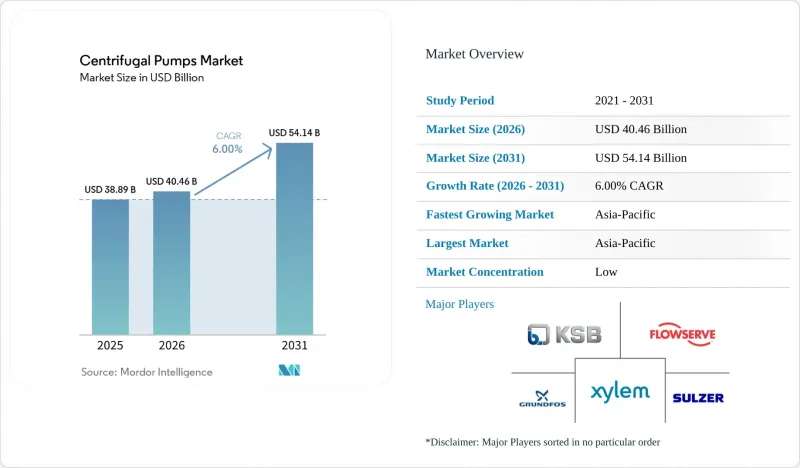
본 보고서는 스테이지(단단 및 다단), 펌프 설계(레이디얼 플로우, 믹스 플로우, 액시얼 플로우), 임펠러 유형(오픈, 세미오픈, 인클로즈드), 용도(상하수도, 화학제품 및 석유화학제품, HVAC 및 빌딩 설비, 식품 및 음료, 광업 및 금속, 기타) 및 지역(북미, 유럽, 아시아태평양, 남미, 중동 및 아프리카)별로 분류되어 있습니다.
세계의 원심 펌프 시장 동향 및 인사이트
하수도 인프라 투자의 급증
지자체 및 산업용 처리 시설은 자본 집약적인 갱신 주기에 접어들었습니다. 미국 환경보호청(EPA)은 2024년에 주 순환 기금 프로그램을 통해 115억 달러를 배분하여 펌프장, 막 생물 반응 장치(MBR) 라인 및 영양염 제거 설비의 현대화를 추진했습니다. ‘클린 워터 주 순환 기금’은 고도 처리 프로젝트에 328억 1,000만 달러, 재이용 프로젝트에 22억 5,500만 달러를 지출했으나, 이 모든 프로젝트는 50-150 psi공급 압력을 확보할 수 있는 다단 펌프에 의존하고 있습니다. 상수도 유틸리티자들은 1980년대와 1990년대에 도입된 정속 펌프를 에너지 사용량을 25-30% 절감할 수 있는 가변속 펌프로 교체하고 있으며, 100마력 펌프 1대당 연간 4만-6만 달러의 비용 절감을 실현하고 있습니다. PFAS(퍼플루오로알킬 물질 및 폴리플루오로알킬 물질) 정화 사업도 수요를 끌어올리고 있습니다. EPA(미국 환경보호청)의 2022 회계연도 신흥 오염 물질 대책 보조금의 85%가 PFAS를 대상으로 하고 있어, 산성 재생액을 처리할 수 있는 내식성 펌프 수요를 견인하고 있습니다. 미국 이외의 국가 중에서는 필리핀이 4,384억 필리핀 페소(85억 달러)를 관개 프로젝트에 배정하여, 681,709헥타르에 걸쳐 태양광 발전식 단단 펌프를 설치할 예정입니다.
상업용 빌딩의 HVAC 개보수 열풍
건물 소유주는 더욱 엄격해진 에너지 규제 및 냉매 단계적 감축 규정을 준수하기 위해 구형 냉수 펌프를 교체하고 있습니다. 국제에너지기구(IEA)는 지열 히트펌프, 냉수 저장, 증발식 시스템 등의 탄력적인 냉각 기술을 꼽고 있지만, 이들 모두는 40-60피트의 양정에서 작동하는 원심 순환 펌프에 의존하고 있습니다. 존슨 컨트롤즈에 따르면, 이 회사의 냉각 장치의 전력 사용 효율(PUE)은 1.18-1.24이며, 이는 정속 설계에 비해 기생 에너지를 15-20% 절감하는 가변속 펌프를 채택한 것도 한 요인으로 작용하고 있습니다. 2023년에 최종 확정된 미국 환경보호청(EPA)의 수소불화탄소(HFC) 단계적 감축 규정에 따라, R-1234ze와 같은 저GWP 냉매로의 전환이 가속화되고 있습니다. 이러한 냉매는 더 높은 압력에서 작동하기 때문에 밀봉 성능이 향상된 펌프가 필요합니다. 다이킨은 저 GWP 냉매를 사용하는 하이퍼스케일 데이터센터용 칠러에 대해 펌프 토출 압력을 8 bar로 규정하고 있으며, 이는 기존의 R-134a 시스템보다 30% 높은 수치입니다.
철강·합금의 가격 변동
국제통화기금(IMF)의 금속 지수는 2024년 2월부터 8월 사이에 7.7% 상승했으며, 구리는 8.1%, 알루미늄은 7.8% 상승했습니다. 역사적으로 볼 때, 구리 가격이 10% 상승하면 12개월 이내에 소비자물가지수가 0.2포인트 상승하는 것으로 나타나, 모터의 권선이나 청동 임펠러에 구리를 사용하는 펌프 OEM 제조업체들은 압박을 받고 있습니다. 2024년 10월 미국의 스테인리스 스틸 생산량은 11% 감소한 반면, 페로크롬 가격은 전년 동월 대비 29% 하락했습니다. 이는 카자흐스탄과 남아프리카공화국에 공급망이 집중된 상황을 반영한 것입니다. 2024년, 인도네시아의 수출 규제와 전기자동차용 배터리 수요로 인해 공급이 부족해진 결과, 니켈 합금 주물 가격은 15-20% 상승했습니다. 이로 인해 OEM 각사는 2상 스테인리스 스틸으로 대체할 수밖에 없게 되거나, 고정가격 계약을 체결하는 상황에 처하게 되었습니다. 또한, 유럽연합(EU)이 중국의 스테인리스 스틸 플랜지에 부과한 반덤핑 관세로 인해 입고 비용이 8-12% 상승하고, 리드타임이 4-6주 연장되고 있습니다.
부문별 분석
다단식 설계는 해수 역삼투 시설, 고층 빌딩의 배관 시스템, 보일러 급수 라인 등에서 콤팩트하면서도 고압 대응이 요구되기 때문에 2031년까지 연평균 성장률(CAGR) 7.3%를 나타낼 것으로 예측되며, 이는 시장 평균인 6.0%를 상회할 전망입니다. 단단 펌프는 2025년 매출의 62.8%를 계속 차지했습니다. 이는 도시의 상수도 배수 및 HVAC 순환 시스템이 대부분의 경우 150피트 미만의 양정에서 가동되기 때문에 복잡성이 낮은 설계가 선호되기 때문입니다. 국제에너지기구(IEA)의 추산에 따르면, 이미 발표된 전해조 프로젝트의 40%는 물 부족 지역에 위치해 있으며, 각 프로젝트마다 60-80바의 역삼투 급수 압력이 필요하기 때문에 트레인당 6-10대의 다단 펌프가 필요합니다. 복합 사이클 발전소용 보일러 급수 패키지에서는 API 610 BB3를 준수하는 배럴 구성이 지정되어 있으며, 3,000 psi의 토출 압력을 지원합니다. 그룬드포스의 IE5 모터 및 VFD 패키지는 와이어-투-워터 효율을 92% 이상으로 높이고, 수명 주기 에너지 소비를 4분의 1로 줄여줍니다. 광업 회사에서는 70-75%의 수력 효율을 유지하면서 내마모성을 갖춘 수평 분할 케이싱식 다단 펌프를 채택하고 있습니다.
단단 펌프는 낮은 자본 비용과 현장에서의 간편한 수리가 중요한 냉각탑의 보충수, 소방 루프 및 관개 시스템에서 여전히 없어서는 안 될 존재입니다. 표준 엔드 흡입형 ANSI/ASME B73.1 설치 형식을 채택하여 1대1 드롭인 교체가 가능하며, 작업자는 현장에서 씰 및 베어링을 재조립할 수 있습니다. 인도의 농업 프로그램에서는 소규모 농가에게 보조금을 지급하여 단단식 태양광 발전 펌프를 공급하고 있으며, 이는 관개 면적 확대에 기여하고 있습니다. 빌딩 서비스 분야에서는 가동·대기 로직을 갖춘 트윈 단일 단계 구성을 통해, 다단 펌프 세트와 같은 추가 비용 없이 이중화 기능을 실현하고 있습니다. 성장 속도는 둔화되고 있지만, 도입 대수가 많기 때문에 씰, 임펠러, 마모 링 등 애프터마켓 분야에서 안정적인 사업 기회가 확보되어 있습니다.
레이디얼 플로우 설계는 2025년 매출의 64.1%를 차지했으며, 그 범용성 덕분에 양정이 50-300피트, 유량이 100-5,000갤런/분인 화학 처리, HVAC, 급수 분야에서 확고한 입지를 다지고 있습니다. 혼합 유동 펌프 시장은 연평균 성장률(CAGR) 6.9%로 성장하고 있습니다. 이는 홍수 대책 구역이나 노천 채굴 광산에서 임펠러 직경을 지나치게 크게 하지 않으면서도 단계당 양력을 높일 수 있는 1,500-4,000 rpm이라는 높은 비회전수가 선호되기 때문입니다. 미 육군 공병대는 미시시피강 및 멕시코만 연안의 시설에서 80-85%의 효율을 달성하는 혼합류 펌프로의 개조를 추진하고 있으며, 기존 레이디얼 펌프에 비해 부수적 손실을 10-15% 줄이고 있습니다. 광산 폐석 처리 라인에서는 고형분 함량이 20-30%인 조건에서도 65-70%의 효율을 유지할 수 있는 혼합류 펌프가 채택되어 있으며, 마모가 심한 환경에서 레이디얼 설계에 비해 뚜렷한 우위를 보이고 있습니다.
축류식 프로펠러 펌프는 틈새 시장용이긴 하지만, 연안 발전소의 냉각수 취수구나 폴더의 배수 등 유량이 매우 크고 양정이 낮은 용도에 사용되며, 양정 30피트 미만에서 5만 GPM 이상의 유량을 처리합니다. 화학 공업 및 정유시설에서는 ANSI 규격에 따른 치수 호환성과 낮은 양정(NPSH) 요건이 공정 가동 시간을 확보하는 데 도움이 되기 때문에 여전히 레이디얼 펌프가 주류를 이루고 있습니다. 수산 양식 및 폐수 폭기 분야에서는 축류식 모델이 최소한의 에너지로 대량의 유체를 이동시키고 용존 산소의 이송률을 향상시키는 능력 덕분에 시장 점유율을 확대되고 있습니다. 모든 형상에서 전산유체역학(CFD)을 통한 최적화와 적층 가공 기술을 활용한 유로 설계를 통해 효율이 미세 조정되어 캐비테이션 위험이 감소되었습니다.
지역별 분석
아시아태평양은 2025년 매출의 50.3%를 차지했으며, 중국의 도시 하수 처리 시설 개보수, 인도의 관개 시설 현대화, 인도네시아의 지열 발전 설비 확충에 힘입어 2031년까지 연평균 성장률(CAGR) 6.4%를 나타낼 것으로 예측됩니다. 중국의 CNP Pumps사는 2023년에 47억 9,500만 위안(6억 7,000만 달러)의 매출을 기록했으며, 국내 및 수출 입찰 수주에 기여하는 600건 이상의 특허를 보유하고 있습니다. 인도의 ‘Pradhan Mantri Krishi Sinchai Yojana’는 소규모 농가 및 영세 농가를 대상으로 한 태양광 발전식 원심 펌프 세트에 보조금을 지급하고 있으며, 대상 시장 규모를 확대되고 있습니다. 동남아시아의 지열 발전 용량은 2022년에 2,360 MW에 달했으며, 염수 온도가 200°C를 초과하기 때문에 재주입 루프에는 내식성 펌프가 필요합니다.
북미와 유럽은 2025년 매출의 35-38%를 합쳐 차지했습니다. 인프라 노후화로 인해 기초 수요는 안정적인 반면, 에너지 효율 향상을 위한 개보수 및 PFAS(퍼플루오로알킬 물질) 제거와 관련된 법규로 인해 교체율이 상승하고 있습니다. 미국 환경보호청(EPA)은 2024년에 펌프장 현대화, 막 생물 반응 장치 및 영양염 제거 프로젝트에 115억 달러를 배정했습니다. 독일에서는 산업용 및 상업시설용 펌프 교체 비용의 최대 35%를 지원하는 제도가 마련되어 있어, 가변속 드라이브(VFD) 도입이 가속화되고 있습니다. KSB사가 2024년에 Hydro Inc.를 인수함에 따라, 메인주 내의 폐수 처리 능력과 미국 북동부 전역에 걸친 판매망이 강화되어, 해당 그룹은 지자체 고객과의 거리를 한층 더 좁히게 되었습니다.
중동 및 아프리카 및 남미에서는 해수 담수화 플랜트, 파이프라인 확장, 광업 프로젝트를 원동력으로 연평균 성장률(CAGR)이 6.5-7.0% 수준을 유지할 것으로 전망됩니다. 사우디아라비아의 ‘비전 2030’에 따르면, 인프라에 1조 달러가 투자될 예정이며, 여기에는 1기당 8-12대의 고압 펌프가 필요한 역삼투 방식의 해수 담수화 설비도 포함되어 있습니다. 남아프리카공화국의 ‘레소토 하이랜즈 수자원 프로젝트 2단계’에서는 16-20대의 가역식 펌프 터빈을 사용하는 1,270 MW 규모의 양수 발전 계획에 대해 23억 달러의 예산이 편성되었습니다. 브라질의 위생법에서는 2033년까지 상수도 및 하수도 수집의 보급률을 90%로 높일 것을 의무화하고 있으며, 이에 따라 주로 단단 엔드 흡입식 펌프 5만-6만 대가 새로 설치될 것으로 예측됩니다.
기타 혜택 :
- 엑셀 형식 시장 예측(ME) 시트
- 3개월간의 애널리스트 지원
자주 묻는 질문
목차
제1장 서론
제2장 조사 방법
제3장 주요 요약
제4장 시장 구도
제5장 시장 규모 및 성장 예측
제6장 경쟁 구도
제7장 시장 기회 및 향후 전망
KTH 26.06.29According to Mordor Intelligence, the centrifugal pumps market size is projected to be USD 38.89 billion in 2025, USD 40.46 billion in 2026, and reach USD 54.14 billion by 2031, growing at a CAGR of 6% from 2026 to 2031.
This report is Segmented by Stage (Single-Stage and Multi-Stage), Pump Design (Radial Flow, Mixed Flow, and Axial Flow), Impeller Type (Open, Semi-Open, and Enclosed), Application (Water and Wastewater, Chemical and Petrochemical, HVAC and Building Services, Food and Beverage, Mining and Metals, and More), and Geography (North America, Europe, Asia-Pacific, South America, and Middle East and Africa).
Global Centrifugal Pumps Market Trends and Insights
Waste-Water Infrastructure Spending Boom
Municipal and industrial treatment plants are in a capital-intensive upgrade cycle. The U.S. Environmental Protection Agency allocated USD 11.5 billion in 2024 through State Revolving Fund programs to modernize pump stations, membrane-bioreactor lines, and nutrient-removal assets. The Clean Water State Revolving Fund disbursed USD 32.81 billion for advanced treatment and USD 2.255 billion for reuse projects, both of which depend on multi-stage pumps able to deliver 50-150 psi feed pressure. Utilities are replacing fixed-speed machines from the 1980s and 1990s with variable-speed units that cut energy use by 25-30%, saving USD 40,000-60,000 per 100-horsepower pump each year. PFAS remediation adds volume: 85% of EPA fiscal-year-2022 emerging-contaminant grants target per- and polyfluoroalkyl substances, driving demand for corrosion-resistant pumps that handle acidic regenerant streams. Outside the United States, the Philippines has earmarked PHP 438.4 billion (USD 8.5 billion) for irrigation projects that will install solar-powered single-stage units across 681,709 hectares.
HVAC Retrofit Wave in Commercial Buildings
Building owners are replacing legacy chilled-water pumps to satisfy tougher energy codes and refrigerant phasedown rules. The International Energy Agency identifies resilient cooling technologies such as ground-source heat pumps, chilled-water storage, and evaporative systems, all of which rely on centrifugal circulation pumps operating at 40-60 feet of head. Johnson Controls reports power-usage-effectiveness ratios of 1.18-1.24 for its cooling units, thanks in part to variable-speed pumps that trim parasitic energy 15-20% compared with constant-speed designs. The U.S. EPA's hydrofluorocarbon phasedown rule, finalized in 2023, accelerates the move to low-GWP refrigerants such as R-1234ze, which operate at higher pressures and therefore require pumps with upgraded seals. Daikin specifies pump discharge pressures of 8 bar for hyperscale-data-center chillers using low-GWP refrigerants, 30% above legacy R-134a systems.
Steel & Alloy Price Volatility
The International Monetary Fund's metals index rose 7.7% between February and August 2024, with copper up 8.1% and aluminum up 7.8%. A 10% copper jump historically adds a 0.2-point increase to consumer inflation within 12 months, pressuring pump OEMs that use copper in motor windings and bronze impellers. U.S. stainless-steel production fell 11% in October 2024, while ferrochromium prices dropped 29% year on year, reflecting supply-chain concentration in Kazakhstan and South Africa. Nickel-alloy castings gained 15-20% in 2024 after Indonesian export curbs and electric-vehicle battery demand tightened supply, forcing OEMs to substitute duplex stainless steels or lock in fixed-price contracts. European Union anti-dumping duties on Chinese stainless-steel flanges add 8-12% to landed cost and extend lead times by 4-6 weeks.
Other drivers and restraints analyzed in the detailed report include:
- Oil & Gas Mid-Stream Capacity Expansion
- Power-Generation Build-Outs, Especially CCGT
- Shift to Positive-Displacement Pumps in Niches
For complete list of drivers and restraints, kindly check the Table Of Contents.
Segment Analysis
Multi-stage designs are forecast to grow at a 7.3% CAGR through 2031, outpacing the 6.0% market average as seawater reverse osmosis facilities, high-rise plumbing systems, and boiler-feed lines demand compact, high-pressure capability. Single-stage pumps still delivered 62.8% of 2025 revenue because municipal water distribution and HVAC circulation often work below 150 feet of head, favoring lower complexity. The International Energy Agency estimates that 40% of announced electrolyzer projects are located in water-stressed areas, each requiring reverse-osmosis feed pressure of 60-80 bar and thus six to ten multi-stage pumps per train. Boiler-feedwater packages for combined-cycle plants specify barrel configurations compliant with API 610 BB3, handling 3,000 psi discharge. Grundfos's IE5 motor and VFD package pushes wire-to-water efficiency past 92%, lowering lifecycle energy by one-quarter. Mining companies adopt horizontal split-case multi-stage units that keep 70-75% hydraulic efficiency while resisting abrasion.
Single-stage pumps remain indispensable for cooling-tower makeup, fire-protection loops, and irrigation systems that value low capital cost and simple field repairs. Standard end-suction ANSI/ASME B73.1 footprints allow one-for-one drop-in replacements, and personnel can rebuild seals and bearings on site. Agricultural programs in India supply subsidized single-stage, solar-powered pumps to smallholder farms, boosting irrigation area coverage. In building services, twin-single-stage configurations with duty-standby logic offer redundancy without the cost premium of multi-stage sets. Despite slower growth, the large installed base secures steady aftermarket opportunities for seals, impellers, and wear rings.
Radial-flow designs held 64.1% of 2025 revenue, anchored by their versatility in chemical processing, HVAC, and water supply, where heads run 50-300 feet and flows cover 100-5,000 gallons per minute. Mixed-flow pumps are expanding at a 6.9% CAGR because flood-control districts and open-pit mines favor higher specific speeds of 1,500-4,000 rpm that deliver greater head per stage without oversizing impeller diameters. The U.S. Army Corps of Engineers is retrofitting Mississippi River and Gulf Coast stations with mixed-flow models that achieve 80-85% efficiency, reducing parasitic power by 10-15% against radial predecessors. Mining tailings lines choose mixed-flow hydraulics for 20-30% solids while maintaining 65-70% efficiency, a clear advantage over radial designs in abrasive service.
Axial-flow propeller pumps, though niche, serve very-high-flow and low-head duties such as cooling-water intakes at coastal power plants and drainage in polders, handling more than 50,000 GPM with heads below 30 feet. Radial machines remain dominant in chemical and refinery services because ANSI dimensional interchangeability and low net-positive-suction-head-required values safeguard process uptime. In aquaculture and wastewater aeration, axial-flow models are gaining share for their ability to move large volumes at minimal energy, improving dissolved-oxygen transfer rates. Across all geometries, computational fluid-dynamic optimization and additive-manufactured flow passages fine-tune efficiency and reduce cavitation risk.
Geography Analysis
Asia-Pacific delivered 50.3% of 2025 revenue and is expected to post a 6.4% CAGR to 2031, supported by municipal wastewater upgrades in China, irrigation modernization in India, and geothermal power additions in Indonesia. China's CNP Pumps generated RMB 4.795 billion (USD 670 million) in 2023 and holds more than 600 patents that help win domestic and export tenders. India's Pradhan Mantri Krishi Sinchai Yojana subsidizes solar-powered centrifugal sets for small and marginal farmers, expanding addressable volumes. Southeast Asia's geothermal capacity reached 2,360 MW in 2022, with brine temperatures above 200 °C requiring corrosion-resistant pumps for reinjection loops.
North America and Europe jointly claimed 35-38% of 2025 sales. Aging infrastructure keeps baseline demand stable while energy-efficiency retrofits and PFAS remediation laws lift replacement rates. The U.S. EPA earmarked USD 11.5 billion in 2024 for pump-station modernization, membrane bioreactors, and nutrient-removal projects. Germany provides rebates covering up to 35% of pump-upgrade costs for industrial and commercial facilities, accelerating VFD adoption. KSB's 2024 purchase of Hydro Inc. adds wastewater capacity in Maine and a distribution network across the U.S. Northeast, positioning the group closer to municipal customers.
Middle East-Africa and South America are on track for a 6.5-7.0% CAGR, driven by desalination plants, pipeline expansions, and mining projects. Saudi Arabia's Vision 2030 channels USD 1 trillion into infrastructure, including reverse-osmosis desalination units that each require eight to twelve high-pressure pumps. South Africa's Lesotho Highlands Water Project Phase II budgets USD 2.3 billion for a 1,270 MW pumped-storage scheme using sixteen to twenty reversible pump-turbines. Brazil's sanitation law mandates 90% water-supply and wastewater-collection coverage by 2033, implying 50,000-60,000 new pump installs, mainly single-stage end-suction units.
- Grundfos Holding A/S
- Flowserve Corporation
- Xylem Inc.
- KSB SE & Co. KGaA
- Sulzer Ltd
- Ebara Corporation
- ITT Inc.
- Weir Group PLC
- Dover Corporation
- Baker Hughes Company
- Ruhrpumpen Group
- Schlumberger Ltd.
- Wilo SE
- Pentair PLC
- SPX FLOW Inc.
- Kirloskar Brothers Ltd.
- Torishima Pump Mfg. Co., Ltd.
- Andritz AG
- DESMI A/S
- CP Pumpen AG
Additional Benefits:
- The market estimate (ME) sheet in Excel format
- 3 months of analyst support
TABLE OF CONTENTS
1 Introduction
- 1.1 Study Assumptions & Market Definition
- 1.2 Scope of the Study
2 Research Methodology
3 Executive Summary
4 Market Landscape
- 4.1 Market Overview
- 4.2 Market Drivers
- 4.2.1 Waste-water infrastructure spending boom
- 4.2.2 HVAC retrofit wave in commercial buildings
- 4.2.3 Oil & gas mid-stream capacity expansion
- 4.2.4 Power-generation build-outs, esp. CCGT
- 4.2.5 Modular skid pumps for data-centre cooling
- 4.2.6 Hydrogen-ready liquid pumps for green H? projects
- 4.3 Market Restraints
- 4.3.1 Steel & alloy price volatility
- 4.3.2 Shift to positive-displacement pumps in niches
- 4.3.3 VFD adoption cutting oversized-pump replacements
- 4.3.4 PFAS regulation limiting fluoropolymer-lined pumps
- 4.4 Supply-Chain Analysis
- 4.5 Regulatory Landscape
- 4.6 Technological Outlook
- 4.7 Porter's Five Forces
- 4.7.1 Bargaining Power of Suppliers
- 4.7.2 Bargaining Power of Buyers
- 4.7.3 Threat of New Entrants
- 4.7.4 Threat of Substitutes
- 4.7.5 Competitive Rivalry
5 Market Size & Growth Forecasts
- 5.1 By Stage
- 5.1.1 Single-Stage Pumps
- 5.1.2 Multi-Stage Pumps
- 5.2 By Pump Design (Flow Direction)
- 5.2.1 Radial Flow
- 5.2.2 Mixed Flow
- 5.2.3 Axial Flow
- 5.3 By Impeller Type
- 5.3.1 Open
- 5.3.2 Semi-Open
- 5.3.3 Enclosed
- 5.4 By Application
- 5.4.1 Water and Wastewater
- 5.4.2 Chemical and Petrochemical
- 5.4.3 HVAC and Building Services
- 5.4.4 Oil and Gas (Upstream, Midstream, Downstream)
- 5.4.5 Food and Beverage
- 5.4.6 Mining and Metals
- 5.4.7 Power Generation (Thermal, Nuclear, Renewables)
- 5.4.8 Pharmaceuticals and Biotech
- 5.4.9 Others
- 5.5 By Geography
- 5.5.1 North America
- 5.5.1.1 United States
- 5.5.1.2 Canada
- 5.5.1.3 Mexico
- 5.5.2 Europe
- 5.5.2.1 United Kingdom
- 5.5.2.2 Germany
- 5.5.2.3 France
- 5.5.2.4 Spain
- 5.5.2.5 NORDIC Countries
- 5.5.2.6 Russia
- 5.5.2.7 Turkey
- 5.5.2.8 Rest of Europe
- 5.5.3 Asia-Pacific
- 5.5.3.1 China
- 5.5.3.2 India
- 5.5.3.3 Japan
- 5.5.3.4 South Korea
- 5.5.3.5 Malaysia
- 5.5.3.6 Thailand
- 5.5.3.7 Indonesia
- 5.5.3.8 Vietnam
- 5.5.3.9 Australia
- 5.5.3.10 Rest of Asia-Pacific
- 5.5.4 South America
- 5.5.4.1 Brazil
- 5.5.4.2 Argentina
- 5.5.4.3 Colombia
- 5.5.4.4 Rest of South America
- 5.5.5 Middle East and Africa
- 5.5.5.1 Saudi Arabia
- 5.5.5.2 United Arab Emirates
- 5.5.5.3 South Africa
- 5.5.5.4 Egypt
- 5.5.5.5 Nigeria
- 5.5.5.6 Qatar
- 5.5.5.7 Rest of Middle East and Africa
- 5.5.1 North America
6 Competitive Landscape
- 6.1 Market Concentration
- 6.2 Strategic Moves (M&A, Partnerships, PPAs)
- 6.3 Market Share Analysis (Market Rank/Share for key companies)
- 6.4 Company Profiles (includes Global level Overview, Market level overview, Core Segments, Financials as available, Strategic Information, Products & Services, and Recent Developments)
- 6.4.1 Grundfos Holding A/S
- 6.4.2 Flowserve Corporation
- 6.4.3 Xylem Inc.
- 6.4.4 KSB SE & Co. KGaA
- 6.4.5 Sulzer Ltd
- 6.4.6 Ebara Corporation
- 6.4.7 ITT Inc.
- 6.4.8 Weir Group PLC
- 6.4.9 Dover Corporation
- 6.4.10 Baker Hughes Company
- 6.4.11 Ruhrpumpen Group
- 6.4.12 Schlumberger Ltd.
- 6.4.13 Wilo SE
- 6.4.14 Pentair PLC
- 6.4.15 SPX FLOW Inc.
- 6.4.16 Kirloskar Brothers Ltd.
- 6.4.17 Torishima Pump Mfg. Co., Ltd.
- 6.4.18 Andritz AG
- 6.4.19 DESMI A/S
- 6.4.20 CP Pumpen AG
7 Market Opportunities & Future Outlook
- 7.1 White-space & Unmet-Need Assessment


