|
시장보고서
상품코드
2116778
중동 및 아프리카의 원심 펌프 시장 : 점유율 분석, 업계 동향과 통계, 성장 예측(2026-2031년)Middle East And Africa Centrifugal Pumps - Market Share Analysis, Industry Trends & Statistics, Growth Forecasts (2026 - 2031) |
||||||
 Mordor Intelligence
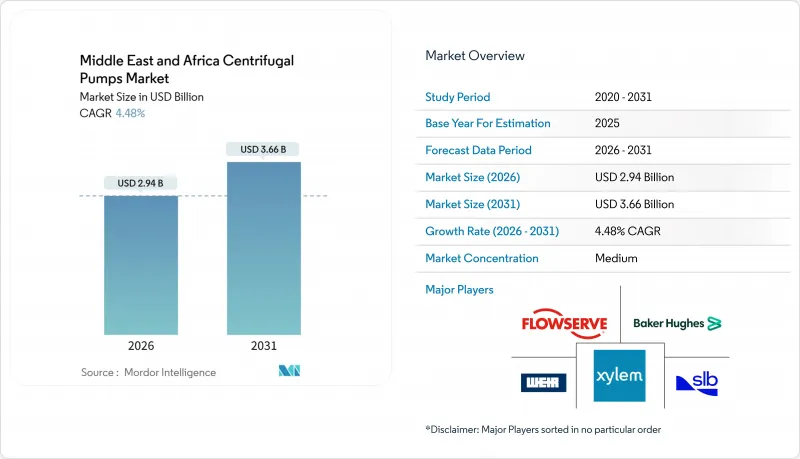
Mordor Intelligence에 의하면, 중동 및 아프리카 원심 펌프 시장 규모는 2026년에 29억 4,000만 달러되어, 2031년까지 36억 6,000만 달러에 이를 것으로 예측되며, 예측 기간을 통해서 CAGR은 4.48%를 나타낼 전망입니다.
본 보고서는 유량 유형(축류식, 방사류식, 혼합식), 단수(단단식, 다단식), 최종 사용자 산업(석유 및 가스, 전력 등),용량 범위(마이크로(500 Gpm 미만), 소형(500-1,000 Gpm), 중형(1,000-5,000 Gpm), 기타), 재질(주철, 스테인리스 스틸, 기타) 및 지역별로 분류되어 있습니다. 시장 전망은 금액(달러) 기준으로 제시됩니다.
중동 및 아프리카 원심 펌프 시장 동향 및 인사이트
급속한 산업화 및 도시화 진행
걸프협력회의(GCC) 인구의 89%는 이미 도시 지역에 거주하고 있으며, 이러한 높은 인구 밀도로 인해 지자체는 연간 약 12,000-15,000기의 새로운 식수 공급, 하수 처리 및 소방 설비를 도입해야 하는 상황에 처해 있습니다. 사우디아라비아의 NEOM이나 이집트의 ‘신행정수도’와 같은 메가 프로젝트에서는 해수 담수화 및 송수 루프에 정격 유량 3,000 gpm을 초과하는 고효율 원심 펌프가 채택되고 있습니다. 지역 냉방, 심층 지하실 배수, 그리고 NFPA-20 준수 소방 시스템 또한 추가적인 수요를 창출하고 있습니다. 설계자들은 에너지 사용량 관리 및 염화물 농도가 높은 환경에 대응하기 위해 가변 속도 구동 장치와 내식성 합금의 채택을 점점 더 많이 지정하고 있습니다. 이러한 도시 건설 프로젝트들은 종합적으로 볼 때 지속적인 수주 파이프라인을 형성하고 있으며, 중동 및 아프리카의 원심 펌프 시장을 베이스로드 인프라와 보조 서비스 양쪽 모두에서 뒷받침하고 있습니다.
도시 하수 처리 투자 확대
사우디아라비아 국립 상수도 공사는 2030년까지 하수 처리 능력을 하루 820만 m³로 끌어올리기 위해 210억 달러를 투자하고 있습니다. 쿠웨이트의 24억 달러 규모 슬라이비아 정수장 개보수 프로젝트와 남아프리카공화국의 32억 랜드 규모 하우텡 주 정수장 개보수 프로젝트는 이 지역 전체에서 처리 기준이 높아지고 있음을 보여줍니다. 현재 프로젝트에서는 막 생물 반응기(MBR) 및 역삼투(RO)를 통한 최종 처리가 선호되고 있으며, 두 방식 모두 스테인리스 스틸 또는 듀플렉스 재질의 액체 접촉 부품을 갖춘, 맥동이 적고 내마모성이 뛰어난 원심 펌프가 요구되고 있습니다. 가변 주파수 구동 장치는 표준 사양으로 장착되어 있어, ISO 50001 요건을 충족하면서 에너지 사용량을 20%-30% 절감하고 있습니다. 상수도 유틸리티자들이 물 재이용률 70%라는 목표 달성을 서두르는 가운데, 중동 및 아프리카의 원심 펌프 시장에서는 장기 운영·유지보수 계약이 확대되고 있어, 1대당 수명 주기 수익이 증가하고 있습니다.
심정 설치 시 발생하는 캐비테이션 및 프라이밍 문제
사우디아라비아의 화석 대수층 지역에서 정수두가 300m를 초과하면 흡입 압력이 저하되어 기포가 발생하고, 이로 인해 임펠러가 침식되어 반년 이내에 효율이 최대 25%까지 떨어지게 됩니다. UAE 알 아인의 우물에서도 유사한 문제가 발생하여 가변 주파수 구동 장치 및 진공 프라이밍 시스템을 도입하는 개조가 필요하게 되었으며, 사이트당 8,000-12,000달러의 추가 비용이 소요되었습니다. 또한, 수평형 소방용 펌프의 경우에도 흡입관 내에 공기가 남아 있으면 시동 목표를 달성할 수 없어 NFPA(미국 화재방지협회) 기준을 준수하지 못하게 됩니다. 자흡식 설계나 상태 모니터링를 통해 고장률을 절반으로 줄이는 것은 가능하지만, 추가적인 설비 투자가 필요하기 때문에 예산에 제약이 있는 사업자들의 도입이 주춤해지면서 중동 및 아프리카의 원심 펌프 시장 성장세가 약화되고 있습니다.
부문 분석
2025년, 중동 및 아프리카 원심 펌프 시장에서 레이디얼 플로우 펌프는 54.67%의 점유율을 차지했습니다. 이는 양정이 150피트를 넘는 경우가 드문 도시 상수도망 및 HVAC 냉각 루프에서의 견조한 수요에 기인합니다. 간단한 수력학적 특성, 폭넓은 공급업체 기반, 가변 속도 구동 장치와의 호환성 덕분에 조달 시 안정성이 높아집니다. 한편, 혼합류 펌프는 광산 기업들이 효율을 저하시키지 않으면서 20%-30%의 고형분을 포함하는 슬러리 회로를 하이브리드 임펠러로 개조함에 따라 2031년까지 연평균 성장률(CAGR) 5.07%로 성장을 지속하고, 있습니다. 콩고 민주 공화국의 카모아-카쿠라 광산 확장 프로젝트는 이러한 전환을 상징하는 사례로, 광미 배출용으로 수십 대의 혼합류 펌프가 채택되었습니다.
이 설계는 양정 요구 사항이 낮기 때문에 새로운 펌프 스테이션 건설 시 굴착 깊이를 얕게 유지할 수 있어, 지하수위가 얕은 아프리카에서는 매우 중요한 이점이 됩니다. 플로우서브(FlowServ)사가 2024년에 출시한 세미 오픈 임펠러 덕분에 유지보수 주기는 6개월로 더욱 연장되었습니다. 고압 해수 담수화 분야에서는 라디얼 펌프가 여전히 주류를 이루고 있으며, 1,000 psi에서 80% 이상의 효율을 달성하고 있습니다. 한편, 축류식 유닛은 유량이 50,000 gpm을 초과하는 이집트 나일강 삼각주의 홍수 대책 프로젝트나 사우디아라비아의 대추야자 관개 프로젝트에서 계속해서 활용되고 있습니다. 이러한 동향들이 맞물리면서 중동 및 아프리카의 원심 펌프 시장은 균형을 유지하면서도 계속 진화하고 있으며, 그중 혼합류 기술은 성장세가 두드러지고 수익성이 높은 틈새 시장을 개척하고 있습니다.
2025년에는 단단식 설계가 원심 펌프 시장의 62.31%를 차지했습니다. 이는 단순한 구조 덕분에 건축 설비 및 상수도 유틸리티 분야의 용도 대부분을 충족시키기 때문입니다. 그러나 다단식 모델은 연평균 성장률(CAGR) 4.86%로 계속 확대되고 있으며, 그 원동력은 사우디아라비아의 자프라 유전입니다. 이 유전에서는 18단식 배럴 펌프가 8,000 psi의 물과 가스를 교대로 주입하고 있습니다. 또한, 1,200 psi에서 막에 물을 공급하는 6-8단식 해수 담수화용 펌프도 또 다른 성장 분야로 떠오르고 있습니다.
술저(Sulzer)사의 ‘HiFlux’ 디퓨저는 단간 손실을 12% 저감하여, 연속 운전 설비에서 2년 이내에 투자 회수를 실현하고 있습니다. 그러나 10단 이상의 펌프에서는 로터의 동적 특성이 복잡해지기 때문에 각 OEM 업체들은 유한요소법을 통한 검증이나 현장에서의 밸런스 조정을 수행해야 할 필요에 직면해 있습니다. NFPA-20 규격에 부합하는 소방 시스템에서는 여전히 단단 펌프가 주류를 이루고 있지만, 초고층 빌딩의 높이가 증가함에 따라 정격 용량의 150%에서 양정을 유지할 수 있는 2단식 스플릿 케이스 유닛에 대한 수요가 높아질 가능성이 있습니다. 현재 중동 및 아프리카의 원심 펌프 시장은 성숙한 단단 펌프의 판매량과 고부가가치 다단 펌프의 가치 성장 간에 균형을 이루고 있습니다.
기타 혜택:
- 엑셀 형식 시장 예측(ME) 시트
- 3개월간의 애널리스트 지원
자주 묻는 질문
목차
제1장 서론
제2장 조사 방법
제3장 주요 요약
제4장 시장 구도
제5장 시장 규모와 성장 예측
제6장 경쟁 구도
제7장 시장 기회와 향후 전망
JHS 26.08.28According to Mordor Intelligence, the centrifugal pumps market size in the Middle East and Africa is USD 2.94 billion in 2026 and is projected to reach USD 3.66 billion by 2031, translating into a 4.48% CAGR through the forecast period.
This report is Segmented by Flow Type (Axial, Radial, Mixed), Number of Stages (Single Stage, and Multi Stage), End-User Industry (Oil and Gas, Power, and More), Capacity Range (Micro (Below 500 Gpm), Small (500-1, 000 Gpm), Medium (1, 000-5, 000 Gpm), and More), Material (Cast Iron, Stainless Steel, and More), and Geography. The Market Forecasts are Provided in Terms of Value (USD).
Middle East And Africa Centrifugal Pumps Market Trends and Insights
Rapid Industrialization and Urbanization Uptick
Urban residents already make up 89% of the Gulf Cooperation Council population, a density that forces municipalities to commission new potable-water, sewage-treatment, and fire-protection assets at an estimated 12,000-15,000 units annually. Mega-projects such as NEOM in Saudi Arabia and Egypt's New Administrative Capital embed high-efficiency centrifugal pumps rated above 3,000 gpm in desalination and transmission loops. District cooling, deep-basement dewatering, and NFPA-20-compliant fire systems add further layers of demand. Designers are increasingly specifying variable-speed drives and corrosion-resistant alloys to manage energy use and chloride-rich conditions. Collectively, these city-building programs anchor a long pipeline of recurring orders that reinforce the Middle East And Africa centrifugal pumps market across both base-load infrastructure and auxiliary services.
Rising Investments in Urban Wastewater Treatment
Saudi Arabia's National Water Company is channeling USD 21 billion toward lifting wastewater throughput to 8.2 million m3/day by 2030. Kuwait's USD 2.4 billion Sulaibiya upgrade and South Africa's ZAR 3.2 billion Gauteng refurbishments underscore a region-wide shift toward higher treatment standards. Projects now favor membrane bioreactor or reverse-osmosis polishing, both of which demand low-pulsation, abrasion-resistant centrifugal pumps with stainless or duplex wetted parts. Variable-frequency drives are standard, cutting energy use 20%-30% while meeting ISO 50001 requirements. As utilities press to achieve 70% water reuse targets, the Middle East And Africa centrifugal pumps market gains exposure to long-term operations and maintenance contracts, enlarging lifetime revenue per installation.
Cavitation and Priming Failures in Deep-Well Installations
Static lifts above 300 m in Saudi fossil-aquifer zones produce low suction pressure, triggering vapor bubbles that erode impellers and trim efficiency by up to 25% within half a year. Similar issues in the UAE's Al Ain wells required retrofits involving variable-frequency drives and vacuum-priming systems, at an additional USD 8,000-12,000 per site. Horizontal fire-water pumps also miss start-up targets when air pockets linger in suction lines, compromising NFPA compliance. Although self-priming designs and condition monitoring can halve failure rates, the added capital outlay slows adoption among budget-strained operators and dilutes the momentum of the Middle East And Africa centrifugal pumps market.
Other drivers and restraints analyzed in the detailed report include:
- Expansion of Desalination Projects in Gulf Countries
- Accelerated Mining Projects in Africa's Copper Belt
- Chemical Compatibility Limitations with Sour Crudes
For complete list of drivers and restraints, kindly check the Table Of Contents.
Segment Analysis
Radial-flow pumps commanded 54.67% of the Middle East And Africa centrifugal pumps market in 2025, thanks to solid traction in municipal grids and HVAC cooling loops where heads rarely exceed 150 ft. Their straightforward hydraulics, broad supplier base, and compatibility with variable-speed drives reinforce procurement comfort. Mixed-flow configurations, however, are registering a 5.07% CAGR through 2031 as mining companies retrofit slurry circuits with hybrid impellers that tolerate 20%-30% solids without sacrificing efficiency. The Kamoa-Kakula expansion in the Democratic Republic of Congo typifies this pivot, specifying dozens of mixed-flow units for tailings discharge.
The design's lower net-positive suction head requirement reduces excavation depth in new pump-station builds, a critical advantage in Africa's shallow water tables. Flowserve's 2024 release of a semi-open impeller further lengthens maintenance intervals to six months. Radial pumps retain dominance in high-pressure desalination, achieving efficiencies above 80% at 1,000 psi, while axial-flow units continue to serve flood-control projects in Egypt's Nile Delta and Saudi date-palm irrigation where flows exceed 50,000 gpm. Collectively, these patterns sustain a balanced yet evolving Middle East And Africa centrifugal pumps market, in which mixed-flow technology is carving out a growing, high-margin niche.
Single-stage designs accounted for 62.31% of the centrifugal pump market in 2025 because their simplicity meets the majority of building-services and municipal-water applications. However, multi-stage models are advancing at a 4.86% CAGR, fueled by Saudi Arabia's Jafurah field, where 18-stage barrel pumps deliver 8,000 psi water-alternating-gas injection. Desalination's six- to eight-stage pumps feeding membranes at 1,200 psi represent another growth vein.
Sulzer's HiFlux diffuser reduced inter-stage losses by 12%, offering payback in less than two years for continuous-duty installations. Yet the rotor-dynamic complexity of more than 10 stages pushes OEMs to provide finite-element validation and field balancing. Single-stage pumps still dominate NFPA-20 fire systems, but rising skyscraper heights may tilt preferences toward twin-stage split-case units that maintain head at 150% rated capacity. For now, the Middle East And Africa centrifugal pumps market balances mature single-stage volumes with premium multi-stage value growth.
Complete Report Scope:
- By Flow Type
- Axial
- Radial
- Mixed
- By Number of Stages
- Single Stage
- Multi Stage
- By End-User Industry
- Oil and Gas
- Food and Beverages
- Water and Wastewater
- Pharmaceutical
- Power
- Construction
- Metal and Mining
- Other End-User Industries
- By Capacity Range
- Micro (Below 500 gpm)
- Small (500-1,000 gpm)
- Medium (1,000-5,000 gpm)
- Large (Above 5,000 gpm)
- By Material
- Cast Iron
- Stainless Steel
- Bronze
- Other Materials
- By Geography
- Middle East
- Saudi Arabia
- United Arab Emirates
- Rest of Middle East
- Africa
- South Africa
- Rest of Africa
- Middle East
List of Companies Covered in this Report:
- Baker Hughes Company
- Ebara Pumps Middle East FZE
- Flowserve Corporation
- KSB Middle East FZE
- Ruhrpumpen Group
- Schlumberger Limited
- Parker Hannifin Corp
- The Weir Group plc
- Dover Corporation
- Xylem Inc
- Sulzer Ltd
- Grundfos Gulf Distribution
- Kirloskar Brothers Ltd
- Torishima Pump Mfg Co Ltd
- Pentair plc
- Wilo Middle East FZE
- Atlas Copco AB
- SPX FLOW Inc
- Tsurumi Manufacturing Co Ltd
- Franklin Electric Co Inc
Additional Benefits:
- The market estimate (ME) sheet in Excel format
- 3 months of analyst support
TABLE OF CONTENTS
1 INTRODUCTION
- 1.1 Study Assumptions and Market Definition
- 1.2 Scope of the Study
2 RESEARCH METHODOLOGY
3 EXECUTIVE SUMMARY
4 MARKET LANDSCAPE
- 4.1 Market Overview
- 4.2 Market Drivers
- 4.2.1 Rapid Industrialization and Urbanization Uptick
- 4.2.2 Rising Investments in Urban Wastewater Treatment
- 4.2.3 Expansion of Desalination Projects in Gulf Countries
- 4.2.4 Accelerated Mining Projects in Africa's Copper Belt
- 4.2.5 Government-Led Oil and Gas Capacity Upgrades
- 4.2.6 Local Manufacturing Incentives for Pump Components
- 4.3 Market Restraints
- 4.3.1 Cavitation and Priming Failures in Deep-Well Installations
- 4.3.2 Chemical Compatibility Limitations with Sour Crudes
- 4.3.3 Price Volatility of Stainless-Steel and Alloy Inputs
- 4.3.4 Persistent Counterfeit Spare-Parts Supply Chain
- 4.4 Industry Value Chain Analysis
- 4.5 Regulatory Landscape
- 4.6 Technological Outlook
- 4.7 Impact of Macroeconomic Factors on the Market
- 4.8 Porter's Five Forces Analysis
- 4.8.1 Bargaining Power of Suppliers
- 4.8.2 Bargaining Power of Buyers
- 4.8.3 Threat of New Entrants
- 4.8.4 Threat of Substitutes
- 4.8.5 Intensity of Competitive Rivalry
5 MARKET SIZE AND GROWTH FORECASTS (VALUE)
- 5.1 By Flow Type
- 5.1.1 Axial
- 5.1.2 Radial
- 5.1.3 Mixed
- 5.2 By Number of Stages
- 5.2.1 Single Stage
- 5.2.2 Multi Stage
- 5.3 By End-User Industry
- 5.3.1 Oil and Gas
- 5.3.2 Food and Beverages
- 5.3.3 Water and Wastewater
- 5.3.4 Pharmaceutical
- 5.3.5 Power
- 5.3.6 Construction
- 5.3.7 Metal and Mining
- 5.3.8 Other End-User Industries
- 5.4 By Capacity Range
- 5.4.1 Micro (Below 500 gpm)
- 5.4.2 Small (500-1,000 gpm)
- 5.4.3 Medium (1,000-5,000 gpm)
- 5.4.4 Large (Above 5,000 gpm)
- 5.5 By Material
- 5.5.1 Cast Iron
- 5.5.2 Stainless Steel
- 5.5.3 Bronze
- 5.5.4 Other Materials
- 5.6 By Geography
- 5.6.1 Middle East
- 5.6.1.1 Saudi Arabia
- 5.6.1.2 United Arab Emirates
- 5.6.1.3 Rest of Middle East
- 5.6.2 Africa
- 5.6.2.1 South Africa
- 5.6.2.2 Rest of Africa
- 5.6.1 Middle East
6 COMPETITIVE LANDSCAPE
- 6.1 Market Concentration
- 6.2 Strategic Moves
- 6.3 Market Share Analysis
- 6.4 Company Profiles (includes Global Level Overview, Market Level Overview, Core Segments, Financials as Available, Strategic Information, Market Rank/Share for Key Companies, Products and Services, and Recent Developments)
- 6.4.1 Baker Hughes Company
- 6.4.2 Ebara Pumps Middle East FZE
- 6.4.3 Flowserve Corporation
- 6.4.4 KSB Middle East FZE
- 6.4.5 Ruhrpumpen Group
- 6.4.6 Schlumberger Limited
- 6.4.7 Parker Hannifin Corp
- 6.4.8 The Weir Group plc
- 6.4.9 Dover Corporation
- 6.4.10 Xylem Inc
- 6.4.11 Sulzer Ltd
- 6.4.12 Grundfos Gulf Distribution
- 6.4.13 Kirloskar Brothers Ltd
- 6.4.14 Torishima Pump Mfg Co Ltd
- 6.4.15 Pentair plc
- 6.4.16 Wilo Middle East FZE
- 6.4.17 Atlas Copco AB
- 6.4.18 SPX FLOW Inc
- 6.4.19 Tsurumi Manufacturing Co Ltd
- 6.4.20 Franklin Electric Co Inc
7 MARKET OPPORTUNITIES AND FUTURE OUTLOOK
- 7.1 White-Space and Unmet-Need Assessment