|
시장보고서
상품코드
2066501
자동차용 알루미늄 부품 고압 다이캐스트(HPDC) : 시장 점유율 분석, 업계 동향 및 통계, 성장 예측(2026-2031년)Automotive Aluminum Parts High-Pressure Die Casting (HPDC) - Market Share Analysis, Industry Trends & Statistics, Growth Forecasts (2026 - 2031) |
||||||
 Mordor Intelligence
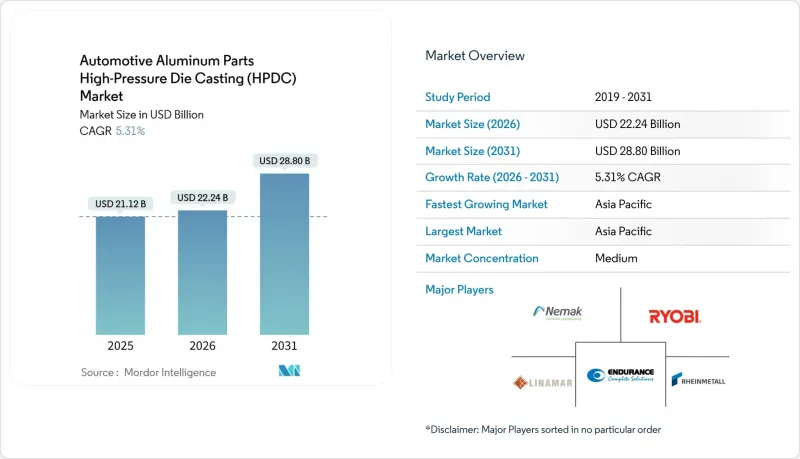
Mordor Intelligence에 의하면, 자동차용 알루미늄 부품 고압 다이캐스트(HPDC) 시장 규모는 2025년 211억 2,000만 달러로 평가되었습니다. 2026년에는 222억 4,000만 달러로 확대되어 2031년까지 288억 달러에 이를 것으로 예상되며 CAGR은 5.31%를 나타낼 전망입니다.
본 보고서는 용도 유형별(화이트 바디 부품, 섀시 부품 등), 차량 유형별(승용차, 소형 상용차 등), 제조 공정별(설계 엔지니어링, 다이캐스팅 등), 최종 용도별(OEM, 애프터마켓 공급업체), 주조 재료별 및 지역별로 분류되어 있습니다. 시장 전망은 금액(달러) 기준으로 제시되어 있습니다.
세계의 자동차용 알루미늄 부품 고압 다이캐스트(HPDC) 시장 동향 및 인사이트
OEM을 통한 경량화 및 배기가스 규제
2031년까지 미국에서 50.4 mpg를 목표로 하는 기업 평균 연비(CAFE) 규제와, 유럽연합(EU)이 정한 CO₂ 배출량 1g/km당 95유로(약 109달러)의 차량군 상한 규제는 과도한 배출에 대해 벌금을 부과하는 것으로, 자동차 제조업체들은 강재 대신 알루미늄을 채택할 수밖에 없는 상황에 놓여 있습니다. 이를 통해 부품당 질량을 대폭 줄일 수 있게 됩니다. 제너럴 모터스(GM)는 알루미늄의 평균 사용률을 높일 계획이며, 이는 장기적인 전략적 전환을 강조하는 것입니다. 고압 다이캐스트(HPDC) 기술을 통해 복잡한 형상의 성형이 가능해졌으며, 배터리 트레이와 크로스 멤버를 단일 부품으로 제조할 수 있게 됨에 따라 60곳 이상의 용접을 줄일 수 있습니다. OEM의 조달 담당 임원은 경량화를 통해 배출량 규제 위반에 따른 벌금을 피할 수 있을 뿐만 아니라, 구동용 배터리 팩의 소형화도 가능해지기 때문에 알루미늄의 높은 재료비를 감수하고 있습니다. 전 세계적으로 규제가 강화되는 가운데, 자동차용 알루미늄 부품 HPDC 시장은 모든 신형 차량 플랫폼으로부터 지속적인 수요 파급 효과를 얻고 있습니다.
전기자동차용 배터리 하우징 및 E-드라이브 수요 급증
전기자동차 판매 대수는 2025년에 2,000만 대를 넘어섰으며, 2031년까지 큰 폭의 성장이 예상에 따라, 셀을 보호하고 열을 방출하는 열전도성 알루미늄 케이스에 대한 수요가 증가하고 있습니다. 테슬라는 4680 셀을 대형 구조용 주물에 직접 통합하여 차량의 무게를 줄이면서도 비틀림 강성을 향상시키고 있습니다. BYD 등 중국의 주요 제조업체들도 이 개념을 따르고 있으며, 셀과 팩의 평탄성을 확보하기 위해 0.1mm의 가공 공차를 지정하고 있습니다. E-드라이브의 고정자 하우징에는 더 높은 열전도율을 실현하는 실리콘을 풍부하게 함유한 A380계 합금이 채택되어 있으며, 이는 합금 개발과 주조 기술의 혁신이 얼마나 조화를 이루며 진행되고 있는지를 보여줍니다. 이러한 각 개발은 HPDC의 자동차용 알루미늄 부품의 목표 시장을 확대되고 있습니다.
알루미늄과 에너지 가격의 변동
2025년, LME 현물 가격이 변동하면서 6개월간 고정 가격 공급 계약의 마진을 압박했습니다. 1차 알루미늄 생산 비용에서 에너지가 큰 비중을 차지하기 때문에 지정학적 혼란 이후 유럽에서 천연가스 가격이 급등하면서 제련소에 어려움을 초래했고, 이로 인해 해당 지역공급량이 감소했습니다. 다이캐스팅 제조업체는 강판 프레스 가공 업체에 비해 1kg당 전력 소비량이 많기 때문에 EBIT 마진을 크게 잠식할 정도의 에너지 가격 급등에 더 취약합니다. 선물 곡선은 불과 18개월 후까지만 적용되기 때문에 헤지를 통한 리스크 완화 효과는 제한적이며, 많은 1차 공급업체들은 계약에 가격 인상 조항을 포함시킬 수밖에 없는 실정입니다. 이러한 가격 변동은 자동차용 알루미늄 부품 HPDC 시장의 단기 성장 전망을 둔화시키고 있습니다.
부문별 분석
화이트 바디 부품은 2025년 수요의 45.18%를 차지하며, 자동차용 알루미늄 부품 HPDC 시장에서 가장 큰 점유율을 차지했습니다. 기가캐스팅 기술을 통해 용접을 많이 사용하는 171개의 강철 부품으로 구성된 조립 라인이 2개의 일체형 구조로 축소되어, 비틀림 강성이 향상되고 타크트 타임이 단축됩니다. 예측 기간 동안 메르세데스-벤츠와 토요타가 테슬라에 이어 구조용 주조 프로그램을 발표함에 따라, 이 부문은 연평균 성장률(CAGR) 6.12%로 성장할 전망입니다. 섀시 모듈은 알루미늄의 강성 대 질량 비율의 이점을 누리는 서스펜션 암과 서브프레임에 의해 견인되며, 전체에서 미미한 비중을 차지하고 있습니다.
경트럭의 싱글 스피드 기어박스나 상용 전기자동차의 멀티 스피드 기어박스는 내연기관의 감소에도 불구하고 변속기 하우징에 대한 수요를 지탱하고 있습니다. 엔진 마운트, 크로스 멤버, 히트 실드와 같은 소형 구조 부품은 저NVH 고급차 모델에서 알루미늄의 진동 감쇠 효과가 활용됨에 따라 수요가 점차 확대되고 있습니다. 이러한 동향들이 맞물리면서, 중기적으로는 자동차용 알루미늄 부품 HPDC 시장을 강화하게 될 것입니다.
2025년 출하량의 75.03%를 승용차가 차지하며, 자동차용 알루미늄 부품 HPDC 시장의 기반을 형성했습니다. 높은 생산량과 빠른 모델 연식 변경으로 인해 금형의 가동률은 높은 수준을 유지하고 있으며, 주조 공정의 추가적인 자동화가 촉진되고 있습니다. 한편, 소형 상용차는 전자상거래 거점에서 알루미늄 배터리 보호 장갑을 장착한 도시 배송용 밴에 대한 수요가 증가하고 있어 7.62%라는 가장 높은 연평균 성장률(CAGR)을 기록하고 있습니다.
중형 및 대형 트럭의 경우, 알루미늄 채택에 따른 투자 수익률(ROI)과 적재량 제한 간의 균형을 검토하고 있습니다. 선단 관리자는 추가 팔레트 1개 분량의 화물을 적재할 수 있게 된다면, 초기 비용이 높아지더라도 이를 수용하고 있습니다. 지역별 차이는 여전히 존재합니다. 유럽의 운송업체들은 탄소세에 대응하기 위해 알루미늄 사용을 확대하고 있는 반면, 아시아의 일부 차량 함대에서는 여전히 저비용의 강재가 선호되고 있습니다. 그렇긴 하지만, 전동화 의무화로 인해 조달 동향이 점차 경량 소재로 전환됨에 따라, 자동차용 알루미늄 부품 HPDC 시장의 장기적인 전망은 밝아질 것입니다.
지역별 분석
아시아태평양은 2025년 매출의 57.04%를 차지했으며, 이는 보크사이트 광산에서 최종 차량 조립에 이르기까지의 깊은 수직 통합을 반영했습니다. 중국의 자동차 제조업체들은 기가캐스팅 도입을 주도하고 있는 반면, 인도의 기업들은 국내 다이캐스팅 투자를 촉진하는 ‘생산 연계형 인센티브(PLI)’를 활용하고 있습니다. 일본과 한국공급업체들은 레오-HPDC 생산 라인을 공동 개발하여, 그 기술을 지역 전체에 수출하고 있습니다. 도시화, 라스트 마일 배송 수요, 그리고 유로 6에 상응하는 배기가스 규제 강화가 맞물리면서 연평균 성장률(CAGR)은 7.02%를 기록했으며, 이는 자동차용 알루미늄 부품 HPDC 시장에서 아시아태평양의 주도적 입지를 더욱 공고히 하고 있습니다.
북미에서는 USMCA(미국·멕시코·캐나다 협정)의 컨텐츠 규제로 인해 지역 내 조달이 장려됨에 따라, 2031년까지 상당한 연평균 성장률(CAGR)이 예상됩니다. 네맥사의 미시간주 확장 사업과 리나마사의 테네시주 생산 라인은 이러한 정책적 호재를 활용하고 있는 반면, 테슬라의 텍사스주 기가팩토리는 국내에서의 대규모 생산을 입증하고 있습니다. 연방 정부의 인프라 자금을 통해 경량 부품 생산 거점에 전력망 용량이 증설됨에 따라, 에너지 집약적인 파운드리의 전력 비용이 절감되고 있습니다. 이러한 요인들이 복합적으로 작용함에 따라, 북미 및 남미 지역의 자동차용 알루미늄 부품 HPDC 시장은 지속적인 성장이 예상됩니다.
유럽은 2025년 매출에 크게 기여했으며, 최고 수준의 주조 품질을 요구하는 프리미엄 브랜드들에 의해 그 기반이 공고히 다져졌습니다. 순환형 경제에 관한 지침에 따라 재활용 소재의 사용이 의무화됨에 따라, 주조 업체들은 폐쇄형 스크랩 회수 시스템의 도입을 요구받고 있습니다. 특정 구조 부재의 경우, 첨단 고장력 강재가 여전히 강력한 경쟁자이지만, 배터리식 전기자동차 플랫폼에서는 알루미늄이 주류로 자리 잡고 있습니다. 또한, 각 OEM 업체들이 지정학적 리스크 노출을 줄이기 위해 공급망의 지역화 재편을 지지하고 있어, EU 역내로의 신규 투자가 촉진되고 있으며, 이는 자동차용 알루미늄 부품 HPDC 업계의 전망을 뒷받침하고 있습니다.
기타 혜택 :
- 엑셀 형식 시장 예측(ME) 시트
- 3개월간의 애널리스트 지원
자주 묻는 질문
목차
제1장 서론
제2장 조사 방법
제3장 주요 요약
제4장 시장 구도
제5장 시장 규모 및 성장 예측
제6장 경쟁 구도
제7장 시장 기회 및 향후 전망
KTH 26.06.29According to Mordor Intelligence, the automotive aluminum parts High-Pressure Die Casting (HPDC) market size is expected to increase from USD 21.12 billion in 2025 to USD 22.24 billion in 2026 and reach USD 28.80 billion by 2031, progressing at a 5.31% CAGR.
This report is Segmented by Application Type (Body-In-White Components, Chassis Parts, and More), Vehicle Type (Passenger Cars, Light Commercial Vehicles, and More), Manufacturing Process (Design Engineering, Die Casting, and More), End Use (OEMs, Aftermarket Suppliers), Casting Material, and Geography. The Market Forecasts are Provided in Terms of Value (USD).
Global Automotive Aluminum Parts High-Pressure Die Casting (HPDC) Market Trends and Insights
OEM Lightweighting and Emission Mandates
Corporate Average Fuel Economy rules targeting 50.4 mpg in the United States by 2031 and the European Union's EUR 95 (~USD 109) per gram CO2/km fleet ceiling penalize excess emissions, forcing automakers to substitute steel for aluminum, which reduces mass per part by a significant amount . General Motors plans to lift average aluminum content, underscoring a long-term strategic shift. High-pressure die casting (HPDC) enables complex geometries, allowing battery trays and cross-members to emerge as single pieces that eliminate upwards of 60 welds. OEM purchasing executives accept aluminum's material premium because weight savings avoid carbon fines and enable smaller traction-battery packs. As regulations tighten globally, the Automotive aluminum parts HPDC market gains recurring pull-through from every new vehicle platform.
EV Battery-Housing and E-Drive Demand Surge
EV sales exceeded 20 million units in 2025 and are tracking toward significant growth by 2031, intensifying the need for thermally conductive aluminum enclosures that shield cells and dissipate heat . Tesla integrates 4680 cells directly into large structural castings, trimming vehicle mass while boosting torsional rigidity. Chinese leaders such as BYD replicate the concept, specifying 0.1 mm machining tolerances to secure cell-to-pack flatness. E-drive stator housings rely on silicon-rich A380 variants that deliver higher thermal conductivity, illustrating how alloy development and casting innovation advance in lockstep. Each of these developments widens the addressable market for HPDC Automotive aluminum parts.
Aluminum and Energy Price Volatility
LME cash prices fluctuated during 2025, compressing margins on six-month fixed-price supply contracts. Energy accounts for a significant share of primary aluminum costs, so the spike in European natural gas prices after geopolitical disruptions squeezed smelters, trimming regional supply. Die casters add more electricity per kilogram than steel stampers, exposing them to tariff shocks that erase notable EBIT margins. Hedging mitigates only limited exposure since forward curves extend merely 18 months, compelling many tier-ones to incorporate price-escalation clauses. Such volatility tempers near-term growth expectations for the Automotive aluminum parts HPDC market.
Other drivers and restraints analyzed in the detailed report include:
- Gigacasting Presses Enable Large Structural Castings
- Circular-Economy Push for Recycled Aluminum
- Advanced High-Strength-Steel Structural Alternatives
For complete list of drivers and restraints, kindly check the Table Of Contents.
Segment Analysis
Body-in-white parts accounted for 45.18% of 2025 demand, the largest slice of the Automotive aluminum parts HPDC market. Gigacasting trims assembly lines from 171 weld-intensive steel parts to two monolithic structures, raising torsional rigidity and curtailing takt time. Over the forecast horizon, this segment will expand at a 6.12% CAGR, as Mercedes-Benz and Toyota join Tesla in announcing structural cast programs. Chassis modules capture a modest share, propelled by suspension arms and sub-frames that benefit from aluminum's stiffness-to-mass ratio.
Single-speed gearboxes in light trucks and multi-speed boxes in commercial EVs sustain transmission-housing demand even as internal-combustion engines decline. Smaller structural items-engine mounts, cross-members, and heat shields-capture incremental gains given aluminum's vibration-damping benefits in low-NVH luxury models. These dynamics collectively fortify the Automotive aluminum parts HPDC market over the mid-term.
Passenger cars accounted for 75.03% of 2025 shipments, forming the cornerstone of the Automotive aluminum parts HPDC market. High production volumes and rapid model-year changeovers keep tooling utilization high, encouraging further casting automation. Meanwhile, light commercial vehicles notch the fastest 7.62% CAGR as e-commerce hubs demand urban-delivery vans outfitted with substantial aluminum battery armor.
Medium-duty and heavy-duty trucks weigh ROI for aluminum against payload limits; fleet managers accept a higher up-front cost if it unlocks an extra pallet of freight. Regional divergence persists: European haulers pursue aluminum to satisfy carbon taxes, whereas some Asian fleets still favor low-cost steel. Nonetheless, electrification mandates will gradually tilt procurement toward lightweight materials, enhancing the long-range prospects of the Automotive aluminum parts HPDC market.
Geography Analysis
Asia-Pacific commanded 57.04% of 2025 turnover, reflecting deep vertical integration from bauxite mines to final vehicle assembly. Chinese automakers spearhead gigacasting adoption, while Indian firms draw on Production-Linked Incentives that encourage local die-casting investments. Japanese and Korean suppliers co-develop rheo-HPDC lines and export the technology across the region. Urbanization, last-mile delivery demand, and tightening Euro 6-equivalent emission rules combine to yield a 7.02% CAGR, reinforcing Asia-Pacific's leadership in the Automotive aluminum parts HPDC market.
North America will see a notable CAGR through 2031 as USMCA content rules reward regional sourcing. Nemak's Michigan expansion and Linamar's Tennessee line tap that policy tailwind, while Tesla's Texas gigafactory demonstrates domestic scale. Federal infrastructure funding channels additional power-grid capacity toward lightweight-component corridors, lowering electricity costs for energy-intensive casting shops. Together, these drivers spell durable growth for the Automotive aluminum parts HPDC market in the Americas.
Europe contributed significantly to 2025 revenue, cemented by premium brands that demand top-tier cast integrity. Circular-economy directives force recycled content, spurring foundries to adopt closed-loop scrap collection. Advanced high-strength steel remains a formidable rival in certain structural nodes, yet battery-electric platforms lean toward aluminum. Supply-chain re-localization also gains favor as OEMs cut exposure to geopolitical risk, channeling new investment within the bloc and supporting the Automotive aluminum parts HPDC industry outlook.
- Nemak, S.A.B. de C.V.
- Rheinmetall AG
- Linamar Corporation
- Endurance Technologies Limited
- Bocar Group
- Gibbs Die Casting Corporation
- Martinrea International Inc.
- Pace Industries, LLC
- Dynacast International LLC
- Ryobi Die Casting Inc.
- Rockman Industries Ltd.
- Guangdong Hongtu Technology (Holdings) Co., Ltd.
- Samkee Corp.
- Rane Holdings Limited
- LCN
- DL Motors Co., Ltd.
Additional Benefits:
- The market estimate (ME) sheet in Excel format
- 3 months of analyst support
TABLE OF CONTENTS
1 Introduction
- 1.1 Study Assumptions & Market Definition
- 1.2 Scope of the Study
2 Research Methodology
3 Executive Summary
4 Market Landscape
- 4.1 Market Overview
- 4.2 Market Drivers
- 4.2.1 OEM Lightweighting and Emission Mandates
- 4.2.2 EV Battery-Housing and E-Drive Demand Surge
- 4.2.3 Gigacasting Presses Enable Large Structural Castings
- 4.2.4 Circular-Economy Push for Recycled Aluminum
- 4.2.5 Vacuum-Assisted HPDC and Deburring Automation Lift Yields
- 4.2.6 Rheo-HPDC Opens High-TC Wrought-Alloy Opportunities
- 4.3 Market Restraints
- 4.3.1 Aluminum and Energy Price Volatility
- 4.3.2 Advanced High-Strength-Steel Structural Alternatives
- 4.3.3 Crash-Repair Complexity of Giga-Cast Modules
- 4.3.4 Corrosion Risks in Recycled-Alloy Structural Parts
- 4.4 Value / Supply-Chain Analysis
- 4.5 Regulatory Landscape
- 4.6 Technological Outlook
- 4.7 Porter's Five Forces
- 4.7.1 Threat of New Entrants
- 4.7.2 Bargaining Power of Suppliers
- 4.7.3 Bargaining Power of Buyers
- 4.7.4 Threat of Substitutes
- 4.7.5 Competitive Rivalry
5 Market Size & Growth Forecasts (Value (USD))
- 5.1 By Application Type
- 5.1.1 Body-in-White Components
- 5.1.2 Chassis Parts
- 5.1.3 Transmission Components
- 5.1.4 Other Structural Parts
- 5.2 By Vehicle Type
- 5.2.1 Passenger Cars
- 5.2.2 Light Commercial Vehicles
- 5.2.3 Medium and Heavy Commercial Vehicles
- 5.3 By Manufacturing Process
- 5.3.1 Design Engineering
- 5.3.2 Die Casting
- 5.3.3 Surface Treatment
- 5.3.4 Assembly
- 5.4 By End Use
- 5.4.1 OEMs
- 5.4.2 Aftermarket Suppliers
- 5.5 By Casting Material
- 5.5.1 Primary Aluminum Alloys
- 5.5.2 Recycled Aluminum Alloys
- 5.6 By Geography
- 5.6.1 North America
- 5.6.1.1 United States
- 5.6.1.2 Canada
- 5.6.1.3 Rest of North America
- 5.6.2 South America
- 5.6.2.1 Brazil
- 5.6.2.2 Argentina
- 5.6.2.3 Rest of South America
- 5.6.3 Europe
- 5.6.3.1 Germany
- 5.6.3.2 United Kingdom
- 5.6.3.3 France
- 5.6.3.4 Italy
- 5.6.3.5 Spain
- 5.6.3.6 Rest of Europe
- 5.6.4 Asia-Pacific
- 5.6.4.1 China
- 5.6.4.2 India
- 5.6.4.3 Japan
- 5.6.4.4 South Korea
- 5.6.4.5 Rest of Asia-Pacific
- 5.6.5 Middle East and Africa
- 5.6.5.1 United Arab Emirates
- 5.6.5.2 Saudi Arabia
- 5.6.5.3 South Africa
- 5.6.5.4 Turkey
- 5.6.5.5 Rest of Middle East and Africa
- 5.6.1 North America
6 Competitive Landscape
- 6.1 Market Concentration
- 6.2 Strategic Moves
- 6.3 Market Share Analysis
- 6.4 Company Profiles (includes Global Level Overview, Market Level Overview, Core Segments, Financials as Available, Strategic Information, Market Rank/Share for Key Companies, Products and Services, SWOT Analysis, and Recent Developments)
- 6.4.1 Nemak, S.A.B. de C.V.
- 6.4.2 Rheinmetall AG
- 6.4.3 Linamar Corporation
- 6.4.4 Endurance Technologies Limited
- 6.4.5 Bocar Group
- 6.4.6 Gibbs Die Casting Corporation
- 6.4.7 Martinrea International Inc.
- 6.4.8 Pace Industries, LLC
- 6.4.9 Dynacast International LLC
- 6.4.10 Ryobi Die Casting Inc.
- 6.4.11 Rockman Industries Ltd.
- 6.4.12 Guangdong Hongtu Technology (Holdings) Co., Ltd.
- 6.4.13 Samkee Corp.
- 6.4.14 Rane Holdings Limited
- 6.4.15 LCN
- 6.4.16 DL Motors Co., Ltd.
7 Market Opportunities & Future Outlook
- 7.1 White-Space & Unmet-Need Assessment