|
시장보고서
상품코드
2113383
유럽의 자동차 부품 다이캐스팅 : 시장 점유율 분석, 업계 동향과 통계, 성장 예측(2026-2031년)Europe Automotive Parts Die Casting - Market Share Analysis, Industry Trends & Statistics, Growth Forecasts (2026 - 2031) |
||||||
 Mordor Intelligence
Mordor Intelligence에 따르면 유럽의 자동차 부품 다이캐스팅 시장 규모는 2025년에 161억 1,000만 달러로 평가되며, 2026년 169억 7,000만 달러에서 2031년까지 219억 8,000만 달러에 달할 것으로 예측되며, 예측 기간(2026-2031년) 동안 CAGR은 5.32%가 될 전망입니다.
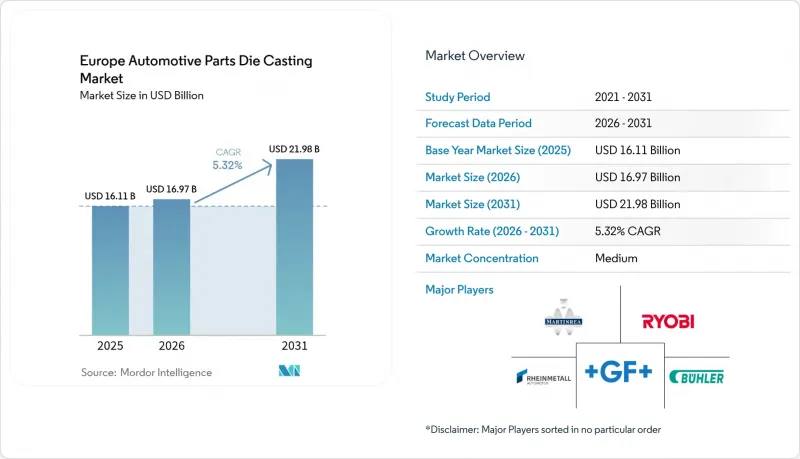
본 보고서는 생산 공정 유형(고압 다이캐스팅, 진공 HPDC 등), 금속 종류(알루미늄 등), 용도(엔진 및 파워트레인 부품 등), 차량 유형(승용차 등), 추진 방식(내연기관(ICE) 등), 주조 크기(소형 등) 및 국가별로 분류되어 있습니다. 시장 전망은 금액(달러) 기준으로 제시되어 있습니다.
유럽 자동차 부품 다이캐스팅 시장의 동향 및 인사이트
EV 주도 하에 대형 ‘기가캐스트’ 구조 부품으로의 전환
유럽의 각 OEM 업체들은 최대 100개의 소형 프레스 부품을 100kg을 초과하는 단일 알루미늄 구조 부품으로 통합하는 ‘기가캐스트’를 채택하고 있으며, 이를 통해 용접 부위와 필요한 바닥 면적을 줄이고 있습니다. 볼보의 예테보리 공장과 메르세데스-벤츠의 브레멘 생산 라인에서는 이미 6,000t을 초과하는 클램핑력을 가진 프레스 기계가 가동되고 있습니다. 이러한 전환으로 인해 유럽 자동차 부품 다이캐스팅 시장에서 메가캐스팅의 점유율이 높아지고, OEM과 주조 업체 간의 기술 협력이 더욱 긴밀해지는 한편, 다수의 프레스 설비에 대한 투자 자금을 조달할 수 있는 공급업체들에게도 혜택이 돌아가고 있습니다. 테슬라가 최근 차세대 기가캐스트의 레이아웃을 재검토한 것은 기술적 과제를 부각시키고 있지만, 유럽의 주조 업체들은 OEM의 충돌 안전 성능 목표를 충족하기 위해 진공 배기, 균열 감지 및 열처리 시스템에 대한 투자를 계속하고 있습니다. 자본 집약도가 높기 때문에 지역적 재편이 가속화되고 있습니다. 이는 소규모 가족 경영 주조소가 메가 프레스 도입 자금을 조달하는 데 어려움을 겪고 있기 때문입니다. 중기적으로는 기가캐스팅을 통해 프레스 톤당 가동률이 향상되고, 주조 공장의 수익이 기존의 파워트레인 부품 이외의 분야로도 확대될 것으로 예상됩니다.
EU의 CO2 및 수명주기 탄소 규제 강화
2026년에 발효되는 유로 7 규제 체계에서는 배기가스 규제에 더해 배터리 내구성과 소재 재활용 기준이 결합되어 있어, 각 OEM 업체들은 재활용된 저탄소 알루미늄 빌렛을 우선적으로 채택할 수밖에 없는 상황입니다. 따라서 다이캐스팅 제조업체는 ISO 14040/14044를 준수하는 수명주기 평가를 기록해야 하며, 그렇지 않을 경우 조달 입찰에서 탈락할 위험이 있습니다. 이미 폐쇄형 합금 회수 시스템을 운영하고 있는 주조소는 우선 공급업체 지위를 확보할 수 있는 반면, 1차 금속을 조달하고 있는 동종 업계 경쟁사들은 이익률 하락에 직면하게 될 것입니다. 또한, 이 규제는 배기가스 이외의 입자상 물질에 대해서도 적용 범위를 확대하고 있어, 브레이크, 서스펜션, 화이트 바디의 재설계를 촉진하게 될 것입니다. 이러한 요건으로 인해, 충돌 시험 및 부식 시험 기준을 충족하는 기공이 없는 얇은 두께의 주물에 대한 향후 수년간의 수요 전망이 서 있습니다. 과도기를 두는 것으로, 지역에 뿌리를 둔 기존 주조 제조업체에게는 탈가스 스테이션이나 대체 플럭스 도입을 위한 개조 시간을 부여하지만, 대응이 늦어진 기업에게는 벌금이 부과되거나 재료 재활용 업체와의 합작 사업이 의무화됩니다.
알루미늄 현물 가격 변동과 고정 가격의 RFQ(견적 요청)
유럽 주조 공장의 이익률은 LME(런던 금속 거래소)의 현물 가격과 자동차 제조업체로부터 확보한 12-24개월치 RFQ(견적 요청) 간의 격차에 따라 확대되거나 축소됩니다. 최근의 에너지 가격 급등과 잠재적인 무역 제재는 빌렛의 안정적인 공급을 위협하고 있으며, 주조 공장은 높은 수준의 프리미엄으로 헤지를 하거나 원자재 가격 상승분을 흡수할 것인지 선택해야 하는 상황에 직면해 있습니다. 재무 기반이 제한적인 소규모 시설은 유동성 부족에 직면해 있으며, 업계 재편이 가속화될 가능성이 있습니다. 일부 공급업체는 새로운 RFQ에 조정 조항을 포함시켜 대응하고 있지만, OEM 각사는 부품표(BOM) 예측을 보호하기 위해 변동 가격제에 저항하고 있습니다. 재고 완충 장치는 일시적인 해결책이 될 수 있지만, 운전자금을 묶어두고 보험 비용을 상승시키기 때문에 역동적인 조달 전략의 필요성이 부각되고 있습니다.
부문 분석
고압 다이캐스팅은 대량 생산 부품에서의 생산성 우위 덕분에 2025년 유럽 자동차 부품 다이캐스팅 시장에서 62.12%의 점유율을 유지했습니다. 그러나 진공 HPDC는 연평균 성장률(CAGR) 6.71%로 시장을 주도할 것으로 예상되며, 이는 배터리 하우징 및 섀시 노드용 무기공 구조가 OEM에 수용되고 있음을 반영합니다. 진공 HPDC에 기인한 유럽 자동차 부품 다이캐스팅 시장 규모는 경량 구조 용도에서 직접적인 이점을 가져다주고 있습니다.
클램핑 힘에 대한 요구 사항이 높아짐에 따라, 주조 제조업체들은 용존 가스를 줄이고 용접 후 열처리가 가능하도록 하는 다단계 배기 시스템으로의 업그레이드를 진행하고 있습니다. 실시간 압력 모니터링에 대한 투자를 통해 결함 감지 피드백 루프가 단축되고, 스크랩 발생 시간이 감소합니다. 표준 HPDC는 엔진 블록의 대량 생산에 있어 여전히 경제적이지만, 내연기관(ICE) 수요가 정체된 가운데, 수익 창출의 가능성은 부가가치가 높은 기가 캐스팅으로 이동하고 있습니다. 스퀴즈 주조 및 반고체 주조 공정은 고급 브레이크 캘리퍼와 같은 틈새 시장에서 여전히 중요한 위치를 차지하고 있으며, 뛰어난 기계적 특성이 사이클 타임의 단점을 상쇄하고 있습니다. 공정 구성의 변화는 인건비뿐만 아니라 기술 사양이 유럽의 경쟁력을 결정짓고 있음을 보여줍니다.
알루미늄은 밀도, 비용, 그리고 성숙한 재활용 경로의 균형이 뛰어나 2025년 유럽 자동차 부품 다이캐스팅 시장 규모에서 75.12%의 점유율을 차지했습니다. 이 부문은 버진 소재 사용에 페널티를 부과하는 순환 경제 규제의 뒷받침을 받아 유럽 자동차 부품 다이캐스팅 시장 규모의 상당 부분을 차지했습니다. 한편, 마그네슘은 2031년까지 연평균 성장률(CAGR) 9.25%가 될 전망입니다. 합금 조성의 기술적 진보로 인해 부식에 대한 우려가 줄어들었고, 강성을 저하시키지 않으면서 두께를 얇게 만들 수 있게 되었습니다.
배터리 팩 하우징이나 스티어링 칼럼 브래킷의 경우, 셀의 무게를 상쇄하고 BEV의 주행 거리를 향상시키기 위해 마그네슘 사용이 점점 더 지정되고 있습니다. 아연 및 특수 합금은 인장 강도보다 치수 정밀도가 요구되는 인포테인먼트용 하우징 및 센서 브래킷에 사용되고 있습니다. 유럽에서 더 대형의 기가 프레스가 도입됨에 따라, 구조용 마그네슘 합금이 가연성 시험을 통과한다면 합금의 종류는 더욱 다양해질 가능성이 있습니다. 1차 마그네슘의 대부분은 EU 역외에서 생산되고 있어 공급 안정성은 여전히 불투명하지만, 스크랩 회수 경로가 정비됨에 따라 위험의 일부는 완화되고 있습니다.
기타 혜택:
- 엑셀 형식의 시장 예측(ME) 시트
- 3개월간의 애널리스트 지원
자주 묻는 질문
목차
제1장 소개
제2장 조사 방법
제3장 주요 요약
제4장 시장 구도
제5장 시장 규모와 성장 예측
제6장 경쟁 구도
제7장 시장 기회와 향후 전망
KSM 26.08.25According to Mordor Intelligence, the European automotive die casting market size was valued at USD 16.11 billion in 2025 and estimated to grow from USD 16.97 billion in 2026 to reach USD 21.98 billion by 2031, at a CAGR of 5.32% during the forecast period (2026-2031).
This report is Segmented by Production Process Type (High-Pressure Die Casting, Vacuum HPDC, and More), Metal Type (Aluminum and More), Application Type (Engine and Power-Train Parts and More), Vehicle Type (Passenger Cars and More), Propulsion Type (Internal Combustion Engine (ICE) and More), Casting Size (Small and More), and Country. The Market Forecasts are Provided in Terms of Value (USD).
Europe Automotive Parts Die Casting Market Trends and Insights
EV-Led Shift to Large "Gigacast" Structural Parts
European OEMs are adopting gigacasting to consolidate up to 100 smaller stampings into single 100 kg-plus aluminum structures, cutting weld points and floor-space requirements. Volvo's Gothenburg plant and Mercedes-Benz's Bremen line already operate presses exceeding 6,000 t clamping force. The transition elevates the share of mega-castings within the European automotive die casting market, encourages closer OEM-foundry engineering collaboration, and rewards suppliers capable of financing a large number of presses. While Tesla's recent reconsideration of its next-generation gigacast layout underlines technical hurdles, European foundries continue investing in vacuum evacuation, crack-detection, and heat-treatment systems to meet OEM crash-performance targets. The capital intensity is accelerating regional consolidation because smaller family-owned shops struggle to fund megapress installations. Over the medium term, gigacasting is expected to lift press-tonnage utilization rates and broaden foundry revenue beyond traditional powertrain parts.
Stricter EU CO2 and Lifecycle-Carbon Regulations
The Euro 7 framework, effective 2026, couples tailpipe limits with battery-durability and material-recycling thresholds, compelling OEMs to prioritize recycled low-carbon aluminum billets. Die casters, therefore, must record lifecycle assessments compliant with ISO 14040/14044 or risk losing sourcing bids. Foundries that already run closed-loop alloy recovery systems will achieve preferred-supplier status, whereas peers sourcing primary metal face margin dilution. The regulation also adds scope for non-exhaust particulates, driving brake, suspension, and body-in-white redesigns. These mandates provide multi-year demand visibility for porosity-free, thin-wall castings compatible with crash and corrosion criteria. Transition periods allow established regional foundries time to retrofit degassing stations and alternative fluxes, but laggards incur penalty fees or require joint ventures with material recyclers.
Spot Aluminum-Price Volatility vs Fixed-Price RFQs
European cast-house margins widen or compress depending on the mismatch between LME spot quotes and 12- to 24-month RFQs secured with automakers. Recent energy-price spikes and potential trade sanctions threaten consistent billet availability, forcing foundries to either hedge positions at elevated premiums or absorb raw-material inflation. Smaller facilities with limited balance-sheet strength face liquidity strain, potentially accelerating consolidation. Some suppliers respond by incorporating adjustment clauses into new RFQs, though OEMs resist variable pricing to protect bill-of-materials forecasts. Inventory buffers offer temporary relief but tie up working capital and raise insurance costs, underscoring the need for dynamic procurement strategies.
Other drivers and restraints analyzed in the detailed report include:
- ICE-EV Parallel Production Extending Tooling Demand
- OEM Push for In-House Alloy Recycling Loops
- Tightening PFAS and HF Gas Limits in EU Foundries
For complete list of drivers and restraints, kindly check the Table Of Contents.
Segment Analysis
High-pressure die casting retained a 62.12% European automotive die casting market share in 2025, thanks to its productivity advantage for high-volume parts. Vacuum HPDC, however, is forecast to outpace at a 6.71% CAGR, reflecting OEM acceptance of porosity-free structures for battery enclosures and chassis nodes. The European automotive die casting market size attributable to vacuum HPDC yields a direct gain in lightweight structural applications.
Rising clamping-force requirements motivate foundries to upgrade to multi-stage evacuation systems that reduce dissolved gases and enable post-weld heat treatment. Investments in real-time pressure monitoring shorten defect-detection feedback loops, reducing scrap times. Standard HPDC remains economical for engine block volumes, yet as ICE demand flattens, profit potential migrates to value-added gigacastings. Squeeze casting and semi-solid processes keep niche relevance for premium brake calipers, where superior mechanical properties offset cycle-time drawbacks. The shift in process mix illustrates how technical specifications, not just labor costs, define European competitiveness.
Aluminum commanded a 75.12% share of the European automotive die casting market size in 2025, given its balance of density, cost, and mature recycling paths. The segment captured a significant portion of the European automotive die casting market size, aided by circular-economy mandates that penalize virgin material. Magnesium, however, will post a 9.25% CAGR through 2031. Technological gains in alloy formulation attenuate corrosion concerns and allow thinner walls without sacrificing stiffness.
Battery-pack enclosures and steering-column brackets increasingly specify magnesium to offset cell weight, offering range benefits to BEVs. Zinc and specialty alloys serve infotainment housings and sensor brackets requiring dimensional accuracy rather than tensile strength. As Europe installs larger gigapresses, the alloy mix could widen further if structural magnesium alloys pass flammability tests. Supply security remains an open question because most primary magnesium originates outside the EU, but enhanced scrap-collection pathways mitigate part of the risk.
Complete Report Scope:
- By Production Process Type
- High-Pressure Die Casting (HPDC)
- Vacuum HPDC
- Squeeze Casting
- Semi-Solid Metal Casting
- Gravity and Low-Pressure Die Casting
- By Metal Type
- Aluminium
- Zinc
- Magnesium
- Others (Cu-, Fe-based alloys)
- By Application Type
- Engine and Power-train Parts
- Transmission Components
- Structural and Body-in-White Parts
- Battery Housings and e-Drive Casings
- Chassis and Suspension Components
- By Vehicle Type
- Passenger Cars
- Light Commercial Vehicles
- Heavy Commercial Vehicles
- Off-highway Vehicles
- By Propulsion Type
- Internal Combustion Engine (ICE)
- Hybrid Electric Vehicle (HEV)
- Plug-in Hybrid Electric Vehicle (PHEV)
- Battery Electric Vehicle (BEV)
- Fuel-Cell Electric Vehicle (FCEV)
- By Casting Size
- Small (Below 1 kg)
- Medium (1 to 10 kg)
- Large (10 to 100 kg)
- Mega-Castings (Above 100 kg)
- Country
- Germany
- United Kingdom
- France
- Italy
- Spain
- Russia
- Rest of Europe
List of Companies Covered in this Report:
- Nemak
- GF Casting Solutions
- Rheinmetall Automotive
- Ryobi Aluminium Casting
- Martinrea Honsel
- Buhler Prince (HPDC machines)
- Dynacast International
- Handtmann Megacasting
- DGS Druckguss Systeme
- Endurance Technologies
- Shiloh Industries
- Brabant Alucast
- Pace Industries
- Alucast S.p.A
- CIE Automotive
- Constellium Automotive Structures
- Tontarra Gusstechnik
- Alteams Group
Additional Benefits:
- The market estimate (ME) sheet in Excel format
- 3 months of analyst support
TABLE OF CONTENTS
1 Introduction
- 1.1 Study Assumptions and Market Definition
- 1.2 Scope of the Study
2 Research Methodology
3 Executive Summary
4 Market Landscape
- 4.1 Market Overview
- 4.2 Market Drivers
- 4.2.1 EV-Led Shift to Large "Gigacast" Structural Parts
- 4.2.2 Stricter EU CO? and Lifecycle-Carbon Regulations
- 4.2.3 ICE-EV Parallel Production Extending Tooling Demand
- 4.2.4 OEM Push for In-House Alloy Recycling Loops
- 4.2.5 Adoption of Multi-Stage Vacuum HPDC To Cut Porosity
- 4.2.6 OEM-Foundry Co-Development of Battery-Housing Castings
- 4.3 Market Restraints
- 4.3.1 Spot Aluminium-Price Volatility Vs Fixed-Price RFQs
- 4.3.2 Tightening PFAS And HF Gas Limits in EU Foundries
- 4.3.3 Foundry Labour Shortages in CEE and DACH Regions
- 4.3.4 OEM Re-Shoring Pressures Squeezing Tier-2 Margins
- 4.4 Value / Supply-Chain Analysis
- 4.5 Regulatory Landscape
- 4.6 Technological Outlook
- 4.7 Porter's Five Forces Analysis
- 4.7.1 Threat of New Entrants
- 4.7.2 Bargaining Power of Buyers
- 4.7.3 Bargaining Power of Suppliers
- 4.7.4 Threat of Substitutes
- 4.7.5 Intensity of Competitive Rivalry
5 Market Size and Growth Forecasts
- 5.1 By Production Process Type
- 5.1.1 High-Pressure Die Casting (HPDC)
- 5.1.2 Vacuum HPDC
- 5.1.3 Squeeze Casting
- 5.1.4 Semi-Solid Metal Casting
- 5.1.5 Gravity and Low-Pressure Die Casting
- 5.2 By Metal Type
- 5.2.1 Aluminium
- 5.2.2 Zinc
- 5.2.3 Magnesium
- 5.2.4 Others (Cu-, Fe-based alloys)
- 5.3 By Application Type
- 5.3.1 Engine and Power-train Parts
- 5.3.2 Transmission Components
- 5.3.3 Structural and Body-in-White Parts
- 5.3.4 Battery Housings and e-Drive Casings
- 5.3.5 Chassis and Suspension Components
- 5.4 By Vehicle Type
- 5.4.1 Passenger Cars
- 5.4.2 Light Commercial Vehicles
- 5.4.3 Heavy Commercial Vehicles
- 5.4.4 Off-highway Vehicles
- 5.5 By Propulsion Type
- 5.5.1 Internal Combustion Engine (ICE)
- 5.5.2 Hybrid Electric Vehicle (HEV)
- 5.5.3 Plug-in Hybrid Electric Vehicle (PHEV)
- 5.5.4 Battery Electric Vehicle (BEV)
- 5.5.5 Fuel-Cell Electric Vehicle (FCEV)
- 5.6 By Casting Size
- 5.6.1 Small (Below 1 kg)
- 5.6.2 Medium (1 to 10 kg)
- 5.6.3 Large (10 to 100 kg)
- 5.6.4 Mega-Castings (Above 100 kg)
- 5.7 Country
- 5.7.1 Germany
- 5.7.2 United Kingdom
- 5.7.3 France
- 5.7.4 Italy
- 5.7.5 Spain
- 5.7.6 Russia
- 5.7.7 Rest of Europe
6 Competitive Landscape
- 6.1 Market Concentration
- 6.2 Strategic Moves
- 6.3 Market Share Analysis
- 6.4 Company Profiles (Includes Global-level Overview, Market-level Overview, Core Segments, Financials, Strategic Information, Market Rank/Share, Products and Services, Recent Developments)
- 6.4.1 Nemak
- 6.4.2 GF Casting Solutions
- 6.4.3 Rheinmetall Automotive
- 6.4.4 Ryobi Aluminium Casting
- 6.4.5 Martinrea Honsel
- 6.4.6 Buhler Prince (HPDC machines)
- 6.4.7 Dynacast International
- 6.4.8 Handtmann Megacasting
- 6.4.9 DGS Druckguss Systeme
- 6.4.10 Endurance Technologies
- 6.4.11 Shiloh Industries
- 6.4.12 Brabant Alucast
- 6.4.13 Pace Industries
- 6.4.14 Alucast S.p.A
- 6.4.15 CIE Automotive
- 6.4.16 Constellium Automotive Structures
- 6.4.17 Tontarra Gusstechnik
- 6.4.18 Alteams Group
7 Market Opportunities and Future Outlook
- 7.1 White-space and Unmet-Need Assessment