

|
시장보고서
상품코드
2066524
종자 가공 기계 : 시장 점유율 분석, 업계 동향 및 통계, 성장 예측(2026-2031년)Seed Processing Machinery - Market Share Analysis, Industry Trends & Statistics, Growth Forecasts (2026 - 2031) |
||||||
 Mordor Intelligence
Mordor Intelligence에 의하면, 종자 가공 기계 시장 규모는 2025년에 44억 5,000만 달러로 평가되었습니다. 2026년 48억 달러에서 2031년까지 68억 7,000만 달러로 성장하여 2026년부터 2031년에 걸쳐 CAGR 7.6%를 나타낼 것으로 예측됩니다.
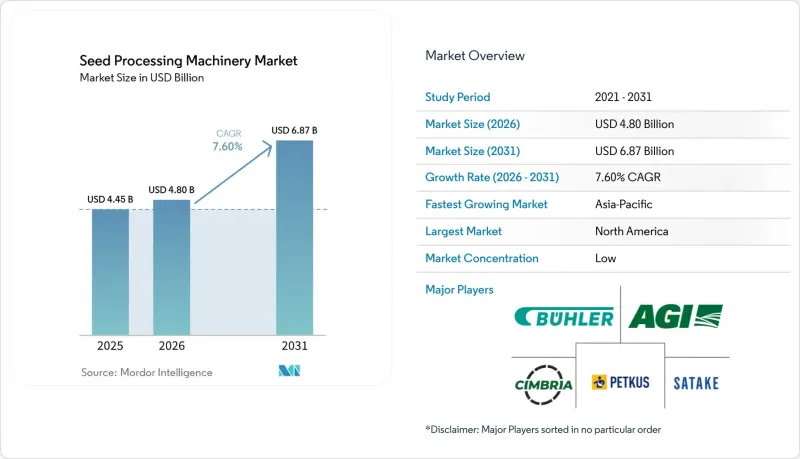
본 보고서는 기계의 유형(프리클리너, 클리너, 건조기, 선별기, 연마기, 광학 선별기, 종자 포장기 등), 가동 모드(자동 및 반자동), 최종 사용자(상업용 종자 가공 공장, 종자 생산자, 농장 내 시설 등), 지역(북미, 유럽 등)별로 분류되어 있습니다. 시장 전망은 금액(달러) 기준으로 제시되어 있습니다.
세계의 종자 가공 기계 시장 동향 및 분석
광학 선별 자동화를 통해 효율이 향상되고 인건비가 절감됩니다.
자동화를 통해 선별 및 결함 제거 공정에서 수작업 개입이 최소화됨에 따라, 종자 가공 기계 시장의 성능 기준이 향상되고 있습니다. 인공지능(AI)을 탑재한 광학 시스템은 단일 종자 수준에서 색상, 질감, 형태의 편차를 식별할 수 있으므로, 가공 업체는 생산 라인 속도를 저하시키지 않고도 순도를 높일 수 있습니다. 2025년 불러(Buhler)사가 ‘SORTEX AI700’을 출시한 것은 종자 및 곡물 분야에서의 검사 품질 향상을 목적으로 한 딥러닝 선별 시스템으로의 전환을 상징하는 사례입니다. 시장이 여러 기계적 공정에서 소수의 지능형 선별 장치로 전환됨에 따라, 각 라인의 생산성은 향상되는 반면, 예기치 못한 가동 중단에 대한 취약성도 커지고 있습니다. 이러한 추세는 종자 가공 기계 시장의 상업적 조달 분야에서 예측 유지보수, 원격 진단 및 견고한 서비스 계약의 중요성이 점점 더 커지고 있음을 여실히 보여주고 있습니다.
가공 및 부가가치가 더해진 종자에 대한 수요 증가
종자 가공 기계 시장은 기본적인 살균제 처리를 넘어선 기술 발전, 즉 생리활성 접종제, 미량 영양소 코팅, 특수 폴리머 필름 등에 힘입어 성장을 거듭하고 있습니다. 이러한 고부가가치 종자 제품에는 정밀한 코팅 균일성, 건조 제어 개선, 그리고 로트 분리 강화가 필수적입니다. 왜냐하면 처리 품질에 편차가 있으면 인증된 배치 전체의 성능이 저하될 우려가 있기 때문입니다. 2024년 10월, 인도의 ‘식용유·유지종자 국가 미션’은 1만 103카롤 루피(11억 9,000만 달러)를 지원하여 65곳의 새로운 종자 허브를 설립했습니다. 이로 인해 종자 처리, 코팅, 포장에 사용되는 장비에 대한 하류 시장의 직접적인 수요가 창출되었습니다. 또한, 가공 공정 전반에 걸쳐 로트의 무결성을 유지하기 위해 선별기, 포장기, 라벨 부착 시스템 등 부대 장비에 대한 수요도 증가하고 있습니다. 미생물의 생존율을 확보하기 위해 가공업체에는 전단력이 낮고 온도가 제어되는 코팅 및 건조 시스템이 요구되고 있어, 생물학적 처리의 보급이 장비 수요를 더욱 끌어올리고 있습니다.
스마트 기계의 높은 초기 비용
높은 초기 비용은 여전히 첨단 종자 가공 기계 도입에 있어 큰 걸림돌이 되고 있습니다. 구매자들은 첨단 광학 선별 시스템의 비용을 기존의 기계식 설비와 비교하는 경우가 많으며, 광학 선별기가 40%에서 60% 더 비싼 것으로 밝혀졌습니다. 또한, 자동화 제어, 연결 인프라, 감시 제어·데이터 수집(SCADA) 시스템과 관련된 비용이 프로젝트 전체의 투자액을 더욱 끌어올리고 있습니다. 이러한 재정적 과제는 농업용 대출 이용 기회가 제한적이고 설비 교체 주기가 긴 지역에서 특히 두드러집니다. 그 결과, 막대한 설비 투자가 필요하기 때문에 협동조합, 농장 차원의 가공업체 및 중소규모 상업 사업자들이 첨단 종자 가공 기계를 도입하는 데는 여전히 어려움이 따르고 있습니다.
부문별 분석
2025년, 종자 가공 기계 시장에서 클리너 부문의 점유율이 42.7%로 가장 높았습니다. 선별, 처리, 건조, 코팅, 포장 등 후속 공정을 시작하기 전에 1차 종자 세척이 필수적이기 때문에 클리너는 여전히 시장을 독점하고 있습니다. 에어스크린식 선별기는 뛰어난 확장성, 손쉬운 유지보수, 그리고 다양한 작물 유형 및 하류 설비 시스템과의 호환성 덕분에 널리 선호되고 있습니다. 또한, 수확 후 수분 관리 문제를 해결하고 있는 지역이나 생물학적 종자 처리 방식의 도입이 증가하고 있는 지역에서는 건조기 및 처리 시스템의 중요성이 커지고 있습니다. 선별기 부문은 전 세계의 대규모 다품목 처리 워크플로우를 관리하는 상업용 종자 공장, 곡물 취급 업체 및 통합형 종자 가공 시설에서 지속되는 수요의 혜택을 누리고 있습니다.
종자 가공 기계 시장에서 광학 선별기 부문은 2026년부터 2031년까지 7.6%라는 가장 높은 연평균 성장률(CAGR)을 기록하며 성장할 것으로 전망됩니다. 이러한 성장은 수출용 종자의 순도에 대한 수요 증가와 디지털 품질 관리 및 자동 결함 감지 기술에 대한 수요 증가에 힘입어 이루어지고 있습니다. 인공지능(AI)을 탑재한 이미지 처리 시스템 덕분에 고부가가치 종자 사업 분야의 처리 정밀도가 향상되고 오염 위험이 최소화됨에 따라, 광학 선별기의 활용이 확대되고 있습니다. 또한, 각 제조업체는 인증 요건을 충족하기 위해 선별 플랫폼에 규정 준수 모니터링, 추적성, 데이터 관리 기능을 통합하고 있습니다. 첨단 선별 시스템이 급속히 성장하고 있음에도 불구하고, 1차 종자 세척 공정이 전 세계 상업용 종자 가공 워크플로우의 운영 기반으로서 여전히 중요한 역할을 하고 있기 때문에 세척기는 여전히 주요 장비 범주에 속합니다.
지역별 분석
2025년, 북미의 종자 가공 기계 시장 점유율은 34.1%로 가장 높은 비중을 차지했습니다. 이 지역은 확립된 상업용 종자 산업, 정밀 종자 처리 기술의 광범위한 도입, 그리고 대규모 줄 재배 시스템의 혜택을 누리고 있습니다. 옥수수나 대두의 대규모 재배가 첨단 종자 세척, 등급 선별 및 광학 선별 시스템에 대한 강력한 수요를 이끌고 있습니다. 미국과 캐나다의 상업용 종자 기업들은 추적성 향상, 순도 기준 준수, 수출 규정 준수를 도모하기 위해 통합형 처리 인프라에 대한 투자를 확대되고 있습니다. 활발한 업데이트 수요, 디지털 프로세스의 통합, 확립된 종자 인증 시스템과 같은 요인들이 상업용 종자 처리 장비 및 인프라 개발 분야에서 북미가 전 세계적으로 주도적인 위치를 계속 유지하도록 뒷받침하고 있습니다.
아시아태평양의 종자 가공 기계 시장 규모는 2026년부터 2031년에 걸쳐 연평균 성장률(CAGR) 8.1%라는 가장 높은 성장률을 기록하며 확대될 것으로 전망됩니다. 이러한 성장은 중국, 인도, 동남아시아 전역에서 인증 종자의 보급 확대, 정부가 지원하는 농업 현대화 이니셔티브, 그리고 상업용 가공 인프라에 대한 투자 증가에 힘입어 이루어지고 있습니다. 종자 허브, 가공 시설 및 곡물 취급 인프라에 대한 공공 자금 투입으로 인해, 해당 지역 전체에서 최신 세척, 건조, 선별 시스템의 도입이 가속화되고 있습니다. 또한, 상업 농업의 부상과 고품질 인증 종자에 대한 수요 증가가 가공 업무의 현대화를 촉진하고 있습니다. 일본, 호주, 한국 등 농업 선진국에서는 상업용 종자 생산 네트워크 분야에서 광학 선별, 디지털 규정 준수 시스템 및 자동 가공 기술에 주력하고 있습니다.
남미는 수출 지향형 농업과 밀접한 관련이 있는 브라질과 아르헨티나에서 진행되고 있는 대규모 곡물 및 유지종자 증산 활동 덕분에 여전히 중요한 성장 지역으로 자리 잡고 있습니다. 유엔 식량농업기구(FAO)에 따르면, 에티오피아의 ‘2024-2030년 수확 후 관리 전략’에서는 수확 후 기계화 및 가공 기술 도입에 143억 에티오피아 부르(2억 6,600만 달러)가 배정되어 있습니다. 이 사업은 종자 및 곡물 인프라의 광범위한 현대화를 지원하는 것입니다. 중동 및 아프리카에서는 식량 안보, 제어 환경 농업, 수확 후 처리의 효율화에 대한 관심이 높아지고 있습니다. 이러한 추세에 따라 농업 발전도상국에서 최신 종자 세척, 선별 및 취급 기술에 대한 수요가 점차 증가하고 있습니다.
기타 혜택 :
- 엑셀 형식 시장 예측(ME) 시트
- 3개월간의 애널리스트 지원
자주 묻는 질문
목차
제1장 서론
제2장 조사 방법
제3장 주요 요약
제4장 시장 구도
제5장 시장 규모 및 성장 예측
제6장 경쟁 구도
제7장 시장 기회 및 향후 전망
KTH 26.06.29According to Mordor Intelligence, the seed processing machinery market size was valued at USD 4.45 billion in 2025 and is projected to grow from USD 4.80 billion in 2026 to USD 6.87 billion by 2031, registering a 7.6% CAGR from 2026 to 2031.
This report is Segmented by Machinery Type (Pre-Cleaners, Cleaners, Dryers, Graders, Polishers, Optical Sorters, Seed Packagers, and More), by Operation Mode (Automatic and Semi-Automatic), by End-User (Commercial Seed Processing Plants, Seed Producers, On-Farm Facilities, and More), and by Geography (North America, Europe, and More). The Market Forecasts are Provided in Terms of Value (USD).
Global Seed Processing Machinery Market Trends and Insights
Automation of Optical Sorting Enhances Efficiency and Reduces Labor Costs
Automation is enhancing performance standards in the seed processing machinery market by minimizing manual intervention in sorting and defect removal processes. Artificial intelligence-enabled optical systems can identify variations in color, texture, and shape at the single-seed level, enabling processors to improve purity without compromising line speed. The launch of Buhler's SORTEX AI700 in 2025 exemplifies the transition toward deep-learning sorting systems aimed at improving inspection quality in seed and grain applications. As the market shifts from multiple mechanical stages to fewer intelligent sorting units, each line achieves higher productivity but also faces increased vulnerability to unplanned stoppages. This development underscores the growing importance of predictive maintenance, remote diagnostics, and robust service contracts in commercial procurement within the seed processing machinery market.
Increasing Demand for Treated and Value-Added Seeds
The seed processing machinery market is experiencing growth driven by advancements beyond basic fungicide treatments, including bioactive inoculants, micronutrient coatings, and specialized polymer films. These high-value seed products necessitate precise coating consistency, improved drying control, and enhanced lot segregation, as inconsistencies in application quality can compromise the performance of an entire certified batch. In October 2024, India's National Mission on Edible Oils and Oilseeds allocated INR 10,103 crore (USD 1.19 billion) and established 65 new seed hubs, generating direct downstream demand for equipment used in treating, coating, and packaging seeds. Additionally, the market is witnessing increased demand for ancillary equipment, such as cleaners, packagers, and labeling systems, to maintain lot integrity throughout the processing chain. The rise of biological treatments has further driven equipment demand, as processors require low-shear and temperature-controlled coating and drying systems to ensure the viability of microorganisms.
High Up-Front Cost of Smart Machinery
High initial costs remain a significant barrier to the adoption of advanced seed processing machinery. Buyers often compare the costs of advanced optical sorting systems with conventional mechanical equipment, finding optical sorters to be 40% to 60% more expensive. Additionally, expenses related to automation controls, connectivity infrastructure, and supervisory control and data acquisition systems further increase the overall project investment. These financial challenges are particularly pronounced in regions with limited access to agricultural financing and long equipment replacement cycles. Consequently, the high capital investment required continues to hinder the adoption of advanced seed processing machinery by cooperatives, farm-level processors, and small to medium-scale commercial operators.
Other drivers and restraints analyzed in the detailed report include:
- Government Subsidies Boost Post-Harvest Mechanization Efforts
- Growth in Commercial Seed Multiplication Centers
- Supply Chain Volatility for Precision Components
For complete list of drivers and restraints, kindly check the Table Of Contents.
Segment Analysis
The seed processing machinery market share for the cleaners segment accounted for the largest 42.7% in 2025. Cleaners continue to dominate as primary seed cleaning is essential before subsequent operations, such as grading, treatment, drying, coating, and packaging, can commence. Air-screen cleaners are widely preferred due to their scalability, low maintenance requirements, and compatibility with various crop types and downstream equipment systems. Additionally, dryers and treatment systems are gaining significance in regions addressing post-harvest moisture management challenges and the increasing adoption of biological seed treatments. The cleaners segment benefits from sustained demand across commercial seed plants, grain handlers, and integrated seed-processing facilities managing large multi-crop processing workflows globally.
The seed processing machinery market for the optical sorters segment will advance to grow at the fastest CAGR of 7.6% from 2026 to 2031. This growth is driven by rising demand for export-grade seed purity, digital quality control, and automated defect detection technologies. Optical sorters are increasingly utilized as artificial intelligence-enabled imaging systems enhance processing precision and minimize contamination risks in high-value seed operations. Manufacturers are also incorporating compliance monitoring, traceability, and data-management features into sorting platforms to meet certification requirements. Despite the rapid growth of advanced sorting systems, cleaners remain the dominant equipment category, as primary seed-cleaning processes continue to serve as the operational foundation for commercial seed-processing workflows globally.
Geography Analysis
The sedd processing machinery market share for North America accounted for the largest 34.1% in 2025. The region benefits from a well-established commercial seed industry, widespread adoption of precision seed-treatment technologies, and extensive row-crop production systems. The large-scale cultivation of corn and soybeans drives strong demand for advanced seed-cleaning, grading, and optical-sorting systems. Commercial seed companies in the United States and Canada are increasingly investing in integrated processing infrastructure to enhance traceability, meet purity standards, and ensure export compliance. Factors such as strong replacement demand, digital process integration, and established seed-certification systems continue to reinforce North America's leading position in commercial seed-processing equipment and infrastructure development globally.
The sedd processing machinery market size for Asia-Pacific is projected to grow at the fastest 8.1% CAGR from 2026 to 2031. This growth is driven by the expansion of certified seeds, government-supported agricultural modernization initiatives, and increasing investments in commercial processing infrastructure across China, India, and Southeast Asia. Public funding for seed hubs, processing units, and grain-handling infrastructure is accelerating the adoption of modern cleaning, drying, and sorting systems throughout the region. Additionally, the rise of commercial agriculture and growing demand for high-quality certified seeds are fostering the modernization of processing operations. More developed agricultural economies, such as Japan, Australia, and South Korea, are focusing on optical sorting, digital compliance systems, and automated processing technologies within their commercial seed-production networks.
South America remains a significant growth region due to the extensive cereal and oilseed seed multiplication activities in Brazil and Argentina, which are closely tied to export-oriented agriculture. According to the Food and Agriculture Organization of the United Nations, Ethiopia's Postharvest Management Strategy 2024-2030 has allocated ETB 14.3 billion (USD 266 million) for post-harvest mechanization and processing technology deployment. This initiative supports the broader modernization of seed and grain infrastructure. In the Middle East and Africa, there is a growing focus on food security, controlled-environment agriculture, and improvements in post-harvest efficiency. These developments are gradually driving demand for modern seed-cleaning, sorting, and handling technologies in developing agricultural economies.
- Buhler AG
- Cimbria A/S (Grain & Protein Technologies)
- PETKUS Technologie GmbH
- Satake Corporation
- Ag Growth International Inc.
- Westrup ApS (Fowler Westrup India Pvt. Ltd.)
- Alvan Blanch Development Company Limited
- Osaw Agro Industries Pvt. Ltd.
- Skiold A/S
- Oliver Manufacturing CO, Inc.
- Shijiazhuang Synmec International Trading, Ltd. (Hebei Ruixue Grain Selecting Machinery Co., Ltd.)
- Carter Day International, Inc.
- Lewis M. Carter Manufacturing, LLC
- Bratney Companies (K.B.C. Group, Inc.)
- Spectrum Industries
Additional Benefits:
- The market estimate (ME) sheet in Excel format
- 3 months of analyst support
TABLE OF CONTENTS
1 Introduction
- 1.1 Study Assumptions and Market Definition
- 1.2 Scope of the Study
2 Research Methodology
3 Executive Summary
4 Market Landscape
- 4.1 Market Overview
- 4.2 Market Drivers
- 4.2.1 Automation of optical sorting enhances efficiency and reduces labor costs
- 4.2.2 Increasing demand for treated and value-added seeds
- 4.2.3 Government subsidies boost post-harvest mechanization efforts
- 4.2.4 Growth in commercial seed multiplication centers
- 4.2.5 Microplastic-free coating transition drives treater and dryer retrofits
- 4.2.6 Digital traceability and certification workflows drive inline sampling and labeling upgrades
- 4.3 Market Restraints
- 4.3.1 High up-front cost of smart machinery
- 4.3.2 Supply chain volatility for precision components
- 4.3.3 Operator and service-skill bottlenecks limit uptime
- 4.3.4 Data ownership and cyber security concerns around connected equipment
- 4.4 Regulatory Landscape
- 4.5 Technological Outlook
- 4.6 Porter's Five Forces Analysis
- 4.6.1 Bargaining Power of Suppliers
- 4.6.2 Bargaining Power of Buyers
- 4.6.3 Threat of New Entrants
- 4.6.4 Threat of Substitutes
- 4.6.5 Intensity of Competitive Rivalry
5 Market Size and Growth Forecasts (Value)
- 5.1 By Machinery Type
- 5.1.1 Pre-cleaners
- 5.1.2 Cleaners
- 5.1.3 Dryers
- 5.1.4 Graders
- 5.1.5 Coaters and Treaters
- 5.1.6 Separators and Destoners
- 5.1.7 Polishers
- 5.1.8 Optical Sorters
- 5.1.9 Seed Packagers
- 5.1.10 Other Specialized Equipment
- 5.2 By Operation Mode
- 5.2.1 Automatic
- 5.2.2 Semi-Automatic
- 5.3 By End-User
- 5.3.1 Commercial Seed Processing Plants
- 5.3.2 Seed Producers
- 5.3.3 Research Institutions
- 5.3.4 On-Farm Facilities
- 5.3.5 Grain Handling Facilities
- 5.4 By Geography
- 5.4.1 North America
- 5.4.1.1 United States
- 5.4.1.2 Canada
- 5.4.1.3 Mexico
- 5.4.1.4 Rest of North America
- 5.4.2 Europe
- 5.4.2.1 Germany
- 5.4.2.2 France
- 5.4.2.3 Italy
- 5.4.2.4 Spain
- 5.4.2.5 United Kingdom
- 5.4.2.6 Russia
- 5.4.2.7 Rest of Europe
- 5.4.3 Asia-Pacific
- 5.4.3.1 China
- 5.4.3.2 India
- 5.4.3.3 Japan
- 5.4.3.4 Australia
- 5.4.3.5 South Korea
- 5.4.3.6 Rest of Asia-Pacific
- 5.4.4 South America
- 5.4.4.1 Brazil
- 5.4.4.2 Argentina
- 5.4.4.3 Rest of South America
- 5.4.5 Middle East
- 5.4.5.1 Saudi Arabia
- 5.4.5.2 United Arab Emirates
- 5.4.5.3 Turkey
- 5.4.5.4 Rest of Middle East
- 5.4.6 Africa
- 5.4.6.1 South Africa
- 5.4.6.2 Egypt
- 5.4.6.3 Rest of Africa
- 5.4.1 North America
6 Competitive Landscape
- 6.1 Market Concentration
- 6.2 Strategic Moves
- 6.3 Market Share Analysis
- 6.4 Company Profiles (Includes Global Level Overview, Market Level Overview, Core Segments, Financials as Available, Strategic Information, Market Rank/Share for Key Companies, Products and Services, and Recent Developments)
- 6.4.1 Buhler AG
- 6.4.2 Cimbria A/S (Grain & Protein Technologies)
- 6.4.3 PETKUS Technologie GmbH
- 6.4.4 Satake Corporation
- 6.4.5 Ag Growth International Inc.
- 6.4.6 Westrup ApS (Fowler Westrup India Pvt. Ltd.)
- 6.4.7 Alvan Blanch Development Company Limited
- 6.4.8 Osaw Agro Industries Pvt. Ltd.
- 6.4.9 Skiold A/S
- 6.4.10 Oliver Manufacturing CO, Inc.
- 6.4.11 Shijiazhuang Synmec International Trading, Ltd. (Hebei Ruixue Grain Selecting Machinery Co., Ltd.)
- 6.4.12 Carter Day International, Inc.
- 6.4.13 Lewis M. Carter Manufacturing, LLC
- 6.4.14 Bratney Companies (K.B.C. Group, Inc.)
- 6.4.15 Spectrum Industries


