
|
시장보고서
상품코드
2066717
우편 서비스 시장 : 시장 점유율 분석, 업계 동향 및 통계, 성장 예측(2026-2031년)Postal Services - Market Share Analysis, Industry Trends & Statistics, Growth Forecasts (2026 - 2031) |
||||||
 Mordor Intelligence
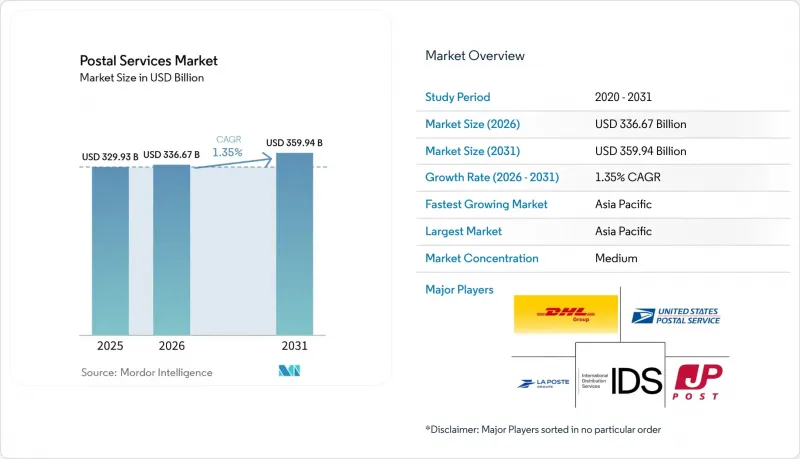
Mordor Intelligence에 의하면, 세계의 우편 서비스 시장 규모는 2025년 3,299억 3,000만 달러로 평가되었고, 2026년에는 3,366억 7,000만 달러로 추정되고, 2031년까지 3,599억 4,000만 달러에 이를 것으로 예상되며, 2026-2031년 CAGR 1.35%로 성장할 전망입니다.
온도 조절이 가능한 의료 물류에 대한 수요 증가, 디지털 플랫폼을 통한 통관 절차의 신속화, 그리고 저탄소 배송 네트워크를 중시하는 기업의 ESG 정책이 사업자들을 프리미엄 소포 서비스 및 전기차(EV) 도입으로 이끌고 있습니다. 본 보고서는 유형별(표준 우편 서비스 및 특급 우편 서비스), 유형별(편지 및 소포), 배송지별(국내 및 국제), 최종 사용자별(B2B, B2C, C2C), 배송 수단별(육상, 항공, 해상, 철도), 지역별(북미, 남미, 아시아태평양, 유럽, 중동 및 아프리카)로 분류되어 있습니다. 시장 전망은 금액(달러) 기준으로 제시되어 있습니다.
세계의 우편 서비스 시장 동향 및 인사이트
탄소 중립적인 우편 배달을 의무화하는 기업 화주들의 ESG 스코어카드
현재 기업의 조달 부서는 물류 계약에 탄소 감축 조항을 포함시켜 우편 사업자에게 차량의 전기화, 재생에너지 조달, 그리고 ISO 14083에 부합하는 배출 데이터 공개를 의무화하고 있으며, 이를 충족하지 못할 경우 대량 발주 입찰에서 제외될 위험이 있습니다. 독일 우정공사 DHL은 2030년까지 탈탄소화를 위해 70억 유로(82억 3,000만 달러)를 배정했으며, 이미 3만 7,000대의 전기 배송 차량을 도입했으며, 2024년 말까지 지속 가능한 항공 연료 조달 비율을 30%로 높일 계획입니다. 월마트, 아마존, 유니레버는 물류 파트너에게 전년 대비 탄소 배출량 감축을 의무화하고 있으며, 2024년 RFP(제안 요청서)의 68%에서 ESG 적합성이 선정 기준 상위 3개 항목에 포함된 만큼, 대응이 늦어지는 기업은 포춘 500대 기업의 입찰에서 점차 배제되고 있습니다. 이러한 추세로 인해, 각 운송 구간별 배출량을 정량화하는 사업자는 혜택을 보는 반면, 투명한 보고 체계를 갖추지 못한 사업자는 불리한 입장에 놓이게 됩니다. 그 결과, 프리미엄 소포 요금에 화주가 스코프 3 공시에 활용할 수 있는 탄소 회계 증명서가 함께 포함되는 경우가 늘고 있습니다.
디지털 통관 플랫폼의 세계 확장이 소액 소포의 통관을 가속화
2024년 3월부터 우편 사업자에게 의무화된 EU의 ICS-2 시스템은 도착 전 전자 데이터 제출을 의무화하고 있으며, 이를 통해 규정을 준수한 소액 소포의 통관 시간을 최대 42% 단축하고 있습니다. 이와 동시에, 미국에서는 ACE 2.0을 통해 800달러 미만의 화물에 대한 관세 산정을 자동화함으로써, 사업자들은 소포 1개당 최대 1.20달러의 처리 비용을 절감할 수 있게 되었습니다. 2024년에는 국경 간 전자상거래 소포가 23% 급증하면서, 자동화된 리스크 스크리닝 기능을 갖추지 못한 게이트웨이들은 이에 대응하느라 분주했습니다. PostNL이나 스위스 우편(Swiss Post) 등 조기에 이 시스템을 도입한 기업들은 체류 시간을 18-22% 단축하고, 수익성이 높은 특송 화물을 위한 창고 공간을 확보했습니다. 그러나 규정 준수 대응에는 막대한 투자가 필요하며, 중규모 우편 사업자들은 IT 플랫폼 및 데이터 품질 관리에 1,500만-2,500만 달러를 투자하고 있습니다. 데이터 무결성 기준을 충족하지 못하는 사업자는 벌금, 출하 지연, 고객 이탈 등의 문제에 직면하게 됩니다.
EU의 NIS-2 및 CISA 의무화에 따른 사이버 보안 규정 준수 비용의 급증
EU의 NIS-2 지침은 우편 서비스를 ‘중요 사업체’로 분류하고 있으며, 침해 발생 시 24시간 이내에 보고할 것을 의무화하고, 위반 시 최대 1,000만 유로(1,176만 달러) 또는 전 세계 매출액의 2%에 해당하는 벌금을 부과하고 있습니다. 미국에서는 CISA가 2025년 3월까지 다단계 인증과 네트워크 분할을 의무화하고 있습니다. 로열 메일 그룹은 2023년 랜섬웨어 공격을 겪은 후 4,700만 파운드(5,900만 달러)를 투자했으나, 업계 조사에 따르면 우편 업계 종사자의 31%가 여전히 피싱 시뮬레이션 테스트에서 실패하고 있습니다. 중견 기업들은 IT 예산의 4-7%를 규정 준수 대응에 할당해야 하며, 고액의 사이버 보안 인력 채용이나 관리형 보안 서비스 제공업체에 대한 아웃소싱을 피할 수 없는 실정입니다. 이로 인해 자유 현금 흐름이 압박을 받게 되어, 자동화 프로젝트의 시행이 지연되는 상황이 발생하고 있습니다.
부문별 분석
아시아태평양은 여전히 성장의 원동력으로, 연평균 성장률(CAGR) 3.51%를 기록하며 2025년에는 전 세계 우편 서비스 시장 점유율의 36.45%를 차지할 것으로 전망됩니다. 베트남에서는 소포 처리량이 25억 개로 급증함에 따라, 2019-2023년 우편 수입이 2배로 증가하여 59조 VND(23억 달러)에 달했습니다. 인도 우정청의 RFID가 탑재된 노드형 물류센터는 추적 가능성을 높이고 있는 반면, 중국 우정청은 Cainiao와의 25억 달러 규모 합작 투자를 통해 ‘일대일로’ 회랑을 따라 40개의 허브를 구축하고 있습니다. 일본우편이 Toll Group에 12억 달러를 출자함으로써 오세아니아 지역에서의 사업 기반을 확대되고 있습니다. 그러나 국가마다 다른 GST(상품 및 서비스세) 과세 기준과 관세 제도로 인해 규정 준수 업무의 부담이 커지고 있어, 사업자는 시장별로 IT 시스템을 최적화해야 합니다. 인구 밀도가 높은 도시 지역의 노선에서는 전동 이륜차의 도입이 확대되면서, 1회당 정차 비용을 18% 절감하고 있습니다.
2025년, 북미는 전 세계 우편 서비스 시장 점유율의 약 28%를 차지했습니다. 미국 우정공사(USPS)의 ‘Delivering for America 2.0’ 계획은 10년 동안 360억 달러의 비용 절감을 목표로 하고 있지만, 2024 회계연도의 95억 달러 적자로 인해 민영화 논의가 활발해지고 있습니다. CISA(사이버보안·인프라보안청)의 규정 준수 조치로 인해 중견 기업들은 1,200만-1,800만 달러의 사이버보안 관련 비용을 부담하고 있습니다. 캐나다 우정공사(Canada Post)는 연간 8.2%에 달하는 우편물 감소세를 막기 위해 소포 분류 자동화와 Shopify와의 제휴를 추진하고 있습니다. 알래스카주와 몬태나주에서 진행 중인 농촌 지역 광대역 시범 사업은 수익 다각화로 이어질 도매 대역폭 수익이 기대되며, 이는 인프라 정책과 우편 사업의 현대화가 얼마나 밀접하게 연관되어 있는지를 보여줍니다. 의료 관련 특급 소포는 수익 밀도를 높이고 있지만, 항공유 할증료가 이익률을 압박하고 있습니다.
유럽 시장 점유율은 26%에 육박했습니다. 덴마크가 2024년에 우편 보편적 서비스 의무(USO)를 폐지하는 것은 자유화의 추세를 시사하는 한편, EU의 NIS-2 및 EPR 규정은 업무상의 규율을 강화하고 있습니다. 독일 우정공사의 AI 분류기는 인건비를 28% 절감하며, 라 포스트나 로열 메일의 네트워크에서도 참고할 만한 경쟁력을 높이고 있습니다. EPR 수수료는 포장 1Kg당 0.08-0.15유로가 가산되어, 연간 총 1억 8,000만-2억 8,000만 유로(2억 1,173만-3억 2,936만 달러)의 추가 부담이 발생합니다. 프랑스의 340개 우체국을 마이크로 풀필먼트 거점으로 전환함으로써, 전자상거래 플랫폼을 위한 당일 배송이 가능해졌으며, 이는 광고 우편물의 감소를 상쇄하고 있습니다. 국경을 넘는 소포 처리량은 ICS-2의 효율화 덕분에 혜택을 보고 있지만, 유가 변동과 브렉시트와 관련된 통관 절차의 복잡성으로 인해 특송 사업의 이익률은 여전히 압박을 받고 있습니다.
지역별 분석
B2C 시장은 연평균 성장률(CAGR) 4.33%로 확대될 전망이며, 의약품의 D2C(소비자 직접 판매), 패션 리셀, 식사 정기 구독 서비스가 보급됨에 따라 2028년까지 그 점유율이 50%를 넘어설 것으로 예측됩니다. 이 부문에서 속도에 대한 요구가 높아짐에 따라, 당일 배송을 지원하는 마이크로 풀필먼트 허브와 AI 경로 계획 시스템에 대한 투자가 확대되고 있습니다. 캡제미니는 2029년까지 퀵 커머스 매출이 2,660억 달러에 달할 것으로 전망하며, 소포 배송의 시급성을 더욱 높이고 있습니다. B2B는 2025년에 52.06%의 시장 점유율을 유지했습니다. 리커머스 플랫폼에 힘입어 C2C(개인 간) 배송은 연평균 성장률(CAGR) 3.2%를 기록하며 꾸준한 성장세를 보이고 있는 반면, B2B 부문은 전자 청구서 및 서류의 디지털화가 진행되는 가운데 정체 상태를 이어가고 있습니다. 사업자들은 밸류체인 시각화 대시보드와 우편 요금 이외의 서비스 수수료를 얻을 수 있는 통관 대행 부가가치 서비스를 도입함으로써 B2B 시장의 침체에 대응하고 있습니다.
헬스케어 정기 구독 프로그램을 통해 B2C 시장 점유율은 더욱 확대되고 있습니다. 약국은 우편 사업자와 제휴하여 콜드체인 거점을 활용해 만성 질환 치료제 키트를 공급함으로써, 일일 취급량을 안정적으로 유지할 수 있는 정기적인 수요를 창출하고 있습니다. 긱 경제 분야의 경쟁사들로부터 가격 면에서 압박을 받고 있지만, 기존 우편 사업자들은 전국적인 서비스 범위, 안전한 보관 및 운송 체계, 그리고 규제 준수 측면에서 차별화를 꾀하고 있습니다.
소포 시장은 2025년 시장 규모의 59.49%를 차지했으며, 2031년까지 전자상거래 보급률이 전 세계 소매 시장의 25%에 근접함에 따라 연평균 성장률(CAGR) 2.90%로 성장할 전망입니다. 소포 시장에서는 재택 간호 및 밀키트의 보급이 확대됨에 따라 헬스케어와 신선식품 부문이 가장 빠른 성장세를 보이고 있으며, 두 부문 모두 연평균 성장률(CAGR)이 8%를 상회하고 있습니다. 자동 분류 시스템에 대한 투자액은 2024년에 9억 9,494만 달러에 달한 것으로 평가되었으며, 2031년까지는 15억 5,000만 달러에 이를 것으로 전망되어, 이에 따라 처리 능력과 추적 가능성이 향상될 것으로 보입니다. 현재 취급 물량의 40.51%를 차지하는 편지는 전자 청구서의 보급으로 인해 연평균 1.8%의 감소 추세를 보이고 있으며, 그 취급량은 50세 이상의 수취인에게 점점 더 집중되고 있습니다. 블록체인을 활용한 전자 등기 우편은 2030년까지 등기 우편의 최대 20%를 대체할 가능성이 있으며, 이로 인해 등기 우편의 감소 추세가 가속화될 것입니다. 세계 우편 서비스 시장에서 편지 시장 규모는 여전히 1,400억 달러를 넘어섰지만, 수익성은 비용 구조의 재검토와 디지털 ID 서비스와의 번들링에 달려 있습니다.
편지 부문은 축소되고 있지만, 법적 및 정부적 요건으로 인해 일정한 수요는 유지되고 있습니다. 사업자들은 신원 확인을 위해 주소 데이터베이스를 수익화하거나, 유권자용 투표용지 프로그램을 위해 배송 확인 네트워크를 활용하고 있습니다. 신흥 시장에서는 농촌 지역의 광대역 인프라 구축이 진전됨에 따라 소액금융 사업자를 대상으로 한 명세서 우편물이 증가하고 있습니다. 그렇긴 하지만, 동적 가격 책정이나 비용 분담 모델이 도입되지 않는 한, 세계 우편 서비스 시장에서 편지가 차지하는 비중은 꾸준히 줄어들 것입니다.
2025년 시장 점유율에서 국내 배송은 83.07%를 차지했으나, 전 세계 소비자들이 상품을 구매하게 됨에 따라 국제 소포 시장은 2031년까지 연평균 성장률(CAGR) 3.65%를 기록하며 국내 배송을 앞지르는 속도로 성장할 전망입니다. 국제 배송과 관련된 전 세계 우편 서비스 시장 규모는 미국이 중국산 수입품에 34%의 관세를 부과하는 등(BBC) 새로운 관세 조치가 시행되더라도 2031년까지 640억 달러에 달할 것으로 전망됩니다. ICS-2와 같은 디지털 통관 기술의 발전으로 인해 통관 절차가 단축되고 신뢰성이 향상되고 있습니다. 그러나 유류할증료나 지정학적 충격이 시장의 변동 요인으로 작용하고 있는 가운데, 허브를 다각화하고 중개 서비스를 제공하는 사업자는 이러한 충격을 더 효과적으로 흡수할 수 있습니다. DHL 익스프레스가 확대하고 있는 ‘관세 포함’ 옵션은 소비자의 편의성을 높이고, 중소기업 수출업체들의 충성도를 높이고 있습니다.
국내 네트워크는 특히 인구가 많은 국가들에서 여전히 규모의 경제를 주도하고 있습니다. 인도 및 브라질의 농촌 지역에 광대역 통신망이 구축됨에 따라, 국내 소포 밀도가 높아지고 배송 경로의 생산성이 향상되고 있습니다. 그러나 도시 지역의 정체 요금과 저공해 구역은 비용 구조에 부담을 주고 있어, 집약형 보관함 배송이나 자전거 택배로의 전환이 가속화되고 있습니다.
익스프레스 서비스는 2025년 시장 점유율의 24.85%를 차지했으나, 화주들이 배송 보증 및 IoT를 활용한 추적 기능을 중시하는 경향이 있어 연평균 성장률(CAGR) 3.91%로 확대될 것으로 예상되며, 이는 표준 서비스의 1.12% 성장률에 비해 거의 3배에 달하는 수치입니다. 특급 배송 서비스에 힘입어 전 세계 우편 서비스 시장 규모는 바이오시밀러 출시와 환자 직접 배송 프로그램의 영향으로 2031년까지 894억 달러에 달할 것으로 전망됩니다. 온도 관리가 필요한 화물에는 추가 요금이 부과되므로, 소포 1개당 수익이 증가하여 항공유 가격 급등을 상쇄하고 있습니다. 사업자는 항공기에 액티브 컨테이너를 장착하고 GPS 센서를 탑재함으로써, 제약 업계의 규정 준수 감사를 충족하는 상세한 데이터를 생성하고 있습니다. 표준 서비스는 대량 우편물이나 긴급성이 낮은 소포에 있어 여전히 필수적이지만, 편지의 자동 대체와 보편적 서비스 의무 완화로 인해 어려움을 겪고 있습니다. 독일 우정공사의 AI 분류기 등 자동화를 통한 시스템 업그레이드로 인건비가 절감되어, 처리량이 감소하더라도 수익성이 유지되고 있습니다.
2025년, 표준 서비스는 정부 기관의 통신 및 저비용 소포 배송을 주축으로 전 세계 우편 서비스 시장 점유율의 75.15%를 차지했습니다. 그러나 규제 체계의 변화(덴마크가 2024년에 우편 보편 서비스 의무를 종료한 것 등)는 가격을 원가에 맞추어 재조정해야 한다는 압력이 커지고 있음을 보여줍니다. 하이브리드 메일에는 성장의 여지가 있습니다. 클라우드 기반 플랫폼을 통해 인쇄된 명세서가 발급되는 이 서비스는 사이버 공격이 증가함에 따라 금융 기관에 규정을 준수하는 대안을 제공합니다. 그러나 부가가치가 높은 물류 서비스를 다각화하지 않은 경우, 표준 서비스 중심의 사업자는 EPR(환경 보고) 및 사이버 보안 비용의 급등으로 인해 이익률이 압박받을 위험에 직면할 수 있습니다.
2025년에도 육상 운송 시장 점유율은 74.93%를 유지했으나, 여객 운송의 회복에 따라 화물칸의 운송 능력이 회복됨에 따라 항공 화물 시장은 연평균 성장률(CAGR) 2.76%로 확대되고 있습니다. 보잉사는 2024년에 777F형 화물기를 단 14대만 인도했기 때문에 공급 부족으로 인해 전세편의 수익률이 상승하고 있습니다. 전 세계 우편 서비스에서 항공 화물 시장 점유율은 여전히 15% 미만이지만, 의료용 콜드체인과 대륙 간 전자상거래는 그 속도에 의존하고 있습니다. 사업자는 우선순위가 높은 SKU를 항공편으로 운송하는 하이브리드 네트워크를 활용하고, 긴급성이 낮은 소포는 해상 또는 철도로 운송함으로써 연료 가격 변동 위험을 줄이고 있습니다. 중국 철도 익스프레스는 2024년에 중국과 유럽 간 열차 1만 7,000편을 운행하여 190만 TEU를 수송했습니다. 이는 중속이며 저탄소 배송 수단으로서 주목받고 있는 대안입니다. 육상 구간에 도입된 전기 밴 덕분에 소포 1개당 CO2 배출량이 24% 감소했으며, 이는 화주의 ESG 평가 기준에도 부합합니다.
배송 기간이 10일을 초과하는 경우, 해상 운송은 이익률을 높여줍니다. IMO의 황 배출 규제로 인해 TEU당 22달러의 추가 비용이 발생하지만, 단위 비용은 항공 운송의 20분의 1 수준에 그치기 때문에 대량 의류 화주들에게 매력적인 선택지입니다. 홍해에서 벌어진 혼란 속에서도 철도가 보여준 강인함은 우편 사업자들을 유라시아 대륙 횡단 노선에 대한 투자로 이끌었고, 이를 통해 위험을 분산시키는 데 성공했습니다. 복합 운송은 연료 가격이나 지정학적 충격에 대처할 수 있는 적응성이 높은 네트워크의 기반이 되고 있습니다.
기타 혜택 :
- 엑셀 형식 시장 예측(ME) 시트
- 3개월간의 애널리스트 지원
자주 묻는 질문
목차
제1장 서론
제2장 조사 방법
제3장 주요 요약
제4장 시장 구도
제5장 시장 규모 및 성장 예측
제6장 경쟁 구도
제7장 시장 기회 및 향후 전망
AJY 26.06.30According to Mordor Intelligence, the global postal services market size is expected to increase from USD 329.93 billion in 2025 to USD 336.67 billion in 2026 and reach USD 359.94 billion by 2031, growing at a CAGR of 1.35% over 2026-2031.
Escalating demand for temperature-controlled healthcare logistics, accelerated customs clearance through digital platforms, and corporate ESG mandates that reward low-carbon delivery networks are steering operators toward premium parcel services and electric vehicle fleets. This report is Segmented by Type (Standard Postal Services and Express Postal Services), by Item (Letters and Parcels), by Destination (Domestic and International), by End-User (B2B, B2C and C2C), by Delivery Mode (Road, Air, Sea, and Rail), and by Geography (North America, South America, Asia-Pacific, Europe, and Middle East and Africa). The Market Forecasts are Provided in Terms of Value (USD).
Global Postal Services Market Trends and Insights
Corporate-Shipper ESG Scorecards Mandating Carbon-Neutral Postal Delivery
Corporate procurement teams now embed carbon-reduction clauses into logistics contracts, obligating postal operators to electrify fleets, procure renewable energy, and publish ISO 14083-aligned emissions data or risk exclusion from high-volume tenders. Deutsche Post DHL allocated EUR 7 billion (USD 8.23 billion) to decarbonization through 2030, already fielding 37,000 electric delivery vehicles and sourcing 30% sustainable aviation fuel by end-2024. Walmart, Amazon, and Unilever require year-on-year carbon cuts from logistics partners, pushing laggards out of Fortune 500 bids as 68% of 2024 RFPs ranked ESG alignment among the top three selection criteria. The dynamic rewards operators that quantify emissions across every shipment leg and penalize those without transparent reporting frameworks. As a result, premium parcel rates increasingly bundle carbon-accounting certificates that shippers can apply toward Scope 3 disclosures.
Global Rollout of Digital Customs Platforms Accelerating Low-Value Parcel Clearance
The EU's ICS-2 system, mandatory for postal operators since March 2024, demands pre-arrival electronic data, reducing compliant low-value parcel clearance times by up to 42%. Concurrently, United States, ACE 2.0 automates duty assessment for shipments under USD 800, saving operators as much as USD 1.20 per parcel in processing costs. Cross-border e-commerce parcels jumped 23% in 2024, overwhelming gateways that lacked automated risk screening. Early adopters such as PostNL and Swiss Post cut dwell times 18-22% and freed warehouse space for higher-margin express goods. Compliance, however, is capital-intensive, with mid-sized postal administrations investing USD 15-25 million in IT platforms and data-quality controls. Operators unable to meet the data-integrity thresholds face penalties, shipment delays, and customer churn.
Escalating Cyber-Security Compliance Spend under EU NIS-2 and CISA Mandates
The EU's NIS-2 Directive classifies postal services as "essential entities," prescribing 24-hour breach reporting and fines up to EUR 10 million (USD 11.76 million) or 2% of global revenue for non-compliance. In the United States, CISA requires multi-factor authentication and network segmentation by March 2025. Royal Mail Group invested GBP 47 million (USD 59 million) after a 2023 ransomware attack, yet industry surveys show 31% of postal workers still fail phishing simulations. Mid-sized operators must divert 4-7% of IT budgets to compliance, hiring expensive cyber-talent or outsourcing to managed-security providers, tightening free cash flow, and delaying automation projects.
Other drivers and restraints analyzed in the detailed report include:
- Boom in Temperature-Controlled Healthcare Parcels Needing Track-and-Trace Postal Solutions
- Rural Broadband Subsidies Enabling Bundled E-Government and Postal Digital Services
- Volatile Jet-Fuel and Marine Bunker Surcharges Compress International Express Margins
For complete list of drivers and restraints, kindly check the Table Of Contents.
Segment Analysis
Asia-Pacific remains the growth engine, expanding 3.51% CAGR, and a commanding Global postal services market share at 36.45% in 2025. Vietnam's postal revenue doubled between 2019 and 2023 to VND 59 trillion (USD 2.3 billion) as parcels soared to 2.5 billion items. India Post's RFID-equipped Nodal Delivery Centres heighten traceability, while China Post's USD 2.5 billion joint venture with Cainiao deploys 40 hubs across Belt-and-Road corridors. Japan Post's USD 1.2 billion stake in Toll Group expands its Oceania footprint. Yet heterogenous GST thresholds and customs regimes multiply compliance workloads; operators must tailor IT systems market by market. Electrified two-wheeler fleets proliferate for dense urban routes, slashing cost per stop by 18%.
North America contributed roughly 28% of Global postal services market share in 2025. The USPS's Delivering for America 2.0 pursues USD 36 billion in savings over 10 years, yet a USD 9.5 billion fiscal-2024 deficit spurs privatization debates. CISA compliance imposes USD 12-18 million in cyber outlays on mid-tier operators. Canada Post targets parcel-sorting automation and Shopify alliances to stem 8.2% annual letter declines. Rural broadband pilots in Alaska and Montana promise wholesale bandwidth rents that diversify revenue, illustrating how infrastructure policy intersects with postal modernization. Express healthcare parcels lift revenue density, but air-fuel surcharges pressure margins.
Europe represented nearly 26% market share. Denmark's 2024 abolition of the letter USO signals liberalization momentum, while the EU's NIS-2 and EPR rules tighten operational discipline. Deutsche Post's AI sorters slash labor by 28%, enhancing competitiveness worth emulating across La Poste and Royal Mail networks. EPR fees add EUR 0.08-0.15 per kilogram of packaging, totaling an extra EUR 180-280 million (USD 211.73-329.36 million) annually. Micro-fulfillment conversions of 340 French post offices enable same-day delivery for e-commerce platforms, countering declining ad-mail. Cross-border parcel volumes benefit from streamlined ICS-2, yet fuel volatility and Brexit-related customs complexity continue to cloud express margins.
Geography Analysis
B2C will grow 4.33% CAGR, lifting its share above 50% by 2028, as direct-to-consumer pharma, fashion resales, and meal subscriptions proliferate. The segment's premium on speed prompts investment in same-day micro-fulfillment hubs and AI route planners. Capgemini forecasts quick-commerce turnover of USD 266 billion by 2029, reinforcing parcel urgency. B2B retained 52.06% market share in 2025. C2C shipments, propelled by recommerce platforms, add steady tailwinds at 3.2% CAGR, while B2B remains flat amid e-invoicing and digitized documentation. Operators counter B2B stagnation by layering supply-chain visibility dashboards and customs brokerage value-adds that capture service fees beyond postage.
Healthcare subscription programs enlarge the B2C share further. Pharmacies partner with posts to supply chronic-care medication kits, leveraging cold-chain nodes and providing recurring traffic that stabilizes daily volumes. Gig-economy rivals exert price pressure, but postal incumbents differentiate on nationwide coverage, secure chain of custody, and regulatory compliance.
Parcels owned 59.49% of 2025 market size and will grow 2.90% CAGR as e-commerce penetration nears 25% of global retail by 2031. Within parcels, healthcare and fresh groceries set the fastest trajectory, each above 8% CAGR, as home-based care and meal-kit adoption rise. Automated sortation investment reached USD 994.94 million in 2024 and is projected at USD 1.55 billion by 2031, driving throughput and traceability. Letters, now 40.51% of items handled, decline 1.8% annually due to digital invoices, with volumes increasingly skewed to recipients aged 50+. Blockchain e-registered mail could displace up to 20% of certified letters by 2030, accelerating contraction. The Global postal services market size for letters still exceeds USD 140 billion, but profitability hinges on cost restructuring and bundling with digital identity services.
Although the letters segment shrinks, legal and government requirements sustain a baseline. Operators monetize address databases for identity verification and leverage delivery confirmation networks for voter-ballot programs. In emerging markets, gap-filled rural broadband triggers incremental statement mail for micro-finance providers. Nonetheless, without dynamic pricing or cost-sharing models, letters' contribution to the Global postal services market will diminish steadily.
Domestic shipments held 83.07% of 2025 market share, yet international parcels will outpace at 3.65% CAGR through 2031 as shoppers source products globally. The Global postal services market size tied to international deliveries is forecast at USD 64 billion by 2031, even with new tariffs such as the United States 34% levy on Chinese imports BBC. Digital customs advances like ICS-2 shorten clearance, enhancing reliability. However, fuel surcharges and geopolitical shocks introduce volatility; operators with diversified hubs and broker services absorb shocks better. Duty-paid options, expanded by DHL Express, simplify consumer experience and build loyalty among SMB exporters.
Domestic networks still drive scale economies, especially in populous countries. Rural broadband grants in India and Brazil raise domestic parcel density, improving route productivity. Yet urban congestion charges and low-emission zones strain cost structures, intensifying the shift toward consolidated locker deliveries and bicycle couriers.
Express services represented 24.85% of the 2025 market share yet are forecast to expand at a 3.91% CAGR, nearly triple standard services' 1.12% pace, as shippers favor guaranteed delivery and IoT-enabled tracking. The Global postal services market size attributable to express services is projected to reach USD 89.4 billion by 2031, buoyed by biosimilar launches and direct-to-patient programs. Temperature-controlled consignments command surcharges, lifting per-parcel yield and offsetting higher aviation fuel costs. Operators retrofit aircraft with active containers and embed GPS sensors, generating granular data that satisfies pharma compliance audits. Standard services remain crucial for bulk mail and low-urgency parcels but suffer from automated letter substitution and relaxed universal service obligations. Automation upgrades, such as Deutsche Post's AI sorters, trim labor expense, sustaining profitability even as volumes wane.
Standard services held 75.15% of the Global postal services market share in 2025, anchored by government correspondence and low-cost parcel delivery. However, shifts in regulatory frameworks Denmark ended its letter USO in 2024 signal mounting pressure to realign prices with cost. Growth pockets exist in hybrid mail, where printed statements are triggered from cloud-based platforms, offering financial institutions a compliant fallback as cyber breaches rise. Yet without diversified value-added logistics, standard-centric operators risk margin compression amid EPR and cybersecurity cost inflation.
Road retained 74.93% market share in 2025, yet air cargo expands 2.76% CAGR, benefiting from restocked belly-hold capacity as passenger traffic rebounds. Boeing delivered only 14 777F freighters in 2024, so constrained supply lifts charter yields. The Global postal services market share of air freight remains below 15%, but healthcare cold-chain and cross-continental e-commerce rely on its speed. Operators mitigate fuel exposure via hybrid networks flying priority SKUs while routing non-urgent parcels by sea or rail. China Railway Express ran 17,000 China-Europe trains in 2024, carrying 1.9 million TEU, an emerging option for mid-speed, low-carbon delivery. Electric vans deployed for road legs cut per-parcel CO2 by 24%, aligning with shipper ESG scorecards.
Sea freight widens margin where delivery windows exceed 10 days. The IMO sulfur cap tacks USD 22 per TEU, but unit costs remain one-twentieth of air, appealing to mass-market apparel shippers. Rail's resilience amid Red Sea disruptions drew postal operators to invest in Eurasian land bridges, diversifying risk. Combined modes underpin adaptive networks that weather fuel and geopolitical shocks.
List of Companies Covered in this Report:
- Aramex
- Australia Post
- bpost Group
- Brazil Correios
- Canada Post
- China Post Group
- Correos (Spain)
- DHL Group
- Emirates Post Group
- FedEx
- International Distribution Services
- Japan Post Holdings
- La Poste Group
- New Zealand Post
- Poste Italiane
- Posti Group (Finland)
- PostNL
- PostNord AB
- SF Express (KEX-SF)
- Singapore Post
- Swiss Post
- United Parcel Service of America, Inc.
- United States Postal Service*
Additional Benefits:
- The market estimate (ME) sheet in Excel format
- 3 months of analyst support
TABLE OF CONTENTS
1 Introduction
- 1.1 Study Assumptions and Market Definition
- 1.2 Scope of the Study
2 Research Methodology
3 Executive Summary
4 Market Landscape
- 4.1 Market Overview
- 4.2 Market Drivers
- 4.2.1 Corporate-Shipper ESG Scorecards Mandating Carbon-Neutral Postal Delivery
- 4.2.2 Global Rollout of Digital Customs Platforms (E.G., EU ICS-2, US ACE 2.0) Accelerating Low-Value Parcel Clearance
- 4.2.3 Boom in Temperature-Controlled Healthcare Parcels (Vaccines, Biologics, Diagnostics) Needing Track-and-Trace Postal Solutions
- 4.2.4 Rural Broadband Subsidies Enabling Bundled E-Government and Postal Digital Services, Lifting Transaction Mail Volumes
- 4.2.5 Blockchain-Based E-Registered Mail Gaining Legal Acceptance for Cross-Border Contracts and Compliance Documentation
- 4.2.6 Same-Day Urban Micro-Fulfilment Hubs Repurposing Post-Office Real Estate and Boosting Premium Parcel Yield
- 4.3 Market Restraints
- 4.3.1 Escalating Cyber-Security Compliance Spend under EU NIS-2, US CISA Mandates and Rising Ransomware Incidents
- 4.3.2 Volatile Jet-Fuel and Marine Bunker Surcharges Compressing Profit in International Express Lanes
- 4.3.3 Extended-Producer-Responsibility (EPR) Packaging Laws Raising Operational Costs for Parcel Handling and Returns
- 4.3.4 Ad-Mail Budget Migration to Cookieless Digital Channels Reducing High-Margin Marketing Mail Revenue
- 4.4 Value / Supply-Chain Analysis
- 4.5 Regulatory Outlook
- 4.6 Technological Outlook
- 4.7 Porter's Five Forces Analysis
- 4.7.1 Threat of New Entrants
- 4.7.2 Bargaining Power of Buyers
- 4.7.3 Bargaining Power of Suppliers
- 4.7.4 Threat of Substitutes
- 4.7.5 Intensity of Competitive Rivalry
- 4.8 Impact of Geo-Political Events on the Market
5 Market Size and Growth Forecasts (Value)
- 5.1 By Type
- 5.1.1 Standard Postal Services
- 5.1.2 Express Postal Services
- 5.2 By Item
- 5.2.1 Letters
- 5.2.2 Parcels
- 5.3 By Destination
- 5.3.1 Domestic
- 5.3.2 International
- 5.4 By End-User
- 5.4.1 Business-to-Business (B2B)
- 5.4.2 Business-to-Consumer (B2C)
- 5.4.3 Consumer-to-Consumer (C2C)
- 5.5 By Delivery Mode
- 5.5.1 Road
- 5.5.2 Air
- 5.5.3 Sea
- 5.5.4 Rail
- 5.6 By Geography
- 5.6.1 North America
- 5.6.1.1 United States
- 5.6.1.2 Canada
- 5.6.1.3 Mexico
- 5.6.2 South America
- 5.6.2.1 Brazil
- 5.6.2.2 Peru
- 5.6.2.3 Chile
- 5.6.2.4 Argentina
- 5.6.2.5 Rest of South America
- 5.6.3 Asia-Pacific
- 5.6.3.1 India
- 5.6.3.2 China
- 5.6.3.3 Japan
- 5.6.3.4 Australia
- 5.6.3.5 South Korea
- 5.6.3.6 South East Asia (Singapore, Malaysia, Thailand, Indonesia, Vietnam, and Philippines)
- 5.6.3.7 Rest of Asia-Pacific
- 5.6.4 Europe
- 5.6.4.1 United Kingdom
- 5.6.4.2 Germany
- 5.6.4.3 France
- 5.6.4.4 Spain
- 5.6.4.5 Italy
- 5.6.4.6 BENELUX (Belgium, Netherlands, and Luxembourg)
- 5.6.4.7 NORDICS (Denmark, Finland, Iceland, Norway, and Sweden)
- 5.6.4.8 Rest of Europe
- 5.6.5 Middle East and Africa
- 5.6.5.1 United Arab of Emirates
- 5.6.5.2 Saudi Arabia
- 5.6.5.3 South Africa
- 5.6.5.4 Nigeria
- 5.6.5.5 Rest of Middle East and Africa
- 5.6.1 North America
6 Competitive Landscape
- 6.1 Market Concentration
- 6.2 Strategic Moves
- 6.3 Market Share Analysis
- 6.4 Company Profiles (Includes Global-Level Overview, Market-Level Overview, Core Segments, Financials, Strategic Information, Market Rank/Share, Products and Services, Recent Developments)
- 6.4.1 Aramex
- 6.4.2 Australia Post
- 6.4.3 bpost Group
- 6.4.4 Brazil Correios
- 6.4.5 Canada Post
- 6.4.6 China Post Group
- 6.4.7 Correos (Spain)
- 6.4.8 DHL Group
- 6.4.9 Emirates Post Group
- 6.4.10 FedEx
- 6.4.11 International Distribution Services
- 6.4.12 Japan Post Holdings
- 6.4.13 La Poste Group
- 6.4.14 New Zealand Post
- 6.4.15 Poste Italiane
- 6.4.16 Posti Group (Finland)
- 6.4.17 PostNL
- 6.4.18 PostNord AB
- 6.4.19 SF Express (KEX-SF)
- 6.4.20 Singapore Post
- 6.4.21 Swiss Post
- 6.4.22 United Parcel Service of America, Inc.
- 6.4.23 United States Postal Service*
7 Market Opportunities and Future Outlook
- 7.1 White-Space and Unmet-Need Assessment