
|
시장보고서
상품코드
2117218
유럽의 우편 서비스 : 시장 점유율 분석, 업계 동향과 통계, 성장 예측(2026-2031년)Europe Postal Services - Market Share Analysis, Industry Trends & Statistics, Growth Forecasts (2026 - 2031) |
||||||
 Mordor Intelligence
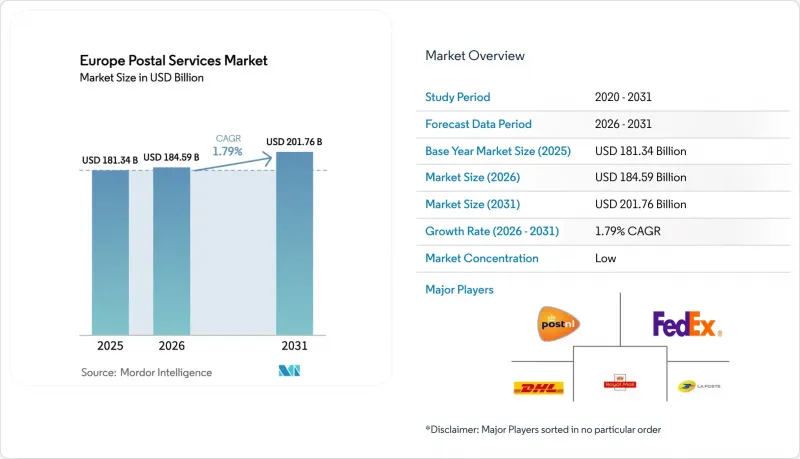
Mordor Intelligence에 따르면 2026년 유럽의 우편 서비스 시장 규모는 1,845억 9,000만 달러로 추정되며, 2025년 1,813억 4,000만 달러에서 확대되어 2031년에는 2,017억 6,000만 달러에 달할 것으로 예측됩니다.
2026년부터 2031년까지의 연평균 성장률(CAGR)은 1.79%가 될 것으로 전망됩니다.
본 보고서는 서비스 유형(특급 우편 서비스 및 일반 우편 서비스), 품목 유형(편지 및 소포), 배송지(국내 및 국제), 국가별(독일, 영국, 프랑스, 이탈리아,스페인, 네덜란드, 북유럽 국가(스웨덴, 덴마크, 노르웨이, 핀란드), 및 기타 유럽(동유럽 및 발칸 반도 포함))별로 분류되어 있습니다. 시장 전망은 금액(달러) 기준으로 제시되어 있습니다.
유럽 우편 서비스 시장의 동향 및 인사이트
독일 및 영국의 소포 처리량 증가를 주도하는 E-Commerce의 급속한 성장
독일의 소포 처리량은 개인 소비가 둔화되었음에도 불구하고 2024년 2분기에 전년 동기 대비 9% 증가했습니다. 영국에서도 유사한 경향이 나타나며, 2024년 소매 매출의 26%를 E-Commerce가 차지하고 있으며, 2028년까지 31%에 달할 전망입니다. 소포와 우편물의 수요 불균형으로 인해 네트워크 이용 현황에 불균형이 발생하고 있으며, 이로 인해 사업자들은 우편물 배달 경로를 소포 수거 경로로 전환해야 하는 상황에 직면해 있습니다. 여기서 도출되는 새로운 인사이트로는, 원래 우편물 분류용으로 설계된 교외의 집배 센터가 조용히 소포의 마이크로 풀필먼트 허브로 변모하고 있으며, 이를 통해 숨겨진 자산의 생산성이 끌어올려지고 있다는 점을 들 수 있습니다.
EU의 탄소 규제가 차량 전동화 투자를 가속화
배출량 상한선이 엄격해짐에 따라 전기자동차(EV) 도입이 가속화되고 있으며, UPS는 파리에서 100대 이상의 신형 EV를 도입했고, 2024년 말까지 유럽 전역에서 600대를 도입할 계획입니다. Bpost는 전기 밴 보유 대수를 두 배로 늘렸고, PostNL은 2023년에 무배출 배송 거리가 전체의 82%를 차지했습니다. 여기서 얻을 수 있는 근본적인 시사점은, 선도 기업들이 탄소 중립 배송에 소액의 추가 요금을 부과함으로써 규제 비용을 헤지할 수 있는 2단계 서비스 체계를 구축할 수 있다는 것입니다.
북유럽 지역의 기존 우편물 처리량 감소
PostNord에 따르면, 북유럽 소비자의 76%가 현재 국경을 넘는 온라인 구매를 하고 있어 국내 우편 서비스에 대한 관심이 줄어들고 있습니다. 편지 처리량의 감소는 편지 1통당 비용 상승을 가속화하여 사업자로 하여금 인력 감축을 강요하고 있습니다. Posti의 최근 인력 감축은 이러한 재편 방향을 뒷받침하고 있습니다. 이를 통해 북유럽 지역에서는 보편적 서비스를 유지하기 위해 민관 협력형 하이브리드 자금 조달 모델을 선구적으로 도입할 가능성이 있다고 볼 수 있습니다.
부문 분석
유럽 우편 서비스 시장에서 특급 서비스의 시장 규모는 2026년부터 2031년까지 연평균 성장률(CAGR) 6.96%로 확대될 것으로 예측되며, 이는 2025년 시점에서 여전히 52.35%의 시장 점유율을 차지하는 표준 서비스보다 현저히 빠른 속도입니다. 이러한 격차의 확대는 시간 지정 프리미엄 상품이 속도에 대한 소비자의 지불 의향을 얼마나 효과적으로 수익화하고 있는지를 여실히 보여주고 있습니다. 현재의 관점에서 볼 때, 네트워크 설계는 수거 마감 시간의 지연과 이른 아침 배송 물량의 조기화로 전환되고 있으며, 이를 통해 기존 차량군의 가동률을 극대화하고자 하고 있습니다.
표준 서비스는 성장률은 낮지만, 규제상 서비스 의무와 전국적인 커버리지를 확보하는 데 여전히 필수적입니다. 독일의 개정 우편법에 따르면, 2025년 이후 편지의 95%에 대해 허용되는 배송 기한이 영업일 기준 3일로 연장되어, 사업자는 수거를 일괄적으로 진행할 수 있게 됩니다. 이러한 규제 완화로 인해 표준 서비스는 비용 최적화된 핵심 서비스로서 점점 더 중요한 역할을 수행하는 한편, 특급 서비스는 잉여 자금을 창출할 것으로 예상됩니다.
기타 혜택:
- 엑셀 형식의 시장 예측(ME) 시트
- 3개월간의 애널리스트 지원
자주 묻는 질문
목차
제1장 소개
제2장 조사 방법
제3장 주요 요약
제4장 시장 구도
제5장 시장 규모와 성장 예측
제6장 경쟁 구도
제7장 시장 기회와 향후 전망
KSM 26.08.26According to Mordor Intelligence, Europe postal services market size in 2026 is estimated at USD 184.59 billion, growing from 2025 value of USD 181.34 billion with 2031 projections showing USD 201.76 billion, growing at 1.79% CAGR over 2026-2031.
This report is Segmented by Service Type (Express Postal Service and Standard Postal Service), by Item Type (Letters and Parcels), by Destination (Domestic and International), by Country (Germany, United Kingdom, France, Italy, Spain, Netherlands, Nordics (Sweden, Denmark, Norway, Finland) and Rest of Europe (incl. Eastern Europe & Balkans)). The Market Forecasts are Provided in Terms of Value (USD).
Europe Postal Services Market Trends and Insights
E-commerce Boom Driving Parcel Volumes in Germany & the UK
Parcel volumes in Germany rose 9 % year-on-year during Q2 2024 even as consumer spending moderated. The United Kingdom echoes this pattern, with e-commerce holding 26 % of retail in 2024 and set to reach 31 % by 2028. This demand imbalance between parcels and letters is producing asymmetric network utilisation that nudges operators to repurpose letter routes for parcel pickups. A fresh inference is that suburban depots originally designed for mail sorting are quietly morphing into parcel micro-fulfilment hubs, unlocking hidden asset productivity.
EU Carbon Regulations Accelerating Fleet Electrification Investments
Stricter emission caps have accelerated electric-vehicle roll-outs, with UPS deploying more than 100 new EVs in Paris and planning 600 across Europe by end-2024 . Bpost doubled its electric van fleet, while PostNL logged 82 % emission-free delivery kilometres in 2023. The underlying inference is that early movers can price carbon-neutral delivery at a modest premium, creating a two-tier service catalogue that hedges against regulatory costs.
Declining Traditional Letter Volumes in Nordic Region
PostNord notes that 76 % of Nordic consumers now purchase cross-border online, diverting attention from domestic mail services. Letter declines accelerate cost-to-serve, forcing operators to trim headcount; Posti's recent layoffs confirm this restructuring path. The inference is that the Nordic region may pioneer hybrid public-private funding models to keep universal service afloat.
Other drivers and restraints analyzed in the detailed report include:
- Cross-Border Single Market Initiatives Simplifying Customs for SMEs
- Ageing Population Sustaining Letter-Mail Demand for Government Correspondence
- High Labor Costs & Unionization in Western Europe
For complete list of drivers and restraints, kindly check the Table Of Contents.
Segment Analysis
Express services hold a Europe Postal Services market size that is forecast to expand at 6.96 % CAGR from 2026-2031, significantly faster than standard services, which still command 52.35 % market share in 2025. The widening spread highlights how premium time-definite products monetise consumer willingness to pay for speed. A current inference is that network design is pivoting toward later collection cut-offs and earlier morning delivery waves, squeezing utilisation out of existing fleets.
Standard services, although lower growth, remain indispensable for regulatory service obligations and nationwide coverage. Germany's revised Postal Act extends permissible delivery time to three business days for 95 % of letters starting 2025, freeing operators to batch deliveries. This regulatory slack implies that standard services will increasingly serve as the cost-optimised backbone, while express layers generate surplus cash.
Complete Report Scope:
- By Service Type
- Express Postal Service
- Standard Postal Service
- By Item Type
- Letters
- Parcels
- By Destination
- Domestic
- International
- By Country
- Germany
- United Kingdom
- France
- Italy
- Spain
- Netherlands
- Nordics (Sweden, Denmark, Norway, Finland)
- Rest of Europe (incl. Eastern Europe & Balkans)
List of Companies Covered in this Report:
- Deutsche Post DHL Group
- La Poste SA (DPDgroup/GeoPost)
- Royal Mail Group plc
- United Parcel Service Inc. (UPS)
- FedEx Corp. (incl. TNT Express)
- Poste Italiane SpA
- PostNL NV
- Swiss Post AG
- Bpost SA/NV
- PostNord AB
- GLS Group
- Hermes Europe GmbH (Evri)
- Asendia Management SAS
- DPD HL LLP (Russia)
- CTT Correios de Portugal SA
- Bring (Norwegian Posten)
- Omniva (Eesti Post AS)
- Correos y Telegrafos SA
- InPost SA
- Russian Post*
Additional Benefits:
- The market estimate (ME) sheet in Excel format
- 3 months of analyst support
TABLE OF CONTENTS
1 Introduction
- 1.1 Study Assumptions & Market Definition
- 1.2 Scope of the Study
2 Research Methodology
3 Executive Summary
4 Market Landscape
- 4.1 Market Overview
- 4.2 Market Drivers
- 4.2.1 E-commerce Boom Driving Parcel Volumes in Germany & the UK
- 4.2.2 EU Carbon Regulations Accelerating Fleet Electrification Investments
- 4.2.3 Cross-Border Single Market Initiatives Simplifying Customs for SMEs
- 4.2.4 Ageing Population Sustaining Letter-Mail Demand for Government Correspondence
- 4.2.5 Same-Day Delivery Expectations Propelling Express Service Premiums
- 4.2.6 Logistics Automation Adoption Reducing Sortation Cost per Piece
- 4.3 Market Restraints
- 4.3.1 Declining Traditional Letter Volumes in Nordic Region
- 4.3.2 High Labor Costs & Unionization in Western Europe
- 4.3.3 Urban Congestion & Access Restrictions Increasing Last-Mile Costs
- 4.3.4 Digital Substitutes (e-Billing, Messaging) Eroding Letter Revenues
- 4.4 Value / Supply-Chain Analysis
- 4.5 Regulatory & Technological Outlook
- 4.6 Porter's Five Forces
- 4.6.1 Threat of New Entrants
- 4.6.2 Bargaining Power of Buyers/Consumers
- 4.6.3 Bargaining Power of Suppliers
- 4.6.4 Threat of Substitute Products
- 4.6.5 Intensity of Competitive Rivalry
- 4.7 Impact of Geo-Political Events in the market
5 Market Size & Growth Forecasts (Value)
- 5.1 By Service Type
- 5.1.1 Express Postal Service
- 5.1.2 Standard Postal Service
- 5.2 By Item Type
- 5.2.1 Letters
- 5.2.2 Parcels
- 5.3 By Destination
- 5.3.1 Domestic
- 5.3.2 International
- 5.4 By Country
- 5.4.1 Germany
- 5.4.2 United Kingdom
- 5.4.3 France
- 5.4.4 Italy
- 5.4.5 Spain
- 5.4.6 Netherlands
- 5.4.7 Nordics (Sweden, Denmark, Norway, Finland)
- 5.4.8 Rest of Europe (incl. Eastern Europe & Balkans)
6 Competitive Landscape
- 6.1 Market Concentration
- 6.2 Strategic Moves
- 6.3 Market Share Analysis
- 6.4 Company Profiles (includes Global Level Overview, Market Level Overview, Core Segments, Financials as available, Strategic Information, Market Rank/Share, Products & Services, Recent Developments)
- 6.4.1 Deutsche Post DHL Group
- 6.4.2 La Poste SA (DPDgroup/GeoPost)
- 6.4.3 Royal Mail Group plc
- 6.4.4 United Parcel Service Inc. (UPS)
- 6.4.5 FedEx Corp. (incl. TNT Express)
- 6.4.6 Poste Italiane SpA
- 6.4.7 PostNL NV
- 6.4.8 Swiss Post AG
- 6.4.9 Bpost SA/NV
- 6.4.10 PostNord AB
- 6.4.11 GLS Group
- 6.4.12 Hermes Europe GmbH (Evri)
- 6.4.13 Asendia Management SAS
- 6.4.14 DPD HL LLP (Russia)
- 6.4.15 CTT Correios de Portugal SA
- 6.4.16 Bring (Norwegian Posten)
- 6.4.17 Omniva (Eesti Post AS)
- 6.4.18 Correos y Telegrafos SA
- 6.4.19 InPost SA
- 6.4.20 Russian Post*