
|
시장보고서
상품코드
2072753
혈관 스텐트 시장 : 시장 점유율 분석, 업계 동향 및 통계, 성장 예측(2026-2031년)Vascular Stents - Market Share Analysis, Industry Trends & Statistics, Growth Forecasts (2026 - 2031) |
||||||
 Mordor Intelligence
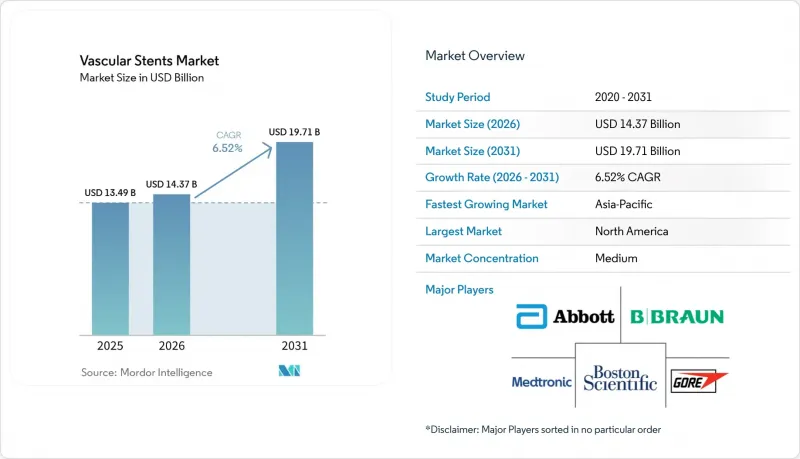
Mordor Intelligence에 의하면, 혈관 스텐트 시장 규모는 2025년 134억 9,000만 달러로 평가되었고, 2026년 143억 7,000만 달러로 추정되고, 2031년까지 197억 1,000만 달러로 확대될 것으로 예측되며, 2026-2031년 연평균 복합 성장률(CAGR)은 6.52%를 나타낼 전망입니다.
본 보고서는 제품 유형별(관상동맥 스텐트(약물 방출형 관상동맥 스텐트 등)), 기술별(약물 방출형 스텐트, 코팅 스텐트 등), 소재별(금속, 고분자제), 삽입 방법별(풍선 확장형, 자가 확장형), 최종 사용자별(병원, 심장 센터 등), 지역별(북미, 유럽, 아시아태평양 등)로 분류되어 있습니다. 예측치는 금액(달러)으로 표시되어 있습니다.
세계의 혈관 스텐트 시장 동향 및 분석
관상동맥 질환 및 말초동맥 질환으로 인한 부담 증가
혈관 스텐트 시장은 전 세계적으로 허혈성 심장 질환이 증가함에 따라 계속해서 성장세를 보이고 있습니다. 허혈성 심장질환의 신규 환자 수는 2021년에 3,190만 건에 달했으며, 2046년까지 연간 5,640만 건으로 증가할 것으로 예측됩니다. 이러한 경향으로 인해 혈관 스텐트 시장은 장기적인 질환의 진행과 밀접한 관련이 있습니다. 왜냐하면 치료 수요는 단기적인 치료 주기가 아니라, 고령화와 대사 위험에의 노출 확대와 지속적으로 연관되어 있기 때문입니다. 또한, 사회인구통계지수(SDI)가 낮은 지역이나 중간 수준의 지역에서도 이 질병으로 인한 부담은 커지고 있습니다. 이러한 지역에서는 공복 시 혈장 포도당 수치의 상승이 동맥경화성 질환의 주요 원인으로 대두되고 있으며, 가장 먼저 구매되는 의료기기의 유형에도 변화가 나타나고 있습니다. 이러한 상황에서 혈관 스텐트 시장은 고소득 국가에서 볼 수 있는 프리미엄 플랫폼 곡선과 같은 궤적을 따르지 않고 있습니다. 왜냐하면, 비용에 민감한 급성기 의료 분야에서는 여전히 더 단순한 의료기기가 선택되는 경우가 많기 때문입니다. 말초동맥질환은 혈관 스텐트 시장에 새로운 환자층을 가져오고 있으며, 이는 수요가 관상동맥질환 환자들의 의뢰나 기존 PCI 경로에만 의존하는 것이 아니라는 것을 의미합니다.
저침습적 시술 건수의 확대
혈관 스텐트 시장은 외래 및 통원 치료 모델에 대한 시술 지원이 확대됨에 따라, 저침습 치료 환경으로의 꾸준한 전환으로 인한 혜택도 누리고 있습니다. SCAI 2025에서 발표된 메디케어의 분석에 따르면, 향후 10년 동안 외래수술센터(ASC)에서 시행되는 PCI 건수는 21% 증가할 것으로 예측되며, 이는 보다 신속한 업무 흐름과 예측 가능한 치료 결과를 중시하여 설계된 기기에 대한 장기적인 수요를 뒷받침할 것입니다. 이러한 치료 장소의 전환은 혈관 스텐트 시장에 있어 중요한 의미를 지닙니다. 왜냐하면 플랫폼의 성능이 명확하고 의약품 목록에 대한 규제가 완화된 경우, 의사 주도의 조달 절차가 더 신속하게 진행되는 경향이 있기 때문입니다. 또한, 이러한 추세에 따라 시술 시간을 단축하고 재시술의 위험을 줄여주는 시스템의 가치가 높아지고 있습니다. 그 결과, 고가 기기의 도입은 임상적 차별화뿐만 아니라 업무 효율과도 밀접한 관련이 있습니다.
장치 관련 혈전증, 재협착 및 재시술의 위험
혈관 스텐트 시장은 여전히 기기 차원에서 뚜렷한 제약에 직면해 있습니다. 왜냐하면 일부 이용 사례에서 스캐폴드의 지연성 혈전증이나 재협착 문제가 여전히 해결되지 않은 채 남아 있어, 의사들의 신뢰에 계속해서 영향을 미치고 있기 때문입니다. 2025년에 발표된 ABSORB 임상시험의 5년간 통합 데이터에 따르면, 생체흡수성 혈관 스캐폴드는 1년 차부터 3년 차에 걸쳐 금속 약물 방출형 스텐트보다 유해 사건 발생률이 더 높았던 것으로 나타났으며, 이는 초기 열풍 이후 광범위한 보급이 지연된 이유를 설명해 줍니다. 이 문제는 제품의 평판에 그치지 않고, 새로운 스캐폴드가 더 광범위한 보험 적용 및 지침상의 지지를 얻으려 할 때, 혈관 스텐트 시장이 장기적인 결과 데이터에 의존하고 있기 때문에 매우 중요합니다. 이 문제는 관상동맥 용도에만 국한되지 않습니다. 말초 혈관 병변 역시 재시술 위험이 높으며, 환자의 치료 경과에 따라 재치료 비용을 지속적으로 증가시키고 있기 때문입니다. 이로 인해 혈관 스텐트 시장에서는 까다로운 균형이 요구되고 있습니다. 재개입은 단기적인 기기 판매를 뒷받침하는 한편, 장기적인 치료 결과의 신뢰성을 훼손하고, 규제 당국이나 보험사로부터 더 엄격한 감시를 초래할 우려가 있기 때문입니다.
부문별 분석
2025년, 관상동맥 스텐트는 혈관 스텐트 시장 점유율의 56.31%를 차지했으며, 혈관 스텐트 시장 전체에서 핵심 수익 부문으로서의 위상을 유지했습니다. 약물 방출형 관상동맥 스텐트 플랫폼은 오랜 임상 실적은 물론, 보험 지급 기관의 높은 인지도와 의료진의 폭넓은 지지를 모두 갖추고 있어 선진국에서 치료의 기반으로 자리매김하고 있습니다. 이러한 제품 구성은 특히 카테터 검사 체계가 이미 성숙한 국가들에서 혈관 스텐트 시장이 여전히 전 세계적으로 주류인 혈관 재건술인 PCI에 크게 의존하고 있는 현실을 반영하고 있습니다. 따라서 보다 전문적인 치료 현장에서 새로운 유형의 기기가 주목을 받고 있음에도 불구하고, 관상동맥 용도는 상업적으로 여전히 중심적인 위치를 차지하고 있습니다. 관상동맥 분야는 일반적으로 대규모 교육, 충분한 재고 확보, 근거 창출을 뒷받침하고 있기 때문에 이러한 기반이야말로 대형 제조업체들이 단계적인 업그레이드를 추진하기 위한 안정적인 토대가 되고 있습니다.
말초 스텐트, 경동맥용 시스템 및 신경혈관용 기기는 관상동맥 질환의 범위를 넘어 혈관 스텐트 시장을 확대하고 있지만, 그 상업적 특성은 여전히 분산되어 있으며 적응증별 데이터에 대한 의존도가 높습니다. 또한, 혈관의 해부학적 구조, 뇌졸중 예방에 대한 수요, 그리고 보험 급여 규정이 관상동맥 치료와 크게 다르기 때문에 혈관 스텐트 업계에서는 이러한 범주 간에 더 큰 편차가 나타납니다. 신경혈관 스텐트는 파이프라인 색전술이나 두개내 용도로 전문의의 사용이 필요하며, 대부분의 경우 전용 보험 급여 제도의 혜택을 받기 때문에 기술적으로 차별화된 역할을 유지하고 있습니다. EVAR 스텐트그래프트는 가장 빠르게 성장하고 있는 제품 카테고리이며, 복부 및 흉복부 대동맥 치료 건수가 증가함에 따라 이 부문의 혈관 스텐트 시장 규모는 2031년까지 연평균 성장률(CAGR) 9.38%로 확대될 것으로 전망됩니다. 2026년 ESVS 지침에서는 흉복부 대동맥류의 권장 치료법으로 페네스트레이션형 및 분지형 복원술로의 전환이 제시되어 있으며, 이에 따라 혈관 스텐트 시장의 대상 범위는 표준적인 신장 하부 해부학적 범위를 넘어, 보다 복잡한 사례까지 혈관 내 치료의 적용 대상이 될 것으로 전망됩니다.
2025년에는 피복 스텐트가 시장의 38.24%를 차지했으며, 혈관 스텐트 시장에서 가장 큰 기술 부문이 되었습니다. 그 역할은 단순히 동맥류의 폐쇄에 그치지 않고, 관강의 개존성과 마찬가지로 혈관의 밀폐성 및 구조적 내구성이 중요한 병변에서 말초 혈관 및 대동맥의 복원도 지원합니다. 약물 방출형 스텐트는 관상동맥 치료 분야에서 여전히 핵심적인 가치를 제공하는 원동력이며, 2세대 얇은 스트라스 플랫폼과 생분해성 폴리머 코팅을 통해 방사상 지지력과 혈관 치유의 균형이 향상되었습니다. 베어메탈 플랫폼은 응급 사용이나 이중 항혈소판 요법의 준수 여부가 불확실한 상황에서 보다 제한적인 역할을 유지하고 있으며, 이는 혈관 스텐트 시장 전체에서 기술의 대체가 아직 완료되지 않았음을 보여줍니다. 이러한 불균등한 전환으로 인해, 특히 상환 제도가 혼재된 환경에서 기존 기술과 신기술이 동시에 상업적 중요성을 유지하고 있습니다.
생체흡수성 스텐트는 2026-2031년 연평균 성장률(CAGR) 8.52%를 나타낼 것으로 예측되며, 이 기술 분야의 혈관 스텐트 시장 규모는 다른 어떤 기술 부문보다 빠르게 확대되고 있습니다. 애보트사의 'Esprit BTK', 바이오트로닉사의 'Freesolve' 프로그램, 마이크로포트사의 'Firesorb'이 모든 것은 혈관 스텐트 시장이 분해 특성의 개선, 병변 부위에서의 사용 기간 연장, 재시술 빈도 감소를 중심으로 새로운 스텐트 파이프라인을 구축해 나가고 있음을 보여줍니다. 혈관 스텐트 업계에서는 금속 DES가 당장 대체되지는 않을 것으로 전망되고 있습니다. 이는 장기적인 실증 자료와 상용화 일정이 여전히 최대 규모의 관상동맥 시장에서 확립된 플랫폼에 유리하게 작용하고 있기 때문입니다. 『Biomedicines』지에 게재된 2025년 체계적 문헌고찰에 따르면, 생분해성 폴리머 DES와 폴리머 프리 DES 간에 12개월 시점의 임상적 결과가 동등한 것으로 보고되었으며, 이에 따라 내구성 폴리머 시스템에 수반되던 가격 프리미엄은 이미 축소되고 있어, 이 하위 부문 내 가격 책정에 압박이 가해지고 있습니다. 따라서 혈관 스텐트 시장의 기술적 발전 방향은 공존을 시사하고 있으며, 증거에 기반한 기존 플랫폼이 시장 규모를 유지하는 한편, 스캐폴드 기반 시스템은 우선 대상 병변 및 환자 집단에서 점차 확대될 것으로 보입니다.
지역별 분석
2025년, 북미는 혈관 스텐트 시장 점유율의 41.22%를 차지했으며, 해당 시장에서 가장 큰 기여를 하는 지역으로서의 위상을 유지했습니다. 이러한 지위는 성숙한 상환 제도, 높은 중재 시술 건수, 그리고 의사가 고도의 영상 진단 및 다양한 의료기기 선택지에 폭넓게 접근할 수 있다는 점에 기반을 두고 있습니다. 2025년 ACC, AHA 및 SCAI의 지침 개정은 영상 유도 하에 시행되는 복잡한 스텐트 삽입술의 확대를 뒷받침하고 있으며, 이를 통해 해당 지역의 시술 건수 증가세가 완만하더라도 1건당 기기 가치를 높일 수 있습니다. 따라서 미국은 여전히 주요 프리미엄 플랫폼 시장으로 자리매김하고 있으며, 특히 근거와 보험 지급 측면 모두에서 지원이 필요한 첨단 관상동맥 및 슬와부 기술 분야에서 그 위상을 유지하고 있습니다. 캐나다도 2025년 9월에 애보트사의 '에스프리트 BTK' 승인된 사례에서 볼 수 있듯이, 새로운 용해성 스캐폴드의 도입 과정을 통해 혈관 스텐트 시장을 뒷받침하고 있습니다.
유럽은 시술 건수가 많고 전문 의료 센터의 인프라가 잘 갖춰져 있어, 혈관 스텐트 시장에 있어 중요한 안정 요인으로 계속해서 자리 잡고 있습니다. 독일은 그 대표적인 사례로, 관상동맥 질환의 유병률이 높고 입원 환자 수도 많기 때문에 심혈관 중재술에 대한 수요는 구조적으로 중요한 위치를 계속 차지하고 있습니다. 또한, ESVS 2026 가이드라인에서는 개창형 및 분기형 혈관내 치료법에 대한 지지가 확대되고 있으며, 이는 복잡한 대동맥 치료에 종사하는 의료기기 제조업체들에게 호재가 될 것입니다. 동시에, MDR(의료기기 규정) 준수에 따라 유럽의 제품 포트폴리오는 확립된 규제 대응 역량을 갖춘 공급업체로 한정되고 있으며, 이는 이미 인증을 받은 플랫폼을 보유한 대기업에 유리하게 작용합니다. 이로 인해 유럽의 혈관 스텐트 시장은 더욱 선별적인 양상을 띠게 되었으며, 상용화로 가는 지름길은 줄어들고, 임상 추적 데이터에 대한 중요성이 높아지고 있습니다.
아시아태평양은 가장 빠르게 성장하고 있는 지역이며, 이 지역의 혈관 스텐트 시장 규모는 2031년까지 연평균 성장률(CAGR) 8.85%로 확대될 것으로 전망됩니다. 중국은 여전히 그 성장의 중심지입니다. 이 나라의 중앙집권적 조달 시스템은 현재 매우 대규모로 운영되고 있으며, 2026년 제2차 관상동맥 스텐트 조달 라운드에서는 4,468개 의료기관을 대상으로 273만 개가 조달될 예정입니다. 이는 아시아태평양의 혈관 스텐트 시장이 활발한 수요 증가와 엄격한 가격 규율을 동시에 갖추고 있음을 의미하며, 북미에서 볼 수 있는 것과는 다른 성장 모델을 만들어내고 있습니다. 인도에서는 가격에 민감한 공공 의료기관과 점점 늘어나는 민간 병원이 공존하고 있어, 다국적 기업과 현지 DES 공급업체 모두에게 사업 기회가 남아 있습니다. 중동 및 아프리카 및 남미는 절대적인 규모 면에서는 여전히 작지만, 연수 체계, 카테터 검사 인프라, 비용 경쟁력이 있는 수입품 덕분에 더 많은 의료 시스템에서 중재 시술에 대한 접근성이 확대되고 있어 그 중요성이 커지고 있습니다.
기타 혜택 :
- 엑셀 형식 시장 예측(ME) 시트
- 3개월간의 애널리스트 지원
자주 묻는 질문
목차
제1장 서론
제2장 조사 방법
제3장 주요 요약
제4장 시장 구도
제5장 시장 규모 및 성장 예측
제6장 경쟁 구도
제7장 시장 기회 및 향후 전망
AJY 26.07.03According to Mordor Intelligence, the vascular stents market size is projected to expand from USD 13.49 billion in 2025 and USD 14.37 billion in 2026 to USD 19.71 billion by 2031, registering a CAGR of 6.52% between 2026 to 2031.
This report is Segmented by Product Type (Coronary Stents [Drug-Eluting Coronary Stents and More, and More), Technology (Drug-Eluting Stents, Covered Stents, and More), Material (Metallic, Polymeric), Mode of Delivery (Balloon-Expandable, Self-Expanding), End User (Hospitals, Cardiac Centers, and More), and Geography (North America, Europe, Asia-Pacific, and More). Forecasts are Provided in Value (USD).
Global Vascular Stents Market Trends and Insights
Rising Coronary and Peripheral Artery Disease Burden
The vascular stents market continues to draw strength from the global rise in ischemic heart disease, which reached 31.9 million new cases in 2021 and is projected to climb to 56.4 million annual cases by 2046. This pattern keeps the vascular stents market tied to long-term disease progression, because treatment demand remains linked to aging populations and widening metabolic risk exposure instead of short-term procedure cycles. The burden is also widening across lower and middle Socio-Demographic Index regions, where high fasting plasma glucose is becoming a stronger contributor to atherosclerotic disease and is changing which devices are purchased first. In those settings, the vascular stents market is not moving through the same premium platform curve seen in higher income economies, because cost-sensitive acute care still favors simpler device choices in many cases. Peripheral artery disease is adding a separate patient pool for the vascular stents market, which means demand is not dependent only on coronary referrals or established PCI pathways.
Expanding Minimally Invasive Intervention Volumes
The vascular stents market is also benefiting from a steady shift toward minimally invasive treatment settings, as outpatient and ambulatory models are receiving broader procedural support. A Medicare analysis presented at SCAI 2025 projected a 21% increase in PCI volume in ambulatory surgical centers over the next decade, which supports longer-term placement demand for devices designed around faster workflows and predictable outcomes. This site-of-care shift matters for the vascular stents market because physician-led procurement often moves faster when platform performance is clear and formulary layers are lighter. The same trend also raises the value of systems that shorten procedure time and reduce repeat intervention risk, which keeps premium device adoption linked to operational efficiency as much as to clinical differentiation.
Device Thrombosis, Restenosis, and Reintervention Risk
The vascular stents market still faces a clear device-level limitation, because late scaffold thrombosis and restenosis remain unresolved in several use cases and still influence physician confidence. Pooled 5-year ABSORB data published in 2025 showed higher adverse event rates for bioresorbable vascular scaffolds than for metallic drug-eluting stents during years 1 through 3, which explains why broad uptake was delayed after early enthusiasm. This issue matters beyond product reputation, because the vascular stents market depends on durable outcome data when new scaffolds seek broader reimbursement and guideline support. The problem is not limited to coronary use, since peripheral lesions also carry high reintervention exposure and keep repeat care costs elevated over the patient pathway. That creates a difficult balance for the vascular stents market, where repeat interventions can support short-term device revenue but can also weaken long-term outcome credibility and invite tighter scrutiny from regulators and payers.
Other drivers and restraints analyzed in the detailed report include:
- Faster Adoption of Drug-Eluting and Covered Stent Platforms
- Imaging-Guided Precision Implantation and Complex Lesion Planning
- Reimbursement Constraints in Price-Sensitive Care Settings
For complete list of drivers and restraints, kindly check the Table Of Contents.
Segment Analysis
Coronary stents held 56.31% of vascular stents market share in 2025, which kept them as the core revenue segment across the vascular stents market. Drug-eluting coronary platforms remained the procedural base in developed systems because they combine long clinical experience with payer familiarity and broad physician acceptance. The product mix also reflects how the vascular stents market still depends heavily on PCI as the dominant global revascularization route, especially in systems that already have mature catheterization capacity. Coronary use has therefore stayed commercially central even while newer device classes have gained attention in more specialized settings. The same base gives large manufacturers a stable platform for launching incremental upgrades, because coronary accounts usually support training, inventory depth, and evidence generation at scale.
Peripheral stents, carotid systems, and neurovascular devices broaden the vascular stents market beyond coronary disease, but their commercial profiles remain more fragmented and more dependent on indication-specific data. The vascular stents industry also shows wider variability across these categories, since vessel anatomy, stroke protection needs, and reimbursement rules differ more than they do in coronary care. Neurovascular stents keep a technically differentiated role because pipeline embolization and intracranial applications command specialist use and often benefit from dedicated reimbursement pathways. EVAR stent grafts are the fastest-growing product category, and vascular stents market size for this segment is projected to expand at a 9.38% CAGR through 2031 as abdominal and thoracoabdominal aortic repair volumes rise. The 2026 ESVS guideline shift toward fenestrated and branched repair as the preferred treatment for thoracoabdominal aneurysms expands the addressable pool for the vascular stents market beyond standard infrarenal anatomy and brings more complex cases into endovascular pathways.
Covered stents accounted for 38.24% of the market in 2025, which made them the largest technology segment within the vascular stents market. Their role is broader than aneurysm exclusion alone, because they also support peripheral and aortic repair in lesions where vessel sealing and structural durability matter as much as lumen patency. Drug-eluting stents remained the core value driver in coronary care, where second-generation thin-strut platforms and biodegradable polymer coatings improved the balance between radial support and vessel healing. Bare-metal platforms retained a narrower role in emergency use and in settings where dual antiplatelet adherence remains uncertain, which shows that technology replacement across the vascular stents market is still incomplete. This uneven transition keeps older and newer technologies commercially relevant at the same time, especially across mixed reimbursement environments.
Bioabsorbable stents are forecast to grow at 8.52% CAGR from 2026 to 2031, and vascular stents market size in this technology band is moving faster than any other technology segment. Abbott's Esprit BTK, Biotronik's Freesolve program, and MicroPort's Firesorb all show how the vascular stents market is building a new scaffold pipeline around improved degradation profiles, longer lesion usability, and lower repeat procedure expectations. The vascular stents industry is not seeing immediate displacement of metallic DES, because long-term evidence and commercialization timelines still favor established platforms in the largest coronary accounts. A 2025 systematic review in Biomedicines reported clinically equivalent 12-month outcomes between biodegradable polymer DES and polymer-free DES, which is already narrowing the premium attached to durable-polymer systems and pressuring pricing within this subsegment. The technology path in the vascular stents market therefore points to coexistence, with evidence-backed incumbent platforms retaining scale while scaffold-based systems expand first in targeted lesions and patient groups.
Complete Report Scope:
- By Product Type
- Coronary Stents
- Drug-Eluting Coronary Stents
- Bare-Metal Coronary Stents
- Covered Coronary Stents
- Bioabsorbable Coronary Stents
- Peripheral Stents
- Carotid Artery Stents
- Femoral Artery Stents
- Iliac Artery Stents
- Renal Artery Stents
- Other Peripheral Stents
- EVAR Stent Grafts
- Abdominal Aortic Aneurysm Stent Grafts
- Thoracic Aortic Aneurysm Stent Grafts
- Neurovascular Stents
- Flow-Diverter Stents
- Intracranial Atherosclerotic Stents
- Coronary Stents
- By Technology
- Drug-Eluting Stents
- Covered Stents
- Bare-Metal Stents
- Bioabsorbable Stents
- By Material
- Metallic Materials
- Cobalt Chromium
- Platinum Chromium
- Nickel Titanium
- Stainless Steel
- Polymeric Materials
- Biodegradable Polymers
- Non-Biodegradable Polymers
- Metallic Materials
- By Mode of Delivery
- Balloon-Expandable Stents
- Self-Expanding Stents
- By End User
- Hospitals
- Cardiac Centers
- Ambulatory Surgical Centers
- Cath Labs
- By Geography
- North America
- United States
- Canada
- Mexico
- Europe
- Germany
- United Kingdom
- France
- Italy
- Spain
- Rest of Europe
- Asia-Pacific
- China
- Japan
- India
- Australia
- South Korea
- Rest of Asia-Pacific
- Middle East and Africa
- GCC
- South Africa
- Rest of Middle East and Africa
- South America
- Brazil
- Argentina
- Rest of South America
- North America
Geography Analysis
North America held 41.22% of vascular stents market share in 2025, which kept it as the largest regional contributor to the vascular stents market. Its position rests on mature reimbursement systems, high interventional volumes, and broad physician access to advanced imaging and device options. The 2025 ACC, AHA, and SCAI guideline update is supporting more imaging-guided complex stenting, which can lift device value per case even when regional procedure growth is moderate. The United States therefore remains the main premium platform market, especially for advanced coronary and below-the-knee technologies that need both evidence and payment support. Canada also supports the vascular stents market through adoption pathways for newer dissolvable scaffolds, as seen in the September 2025 authorization for Abbott's Esprit BTK.
Europe remains an important stabilizing region for the vascular stents market because of its large procedure base and strong specialty center infrastructure. Germany is a key example, with a large coronary disease burden and a high volume of hospital admissions that keep cardiovascular intervention demand structurally relevant. The ESVS 2026 guideline is also expanding support for fenestrated and branched endovascular repair, which benefits device makers active in complex aortic treatment. At the same time, MDR compliance is narrowing European portfolios toward suppliers with established regulatory depth, which favors larger companies with already certified platforms. This keeps the vascular stents market in Europe more selective, with fewer commercialization shortcuts and a stronger premium on clinical follow-up data.
Asia-Pacific is the fastest-growing region, and vascular stents market size in the region is forecast to advance at an 8.85% CAGR through 2031. China remains central to that growth because its centralized procurement system now operates at very large scale, with the second 2026 coronary stent round covering 2.73 million units across 4,468 institutions. This means the vascular stents market in Asia-Pacific combines strong demand expansion with intense price discipline, which creates a different growth model than the one seen in North America. India adds another layer through a mix of price-sensitive public accounts and a growing private hospital base, which keeps room open for both multinational and local DES suppliers. The Middle East and Africa and South America remain smaller in absolute value, but they continue to gain relevance as training capacity, catheterization infrastructure, and cost-competitive imports expand access to intervention across more health systems.
- Abbott Laboratories
- Artivion, Inc.
- B. Braun
- Beckton Dickinson
- Biosensors International Group, Ltd.
- BIOTRONIK
- Boston Scientific
- Cook Group
- Cordis
- Endologix LLC
- Lepu Medical Technology (Beijing) Co., Ltd.
- LifeTech Scientific Corporation
- Medtronic
- Meril Life Science
- MicroPort
- Sahajanand Medical Technologies
- Stryker
- Terumo
- Translumina
- W. L. Gore and Associates, Inc.
Additional Benefits:
- The market estimate (ME) sheet in Excel format
- 3 months of analyst support
TABLE OF CONTENTS
1 Introduction
- 1.1 Study Assumptions & Market Definition
- 1.2 Scope of the Study
2 Research Methodology
3 Executive Summary
4 Market Landscape
- 4.1 Market Overview
- 4.2 Market Drivers
- 4.2.1 Rising Coronary and Peripheral Artery Disease Burden
- 4.2.2 Expanding Minimally Invasive Intervention Volumes
- 4.2.3 Faster Adoption of Drug-Eluting and Covered Stent Platforms
- 4.2.4 Aging Population and Higher Reintervention Demand
- 4.2.5 Imaging-Guided Precision Implantation and Complex Lesion Planning
- 4.2.6 Cost Pressure Shifting Purchasers Toward High-Value Stent Platforms
- 4.3 Market Restraints
- 4.3.1 Device Thrombosis, Restenosis, and Reintervention Risk
- 4.3.2 Stringent Regulatory Evidence and Post-Market Surveillance Burden
- 4.3.3 Reimbursement Constraints in Price-Sensitive Care Settings
- 4.3.4 Procedural Preference for Alternative Revascularization Approaches in Select Cases
- 4.4 Supply Chain Analysis
- 4.5 Regulatory Landscape
- 4.6 Technological Outlook
- 4.7 Porter's Five Forces Analysis
- 4.7.1 Threat of New Entrants
- 4.7.2 Bargaining Power of Suppliers
- 4.7.3 Bargaining Power of Buyers
- 4.7.4 Threat of Substitutes
- 4.7.5 Competitive Rivalry
5 Market Size & Growth Forecasts (Value, USD)
- 5.1 By Product Type
- 5.1.1 Coronary Stents
- 5.1.1.1 Drug-Eluting Coronary Stents
- 5.1.1.2 Bare-Metal Coronary Stents
- 5.1.1.3 Covered Coronary Stents
- 5.1.1.4 Bioabsorbable Coronary Stents
- 5.1.2 Peripheral Stents
- 5.1.2.1 Carotid Artery Stents
- 5.1.2.2 Femoral Artery Stents
- 5.1.2.3 Iliac Artery Stents
- 5.1.2.4 Renal Artery Stents
- 5.1.2.5 Other Peripheral Stents
- 5.1.3 EVAR Stent Grafts
- 5.1.3.1 Abdominal Aortic Aneurysm Stent Grafts
- 5.1.3.2 Thoracic Aortic Aneurysm Stent Grafts
- 5.1.4 Neurovascular Stents
- 5.1.4.1 Flow-Diverter Stents
- 5.1.4.2 Intracranial Atherosclerotic Stents
- 5.1.1 Coronary Stents
- 5.2 By Technology
- 5.2.1 Drug-Eluting Stents
- 5.2.2 Covered Stents
- 5.2.3 Bare-Metal Stents
- 5.2.4 Bioabsorbable Stents
- 5.3 By Material
- 5.3.1 Metallic Materials
- 5.3.1.1 Cobalt Chromium
- 5.3.1.2 Platinum Chromium
- 5.3.1.3 Nickel Titanium
- 5.3.1.4 Stainless Steel
- 5.3.2 Polymeric Materials
- 5.3.2.1 Biodegradable Polymers
- 5.3.2.2 Non-Biodegradable Polymers
- 5.3.1 Metallic Materials
- 5.4 By Mode of Delivery
- 5.4.1 Balloon-Expandable Stents
- 5.4.2 Self-Expanding Stents
- 5.5 By End User
- 5.5.1 Hospitals
- 5.5.2 Cardiac Centers
- 5.5.3 Ambulatory Surgical Centers
- 5.5.4 Cath Labs
- 5.6 By Geography
- 5.6.1 North America
- 5.6.1.1 United States
- 5.6.1.2 Canada
- 5.6.1.3 Mexico
- 5.6.2 Europe
- 5.6.2.1 Germany
- 5.6.2.2 United Kingdom
- 5.6.2.3 France
- 5.6.2.4 Italy
- 5.6.2.5 Spain
- 5.6.2.6 Rest of Europe
- 5.6.3 Asia-Pacific
- 5.6.3.1 China
- 5.6.3.2 Japan
- 5.6.3.3 India
- 5.6.3.4 Australia
- 5.6.3.5 South Korea
- 5.6.3.6 Rest of Asia-Pacific
- 5.6.4 Middle East and Africa
- 5.6.4.1 GCC
- 5.6.4.2 South Africa
- 5.6.4.3 Rest of Middle East and Africa
- 5.6.5 South America
- 5.6.5.1 Brazil
- 5.6.5.2 Argentina
- 5.6.5.3 Rest of South America
- 5.6.1 North America
6 Competitive Landscape
- 6.1 Market Concentration
- 6.2 Market Share Analysis
- 6.3 Company Profiles (includes Global Level Overview, Market Level Overview, Core Segments, Financials as available, Strategic Information, Market Rank/Share, Products and Services, Recent Developments)
- 6.3.1 Abbott Laboratories
- 6.3.2 Artivion, Inc.
- 6.3.3 B. Braun SE
- 6.3.4 Becton, Dickinson and Company
- 6.3.5 Biosensors International Group, Ltd.
- 6.3.6 Biotronik SE and Co. KG
- 6.3.7 Boston Scientific Corporation
- 6.3.8 Cook Medical LLC
- 6.3.9 Cordis Corporation
- 6.3.10 Endologix LLC
- 6.3.11 Lepu Medical Technology (Beijing) Co., Ltd.
- 6.3.12 LifeTech Scientific Corporation
- 6.3.13 Medtronic plc
- 6.3.14 Meril Life Sciences Pvt. Ltd.
- 6.3.15 MicroPort Scientific Corporation
- 6.3.16 Sahajanand Medical Technologies Limited
- 6.3.17 Stryker Corporation
- 6.3.18 Terumo Corporation
- 6.3.19 Translumina GmbH
- 6.3.20 W. L. Gore and Associates, Inc.
7 Market Opportunities & Future Outlook
- 7.1 White-space & unmet-need assessment