

|
시장보고서
상품코드
2072849
미국의 실내 농업 시장 : 점유율 분석, 업계 동향과 통계, 성장 예측(2026-2031년)United States Indoor Farming - Market Share Analysis, Industry Trends & Statistics, Growth Forecasts (2026 - 2031) |
||||||
 Mordor Intelligence
Mordor Intelligence에 의하면, 미국 실내 농업 시장 규모는 2025년에 50억 2,000만 달러로 평가되었고 2026년에는 55억 3,000만 달러로 확대되어 2031년까지 89억 8,000만 달러에 이를 것으로 예측됩니다.
2026년부터 2031년까지의 예측 기간 동안 연평균 성장률(CAGR)은 10.2%를 나타낼 것으로 전망됩니다.
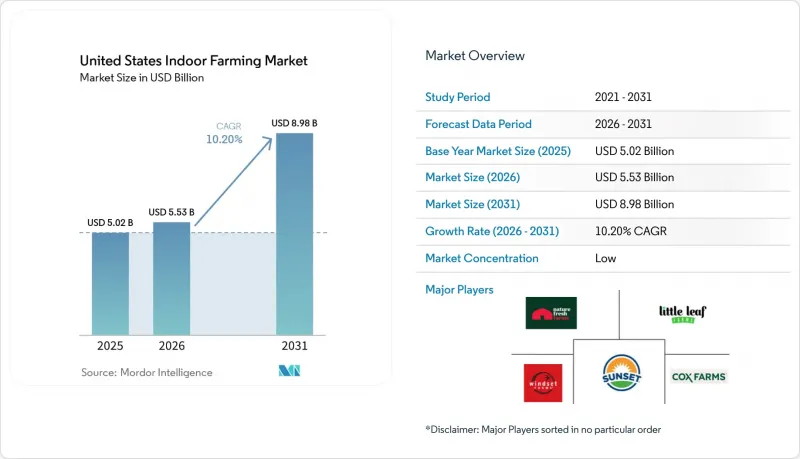
본 보고서는 시설 유형(온실, 실내 수직 농업, 운송용 컨테이너 농업), 재배 시스템(수경 재배, 에어로포닉스, 아쿠아포닉스, 토양 재배, 하이브리드), 그리고 작물 유형(과일, 채소, 허브, 꽃·관상용 식물, 모종·번식용 작물)별로 분류되어 있습니다. 시장 전망은 금액(달러) 기준으로 제시되어 있습니다.
미국 실내 농업 시장 동향과 인사이트
무농약 지역산 농산물에 대한 수요
클린 라벨 농산물에 대한 수요는 실내 농업 시장에 일시적인 프리미엄 틈새 시장을 넘어선 안정적이고 지속 가능한 기반을 마련해 주고 있습니다. 소비자들은 소매 및 외식 산업의 유통 경로에 도달하기 전에, 원산지 및 취급 과정에 관한 명확한 정보가 기재된 제품을 점점 더 많이 찾고 있습니다. 2024년 FAO(유엔 식량농업기구)의 평가 보고서에 따르면, 수경 재배된 상추, 토마토, 딸기에서 농약이 거의 검출되지 않은 것으로 나타났으며, 이는 소매업체와 소비자 모두에게 실내 농업이 더 깨끗한 재배 방법이라는 매력을 입증해 주고 있습니다. 이러한 장점은 보다 엄격한 수자원 정책과 식료품 조달 기준이 도입된 미국 서부 주들에서 특히 큰 의미를 지닙니다. 또한, 대형 소매업체들은 지역 특산품 조달 및 추적성 관련 노력을 시범 프로그램 단계에서 공급업체에 대한 필수 요건으로 전환하고 있으며, 이는 실내 재배 농산물에 대한 수요 증가를 뒷받침하고 있습니다. 인증되고 추적 가능성이 확보된 공급 프로그램에 참여하려면, 대부분의 경우 감시 체계 강화, 환경 관리 및 자동화가 요구됩니다. 그 결과, 실내 농업 시장 전반에서 시스템에 대한 투자 확대가 촉진되고 있습니다.
연중 공급 안정성에 대한 요건
실내 농산물 시장은 신선 농산물 공급에 따른 혼란을 최소화하고자 하는 바이어들로부터도 지지를 얻고 있습니다. 잇따른 리콜과 노지 농업에서 기상 조건으로 인한 공급 차질로 인해, 소매업체와 외식업체는 토양 및 지표수 오염 위험에 대한 노출을 줄일 수 있는 생산 시스템을 모색해야 하는 상황에 놓여 있습니다. 실내 시설은 보다 체계적으로 관리되는 환경을 제공하기 때문에 구매자는 노지 재배를 통한 공급에서는 반드시 실현할 수 없는 방식으로 식품의 안전성, 납기, 품질의 안정성을 관리할 수 있습니다. 이러한 변화가 중요한 이유는 현재 농산물 계약이 가격뿐만 아니라 일년내내 유지되는 신뢰성 측면에서도 평가받고 있기 때문입니다. 병원, 대학, 교정 시설 등의 기관 구매 담당자들은 안정적인 공급이 제품 품질만큼 중요하기 때문에 지역 조달 모델에 대한 참여를 강화하고 있습니다. 사우스캐롤라이나주에 위치한 미국 최초의 교도소 내 수직 농장에서 AmplifiedAg사가 2025년 9월에 실시한 수확 결과, 이 모델을 통해 연간 약 21.7메트르톤의 잎채소를 공급할 수 있음이 입증되어, 연중 기관 수요를 충족시킨 실제 사례가 되었습니다. 더 많은 구매자들이 탄탄한 지역 조달을 조달의 필수 요건으로 인식하게 됨에 따라, 시장은 더 장기적이고 안정적인 구매 계약의 혜택을 누리게 될 것입니다.
높은 설비 투자와 에너지 집약도
높은 초기 투자 비용은 여전히 실내 농업 부문에 있어 가장 큰 제약 요인으로 남아 있습니다. 이는 프로젝트의 수익성이 복잡한 인프라와 에너지 집약적인 운영 비용을 모두 감당해야 하기 때문입니다. 2025년 조사에 따르면, 미국의 대규모 수직 농장에서 조명, 온도 관리, 환기에 드는 비용이 총 운영 비용의 약 25%를 차지하고 있으며, 이는 에너지 비용이 부차적인 것이 아니라 핵심적인 요소임을 뒷받침하고 있습니다. 실내형 수직 농장에서 인공 조명은 총 에너지의 60-85%를 소비하여 가장 큰 에너지 부담 요인이 되고 있습니다. 이러한 비용 항목들은 구조물, 제어 시스템, 관개 시스템 및 기타 설치 설비의 감가상각비에 가산되기 때문에 큰 과제가 되고 있습니다. 2025년 『Energy Journal』의 조사에 따르면, 태양광 발전과 축전지를 결합함으로써 제어 환경 농업에서 발생하는 과도한 에너지 비용을 25% 절감할 수 있는 것으로 밝혀졌으나, 시스템 통합에 드는 추가 비용으로 인해 여전히 초기 자본 투자가 많이 필요합니다. 캘리포니아주나 뉴욕주 등 시장에서는 산업용 전력 비용이 높기 때문에 이 문제는 더욱 심각해지고 있습니다. 왜냐하면, 이 주들은 지역산 농산물 수요 측면에서 상업적으로 가장 매력적인 지역으로 꼽히는 경우가 많기 때문입니다. 더 많은 작물 품종과 시설 모델에서 효율성 제고를 통한 이익이 이러한 부담을 상회하게 될 때까지는 높은 비용이 실내 농업 업계에 있어 계속해서 큰 걸림돌이 될 것입니다.
부문별 분석
2025년 현재, 미국 실내 농업 시장의 67%를 온실이 차지하고 있으며, 완전 밀폐형 농장에 비해 자본 요건이 낮고 에너지 의존도가 낮기 때문에 이 분야를 주도하고 있습니다. 한편, 실내 수직 농장은 고밀도 배치, 자동화, 도시 공간의 보다 효율적인 활용에 힘입어 2031년까지 연평균 성장률(CAGR) 12.5%를 기록하며 가장 빠르게 성장하는 부문이 될 것으로 전망됩니다. 플로리다주에 위치한 AmHydro사의 "Harvest Singularity" 시설 등 최근 프로젝트는 2024년부터 2025년에 걸친 업계 재편을 거쳐, 작물의 생육 단계에 맞춘 자동화와 보다 체계적인 확장 전략으로의 전환을 반영하고 있습니다.
운송용 컨테이너 농장은 여전히 틈새 시장으로, 주로 외딴 지역, 기관 및 연구 용도로 이용되고 있습니다. AmplifiedAg사의 미국 농무부(USDA) 자금 지원을 받은 컨테이너 프로젝트와 교정 시설과의 제휴는 시장 전체의 수익 성장에 기여하는 정도는 제한적이지만, 그 실용적 중요성이 여전히 높음을 보여주고 있습니다. 온실은 확장성, 운영에 대한 익숙함, 그리고 인공 조명에 대한 의존도가 낮다는 점 때문에 계속해서 업계에 안정적인 수익 기반을 제공합니다. 또한, 이 부문은 국내 시장에 대한 집중을 강화하고 있습니다. GrowSpan사가 아이오와주에서 실시한 25,000제곱피트 규모의 벤로식 온실 확장 사업과, Prospiant사가 미국산 온실 솔루션 보급에 주력하고 있는 점은 현지 조달로의 광범위한 전환, 수입 의존도 감소, 그리고 전미에 걸친 온실 개보수 및 확장 지원 강화를 시사합니다.
기타 혜택:
- 엑셀 형식 시장 예측(ME) 시트
- 3개월간의 애널리스트 지원
자주 묻는 질문
목차
제1장 서론
제2장 조사 방법
제3장 주요 요약
제4장 시장 구도
제5장 시장 규모와 성장 예측
제6장 경쟁 구도
제7장 시장 기회와 향후 동향
JHS 26.07.03According to Mordor Intelligence, the united states indoor farming market size was valued at USD 5.02 billion in 2025 and is projected to grow to USD 5.53 billion in 2026 and reach USD 8.98 billion by 2031, at a CAGR of 10.2% during the forecast period of 2026-2031.
This report is Segmented by Facility Type (Greenhouses, Indoor Vertical Farms, and Shipping-Container Farms), by Growing System (Hydroponics, Aeroponics, Aquaponics, Soil-Based, and Hybrid), and by Crop Type (Fruits, Vegetables, and Herbs, Flowers and Ornamentals, Nursery and Propagation Crops). The Market Forecasts are Provided in Terms of Value (USD).
United States Indoor Farming Market Trends and Insights
Demand for Pesticide-Free Local Produce
The demand for clean-label produce is providing the indoor farming market with a stable, sustained base, moving beyond a temporary premium niche. Consumers increasingly seek products with clear information about their origin and handling processes before reaching retail and foodservice channels. A 2024 FAO assessment reported near-zero pesticide detections in hydroponically grown lettuce, tomatoes, and strawberries, reinforcing the appeal of indoor farming as a cleaner growing method for both retailers and consumers. These benefits are particularly significant in Western states, where stricter water policies and grocery procurement standards are being implemented. Furthermore, large retailers are transitioning local sourcing and traceability initiatives from pilot programs to mandatory supplier requirements, driving increased demand for indoor-grown produce. Participation in certified, traceable supply programs often requires enhanced monitoring, environmental controls, and automation, which, in turn, drives higher system investments across the indoor farming market.
Year-Round Supply Resilience Requirements
The indoor farming market is also gaining support from buyers who want fewer disruptions in fresh produce supply. Repeated recall events and weather-related disruptions in field agriculture pushed retailers and foodservice operators to examine production systems that can reduce exposure to soil and surface-water contamination risks. Indoor facilities offer a more controlled setting, which helps buyers manage food safety, timing, and consistency in ways open-field supply cannot always match. This shift matters because produce contracts are now judged not only on price but also on reliability throughout the year. Institutional buyers such as hospitals, universities, and correctional systems are becoming more active in local procurement models because stable supply matters as much as product quality in those settings. AmplifiedAg's September 2025 harvest at the first United States prison vertical farm in South Carolina showed that this model can supply around 21.7 metric tons of leafy greens annually, giving a practical example of year-round institutional demand. As more buyers treat resilient local sourcing as a procurement need, the market stands to benefit from longer and more stable purchase agreements.
High Capex and Energy Intensity
High upfront spending remains the single largest limit on the indoor farming sector because project economics must cover both complex infrastructure and energy-heavy operations. A 2025 study found that lighting, temperature control, and ventilation accounted for around 25% of total operating costs at large United States vertical farms, which confirms that utility spending is central rather than secondary. Artificial lighting accounts for the largest energy burden in enclosed vertical farms, consuming 60-85% of total energy. These cost layers are challenging because they sit on top of depreciation from structures, controls, irrigation systems, and other installed equipment. A 2025 Energy Journal study found that combined photovoltaic and battery storage could reduce excessive energy costs in controlled environment agriculture by 25%, but the added system integration costs still raise the starting capital requirement. High industrial electricity costs in markets such as California and New York deepen this challenge because those states are often among the most commercially attractive for local produce demand. Until efficiency gains outweigh those burdens across more crop types and facility models, cost intensity will remain a major brake on the indoor farming industry.
Other drivers and restraints analyzed in the detailed report include:
- Water-Efficiency and Land-Productivity Gains
- LED, Automation, and Climate-Control Advances
- Skilled Labor and Agronomy-Automation Talent Shortages
For complete list of drivers and restraints, kindly check the Table Of Contents.
Segment Analysis
Greenhouses accounted for 67% of the United States indoor farming market share in 2025, leading the sector due to lower capital requirements and reduced energy dependence compared to fully enclosed farms. Meanwhile, indoor vertical farms are projected to be the fastest-growing segment, growing at a 12.5% CAGR through 2031, driven by denser layouts, automation, and more efficient use of urban space. Recent projects, such as AmHydro's Harvest Singularity facility in Florida, reflect a shift toward crop-stage-specific automation and more disciplined expansion strategies following the 2024-2025 industry shakeout.
Shipping-container farms remain a niche segment, mainly serving remote, institutional, and research applications. AmplifiedAg's USDA (United States Department of Agriculture)-funded container projects and correctional facility partnerships highlight their continued practical relevance despite limited contribution to overall market revenue growth. Greenhouses continue to provide the industry's stable revenue base due to their scalability, operational familiarity, and lower reliance on artificial lighting. The segment is also becoming more domestically focused. GrowSpan's 25,000-square-foot Venlo greenhouse expansion in Iowa and Prospiant's push toward United States-manufactured greenhouse solutions indicate a broader shift toward local sourcing, reduced import dependence, and stronger support for greenhouse retrofits and expansions across the United States.
Complete Report Scope:
- By Facility Type
- Greenhouses
- Indoor Vertical Farms
- Shipping-container Farms
- By Growing System
- Hydroponics
- Aeroponics
- Aquaponics
- Soil-based and Hybrid Systems
- By Crop Type
- Fruits, Vegetables, and Herbs
- Leafy Greens
- Herbs
- Tomatoes
- Cucumbers
- Peppers
- Strawberries and Berries
- Microgreens
- Flowers and Ornamentals
- Nursery and Propagation Crops
- Fruits, Vegetables, and Herbs
List of Companies Covered in this Report:
- Mastronardi Produce Ltd. (Sunset)
- Windset Farms
- Cox Enterprises, LLC
- Nature Fresh Farms
- Little Leaf Farms
- Village Farms International
- Houwelings
- BrightFarms
- Gotham Greens
- Local Bounti
- Revol Greens
- Pure Green Farms
- Superior Fresh
- Edible Garden AG
- Soli Organic
- Great Lakes Growers
- Springworks Farm
- AeroFarms
- 80 Acres Farms
- Oishii
Additional Benefits:
- The market estimate (ME) sheet in Excel format
- 3 months of analyst support
TABLE OF CONTENTS
1 Introduction
- 1.1 Study Assumptions and Market Definition
- 1.2 Scope of the Study
2 Research Methodology
3 Executive Summary
4 Market Landscape
- 4.1 Market Overview
- 4.2 Market Drivers
- 4.2.1 Demand for pesticide-free local produce
- 4.2.2 Year-round supply resilience requirements
- 4.2.3 Water-efficiency and land-productivity gains
- 4.2.4 LED, automation, and climate-control advances
- 4.2.5 Retail offtake contracts improving project financeability
- 4.2.6 USDA (United States Department of Agriculture) grants and technical assistance for CEA buildouts
- 4.3 Market Restraints
- 4.3.1 High capex and energy intensity
- 4.3.2 Skilled labor and agronomy-automation talent shortages
- 4.3.3 Financing gap after vertical farming failures
- 4.3.4 Zoning, permitting, and utility-interconnection delays
- 4.4 Regulatory Landscape
- 4.5 Technological Outlook
- 4.6 Porter's Five Forces Analysis
- 4.6.1 Bargaining Power of Suppliers
- 4.6.2 Bargaining Power of Buyers
- 4.6.3 Threat of New Entrants
- 4.6.4 Threat of Substitutes
- 4.6.5 Intensity of Competitive Rivalry
5 Market Size & Growth Forecasts (Value, USD)
- 5.1 By Facility Type
- 5.1.1 Greenhouses
- 5.1.2 Indoor Vertical Farms
- 5.1.3 Shipping-container Farms
- 5.2 By Growing System
- 5.2.1 Hydroponics
- 5.2.2 Aeroponics
- 5.2.3 Aquaponics
- 5.2.4 Soil-based and Hybrid Systems
- 5.3 By Crop Type
- 5.3.1 Fruits, Vegetables, and Herbs
- 5.3.1.1 Leafy Greens
- 5.3.1.2 Herbs
- 5.3.1.3 Tomatoes
- 5.3.1.4 Cucumbers
- 5.3.1.5 Peppers
- 5.3.1.6 Strawberries and Berries
- 5.3.1.7 Microgreens
- 5.3.2 Flowers and Ornamentals
- 5.3.3 Nursery and Propagation Crops
- 5.3.1 Fruits, Vegetables, and Herbs
6 Competitive Landscape
- 6.1 Market Concentration
- 6.2 Strategic Moves
- 6.3 Market Share Analysis
- 6.4 Company Profiles (Includes Global level Overview, Market Level Overview, Core Segments, Financials as Available, Strategic Information, Market Rank/Share for Key Companies, Products and Services, and Recent Developments)
- 6.4.1 Mastronardi Produce Ltd. (Sunset)
- 6.4.2 Windset Farms
- 6.4.3 Cox Enterprises, LLC
- 6.4.4 Nature Fresh Farms
- 6.4.5 Little Leaf Farms
- 6.4.6 Village Farms International
- 6.4.7 Houwelings
- 6.4.8 BrightFarms
- 6.4.9 Gotham Greens
- 6.4.10 Local Bounti
- 6.4.11 Revol Greens
- 6.4.12 Pure Green Farms
- 6.4.13 Superior Fresh
- 6.4.14 Edible Garden AG
- 6.4.15 Soli Organic
- 6.4.16 Great Lakes Growers
- 6.4.17 Springworks Farm
- 6.4.18 AeroFarms
- 6.4.19 80 Acres Farms
- 6.4.20 Oishii


