

|
시장보고서
상품코드
2072987
조직 나노트랜스펙션 시장 : 점유율 분석, 업계 동향과 통계, 성장 예측(2026-2031년)Tissue Nanotransfection - Market Share Analysis, Industry Trends & Statistics, Growth Forecasts (2026 - 2031) |
||||||
 Mordor Intelligence
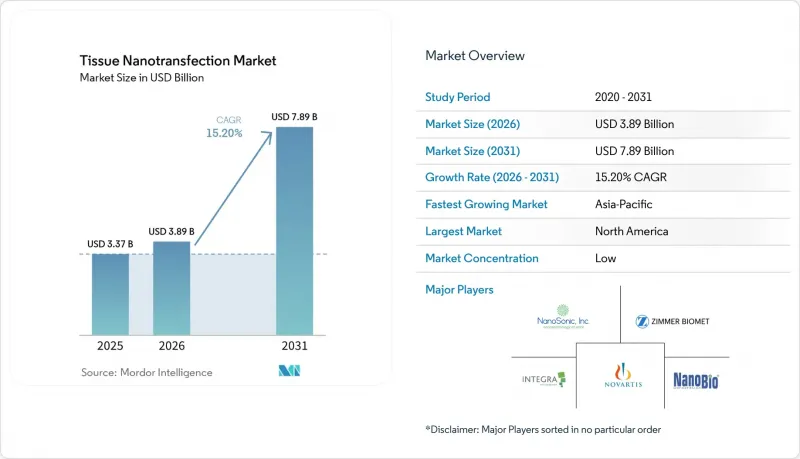
Mordor Intelligence에 의하면, 조직 나노트랜스펙션 시장 규모는 2025년에 33억 7,000만 달러로 평가되었고 2026년 38억 9,000만 달러에서 2031년까지 78억 9,000만 달러에 이를 것으로 예측되며, 예측 기간(2026-2031년) CAGR은 15.20%를 나타낼 전망입니다.
본 보고서는 기술별(나노일렉트로포레이션, 마이크로니들 보조, 관련 일렉트로포레이션, 기타), 용도별(상처 치유, 혈관 복원, 신경계, 근골격계, 종양학, 기타), 최종 사용자별(병원, 클리닉, 학술 기관, 제약 회사, 기타), 지역별(북미, 유럽, 기타)로 분류되어 있습니다. 시장 전망은 금액(달러) 기준으로 제시되어 있습니다.
전 세계 조직 나노트랜스펙션 시장 동향 및 인사이트
비바이러스성 생체 내 유전자 도입에 대한 수요 증가
조직 나노트랜스펙션 시장은 비바이러스성 전달 방식으로의 업계 전반적 전환이라는 큰 흐름의 혜택을 받고 있습니다. 연구자와 개발자들은 바이러스 계열에 흔히 수반되는 합병증을 피하면서 유전 물질을 조직에 도입하는 방법을 점점 더 모색하고 있습니다. 조직 나노트랜스펙션은 실리콘 기반 칩과 단시간의 전기 펄스를 병용하여, 치료 부위의 세포막을 통해 플라스미드 DNA, mRNA 및 이와 유사한 물질을 직접 전달합니다. 이러한 국소 투여 방식은 바이러스 벡터의 사용을 피할 뿐만 아니라, 전신에 대한 노출도 최소화합니다. 또한, 국소적 또는 외과적 방법으로 접근 가능한 조직에서 재현 가능한 현장 재프로그래밍을 용이하게 합니다. 이러한 추세를 뒷받침하는 중요한 움직임으로, 애브비(AbbVie)는 2025년 6월 캡스턴 테라퓨틱스(Capstan Therapeutics)를 최대 21억 달러에 인수하는 계약을 체결하며, RNA를 중심으로 한 생체 내 세포 공학 분야에서 입지를 공고히 했습니다. 조직 나노트랜스펙션 시장은 단순한 학술적 호기심의 대상이라는 이미지를 점차 벗어던지고 있습니다. 현재는 상처 치료와 혈관 복원부터 신경 복원, 그 밖의 조직 중심 연구에 이르기까지 폭넓게 응용할 수 있는 실용적인 플랫폼으로 인식되고 있습니다.
국소적 조직 재프로그래밍에 대한 임상적 관심 증가
조직 나노트랜스펙션 시장은 국소적인 조직 재프로그래밍에 대한 관심이 높아짐에 따라 호재를 맞이하고 있습니다. 발표된 연구들은 일관되게, 표적화된 유전자 도입을 통해 세포 채취 없이도 손상 부위의 복구 반응을 변화시킬 수 있음을 보여주고 있습니다. 예를 들어, 뇌졸중 관련 전임상 연구에서 EFF 인자를 이용한 두개내 조직 나노트랜스펙션을 통해 마우스 모델에서 경색 부피가 감소했을 뿐만 아니라 기능적 회복도 촉진되었습니다. 마찬가지로, 말초 신경 손상 모델에서도 조직 나노트랜스펙션을 통해 혈관 형성 관련 유전자를 도입한 결과, 20주 동안 혈관 신생이 촉진되었으며, 악력 검사 결과도 개선되었습니다. 상처 치유 분야에서는 조직 나노트랜스펙션이 혈관 신생 신호를 재활성화함으로써 당뇨병 환자의 치유 속도를 높이는 능력이 연구를 통해 밝혀졌습니다. 이러한 연구 결과를 종합해 보면, 조직 나노트랜스펙션 시장은 학술적 검증 단계에서 구체적인 응용을 목표로 하는 개발 단계로 전환되고 있음을 시사합니다.
임상적 근거가 부족하고, 인간에 대한 적용이 초기 단계에 있다는 점
조직 나노트랜스펙션 시장은 광범위한 전임상 연구에 비해 임상적 근거가 제한적이라는 점에서 과제에 직면해 있습니다. 2026년 현재, 연구는 주로 동물 모델을 대상으로 한 상처 치유, 뇌졸중, 말초 신경 손상에 초점을 맞추고 있으며, 인간을 대상으로 한 장기적인 안전성 및 유효성에 관한 데이터는 불충분합니다. 이러한 근거의 부족은 병원 및 보험사로부터의 지원에 영향을 미치고 있습니다. 왜냐하면 일상적인 도입에는 메커니즘에 관한 데이터 이상의 것이 요구되기 때문입니다. 또한, 이 시장은 진료 현장에서 학습 곡선에 직면해 있으며, 그 성공 여부는 기기의 정확한 배치, 조직의 준비, 펄스 선택, 그리고 시술자의 일관성에 달려 있습니다. 또한, 재프로그래밍된 세포가 역동적인 조직 환경 속에서 의도된 표현형을 유지해야 하기 때문에 생물학적 불확실성도 여전히 남아 있습니다. 보다 강력한 임상 추적 조사와 표준화된 프로토콜을 통해 이러한 문제들이 해결될 때까지는 시장 성장이 완만할 가능성이 높습니다.
부문별 분석
2025년, 나노전기천공법을 기반으로 한 조직 나노트랜스펙션은 기술 부문 내 조직 나노트랜스펙션 시장에서 54.67%의 점유율을 차지했습니다. 이러한 압도적인 시장 점유율은 이 분야가 기반이 되는 실리콘 나노채널 아키텍처에 의존하고 있음을 반영하며, 광범위한 검증, 재생의학 모델에서의 일관된 적용, 그리고 명확하게 정의된 기술적 특징에 의해 뒷받침되고 있습니다. 이 기술은 단시간의 전기 자극을 통해 나노 규모의 구조를 매개로 약물을 직접 전달할 수 있게 하며, 전신성 비바이러스성 운반체나 벌크 전기천공법과 차별화된 국소적 전달 방법을 제공합니다. 경쟁 기기 설계가 발전하고 있음에도 불구하고, 나노일렉트로포레이션은 여전히 시장의 기준이 되고 있습니다.
마이크로니들 보조 조직 나노트랜스펙션은 2031년까지 연평균 성장률(CAGR) 16.99%를 나타낼 것으로 예측되며, 조직 나노트랜스펙션 시장에서 가장 빠르게 성장하는 기술이 될 전망입니다. 이러한 성장은 조직과의 접촉성 향상, 표층으로의 침투 용이화, 그리고 용해형, 하이드로겔, 중공 마이크로니들 등 범용성이 높은 설계에 힘입어 이루어지고 있습니다. 2025년 리뷰에서는 전임상 단계의 용해형 마이크로니들 연구 중 83%가 기존 방법과 동등하거나 그 이상의 형질 도입 효율을 달성했다는 점이 강조되었습니다. 다른 형식들도 여전히 중요하기는 하지만, 시장은 앞으로도 확립된 나노채널 시스템과 급속히 진화하는 마이크로니들 플랫폼을 중심으로 전개될 것으로 보입니다.
지역별 분석
2025년, 북미는 조직 나노트랜스펙션 시장을 독점하며 42.33%라는 높은 점유율을 차지했습니다. 이러한 선도적 지위는 견고한 학술적 기반, 초기 단계의 중개 연구 활동, 그리고 환급의 불확실성에도 불구하고 첨단 재생의학 제품을 지원하는 규제 체계에 기인합니다. 미국은 주요 연구 및 중개 연구 이니셔티브를 주도하는 데 중요한 역할을 하고 있습니다. 또한, 북미의 병원 네트워크는 2025년 상처 치유 학회(Wound Healing Society)의 연구 결과 등 중요한 안전성 데이터를 활용하고 있습니다. 본 연구회에서는 유전자 도입된 피부 조직에서 미토콘드리아의 생체 에너지 대사 및 세포 골격의 완전성이 유지되고 있음이 입증되었습니다. 이러한 과학적 전문 지식, 중개 연구 활동, 그리고 임상 인프라의 결합이 북미 시장에서 선도적인 입지를 확고히 하고 있습니다.
아시아태평양은 2031년까지 연평균 성장률(CAGR) 16.26%를 기록하며 성장할 것으로 예상되며, 조직 나노트랜스펙션 시장에서 가장 빠르게 성장하는 지역이 될 전망입니다. 이 지역의 반도체 제조 분야 강점은 소자 제조에 사용되는 실리콘 칩의 공정과 일치합니다. 한국과 대만은 주요 주자이며, 기기 규모의 확대를 뒷받침하는 성숙한 미세 가공 생태계를 갖추고 있습니다. 또한, 재생의학 및 유전자 전달 연구의 발전이 국소 전달 도구에 대한 수요를 견인하고 있으며, 이를 통해 연구 단계에서 실용화로의 전환을 가능하게 하고 있습니다. 이러한 요인들로 인해 국가별로 임상 도입 현황에는 차이가 있지만, 아시아태평양은 중요한 성장 지역으로서의 위상을 확고히 하고 있습니다.
2025년에는 유럽, 중동 및 아프리카, 남미가 합쳐서 나머지 시장 점유율을 차지했습니다. 유럽은 상처 치료 및 재생 의학 분야에서 탄탄한 과학적 기반과 전문 지식을 보유하고 있지만, 엄격한 증거 요건이 상용화를 지연시킬 가능성이 있습니다. 독일과 영국은 전기천공법 및 중개 의학 응용 분야에서 활발한 임상 연구로 주목받고 있습니다. 중동 및 아프리카에서는 투자가 활발한 의료 시스템에서 도입이 확대될 것으로 예상되는 반면, 기타 지역은 여전히 도입 준비의 초기 단계에 머물러 있습니다. 남미는 아직 개발도상국이지만, 연구 협력과 생명공학 역량 강화라는 혜택을 누리고 있습니다. 이 지역들은 시장의 선두주자라고 할 수는 없지만, 임상 측면이나 보험 급여에 대한 명확성이 높아짐에 따라 성장이 기대되고 있습니다.
기타 혜택:
- 엑셀 형식 시장 예측(ME) 시트
- 3개월간의 애널리스트 지원
자주 묻는 질문
목차
제1장 서론
제2장 조사 방법
제3장 주요 요약
제4장 시장 구도
제5장 시장 규모와 성장 예측
제6장 경쟁 구도
제7장 시장 기회와 향후 전망
JHS 26.07.03According to Mordor Intelligence, the tissue nanotransfection market size was valued at USD 3.37 billion in 2025 and is estimated to grow from USD 3.89 billion in 2026 to reach USD 7.89 billion by 2031, at a CAGR of 15.20% during the forecast period (2026-2031).
This report is Segmented by Technology (Nanoelectroporation, Microneedle Assisted, Related Electroporation, Other), Application (Wound Healing, Vascular Repair, Neurological, Musculoskeletal, Oncology, Other), End User (Hospitals, Clinics, Academic Institutes, Pharma Companies, Other), and Geography (North America, Europe, and More). The Market Forecasts are Provided in Terms of Value (USD).
Global Tissue Nanotransfection Market Trends and Insights
Rising Demand for Non-Viral In Vivo Gene Delivery
The tissue nanotransfection market is benefiting from a broader industry shift toward non-viral delivery methods. Researchers and developers are increasingly seeking ways to introduce genetic material into tissues without the complications often associated with viral systems. Tissue nanotransfection employs a brief electrical pulse alongside a silicon-based chip to directly transfer plasmid DNA, mRNA, and similar materials across cell membranes at the treatment site. This localized delivery approach not only sidesteps the use of viral vectors but also minimizes systemic exposure. Furthermore, it facilitates repeatable in situ reprogramming in tissues accessible through topical or surgical means. In a significant move underscoring this trend, AbbVie inked a deal to acquire Capstan Therapeutics for up to USD 2.1 billion in June 2025, bolstering its foothold in RNA-centric in vivo cell engineering. The tissue nanotransfection market is increasingly shedding its image as merely an academic curiosity. It's now being recognized as a viable platform for applications ranging from wound care and vascular repair to nerve repair and other tissue-centric initiatives.
Increasing Clinical Interest in Localized Tissue Reprogramming
The tissue nanotransfection market is witnessing a boost from heightened interest in localized tissue reprogramming. Published studies consistently demonstrate that targeted gene delivery can modify repair responses at injury sites, all without the need for cell harvesting. For instance, in preclinical studies related to strokes, using intracranial tissue nanotransfection with EFF factors not only reduced infarct volume but also enhanced functional recovery in murine models. Similarly, in models of peripheral nerve injuries, delivering vasculogenic genes via tissue nanotransfection led to improved vascularization and better grip outcomes over a 20-week span. In wound healing, studies have highlighted tissue nanotransfection's ability to reactivate angiogenic signaling, thereby accelerating healing in diabetic scenarios. Collectively, these findings signal a shift for the tissue nanotransfection market, moving from academic validation to concrete application-driven development.
Limited Clinical Evidence and Early-Stage Human Adoption
The tissue nanotransfection market faces challenges due to limited clinical evidence compared to extensive preclinical studies. As of 2026, research primarily focuses on wound healing, stroke, and peripheral nerve injuries in animal models, with insufficient long-term human safety and efficacy data. This lack of evidence impacts hospital and payer support, as they require more than mechanistic data for routine adoption. Additionally, the market encounters a learning curve at the point of care, where success depends on precise device placement, tissue preparation, pulse selection, and operator consistency. Biological uncertainty also persists, as reprogrammed cells must maintain their intended phenotype in dynamic tissue environments. Until these issues are resolved with stronger clinical follow-ups and standardized protocols, market growth will likely remain gradual.
Other drivers and restraints analyzed in the detailed report include:
- Advances in Silicon Hollow-Needle and Nanochannel Chip Fabrication
- AI-Guided Pulse Optimization and Semiconductor-Scale Manufacturing
- Reimbursement and Regulatory Uncertainty for First-in-Class Devices
For complete list of drivers and restraints, kindly check the Table Of Contents.
Segment Analysis
In 2025, Nanoelectroporation Based Tissue Nanotransfection held a 54.67% share of the tissue nanotransfection market within its technology segment. This dominance reflects the field's reliance on the foundational silicon nanochannel architecture, supported by extensive validation, consistent use in regenerative models, and a well-defined technical identity. The technology enables direct cargo transfer via nanoscale structures with brief electrical stimulation, offering a localized delivery method distinct from systemic non-viral carriers and bulk electroporation approaches. Nanoelectroporation remains the benchmark in the market, even as competing device designs advance.
Microneedle Assisted Tissue Nanotransfection is projected to grow at a 16.99% CAGR through 2031, making it the fastest-growing technology in the tissue nanotransfection market. Its growth is driven by improved tissue contact, easier penetration of surface layers, and versatile designs like dissolving, hydrogel, and hollow microneedles. A 2025 review highlighted that 83% of preclinical dissolving microneedle studies achieved transfection efficacy comparable to or better than traditional methods. While other formats remain relevant, the market will likely continue to center on established nanochannel systems and rapidly advancing microneedle platforms.
Complete Report Scope:
- By Technology
- Nanoelectroporation Based Tissue Nanotransfection
- Microneedle Assisted Tissue Nanotransfection
- Related Electroporation Based Platforms
- Other Nanotransfection Technologies
- By Application
- Wound Healing and Skin Repair
- Vascular and Ischemic Tissue Repair
- Neurological Repair
- Musculoskeletal and Muscle Regeneration
- Oncology and Tumor Microenvironment Reprogramming
- Other Applications
- By End User
- Hospitals
- Specialty Clinics
- Academic and Research Institutes
- Biotech and Pharmaceutical Companies
- Other End Users
- By Geography
- North America
- United States
- Canada
- Mexico
- Europe
- Germany
- United Kingdom
- France
- Italy
- Spain
- Rest of Europe
- Asia-Pacific
- China
- India
- Japan
- Australia
- South Korea
- Rest of Asia-Pacific
- Middle East and Africa
- GCC
- South Africa
- Rest of Middle East and Africa
- South America
- Brazil
- Argentina
- Rest of South America
- North America
Geography Analysis
In 2025, North America dominated the tissue nanotransfection market, holding a significant 42.33% share. This leadership stems from a strong academic foundation, early translational efforts, and a regulatory framework that supports advanced regenerative products, despite reimbursement uncertainties. The U.S. plays a key role, driving major studies and translational initiatives. North American hospital networks also leverage critical safety data, such as findings from the 2025 Wound Healing Society, which demonstrated preserved mitochondrial bioenergetics and cytoskeletal integrity in gene-transfected skin tissue. This combination of scientific expertise, translational activity, and clinical infrastructure secures North America's leading position in the market.
Asia-Pacific is projected to grow at a 16.26% CAGR through 2031, making it the fastest-growing region in the tissue nanotransfection market. The region's strength in semiconductor fabrication aligns with the silicon chip processes used in device manufacturing. South Korea and Taiwan are key players, with mature microfabrication ecosystems supporting device scale-up. Additionally, advancements in regenerative medicine and gene delivery research drive demand for localized delivery tools, enabling their transition from research to application. These factors position Asia-Pacific as a critical growth region, despite varying clinical adoption across countries.
In 2025, Europe, the Middle East and Africa, and South America collectively held the remaining market share. Europe has a strong scientific base and expertise in wound care and regenerative medicine, but stringent evidence requirements can delay commercialization. Germany and the U.K. are notable for their active clinical work in electroporation and translational applications. In the Middle East and Africa, adoption is expected to grow in high-investment health systems, while other areas remain in earlier stages of readiness. South America, though nascent, benefits from research links and improving biotech capacity. These regions, while not market leaders, are positioned for growth as clinical and reimbursement clarity improves.
- Abbvie
- AstraZeneca
- B. Braun
- Beckton Dickinson
- GlaxoSmithKline
- Imaxio SA
- Integra LifeSciences
- Johnson & Johnson
- Medtronic
- Merck
- Nano Biotechnology Co., Ltd.
- NanoBio Corporation
- NanoSonic, Inc.
- Novartis
- Organogenesis
- Osiris Therapeutics, LLC
- Pfizer
- Roche
- Smiths Group
- Zimmer Biomet
Additional Benefits:
- The market estimate (ME) sheet in Excel format
- 3 months of analyst support
TABLE OF CONTENTS
1 INTRODUCTION
- 1.1 Study Assumptions and Market Definition
- 1.2 Scope of the Study
2 RESEARCH METHODOLOGY
3 EXECUTIVE SUMMARY
4 MARKET LANDSCAPE
- 4.1 Market Overview
- 4.2 Market Drivers
- 4.2.1 Rising Demand for Non-Viral In Vivo Gene Delivery
- 4.2.2 Increasing Clinical Interest in Localized Tissue Reprogramming
- 4.2.3 Advances in Silicon Hollow-Needle and Nanochannel Chip Fabrication
- 4.2.4 Expanding Use Cases Across Wound Healing, Vascular Repair, and Neurology
- 4.2.5 Growing Translation from Academic Proof-of-Concept to Foundational Device Platforms
- 4.2.6 AI-Guided Pulse Optimization and Semiconductor-Scale Manufacturing Readiness
- 4.3 Market Restraints
- 4.3.1 Limited Clinical Evidence and Early-Stage Human Adoption
- 4.3.2 Complex Protocol Optimization Across Tissue Types and Cargo Types
- 4.3.3 GMP Sterility, Yield, and Device Reproducibility Challenges
- 4.3.4 Reimbursement and Regulatory Uncertainty for First-in-Class Reprogramming Devices
- 4.4 Value/Supply Chain Analysis
- 4.5 Regulatory Landscape
- 4.6 Technological Outlook
- 4.7 Porter's Five Forces Analysis
- 4.7.1 Threat of New Entrants
- 4.7.2 Bargaining Power of Suppliers
- 4.7.3 Bargaining Power of Buyers
- 4.7.4 Threat of Substitutes
- 4.7.5 Industry Rivalry
5 MARKET SIZE AND GROWTH FORECASTS (VALUE, USD)
- 5.1 By Technology
- 5.1.1 Nanoelectroporation Based Tissue Nanotransfection
- 5.1.2 Microneedle Assisted Tissue Nanotransfection
- 5.1.3 Related Electroporation Based Platforms
- 5.1.4 Other Nanotransfection Technologies
- 5.2 By Application
- 5.2.1 Wound Healing and Skin Repair
- 5.2.2 Vascular and Ischemic Tissue Repair
- 5.2.3 Neurological Repair
- 5.2.4 Musculoskeletal and Muscle Regeneration
- 5.2.5 Oncology and Tumor Microenvironment Reprogramming
- 5.2.6 Other Applications
- 5.3 By End User
- 5.3.1 Hospitals
- 5.3.2 Specialty Clinics
- 5.3.3 Academic and Research Institutes
- 5.3.4 Biotech and Pharmaceutical Companies
- 5.3.5 Other End Users
- 5.4 By Geography
- 5.4.1 North America
- 5.4.1.1 United States
- 5.4.1.2 Canada
- 5.4.1.3 Mexico
- 5.4.2 Europe
- 5.4.2.1 Germany
- 5.4.2.2 United Kingdom
- 5.4.2.3 France
- 5.4.2.4 Italy
- 5.4.2.5 Spain
- 5.4.2.6 Rest of Europe
- 5.4.3 Asia-Pacific
- 5.4.3.1 China
- 5.4.3.2 India
- 5.4.3.3 Japan
- 5.4.3.4 Australia
- 5.4.3.5 South Korea
- 5.4.3.6 Rest of Asia-Pacific
- 5.4.4 Middle East and Africa
- 5.4.4.1 GCC
- 5.4.4.2 South Africa
- 5.4.4.3 Rest of Middle East and Africa
- 5.4.5 South America
- 5.4.5.1 Brazil
- 5.4.5.2 Argentina
- 5.4.5.3 Rest of South America
- 5.4.1 North America
6 COMPETITIVE LANDSCAPE
- 6.1 Market Concentration
- 6.2 Market Share Analysis
- 6.3 Company Profiles (includes Global Level Overview, Market Level Overview, Core Segments, Financials as available, Strategic Information, Market Rank/Share, Products and Services, Recent Developments)
- 6.3.1 AbbVie Inc.
- 6.3.2 AstraZeneca plc
- 6.3.3 B. Braun SE
- 6.3.4 Becton, Dickinson and Company
- 6.3.5 GSK plc
- 6.3.6 Imaxio SA
- 6.3.7 Integra LifeSciences Holdings Corporation
- 6.3.8 Johnson and Johnson
- 6.3.9 Medtronic plc
- 6.3.10 Merck and Co., Inc.
- 6.3.11 Nano Biotechnology Co., Ltd.
- 6.3.12 NanoBio Corporation
- 6.3.13 NanoSonic, Inc.
- 6.3.14 Novartis AG
- 6.3.15 Organogenesis Holdings Inc.
- 6.3.16 Osiris Therapeutics, LLC
- 6.3.17 Pfizer Inc.
- 6.3.18 Roche Holding AG
- 6.3.19 Smith and Nephew plc
- 6.3.20 Zimmer Biomet Holdings, Inc.
7 MARKET OPPORTUNITIES AND FUTURE OUTLOOK
- 7.1 White-Space and Unmet-Need Assessment


