

|
시장보고서
상품코드
2115056
심혈관 및 연부 조직 수복 패치 시장 : 시장 점유율 분석, 업계 동향 및 통계, 성장 예측(2026-2031년)Cardiovascular And Soft Tissue Repair Patches - Market Share Analysis, Industry Trends & Statistics, Growth Forecasts (2026 - 2031) |
||||||
 Mordor Intelligence
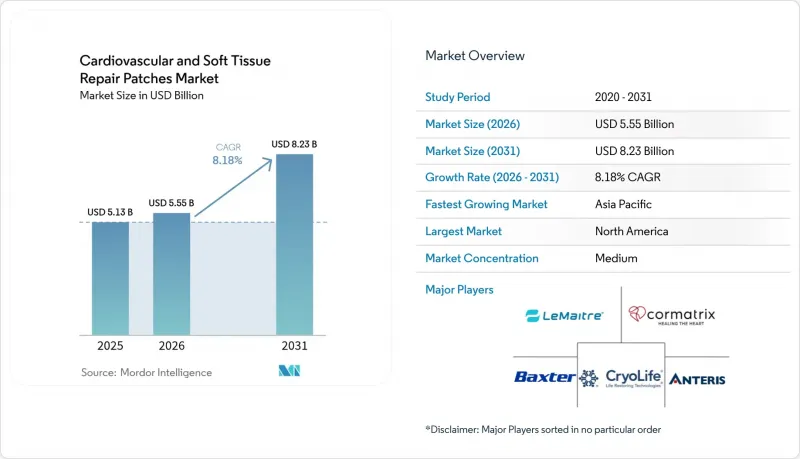
Mordor Intelligence에 의하면, 심혈관 및 연부 조직 수복 패치 시장 규모는 2025년 51억 3,000만 달러로 평가되었고, 2026년에는 55억 5,000만 달러로 추정되고, 2026-2031년 CAGR 8.18%로 성장을 지속할 전망이며, 2031년에는 82억 3,000만 달러에 이를 것으로 예측됩니다.
본 보고서는 소재 유형별(생체 유래, 합성, 기타), 용도별(심장 재생, 연조직 재생, 기타), 최종 사용자별(병원, 전문 심혈관 클리닉, 기타) 및 지역별(북미, 유럽, 아시아태평양, 기타)로 분류되어 있습니다. 시장 예측은 금액(달러) 기준으로 제시되어 있습니다.
세계의 심혈관 및 연부 조직 수복 패치 시장 동향과 인사이트
생체 유래 패치의 장점으로 재시술률 감소
임상 추적 조사에 따르면, 생체 유래 매트릭스는 재수술률을 25-40% 감소시키는 것으로 나타났으며, 생체 조직과 융합되는 소 및 돼지 심막을 이용한 옵션이 외과의사들 사이에서 선택되고 있습니다. 초기 단계의 줄기세포 패치는 다기관 공동 임상시험에서 좌심실 박출률을 현저히 향상시킨 것으로 나타났습니다. 새로운 케라틴 기반 지지체 재료는 생분해성을 갖추고 세포 증식을 촉진하므로 소아 및 고위험 환자군을 위한 선택의 폭을 넓히고 있습니다. 재수술 필요성이 감소함에 따라 비용 절감이 실현되어, 병원 측의 구매 결정을 뒷받침하고 있습니다. 이러한 이점들이 결합되어 심혈관 및 연부 조직 수복 패치 시장 전반에서 생체 재료의 채택이 가속화되고 있습니다.
저침습적 심장 결손 폐쇄술의 급속한 보급
절개 부위를 축소하고 로봇 보조 삽입을 결합함으로써, 외과의는 패치를 정확하게 삽입할 수 있으며, 수술 시간을 단축하고 회복 기간을 줄일 수 있습니다. 멀티포인트 페이싱 및 자가 접착성 콜라겐 프리스 소재에 대한 FDA의 승인은 최소 침습 의료기기에 대한 규제 당국의 지지를 보여줍니다. 병원들은 의뢰 환자를 유치하기 위해 조기 퇴원을 강조하고 있으며, 전문 클리닉에서는 심방 중격 수복 전용 카테터실이 도입되고 있습니다. 이러한 추세는 수익성이 높은 심장용 패치의 성장을 뒷받침하며, 심혈관 및 연조직 수복용 패치 시장의 향후 수익 전망을 공고히 하고 있습니다.
봉합사 및 이식편 대체재에 비해 높은 비용
고급 생체 유래 패치의 소매 가격은 단순한 봉합 세트의 5배에서 10배에 달할 수 있어, 자본 예산이 빠듯한 현장에서는 도입에 걸림돌이 되고 있습니다. 관리자들은 재수술 감소로 인한 장기적인 비용 절감보다는 당장의 지출을 더 중시하는 경향이 있습니다. 대규모 의료 시스템에서는 가치 기반 계약이 확산되고 있지만, 지급 기관에 의한 보상 기준 재검토는 지연되고 있습니다. 초기 비용 격차가 줄어들기 전까지는 가격에 민감한 의료 기관이 기존 재료를 우선할 가능성이 있으며, 그 결과 심혈관 및 연부 조직 수복 패치 시장의 단기 도입률은 둔화될 우려가 있습니다.
부문 분석
2025년, 합성 제품은 심혈관 및 연부 조직 수복 패치 시장에서 54.20%의 점유율을 유지했습니다. PTFE의 기계적 강도와 안정적인 공급망 덕분에 수술 건수가 많은 의료 기관에서는 여전히 인기가 높습니다. 그러나 생체 유래 매트릭스는 연평균 성장률(CAGR) 8.52%로 성장하고 있으며, 이는 뛰어난 조직 통합성과 석회화 위험 감소에 대한 수요를 반영하고 있습니다. 하이브리드 설계는 합성 보강재와 생체 유래 코팅을 결합한 것으로, 임상의가 기대하는 내구성을 확보하면서 생체 적합성을 향상시키는 길을 제시하고 있습니다. 소 심막공급 부족을 배경으로, 케라틴이나 조류 유래 폴리머에 대한 연구 개발이 활발해지고 있어 재료의 다양성이 확보되고 있습니다. 복합재료 및 3D 프린팅 제품은 절대 수로는 적지만, 그 규모에 비해 비례하지 않을 정도의 벤처 자금을 유치하고 있어, 투자자들이 심혈관 및 연조직 복구용 패치 시장의 장기적인 변혁을 확신하고 있음을 시사합니다.
생체 유래 제품의 성장은 패치가 환자의 해부학적 구조에 맞추어 확장되어야 하는 소아 분야 수요에 의해 더욱 가속화되고 있습니다. 연구에 따르면, 성장에 맞추어 확장되는 소 유래 패치는 2차 시술을 최대 30%까지 줄일 수 있는 것으로 나타났습니다. 각 제조업체는 천연 콜라겐을 그대로 보존하고 숙주 세포의 이동을 촉진하는 탈세포화 조직으로 이에 대응하고 있습니다. FDA 승인 절차의 개혁으로 인해 세포를 접종한 구조물이 장려되고 있으며, 향후에는 비활성 합성 소재가 불필요해질 가능성이 있습니다. 데이터가 축적됨에 따라 생체 재료가 합성 재료의 우위를 서서히 잠식하여, 심혈관 및 연부 조직 수복 패치 시장 전체경쟁 구도를 재편할 것으로 예측됩니다.
지역별 분석
북미의 39.98% 점유율은 첨단 심장 치료 프로그램, 광범위한 보험 적용 범위, 그리고 승인을 가속화하는 국방 예산에 의한 재생 의학 이니셔티브 파이프라인에 의해 뒷받침되고 있습니다. 미국에서는 연간 60만 건 이상의 심장 수술이 시행되고 있어 공급업체에 타의 추종을 불허하는 수요 기반을 제공합니다. 캐나다의 단일 지불자 모델은 총 의료비 절감을 장려하고 있으며, 재입원 위험을 줄여주는 바이오 제품으로의 병원 전환을 촉진하고 있습니다. 멕시코에서는 의료 관광 경로를 통해 외래 환자 수요가 증가하고 있습니다. 규제 당국은 신속한 심사 일정을 유지하고 있으며, 2025년 3월까지 1,000건 이상의 AI 탑재 기기가 승인될 전망입니다. 가치 기반 규제 하에서 가격 압박이 지속되고 있어 공급업체들은 실제 환경에서의 비용 절감 효과를 입증해야 하지만, 이 지역은 여전히 차세대 기술의 거점으로서 심혈관 및 연부 조직 수복 패치 시장에서 확고한 영향력을 유지하고 있습니다.
아시아태평양은 연평균 성장률(CAGR) 8.67%로 성장을 주도하고 있습니다. 일본과 한국에서는 현저한 고령화가 진행되고 있어 판막 수복 수술 건수가 증가하고 있습니다. 중국에서는 2급 도시의 3급 병원 규모가 확대되고 있으며, 이러한 증설로 인해 합성 PTFE의 대량 주문이 발생하고 있습니다. 인도의 공적 보험은 저소득 가구의 소아 심장 수술 비용을 보장하고 있어, 이를 통해 생체 재료의 채택이 촉진되고 있습니다. 각국 정부는 수입 비용 절감을 위해 국내 생산을 지원하고 있으며, 현지 스타트업 기업들은 3D 프린팅 기술을 활용하여 맞춤형 스캐폴드를 공급하고 있습니다. 태국과 싱가포르의 의료 관광 거점에서는 해외 환자들을 대상으로 저침습 치료 옵션을 홍보하고 있어, 고부가가치 제품의 판매를 뒷받침하고 있습니다. 이러한 요인들이 맞물려 아시아태평양은 심혈관 및 연부 조직 수복 패치 시장에서 주요 성장 동력으로서의 입지를 확고히 하고 있습니다.
유럽은 의료기기 규정에 기반한 품질 중심의 조달과 엄격한 증거 요건을 통해 경쟁력을 유지하고 있습니다. 독일은 확립된 PTFE 생산 능력으로 지역 생산을 뒷받침하고 있으며, 영국은 이식 연구를 주도하고 있습니다. 프랑스는 탈세포화 매트릭스를 연구하는 민관 컨소시엄을 주도하고 있습니다. 각국의 건강보험 기금은 품질조정생존년(QALY) 측면에서 명확한 이점을 보이는 제품에 대해 보험 급여를 적용하고 있으며, 장기적인 데이터를 보유한 생체 유래 제품을 우선시하고 있습니다. 더욱 엄격해진 시판 요건은 신규 진출기업 시장 진입을 지연시키는 한편, 전반적인 안전 기준을 높이고 있습니다. 국경을 초월한 의료 협정을 통해 고성능 패치가 유럽 전역에 도입되고 있으며, 유럽의 임상의들은 최신 치료법에 접근할 수 있고 환자들은 이동의 자유를 보장받고 있습니다. 이러한 구조적 특징이 심혈관 및 연부 조직 수복 패치 시장 전체의 꾸준한 성장과 혁신 노력을 뒷받침하고 있습니다.
기타 혜택 :
- 엑셀 형식 시장 예측(ME) 시트
- 3개월간의 애널리스트 지원
자주 묻는 질문
목차
제1장 서론
제2장 조사 방법
제3장 주요 요약
제4장 시장 구도
제5장 시장 규모 및 성장 예측
제6장 경쟁 구도
제7장 시장 기회 및 향후 전망
AJY 26.08.28According to Mordor Intelligence, the cardiovascular and soft tissue repair patches market size is expected to grow from USD 5.13 billion in 2025 to USD 5.55 billion in 2026 and is forecast to reach USD 8.23 billion by 2031 at 8.18% CAGR over 2026-2031.
This report is Segmented by Material Type (Biologic, Synthetic, and More), Application (Cardiac Repair, Soft Tissue Repair, and More), End User (Hospitals, Specialty Cardiovascular Clinics, and More) and by Geography (North America, Europe, Asia-Pacific, and More). The Market Forecasts are Provided in Terms of Value (USD).
Global Cardiovascular And Soft Tissue Repair Patches Market Trends and Insights
Biologic Patch Superiority Lowering Re-intervention Rates
Clinical follow-up shows biologic matrices cut repeat operations by 25-40%, steering surgeons toward bovine and porcine pericardial options that integrate with living tissue. Early-stage stem-cell patches registered marked gains in left-ventricular ejection fraction in multicenter trials. New keratin-based scaffolds add biodegradability and stimulate cell proliferation, broadening choices for pediatric and high-risk populations. Cost savings accrue when fewer revisions are needed, which strengthens hospital purchasing arguments. Collectively these gains push biologic adoption across the cardiovascular and soft tissue repair patches market at an accelerated clip.
Rapid Adoption of Minimally Invasive Cardiac Defect Closures
Smaller incisions paired with robot-assisted delivery let surgeons seat patches precisely, cut operating time, and shorten recovery. FDA clearance of multipoint pacing and self-adhering collagen fleece materials signals regulatory support for less-invasive hardware. Hospitals advertise faster discharge times to attract referrals, and specialty clinics deploy dedicated cath-lab suites for atrial-septal repairs. This momentum feeds growth in high-margin cardiac-use patches, strengthening future revenue visibility for the cardiovascular and soft tissue repair patches market.
High Comparative Cost Versus Suturing and Graft Substitutes
Premium biologic patches can retail for five to ten times the cost of a simple suture set, impeding adoption where capital budgets are strained. Administrators weigh immediate outlays more heavily than downstream savings from fewer revisions. Payers have been slow to realign reimbursement schedules, although value-based contracts are gaining traction in larger systems. Until upfront pricing narrows, price-sensitive facilities may favor traditional materials, dampening near-term install rates in the cardiovascular and soft tissue repair patches market.
Other drivers and restraints analyzed in the detailed report include:
- Aging Population Boosting Valve & Septal Repair Volumes
- Reimbursement Expansion for Congenital Heart Repair in Emerging Markets
- Limited Long-term Durability Data for Bio-engineered Tissue
For complete list of drivers and restraints, kindly check the Table Of Contents.
Segment Analysis
Synthetic products retained a 54.20% share of the cardiovascular and soft tissue repair patches market in 2025. PTFE's mechanical strength and predictable supply chains keep it popular in high-volume centers. However, biologic matrices are growing at an 8.52% CAGR, reflecting demand for superior integration and lower calcification risk. Hybrid designs marry synthetic reinforcement with biologic coatings, a route that promises the durability clinicians expect while improving biocompatibility. Supply shortages of bovine pericardium spur R&D into keratin and algae-derived polymers, ensuring material diversity. Composite and 3D-printed options, though small in absolute terms, receive disproportionate venture funding, signaling investor belief in long-run disruption of the cardiovascular and soft tissue repair patches market.
Biologic growth is further fueled by pediatric needs where patches must expand with patient anatomy. Studies show growth-accommodating bovine patches cut secondary interventions by up to 30%. Manufacturers respond with decellularized tissues that leave natural collagen intact, boosting host-cell migration. FDA pathway reforms encourage cell-seeded constructs that may one day render inert synthetics obsolete. As data accumulate, biologics are expected to erode synthetic dominance, reshaping competitive stakes across the cardiovascular and soft tissue repair patches market.
Complete Report Scope:
- By Material Type
- Biologic
- Synthetic
- Next-gen Bio-printed/Composite
- By Application
- Cardiac Repair
- Atrial & Ventricular Septal Defect Closure
- Valve Reconstruction & Annuloplasty
- Soft-Tissue Repair
- Vascular Repair & Reconstruction
- Others
- Cardiac Repair
- By End User
- Hospitals
- Specialty Cardiovascular Clinics
- Ambulatory Surgery Centers
- By Geography
- North America
- United States
- Canada
- Mexico
- Europe
- Germany
- United Kingdom
- France
- Italy
- Spain
- Rest of Europe
- Asia-Pacific
- China
- Japan
- India
- Australia
- South Korea
- Rest of Asia-Pacific
- Middle East & Africa
- GCC
- South Africa
- Rest of Middle East and Africa
- South America
- Brazil
- Argentina
- Rest of South America
- North America
Geography Analysis
North America's 39.98% share rests on sophisticated cardiac programs, extensive insurance coverage, and a pipeline of defense-funded regenerative initiatives that speed clearances. The United States surpasses 600,000 cardiac surgeries annually, giving suppliers an unmatched volume base. Canada's single-payer model rewards lower total-care costs, nudging hospitals toward biologics that reduce readmission risk. Mexico adds outpatient demand via medical tourism corridors. Regulators maintain brisk review timelines, with more than 1,000 AI-enabled devices green-lit by March 2025. Pricing pressures persist under value-based rules, challenging suppliers to demonstrate real-world savings, yet the region remains the launchpad for next-wave technologies, cementing its influence on the cardiovascular and soft tissue repair patches market.
Asia-Pacific leads growth at an 8.67% CAGR. Japan and South Korea face pronounced aging curves, boosting valve-repair volumes. China scales tertiary hospitals in tier-two cities, adding capacity that funnels bulk orders for synthetic PTFE. India's state insurance covers pediatric heart surgery for low-income families, unlocking biologic adoption. Governments back domestic manufacturing to cut import bills, and local startups tap 3D-printing know-how to supply custom scaffolds. Medical-tourism hubs in Thailand and Singapore market minimally invasive options to international patients, reinforcing premium sales. These converging forces position Asia-Pacific as the prime accelerator within the cardiovascular and soft tissue repair patches market.
Europe stays competitive through quality-focused procurement and rigorous evidence demands under the Medical Device Regulation. Germany anchors regional output with established PTFE capacity, while the United Kingdom powers transplantation research. France champions public-private consortia exploring decellularized matrices. National health funds reimburse products that show clear quality-adjusted life-year benefits, favoring biologics with durable data. Stricter launch requirements slow entry for newcomers yet raise overall safety standards. Cross-border care agreements deploy high-performance patches across the continent, keeping European clinicians current and patients mobile. These structural hallmarks sustain steady expansion and innovation engagement across the cardiovascular and soft tissue repair patches market.
- Baxter
- LeMaitre Vascular
- Terumo
- W. L. Gore & Associates
- CryoLife (Artivion)
- Abbott (St. Jude Medical)
- B. Braun
- Medtronic
- Edward Lifesciences
- Boston Scientific
- Cook Group
- Integra LifeSciences
- Anteris Technologies
- CorMatrix
- Getinge
- Labcor Laboratorios
- Lifescitex
- Glycar SA
- Admedus
- Suprabio
- Biogeneric Pharma
- Edwards Biomaterials (service arm)
Additional Benefits:
- The market estimate (ME) sheet in Excel format
- 3 months of analyst support
TABLE OF CONTENTS
1 Introduction
- 1.1 Study Assumptions & Market Definition
- 1.2 Scope of the Study
2 Research Methodology
3 Executive Summary
4 Market Landscape
- 4.1 Market Overview
- 4.2 Market Drivers
- 4.2.1 Biologic Patch Superiority Lowering Re-intervention Rates
- 4.2.2 Rapid Adoption of Minimally-invasive Cardiac Defect Closures
- 4.2.3 Aging Population Boosting Valve & Septal Repair Volumes
- 4.2.4 Reimbursement Expansion for Congenital Heart Repair in Emerging Markets
- 4.2.5 Bio-printed ECM Scaffolds Entering Clinical Pipelines
- 4.2.6 Defense-funded Regenerative Medicine Programs Accelerating Approvals
- 4.3 Market Restraints
- 4.3.1 High Comparative Cost Versus Suturing and Graft Substitutes
- 4.3.2 Limited Long-term Durability Data for Bioengineered Tissue
- 4.3.3 Supply Shortage of Medical-grade Bovine & Porcine Pericardium
- 4.3.4 Stricter EU MDR Evidence Requirements Delaying Launches
- 4.4 Value / Supply-Chain Analysis
- 4.5 Regulatory Landscape
- 4.6 Technological Outlook
- 4.7 Porter's Five Forces Analysis
- 4.7.1 Threat of New Entrants
- 4.7.2 Bargaining Power of Buyers
- 4.7.3 Bargaining Power of Suppliers
- 4.7.4 Threat of Substitutes
- 4.7.5 Intensity of Competitive Rivalry
5 Market Size & Growth Forecasts (Value in USD)
- 5.1 By Material Type
- 5.1.1 Biologic
- 5.1.2 Synthetic
- 5.1.3 Next-gen Bio-printed/Composite
- 5.2 By Application
- 5.2.1 Cardiac Repair
- 5.2.1.1 Atrial & Ventricular Septal Defect Closure
- 5.2.1.2 Valve Reconstruction & Annuloplasty
- 5.2.2 Soft-Tissue Repair
- 5.2.3 Vascular Repair & Reconstruction
- 5.2.4 Others
- 5.2.1 Cardiac Repair
- 5.3 By End User
- 5.3.1 Hospitals
- 5.3.2 Specialty Cardiovascular Clinics
- 5.3.3 Ambulatory Surgery Centers
- 5.4 By Geography
- 5.4.1 North America
- 5.4.1.1 United States
- 5.4.1.2 Canada
- 5.4.1.3 Mexico
- 5.4.2 Europe
- 5.4.2.1 Germany
- 5.4.2.2 United Kingdom
- 5.4.2.3 France
- 5.4.2.4 Italy
- 5.4.2.5 Spain
- 5.4.2.6 Rest of Europe
- 5.4.3 Asia-Pacific
- 5.4.3.1 China
- 5.4.3.2 Japan
- 5.4.3.3 India
- 5.4.3.4 Australia
- 5.4.3.5 South Korea
- 5.4.3.6 Rest of Asia-Pacific
- 5.4.4 Middle East & Africa
- 5.4.4.1 GCC
- 5.4.4.2 South Africa
- 5.4.4.3 Rest of Middle East and Africa
- 5.4.5 South America
- 5.4.5.1 Brazil
- 5.4.5.2 Argentina
- 5.4.5.3 Rest of South America
- 5.4.1 North America
6 Competitive Landscape
- 6.1 Market Concentration
- 6.2 Market Share Analysis
- 6.3 Company Profiles
- 6.3.1 Baxter
- 6.3.2 LeMaitre Vascular
- 6.3.3 Terumo Medical
- 6.3.4 W. L. Gore & Associates
- 6.3.5 CryoLife (Artivion)
- 6.3.6 Abbott (St. Jude Medical)
- 6.3.7 B. Braun Melsungen
- 6.3.8 Medtronic
- 6.3.9 Edwards Lifesciences
- 6.3.10 Boston Scientific
- 6.3.11 Cook Medical
- 6.3.12 Integra LifeSciences
- 6.3.13 Anteris Technologies
- 6.3.14 CorMatrix
- 6.3.15 Getinge (Maquet)
- 6.3.16 Labcor Laboratorios
- 6.3.17 Lifescitex
- 6.3.18 Glycar SA
- 6.3.19 Admedus
- 6.3.20 Suprabio
- 6.3.21 Biogeneric Pharma
- 6.3.22 Edwards Biomaterials (service arm)
7 Market Opportunities & Future Outlook
- 7.1 White-space & Unmet-Need Assessment


