|
시장보고서
상품코드
2072991
효소 시장 : 점유율 분석, 업계 동향과 통계, 성장 예측(2026-2031년)Enzymes - Market Share Analysis, Industry Trends & Statistics, Growth Forecasts (2026 - 2031) |
||||||
 Mordor Intelligence
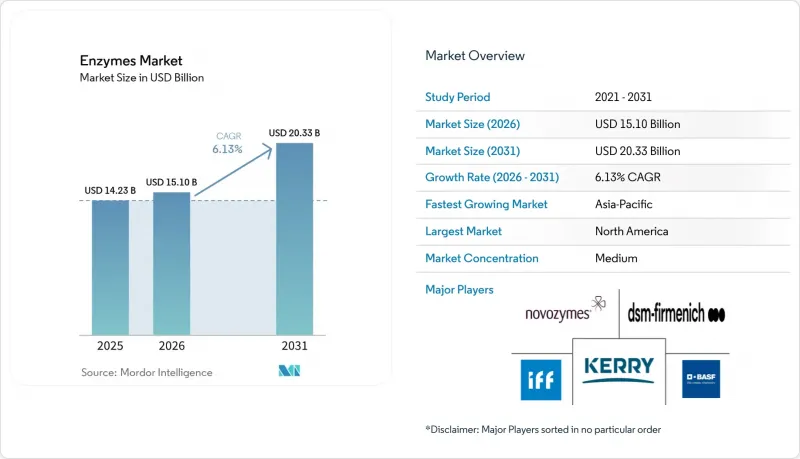
Mordor Intelligence에 의하면, 효소 시장은 2025년에 142억 3,000만 달러 규모가 되어, 2026년에는 151억 달러로 확대한다고 추정되고 있습니다.
또한, 2026년부터 2031년까지 연평균 성장률(CAGR) 6.13%를 기록하며, 2031년까지 203억 3,000만 달러에 달할 것으로 전망됩니다.
본 보고서는 제품 유형(공업용 효소 및 특수 효소), 원료 출처(식물 유래, 미생물 유래, 동물 유래), 유형(탄수화물 분해 효소, 단백질 분해 효소 등), 용도(식품 및 음료, 의약품·생명공학 등), 지역(북미, 유럽, 아시아태평양, 남미, 중동 및 아프리카)별로 분류되어 있습니다. 시장 전망은 금액(달러)과 수량(톤) 두 가지 측면에서 제시되어 있습니다.
세계 효소 시장 동향과 인사이트
건강에 대한 관심 증가
건강을 중시하는 소비자 행동에 대한 관심이 높아지고 있는 것이 효소 시장의 성장을 이끌고 있습니다. 소비자들은 더 나은 영양, 건강, 그리고 삶의 질 향상에 기여하는 제품을 찾고 있습니다. 더 건강한 라이프스타일에 대한 관심이 높아짐에 따라, 제품의 기능성을 높이고 영양가를 향상시키며 자연스러운 가공 방식을 지원하는 효소 기반 솔루션이 도입되고 있습니다. 클린 라벨, 천연 유래, 최소한의 가공을 거친 제품에 대한 선호도가 높아지면서, 기존 가공 방식을 대체할 효과적인 생물학적 대안으로서 효소에 대한 수요가 증가하고 있습니다. 효소는 소화 기능 향상, 기능성 강화, 그리고 변화하는 웰니스 트렌드에 부응하는 제품 개발에 기여하고 있습니다. 또한, 예방 의료, 원재료의 투명성, 지속 가능한 생산 방식에 대한 관심이 높아짐에 따라 제조업체들은 효소 기술을 혁신 전략에 반영하도록 유도되고 있습니다.
클린 라벨 및 천연 원료 동향의 확대
클린 라벨 및 천연 원료에 대한 선호도가 높아지는 것은 투명성이 보장되고 천연 유래이며 지속 가능한 솔루션을 통해 제조된 제품에 대한 소비자 수요에 힘입은 결과입니다. 효소는 제품의 품질, 기능성, 성능을 유지하면서 합성 첨가물이나 가혹한 화학 공정에 대한 의존도를 낮추는 데 도움이 되기 때문에 그 사용이 점점 더 확대되고 있습니다. 성분의 투명성, 단순한 배합, 그리고 천연 유래 가공 제품에 대한 소비자의 관심이 높아짐에 따라, 효과적인 생물학적 대안으로서 효소 기반 기술의 활용이 촉진되고 있습니다. 예를 들어, 국제식품정보협의회(IFIC)에 따르면, 2024년에는 미국인의 36%가 식품을 선택할 때 중요한 요소로 "내추럴" 또는 '유기농' 이라는 표시를 예로 들며, 천연 유래를 내세우는 제품에 대한 선호도가 높아지고 있음이 뚜렷이 드러나고 있습니다. 이러한 추세에 따라 제조업체들은 보다 친환경적인 생산 방식, 제품 특성 향상, 그리고 지속 가능한 가공 기법을 가능하게 하는 효소 솔루션의 도입을 촉진하고 있습니다.
엄격하고 단편적인 규제 승인 절차
엄격하고 단편적인 규제 승인 절차가 효소 시장의 성장을 저해하고 있습니다. 제조업체는 상품화를 앞두고 복잡한 안전성 평가를 통과하고, 품질 기준을 준수하며, 지역별 승인 요건을 충족해야 합니다. 다양한 시장의 규제 체계 차이는 문서화, 시험 절차, 표시 기준, 승인 일정 등의 측면에서 과제를 야기하며, 효소 기반 제품의 세계 출시를 복잡하게 만들고 있습니다. 기업들은 광범위한 평가를 통해 효소의 안전성, 순도, 제조 일관성 및 잠재적 영향에 대한 증거를 제시해야 하며, 그 결과 개발 주기가 길어지고 규정 준수 노력도 증가하고 있습니다. 또한, 생명공학에서 유래한 효소, 유전자 재조합 생산 시스템 및 신규 효소 제제에 관한 규제 변화는 제조업체에 불확실성을 초래하여 제품 출시를 지연시킬 가능성이 있습니다.
부문별 분석
2025년, 산업용 효소 부문은 지속 가능하고 효율적이며 바이오의 가공 솔루션으로의 전환이 진행되고 있는 것을 배경으로, 전 세계 효소 시장 점유율의 64.52%를 차지했습니다. 이러한 성장은 효소가 공정의 효율을 높이고, 제품의 품질을 향상시키며, 처리 시간을 단축하고, 기존의 화학적 방법에 대한 의존도를 낮출 수 있기 때문인 것으로 보입니다. 친환경 생산 방식에 대한 관심이 높아짐에 따라, 효소의 도입이 더욱 가속화되고 있습니다. 이는 효소가 온화한 조건에서 작용하여 에너지 소비를 줄이고 폐기물 발생을 최소화하기 위함입니다. 효소 공학, 단백질 변형 및 발효 기술의 발전으로 인해 효소의 안정성, 특이성 및 성능이 향상되어, 보다 폭넓은 상업적 응용이 가능해졌습니다. 고성능 생물 촉매, 제조 생산성 향상, 그리고 맞춤형 효소 솔루션에 대한 수요 증가가 이 부문의 혁신과 대규모 생산을 촉진하고 있습니다.
특수 효소 부문은 2026년부터 2031년까지 연평균 성장률(CAGR) 7.23%를 기록하며, 가장 빠르게 성장하는 제품 유형이 될 것으로 전망됩니다. 이러한 성장은 높은 특이성과 첨단 효소 솔루션에 대한 수요 증가에 힘입어 이루어지고 있습니다. 효소 개량, 단백질 공학, 생명공학 분야의 지속적인 발전으로 인해 효소의 효율, 선택성 및 기능적 성능이 향상되고 있습니다. 정밀성을 중시하는 생물학적 솔루션에 대한 관심이 높아짐에 따라, 특정 공정이나 최적화된 결과에 맞추어 설계된 맞춤형 효소의 개발이 가속화되고 있습니다. 재조합 기술 및 효소 최적화 기술의 혁신을 통해, 안정성 향상, 활성 지속 시간 연장, 그리고 다양한 작동 조건에서의 적응성 개선을 갖춘 효소를 개발할 수 있게 되었습니다.
2025년, 미생물 유래 효소 부문은 높은 생산 효율, 확장성 및 안정적인 효소 품질을 바탕으로 전 세계 효소 시장 점유율의 61.23%를 차지했습니다. 이 부문의 성장은 성장 주기가 빠르고, 배양이 용이하며, 제어된 공정을 통해 대량의 효소를 생산할 수 있는 능력 등 미생물이 지닌 장점 덕분입니다. 미생물 균주의 개량, 발효 기술 및 유전공학의 발전으로 인해 효소의 수율, 순도, 안정성, 기능적 성능이 크게 향상되었으며, 상업용 효소 생산 분야에서 미생물 유래 효소가 선호되는 선택지가 되고 있습니다. 내열성 향상, 활성 강화, 작동 안정성 증대 등 다양한 개선 사항에 대한 적응성 덕분에, 다양한 용도에서의 채택이 더욱 확대되고 있습니다. 또한, 지속 가능한 생산 방식에 대한 관심이 높아지고 있으며, 비용 대비 효과가 높은 효소 제조 기술의 개발이 진전되고 있는 점도 미생물 유래 효소 생산의 신뢰성과 효율성을 높이고 있습니다.
동물 유래 효소 부문은 높은 촉매 효율과 특수한 기능적 특성을 갖춘 천연 유래 효소에 대한 수요가 증가하는 것을 배경으로, 2026년부터 2031년까지 연평균 성장률(CAGR) 6.58%를 기록하며 성장할 것으로 예측됩니다. 이 부문의 성장은 높은 특이성, 신뢰성, 그리고 대상 공정에서의 효능과 같은 동물 유래 효소 특유의 생화학적 특성에 힘입고 있습니다. 추출, 정제, 안정화 기술의 발전으로 인해 효소의 품질, 균일성, 성능이 향상되어 시장에서 폭넓은 수용을 촉진하고 있습니다. 또한, 가공 방법을 개선함으로써 생물학적 활성과 기능적 완전성을 유지하면서 효소의 회수 효율도 향상되었습니다. 또한, 고순도 효소 제제의 개발과 다양한 조건 하에서의 안정성, 안전성, 성능 향상을 목표로 한 혁신에 대한 집중이 이 부문의 성장 전망을 뒷받침하고 있습니다.
지역별 분석
북미는 확립된 효소 생산 및 활용 생태계, 생명공학의 발전, 그리고 산업 공정에서 효소 기반 솔루션의 광범위한 도입에 힘입어 2025년 전 세계 효소 시장 점유율의 31.87%를 차지했습니다. 이 지역의 성장은 성숙한 산업용 효소 생태계, 특히 대규모 옥수수 습식 제분, 대두 가공 및 에탄올 생산에 의해 주도되고 있으며, 이러한 요인들이 효율적인 생물학적 촉매에 대한 수요를 뒷받침하고 있습니다. 미국 농무부(USDA)에 따르면, 2025/2026년 대두 총 생산량은 1억 1,599만 메트르톤으로 예측되며, 효소를 활용한 가공 활동을 위한 농업 원료의 안정적인 공급이 확보되어 있습니다. 또한, 효소 공학, 발효 기술 및 지속 가능한 가공 방식에 대한 투자 확대가 세계 효소 시장에서 북미의 주도적 지위를 더욱 공고히 하고 있습니다.
아시아태평양은 2026년부터 2031년까지 연평균 성장률(CAGR) 7.06%를 나타낼 것으로 전망되며, 가장 빠르게 성장하는 지역이 될 것으로 예측됩니다. 이러한 성장은 생명공학 역량의 급속한 확대, 산업 분야에서 효소 기반 공정의 채택 확대, 그리고 지속 가능하고 효율적인 생산 기술에 대한 수요 증가에 힘입어 이루어지고 있습니다. 유럽은 지속가능성에 대한 규제적 측면에서의 높은 중시, 선진적인 연구 인프라, 그리고 혁신적인 효소 기술 개발을 바탕으로, 여전히 효소 시장에서 최대 규모를 자랑하는 지역 중 하나입니다. 이 지역의 바이오 솔루션, 순환형 생산 방식 및 효소 성능의 지속적인 개선에 대한 노력이 꾸준한 시장 확대의 기반이 되고 있습니다. 지속가능성과 혁신에 중점을 두는 유럽의 입장은 세계 효소 시장에서 유럽의 지속적인 우위를 확고히 하고 있습니다.
남미, 중동 및 아프리카는 효소 기술에 대한 인식 제고, 산업 역량 강화, 그리고 지속 가능한 가공 방식의 도입 확대에 힘입어 세계 효소 시장에서 신흥 지역으로 부상하고 있습니다. 남미에서는 생물학적 가공 활동의 확대와 생산성 및 효율성 향상을 위한 효소 솔루션의 활용 확대에 힘입어 성장이 나타나고 있습니다. 중동 및 아프리카에서는 생산 공정의 현대화와 지속 가능한 대체 수단에 대한 관심이 높아지는 가운데, 첨단 효소 기술의 단계적 도입이 진행되고 있습니다.
기타 혜택:
- 엑셀 형식 시장 예측(ME) 시트
- 3개월간의 애널리스트 지원
자주 묻는 질문
목차
제1장 서론
제2장 조사 방법
제3장 주요 요약
제4장 시장 구도
제5장 시장 규모와 성장 예측
제6장 경쟁 구도
제7장 시장 기회와 향후 전망
JHS 26.07.03According to Mordor Intelligence, the enzymes market was valued at USD 14.23 billion in 2025 and is estimated to grow to USD 15.1 billion in 2026, with projections indicating it will reach USD 20.33 billion by 2031, registering a CAGR of 6.13% during 2026-2031.
This report is Segmented by Product Type (Industrial Enzymes and Specialty Enzymes), Source (Plant, Microbial, and Animal), Type (Carbohydrase's, Proteases, and More), Application (Food and Beverages, Pharmaceuticals and Biotechnology, and More), and Geography (North America, Europe, Asia-Pacific, South America, Middle East and Africa). The Market Forecasts are Provided in Both Value (USD) and Volume (Tons).
Global Enzymes Market Trends and Insights
Rising health-conscious consumer behaviour
The increasing focus on health-conscious consumer behavior is driving growth in the enzymes market. Consumers are seeking products that promote better nutrition, wellness, and an improved quality of life. Greater awareness of healthier lifestyles has led to the adoption of enzyme-based solutions that enhance product functionality, improve nutritional value, and support natural processing methods. There is a growing preference for clean-label, naturally derived, and minimally processed products, which has boosted the demand for enzymes as effective biological alternatives to traditional processing methods. Enzymes contribute to improved digestibility, enhanced functional benefits, and the development of products that align with changing wellness trends. Furthermore, rising interest in preventive health, ingredient transparency, and sustainable production practices is motivating manufacturers to integrate enzyme technologies into their innovation strategies.
Growth of clean-label and natural ingredient trends
The growing preference for clean-label and natural ingredients is driven by consumer demand for products made with transparent, naturally derived, and sustainable solutions. Enzymes are increasingly adopted as they help manufacturers reduce reliance on synthetic additives and harsh chemical processes while maintaining product quality, functionality, and performance. The rising consumer focus on ingredient transparency, simpler formulations, and naturally processed products has promoted the use of enzyme-based technologies as effective biological alternatives. For example, according to the International Food Information Council (IFIC), in 2024, 36% of Americans identified "natural" or "organic" labels as important factors when choosing food, unde rscoring the increasing preference for naturally positioned products . This trend is encouraging manufacturers to adopt enzyme solutions that enable cleaner production methods, enhanced product characteristics, and sustainable processing practices.
Stringent and fragmented regulatory approval paths
The stringent and fragmented regulatory approval processes are limiting the growth of the enzymes market. Manufacturers must navigate complex safety assessments, adhere to quality standards, and meet region-specific approval requirements before commercialization. Differences in regulatory frameworks across various markets pose challenges in areas such as documentation, testing procedures, labeling standards, and approval timelines, complicating the global launch of enzyme-based products. Companies are required to provide evidence of enzyme safety, purity, production consistency, and potential impacts through extensive evaluations, resulting in longer development cycles and increased compliance efforts. Furthermore, evolving regulations related to biotechnology-derived enzymes, genetically modified production systems, and novel enzyme formulations create uncertainty for manufacturers and may delay product launches.
Other drivers and restraints analyzed in the detailed report include:
- Technological advancements in enzyme engineering
- Expansion of biofuel production and renewable energy initiatives
- High cost of downstream purification and formulation
For complete list of drivers and restraints, kindly check the Table Of Contents.
Segment Analysis
The industrial enzymes segment accounted for 64.52% of the global enzymes market share in 2025, driven by the growing shift toward sustainable, efficient, and bio-based processing solutions. This growth is attributed to enzymes' ability to enhance process efficiency, improve product quality, reduce processing time, and decrease reliance on conventional chemical methods. The increasing preference for environmentally friendly production practices has further accelerated enzyme adoption, as they operate under mild conditions, reduce energy consumption, and minimize waste generation. Advancements in enzyme engineering, protein modification, and fermentation technologies have enhanced enzyme stability, specificity, and performance, enabling broader commercial applications. The rising demand for high-performance biological catalysts, improved manufacturing productivity, and customized enzyme solutions has fostered innovation and large-scale production in this segment.
The specialty enzymes segment is projected to be the fastest-growing product type, with a CAGR of 7.23% during 2026-2031. This growth is driven by increasing demand for highly specific and advanced enzyme solutions. Continuous advancements in enzyme modification, protein engineering, and biotechnology are improving enzyme efficiency, selectivity, and functional performance. The rising preference for precision-based biological solutions has accelerated the development of customized enzymes tailored for targeted processes and optimized outcomes. Innovations in recombinant technologies and enzyme optimization techniques are enabling the creation of enzymes with enhanced stability, extended activity duration, and improved compatibility across diverse operating conditions.
The microbial-sourced enzymes segment accounted for 61.23% of the global enzymes market share in 2025, driven by their high production efficiency, scalability, and consistent enzyme quality. The segment's growth is attributed to the advantages of microorganisms, such as faster growth cycles, ease of cultivation, and the ability to produce large quantities of enzymes through controlled processes. Advancements in microbial strain improvement, fermentation technologies, and genetic engineering have significantly enhanced enzyme yield, purity, stability, and functional performance, making microbial sources a preferred choice for commercial enzyme production. Their adaptability for modifications, including improved temperature tolerance, enhanced activity, and extended operational stability, has further increased their adoption across various applications. Additionally, the growing emphasis on sustainable production methods and the development of cost-effective enzyme manufacturing techniques have bolstered the reliability and efficiency of microbial enzyme production.
The animal-sourced enzymes segment is expected to grow at a CAGR of 6.58% during 2026-2031, fueled by the rising demand for naturally derived enzymes with high catalytic efficiency and specialized functional properties. The segment's growth is supported by the unique biochemical characteristics of animal-derived enzymes, such as strong specificity, reliability, and effectiveness in targeted processes. Advances in extraction, purification, and stabilization technologies have improved enzyme quality, consistency, and performance, facilitating broader commercial acceptance. Enhanced processing methods have also increased enzyme recovery efficiency while preserving biological activity and functional integrity. Furthermore, the focus on developing highly purified enzyme formulations and innovations aimed at improving stability, safety, and performance under diverse conditions is driving the segment's growth prospects.
Complete Report Scope:
- By Product Type
- Industrial Enzymes
- Specialty Enzymes
- By Source
- Plant
- Microbial
- Animal
- By Type
- Carbohydrases
- Proteases
- Lipases
- Others
- By Application
- Food and Beverages
- Pharmaceuticals and Biotechnology
- Diagnostics and Clinical Testing
- Detergents and Household Care
- Biofuels and Industrial Processing
- Animal Feed
- Textiles and Leather
- Paper and Pulp
- Others
- By Geography
- North America
- United States
- Canada
- Mexico
- Rest of North America
- Europe
- United Kingdom
- Germany
- France
- Italy
- Spain
- Netherlands
- Poland
- Belgium
- Sweden
- Rest of Europe
- Asia-Pacific
- China
- Japan
- India
- Australia
- Indonesia
- South Korea
- Thailand
- Singapore
- Rest of Asia-Pacific
- South America
- Brazil
- Argentina
- Colombia
- Chile
- Peru
- Rest of South America
- Middle East and Africa
- South Africa
- Saudi Arabia
- United Arab Emirates
- Nigeria
- Egypt
- Morocco
- Turkey
- Rest of Middle East and Africa
- North America
Geography Analysis
North America accounted for 31.87% of the global enzymes market share in 2025, supported by a well-established enzyme production and utilization ecosystem, advancements in biotechnology, and widespread adoption of enzyme-based solutions in industrial processes. The region's growth is driven by a mature industrial enzyme ecosystem, particularly in large-scale corn wet milling, soy processing, and ethanol production, which sustain the demand for efficient biological catalysts. According to the United States Department of Agriculture (USDA), total soy bean production for 2025/2026 is projected at 115.99 million metric tons, ensuring a steady supply of agricultural feedstocks for enzyme-driven processing activities . Additionally, increasing investments in enzyme engineering, fermentation technologies, and sustainable processing practices continue to reinforce North America's leadership in the global enzymes market.
Asia-Pacific is expected to be the fastest-growing region, with a projected CAGR of 7.06% during 2026-2031. This growth is fueled by the rapid expansion of biotechnology capabilities, increasing industrial adoption of enzyme-based processes, and rising demand for sustainable and efficient production technologies. Europe remains one of the largest regions in the enzymes market, supported by a strong regulatory emphasis on sustainability, advanced research infrastructure, and the development of innovative enzyme technologies. The region's commitment to bio-based solutions, circular production practices, and continuous improvements in enzyme performance underpins steady market expansion. Europe's focus on sustainability and innovation ensures its continued prominence in the global enzymes market.
South America and the Middle East and Africa are emerging regions in the global enzymes market, driven by increasing awareness of enzyme-based technologies, improving industrial capabilities, and growing adoption of sustainable processing methods. South America is experiencing growth due to the expansion of biological processing activities and the greater use of enzyme solutions to enhance productivity and efficiency. In the Middle East and Africa, the gradual adoption of advanced enzyme technologies is supported by the modernization of production processes and a growing interest in sustainable alternatives.
- Novozymes A/S
- International Flavors and Fragrances Inc.
- DSM-Firmenich AG
- BASF SE
- Kerry Group plc
- Associated British Foods plc
- Amano Enzyme Inc.
- Advanced Enzyme Technologies Ltd.
- AB Enzymes GmbH
- Codexis, Inc.
- Biocatalysts Ltd.
- Enzyme Development Corporation
- Chr. Hansen Holding A/S
- Merck KGaA
- Thermo Fisher Scientific Inc.
- Promega Corporation
- Takara Bio Inc.
- F. Hoffmann-La Roche Ltd.
- Sanofi S.A.
- Enzyme Solutions Inc.
Additional Benefits:
- The market estimate (ME) sheet in Excel format
- 3 months of analyst support
TABLE OF CONTENTS
1 INTRODUCTION
- 1.1 Study Assumptions and Market Definition
- 1.2 Scope of the Study
2 RESEARCH METHODOLOGY
3 EXECUTIVE SUMMARY
4 MARKET LANDSCAPE
- 4.1 Market Overview
- 4.2 Market Drivers
- 4.2.1 Rising health-conscious consumer behaviour
- 4.2.2 Growth of clean-label and natural ingredient trends
- 4.2.3 Technological advancements in enzyme engineering
- 4.2.4 Expansion of biofuel production and renewable energy initiatives
- 4.2.5 Expansion of precision fermentation capacity
- 4.2.6 Shift toward low-energy, low-waste processing
- 4.3 Market Restraints
- 4.3.1 Stringent and fragmented regulatory approval paths
- 4.3.2 High cost of downstream purification and formulation
- 4.3.3 Dependence on feedstock-grade fermentation inputs
- 4.3.4 Availability of alternative chemical-based processing solutions
- 4.4 Supply Chain Analysis
- 4.5 Regulatory Landscape
- 4.6 Technological Outlook
- 4.7 Porter's Five Forces Analysis
- 4.7.1 Threat of New Entrants
- 4.7.2 Bargaining Power of Buyers
- 4.7.3 Bargaining Power of Suppliers
- 4.7.4 Threat of Substitutes
- 4.7.5 Intensity of Competitive Rivalry
5 MARKET SIZE AND GROWTH FORECASTS (VALUE AND VOLUME)
- 5.1 By Product Type
- 5.1.1 Industrial Enzymes
- 5.1.2 Specialty Enzymes
- 5.2 By Source
- 5.2.1 Plant
- 5.2.2 Microbial
- 5.2.3 Animal
- 5.3 By Type
- 5.3.1 Carbohydrases
- 5.3.2 Proteases
- 5.3.3 Lipases
- 5.3.4 Others
- 5.4 By Application
- 5.4.1 Food and Beverages
- 5.4.2 Pharmaceuticals and Biotechnology
- 5.4.3 Diagnostics and Clinical Testing
- 5.4.4 Detergents and Household Care
- 5.4.5 Biofuels and Industrial Processing
- 5.4.6 Animal Feed
- 5.4.7 Textiles and Leather
- 5.4.8 Paper and Pulp
- 5.4.9 Others
- 5.5 By Geography
- 5.5.1 North America
- 5.5.1.1 United States
- 5.5.1.2 Canada
- 5.5.1.3 Mexico
- 5.5.1.4 Rest of North America
- 5.5.2 Europe
- 5.5.2.1 United Kingdom
- 5.5.2.2 Germany
- 5.5.2.3 France
- 5.5.2.4 Italy
- 5.5.2.5 Spain
- 5.5.2.6 Netherlands
- 5.5.2.7 Poland
- 5.5.2.8 Belgium
- 5.5.2.9 Sweden
- 5.5.2.10 Rest of Europe
- 5.5.3 Asia-Pacific
- 5.5.3.1 China
- 5.5.3.2 Japan
- 5.5.3.3 India
- 5.5.3.4 Australia
- 5.5.3.5 Indonesia
- 5.5.3.6 South Korea
- 5.5.3.7 Thailand
- 5.5.3.8 Singapore
- 5.5.3.9 Rest of Asia-Pacific
- 5.5.4 South America
- 5.5.4.1 Brazil
- 5.5.4.2 Argentina
- 5.5.4.3 Colombia
- 5.5.4.4 Chile
- 5.5.4.5 Peru
- 5.5.4.6 Rest of South America
- 5.5.5 Middle East and Africa
- 5.5.5.1 South Africa
- 5.5.5.2 Saudi Arabia
- 5.5.5.3 United Arab Emirates
- 5.5.5.4 Nigeria
- 5.5.5.5 Egypt
- 5.5.5.6 Morocco
- 5.5.5.7 Turkey
- 5.5.5.8 Rest of Middle East and Africa
- 5.5.1 North America
6 COMPETITIVE LANDSCAPE
- 6.1 Market Concentration
- 6.2 Strategic Moves
- 6.3 Market Positioning Analysis
- 6.4 Company Profiles (includes Global level Overview, Market level overview, Core Segments, Financials as available, Strategic Information, Market Rank/Share for key companies, Products and Services, and Recent Developments)
- 6.4.1 Novozymes A/S
- 6.4.2 International Flavors and Fragrances Inc.
- 6.4.3 DSM-Firmenich AG
- 6.4.4 BASF SE
- 6.4.5 Kerry Group plc
- 6.4.6 Associated British Foods plc
- 6.4.7 Amano Enzyme Inc.
- 6.4.8 Advanced Enzyme Technologies Ltd.
- 6.4.9 AB Enzymes GmbH
- 6.4.10 Codexis, Inc.
- 6.4.11 Biocatalysts Ltd.
- 6.4.12 Enzyme Development Corporation
- 6.4.13 Chr. Hansen Holding A/S
- 6.4.14 Merck KGaA
- 6.4.15 Thermo Fisher Scientific Inc.
- 6.4.16 Promega Corporation
- 6.4.17 Takara Bio Inc.
- 6.4.18 F. Hoffmann-La Roche Ltd.
- 6.4.19 Sanofi S.A.
- 6.4.20 Enzyme Solutions Inc.