

|
시장보고서
상품코드
2073236
중동의 사료용 안료 : 시장 점유율 분석, 업계 동향 및 통계, 성장 예측(2026-2031년)Middle East Feed Pigments - Market Share Analysis, Industry Trends & Statistics, Growth Forecasts (2026 - 2031) |
||||||
 Mordor Intelligence
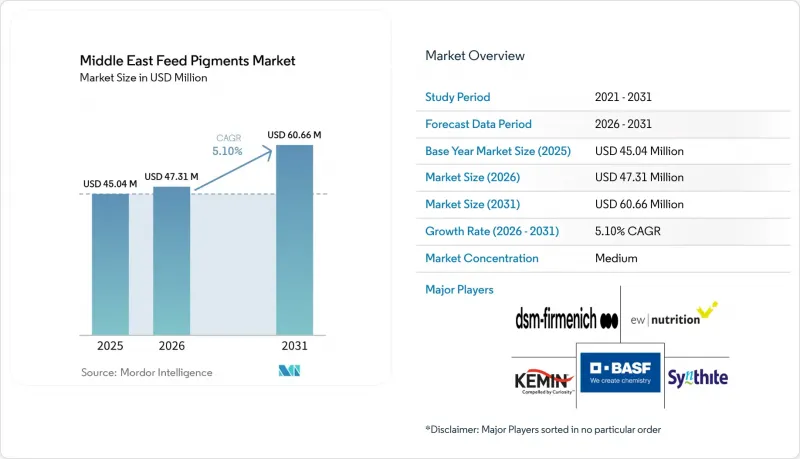
Mordor Intelligence에 의하면, 중동의 사료용 안료 시장 규모는 2025년 4,504만 달러로 평가되었습니다. 2026년 4,731만 달러에서 2031년까지 6,066만 달러로 확대되며 2026년부터 2031년에 걸쳐 CAGR 5.10%를 기록할 전망입니다.
본 보고서는 유형별(카로티노이드, 커큐민, 스피루리나, 기타), 동물 유형별(수산물 양식, 가금류, 반추동물, 돼지, 기타 동물 종), 지역별(사우디아라비아, 아랍에미리트, 이스라엘, 카타르, 쿠웨이트, 오만, 기타 중동 국가)로 분류되어 있습니다. 시장 전망은 금액(달러) 및 수량(미터톤) 단위로 제시되어 있습니다.
중동의 사료용 안료 시장 동향 및 분석
고온 기후의 생산 시스템에서 가금류 및 수산 양식용 색소 사용량 증가
만안 지역의 가금류 및 양식 시스템은 지속적인 열 스트레스 하에서 운영되고 있기 때문에 색소의 안정성은 단순한 외관상의 선택이 아니라 매일의 사료 배합에 있어 중요한 과제가 되고 있습니다. 카로티노이드는 열 스트레스 하에서 쉽게 분해되기 때문에 사료 제조업체는 유효 성분이 난황, 피부 또는 어류 조직에 침착되기 전에 이를 보호하기 위해 더 안정성이 높은 형태를 필요로 하는 경우가 많습니다. 이에 따라 중동의 사료용 안료 시장에서 캡슐화, 적절한 취급 및 확실한 투여의 중요성이 커지고 있습니다. BASF SE는 가금류 및 수산 양식 생산자들이 제품의 품질과 일관성을 유지하면서 목표하는 난황 및 육질의 색상 특성을 달성할 수 있도록 지원하는 제품을 통해 사료용 안료 시장에 진출하고 있습니다. 또한, DSM-Firmenich는 보관 및 가공 조건이 카로티노이드의 안정성에 미치는 영향을 규명함으로써, 따뜻한 지역 환경에서 색소를 안전하게 공급할 필요성을 입증하고 있습니다. 수산 양식 분야에서도 비슷한 경향이 나타납니다. 이는 주변 온도가 높으면 사료의 보관 및 취급 과정에서 아스타잔틴의 유지율이 떨어질 가능성이 있기 때문입니다. 이것이 바로 중동의 사료용 안료 시장에서 펠릿화, 운송 및 농장 내 사용을 통해 안정적인 성능을 입증할 수 있는 공급업체가 계속해서 높은 평가를 받고 있는 이유 중 하나입니다. 그 결과, 단순히 저비용 수입 원료로의 전환에 그치지 않고, 기술적으로 차별화된 색소에 대한 안정적인 수요가 생겨나고 있습니다.
만안 지역 소매 채널에서 달걀 노른자, 육계 껍질, 생선 살의 색상을 고급화
만안 지역의 소매 채널에서 색상은 여전히 신선 가금육, 달걀, 양식 어류에 있어 가장 뚜렷한 제품 특징 중 하나입니다. 짙은 달걀 노른자의 색, 균일한 육계 껍질의 색조, 그리고 매력적인 생선 살의 색상은 소비자가 구매 시 신선도와 가치를 판단하는 데 있어 여전히 중요한 요소로 작용하고 있습니다. 따라서 사료 예산에 부담이 가해지는 상황에서도 착색 프로그램은 여전히 상업적으로 중요한 위치를 차지하고 있습니다. 사료용 안료는 생산자가 일관된 색상을 구현하기 위해 널리 사용되고 있으며, 이는 제품 차별화와 소비자 수용 측면에서 시각적 품질 특성이 얼마나 중요한지를 반영하고 있습니다. 중동의 사료용 안료 시장에서 이러한 추세는 특히 현대적인 소매 및 외식 산업 채널에 공급하는 통합형 사업자들 사이에서 일시적인 첨가가 아닌 지속적인 사용을 촉진하고 있습니다. 또한, 표준화된 색상 평가 기준과 보다 엄격한 투여 절차의 도입을 정당화할 근거도 더욱 확고해지고 있습니다. 고급 판매 채널이나 재구매 행동에서 외관이 중요하게 여겨지기 때문에 수산 양식업자들도 마찬가지로 그 혜택을 누리고 있습니다. 이로 인해 중동의 사료용 안료 시장은 동물의 영양 요구 사항뿐만 아니라 소매 진열 기준에도 지속적으로 부합하고 있습니다.
수입 카로티노이드 및 스피루리나 원료에 대한 높은 의존도
중동의 사료용 안료 시장은 기능성 원료 공급의 상당 부분을 여전히 수입 카로티노이드와 스피루리나에 의존하고 있습니다. 따라서 사료 제조업체와 통합형 사업자는 리드타임 변동, 운송 차질, 그리고 완전히 통제할 수 없는 원자재 가격 변동과 같은 위험에 노출되어 있습니다. 시장에서 현지산 원자재공급 기반은 매우 제한적이기 때문에 업스트림 공급 단계에서 어떤 문제가 발생하면 공급 상황이나 비용에 신속히 영향을 미치는 경향이 있습니다. 2024년 9월, DSM-Firmenich는 중동 전역의 고객을 지원하기 위해 이집트에 새로운 제조 공장을 설립했습니다. 이는 현지 서비스 강화와 배송 위험 감소가 요구되고 있음을 반영한 것입니다. 동시에, 사우디아라비아에서 수산 양식업이 확대됨에 따라, 해당 지역에서 공급 체계가 확립되지 않은 특수 사료용 안료 원료에 대한 수요가 계속해서 증가하고 있습니다. 이러한 불균형이 중요한 이유는 수입 의존도가 높은 성장 시장에서는 고객의 계획이 엄격해지고, 재고 관리에 대한 판단이 더욱 보수적으로 되는 경향이 있기 때문입니다. 소규모 구매자는 대개 협상력이 약하고 공급처의 선택지도 적기 때문에 이러한 영향을 가장 먼저 받게 됩니다. 수입 의존도가 높은 상황이 지속되는 한, 중동의 사료용 안료 시장은 국내 생산 기반이 탄탄한 다른 부문에 비해 공급 측면의 압박에 더 취약한 상태가 계속될 것입니다.
부문별 분석
2025년, 중동의 사료용 안료 시장에서 카로티노이드는 시장 점유율의 58.4%를 차지하며, 금액 기준으로 압도적인 1위를 유지했습니다. 이에 이어 스피루리나, 커큐민, 그 밖의 유형들이 뒤를 이었으며, 이들은 종합적으로 보다 소규모이고 전문적인 이용 사례에 대응하고 있었습니다. 카로티노이드는 가금류의 난황 및 껍질 색상 개선 프로그램과 수산 양식 분야의 육색 착색 요구를 모두 충족시키기 때문에 여전히 핵심적인 위치를 차지하고 있습니다. BASF SE와 DSM-Firmenich는 전용 카로티노이드 제품군과 내열성 제품 형태를 통해 이 부문을 지속적으로 지원하고 있습니다. 규제 당국의 승인이 확립되어 있고, 착색 효율이 입증되었으며, 시판 사료 제조와 호환성이 있다는 점이 수요를 더욱 부추기고 있습니다.
스피루리나는 2026년부터 2031년까지 연평균 성장률(CAGR) 7.4%로 가장 빠른 성장세를 보일 것으로 예상되며, 그 뒤를 커큐민, 카로티노이드 및 기타 유형이 따를 것으로 전망됩니다. 그 매력은 단일 원료로 착색 효과와 기능성 영양가를 모두 제공할 수 있다는 점에 있으며, 이는 특히 수산 양식 분야에서 유용합니다. 2024년 사우디아라비아 리야드에 있는 환경·수자원·농업부가 실시한 "스피루리나의 단백질, 에너지 및 아미노산의 소화율"관련 조사 결과, 대상 어종에서 양호한 사료 반응과 높은 소화율이 확인되어, 중동의 사료용 안료 시장에서 스피루리나의 채택 확대가 뒷받침되고 있습니다. 또한 천연 색소 원료이자 기능성 영양 성분이라는 이중 역할을 수행하기 때문에 수산 양식 분야에서의 활용도 확대되고 있으며, 고급 사료 및 특수 사료의 배합에 사용되는 사례가 늘고 있습니다.
기타 혜택 :
- 엑셀 형식 시장 예측(ME) 시트
- 3개월간의 애널리스트 지원
자주 묻는 질문
목차
제1장 서론
제2장 조사 방법
제3장 주요 요약
제4장 시장 구도
제5장 시장 규모 및 성장 예측
제6장 경쟁 구도
제7장 시장 기회 및 향후 전망
KTH 26.07.07According to Mordor Intelligence, the middle east feed pigments market size is projected to expand from USD 45.04 million in 2025 and USD 47.31 million in 2026 to USD 60.66 million by 2031, registering a 5.10% CAGR between 2026 and 2031.
This report is Segmented by Type (Carotenoids, Curcumin, Spirulina, and Other Types), by Animal Type (Aquaculture, Poultry, Ruminants, Swine, and Other Animal Types), and by Geography (Saudi Arabia, United Arab Emirates, Israel, Qatar, Kuwait, Oman, and Rest of the Middle East). The Market Forecasts are Provided in Terms of Value (USD) and Volume (Metric Tons).
Middle East Feed Pigments Market Trends and Insights
Rising Poultry and Aquaculture Pigment Intensity in Hot-Climate Production Systems
Poultry and aquaculture systems in the Gulf operate under persistent heat stress, which makes pigment stability a daily formulation issue rather than a cosmetic choice. Carotenoids break down more easily under thermal stress, which means feed producers often need more stable forms to protect active value before deposition in yolk, skin, or fish tissue. This raises the importance of encapsulation, controlled handling, and dependable dosing in the Middle East feed pigments market. BASF SE participates in the feed pigment market through products that help poultry and aquaculture producers achieve targeted yolk and flesh color characteristics while maintaining product quality and consistency. DSM-Firmenich has also documented the effects of storage and processing conditions on carotenoid stability, supporting the need for protected pigment delivery in warm regional conditions. The aquaculture side follows the same pattern because high ambient temperatures can reduce astaxanthin retention during feed storage and handling. This is one reason the Middle East feed pigments market continues to reward suppliers that can prove stable performance across pelleting, transport, and on-farm use. The result is steady demand for technically differentiated pigments instead of a simple shift toward low-cost imported material.
Premiumization of Egg Yolk, Broiler Skin, and Fish Flesh Color in Gulf Retail Channels
Color remains one of the clearest product signals in fresh poultry, eggs, and farmed fish across Gulf retail channels. Deep yolk color, uniform broiler skin tone, and attractive fish flesh color continue to influence how buyers judge freshness and value at the point of purchase. That keeps pigmentation programs commercially relevant even when feed budgets come under pressure. Feed pigments are widely used to help producers achieve consistent coloration, reflecting the importance of visual quality attributes for product differentiation and consumer acceptance. In the Middle East feed pigments market, this preference supports repeat use rather than occasional supplementation, especially among integrated operations serving modern retail and hospitality channels. It also strengthens the case for standardized color scoring and tighter dosing routines. Fish producers benefit similarly because appearance matters in premium sales channels and repeat purchase behavior. This keeps the Middle East feed pigments market aligned with retail presentation standards as much as with animal nutrition needs.
High Dependence on Imported Carotenoid and Spirulina Inputs
The Middle East feed pigments market still depends on imported carotenoids and spirulina for most of its functional supply. That leaves feed mills and integrators exposed to changes in lead times, shipping disruptions, and shifts in raw material pricing that they cannot fully control. The market has very limited local raw material depth, so any issue in upstream supply tends to quickly affect availability and cost. In September 2024, DSM-Firmenich opened a new manufacturing plant in Egypt to serve customers across the Middle East, reflecting the need for stronger local service and lower delivery risk. At the same time, aquaculture expansion in Saudi Arabia continues to drive demand for specialized pigment inputs that lack a regional supply solution. This imbalance matters because a growing market with imported dependence often sees periods of tighter customer planning and more conservative inventory decisions. Smaller buyers feel this first because they usually have less bargaining power and fewer supply alternatives. As long as import reliance stays high, the Middle East feed pigments market will remain more vulnerable to supply-side pressure than categories with stronger domestic production support.
Other drivers and restraints analyzed in the detailed report include:
- Food Security Programs Favoring Specialized Feed Additives in Saudi Arabia and the United Arab Emirates
- Replacement of Broad-Spectrum Synthetic Colorants with Species-Specific Carotenoid Blends
- Narrow Application Base Outside Poultry and Aquaculture
For complete list of drivers and restraints, kindly check the Table Of Contents.
Segment Analysis
Carotenoids accounted for 58.4% of the Middle East feed pigments market share in 2025, making them the clear leader by value. They were followed by spirulina, curcumin, and other types, which together served smaller and more specialized use cases. Carotenoids remain central because they meet both poultry yolk and skin programs and the needs of aquaculture flesh coloration. BASF SE and DSM-Firmenich continue to support this segment through dedicated carotenoid portfolios and heat-protected product formats. Their established regulatory acceptance, proven pigmentation efficiency, and compatibility with commercial feed manufacturing further strengthen demand.
Spirulina is anticipated to record the fastest growth at a 7.4% CAGR from 2026 to 2031, followed by curcumin, carotenoids, and other types. Its appeal lies in providing color support and functional nutritional value in a single ingredient, which is especially useful in aquaculture. Research conducted by the Ministry of Environment, Water and Agriculture, Riyadh, Saudi Arabia, on the Protein, Energy, and Amino Acid Digestibility of Spirulina in 2024 showed a positive feed response and strong digestibility in relevant fish species, which supports its rising adoption in the Middle East feed pigments market. It is also gaining traction in aquaculture applications due to its dual role as a natural pigment source and functional nutritional ingredient, supporting its use in premium and specialized feed formulations.
Complete Report Scope:
- By Type
- Carotenoids
- Curcumin
- Spirulina
- Other Types
- By Animal Type
- Aquaculture
- Fish
- Shrimp
- Other Aquaculture Species
- Poultry
- Broiler
- Layer
- Other Poultry Birds
- Ruminants
- Beef Cattle
- Dairy Cattle
- Other Ruminants
- Swine
- Other Animals
- Aquaculture
- By Geography
- Saudi Arabia
- United Arab Emirates
- Israel
- Qatar
- Kuwait
- Oman
- Rest of Middle East
List of Companies Covered in this Report:
- DSM-Firmenich
- BASF SE
- Bordas S.A.
- Kemin Industries, Inc.
- EW Nutrition
- Nutreco N.V. (SHV Holdings N.V.)
- Innovad (PAI Partners)
- Synthite Industries Ltd.
- Camlin Fine Sciences Ltd.
- Impextraco N.V.
- Unichemie International Private Limited
- Behn Meyer
Additional Benefits:
- The market estimate (ME) sheet in Excel format
- 3 months of analyst support
TABLE OF CONTENTS
1 Introduction
- 1.1 Study Assumptions and Market Definition
- 1.2 Scope of the Study
2 Research Methodology
3 Executive Summary
4 Market Landscape
- 4.1 Market Overview
- 4.2 Market Drivers
- 4.2.1 Rising Poultry and Aquaculture Pigment Intensity in Hot-Climate Production Systems
- 4.2.2 Premiumization of Egg Yolk, Broiler Skin, and Fish Flesh Color in Gulf Retail Channels
- 4.2.3 Food Security Programs Favoring Specialized Feed Additives in Saudi Arabia and the United Arab Emirates
- 4.2.4 Replacement of Broad-Spectrum Synthetic Colorants with Species-Specific Carotenoid Blends
- 4.2.5 Expansion of Halal-Positioned Natural Pigment Demand in Export-Oriented Poultry Supply Chains
- 4.2.6 Localization of Additive Manufacturing to Improve Regional Supply Reliability
- 4.3 Market Restraints
- 4.3.1 High Dependence on Imported Carotenoid and Spirulina Inputs
- 4.3.2 Narrow Application Base Outside Poultry and Aquaculture
- 4.3.3 Approval and Registration Friction Across Multiple Middle Eastern Jurisdictions
- 4.3.4 Heat and Storage Sensitivity of Natural Pigments in Regional Logistics
- 4.4 Regulatory Landscape
- 4.5 Technological Outlook
- 4.6 Porter's Five Forces Analysis
- 4.6.1 Threat of New Entrants
- 4.6.2 Bargaining Power of Suppliers
- 4.6.3 Bargaining Power of Buyers
- 4.6.4 Threat of Substitutes
- 4.6.5 Intensity of Competitive Rivalry
5 Market Size and Growth Forecasts (Value and Volume)
- 5.1 By Type
- 5.1.1 Carotenoids
- 5.1.2 Curcumin
- 5.1.3 Spirulina
- 5.1.4 Other Types
- 5.2 By Animal Type
- 5.2.1 Aquaculture
- 5.2.1.1 Fish
- 5.2.1.2 Shrimp
- 5.2.1.3 Other Aquaculture Species
- 5.2.2 Poultry
- 5.2.2.1 Broiler
- 5.2.2.2 Layer
- 5.2.2.3 Other Poultry Birds
- 5.2.3 Ruminants
- 5.2.3.1 Beef Cattle
- 5.2.3.2 Dairy Cattle
- 5.2.3.3 Other Ruminants
- 5.2.4 Swine
- 5.2.5 Other Animals
- 5.2.1 Aquaculture
- 5.3 By Geography
- 5.3.1 Saudi Arabia
- 5.3.2 United Arab Emirates
- 5.3.3 Israel
- 5.3.4 Qatar
- 5.3.5 Kuwait
- 5.3.6 Oman
- 5.3.7 Rest of Middle East
6 Competitive Landscape
- 6.1 Market Concentration
- 6.2 Strategic Moves
- 6.3 Market Share Analysis
- 6.4 Company Profiles (Includes Global Level Overview, Market Level Overview, Core Segments, Financials as Available, Strategic Information, Market Rank/Share, Products and Services, Recent Developments)
- 6.4.1 DSM-Firmenich
- 6.4.2 BASF SE
- 6.4.3 Bordas S.A.
- 6.4.4 Kemin Industries, Inc.
- 6.4.5 EW Nutrition
- 6.4.6 Nutreco N.V. (SHV Holdings N.V.)
- 6.4.7 Innovad (PAI Partners)
- 6.4.8 Synthite Industries Ltd.
- 6.4.9 Camlin Fine Sciences Ltd.
- 6.4.10 Impextraco N.V.
- 6.4.11 Unichemie International Private Limited
- 6.4.12 Behn Meyer


