

|
시장보고서
상품코드
2113264
유럽의 사료용 안료 : 시장 점유율 분석, 업계 동향과 통계, 성장 예측(2026-2031년)Europe Feed Pigments - Market Share Analysis, Industry Trends & Statistics, Growth Forecasts (2026 - 2031) |
||||||
 Mordor Intelligence
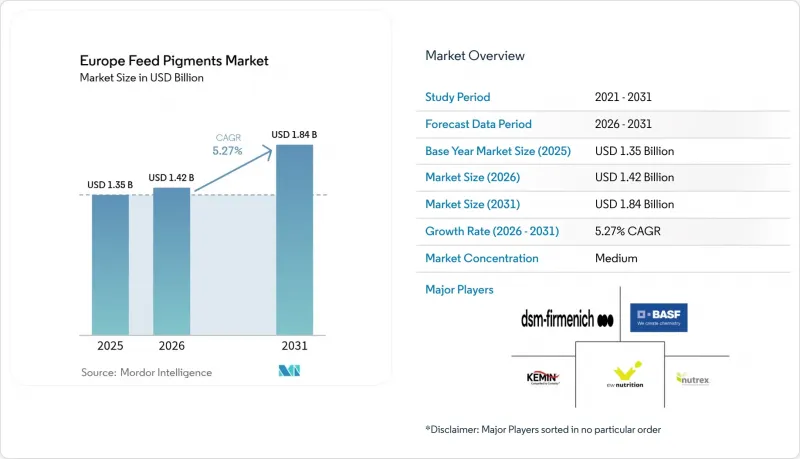
Mordor Intelligence에 따르면 유럽의 사료용 안료 시장 규모는 2025년에 13억 5,000만 달러로 평가되며, 2026년 14억 2,000만 달러에서 2031년까지 18억 4,000만 달러에 달할 것으로 예측되고 있으며, 예측 기간(2026-2031년)에 CAGR은 5.27%에 달할 전망입니다.
이 보고서는 유형별(카로티노이드, 커큐민, 카라멜, 스피룰리나, 기타), 대상 동물별(반추동물, 가금류, 돼지, 수산양식) 및 지역별(스페인, 영국, 독일, 프랑스, 이탈리아, 러시아, 기타 유럽)로 분류되어 있습니다. 시장 예측은 금액(달러)으로 표시되어 있습니다.
유럽 사료용 안료 시장의 동향 및 인사이트
카로티노이드가 풍부한 가금류 제품에 대한 수요 증가
독일, 프랑스, 스페인의 소매업체들은 신선도와 높은 영양가를 나타내기 위해 달걀 노른자의 색이 더 진할 것을 요구하고 있으며, 슈퍼마켓 체인에서는 프리미엄 달걀 라인에 대해 로슈 점수 14 이상을 지정하고 있습니다. 이러한 시각적 기준은 산란계 사료 1kg당 20-30mg의 루테인과 제아잔틴 배합 비율과 직접적으로 연결되어 있으며, 이에 따라 2024년에는 카로티노이드 수요가 전년 대비 8% 증가할 것으로 예측됩니다. 2024년에 발표된 DSM-Firmenich사의 시험 데이터에 따르면 아포카로티노이드 에스테르 배합물은 난황에 46.2%의 침착 효율을 달성한 반면, 칸타잔틴은 31.9%에 그쳤습니다. 이를 통해 배합 담당자는 목표 색상 점수를 유지하면서 배합량을 줄일 수 있게 되어 사료 비용을 3% 절감할 수 있게 되었습니다. 독일에서 실시된 소비자 조사에 따르면 달걀 노른자의 색상과 지방산 조성 간에는 상관관계가 없음에도 불구하고 쇼핑객의 68%가 ‘짙은 색의 달걀 노른자 = 오메가-3 함량이 높다’고 연관 짓고 있는 것으로 나타났습니다. 이러한 인식의 격차는 달걀 밸류체인 전반에 걸친 프리미엄화 전략을 지원하고 있습니다.
천연 색소 원료로의 전환
유럽연합(EU)의 레드 2G를 포함한 합성 아조 색소에 대한 사실상 금지 조치로 인해 식물 및 조류 유래 색소의 채택이 가속화되고 있으며, 스피룰리나와 파프리카 오레오레진이 화학 합성 대체품의 시장 점유율을 빼앗고 있습니다. 스피룰리나에 함유된 피코시아닌과 카로티노이드 덕분에 이 원료는 수산양식 분야에서 이중 기능을 하는 성분이 되었습니다. 관상어에게는 청록색을 띠게 하고, 아스타잔틴과 조합하면 연어과 어류에게는 적주황색을 띠게 합니다. 유럽식품안전청(EFSA)은 2024년, 일부 조류 추출물에 대한 승인 절차를 가속화하여 확실한 안전성 데이터를 갖춘 신청 건에 대해서는 규제 소요 기간을 18개월에서 12개월 미만으로 단축했습니다. 이에 따라 원료 공급업체들은 유럽내 재배 능력에 대한 투자에 적극적으로 나서게 되었습니다. 스페인의 파프리카 산지에서는 2024년 가뭄과 여름 기온 상승으로 인해 수확량이 12% 감소했습니다. 이로 인해 올레오레진 공급이 부족해졌고, 현물 가격은 전년 대비 18% 상승했습니다. 이에 따라 프랑스와 이탈리아의 가금류 통합 생산 업체들은 선물 계약을 체결하거나 합성 칸타크산틴을 배합에 포함시키는 방식으로 변경할 수밖에 없었습니다.
변동이 심한 원자재 비용
헤마토코쿠스 조류 유래 천연 아스타잔틴은 2024년에 1kg당 6,000-7,150달러에 거래되어, 1kg당 1,000달러인 합성 아스타잔틴의 약 6배에 달하는 가격이 되었습니다. 이로 인해 프리미엄급 완전 천연 연어 사료를 판매하는 수산 사료 제조업체들은 이익률 압박에 직면해 있습니다. 2024년, 마리골드 오레오레진 가격은 전년 대비 18% 급등했습니다. 이는 2대 수출국인 인도와 멕시코의 수확량 감소에 더해, 가뭄으로 인해 스페인의 파프리카 수확량이 12% 감소함에 따라 유럽에서 파프리카 공급이 부족해진 것이 원인입니다. 이에 대응해 노르웨이와 스코틀랜드의 수산양식업자들은 천연 아스타잔틴과 합성 아스타잔틴을 30:70 또는 40:60의 비율로 혼합하는 방안을 취하고 있습니다. 이를 통해 천연 색소를 함유한다는 표시를 유지하면서 원재료 비용을 관리하고 있지만, 원재료의 투명성이 경쟁의 쟁점이 될 경우 이 전략은 소비자의 반발을 초래할 위험이 있습니다.
부문 분석
2025년, 카로티노이드는 유럽 사료용 색소 시장 규모의 61.45%를 차지했습니다. 이는 가금류, 양식, 돼지 등 각 용도에서의 범용성에 힘입은 것이며, 루테인, 제아잔틴,아스타잔틴, 칸타잔틴은 착색 기능과 면역 지원 기능을 모두 수행하고 있습니다. 커큐민은 여전히 틈새 시장 부문에 머물러 있으며, 주로 유기 가금류 사육 시스템에서 채택되고 있습니다. 여기서는 강황의 항산화 특성이 그 옅은 노란색 착색 효과를 보완하고 있습니다. 유럽식품안전청(EFSA)은 구체적인 배합 지침을 마련하지는 않았으나, 배합 설계자들은 식품 분야의 ‘일반적으로 안전하다고 인정되는(GRAS)’ 선례를 참고하고 있습니다. 캐러멜 착색료는 사료 용도에서 극히 미미한 점유율을 차지하고 있으며, 주로 반려동물 사료의 특수 배합에 사용됩니다. 이 경우, 인간 구매자에게 주는 시각적 매력이 성분의 영양학적 기여도(극히 미미함)를 상회합니다.
스피룰리나는 클린 라벨 포지셔닝에 따른 유럽 수산양식 업계의 조류 유래 색소로 전환, 그리고 유럽식품안전청(EFSA)의 식물 추출물 승인 절차 간소화에 힘입어 2031년까지 연평균 성장률(CAGR) 9.25%로 성장할 것으로 예측됩니다. 단백질 공급원 및 착색제라는 이중 기능을 가진 스피룰리나는 수산양식 분야에서 시장 점유율 확대가 예상됩니다. 특히 노르웨이와 스코틀랜드의 연어 양식업자들이 합성 아스타잔틴에 의존하는 칠레의 경쟁사들과 차별화를 꾀하고 있는 것이 그 배경입니다. 다만, 유럽의 재배 능력은 여전히 연간 2,000메트릭톤 미만에 그치고 있으며, 가공업체들은 아시아에서 건조 바이오매스를 25-30%의 추가 비용을 지불하고 수입할 수밖에 없는 상황입니다.
기타 혜택:
- 엑셀 형식의 시장 예측(ME) 시트
- 3개월간의 애널리스트 지원
자주 묻는 질문
목차
제1장 서론
제2장 조사 방법
제3장 개요
제4장 시장 구도
제5장 시장 규모와 성장 예측
제6장 경쟁 구도
제7장 시장 기회와 향후 전망
KSA 26.08.25According to Mordor Intelligence, the Europe feed pigments market size was valued at USD 1.35 billion in 2025 and estimated to grow from USD 1.42 billion in 2026 to reach USD 1.84 billion by 2031, at a CAGR of 5.27% during the forecast period (2026-2031).
This report is Segmented by Type (Carotenoids, Curcumin, Caramel, Spirulina, and Others), by Animal (Ruminant, Poultry, Swine, and Aquaculture), and by Geography (Spain, United Kingdom, Germany, France, Italy, Russia, and Rest of Europe). The Market Forecasts are Provided in Terms of Value (USD).
Europe Feed Pigments Market Trends and Insights
Rising Demand for Carotenoid-Enriched Poultry Products
Retailers across Germany, France, and Spain are mandating deeper yolk colors to signal freshness and nutritional density, with supermarket chains specifying Roche scores of 14 or higher for premium egg lines. This visual benchmark translates directly into lutein and zeaxanthin inclusion rates of 20 to 30 milligrams per kilogram of layer feed, which is projected to increase carotenoid demand by an 8% year-over-year in 2024. DSM-Firmenich's trial data, published in 2024, showed that apocarotenoid-ester formulations achieved 46.2% deposition efficiency in egg yolks, compared with 31.9% for canthaxanthin . This enabled formulators to reduce inclusion rates while maintaining target color scores and lowering feed costs by 3%. Consumer surveys in Germany indicate that 68% of shoppers associate darker yolks with higher omega-3 content, even though yolk color is unrelated to fatty-acid profile, creating a perception gap that drives premiumization strategies across the egg value chain.
Shift Toward Natural Pigment Sources
The European Union's de facto ban on synthetic azo dyes, including Red 2G, has accelerated adoption of plant- and algae-derived pigments, with spirulina and paprika oleoresin capturing share from chemically synthesized alternatives. Spirulina's phycocyanin and carotenoid content make it a dual-function ingredient for aquaculture, providing both blue-green hues for ornamental fish and red-orange tones for salmonids when combined with astaxanthin. The European Food Safety Authority (EFSA) fast-tracked approvals for several algal extracts in 2024, reducing the regulatory timeline from 18 months to under 12 months for dossiers with robust safety data. This has emboldened ingredient suppliers to invest in European cultivation capacity. Spain's paprika-growing regions experienced a 12% decline in yield in 2024 due to drought and elevated summer temperatures, which tightened the oleoresin supply and pushed spot prices up 18% year-over-year. This, in turn, prompted poultry integrators in France and Italy to lock in forward contracts or reformulate with synthetic canthaxanthin blends.
Volatile Raw-Material Costs
Natural astaxanthin derived from Haematococcus algae was traded between USD 6,000 and USD 7,150 per kilogram in 2024, roughly six times the cost of synthetic astaxanthin at USD 1,000 per kilogram, creating margin pressure for aquafeed mills that market premium, all-natural salmon diets . Marigold oleoresin prices surged 18% year-over-year in 2024, driven by reduced harvests in India and Mexico, the two largest exporters, as well as a tightening European paprika supply following Spain's 12% yield decline due to drought. Aquaculture operators in Norway and Scotland have responded by blending natural and synthetic astaxanthin at ratios of 30:70 or 40:60, preserving the label claims of containing natural pigments while managing input costs, though this strategy risks consumer backlash if ingredient transparency becomes a competitive battleground.
Other drivers and restraints analyzed in the detailed report include:
- Technological Advances in Microencapsulation for Stability
- Regulatory Easing on Algal Pigment Approvals
- Stringent Maximum Inclusion limits by European Food Safety Authority (EFSA)
For complete list of drivers and restraints, kindly check the Table Of Contents.
Segment Analysis
Carotenoids captured 61.45% of the Europe feed pigments market size in 2025, underpinned by their versatility across poultry, aquaculture, and swine applications, where lutein, zeaxanthin, astaxanthin, and canthaxanthin serve both pigmentation and immune-support functions. Curcumin remains a niche segment, primarily deployed in organic poultry systems, where turmeric's antioxidant properties complement its mild yellow pigmentation. Although the Europe Food Safety Authority (EFSA) has not issued specific inclusion guidelines, formulators rely on Generally Recognized as Safe (GRAS) precedents from the food sector. Caramel colorants capture a minimal share in feed applications, primarily used in specialty pet-food formulations where the visual appeal to human purchasers outweighs the ingredient's negligible nutritional contribution.
Spirulina is projected to grow at a 9.25% CAGR through 2031, driven by European aquaculture's pivot toward algae-derived pigments that align with clean-label positioning and the Europe Food Safety Authority (EFSA) streamlined approval pathway for botanical extracts. Spirulina's dual functionality as a protein source and pigment positions it for incremental share gains in aquaculture, particularly as Norwegian and Scottish salmon farms seek to differentiate from Chilean competitors that rely on synthetic astaxanthin, though European cultivation capacity remains below 2,000 metric tons annually and forces mills to import dried biomass from Asia at a 25 to 30% cost premium .
Complete Report Scope:
- By Type
- Carotenoids
- Curcumin
- Caramel
- Spirulina
- Others
- By Animal
- Poultry
- Swine
- Ruminant
- Aquaculture
- By Geography
- Germany
- Spain
- France
- Italy
- United Kingdom
- Russia
- Rest of Europe
List of Companies Covered in this Report:
- DSM-Firmenich AG
- BASF SE
- Kemin Industries Inc.
- EW Nutrition GmbH
- Nutrex N.V.
- Synthite Industries Ltd
- Impextraco N.V.
- Bordas Chacn S.A.
- Biochem Holding GmbH
- AstaReal AB
- Camlin Fine Sciences Europe Ltd
- DuPont Nutrition Biosciences ApS
- Givaudan Natural Colorants SAS
- ADM
- Kalsec Europe Ltd
Additional Benefits:
- The market estimate (ME) sheet in Excel format
- 3 months of analyst support
TABLE OF CONTENTS
1 INTRODUCTION
- 1.1 Study Assumptions and Market Definition
- 1.2 Scope of the Study
2 RESEARCH METHODOLOGY
3 EXECUTIVE SUMMARY
4 MARKET LANDSCAPE
- 4.1 Market Overview
- 4.2 Market Drivers
- 4.2.1 Rising demand for carotenoid-enriched poultry products
- 4.2.2 Shift toward natural pigment sources
- 4.2.3 Technological advances in microencapsulation for stability
- 4.2.4 Regulatory easing on algal pigment approvals
- 4.2.5 Consumer preference for clean-label meat and eggs
- 4.2.6 Growth of antibiotic-free feed driving functional pigments
- 4.3 Market Restraints
- 4.3.1 Volatile raw-material costs
- 4.3.2 Stringent maximum inclusion limits by European Food Safety Authority (EFSA)
- 4.3.3 Slow farmer adoption in Central and Eastern Europe
- 4.3.4 Supply constraints of natural pigment biomass
- 4.4 Regulatory Landscape
- 4.5 Technological Outlook
- 4.6 Porter's Five Forces Analysis
- 4.6.1 Bargaining Power of Suppliers
- 4.6.2 Bargaining Power of Buyers
- 4.6.3 Threat of New Entrants
- 4.6.4 Threat of Substitutes
- 4.6.5 Intensity of Competitive Rivalry
5 MARKET SIZE AND GROWTH FORECASTS (VALUE)
- 5.1 By Type
- 5.1.1 Carotenoids
- 5.1.2 Curcumin
- 5.1.3 Caramel
- 5.1.4 Spirulina
- 5.1.5 Others
- 5.2 By Animal
- 5.2.1 Poultry
- 5.2.2 Swine
- 5.2.3 Ruminant
- 5.2.4 Aquaculture
- 5.3 By Geography
- 5.3.1 Germany
- 5.3.2 Spain
- 5.3.3 France
- 5.3.4 Italy
- 5.3.5 United Kingdom
- 5.3.6 Russia
- 5.3.7 Rest of Europe
6 COMPETITIVE LANDSCAPE
- 6.1 Strategic Moves
- 6.2 Market Share Analysis
- 6.3 Company Profiles (Includes Global Level Overview, Market Level Overview, Core Segments, Financials as Available, Strategic Information, Market Rank/Share, Products and Services, Recent Developments)
- 6.3.1 DSM-Firmenich AG
- 6.3.2 BASF SE
- 6.3.3 Kemin Industries Inc.
- 6.3.4 EW Nutrition GmbH
- 6.3.5 Nutrex N.V.
- 6.3.6 Synthite Industries Ltd
- 6.3.7 Impextraco N.V.
- 6.3.8 Bordas Chacn S.A.
- 6.3.9 Biochem Holding GmbH
- 6.3.10 AstaReal AB
- 6.3.11 Camlin Fine Sciences Europe Ltd
- 6.3.12 DuPont Nutrition Biosciences ApS
- 6.3.13 Givaudan Natural Colorants SAS
- 6.3.14 ADM
- 6.3.15 Kalsec Europe Ltd


