

|
시장보고서
상품코드
2073327
아프리카의 사료용 안료 : 시장 점유율 분석, 업계 동향 및 통계, 성장 예측(2026-2031년)Africa Feed Pigments - Market Share Analysis, Industry Trends & Statistics, Growth Forecasts (2026 - 2031) |
||||||
 Mordor Intelligence
Mordor Intelligence에 의하면, 아프리카의 사료용 안료 시장은 2025년에 5,640만 달러로 평가되었습니다. 2026년 5,854만 달러에서 2031년까지 7,061만 달러로 성장하여 2026년부터 2031년까지 예측 기간 동안 CAGR 3.82%를 나타낼 전망입니다.
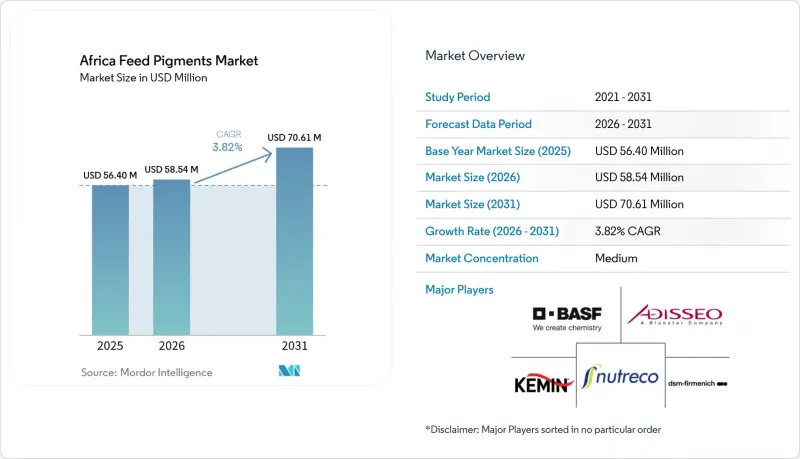
본 보고서는 부가물 유형별(카로티노이드, 커큐민, 스피루리나), 동물 유형별(수산물 양식, 가금류, 반추동물, 돼지, 기타 동물), 그리고 지역별(이집트, 케냐, 남아프리카공화국, 기타 아프리카 국가)로 분류되어 있습니다. 시장 전망은 금액(달러) 및 수량(미터톤) 단위로 제시되어 있습니다.
아프리카의 사료용 안료 시장 동향 및 분석
가금류 사료 수요 증가와 고품질 달걀 색상에 대한 요구 증가
아프리카의 사료용 안료 시장에서는 특히 남아프리카공화국에서 상업적 가금류 생산이 확대되고 있는 것을 배경으로 수요가 증가하고 있습니다. 가금류는 남아프리카공화국의 농업 부문에서 가장 큰 기여를 하는 분야이며, 배합 사료의 주요 소비 분야이기도 합니다. 미국 농무부에 따르면, 남아프리카공화국의 닭고기 생산량은 업계의 성장과 사료 경제성 개선에 힘입어 2025년 추정치인 164만 톤에서 2026년에는 168만 톤에 달할 것으로 전망됩니다. 가금류 생산량이 증가함에 따라 카로티노이드 색소 등 특수 사료 첨가제에 대한 수요도 높아지고 있습니다. 계란 생산자들은 소매 업계나 브랜드 계란 프로그램의 기준을 충족하고, 노른자 색을 균일하게 유지하기 위해 사료에 착색제를 첨가하는 경우가 늘고 있습니다. 달걀 노른자의 색은 소비자의 구매 결정에 큰 영향을 미치기 때문에 사료용 안료는 산란계 사료 배합에 있어 필수적인 성분이 되었으며, 가금 사료 업계 전반에 걸쳐 그 사용을 촉진함으로써 아프리카 시장의 성장에 기여하고 있습니다.
아프리카 전역에 걸친 상업용 사료 공장 확대
대규모 상업용 사료 제조 시설의 설립은 아프리카의 사료용 안료 시장의 기반을 강화하고 있습니다. 현대적인 사료 공장은 정밀한 배합 및 품질 관리 시스템을 통해 특수 첨가물을 배합할 수 있도록 갖추어져 있습니다. 예를 들어, 2026년 2월, 데 헤우스사는 케냐의 아티 강에 2,320만 달러를 투자해 사료 제조 공장을 설립했습니다. 이 공장의 초기 연간 생산 능력은 24만 메트르톤이며, 가금류, 돼지, 반추동물 및 수산 양식 분야를 아우르고 있습니다. 이러한 투자를 통해 산업용 가공 시설을 통한 사료 생산량이 증가함에 따라, 가축 및 가금류 생산에서 제품의 품질과 균일성을 향상시키기 위한 사료용 안료 도입 가능성이 높아지고 있습니다. 아프리카 전역에서 상업적 사료 생산 능력이 확대됨에 따라, 색소 공급업체들은 표준화된 사료 제조 관행을 따르는 더 광범위한 고객층에 접근할 수 있는 이점을 누리고 있으며, 이를 통해 아프리카 사료용 색소 시장의 성장을 주도하고 있습니다.
카로티노이드 및 색소 프리믹스에 대한 높은 수입 의존도
아프리카의 사료용 안료 시장은 카로티노이드 및 착색제 프리믹스를 포함한 수입 특수 사료 첨가제에 대한 현저한 의존도로 인해 제약을 받고 있습니다. 이러한 높은 의존도는 공급망 혼란에 대한 취약성을 높이며, 조달 비용 상승을 초래하고 있습니다. 학술지 『Ruminants』에 게재된 2025년 연구에 따르면, 사하라 이남 아프리카에서 사료 첨가제의 높은 비용과 구하기 어려움으로 인해 축산 시스템에 이를 도입하는 데 심각한 장애가 되고 있는 것으로 지적되었습니다. 이러한 문제는 주로 국제적인 공급망을 통해 조달되며, 추가적인 물류·유통 체계를 필요로 하는 사료용 안료의 경우 특히 심각합니다. 그 결과, 비용 압박이 심해지는 시기에는 사료 제조업체들이 사료 배합 시 색소 첨가량을 줄일 가능성이 있어, 시장 침투가 제한되고 아프리카 사료용 색소 시장의 성장이 저해될 것입니다.
부문별 분석
2025년, 아프리카 사료용 색소 시장에서 커큐민과 스피루리나 시장 점유율은 51.4%로 가장 높은 비중을 차지했습니다. 커큐민과 스피루리나는 착색 효과와 기능성 영양 특성을 모두 갖추고 있어, 상업적 축산 및 수산 양식업자들의 지지를 받으며 선두 자리를 유지하고 있습니다. 이러한 사용은 착색 효과를 높이는 동시에 동물의 생산성을 향상시키는 천연 사료 원료에 대한 선호도가 높아지는 추세와 부합합니다. 이러한 이중 가치 제안이 다양한 분야에서 채택을 촉진하고, 천연 유래 착색제 솔루션에 대한 수요를 뒷받침하고 있습니다.
아프리카의 사료용 안료 시장에서 카로티노이드 시장 규모는 2026년부터 2031년까지 연평균 성장률(CAGR) 4.0%라는 가장 높은 성장률을 기록하며 확대될 것으로 전망됩니다. 이러한 성장은 주로 수산 양식 및 가금류 사료 분야에서 카로티노이드의 용도가 확대된 데 기인합니다. 이러한 분야에서는 생선 살, 새우, 달걀 노른자, 가금류 껍질의 색조가 중요한 품질 요인으로 작용합니다. 또한, 카로티노이드에는 동물의 건강과 생산성을 증진시키는 항산화 작용도 있습니다. 상업용 사료 생산의 확대와 고품질 동물성 단백질 제품에 대한 수요 증가가 카로티노이드 계열 첨가제의 채택을 더욱 촉진하고 있습니다. 이러한 요인들이 복합적으로 작용하여 이 부문의 장기적인 견실한 성장 전망을 뒷받침하고 있습니다.
기타 혜택 :
- 엑셀 형식 시장 예측(ME) 시트
- 3개월간의 애널리스트 지원
자주 묻는 질문
목차
제1장 서론
제2장 보고서의 내용
제3장 주요 요약 및 주요 조사 결과
제4장 주요 업계 동향
제5장 시장 규모 및 성장 예측
제6장 경쟁 구도
제7장 CEO에 대한 주요 전략적 질문
KTH 26.07.08According to Mordor Intelligence, the africa feed pigments market was valued at USD 56.40 million in 2025 and is projected to grow from USD 58.54 million in 2026 to USD 70.61 million by 2031, registering a CAGR of 3.82% during the forecast period from 2026 to 2031.
This report is Segmented by Sub-Additive (Carotenoids, and Curcumin and Spirulina), by Animal (Aquaculture, Poultry, Ruminants, Swine, and Other Animals), and by Geography (Egypt, Kenya, South Africa, and Rest of Africa). The Market Forecasts are Provided in Terms of Value (USD) and Volume (Metric Tons).
Africa Feed Pigments Market Trends and Insights
Rising Poultry Feed Demand and Premium Egg Color Requirements
The Africa feed pigments market is witnessing growing demand driven by the expansion of commercial poultry production, particularly in South Africa. Poultry is the largest contributor to South Africa's agricultural sector and a major consumer of compound feed. According to the United States Department of Agriculture, South Africa's chicken meat production is forecasted to reach 1.68 million tons in 2026, up from an estimated 1.64 million tons in 2025, supported by industry growth and improved feed economics. With the increase in poultry production, the demand for specialized feed additives, such as carotenoid pigments, is also rising. Egg producers are increasingly incorporating pigments to ensure consistent yolk coloration that meets retail and branded egg program standards. As yolk color significantly influences consumer purchasing decisions, feed pigments have become a critical component of layer feed formulations, driving their adoption across the poultry feed industry and contributing to market growth in Africa.
Expansion of Commercial Feed Mills Across Africa
The establishment of large-scale commercial feed manufacturing facilities is strengthening the foundation of the Africa feed pigments market. Modern feed mills are equipped to incorporate specialty additives through precise formulation and quality-control systems. For instance, in February 2026, De Heus inaugurated a USD 23.2 million feed manufacturing plant in Athi River, Kenya, with an initial annual production capacity of 240,000 metric tons, catering to poultry, pigs, ruminants, and aquaculture sectors. These investments increase the volume of feed produced through industrial processing facilities, enhancing the potential adoption of feed pigments to improve product quality and consistency in livestock and poultry production. As commercial feed production capacity expands across Africa, pigment suppliers benefit from access to a wider customer base adhering to standardized feed manufacturing practices, thereby driving the growth of the Africa feed pigments market.
High Import Dependence for Carotenoids and Pigment Premixes
The Africa feed pigments market is constrained by its significant dependence on imported specialty feed additives, including carotenoids and pigment premixes. This reliance increases vulnerability to supply chain disruptions and higher procurement costs. A 2025 study published in the journal Ruminants highlighted the high cost and limited availability of feed additives in sub-Saharan Africa as significant obstacles to their adoption in livestock production systems. These issues are particularly critical for feed pigments, which are predominantly sourced through international supply chains and require additional logistics and distribution efforts. Consequently, feed manufacturers may reduce pigment inclusion in feed formulations during periods of cost pressure, limiting market penetration and constraining the growth of the Africa feed pigments market.
Other drivers and restraints analyzed in the detailed report include:
- Aquaculture Scale-Up in Egypt, Nigeria, and East Africa
- Shift Toward Natural Pigments in Branded Poultry Products
- Cost-Sensitive Poultry Economics Limit Pigment Inclusion Rates
For complete list of drivers and restraints, kindly check the Table Of Contents.
Segment Analysis
The Africa feed pigment market share for curcumin and spirulina accounted for the largest 51.4% in 2025. Curcumin and spirulina maintain their leading position due to their combined pigmentation benefits and functional nutritional attributes, which appeal to commercial livestock and aquaculture producers. Their usage aligns with the increasing preference for natural feed ingredients that enhance animal performance while providing color enhancement. This dual-purpose value proposition drives adoption across various species and sustains demand for naturally sourced pigment solutions.
The Africa feed pigment market size for carotenoids is projected to grow at the fastest CAGR of 4.0% from 2026 to 2031. This growth is primarily attributed to their increasing application in aquaculture and poultry feed, where coloration is a critical quality factor for fish flesh, shrimp, egg yolks, and poultry skin. Additionally, carotenoids offer antioxidant benefits that promote animal health and productivity. The expansion of commercial feed production and the rising demand for premium-quality animal protein products are further driving the inclusion of carotenoid-based additives. These factors collectively support strong long-term growth prospects for this segment.
Complete Report Scope:
- By Sub-Additive
- Carotenoids
- Curcumin and Spirulina
- By Animal Type
- Aquaculture
- Fish
- Shrimp
- Other Aquaculture Species
- Poultry
- Broiler
- Layer
- Other Poultry Birds
- Ruminants
- Beef Cattle
- Dairy Cattle
- Other Ruminants
- Swine
- Other Animals
- Aquaculture
- By Geography
- Egypt
- Kenya
- South Africa
- Rest of Africa
List of Companies Covered in this Report:
- BASF SE
- dsm-firmenich AG
- Kemin Industries, Inc.
- EW Nutrition GmbH (EW Group)
- Nutreco N.V.
- Adisseo (China National Bluestar (Group) Co., Ltd.)
- Kalsec, Inc.
- Synthite Industries Private Limited
- Divi's Laboratories Limited
- ROHA Dyechem Private Limited
- Industrias Vepinsa, S.A. de C.V.
- Innov Ad NV/SA (PAI Partners)
- Bioergex S.A.
- Behn Meyer Holding AG
- Phytobiotics Futterzusatzstoffe GmbH
Additional Benefits:
- The market estimate (ME) sheet in Excel format
- 3 months of analyst support
TABLE OF CONTENTS
1 INTRODUCTION
- 1.1 Study Assumptions and Market Definition
- 1.2 Scope of the Study
- 1.3 Research Methodology
2 REPORT OFFERS
3 EXECUTIVE SUMMARY AND KEY FINDINGS
4 KEY INDUSTRY TRENDS
- 4.1 Animal Headcount
- 4.1.1 Poultry
- 4.1.2 Ruminants
- 4.1.3 Swine
- 4.2 Feed Production
- 4.2.1 Aquaculture
- 4.2.2 Poultry
- 4.2.3 Ruminants
- 4.2.4 Swine
- 4.3 Regulatory Framework
- 4.3.1 Egypt
- 4.3.2 Kenya
- 4.3.3 South Africa
- 4.3.4 Rest of Africa
- 4.4 Value Chain and Distribution Channel Analysis
- 4.5 Market Drivers
- 4.5.1 Rising poultry feed demand and premium egg color requirements
- 4.5.2 Expansion of commercial feed mills across Africa
- 4.5.3 Aquaculture scale-up in Egypt, Nigeria, and East Africa
- 4.5.4 Shift toward natural pigments in branded poultry products
- 4.5.5 Modern retail and foodservice color consistency requirements
- 4.5.6 Tax and VAT relief on specialized feed inputs in select markets
- 4.6 Market Restraints
- 4.6.1 High import dependence for carotenoids and pigment premixes
- 4.6.2 Cost-sensitive poultry economics limit pigment inclusion rates
- 4.6.3 Foreign exchange shortages delay additive procurement
- 4.6.4 Heat and storage instability in fragmented logistics networks
- 4.7 Porter's Five Forces Analysis
- 4.7.1 Bargaining Power of Suppliers
- 4.7.2 Bargaining Power of Buyers
- 4.7.3 Threat of New Entrants
- 4.7.4 Threat of Substitutes
- 4.7.5 Intensity of Competitive Rivalry
5 MARKET SIZE AND GROWTH FORECASTS (VALUE AND VOLUME)
- 5.1 By Sub-Additive
- 5.1.1 Carotenoids
- 5.1.2 Curcumin and Spirulina
- 5.2 By Animal Type
- 5.2.1 Aquaculture
- 5.2.1.1 Fish
- 5.2.1.2 Shrimp
- 5.2.1.3 Other Aquaculture Species
- 5.2.2 Poultry
- 5.2.2.1 Broiler
- 5.2.2.2 Layer
- 5.2.2.3 Other Poultry Birds
- 5.2.3 Ruminants
- 5.2.3.1 Beef Cattle
- 5.2.3.2 Dairy Cattle
- 5.2.3.3 Other Ruminants
- 5.2.4 Swine
- 5.2.5 Other Animals
- 5.2.1 Aquaculture
- 5.3 By Geography
- 5.3.1 Egypt
- 5.3.2 Kenya
- 5.3.3 South Africa
- 5.3.4 Rest of Africa
6 COMPETITIVE LANDSCAPE
- 6.1 Market Concentration
- 6.2 Strategic Moves
- 6.3 Market Share Analysis
- 6.4 Company Profiles (Includes Global Level Overview, Market Level Overview, Core Segments, Financials as Available, Strategic Information, Market Rank/Share for Key Companies, Products and Services, and Recent Developments)
- 6.4.1 BASF SE
- 6.4.2 dsm-firmenich AG
- 6.4.3 Kemin Industries, Inc.
- 6.4.4 EW Nutrition GmbH (EW Group)
- 6.4.5 Nutreco N.V.
- 6.4.6 Adisseo (China National Bluestar (Group) Co., Ltd.)
- 6.4.7 Kalsec, Inc.
- 6.4.8 Synthite Industries Private Limited
- 6.4.9 Divi's Laboratories Limited
- 6.4.10 ROHA Dyechem Private Limited
- 6.4.11 Industrias Vepinsa, S.A. de C.V.
- 6.4.12 Innov Ad NV/SA (PAI Partners)
- 6.4.13 Bioergex S.A.
- 6.4.14 Behn Meyer Holding AG
- 6.4.15 Phytobiotics Futterzusatzstoffe GmbH


