

|
시장보고서
상품코드
2073319
BFSI 분야 학습 관리 시스템(LMS) : 시장 점유율 분석, 업계 동향 및 통계, 성장 예측(2026-2031년)Learning Management System (LMS) In BFSI - Market Share Analysis, Industry Trends & Statistics, Growth Forecasts (2026 - 2031) |
||||||
 Mordor Intelligence
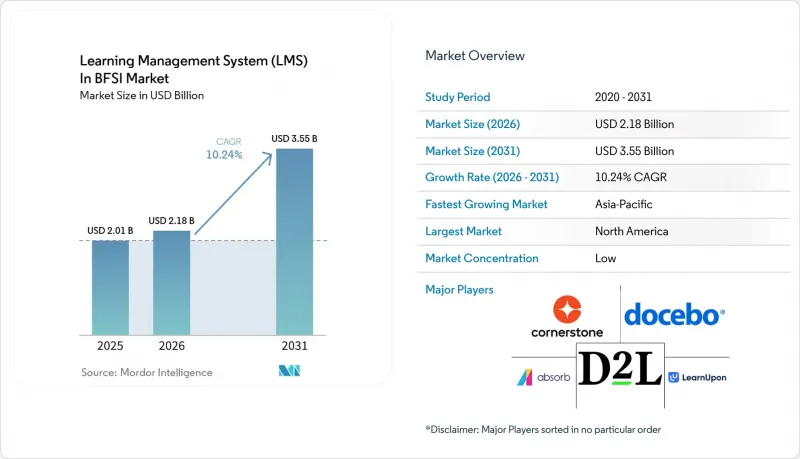
Mordor Intelligence에 의하면, BFSI 분야 학습 관리 시스템(LMS) 시장 규모는 2025년 20억 1,000만 달러로 평가되었습니다. 2026년에는 21억 8,000만 달러로 확대되어 2031년까지 35억 5,000만 달러에 이를 것으로 예상되며 2026년부터 2031년에 걸쳐 CAGR 10.24%로 성장할 전망입니다.
본 보고서는 구성 요소(소프트웨어 플랫폼 및 서비스), 배포 모드(클라우드 기반, On-Premise형, 하이브리드형), 제공 방식(자기 주도형 및 원격 학습 등), 용도(컴플라이언스 및 규제 관련 교육, AML/KYC 교육 등), 최종 사용자(은행, 보험사 등), 그리고 지역별로 분류되어 있습니다. 시장 전망은 금액(달러) 기준으로 제시되어 있습니다.
세계의 BFSI 분야 학습 관리 시스템(LMS) 시장 동향 및 인사이트
BFSI 워크플로우 전반에 걸친 규제 준수 프로세스의 디지털화
감독 당국이 감사 가능하고, 역할에 기반하며, 성과와 연계된 교육 기록을 요구하게 됨에 따라, 규제 준수 업무의 디지털화는 BFSI 분야 학습 관리 시스템(LMS) 시장에서 주요 구매 동인이 되고 있습니다. 감사관이 직원들이 필수 통제 조치를 이해하고 적용했는지 여부를 확인할 때, 금융기관은 더 이상 연간 이수 증명서에만 의존할 수 없습니다. FINRA의 2026년 검사 우선순위에 따르면, 기업들에게 “팜 엘리먼트"교육의 적절성을 문서화하고, 원격 수료 여부를 확인하며, 규제 변경 사항을 신속하게 반영해야 하므로, 강력한 감사 기능과 워크플로 관리 기능을 갖춘 시스템의 가치가 높아지고 있습니다. 유럽에서 회복탄력성에 대한 기대가 높아짐에 따라, 영향을 받는 모든 직원 그룹을 대상으로 최신 ICT 위험에 관한 학습 내용을 제공하고, 그 타당성을 입증할 수 있는 교육 증빙 자료를 유지하도록 금융 기관에 대한 압박이 강화되고 있습니다. BFSI 분야 학습 관리 시스템(LMS) 시장에서는 컨텐츠 이수 현황을 직무 역할, 규제 조항 및 검토 일정에 연계하는 플랫폼이 기존의 정적인 인증 절차를 점차 대체하고 있습니다. 이러한 변화로 인해 연수 예산은 재량적인 인사 계획이 아닌, 운영 리스크 및 감사 대응 준비에 중점을 두고 배분되고 있습니다.
사이버 보안 및 데이터 개인정보 보호 교육 의무화 확대
금융 기관들이 끊임없는 위협, 개인정보 보호 의무 및 복원력 요건에 직면함에 따라, 사이버 보안은 BFSI 분야 학습 관리 시스템(LMS)에서 교육 수요의 핵심이 되고 있습니다. 유럽은행감독청(EBA)의 보고서에 따르면, 2025년 3월 기준으로 EU 은행의 82%가 사이버 위험과 데이터 보안을 가장 큰 우려 사항으로 꼽았으며, 이는 디지털 위험이 기존의 많은 업무상 우선순위를 앞지르고 있음을 보여주었습니다. 미국에서는 뉴욕주 금융서비스국(NYDFS)의 파트 500 프레임워크에 따라, 대상에 해당하는 모든 사업체에 대해 소셜 엔지니어링을 포함한 연례 사이버 보안 교육이 의무화되어 있으며, 이를 통해 지속적인 기업 학습 주기가 지원되고 있습니다. 또한, FFIEC(연방금융기관검사위원회)의 사이버 보안 인식 제고에 관한 지침과 NIST 사이버 보안 프레임워크 2.0으로의 전환이 맞물리면서, 교육이 일회성 차원이 아닌 지속적이고 문서화되어야 한다는 기대가 높아지고 있습니다. OCC의 2025년 회복탄력성 보고서에 따르면, 검사관을 대상으로 한 교육 과정에는 이미 랜섬웨어, 분산 원장 기술, AI를 활용한 부정 행위 등이 포함되어 있으며, 이는 감독 대상 기관에 대해 이러한 기준을 충족할 것을 점점 더 요구하고 있음을 시사합니다. 따라서 규제 당국의 공표 일정에 맞추어 컨텐츠를 신속하게 업데이트할 수 있는 공급업체는 연간 업데이트 주기를 기반으로 하는 플랫폼에 비해 우위를 점하고 있습니다.
레거시 핵심 시스템과 HRIS 통합의 복잡성
레거시 시스템의 아키텍처는 BFSI 분야 학습 관리 시스템(LMS) 도입에 있어 여전히 가장 뚜렷한 제약 요인 중 하나입니다. 그 이유는 도입의 품질이 여전히 기존 플랫폼 간의 ID, 데이터 및 사용자 라이프사이클 연동에 의존하고 있기 때문입니다. 많은 은행과 보험사는 여러 세대에 걸친 HRIS, 인증 시스템, 코어 시스템을 병행하여 운영하고 있으며, 각 시스템 간의 불일치는 등록 누락, 접근 문제, 또는 규정 준수 기록의 미비 등을 초래할 가능성이 있습니다. 네이티브 커넥터를 사용할 수 있는 경우 통합은 몇 주 만에 완료되지만, 구형 사내 호스팅 시스템과의 맞춤형 통합의 경우 도입 기간이 수개월에 달할 수도 있어 신속한 조달 결정의 가치를 떨어뜨릴 우려가 있습니다. OnCourse Learning사는 LMS와 HRIS의 통합 실패가 감사관의 심사 과정에서 자동 등록 미비 및 규정 준수 기록 누락의 주된 원인으로 지목하고 있으며, 통합의 미흡함은 단순한 기술적 불편함을 넘어 비즈니스상의 위험 요인이 되고 있습니다. 연방준비제도 감사국(OIG)도 2025년 검토에서 IT 감사 도구의 비일관성을 지적했습니다. 이는 학습 시스템이 통제 환경과 원활하게 연계되지 않을 때 금융 기관이 직면하게 되는 보다 광범위한 거버넌스상의 문제와 일치합니다. 이러한 제약은 아시아태평양과 중동 및 아프리카에서 더욱 두드러지는데, 이는 해당 지역에서 현지에서 개발된 은행 시스템에 전 세계 LMS 공급업체들이 기대하는 표준화된 인터페이스가 부족한 경우가 많기 때문입니다.
부문별 분석
2025년, 소프트웨어 플랫폼은 구성 요소 부문의 70%를 차지했으며, 핵심 플랫폼 계층은 BFSI(은행 및 금융 및 보험) 분야의 LMS 시장에서 여전히 가장 큰 수익 기반이었습니다. 이러한 우위는 교실 중심의 연수에서 지점, 사업 부문, 컴플라이언스 프로그램 전체로 확장 가능한 디지털 시스템으로의 지속적인 전환에 기인합니다. 금융기관이 플랫폼을 중시하는 이유는 감사 추적을 기록하고, 일원화하여 관리하며, 규정 변경 시 거의 실시간으로 업데이트할 수 있기 때문입니다. 즉, 플랫폼 자체는 단순한 도구 그 이상이며, 대규모 및 중규모 금융기관에 있어 필수적인 요건이 되고 있습니다.
서비스 분야는 2031년까지 연평균 성장률(CAGR) 11.52%를 나타낼 것으로 예측되며, 이는 BFSI 시장에서 구매자들이 LMS와 관련하여 가장 높은 부가가치를 창출하고 있는 분야임을 보여줍니다. 금융 기관들은 소프트웨어 라이선스 외에도 도입 지원, 규정 준수 교육 과정 설계, 현지화, 그리고 학습 운영 관리 서비스를 점점 더 많이 구매하고 있습니다. FINRA의 “FLEX"서비스는 플랫폼 인프라와 규정 준수 컨텐츠 서비스 간의 이러한 분리를 여실히 보여주고 있습니다. 이는 기업이 미리 제작된 학습 컨텐츠에 접근하면서 자사의 환경을 통해 배포를 관리할 수 있기 때문입니다. 이러한 경향은 신속한 규제 대응이 필요한 상황임에도 불구하고, 종합적인 규정 준수 교육 과정을 설계하고 유지하기 위한 사내 L&D 자원이 부족한 중견 은행 및 보험사에서 가장 두드러지게 나타납니다.
2025년 기준으로 BFSI 분야 학습 관리 시스템(LMS) 시장에서 클라우드 기반 솔루션의 도입 비중이 68.23%를 차지했으며, 2031년까지 연평균 성장률(CAGR) 11.53%로 확대될 것으로 전망됩니다. 이러한 상황은 인증 취득이 가장 활발하던 시기에 시스템 확장이 가능하고, 모바일 액세스를 지원하며, 규정 준수 담당자에게 여러 거점을 아우르는 통합된 보고서 보기를 제공할 수 있는 시스템의 운영적 가치를 반영하고 있습니다. BFSI 시장에서 LMS는 클라우드 인프라를 선호하는 추세입니다. 이는 규제 당국이나 내부통제팀이 지침이 변경되었을 때 교육 내용을 신속하게 수정할 수 있다는 증거를 요구하기 때문입니다. 또한, 클라우드 시스템은 특히 금융 기관이 학습 데이터를 인사, 성과 평가, 접근 관리 시스템과 연동하고자 할 때, 보다 광범위한 기업 소프트웨어 스택과의 호환성이 높아집니다.
On-Premise 구축은 엄격한 내부 호스팅 정책을 가진 금융 기관, 특히 기밀성이 높은 직원 기록을 국내 인프라 내에 보관하는 국영 은행이나 규제 대상 기관에게 여전히 중요한 선택지로 남아 있습니다. 따라서 학습자 데이터를 국내에 보관하면서 속도, 도달 범위, 장애 복원력을 확보하기 위해 클라우드 전송을 활용할 수 있는 하이브리드 방식이 주목받고 있습니다. AWS의 “European Sovereign Cloud" 이 이니셔티브는 규제 대상 구매자들이 현재 하이브리드 및 소버린 대응 조달 모델을 지원하는 데이터 소재지를 고려한 아키텍처를 기대하고 있음을 뒷받침하고 있습니다. BFSI 분야 학습 관리 시스템(LMS)에서 이는 장기적으로 성공할 모델이 순수한 클라우드 모델이나 순수한 On-Premise 모델이 아니라, 지역별 규정 준수 요건에 따라 구축된 관리형 클라우드 아키텍처가 될 가능성이 높다는 것을 의미합니다.
지역별 분석
2025년, 북미는 BFSI LMS 시장의 38.12%를 차지하며 지역별로는 가장 큰 점유율을 기록했습니다. 해당 지역은 금융기관들이 연방, 자율 규제, 주 정부 등 각 수준에서 중복되는 교육 요건 하에 운영되고 있기 때문에 여전히 규정 준수가 도입의 가장 큰 원동력이 되고 있는 환경입니다. 뉴욕주 금융서비스국의 파트 500 규정에 따르면, 해당 사업자는 연례 사이버 보안 교육을 이수해야 하며, 이를 통해 지속적인 학습 주기와 보다 견고한 감사 문서화가 촉진되고 있습니다. FINRA의 현재 검사 우선순위에는 교육 내용의 적시 갱신, 원격 수료 확인, 그리고 “팜 엘리먼트" 프로그램의 적절성에 대한 문서화가 강조되고 있으며, 이 모든 요소가 학습 인프라를 감독 체계의 준비 상태와 밀접하게 연결하고 있습니다.
유럽은 BFSI 분야 학습 관리 시스템(LMS)에 대한 주요 수요 시장으로 자리 잡고 있습니다. 이는 금융기관이 업무 복원력, 행동 강령, 개인정보 보호 및 각국의 은행 비밀법과 관련된 중복된 의무를 관리해야 하기 때문입니다. 해당 지역의 규정 준수 요건은 ICT 리스크, 고객 대응, 상품 거버넌스, 데이터 처리 등 다양한 분야에 걸쳐 교육 수요를 창출하고 있으며, 이에 따라 커리큘럼 매핑 및 증거 관리 기능이 잘 갖춰진 플랫폼의 가치가 높아지고 있습니다. 유럽의 운영 탄력성 요건에 따라 금융기관들은 ICT 위험에 대한 교육을 더 자주 실시하게 되었으며, 연 1회 갱신만 하는 모델에서 벗어나고 있습니다. 남미에서도 금융기관들이 분산된 지점 네트워크와 디지털 채널 전반에 걸쳐 컴플라이언스 프로그램을 표준화하고 있어 그 중요성이 높아지고 있지만, 도입 현황은 북미나 유럽에 비해 아직 성숙도가 부족한 실정입니다.
아시아태평양은 2031년까지 연평균 성장률(CAGR) 12.84%를 기록하며 성장할 것으로 예상되며, BFSI 분야 학습 관리 시스템(LMS) 시장에서 가장 빠르게 성장하는 지역 블록이 될 전망입니다. 이러한 성장은 아세안 및 남아시아 지역의 규제 체계가 점차 성숙해지고, 은행, 핀테크, 인슈어테크 분야의 인력이 급속히 확대된 데 기인합니다. 2025년 11월에 발표된 싱가포르의 AI 리스크 관리 지침에서는 금융기관이 AI 개발 및 도입에 참여하는 직원의 역량을 문서화하여 확보할 것을 요구하고 있으며, 이에 따라 거버넌스 및 감독을 위한 명확한 교육 수요 주기가 형성되고 있습니다. 중국에서도 정식 학위 취득이나 인증 자격 취득 과정을 통해 체계적인 학습이 심화되고 있으며, 보험 채널을 대상으로 한 연수는 인증을 받은 온라인 프로그램을 통해 제도화가 진행되고 있습니다. 중동에서는 사이버 보안 및 리스크 관리 관련 교육 의무화가 더욱 철저히 시행되고 있는 걸프 지역 금융 중심지에 도입이 집중되고 있는 반면, 아프리카는 여전히 초기 단계에 머물러 있으며, 확대되는 디지털 결제 및 대리점 은행 네트워크를 지원할 수 있는 ‘모바일 우선"형식의 도입에 적합합니다.
기타 혜택 :
- 엑셀 형식 시장 예측(ME) 시트
- 3개월간의 애널리스트 지원
자주 묻는 질문
목차
제1장 서론
제2장 조사 방법
제3장 주요 요약
제4장 시장 구도
제5장 시장 규모 및 성장 예측
제6장 경쟁 구도
제7장 시장 기회 및 향후 전망
KTH 26.07.08According to Mordor Intelligence, the learning management system (LMS) in the BFSI Market is expected to increase from USD 2.01 billion in 2025 to USD 2.18 billion in 2026, and reach USD 3.55 billion by 2031, growing at a CAGR of 10.24% over 2026-2031.
This report is Segmented by Component (Software Platforms and Services), Deployment Mode (Cloud-Based, On-Premises, and Hybrid), Delivery Mode (Self-Paced and Distance Learning, and More), Application (Compliance and Regulatory Training, AML/KYC Training, and More), End User (Banks, Insurance Firms, and More), and Geography. The Market Forecasts are Provided in Terms of Value (USD).
Global Learning Management System (LMS) In BFSI Market Trends and Insights
Regulatory Compliance Digitization Across BFSI Workflows
Regulatory compliance digitization has become the primary purchase trigger in the LMS market for the BFSI industry, as supervisors now demand auditable, role-based, and outcome-linked training records. Financial institutions can no longer rely on annual completion certificates when examiners ask whether staff understood and applied the required controls. FINRA's 2026 examination priorities require firms to document the adequacy of Firm Element training, verify remote completion, and integrate regulatory updates promptly, which raises the value of systems with strong audit features and workflow discipline. European resilience expectations have also increased pressure on institutions to maintain current ICT risk learning and defensible training evidence across affected staff groups. In the LMS market in BFSI, platforms that map content completion to job roles, regulatory clauses, and review calendars are steadily replacing static certification routines. This shift keeps training budgets tied to operational risk and examination readiness rather than to discretionary HR planning.
Rising Cybersecurity And Data Privacy Training Mandates
Cybersecurity has moved to the center of training demand in the LMS in the BFSI market because institutions now face a constant stream of threats, privacy obligations, and resilience requirements. The European Banking Authority reported that 82% of EU banks identified cyber risk and data security as their primary concern in March 2025, showing how digital risk has overtaken many traditional operational priorities. In the United States, the New York State Department of Financial Services Part 500 framework requires annual cybersecurity training covering social engineering for all covered entities, supporting recurring enterprise learning cycles. The FFIEC's cybersecurity awareness guidance and the move toward NIST Cybersecurity Framework 2.0 have also strengthened the expectation that training be ongoing and documented rather than event-based. The OCC's 2025 resilience report showed that examiner training already includes ransomware, distributed ledger technology, and AI-enabled fraud, signaling that supervised institutions are increasingly expected to meet this standard. Vendors that can update content quickly in line with regulatory publication calendars are therefore gaining an edge over platforms built around annual refresh cycles.
Legacy Core System And HRIS Integration Complexity
Legacy system architecture remains one of the clearest brakes on the LMS in the BFSI market because implementation quality still depends on identity, data, and user lifecycle connections across old platforms. Many banks and insurers operate with several generations of HRIS, authentication, and core systems, and each mismatch can create missing enrollments, access issues, or incomplete compliance records. When native connectors are available, integration can move in weeks, but custom integration with older self-hosted systems can extend implementation timelines into months and undermine the value of fast procurement decisions. OnCourse Learning identified LMS-HRIS integration failures as a leading cause of auto-enrollment gaps and missing compliance records in examiner reviews, making integration depth a business risk rather than a technical inconvenience. The Federal Reserve OIG also pointed to inconsistent IT examination tooling in its 2025 review, which aligns with the broader governance problems institutions face when learning systems do not connect cleanly to control environments. This restraint is sharper in Asia-Pacific and the Middle East and Africa, where locally built banking systems often lack the standardized interfaces expected by global LMS vendors.
Other drivers and restraints analyzed in the detailed report include:
- Accelerating Digital Banking And Insurtech Upskilling Needs
- Cloud-Based Learning Adoption Across Distributed Workforces
- Data Residency And Information Security Concerns In Regulated Learning Workflows
For complete list of drivers and restraints, kindly check the Table Of Contents.
Segment Analysis
Software platforms retained 70% of the component segment in 2025, keeping the core platform layer as the largest revenue base in the LMS market in BFSI. This lead came from the continued shift away from classroom-heavy delivery toward digital systems that can scale across branches, business lines, and compliance programs. Institutions value the platform because it supports audit trails, centralized administration, and near-real-time updates when rules change. That means the platform itself has become a basic requirement for large and mid-sized financial organizations rather than a discretionary tool.
Services are forecast to grow at a 11.52% CAGR through 2031, indicating where buyers are adding the most incremental value around the LMS in the BFSI market. Financial institutions increasingly purchase implementation support, compliance curriculum design, localization, and managed learning operations together with the software license. FINRA's FLEX offering illustrates this split between platform infrastructure and compliance content services because firms can access pre-built learning content while still managing delivery through their own environments. This pattern is strongest among mid-tier banks and insurers that need quick regulatory readiness but lack internal L&D resources to design and maintain a comprehensive compliance curriculum.
Cloud-based deployment accounted for 68.23% of the LMS market in the BFSI market in 2025 and is projected to expand at a 11.53% CAGR through 2031. This position reflects the operational value of systems that can scale during certification peaks, support mobile access, and give compliance leaders a unified reporting view across locations. In the BFSI market, LMSs have favored cloud infrastructure because regulators and internal control teams want evidence that training changes can be distributed quickly when guidance changes. Cloud systems also align better with broader enterprise software stacks, especially when institutions want learning data connected to HR, performance, and access management systems.
On-premises deployments remain relevant for institutions with strict internal hosting policies, especially state-linked banks and regulated entities that retain sensitive employee records within domestic infrastructure. Hybrid deployment is therefore gaining traction because it lets institutions keep learner data in-country while using cloud delivery for speed, reach, and resilience. AWS's European Sovereign Cloud initiative confirms that regulated buyers now expect residency-aware architecture, which supports hybrid and sovereign-ready procurement models. In the LMS in the BFSI industry, this means the long-term winner is less likely to be a pure cloud or pure on-premises model and more likely to be a controlled cloud architecture built around regional compliance needs.
Complete Report Scope:
- By Component
- Software Platforms
- Services
- By Deployment Mode
- Cloud-Based
- On-Premises
- Hybrid
- By Delivery Mode
- Self-Paced and Distance Learning
- Instructor-Led Training
- Blended Learning
- Mobile Microlearning
- By Application
- Compliance and Regulatory Training
- AML/KYC Training
- Product Training
- Process and Operational Training
- Risk, Fraud and Cybersecurity Training
- Customer Education and Partner Enablement
- Onboarding
- Sales Enablement
- Leadership and Advisory Training
- Certification and Continuing Education
- By End User
- Banks
- Insurance Firms
- Capital Markets and Wealth Management Firms
- Fintech and Payment Service Providers
- Credit Unions and Cooperative Financial Institutions
- NBFCs and Lending Institutions
- By Geography
- North America
- United States
- Canada
- Mexico
- South America
- Brazil
- Argentina
- Chile
- Rest of South America
- Europe
- United Kingdom
- Germany
- France
- Italy
- Spain
- Rest of Europe
- Asia-Pacific
- China
- Japan
- India
- South Korea
- Australia
- Singapore
- Rest of Asia-Pacific
- Middle East
- Saudi Arabia
- United Arab Emirates
- Rest of Middle East
- Africa
- South Africa
- Nigeria
- Rest of Africa
- North America
Geography Analysis
North America accounted for 38.12% of the global LMS market in the BFSI market in 2025, making it the largest regional contributor. The region remains the most compliance-driven adoption environment because institutions operate under overlapping federal, self-regulatory, and state training expectations. The New York State Department of Financial Services Part 500 regulation requires covered entities to complete annual cybersecurity training, which supports recurring learning cycles and stronger audit documentation. FINRA's current examination priorities add to this pressure by emphasizing timely training updates, remote completion verification, and documented adequacy of Firm Element programs, all of which keep learning infrastructure tied to supervisory readiness.
Europe is a major demand center for LMSs in the BFSI market because institutions must manage overlapping obligations tied to operational resilience, conduct, privacy, and national banking secrecy rules. The region's compliance stack creates training demand across ICT risk, consumer treatment, product governance, and data handling, which increases the value of platforms with stronger curriculum mapping and evidence controls. European operational resilience requirements have pushed institutions toward more frequent ICT risk learning and away from annual refresh-only models. South America is also becoming more relevant as financial institutions standardize compliance programs across dispersed branch networks and digital channels, even though adoption remains less mature than in North America and Europe.
Asia-Pacific is projected to grow at a 12.84% CAGR through 2031, making it the fastest-expanding regional block in the LMS BFSI market. Growth comes from stronger regulatory maturity in ASEAN and South Asia and from rapid workforce expansion in banking, fintech, and insurtech. Singapore's AI risk management guidelines, published in November 2025, require financial institutions to ensure documented competency among personnel involved in AI development and deployment, thereby creating a clear training demand cycle for governance and oversight. China is also deepening structured learning through formal credit hours and certification pathways, while insurance channel training is being institutionalized through accredited online programs. In the Middle East, adoption is concentrated in Gulf financial centers with stronger cyber and risk training mandates, while Africa remains earlier stage and is better suited to mobile-first deployments that can support expanding digital payments and agent banking networks.
- Cornerstone OnDemand, Inc.
- Docebo Inc.
- D2L Corporation
- Absorb Software Inc.
- LearnUpon Limited
- 360Learning SA
- Epignosis LLC
- Intellum, Inc.
- Thought Industries, Inc.
- iSpring Solutions, Inc.
- Learning Pool Limited
- Heuristix Digital Technologies Private Limited
- Paradiso Solutions LLC
- Neovation Inc.
- TOVUTI, INC.
- SkyPrep Inc.
- Skillcast Group plc
- LearnWorlds (CY) Ltd
- Schoox, LLC
- DigitalChalk
Additional Benefits:
- The market estimate (ME) sheet in Excel format
- 3 months of analyst support
TABLE OF CONTENTS
1 INTRODUCTION
- 1.1 Study Assumptions and Market Definition
- 1.2 Scope of the Study
2 RESEARCH METHODOLOGY
3 EXECUTIVE SUMMARY
4 MARKET LANDSCAPE
- 4.1 Market Overview
- 4.2 Impact of Macroeconomic Factors on the Market
- 4.3 Market Drivers
- 4.3.1 Regulatory Compliance Digitization Across BFSI Workflows
- 4.3.2 Rising Cybersecurity and Data Privacy Training Mandates
- 4.3.3 Accelerating Digital Banking and Insurtech Upskilling Needs
- 4.3.4 Cloud-Based Learning Adoption Across Distributed Workforces
- 4.3.5 AI Literacy and Model Risk Governance Training Demand
- 4.3.6 Extended Enterprise Training for Agents, Brokers, Advisors, and Partners
- 4.4 Market Restraints
- 4.4.1 Legacy Core System and HRIS Integration Complexity
- 4.4.2 Data Residency and Information Security Concerns in Regulated Learning Workflows
- 4.4.3 Training Fatigue From Always-On Regulatory Change Cycles
- 4.4.4 Localization Burden Across Multi-Jurisdiction Rulebooks and Product Taxonomies
- 4.5 Industry Value Chain Analysis
- 4.6 Regulatory Landscape
- 4.7 Technological Outlook
- 4.8 Porter's Five Forces Analysis
- 4.8.1 Bargaining Power of Buyers
- 4.8.2 Bargaining Power of Suppliers
- 4.8.3 Threat of New Entrants
- 4.8.4 Threat of Substitutes
- 4.8.5 Intensity of Competitive Rivalry
5 MARKET SIZE AND GROWTH FORECASTS (VALUE)
- 5.1 By Component
- 5.1.1 Software Platforms
- 5.1.2 Services
- 5.2 By Deployment Mode
- 5.2.1 Cloud-Based
- 5.2.2 On-Premises
- 5.2.3 Hybrid
- 5.3 By Delivery Mode
- 5.3.1 Self-Paced and Distance Learning
- 5.3.2 Instructor-Led Training
- 5.3.3 Blended Learning
- 5.3.4 Mobile Microlearning
- 5.4 By Application
- 5.4.1 Compliance and Regulatory Training
- 5.4.2 AML/KYC Training
- 5.4.3 Product Training
- 5.4.4 Process and Operational Training
- 5.4.5 Risk, Fraud and Cybersecurity Training
- 5.4.6 Customer Education and Partner Enablement
- 5.4.7 Onboarding
- 5.4.8 Sales Enablement
- 5.4.9 Leadership and Advisory Training
- 5.4.10 Certification and Continuing Education
- 5.5 By End User
- 5.5.1 Banks
- 5.5.2 Insurance Firms
- 5.5.3 Capital Markets and Wealth Management Firms
- 5.5.4 Fintech and Payment Service Providers
- 5.5.5 Credit Unions and Cooperative Financial Institutions
- 5.5.6 NBFCs and Lending Institutions
- 5.6 By Geography
- 5.6.1 North America
- 5.6.1.1 United States
- 5.6.1.2 Canada
- 5.6.1.3 Mexico
- 5.6.2 South America
- 5.6.2.1 Brazil
- 5.6.2.2 Argentina
- 5.6.2.3 Chile
- 5.6.2.4 Rest of South America
- 5.6.3 Europe
- 5.6.3.1 United Kingdom
- 5.6.3.2 Germany
- 5.6.3.3 France
- 5.6.3.4 Italy
- 5.6.3.5 Spain
- 5.6.3.6 Rest of Europe
- 5.6.4 Asia-Pacific
- 5.6.4.1 China
- 5.6.4.2 Japan
- 5.6.4.3 India
- 5.6.4.4 South Korea
- 5.6.4.5 Australia
- 5.6.4.6 Singapore
- 5.6.4.7 Rest of Asia-Pacific
- 5.6.5 Middle East
- 5.6.5.1 Saudi Arabia
- 5.6.5.2 United Arab Emirates
- 5.6.5.3 Rest of Middle East
- 5.6.6 Africa
- 5.6.6.1 South Africa
- 5.6.6.2 Nigeria
- 5.6.6.3 Rest of Africa
- 5.6.1 North America
6 COMPETITIVE LANDSCAPE
- 6.1 Market Concentration
- 6.2 Strategic Moves
- 6.3 Market Share Analysis
- 6.4 Company Profiles (includes Global Level Overview, Market Level Overview, Core Segments, Financials as available, Strategic Information, Market Rank/Share, Products and Services, Recent Developments).
- 6.4.1 Cornerstone OnDemand, Inc.
- 6.4.2 Docebo Inc.
- 6.4.3 D2L Corporation
- 6.4.4 Absorb Software Inc.
- 6.4.5 LearnUpon Limited
- 6.4.6 360Learning SA
- 6.4.7 Epignosis LLC
- 6.4.8 Intellum, Inc.
- 6.4.9 Thought Industries, Inc.
- 6.4.10 iSpring Solutions, Inc.
- 6.4.11 Learning Pool Limited
- 6.4.12 Heuristix Digital Technologies Private Limited
- 6.4.13 Paradiso Solutions LLC
- 6.4.14 Neovation Inc.
- 6.4.15 TOVUTI, INC.
- 6.4.16 SkyPrep Inc.
- 6.4.17 Skillcast Group plc
- 6.4.18 LearnWorlds (CY) Ltd
- 6.4.19 Schoox, LLC
- 6.4.20 DigitalChalk
7 MARKET OPPORTUNITIES AND FUTURE OUTLOOK
- 7.1 White-Space and Unmet-Need Assessment


