|
시장보고서
상품코드
2073439
매니지드 정보 서비스 : 시장 점유율 분석, 업계 동향 및 통계, 성장 예측(2026-2031년)Managed Information Services - Market Share Analysis, Industry Trends & Statistics, Growth Forecasts (2026 - 2031) |
||||||
 Mordor Intelligence
Mordor Intelligence에 의하면, 2026년 매니지드 정보 서비스 시장 규모는 3,256억 5,000만 달러에 달할 것으로 예상되고, 2025년 3,031억 6,000만 달러에서 확대해, 2031년에는 4,657억 4,000만 달러에 이를 것으로 예측됩니다.
2026년부터 2031년까지의 연평균 성장률(CAGR)은 7.42%를 나타낼 것으로 전망됩니다.
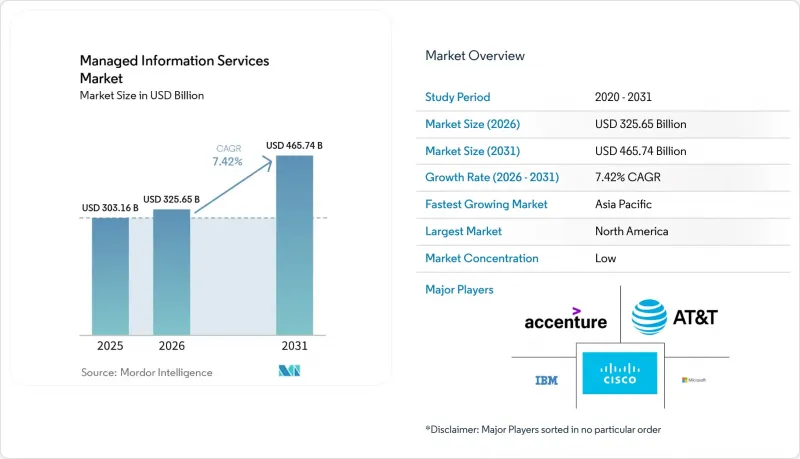
본 보고서는 도입 형태(클라우드 및 On-Premise), 서비스 유형(관리형 데이터센터, 관리형 보안, 관리형 커뮤니케이션(UC 및 VoIP) 등), 최종 사용자 기업의 규모(중소기업 및 대기업), 최종 사용자의 업종(IT 및 통신, 은행, 금융서비스 및 보험(BFSI), 헬스케어 등) 및 지역별로 분류되어 있습니다. 시장 전망은 금액(달러) 기준으로 제시되어 있습니다.
세계의 매니지드 정보 서비스 시장 동향 및 인사이트
하이브리드/멀티 클라우드 아키텍처로의 전환
하이브리드 및 멀티클라우드는 단순한 도구 선택의 문제가 아니라 경영진 차원의 필수 요건이 되었으며, 2027년까지 기업의 90%가 이러한 접근 방식을 채택할 것으로 예측됩니다. 워크로드의 이식성, 데이터 상주 규정, 공급업체의 다양화로 인해 운영상의 복잡성이 증가함에 따라, 조직들은 통합 관리를 제3자 전문 업체에 위탁하고 있습니다. 시스코의 보고서에 따르면, 53%의 기업이 매주 On-Premise 환경과 클라우드 환경 간에 워크로드를 이동시키고 있으며, 이로 인해 오케스트레이션 플랫폼 및 크로스 도메인 거버넌스 서비스에 대한 지속적인 수요가 발생하고 있습니다. 서로 다른 플랫폼 간에 일관된 정책 적용, 통합된 가시성, 그리고 자동화된 워크로드 배치를 제공하는 공급업체들은 현재 프리미엄 가격을 책정하고 있습니다. 이러한 도입 추세는 규정 준수와 혁신이라는 두 가지 목표를 동시에 충족해야 하는 규제가 엄격한 업계에서 특히 두드러지며, 현지에서의 제어와 클라우드의 민첩성을 결합할 수 있는 매니지드 서비스의 가치 제안을 더욱 공고히 하고 있습니다.
비용 최적화 및 운영비(OPEX) 중시
경제적 불확실성과 기술의 급속한 변화로 인해 재무 책임자들은 예측 가능한 구독형 지출을 선호하는 추세입니다. 매니지드 서비스는 설비 투자를 운영비(OPEX)로 전환하는 동시에, 하드웨어 노후화, 라이선스, 인력 확보와 관련된 위험을 공급업체에 전가합니다. 중소기업이 이 모델을 가장 빠르게 도입하고 있습니다. 왜냐하면 막대한 초기 투자 없이도 엔터프라이즈급 보안 및 분석 기능을 활용할 수 있기 때문입니다. 또한, 서비스 제공업체가 규정 준수 보고 및 사고 대응 책임을 맡게 됨에 따라, 사내 팀은 제한된 기술 자원을 고객 중심의 혁신에 집중할 수 있게 됩니다. 그 결과, OPEX 주도형 계약에서는 인프라 가용성뿐만 아니라 서비스 수준, 사용자 경험, 비즈니스 지표와 연계된 성과 보장이 포함되는 사례가 늘고 있습니다.
레거시 시스템의 통합과 규제의 복잡성
많은 기업에서는 최신 관리형 플랫폼과 쉽게 연동할 수 없는 수십년전의 시스템에서 핵심 용도를 운영하고 있습니다. 은행, 유틸리티체, 공공기관은 엄격한 감사 요건에 직면해 있으며, 여기에는 맞춤형 제어 기능, 전용 어댑터 및 장기간에 걸친 검증 주기가 요구됩니다. 맞춤형 통합은 프로젝트 비용을 증가시키고, 관리형 서비스의 매력을 뒷받침하는 규모의 경제를 저해합니다. SOX나 GDPR(EU 개인정보보호규정)과 같은 규정 준수 프레임워크에서는 On-Premise 환경에서의 감사 로그 기록이나 데이터 분리가 의무화되는 경우가 많아, 서비스 제공업체는 전용 환경을 구축할 수밖에 없게 되며, 이로 인해 도입 부담이 커집니다. 이러한 요인들로 인해, 특히 다양한 규제 의무를 지고 있는 세계 기업의 경우, 판매 주기가 길어지고 가치를 실현하는 데까지 걸리는 시간이 지연됩니다.
부문별 분석
2025년, On-Premise 환경은 매니지드 정보 서비스 시장에서 53.42%의 점유율을 유지했습니다. 이는 규제가 엄격한 많은 기업들이 인프라의 직접 관리를 계속 요구하고 있기 때문입니다. 사설 데이터센터와 지연 시간에 민감한 워크로드에 대한 막대한 투자가 이러한 추세를 더욱 강화하고 있습니다. 그러나 클라우드 기반 관리형 서비스는 2031년까지 연평균 성장률(CAGR) 13.25%로 성장할 것으로 전망되며, 이는 민첩성과 유연한 활용을 중시하는 업계 전반에서 워크로드 이전이 가속화되고 있음을 보여줍니다. 현재는 하이브리드 환경이 주류를 이루고 있으며, 서비스 제공업체는 두 환경에 걸친 통합적인 가시성, 구성 불일치에 대한 자동 수정, 그리고 통일된 보안 제어 기능을 제공해야 할 필요가 있습니다.
클라우드 보급의 가속화는 업계 고유의 규정 준수 청사진, 주권형 클라우드 존, 세분화된 암호화 옵션을 제공하게 된 하이퍼스케일 플랫폼에 대한 신뢰가 높아지고 있음을 반영하고 있습니다. 또한 기업들은 클라우드 현대화가 용도 혁신과 뗄 수 없는 관계임을 인식하고 있으며, 이는 리팩토링, DevSecOps 파이프라인, 그리고 지속적인 규정 준수 모니터링에 대한 수요를 촉진하고 있습니다. 인증된 클라우드 전문 지식, 독자적인 마이그레이션 가속화 도구, 그리고 강력한 재무 최적화 도구를 갖춘 매니지드 서비스 파트너들이 더 대규모의 계약을 수주하고 있습니다. 한편, 데이터센터 아웃소싱에만 국한된 서비스 제공업체들은 고객들이 클라우드 네이티브 설계 패턴을 채택하고 워크로드 배치의 경제성에 대한 적극적인 지침을 기대하게 됨에 따라 계약 축소 위험에 직면하고 있습니다.
매니지드 보안 서비스는 2025년에 총 매출의 28.92%를 차지하며 연평균 성장률(CAGR) 14.18%로 성장했는데, 이는 사이버 위험이 기업 전반의 최우선 과제로 부상했음을 반영합니다. 고급 서비스에서는 현재 위협 인텔리전스, 행동 분석 및 통합 플랫폼을 통해 수행되는 자동 대응이 융합되어, 수동으로 진행되는 분류 작업의 업무 부담이 줄어들고 있습니다.
또한, 제로 트러스트 네트워크 액세스, 클라우드 워크로드 보호, 공급망 위험 평가에 대한 수요도 증가하고 있습니다. 한편, 관리형 데이터센터 및 네트워크 서비스는 여전히 예측 가능한 정기 수익을 창출하고 있지만, 인프라 자동화로 인해 기존 티켓 건수가 감소함에 따라 그 성장률은 보안 분야에 뒤처지고 있습니다. 따라서 서비스 포트폴리오는 안전한 멀티클라우드 환경 구축을 중심으로 통합이 진행되고 있으며, 각 제공업체들은 ID 거버넌스, 데이터 유출 방지, 규정 준수 대시보드를 통합하고 있습니다. Canalys는 보안과 클라우드 최적화를 결합한 솔루션이 사일로화된 제안에 비해 1.6배 더 높은 교차 판매 수익을 창출한다고 강조하고 있습니다. 그 결과, MDR 플랫폼, 보안 분석, 전문 사고 대응 팀에 투자하는 벤더들은 차별화된 이익률을 확보하고 있습니다.
지역별 분석
북미는 클라우드의 조기 도입, 엄격한 사이버 보안 규제, 그리고 일류 공급업체들이 구축한 탄탄한 생태계 덕분에 2025년 매출의 34.87%를 계속 차지했습니다. 미국 기업들은 예측 분석, AI를 활용한 운영, 그리고 요금을 비즈니스 KPI와 연계하는 성과 기반 계약을 일상적으로 요구하고 있습니다. 캐나다에서는 연방 정부의 디지털 행정 프로그램과 보안이 강화된 멀티클라우드의 확장성에 기반을 둔 현대적인 은행 업무 이니셔티브를 통해 그 기세가 더욱 거세지고 있습니다. 많은 통신사들은 낮은 지연 시간을 유지하면서도 진화하는 주 차원의 개인정보 보호법을 준수하기 위해 지역별 전송 허브와 주권 클라우드 구역을 구축하고 있습니다.
아시아태평양은 연평균 성장률(CAGR) 12.45%를 기록하며 가장 빠르게 성장하고 있는 시장으로, 기존 지역과의 격차를 점차 좁혀가고 있습니다. 중국에서는 스마트 시티에 대한 투자와, 엣지 오케스트레이션 및 안전한 연결성을 필요로 하는 제조업 고도화 정책을 통해 매니지드 정보 서비스의 규모를 확대되고 있습니다. 동남아시아 국가들은 클라우드 호스팅형 용도과 모바일 우선 전자상거래를 도입함으로써 기존 인프라를 비약적으로 뛰어넘고 있으며, 네트워크 최적화 및 규제 준수를 위한 파트너의 지원이 필요해지고 있습니다. 합작 사업 설립, 다국어 지원 서비스 데스크, 지역에 특화된 수직형 솔루션을 제공하는 업체는 시장 점유율을 확보하는 데 유리한 입장에 있습니다.
유럽에서는 GDPR(EU 개인정보보호규정), 디지털 운영 복원력법, 그리고 지속가능성 보고 의무에 힘입어 성숙해 가면서도 견조한 수요가 나타나고 있습니다. 독일과 영국은 여전히 가장 많은 자금을 지출하는 국가이지만, EU 부흥 기금이 디지털화 프로젝트를 지원함에 따라 남유럽 국가들의 성장도 가속화되고 있습니다. 각 통신사는 측정 가능한 탄소 감축 이니셔티브, EU 지역 내로 한정된 데이터 거주 요건, 감사를 완료한 규정 준수 관련 자료 제공 등을 통해 타사와의 차별화를 꾀하고 있습니다. 앞으로 환경 규제가 더욱 강화됨에 따라, 재생에너지 조달 및 순환형 경제에 기반한 하드웨어 운영 분야에서 검증 가능한 진척 상황을 보여주는 파트너를 선정하는 방향으로 조달 기준이 변화할 것입니다.
기타 혜택 :
- 엑셀 형식 시장 예측(ME) 시트
- 3개월간의 애널리스트 지원
자주 묻는 질문
목차
제1장 서론
제2장 조사 방법
제3장 주요 요약
제4장 시장 구도
제5장 시장 규모 및 성장 예측
제6장 경쟁 구도
제7장 시장 기회 및 향후 전망
KTH 26.07.07According to Mordor Intelligence, managed information services market size in 2026 is estimated at USD 325.65 billion, growing from 2025 value of USD 303.16 billion with 2031 projections showing USD 465.74 billion, growing at 7.42% CAGR over 2026-2031.
This report is Segmented by Deployment (Cloud and On-Premise), Service Type (Managed Data Centre, Managed Security, Managed Communications (UC and VoIP) and More), End-User Enterprise Size (Small and Medium-Sized Enterprises and Large Enterprises), End-User Vertical (IT and Telecom, BFSI, Healthcare, and More) and by Geography. The Market Forecasts are Provided in Terms of Value (USD).
Global Managed Information Services Market Trends and Insights
Shift to Hybrid / Multi-Cloud Architectures
Hybrid and multi-cloud have become a board-level imperative rather than a tooling preference, with 90% of enterprises projected to adopt the approach by 2027. Workload portability, data residency rules, and vendor diversification multiply operational complexity, prompting organisations to source unified management from third-party specialists. Cisco reports that 53% of firms move workloads between on-premise and cloud environments each week, creating sustained demand for orchestration platforms and cross-domain governance services. Providers that supply consistent policy enforcement, integrated observability, and automated workload placement across dissimilar platforms currently command premium pricing. Adoption is most visible in highly regulated sectors that must simultaneously satisfy compliance and innovation goals, reinforcing the value proposition of managed services that can blend local control with cloud agility.
Cost-Optimization and OPEX Preference
Economic uncertainty and rapid technology churn are driving finance leaders toward predictable subscription spending. Managed services convert capital outlays into operating expenses while transferring hardware obsolescence, licence management, and talent retention risks to the vendor. Small and medium enterprises are embracing the model fastest because it unlocks enterprise-grade security and analytics without heavy up-front investment. Providers also assume compliance reporting and incident response responsibilities, allowing internal teams to redirect scarce skills toward customer-facing innovation. As a result, OPEX-driven contracts increasingly include outcome guarantees tied to service levels, user experience, and business metrics rather than infrastructure availability alone.
Legacy Integration and Regulatory Complexity
Many enterprises run core applications on decades-old systems that cannot easily interface with modern managed platforms. Banking, utilities, and public-sector agencies face stringent audit requirements that demand bespoke controls, specialised adapters, and extended validation cycles. Custom integration inflates project costs and erodes the economies of scale that make managed services attractive. Compliance frameworks such as SOX and GDPR often mandate on-premise audit logging and data segregation, forcing providers to deploy dedicated environments that increase delivery effort. These factors lengthen sales cycles and delay time-to-value, especially for global organisations with diverse regulatory obligations.
Other drivers and restraints analyzed in the detailed report include:
- Escalating Cyber-Threat and Compliance Pressure
- Edge-Computing Roll-Outs Requiring Local MSP Nodes
- Serverless / No-Ops Architectures Reducing MSP Scope
For complete list of drivers and restraints, kindly check the Table Of Contents.
Segment Analysis
On-premise environments retained 53.42% of managed information services market share in 2025 because many highly regulated firms continue to demand direct infrastructure custody. Heavy investments in private data centres and latency-sensitive workloads further anchor this preference. Yet cloud-based managed services are on track for a 13.25% CAGR through 2031, underscoring that workload migration is gathering pace across industries that prize agility and elastic consumption. Hybrid estates now prevail, compelling service providers to offer single-pane visibility, automated configuration drift remediation, and uniform security controls across both venues.
Cloud acceleration also reflects growing trust in hyperscale platforms that now provide sector-specific compliance blueprints, sovereign cloud zones, and granular encryption options. Enterprises moreover recognise that cloud modernisation is inseparable from application transformation, driving demand for refactoring, DevSecOps pipelines, and continuous compliance monitoring. Managed services partners that demonstrate certified cloud expertise, proprietary migration accelerators, and robust financial optimisation tooling are winning larger contract scopes. Conversely, providers limited to data-centre outsourcing risk contract attrition as clients adopt cloud-native design patterns and expect proactive guidance on workload placement economics.
Managed security services controlled 28.92% of the total revenue pool in 2025 and are expanding at 14.18% CAGR, reflecting cyber risk's elevation to an enterprise-wide priority. Advanced services now blend threat intelligence, behaviour analytics, and automated response executed through unified platforms, reducing manual triage workloads.
Demand also rises for zero-trust network access, cloud workload protection, and supply-chain risk assessments. In parallel, managed data-centre and network services continue to deliver predictable annuity streams, but their growth trails security because infrastructure automation compresses traditional ticket volumes. Service portfolios are therefore converging around secure multi-cloud enablement, with providers integrating identity governance, data loss prevention, and compliance dashboards. Canalys highlights that combined security and cloud optimisation offerings generate 1.6 times higher cross-sell revenue relative to siloed propositions. Vendors investing in MDR platforms, security analytics, and specialist incident-response teams consequently command differentiated margins.
Complete Report Scope:
- By Deployment
- On-premise
- Cloud
- By Service Type
- Managed Data Centre
- Managed Security
- Managed Communications (UC and VoIP)
- Managed Network (LAN/WAN/SASE)
- Managed Infrastructure (Server / Storage)
- Managed Mobility and Device
- Managed Application and DevOps
- By End-user Enterprise Size
- Small and Medium Enterprises (SME)
- Large Enterprises
- By End-user Vertical
- BFSI
- IT and Telecom
- Healthcare
- Media and Entertainment
- Retail and E-commerce
- Manufacturing
- Government and Public Sector
- Other Verticals
- By Geography
- North America
- United States
- Canada
- Mexico
- South America
- Brazil
- Argentina
- Rest of South America
- Europe
- Germany
- United Kingdom
- France
- Italy
- Russia
- Spain
- Switzerland
- Rest of Europe
- Asia-Pacific
- China
- India
- Japan
- South Korea
- Malaysia
- Singapore
- Vietnam
- Indonesia
- Rest of Asia-Pacific
- Middle East and Africa
- Middle East
- Saudi Arabia
- United Arab Emirates
- Turkey
- Rest of Middle East
- Africa
- Nigeria
- South Africa
- Rest of Africa
- Middle East
- North America
Geography Analysis
North America retained 34.87% of 2025 revenue due to early cloud adoption, sophisticated cybersecurity regulations, and a deep ecosystem of tier-one providers. Enterprises in the United States routinely demand predictive analytics, AI-assisted operations, and outcome-based contracts that tie fees to business KPIs. Canada adds momentum through federal digital-government programmes and modern banking initiatives that depend on secure multi-cloud elasticity. Many providers deploy regional delivery hubs and sovereign cloud zones to comply with evolving state-level privacy laws while sustaining low-latency service levels.
Asia-Pacific is the fastest-growing theatre at 12.45% CAGR and is closing the gap on incumbent regions. China scales managed information services through smart-city investments and manufacturing upgrade policies that require edge orchestration and secure connectivity. Southeast Asian nations are leapfrogging legacy infrastructure by adopting cloud-hosted applications and mobile-first commerce, necessitating partner support for network optimisation and regulatory compliance. Providers that establish joint ventures, multilingual service desks, and region-specific vertical solutions are well positioned to capture wallet share.
Europe shows mature yet resilient demand anchored in GDPR, the Digital Operational Resilience Act, and sustainability reporting obligations. Germany and the United Kingdom remain top spenders, but southern Europe is accelerating as EU recovery funds support digitisation projects. Providers differentiate by offering measurable carbon-reduction initiatives, EU-only data residency, and audit-ready compliance artefacts. Over time, tighter environmental rules will shift procurement criteria toward partners that demonstrate verifiable progress on renewable energy sourcing and circular-economy hardware practices
- IBM Corporation
- Accenture plc
- Cisco Systems Inc.
- Microsoft Corporation
- AT&T Inc.
- Fujitsu Ltd
- Hewlett Packard Enterprise (HPE)
- Dell Technologies Inc.
- Verizon Communications Inc.
- Rackspace Technology
- Deutsche Telekom AG (T-Systems)
- Nokia Solutions and Networks
- Telefonaktiebolaget LM Ericsson
- Tata Consultancy Services (TCS)
- Wipro Ltd
- HCL Technologies Ltd
- Cognizant Technology Solutions
- NTT DATA Corporation
- Capgemini SE
- Kyndryl Holdings Inc.
- Orange Business Services
Additional Benefits:
- The market estimate (ME) sheet in Excel format
- 3 months of analyst support
TABLE OF CONTENTS
1 INTRODUCTION
- 1.1 Study Assumptions and Market Definition
- 1.2 Scope of the Study
2 RESEARCH METHODOLOGY
3 EXECUTIVE SUMMARY
4 MARKET LANDSCAPE
- 4.1 Market Overview
- 4.2 Market Drivers
- 4.2.1 Shift to hybrid / multi-cloud architectures
- 4.2.2 Cost-optimisation and OPEX preference
- 4.2.3 Escalating cyber-threat and compliance pressure
- 4.2.4 Edge-computing roll-outs needing local MSP nodes
- 4.2.5 Sustainability mandates for green managed services
- 4.2.6 AI-driven autonomous operations (AIOps) maturity
- 4.3 Market Restraints
- 4.3.1 Legacy integration and regulatory complexity
- 4.3.2 Data-sovereignty / privacy concerns
- 4.3.3 Skilled-talent crunch inflating MSP costs
- 4.3.4 Serverless / No-Ops architectures reducing MSP scope
- 4.4 Value Chain Analysis
- 4.5 Regulatory Landscape
- 4.6 Technological Outlook
- 4.7 Porter's Five Forces Analysis
- 4.7.1 Threat of New Entrants
- 4.7.2 Bargaining Power of Buyers
- 4.7.3 Bargaining Power of Suppliers
- 4.7.4 Threat of Substitutes
- 4.7.5 Intensity of Competitive Rivalry
- 4.8 Investment Analysis
5 MARKET SIZE AND GROWTH FORECASTS (VALUE)
- 5.1 By Deployment
- 5.1.1 On-premise
- 5.1.2 Cloud
- 5.2 By Service Type
- 5.2.1 Managed Data Centre
- 5.2.2 Managed Security
- 5.2.3 Managed Communications (UC and VoIP)
- 5.2.4 Managed Network (LAN/WAN/SASE)
- 5.2.5 Managed Infrastructure (Server / Storage)
- 5.2.6 Managed Mobility and Device
- 5.2.7 Managed Application and DevOps
- 5.3 By End-user Enterprise Size
- 5.3.1 Small and Medium Enterprises (SME)
- 5.3.2 Large Enterprises
- 5.4 By End-user Vertical
- 5.4.1 BFSI
- 5.4.2 IT and Telecom
- 5.4.3 Healthcare
- 5.4.4 Media and Entertainment
- 5.4.5 Retail and E-commerce
- 5.4.6 Manufacturing
- 5.4.7 Government and Public Sector
- 5.4.8 Other Verticals
- 5.5 By Geography
- 5.5.1 North America
- 5.5.1.1 United States
- 5.5.1.2 Canada
- 5.5.1.3 Mexico
- 5.5.2 South America
- 5.5.2.1 Brazil
- 5.5.2.2 Argentina
- 5.5.2.3 Rest of South America
- 5.5.3 Europe
- 5.5.3.1 Germany
- 5.5.3.2 United Kingdom
- 5.5.3.3 France
- 5.5.3.4 Italy
- 5.5.3.5 Russia
- 5.5.3.6 Spain
- 5.5.3.7 Switzerland
- 5.5.3.8 Rest of Europe
- 5.5.4 Asia-Pacific
- 5.5.4.1 China
- 5.5.4.2 India
- 5.5.4.3 Japan
- 5.5.4.4 South Korea
- 5.5.4.5 Malaysia
- 5.5.4.6 Singapore
- 5.5.4.7 Vietnam
- 5.5.4.8 Indonesia
- 5.5.4.9 Rest of Asia-Pacific
- 5.5.5 Middle East and Africa
- 5.5.5.1 Middle East
- 5.5.5.1.1 Saudi Arabia
- 5.5.5.1.2 United Arab Emirates
- 5.5.5.1.3 Turkey
- 5.5.5.1.4 Rest of Middle East
- 5.5.5.2 Africa
- 5.5.5.2.1 Nigeria
- 5.5.5.2.2 South Africa
- 5.5.5.2.3 Rest of Africa
- 5.5.5.1 Middle East
- 5.5.1 North America
6 COMPETITIVE LANDSCAPE
- 6.1 Market Concentration
- 6.2 Strategic Moves
- 6.3 Market Share Analysis
- 6.4 Company Profiles (includes Global level Overview, Market level overview, Core Segments, Financials as available, Strategic Information, Market Rank/Share, Products and Services, Recent Developments)
- 6.4.1 IBM Corporation
- 6.4.2 Accenture plc
- 6.4.3 Cisco Systems Inc.
- 6.4.4 Microsoft Corporation
- 6.4.5 AT&T Inc.
- 6.4.6 Fujitsu Ltd
- 6.4.7 Hewlett Packard Enterprise (HPE)
- 6.4.8 Dell Technologies Inc.
- 6.4.9 Verizon Communications Inc.
- 6.4.10 Rackspace Technology
- 6.4.11 Deutsche Telekom AG (T-Systems)
- 6.4.12 Nokia Solutions and Networks
- 6.4.13 Telefonaktiebolaget LM Ericsson
- 6.4.14 Tata Consultancy Services (TCS)
- 6.4.15 Wipro Ltd
- 6.4.16 HCL Technologies Ltd
- 6.4.17 Cognizant Technology Solutions
- 6.4.18 NTT DATA Corporation
- 6.4.19 Capgemini SE
- 6.4.20 Kyndryl Holdings Inc.
- 6.4.21 Orange Business Services
7 MARKET OPPORTUNITIES AND FUTURE OUTLOOK
- 7.1 White-space and Unmet-need Assessment