|
시장보고서
상품코드
2073475
임상시험수탁기관(CRO) : 시장 점유율 분석, 업계 동향 및 통계, 성장 예측(2026-2031년)Contract Research Organization - Market Share Analysis, Industry Trends & Statistics, Growth Forecasts (2026 - 2031) |
||||||
 Mordor Intelligence
Mordor Intelligence에 의하면, 임상시험수탁기관(CRO) 시장 규모는 2026년에 929억 8,000만 달러에 달할 것으로 예상되고, 예측 기간(2026-2031년) CAGR 8.27%로 성장해 2031년에는 1,383억 4,000만 달러에 이를 전망입니다.
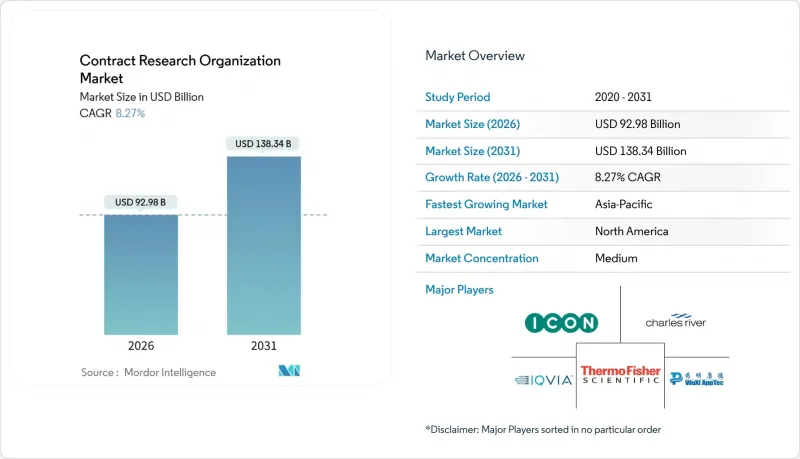
본 보고서는 서비스 유형별(초기 개발 서비스, 기타), 치료 분야별(종양학, 감염증, 기타), 최종 사용자별(제약·바이오의약품, 의료기기, 기타), 제공 모델(풀 서비스, FSP, 하이브리드), 지역(북미, 유럽, 아시아태평양, 중동 및 아프리카, 남미)별로 분류되어 있습니다. 시장 전망치는 금액(달러) 단위로 제시되어 있습니다.
세계의 임상시험수탁기관(CRO) 시장 동향 및 인사이트
바이오의약품 및 첨단 치료법의 개발 건수 증가
바이오의약품 및 세포 및 유전자 치료제 파이프라인에는 바이러스 벡터 제조, 체외 세포 조작, 장기간에 걸친 환자 모니터링이 필요하지만, 이러한 역량을 사내에 갖춘 의뢰사는 거의 없습니다. FDA의 “재생의학 첨단 치료법(Regenerative Medicine Advanced Therapy)" 지정에 따라 제품의 적격성 심사가 신속화되었으며, 적응형 설계 및 분산형 시료 물류를 관리할 수 있는 CRO가 우대받고 있습니다. 새로운 CMC 지침에 따라 IND 신청의 불확실성이 완화되면서, 저분자 의약품 포트폴리오에서 바이오의약품으로의 자본 재분배가 진행되고 있습니다. 바이오시밀러가 기존 수익원을 압박하는 가운데, 의뢰사는 장기간에 걸친 유전자 편집 임상시험에 필요한 고도로 전문화된 인프라를 CRO 파트너에 의존하고 있습니다.
신흥 시장의 환자 풀 및 임상시험 실시 기관의 확대
중국의 다지역 임상시험 체계는 현재 해외 데이터를 승인하고 있으며, 다국적 프로그램에서의 시험 개시가 가속화되고 있습니다. 인도의 중앙의약품표준관리기구(CDSCO)는 심사 주기를 단축함으로써, 치료 경험이 없는 피험자 집단을 필요로 하는 종양학 및 대사 질환 분야의 후원사들을 유치하고 있습니다. 브라질의 ANVISA는 ICH E6(R2)를 준수함으로써 행정상의 마찰을 줄이는 동시에, 라틴아메리카에서의 피험자 등록을 촉진하고 있습니다. 이러한 지역의 폭넓은 인구 구성은 신속한 피험자 등록을 가능하게 하며, 인종적으로 다양한 데이터 세트를 통해 규제 당국에 제출하는 신청서의 신뢰성을 높여줍니다.
품질 감사와 규정 위반에 대한 처벌 강화
FDA는 적정 임상시험 실시 기준(GCP)을 철저히 준수하기 위해 임상시험 책임의사, IRB, 의뢰사를 조사했으며, 이에 따라 각 CRO는 모니터링, 전자 감사 추적 기록, 제3자 검증에 더 많은 예산을 할당해야 하는 상황에 직면해 있습니다. EMA의 임상시험 정보 시스템(CTIS)은 투명성을 높이고 있으며, 그로 인해 평판에 대한 위험도 커지고 있습니다. 규제 준수 비용이 증가하는 가운데, 소규모 제공업체들은 이익률 압박과 산업 재편의 위험에 직면해 있습니다.
부문별 분석
임상시험수탁기관(CRO) 시장에서 가장 빠르게 성장하고 있는 부문인 초기 단계 개발 서비스는 2031년까지 연평균 10.72%의 성장률을 보일 것으로 전망됩니다. 금액 기준으로 볼 때, 생명공학 기업 후원사들이 신속한 개념 증명(PoC) 프로그램을 우선시함에 따라 이 부문이 임상시험수탁기관(CRO) 시장 규모에서 차지하는 비중은 점차 확대될 것으로 보입니다. 임상 연구 서비스는 여전히 지배적인 위치를 유지하고 있으며, 2025년에는 매출 점유율의 61.45%를 차지했지만, 조달 심사가 엄격해짐에 따라 가격 상승은 억제되고 있습니다. 1상 임상시험 부서는 전용 시설, 경험이 풍부한 의료 모니터, 학술 기관과의 즉각적인 연계망을 갖추고 있어, 인간 대상 첫 투여에 수반되는 위험을 줄일 수 있으므로 프리미엄 요금 책정이 가능합니다. 2단계 및 3단계 업무의 경우, 전자 데이터 수집(EDC)의 보급으로 인해 차별화가 약화되고, 상품화가 진행되고 있습니다. 검사 서비스는 정밀 의학에 대한 수요에 힘입어 꾸준히 성장하고 있는 반면, 컨설팅 서비스는 복잡한 규제 전략 분야에서 틈새 수요를 유지하고 있습니다.
스폰서들은 바이오마커를 활용한 피험자 선정을 점점 더 많이 채택하고 있으며, 이로 인해 피험자 수는 감소하고 있지만 분석의 복잡성은 증가하고 있습니다. 4상 모니터링은 규제 당국이 승인 후 안전성 데이터 제출을 요구함에 따라 점차 확대되고 있지만, 많은 대형 후원사들은 실세계 데이터에 대한 통제권을 유지하기 위해 이러한 연구를 자체적으로 수행하고 있습니다. 차별화의 초점은 기술 플랫폼, 적응형 검사 설계에 대한 전문 지식, 분산형 임상 검사의 구성 요소 간 원활한 통합으로 옮겨가고 있습니다. 이러한 양극화로 인해 초기 단계의 활동에서는 프리미엄 가격 책정이 유지되는 반면, 성숙기에 접어든 서비스는 운영 규모를 바탕으로 경쟁하게 됩니다.
종양학 부문은 면역요법, 표적 지향성 저분자 약물, 세포 요법을 포함한 1,000건 이상의 진행 중인 임상 자산을 바탕으로 2025년에는 21.43%의 매출을 기록하며, 치료 분야별 매출에서 가장 큰 비중을 차지했습니다. 한편, 감염병 부문은 팬데믹 대응을 위한 투자와 mRNA 백신 플랫폼을 배경으로 2031년까지 연평균 성장률(CAGR) 10.81%를 기록하며 가장 빠른 성장세를 보이고 있습니다. 중추신경계 및 면역학 분야 역시 주관적인 평가의 필요성을 줄여주는 디지털 바이오마커의 보급에 힘입어 각각 막대한 투자를 유치하고 있습니다. 심혈관계 및 호흡기계 각 분야는 제네릭 의약품의 부상으로 인해 연구개발 자금이 희귀질환 쪽으로 이동하고 있는 탓에 뒤처지고 있습니다.
항생제 개발에 대한 정부의 장려책과 백신 파이프라인의 개편이 감염병 부문의 성장세를 뒷받침하고 있습니다. 종양학 부문의 성장 둔화는 쇠퇴라기보다는 성숙의 징후입니다. 이미 상용화된 체크포인트 억제제는 후기 임상시험 단계에서 시판 후 활동 단계로 전환되고 있습니다. 중추신경계(CNS) 임상시험 프로그램은 여전히 높은 선별 검사 실패율과 장기간에 걸친 추적 관찰 기간이라는 과제에 직면해 있으며, 신경학 전문가 및 탄탄한 연구자 네트워크를 보유한 CRO와의 협력이 필수적입니다. 희귀질환의 식별은 여전히 병목 현상으로 남아 있으며, 독자적인 등록 데이터베이스를 보유한 CRO에게는 경쟁 우위가 생기고 있습니다.
지역별 분석
2025년, 북미는 매출의 38.92%를 차지했습니다. 이는 미국이 보유한 35만 곳의 연구 인프라와 FDA가 전 세계적으로 행사하는 규제적 영향력에 힘입은 결과입니다. 스폰서들이 비용 절감과 다양한 환자 집단에 대한 접근을 목적으로 다각화를 추진하는 가운데, 성장률은 임상시험수탁기관(CRO) 시장 평균을 밑돌고 있습니다. 캐나다와 멕시코는 신속한 윤리 심사 승인을 통해 심혈관 질환 및 당뇨병 코호트를 제공하고 있는 반면, 미국의 학술 연구센터는 복잡한 종양학 및 유전자 치료 프로토콜을 지원하고 있습니다.
아시아태평양은 규제 현대화와 치료를 한 번도 받아본 적이 없는 방대한 환자층에 힘입어 2031년까지 연평균 성장률(CAGR) 11.26%를 나타낼 것으로 예측되며, 이는 임상시험수탁기관(CRO) 시장에서 가장 빠른 지역 성장 궤적을 보일 것입니다. 중국에서는 IND 심사 효율화와 MRCT를 통한 외국 데이터 승인으로 인해, 세계 프로그램에 대한 참여가 촉진되고 있습니다. 인도에서는 심사 주기가 단축됨에 따라 종양학 부문의 피험자 등록이 가속화되고 있으며, 일본에서는 ICH 준수에 따라 다국적 신청 절차가 원활해지고 있습니다. 호주는 연구개발(R&D) 세액 공제 및 신속한 윤리 심사를 활용하여, 인간 대상 최초 임상시험 유치를 위해 힘쓰고 있습니다. 한국은 세포 치료 인프라에 막대한 투자를 하고 있으며, 이에 따라 첨단 치료법의 임상시험이 증가하고 있습니다.
유럽은 EMA(유럽의약품청)의 임상시험 정보 시스템을 통한 승인 조화를 통해, 성숙한 3상 임상시험 수행 능력을 유지하고 있습니다. 독일, 영국, 프랑스는 여전히 핵심 거점이지만, 브렉시트로 인해 현재는 영국용 병행 프로토콜이 필요하게 되었습니다. 스페인과 이탈리아는 비용 면에서 상대적인 우위를 점하고 있으며, 호흡기 및 심혈관계 임상 검사 시장을 점차 확대해 나가고 있습니다. 중동 및 아프리카는 여전히 규모는 작지만, 걸프 연안 국가들이 연구 다각화에 투자하고 있어 희귀질환 및 백신에 대한 임상시험을 수용하고 있습니다. 한편, 브라질과 아르헨티나를 필두로 한 남미에서는 규제 조화가 진행되는 가운데, 감염병 조사 분야에서 존재감을 높이고 있습니다.
기타 혜택
- 엑셀 형식 시장 예측(ME) 시트
- 3개월간의 애널리스트 지원
자주 묻는 질문
목차
제1장 서론
제2장 조사 방법
제3장 주요 요약
제4장 시장 구도
제5장 시장 규모 및 성장 예측
제6장 경쟁 구도
제7장 시장 기회 및 향후 전망
KTH 26.07.08According to Mordor Intelligence, the contract research organization market size is estimated at USD 92.98 billion in 2026, and is expected to reach USD 138.34 billion by 2031, at a CAGR of 8.27% during the forecast period (2026-2031).
This report is Segmented by Service Type (Early-Phase Development, and More), Therapeutic Area (Oncology, Infectious Diseases, and More), End User (Pharmaceutical & Biopharmaceutical, Medical Device, and Other), Delivery Model (Full-Service, FSP, and Hybrid), and Geography (North America, Europe, Asia-Pacific, MEA, and South America). Market Forecasts are Provided in Value (USD).
Global Contract Research Organization Market Trends and Insights
Rising Volume of Biologics and Advanced Therapies Development
Biologics and cell- and gene-therapy pipelines require viral-vector production, ex vivo cell manipulation, and long-term patient monitoring, which most sponsors lack internally. The FDA's Regenerative Medicine Advanced Therapy designation expedites the qualification of products, rewarding CROs that can manage adaptive designs and decentralized sample logistics. New CMC guidelines have reduced IND uncertainties, prompting a reallocation of capital from small-molecule portfolios toward biologics. As biosimilars pressure legacy revenues, sponsors lean on CRO partners to supply the highly specialized infrastructure needed for durable gene-editing trials.
Expansion of Emerging Market Patient Pools and Investigator Sites
China's multi-regional clinical trial framework now accepts foreign data, accelerating site initiation for multinational programs. India's Central Drugs Standard Control Organisation has shortened review cycles, drawing oncology and metabolic sponsors seeking treatment-naive cohorts. Brazil's ANVISA aligned with ICH E6(R2), reducing administrative friction and promoting Latin American enrollment. The demographic breadth in these regions offers rapid accrual and strengthens regulatory submissions through ethnically diverse datasets.
Intensifying Quality Audits and Compliance Penalties
The FDA inspects investigators, IRBs, and sponsors to enforce Good Clinical Practice, pushing CROs to allocate larger budgets to monitoring, electronic audit trails, and third-party verification. The EMA's Clinical Trials Information System increases transparency, thereby raising the reputational stakes. Smaller providers face margin pressure and consolidation risk as compliance costs climb.
Other drivers and restraints analyzed in the detailed report include:
- Accelerated Regulatory Pathways for Orphan and Fast-Track Drugs
- Growing Venture Capital Funding for Early-Stage Biotech Firms
- High Capital Expenditure for Cutting-Edge Lab Automation
For complete list of drivers and restraints, kindly check the Table Of Contents.
Segment Analysis
Early-phase development services, representing the fastest-growing segment of the Contract Research Organization market, are forecast to increase at a 10.72% annual rate through 2031. In value terms, this segment will account for a rising portion of the Contract Research Organization market size as biotech sponsors prioritize rapid proof-of-concept programs. Clinical Research Services remained dominant, with a 61.45% revenue share in 2025; however, heightened procurement scrutiny limits price escalation. Phase I units command premium rates because they have dedicated facilities, experienced medical monitors, and immediate access to academic centers, which mitigate the first-in-human risk. Phase II and Phase III work face commoditization as electronic data capture narrows differentiation. Laboratory Services grow steadily in response to the demand for precision medicine, while Consulting Services retain a niche appeal for complex regulatory strategies.
Sponsors are increasingly deploying biomarker-selected cohorts, which reduces enrollment numbers but increases analytical complexity. Phase IV surveillance expands modestly as agencies request post-approval safety evidence, yet many large sponsors internalize these studies to maintain control over real-world data. Differentiation shifts toward technology platforms, adaptive design expertise, and the seamless integration of decentralized trial components. This bifurcation keeps premium pricing in early-phase activities while mature services compete on operational scale.
Oncology generated the most considerable therapeutic-area revenue, at 21.43% in 2025, benefiting from over 1,000 active clinical assets that encompassed immunotherapies, targeted small molecules, and cell therapies. Infectious Diseases, however, exhibits the fastest expansion at 10.81% CAGR through 2031, reflecting pandemic-preparedness investment and mRNA vaccine platforms. Central Nervous System and Immunology each draw sizable spending, aided by the acceptance of digital biomarkers that reduce the need for subjective evaluations. Cardiovascular and Respiratory categories trail as generic erosion shifts R&D funding toward orphan conditions.
Government incentives for antimicrobial development, along with renewed vaccine pipelines, underpin infectious-disease momentum. Oncology's deceleration represents maturity rather than decline: commercialized checkpoint inhibitors transition activity from late-stage trials to post-marketing commitments. CNS programs still confront high screen-failure rates and lengthy follow-up periods, necessitating collaborations with CROs that include neurology specialists and robust investigator networks. Rare-disease identification remains a bottleneck, granting CROs with proprietary registries a competitive edge.
Complete Report Scope:
- By Service Type
- Early-Phase Development Services
- Clinical Research Services
- Phase I
- Phase II
- Phase III
- Phase IV
- Laboratory Services
- Consulting Services
- By Therapeutic Area
- Oncology
- Infectious Diseases
- Central Nervous System (CNS) Disorders
- Immunological Disorders
- Cardiovascular Diseases
- Respiratory Disorders
- Diabetes
- Other Therapeutic Areas
- By End User
- Pharmaceutical & Biopharmaceutical Companies
- Medical Device Companies
- Other End Users (Academic / Government Institutes)
- By Delivery Model
- Full-Service / Integrated CRO
- Functional Service Provider (FSP)
- Hybrid / Modular Model
- Geography
- North America
- United States
- Canada
- Mexico
- Europe
- Germany
- United Kingdom
- France
- Italy
- Spain
- Rest Of Europe
- Asia-Pacific
- China
- Japan
- India
- Australia
- South Korea
- Rest Of Asia-Pacific
- Middle East And Africa
- GCC
- South Africa
- Rest Of Middle East And Africa
- South America
- Brazil
- Argentina
- Rest Of South America
- North America
Geography Analysis
North America contributed 38.92% revenue in 2025, anchored by the United States' 350,000-site research infrastructure and the FDA's global regulatory influence. Growth lags the Contract Research Organization market average as sponsors diversify to contain costs and access varied patient pools. Canada and Mexico supply cardiovascular and diabetes cohorts through swift ethics approvals, while U.S. academic centers sustain complex oncology and gene-therapy protocols.
The Asia-Pacific region is poised for an 11.26% CAGR to 2031, the Contract Research Organization market's fastest regional trajectory, driven by regulatory modernization and vast treatment-naive populations. China's streamlined IND reviews and acceptance of foreign data under MRCT promote inclusion in global programs. India accelerates oncology enrollment via shortened review cycles, and Japan's ICH alignment eases multinational submissions. Australia leverages R&D tax offsets and rapid ethics reviews to attract first-in-human studies. South Korea invests heavily in cell-therapy infrastructure, leading to an increase in advanced-therapy trials.
Europe maintains mature Phase III capacity with harmonized approvals via the EMA's Clinical Trials Information System. Germany, the United Kingdom, and France remain core hubs, although Brexit now requires parallel UK protocols. Spain and Italy offer relative cost advantages and are capturing incremental respiratory and cardiovascular studies. The Middle East and Africa remain small but are receiving rare-disease and vaccine trials as Gulf states invest in research diversification. Meanwhile, South America, led by Brazil and Argentina, is gaining ground in infectious-disease research amid regulatory harmonization.
- BioAgile Therapeutics Private Limited
- Charles River
- CRITERIUM, INC.
- Evotec
- Eurofins
- Fortrea
- ICON
- IQVIA
- Inotiv
- MedPace
- Parexel International (MA) Corporation
- Pharmaron
- PSI
- SGS
- Syneos Health
- Syngene International
- Thermo Fisher Scientific
- Tigermed
- Worldwide Clinical Trials
- WuXi AppTec (WuXi Clinical)
Additional Benefits:
- The market estimate (ME) sheet in Excel format
- 3 months of analyst support
TABLE OF CONTENTS
1 Introduction
- 1.1 Study Assumptions & Market Definition
- 1.2 Scope Of The Study
2 Research Methodology
3 Executive Summary
4 Market Landscape
- 4.1 Market Overview
- 4.2 Market Drivers
- 4.2.1 Rising Volume of Biologics and Advanced Therapies Development
- 4.2.2 Expansion of Emerging Market Patient Pools and Investigator Sites
- 4.2.3 Accelerated Regulatory Pathways for Orphan and Fast-Track Drugs
- 4.2.4 Growing Venture Capital Funding for Early-Stage Biotech Firms
- 4.2.5 Adoption of Decentralized/Hybrid Clinical Trial Architectures
- 4.2.6 Integration of Real-World Evidence and Digital Biomarkers to Shorten Timelines
- 4.3 Market Restraints
- 4.3.1 Intensifying Quality Audits and Compliance Penalties
- 4.3.2 High Capital Expenditure for Cutting-Edge Lab Automation
- 4.3.3 Rising Geopolitical Risks Affecting Cross-Border Trials
- 4.3.4 Scarcity of GMP-Grade Viral Vector Manufacturing Capacity
- 4.4 Regulatory Outlook
- 4.5 Porter's Five Forces Analysis
- 4.5.1 Threat Of New Entrants
- 4.5.2 Bargaining Power Of Suppliers
- 4.5.3 Bargaining Power Of Buyers
- 4.5.4 Threat Of Substitutes
- 4.5.5 Industry Rivalry
5 Market Size & Growth Forecasts (Value, USD)
- 5.1 By Service Type
- 5.1.1 Early-Phase Development Services
- 5.1.2 Clinical Research Services
- 5.1.2.1 Phase I
- 5.1.2.2 Phase II
- 5.1.2.3 Phase III
- 5.1.2.4 Phase IV
- 5.1.3 Laboratory Services
- 5.1.4 Consulting Services
- 5.2 By Therapeutic Area
- 5.2.1 Oncology
- 5.2.2 Infectious Diseases
- 5.2.3 Central Nervous System (CNS) Disorders
- 5.2.4 Immunological Disorders
- 5.2.5 Cardiovascular Diseases
- 5.2.6 Respiratory Disorders
- 5.2.7 Diabetes
- 5.2.8 Other Therapeutic Areas
- 5.3 By End User
- 5.3.1 Pharmaceutical & Biopharmaceutical Companies
- 5.3.2 Medical Device Companies
- 5.3.3 Other End Users (Academic / Government Institutes)
- 5.4 By Delivery Model
- 5.4.1 Full-Service / Integrated CRO
- 5.4.2 Functional Service Provider (FSP)
- 5.4.3 Hybrid / Modular Model
- 5.5 Geography
- 5.5.1 North America
- 5.5.1.1 United States
- 5.5.1.2 Canada
- 5.5.1.3 Mexico
- 5.5.2 Europe
- 5.5.2.1 Germany
- 5.5.2.2 United Kingdom
- 5.5.2.3 France
- 5.5.2.4 Italy
- 5.5.2.5 Spain
- 5.5.2.6 Rest Of Europe
- 5.5.3 Asia-Pacific
- 5.5.3.1 China
- 5.5.3.2 Japan
- 5.5.3.3 India
- 5.5.3.4 Australia
- 5.5.3.5 South Korea
- 5.5.3.6 Rest Of Asia-Pacific
- 5.5.4 Middle East And Africa
- 5.5.4.1 GCC
- 5.5.4.2 South Africa
- 5.5.4.3 Rest Of Middle East And Africa
- 5.5.5 South America
- 5.5.5.1 Brazil
- 5.5.5.2 Argentina
- 5.5.5.3 Rest Of South America
- 5.5.1 North America
6 Competitive Landscape
- 6.1 Market Concentration
- 6.2 Market Share Analysis
- 6.3 Company Profiles {(Includes Global Level Overview, Market Level Overview, Core Segments, Financials as Available, Strategic Information, Market Rank/Share for Key Companies, Products & Services, and Recent Developments)}
- 6.3.1 BioAgile Therapeutics Private Limited
- 6.3.2 Charles River Laboratories
- 6.3.3 CRITERIUM, INC.
- 6.3.4 Evotec SE
- 6.3.5 Eurofins Scientific
- 6.3.6 Fortrea
- 6.3.7 ICON Plc
- 6.3.8 IQVIA Holdings Inc.
- 6.3.9 Inotiv
- 6.3.10 Medpace, Inc.
- 6.3.11 Parexel International (MA) Corporation
- 6.3.12 Pharmaron
- 6.3.13 PSI
- 6.3.14 SGS S.A.
- 6.3.15 Syneos Health
- 6.3.16 Syngene International Limited
- 6.3.17 Thermo Fisher Scientific Inc. (PPD Inc.)
- 6.3.18 Tigermed
- 6.3.19 Worldwide Clinical Trials
- 6.3.20 WuXi AppTec (WuXi Clinical)
7 Market Opportunities & Future Outlook
- 7.1 White-Space & Unmet-Need Assessment