|
시장보고서
상품코드
2073485
벙커 연료 : 시장 점유율 분석, 업계 동향 및 통계, 성장 예측(2026-2031년)Bunker Fuel - Market Share Analysis, Industry Trends & Statistics, Growth Forecasts (2026 - 2031) |
||||||
 Mordor Intelligence
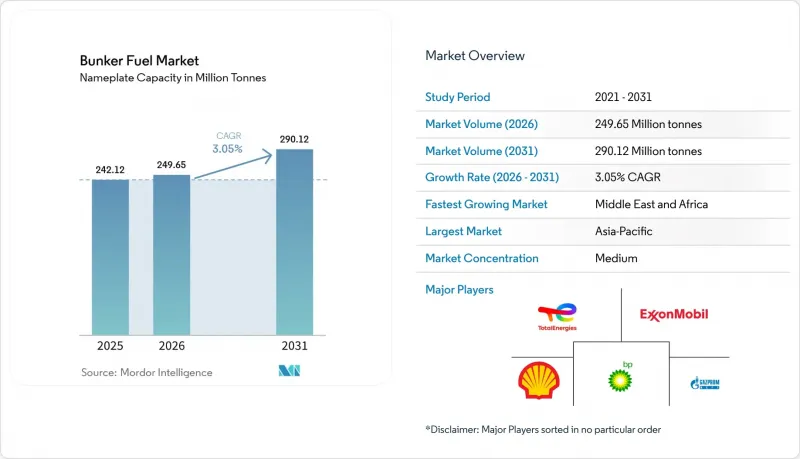
Mordor Intelligence에 의하면, 정격 용량 기반 벙커 연료 시장 규모는 2025년에 2억 4,212만 톤으로 평가되었습니다. 2026년 2억 4,965만 톤에서 2031년까지 2억 9,012만 톤에 이를 것으로 예상되고, 예측 기간(2026-2031년) CAGR 3.05%를 나타낼 것으로 전망됩니다.
본 보고서는 연료 유형별(HSFO, VLSFO, ULSFO, MGO, LNG, 메탄올, 바이오/합성 연료, 암모니아, 기타), 급유 방법별(선박 대 선박, 항만 대 선박, LNG 바지선 대 선박, 이동식 탱크 및 컨테이너), 선박 유형(컨테이너선, 유조선, 벌크선, 일반 화물선, 여객·로팍스선, 해양 특수선), 그리고 지역(북미, 유럽, 아시아태평양, 남미, 기타)별로 분류되어 있습니다.
세계의 벙커 연료 시장 동향 및 인사이트
IMO 2020의 시행과 ECA(유황 배출 규제 해역)의 확대
2020년에 시행된 엄격한 황 함량 규제로 인해 선주들은 계속해서 규제 준수 연료로 전환해야 하는 상황에 놓여 있습니다. 2025년에는 로테르담과 싱가포르에서 유황 함량이 기준을 충족하지 못해 선박이 억류되는 사례가 증가함에 따라, 공급업체들은 선적지에 실시간 검사 시스템을 도입해야만 했습니다. “FuelEU Maritime"에서는 유황 규제에 더해 탄소 강도 목표도 부과되어 있기 때문에 운항사는 현재 단거리 항로에는 VLSFO를, 신조선에는 LNG를, 운항 중인 중고선에는 바이오연료 혼합 연료를 조합하여 운영하고 있습니다. 선급협회에 따르면, 2024년 운항 중이었던 LNG 추진선은 638척을 기록했으며, 수주 잔고를 고려할 때 2028년까지 1,200척에 달할 것으로 전망됩니다. 이는 규제 대응이 단순한 연료 전환에서 차량 함대 갱신으로 전환되었음을 뒷받침합니다. 지중해와 동남아시아 일부 지역의 배출 규제 해역(ECA)이 확대됨에 따라, 스크러버를 장착한 선단을 제외하고는 고황연료의 경제적 타당성이 떨어지고 있습니다. 규제 강화에 따라 저유황 연료에 대한 예측 가능한 수요가 벙커 연료 시장을 지탱하고 있지만, 탄소 배출 규제 강화로 인해 메탄올 및 암모니아로의 다각화가 가속화되고 있습니다.
LNG 연료선 수주가 급증
2024년에 체결된 대체 연료 선박 계약 중 약 70%를 LNG가 차지했습니다. 이는 엔진의 신뢰성이 입증되었습니다는 점, VLSFO와 비교했을 때 “우물에서 선미까지"의 CO2 배출량이 최대 25% 감소한다는 점을 반영하고 있습니다. 현대중공업과 중국선박공업집단은 2026년부터 2029년에 걸쳐 인도될 LNG 대응 컨테이너선과 벌크선 수주량을 합쳐 100척 이상 확보하고 있습니다. 유럽의 페리 운항사들은 저배출 선박에 대한 우대 조치로 노르웨이와 독일에서 적용되는 계류료 할인을 계기로, Ro-Pax 선박의 LNG 개조를 추진하고 있습니다. 크루즈 선사들도 비슷한 추세를 보이고 있으며, 카니발 코퍼레이션의 LNG 선박 발주는 보다 친환경적인 항로를 원하는 승객들 수요와 부합하고 있습니다. 엔진 납기 기간은 현재 18개월까지 늘어났으며, 선주는 선체 본계약에 앞서 제조 할당량을 확보해야 하는 상황입니다. 이는 메탄 슬립을 둘러싼 논란이 불거지고 있음에도 불구하고, LNG에 대한 신뢰도가 높음을 시사합니다.
CO2를 넘어선 생애주기 온실가스 규제 강화
세계의 규제 기준은 배기가스에서 발생하는 탄소 배출량에서 메탄 누출 및 업스트림 단계의 배출량까지 포괄하는 전 생애 주기 지표로 점차 전환되고 있습니다. 2026년에 제정될 예정인 IMO(국제해사기구)의 지침안에서는 선주에게 메탄 누출 계수의 공개를 의무화할 예정입니다. 엔진이 고압 시스템이 아닌 경우, 이 계수로 인해 LNG의 배출량 측면에서 갖는 우위가 상쇄될 가능성이 있습니다. 캘리포니아주가 계획하고 있는 ‘저탄소 연료 기준(LCFS)" 개정안에도 유사한 처벌 조항이 포함되어 있어, 구형 듀얼 연료 엔진에는 비용 면에서 부담이 가중되고 있습니다. 연구에 따르면, 메탄 누출률은 엔진 부하에 따라 0.2%에서 3.5% 사이로 추정되며, 메탄의 지구 온난화 지수가 28배라는 점을 고려할 때, 이는 연비에 실질적인 변화를 가져올 가능성이 있습니다. 싱가포르와 푸자이라에서 시행되고 있는 스크러버 배출 금지 조치는 중유(HSFO) 사용자에게 규정 준수상의 부담을 가중시키고 있습니다. 이러한 복합적인 영향으로 인해 LNG의 상승 여력은 제한될 것이며, 하드웨어나 규제의 급속한 발전이 없는 한 벙커 연료 시장의 연평균 성장률(CAGR)은 둔화될 것입니다.
부문별 분석
2025년에도 VLSFO는 전 세계 총량의 52.4%를 차지하며, 큰 하드웨어 변경 없이 단일 등급으로 광범위한 규제 요건을 충족할 수 있는 수준으로 벙커 연료 시장 규모를 지탱했습니다. 많은 선주들이 장기 계약을 통해 가격 리스크를 헤지하고 있으며, 단기 스프레드에 대한 노출이 제한적이기 때문에 이 연료의 경쟁력은 서서히만 약화될 것으로 예측됩니다. LNG의 예상 연평균 성장률(CAGR) 31.6%는 저온 저장, 듀얼 연료 엔진, 관련 공급망에 대한 투자를 견인하는 성장의 두 번째 축을 보여줍니다. 고황분 연료유(HSFO)는 스크러버를 장착한 선박에 있어 여전히 실용적인 선택지이지만, 정유시설의 설비 현대화로 인해 잔류유 생산량이 감소하고 있어, 스크러버 도입 비용을 정당화해 주던 가격 차이가 점차 좁혀지고 있습니다.
메탄올과 암모니아는 시범 단계에서 초기 상용화 단계로 넘어가고 있으며, 선행하는 선단이 그린 코리도의 항로와 보조금이 지원되는 벙커링 할당량을 확보하고 있습니다. 바이오연료와 e-연료는 5-20%의 비율로 혼합되어 있으며, 선주는 엔진을 교체하지 않고도 수명 주기 전반에 걸친 탄소 강도를 줄일 수 있기 때문에 대규모 기술 전환이 진행되는 동안 단기적인 수요를 뒷받침하고 있습니다. 그 결과, 벙커 연료 시장은 양극화되고 있습니다. 기존 선단은 VLSFO의 경제성을 최대한 활용하는 한편, 전략적으로 건조되는 신조선은 탄소세에 대비해 미래를 내다보며 LNG나 메탄올을 연료로 확보하고 있습니다.
지역별 분석
2025년, 아시아태평양은 총 취급량의 44.7%를 차지했는데, 이는 싱가포르의 5,060만 톤 취급량과 중국 내 기항 횟수의 급증에 기인한 것입니다. 한국과 일본은 근해 페리 및 태평양 횡단 컨테이너 항로를 위해 LNG 공급을 확대한 반면, 인도네시아와 베트남은 연안 지역의 제조업을 지원하기 위해 트럭을 이용한 VLSFO 배송에 투자했습니다. 인도의 내항 운항 규제가 부분적으로 완화됨에 따라 뭄바이와 첸나이에서의 벙커유 적재량은 증가했으나, 저유황 연료의 저장 용량 제한이 성장을 저해했습니다.
중동 및 아프리카는 푸자이라에서의 630만 톤 판매와 사우디 아람코의 홍해 게이트웨이 LNG 투자를 견인력으로 삼아, 연평균 성장률(CAGR) 3.5%를 기록하며 다른 모든 지역을 앞지르는 성장이 예상됩니다. ADNOC과 토탈에너지스는 2026년 초에 1만 8,000m³ 규모의 부유식 LNG 저장 시설을 증설함으로써, 걸프 지역이 아시아와 유럽 간의 물류 흐름을 확보할 수 있는 체제를 갖췄습니다. 이집트는 우회로 인한 혼란이 있었음에도 불구하고, 2024년에도 2만 600척의 선박이 수에즈 운하를 이용했다는 점을 감안하여, 포트사이드와 수에즈에 LNG 공급 거점을 마련하는 방안을 검토함으로써 이 모델을 재현하고자 하고 있습니다.
유럽에서는 발트해, 북해, 영국-프랑스 해협에 대한 엄격한 ECA(배출 규제 해역) 규정이 여전히 적용되고 있습니다. 로테르담은 920만 톤의 처리량과 확장된 게이트 터미널을 자랑하며, VLSFO(저유황 중유)와 LNG 모두에서 지역 허브 역할을 하고 있습니다. “FuelEU Maritime"에 따르면, 2025년 이후 탄소 집약도 과세가 도입됨에 따라 선주들은 CO2 환산 1톤당 2,400유로의 벌금을 피하기 위해 바이오연료를 혼합하거나 메탄올 적재 한도를 확보해야 하는 상황에 놓여 있습니다. 북미에서는 “존스법" 규제로 인해 선박 간(S/S) LNG 공급이 차질을 빚고 있는 반면, 남미 항만에서는 극저온 저장 시설이 부족하여 해당 지역의 벙커 연료 시장은 여전히 기존 연료에 의존하는 상태가 지속되고 있습니다.
기타 혜택
- 엑셀 형식 시장 예측(ME) 시트
- 3개월간의 애널리스트 지원
자주 묻는 질문
목차
제1장 서론
제2장 조사 방법
제3장 주요 요약
제4장 시장 구도
제5장 시장 규모 및 성장 예측
제6장 경쟁 구도
제7장 시장 기회 및 향후 전망
KTH 26.07.08According to Mordor Intelligence, the bunker fuel market size in terms of nameplate capacity was valued at 242.12 million tonnes in 2025 and is estimated to grow from 249.65 million tonnes in 2026 to reach 290.12 million tonnes by 2031, at a CAGR of 3.05% during the forecast period (2026-2031).
This report is Segmented by Fuel Type (HSFO, VLSFO, ULSFO, MGO, LNG, Methanol, Bio-/Synthetic Fuels, Ammonia, and More), Bunkering Method (Ship-To-Ship, Port-To-Ship, LNG Barge-To-Ship, and Portable Tanks and Containers), Vessel Type (Container, Tanker, Bulk Carrier, General Cargo, Passenger/Ro-Pax, and Offshore and Specialized), and Geography (North America, Europe, Asia-Pacific, South America, and More).
Global Bunker Fuel Market Trends and Insights
IMO 2020 Enforcement & ECA Expansion
Strict sulfur caps that began in 2020 continue to steer fleet owners toward compliant fuels. Detentions for non-compliant sulfur levels rose in Rotterdam and Singapore during 2025, pushing suppliers to install real-time testing at loading points. FuelEU Maritime layers carbon-intensity targets on top of sulfur limits, so operators now juggle VLSFO for short runs, LNG for new-builds, and bio-fuel blends for mid-life tonnage. Classification societies recorded 638 LNG-powered vessels on the water in 2024, with the orderbook pointing to 1,200 units by 2028, confirming that compliance has shifted from simple fuel switching to fleet renewal. ECAs in the Mediterranean and parts of Southeast Asia are widening, which narrows the economic case for high-sulfur grades outside scrubber-equipped fleets. As enforcement tightens, predictable demand for low-sulfur options anchors the bunker fuel market, yet the added carbon layer accelerates diversification toward methanol and ammonia.
Rapid Growth in LNG-Fuelled Fleet Orders
LNG secured around 70% of alternative-fuel vessel contracts placed during 2024, reflecting proven engine reliability and up to 25% lower well-to-wake CO2 emissions versus VLSFO. Hyundai Heavy Industries and China State Shipbuilding Corporation together hold more than 100 LNG-ready container and bulk carrier orders that will deliver between 2026 and 2029. European ferry operators are retrofitting Ro-Pax units to LNG, supported by discounted berthing fees in Norway and Germany that reward lower-emission vessels. Cruise lines mirror the trend; Carnival Corporation's LNG ship orders align with passenger demand for greener itineraries. Engine lead times now stretch to 18 months, prompting owners to secure manufacturing slots ahead of final hull contracts, signaling confidence in LNG despite emerging debate over methane slip.
Tightening Lifecycle-GHG Regulations Beyond CO2
Global rules are shifting from tailpipe carbon to full lifecycle metrics that capture methane slip and upstream emissions. IMO draft guidelines due in 2026 will force owners to disclose methane leakage factors that can neutralize LNG's headline emissions advantage if engines are not high-pressure systems. California's planned Low Carbon Fuel Standard revisions outline similar penalties, putting older dual-fuel engines under cost pressure. Studies peg methane slip between 0.2% and 3.5% depending on engine load, and given methane's 28X global-warming potential, this can materially shift fuel economics. Scrubber discharge bans in Singapore and Fujairah add parallel compliance burdens for HSFO users. The combined effect restrains LNG upside and crimps the bunker fuel market CAGR absent rapid hardware and regulatory evolution.
Other drivers and restraints analyzed in the detailed report include:
- Surging APAC Seaborne Trade Volumes
- Green-Corridor Initiatives Accelerating Ammonia & Methanol Bunkering
- Limited Global LNG Bunkering Infrastructure
For complete list of drivers and restraints, kindly check the Table Of Contents.
Segment Analysis
VLSFO retained 52.4% of global volume in 2025, anchoring the bunker fuel market size at a point where one grade still meets broad compliance without major hardware changes. The fuel's dominance is expected to erode only gradually because many owners hedge price risk through term contracts, limiting exposure to short-term spreads. LNG's 31.6% forecast CAGR signals a second axis of growth that pulls investment into cryogenic storage, dual-fuel engines, and related supply chains. High-Sulfur Fuel Oil (HSFO) remains viable for scrubber-equipped tonnage, but refinery upgrades are shrinking residual output, squeezing discounts that justified scrubber spend.
Methanol and ammonia are moving from pilot to early commercialization as first-mover fleets secure green-corridor routes and subsidized bunkering slots. Bio-fuels and e-fuels are being blended at 5-20% levels, enabling owners to cut lifecycle intensity without engine changes, which shores up short-run demand while larger technology transitions play out. The result is a bifurcated bunker fuel market: legacy fleets maximize VLSFO economics, while strategic new builds lock in LNG or methanol to future-proof against carbon levies.
Complete Report Scope:
- By Fuel Type
- High-Sulfur Fuel Oil (HSFO)
- Very-Low-Sulfur Fuel Oil (VLSFO)
- Ultra-Low-Sulfur Fuel Oil (ULSFO)
- Marine Gas Oil (MGO)
- Liquefied Natural Gas (LNG)
- Methanol
- Bio-/Synthetic Fuels
- Ammonia
- Other Fuel Types
- By Bunkering Method
- Ship-to-Ship
- Port-to-Ship (Truck/Pipeline)
- LNG Barge-to-Ship
- Portable Tanks and Containers
- By Vessel Type
- Container
- Tanker
- Bulk Carrier
- General Cargo
- Passenger/Ro-Pax
- Offshore and Specialized
- By Geography
- North America
- United States
- Canada
- Mexico
- Europe
- Germany
- United Kingdom
- Spain
- Italy
- NORDIC Countries
- Russia
- Rest of Europe
- Asia-Pacific
- China
- India
- Japan
- South Korea
- Singapore
- Indonesia
- Australia
- Rest of Asia-Pacific
- South America
- Brazil
- Argentina
- Chile
- Rest of South America
- Middle East and Africa
- Saudi Arabia
- United Arab Emirates
- Qatar
- South Africa
- Nigeria
- Egypt
- Rest of Middle East and Africa
- North America
Geography Analysis
Asia-Pacific held 44.7% of volume in 2025, reflecting Singapore's 50.6 million-tonne throughput and China's surging port calls. South Korea and Japan expanded LNG offerings for short-sea ferries and trans-Pacific container loops, while Indonesia and Vietnam invested in truck-based VLSFO delivery to back near-shore manufacturing. India's partial cabotage liberalization boosted bunker uplift at Mumbai and Chennai, yet limited low-sulfur storage caps growth.
The Middle East and Africa region is projected to outpace all others at a 3.5% CAGR, anchored by Fujairah's 6.3 million-tonne sales and Saudi Aramco's LNG investments at Red Sea gateways. ADNOC and TotalEnergies added 18,000 m3 of floating LNG storage in early 2026, positioning the Gulf to intercept Asia-Europe flows. Egypt seeks to replicate the model by studying LNG supply points at Port Said and Suez, as 20,600 vessels still used the canal in 2024 despite diversion shocks.
Europe remains defined by strict ECA rules in the Baltic, North Sea, and English Channel. Rotterdam's 9.2 million-tonne throughput and expanded Gate terminal make it the regional hub for both VLSFO and LNG. FuelEU Maritime adds a carbon-intensity levy from 2025 onward, prompting owners to blend bio-fuels or book methanol slots to avoid EUR 2,400 penalties per tonne of CO2 equivalent. North America's Jones Act hurdles inhibit ship-to-ship LNG supply, while South American ports lack cryogenic storage, keeping the bunker fuel market there dependent on conventional grades.
- Exxon Mobil
- Shell plc
- BP plc
- TotalEnergies SE
- Chevron Corp.
- Gazpromneft Marine Bunker
- Lukoil
- Minerva Bunkering
- Peninsula Petroleum
- World Fuel Services
- Bomin Bunker Holding
- GAC Bunker Fuels
- AP Moller-Maersk
- Mediterranean Shipping Co.
- CMA CGM
- COSCO Shipping
- Hapag-Lloyd
- Evergreen Marine
- ONE (Ocean Network Express)
- Yang Ming
- HMM Co.
- Pacific International Lines
Additional Benefits:
- The market estimate (ME) sheet in Excel format
- 3 months of analyst support
TABLE OF CONTENTS
1 Introduction
- 1.1 Study Assumptions & Market Definition
- 1.2 Scope of the Study
2 Research Methodology
3 Executive Summary
4 Market Landscape
- 4.1 Market Overview
- 4.2 Market Drivers
- 4.2.1 IMO 2020 enforcement & ECA expansion
- 4.2.2 Rapid growth in LNG-fuelled fleet orders
- 4.2.3 Surging APAC seaborne trade volumes
- 4.2.4 Scrubber retrofits sustaining HSFO demand
- 4.2.5 Green-corridor initiatives accelerating ammonia & methanol bunkering
- 4.2.6 AI-driven fuel-route optimisation cutting wastage
- 4.3 Market Restraints
- 4.3.1 Tightening lifecycle-GHG regulations beyond CO2
- 4.3.2 Volatile crude spreads disrupting VLSFO pricing
- 4.3.3 Limited global LNG bunkering infrastructure
- 4.3.4 Refinery yield shift reducing residual fuel supply
- 4.4 Supply-Chain Analysis
- 4.5 Regulatory Landscape
- 4.6 Technological Outlook
- 4.7 Porter's Five Forces
- 4.7.1 Bargaining Power of Suppliers
- 4.7.2 Bargaining Power of Consumers
- 4.7.3 Threat of New Entrants
- 4.7.4 Threat of Substitute Products & Services
- 4.7.5 Intensity of Competitive Rivalry
- 4.8 Investment Analysis
5 Market Size & Growth Forecasts
- 5.1 By Fuel Type
- 5.1.1 High-Sulfur Fuel Oil (HSFO)
- 5.1.2 Very-Low-Sulfur Fuel Oil (VLSFO)
- 5.1.3 Ultra-Low-Sulfur Fuel Oil (ULSFO)
- 5.1.4 Marine Gas Oil (MGO)
- 5.1.5 Liquefied Natural Gas (LNG)
- 5.1.6 Methanol
- 5.1.7 Bio-/Synthetic Fuels
- 5.1.8 Ammonia
- 5.1.9 Other Fuel Types
- 5.2 By Bunkering Method
- 5.2.1 Ship-to-Ship
- 5.2.2 Port-to-Ship (Truck/Pipeline)
- 5.2.3 LNG Barge-to-Ship
- 5.2.4 Portable Tanks and Containers
- 5.3 By Vessel Type
- 5.3.1 Container
- 5.3.2 Tanker
- 5.3.3 Bulk Carrier
- 5.3.4 General Cargo
- 5.3.5 Passenger/Ro-Pax
- 5.3.6 Offshore and Specialized
- 5.4 By Geography
- 5.4.1 North America
- 5.4.1.1 United States
- 5.4.1.2 Canada
- 5.4.1.3 Mexico
- 5.4.2 Europe
- 5.4.2.1 Germany
- 5.4.2.2 United Kingdom
- 5.4.2.3 Spain
- 5.4.2.4 Italy
- 5.4.2.5 NORDIC Countries
- 5.4.2.6 Russia
- 5.4.2.7 Rest of Europe
- 5.4.3 Asia-Pacific
- 5.4.3.1 China
- 5.4.3.2 India
- 5.4.3.3 Japan
- 5.4.3.4 South Korea
- 5.4.3.5 Singapore
- 5.4.3.6 Indonesia
- 5.4.3.7 Australia
- 5.4.3.8 Rest of Asia-Pacific
- 5.4.4 South America
- 5.4.4.1 Brazil
- 5.4.4.2 Argentina
- 5.4.4.3 Chile
- 5.4.4.4 Rest of South America
- 5.4.5 Middle East and Africa
- 5.4.5.1 Saudi Arabia
- 5.4.5.2 United Arab Emirates
- 5.4.5.3 Qatar
- 5.4.5.4 South Africa
- 5.4.5.5 Nigeria
- 5.4.5.6 Egypt
- 5.4.5.7 Rest of Middle East and Africa
- 5.4.1 North America
6 Competitive Landscape
- 6.1 Market Concentration
- 6.2 Strategic Moves (M&A, Partnerships, PPAs)
- 6.3 Market Share Analysis (Market Rank/Share for key companies)
- 6.4 Company Profiles (includes Global level Overview, Market level overview, Core Segments, Financials as available, Strategic Information, Products & Services, and Recent Developments)
- 6.4.1 Exxon Mobil
- 6.4.2 Shell plc
- 6.4.3 BP plc
- 6.4.4 TotalEnergies SE
- 6.4.5 Chevron Corp.
- 6.4.6 Gazpromneft Marine Bunker
- 6.4.7 Lukoil
- 6.4.8 Minerva Bunkering
- 6.4.9 Peninsula Petroleum
- 6.4.10 World Fuel Services
- 6.4.11 Bomin Bunker Holding
- 6.4.12 GAC Bunker Fuels
- 6.4.13 AP Moller-Maersk
- 6.4.14 Mediterranean Shipping Co.
- 6.4.15 CMA CGM
- 6.4.16 COSCO Shipping
- 6.4.17 Hapag-Lloyd
- 6.4.18 Evergreen Marine
- 6.4.19 ONE (Ocean Network Express)
- 6.4.20 Yang Ming
- 6.4.21 HMM Co.
- 6.4.22 Pacific International Lines
7 Market Opportunities & Future Outlook
- 7.1 White-space & unmet-need assessment