|
시장보고서
상품코드
2073560
남미의 벙커 연료 : 시장 점유율 분석, 업계 동향 및 통계, 성장 예측(2026-2031년)South America Bunker Fuel - Market Share Analysis, Industry Trends & Statistics, Growth Forecasts (2026 - 2031) |
||||||
 Mordor Intelligence
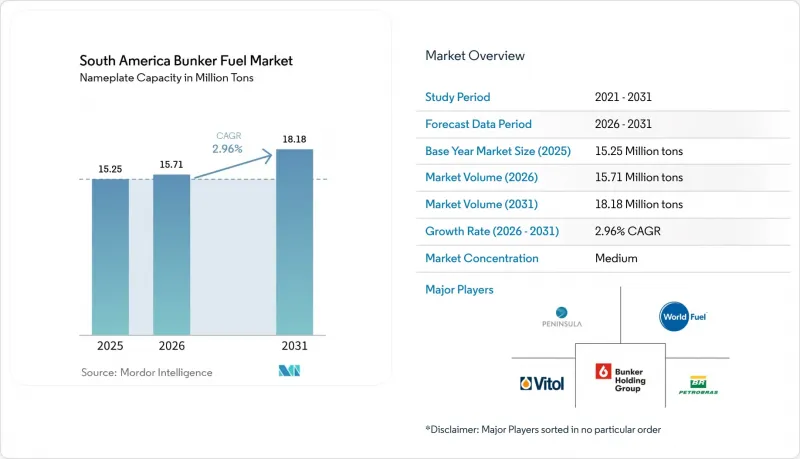
Mordor Intelligence에 의하면, 남미의 벙커 연료 시장 규모(정격 용량 기반)는 2025년 1,525만 톤으로 평가되었습니다. 2026년 1,571만 톤으로부터, 2031년까지 1,818만 톤으로 확대될 것으로 예측되며 2026년부터 2031년까지 연평균 복합 성장률(CAGR)은 2.96%를 나타낼 전망입니다.
본 보고서는 연료 유형별(HSFO, VLSFO, ULSFO, MGO, LNG, 메탄올, 바이오/합성 연료, 암모니아 등), 급유 방법별(선박 대 선박, 항만 대 선박, LNG 바지선 대 선박, 이동식 탱크·컨테이너), 선박 유형(컨테이너선, 유조선, 벌크선, 일반 화물선, 여객·로팍스선, 해양·특수선), 그리고 지역(브라질, 아르헨티나, 칠레, 기타 남미)별로 분류되어 있습니다.
남미의 벙커 연료 시장 동향 및 인사이트
남미 지역 주요 상품의 해상 운송량 증가
대두, 옥수수, 철광석, 구리, 리튬의 수출은 대서양과 태평양의 주요 항구에서 항해 횟수를 늘려, 선박 연료 수요를 지속적으로 뒷받침하고 있습니다. 2024년, 브라질은 1억 200만 톤의 대두와 5,500만 톤의 옥수수를 수출했습니다. 한편, 발레사는 주로 중국으로 3억 8,000만 톤의 철광석을 운송했습니다. 칠레는 550만 톤의 구리와 18만 톤의 탄산리튬을 수출하며, 발파라이소, 산안토니오, 킨테로에서 선박 연료의 선적을 꾸준히 뒷받침하고 있습니다. 아르헨티나의 바카 무에르타 파이프라인 프로젝트 덕분에 2027년까지 초대형 원유 운반선(VLCC)의 선적이 가능해져, 푼타 콜로라다에서 추가적인 선적 수요가 창출될 전망입니다. 운송 기간이 길어지면서 저속 항해로 인한 연료비 절감 효과가 상쇄되고 있어, 상품의 흐름은 여전히 견조한 추세를 보이고 있습니다. 2028년까지 예정된 인프라 확충으로 인해, 남미의 벙커 연료 시장에 미칠 이러한 중기적 영향은 확고해질 것입니다.
IMO 2020 규정을 준수하는 연료 전환 인센티브 및 현지 황세 감면 조치에 힘입어
규제 당국은 저유황 연료를 사용하는 선박에 대한 보상 차원의 비용 경감 조치를 도입했습니다. 브라질 국가수로운송청은 유황 함량이 0.10% 이하인 연료에 대해 항만 요금의 추가 요금을 면제하고 있으며, 아르헨티나 해군 경비대(Prefectura Naval)는 ISO 8217 규격을 준수하는 연료 공급에 대해 계류료 감면을 허용하고 있습니다. 칠레는 2025년에 IMO 2020 요건을 준수하며, 황 함량 3.5%의 중유(HSFO)에서 저황 연료유(VLSFO) 및 선박용 경유(MGO)로의 전환을 가속화했습니다. 이러한 조치로 인해 선주들은 향후 2년 이내에 스크러버를 설치하거나 적합한 연료로 전환해야 합니다. 또한, 이러한 조치는 탄소 강도에 따른 차별화된 항만 요금의 선례가 될 것이며, 신흥 LNG 및 메탄올 공급망을 뒷받침할 것으로 보입니다.
원유 가격의 지속적인 변동이 벙커유 가격의 안정성에 영향을 미침
2025년, 브렌트 원유는 배럴당 70-90달러 사이에서 등락을 보였으며, 산토스와 부에노스아이레스의 VLSFO 및 HSFO 가격은 매월 15-20%의 변동폭을 나타냈습니다. 고정 운임 계약을 체결한 선주들은 이익률 압박에 직면해 있으며, 현지 프리미엄이 벤치마크가 되는 허브 가격보다 톤당 30달러를 초과할 경우 종종 연료 보급을 미루고 있습니다. 2025년, 남미의 거래량 중 고작 22%만이 분기별 고정가격 계약에 따라 이루어졌으며, 이는 싱가포르의 45%라는 점유율보다 훨씬 낮은 수치입니다. 이 때문에 트레이더는 더 많은 운전자금을 마련할 수밖에 없습니다. 파생상품 시장의 유동성이 제한적이어서(남미는 전 세계 선박용 연료 스왑 거래의 2% 미만을 차지할 뿐입니다), 리스크 관리의 선택지가 제한적입니다.
부문별 분석
2025년, 고황유(HSFO)는 남미의 선박용 연료 시장에서 43.8%의 점유율을 유지했습니다. 이는 유황 함량 3.5%의 연료를 합법적으로 사용할 수 있는 스크러버를 장착한 유조선 및 벌크선 등으로 구성된 대규모 선단에 힘입은 결과입니다. LNG 취급량은 소규모이지만 연평균 성장률(CAGR)이 13.3%를 나타낼 것으로 예측되며, 듀얼 연료 선박의 취항이 늘어남에 따라 중유(HSFO) 시장 점유율을 꾸준히 잠식해 나갈 것으로 전망됩니다. VLSFO는 배기가스 정화 시스템을 도입하지 않은 컨테이너선이나 일반 화물선에 공급되고 있는 반면, MGO는 연료 품질 기준이 엄격한 틈새 시장의 보조 엔진 수요를 충족시키고 있습니다. 메탄올, 암모니아, 합성 연료는 엔진 및 취급 인프라가 제한적이어서 아직 발전 단계에 있지만, 여러 정기선 운항사가 2027년 이후 취항을 목표로 메탄올 대응 선박을 발주하고 있습니다. 바이오 뱅크는 2025년 공급량의 약 1.2%를 차지했으며, 그 동향은 원료의 경제성에 따라 달라집니다. MGO와의 가격 경쟁력이 확보될지 여부가, 이 카테고리가 얼리 어답터들 수요를 넘어 확장될지 여부를 결정지을 것입니다.
남미의 벙커 연료 시장에서 LNG가 차지하는 규모는 육상 인프라가 계획대로 12곳의 터미널로 구축될 경우, 2025년의 95만 톤에서 2031년까지 200만 톤 이상으로 증가할 가능성이 있습니다. 2025년 산토스 항구의 LNG 공급 가격은 1MMBtu당 평균 14달러였습니다. 이는 에너지 환산 기준으로 VLSFO와 비교했을 때 12-15%의 연료비 절감에 해당하지만, 듀얼 연료 엔진의 자본 상각으로 인해 20년 기간으로 볼 때 그 차이는 줄어듭니다. ULSFO는 해당 지역 외부의 배출 규제 해역에 진입하는 선박에서 틈새 시장에서의 역할을 유지하고 있지만, 남미에서 수요가 제한적이어서 혼합 연료 공급은 여전히 부족한 상태입니다. 남미의 선박 연료 시장에서는 HSFO, VLSFO, LNG 및 신흥 대체 연료에 걸쳐 선박 연료 예산을 배분할 때, 비용, 규제 준수, 인프라 성숙도 간의 균형을 지속적으로 고려하고 있습니다.
기타 혜택 :
- 엑셀 형식 시장 예측(ME) 시트
- 3개월간의 애널리스트 지원
자주 묻는 질문
목차
제1장 서론
제2장 조사 방법
제3장 주요 요약
제4장 시장 구도
제5장 시장 규모 및 성장 예측
제6장 경쟁 구도
제7장 시장 기회 및 향후 전망
KTH 26.07.08According to Mordor Intelligence, the south america bunker fuel market size in terms of nameplate capacity is projected to expand from 15.25 million tons in 2025 and 15.71 million tons in 2026 to 18.18 million tons by 2031, registering a CAGR of 2.96% between 2026 to 2031.
This report is Segmented by Fuel Type (HSFO, VLSFO, ULSFO, MGO, LNG, Methanol, Bio-/Synthetic Fuels, Ammonia, and More), Bunkering Method (Ship-To-Ship, Port-To-Ship, LNG Barge-To-Ship, and Portable Tanks and Containers), Vessel Type (Container, Tanker, Bulk Carrier, General Cargo, Passenger/Ro-Pax, and Offshore and Specialized), and Geography (Brazil, Argentina, Chile, and Rest of South America).
South America Bunker Fuel Market Trends and Insights
Rising Marine Transportation Of Essential Commodities In South America
Exports of soybeans, corn, iron ore, copper, and lithium continue to lift voyage counts and sustain bunker demand across major Atlantic and Pacific ports. Brazil shipped 102 million tons of soybeans and 55 million tons of corn in 2024, while Vale moved 380 million tons of iron ore primarily to China. Chile exported 5.5 million tonnes of copper and 180,000 tons of lithium carbonate, feeding steady bunker liftings at Valparaiso, San Antonio, and Quintero. Argentina's Vaca Muerta pipeline project will allow very large crude carriers to load by 2027, creating additional uplift demand at Punta Colorada. Commodity flows remain resilient because longer transit times offset slow-steaming fuel savings. Infrastructure expansions scheduled through 2028 will cement this medium-term influence on the South America bunker fuel market.
Supportive IMO-2020 Compliant Fuel-Switching Incentives And Local Sulfur-Tax Breaks
Regulators introduced cost-relief mechanisms that reward vessels burning lower-sulfur fuels. Brazil's National Waterway Transport Agency waives port-fee surcharges for fuels at or below 0.10% sulfur, and Argentina's Prefectura Naval grants dockage-fee reductions for ISO 8217-compliant deliveries. Chile aligned with IMO 2020 requirements in 2025, accelerating the shift from 3.5% sulfur HSFO to VLSFO and MGO. These measures prompt shipowners to retrofit scrubbers or switch to compliant fuels within the next two years. They also establish a precedent for differentiated port charges tied to carbon intensity, likely supporting emerging LNG and methanol supply chains.
Persistent Crude-Price Volatility Impacting Bunker Price Stability
Brent crude oscillated between USD 70 and USD 90 per barrel during 2025, driving 15-20% monthly swings in VLSFO and HSFO prices at Santos and Buenos Aires. Shipowners on fixed freight contracts experience margin pressure and often defer bunkering when local premiums exceed USD 30 per ton relative to benchmark hubs. Only 22% of South American volumes moved under quarterly fixed-price deals in 2025, far below Singapore's 45% share, which forces traders to hold larger working-capital buffers. Limited derivative liquidity, South America accounts for less than 2% of global marine-fuel swaps, hampers risk-management options.
Other drivers and restraints analyzed in the detailed report include:
- Accelerating Pre-Salt Crude Exports Boosting Demand At Brazilian And Uruguayan Hubs
- Rapid Port-Call Growth On Asia-South America Container Loops
- Delayed LNG Bunkering Infrastructure Build-Out Across Atlantic And Pacific Coasts
For complete list of drivers and restraints, kindly check the Table Of Contents.
Segment Analysis
High-sulfur fuel oil retained 43.8% of the South America bunker fuel market share in 2025, supported by a large fleet of scrubber-equipped tankers and bulk carriers that can legally consume 3.5% sulfur fuel. LNG volumes, though smaller, are projecting a 13.3% CAGR that will steadily erode HSFO share as more dual-fuel vessels enter service. VLSFO serves container and general-cargo vessels that have not installed exhaust-gas-cleaning systems, while MGO fills niche auxiliary-engine demand where fuel-quality thresholds are strict. Methanol, ammonia, and synthetic fuels remain embryonic because engines and handling infrastructure are limited, yet multiple liner operators have placed methanol-capable vessels on order for post-2027 deployment. Bio-bunkers occupied roughly 1.2% of 2025 volumes and hinge on feedstock economics; cost parity with MGO will determine whether the category scales beyond early-adopter volumes.
The South America bunker fuel market size attributable to LNG could rise from 950,000 tons in 2025 to more than 2 million tons by 2031 if shore-side infrastructure reaches the planned twelve terminals. Delivered LNG in Santos averaged USD 14 per MMBtu in 2025, which equates to a 12-15% fuel-cost saving versus VLSFO on an energy-equivalent basis, although capital amortization for dual-fuel engines narrows the margin over a 20-year horizon. ULSFO retains a niche role for vessels entering emission-control areas outside the region, but limited South American demand keeps blended supply tight. The South America bunker fuel market continues to balance cost, compliance, and infrastructure maturity when allocating bunker-fuel budgets across HSFO, VLSFO, LNG, and emerging alternatives.
Complete Report Scope:
- By Fuel Type
- High-Sulfur Fuel Oil (HSFO)
- Very-Low-Sulfur Fuel Oil (VLSFO)
- Ultra-Low-Sulfur Fuel Oil (ULSFO)
- Marine Gas Oil (MGO)
- Liquefied Natural Gas (LNG)
- Methanol
- Bio-/Synthetic Fuels
- Ammonia
- Other Fuel Types
- By Bunkering Method
- Ship-to-Ship
- Port-to-Ship (Truck/Pipeline)
- LNG Barge-to-Ship
- Portable Tanks and Containers
- By Vessel Type
- Container
- Tanker
- Bulk Carrier
- General Cargo
- Passenger/Ro-Pax
- Offshore and Specialized
- By Geography
- Brazil
- Argentina
- Chile
- Rest of South America
List of Companies Covered in this Report:
- Vitol Holding BV
- Monjasa Holding A/S
- Bunker Holding A/S
- World Fuel Services Corp
- Peninsula Petroleum Ltd
- TotalEnergies SE
- Chevron Corp
- Petrobras
- Integr8 Fuels
- Trafigura Group Pte
- Aegean Marine Petroleum
- Repsol SA
- ExxonMobil Corp
- Bomin Bunker Oil Corp
- PetroEcuador
- YPF SA
- AP Moller-Maersk A/S
- Mediterranean Shipping Company SA
- CMA CGM Group
- China COSCO Shipping
- Hapag-Lloyd AG
- Ocean Network Express
Additional Benefits:
- The market estimate (ME) sheet in Excel format
- 3 months of analyst support
TABLE OF CONTENTS
1 Introduction
- 1.1 Study Assumptions & Market Definition
- 1.2 Scope of the Study
2 Research Methodology
3 Executive Summary
4 Market Landscape
- 4.1 Market Overview
- 4.2 Market Drivers
- 4.2.1 Rising marine transportation of essential commodities in South America
- 4.2.2 Supportive IMO-2020-compliant fuel-switching incentives & local sulfur-tax breaks
- 4.2.3 Accelerating pre-salt crude exports driving bunkering demand at Brazilian & Uruguayan hubs
- 4.2.4 Rapid port-call growth on Asia-South America container loops post-Panama Canal expansions
- 4.2.5 Petrobras refinery divestments unlocking third-party physical supply and price competition
- 4.2.6 Pilot-scale bio-bunker (B24-B30) certification creating first-mover advantage for low-carbon blends
- 4.3 Market Restraints
- 4.3.1 Persistent crude-price volatility impacting bunker price stability
- 4.3.2 Delayed LNG bunkering infrastructure build-out across Atlantic & Pacific coasts
- 4.3.3 Quality-control issues: VLSFO/HSFO off-spec rates >5.9 % in region
- 4.3.4 Feedstock competition inflating bio-bunker input costs (soy oil, methanol)
- 4.4 Supply-Chain Analysis
- 4.5 Regulatory Landscape
- 4.6 Technological Outlook
- 4.7 Porter's Five Forces
- 4.7.1 Bargaining Power of Suppliers
- 4.7.2 Bargaining Power of Consumers
- 4.7.3 Threat of New Entrants
- 4.7.4 Threat of Substitutes
- 4.7.5 Intensity of Competitive Rivalry
5 Market Size & Growth Forecasts
- 5.1 By Fuel Type
- 5.1.1 High-Sulfur Fuel Oil (HSFO)
- 5.1.2 Very-Low-Sulfur Fuel Oil (VLSFO)
- 5.1.3 Ultra-Low-Sulfur Fuel Oil (ULSFO)
- 5.1.4 Marine Gas Oil (MGO)
- 5.1.5 Liquefied Natural Gas (LNG)
- 5.1.6 Methanol
- 5.1.7 Bio-/Synthetic Fuels
- 5.1.8 Ammonia
- 5.1.9 Other Fuel Types
- 5.2 By Bunkering Method
- 5.2.1 Ship-to-Ship
- 5.2.2 Port-to-Ship (Truck/Pipeline)
- 5.2.3 LNG Barge-to-Ship
- 5.2.4 Portable Tanks and Containers
- 5.3 By Vessel Type
- 5.3.1 Container
- 5.3.2 Tanker
- 5.3.3 Bulk Carrier
- 5.3.4 General Cargo
- 5.3.5 Passenger/Ro-Pax
- 5.3.6 Offshore and Specialized
- 5.4 By Geography
- 5.4.1 Brazil
- 5.4.2 Argentina
- 5.4.3 Chile
- 5.4.4 Rest of South America
6 Competitive Landscape
- 6.1 Market Concentration
- 6.2 Strategic Moves (M&A, Partnerships, PPAs)
- 6.3 Market Share Analysis (Market Rank/Share for key companies)
- 6.4 Company Profiles (includes Global level Overview, Market level overview, Core Segments, Financials as available, Strategic Information, Products & Services, and Recent Developments)
- 6.4.1 Vitol Holding BV
- 6.4.2 Monjasa Holding A/S
- 6.4.3 Bunker Holding A/S
- 6.4.4 World Fuel Services Corp
- 6.4.5 Peninsula Petroleum Ltd
- 6.4.6 TotalEnergies SE
- 6.4.7 Chevron Corp
- 6.4.8 Petrobras
- 6.4.9 Integr8 Fuels
- 6.4.10 Trafigura Group Pte
- 6.4.11 Aegean Marine Petroleum
- 6.4.12 Repsol SA
- 6.4.13 ExxonMobil Corp
- 6.4.14 Bomin Bunker Oil Corp
- 6.4.15 PetroEcuador
- 6.4.16 YPF SA
- 6.4.17 AP Moller-Maersk A/S
- 6.4.18 Mediterranean Shipping Company SA
- 6.4.19 CMA CGM Group
- 6.4.20 China COSCO Shipping
- 6.4.21 Hapag-Lloyd AG
- 6.4.22 Ocean Network Express
7 Market Opportunities & Future Outlook
- 7.1 White-space & Unmet-Need Assessment